Entanglement Pattern Transition of Quantum States from Directed Percolation
Pith reviewed 2026-06-29 21:30 UTC · model grok-4.3
The pith
A mapping from the Domany-Kinzel automaton to an isometric tensor network state produces algebraic correlations and a degenerate parent Hamiltonian whose second ground state undergoes an entanglement pattern transition at the directed perco
A machine-rendered reading of the paper's core claim, the machinery that carries it, and where it could break.
Core claim
At the critical point of the Domany-Kinzel automaton the corresponding isoTNS hosts algebraic correlations in all spatial directions; its continuous parent Hamiltonian has a degenerate ground-state manifold consisting of a product state and a second state that undergoes a transition from pairwise entanglement between distant regions to a state with trivial entanglement.
What carries the argument
The mapping from the Domany-Kinzel automaton to an isometric tensor network state (isoTNS) that preserves the directed-percolation universality class and yields a continuous parent Hamiltonian.
If this is right
- Algebraic correlations appear in all spatial directions of the isoTNS precisely at the automaton critical point.
- The parent Hamiltonian admits an exactly degenerate ground-state manifold that includes the absorbing product state.
- The second ground state changes its entanglement structure from W-state-like distant pairwise entanglement to trivial entanglement when the automaton reaches criticality.
Where Pith is reading between the lines
- The same automaton-to-isoTNS construction could be applied to other absorbing-state universality classes to generate additional families of states with controlled entanglement transitions.
- The observed entanglement pattern change supplies a concrete example of a transition between distinct classes of quantum states that is not tied to a conventional equilibrium phase transition.
- Finite-size scaling of the parent Hamiltonian spectrum around the critical point would provide a direct numerical test of the claimed degeneracy and entanglement transition.
Load-bearing premise
The mapping from the stochastic automaton to the isometric tensor-network state preserves the directed-percolation universality class and yields a well-defined continuous parent Hamiltonian whose ground-state degeneracy and entanglement properties can be analyzed without additional approximations or cutoffs.
What would settle it
A numerical diagonalization or analytic calculation of the parent Hamiltonian at the critical point that finds either a unique ground state or a second ground state whose entanglement does not transition from distant pairwise to trivial would falsify the central claim.
Figures
read the original abstract
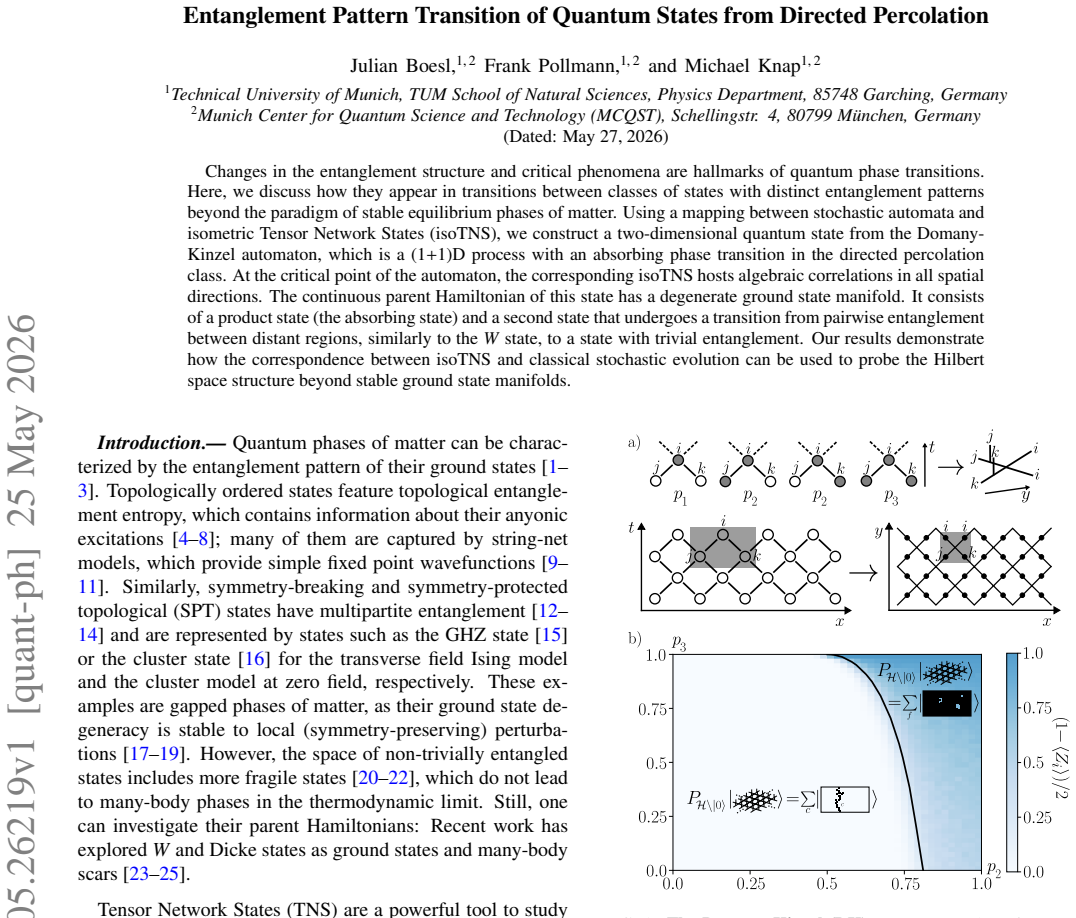
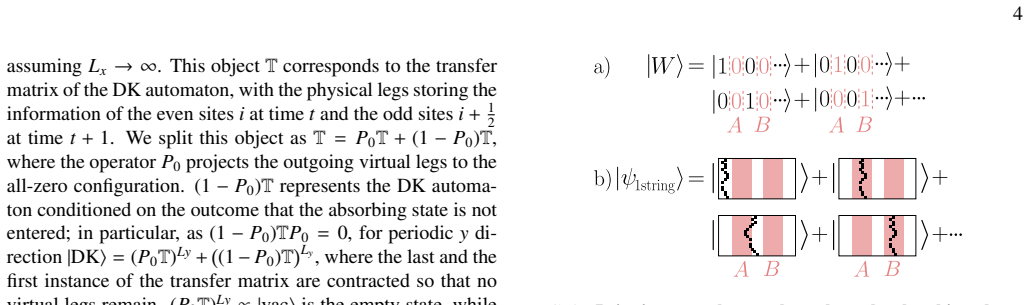
Changes in the entanglement structure and critical phenomena are hallmarks of quantum phase transitions. Here, we discuss how they appear in transitions between classes of states with distinct entanglement patterns beyond the paradigm of stable equilibrium phases of matter. Using a mapping between stochastic automata and isometric Tensor Network States (isoTNS), we construct a two-dimensional quantum state from the Domany-Kinzel automaton, which is a (1+1)D process with an absorbing phase transition in the directed percolation class. At the critical point of the automaton, the corresponding isoTNS hosts algebraic correlations in all spatial directions. The continuous parent Hamiltonian of this state has a degenerate ground state manifold. It consists of a product state (the absorbing state) and a second state that undergoes a transition from pairwise entanglement between distant regions, similarly to the W state, to a state with trivial entanglement. Our results demonstrate how the correspondence between isoTNS and classical stochastic evolution can be used to probe the Hilbert space structure beyond stable ground state manifolds.
Editorial analysis
A structured set of objections, weighed in public.
Referee Report
Summary. The manuscript constructs a two-dimensional isometric tensor-network state (isoTNS) by mapping the Domany-Kinzel automaton, a (1+1)D stochastic process in the directed-percolation class, onto a quantum state. At the automaton's critical point the isoTNS exhibits algebraic correlations in all spatial directions. Its continuous parent Hamiltonian possesses a degenerate ground-state manifold consisting of an absorbing product state and a second state whose entanglement pattern transitions from pairwise distant entanglement (W-state-like) to trivial entanglement.
Significance. The construction supplies a direct, parameter-free link between a well-studied classical critical phenomenon and a quantum entanglement-pattern transition outside the equilibrium ground-state paradigm. Because the mapping proceeds by definition from an independently known classical critical point, the resulting statements about algebraic correlations and the structure of the parent-Hamiltonian degeneracy are falsifiable and do not rely on additional fitting or cutoffs.
minor comments (3)
- [§3] §3 (parent-Hamiltonian construction): the explicit operator form of the continuous parent Hamiltonian and the proof that its ground-state degeneracy is exactly two should be stated with the same level of detail given to the isoTNS tensors themselves.
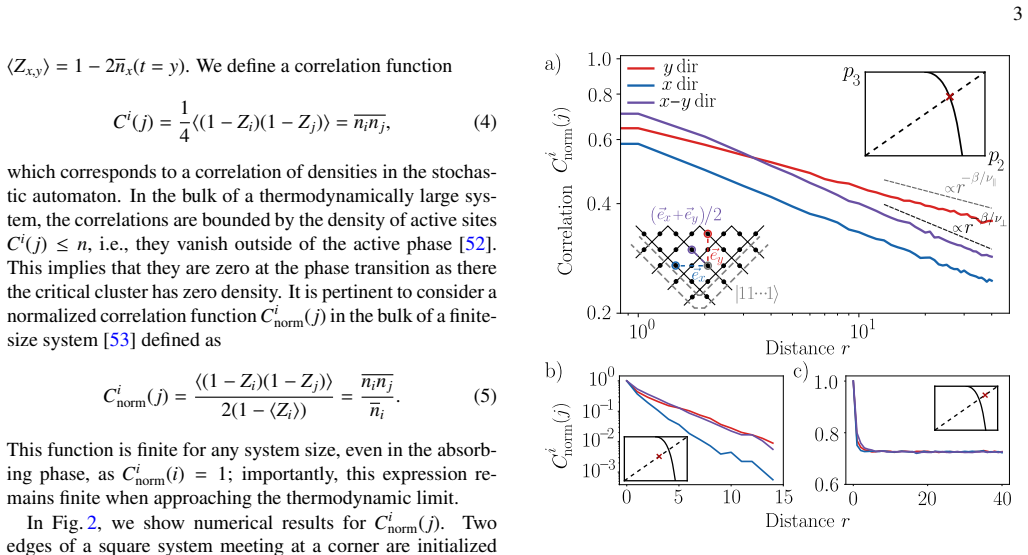
- [Figure 2 / §4] Figure 2 / §4: the finite-size scaling collapse used to confirm algebraic correlations should include the extracted correlation-length exponent and a direct comparison with the known directed-percolation value.
- Notation: the distinction between the two ground states in the degenerate manifold is introduced only in the abstract; a short paragraph in the main text defining |ψ_abs⟩ and |ψ_ent⟩ would improve readability.
Simulated Author's Rebuttal
We thank the referee for the positive assessment of our manuscript, the recognition of its significance in linking classical directed percolation to a quantum entanglement-pattern transition, and the recommendation for minor revision. No specific major comments were provided in the report.
Circularity Check
No significant circularity; derivation from external automaton
full rationale
The paper constructs the isoTNS and parent Hamiltonian directly from the known Domany-Kinzel automaton (an external classical model with independently established directed-percolation critical point). Algebraic correlations and the described ground-state degeneracy/entanglement transition are outputs of this mapping rather than inputs or fitted quantities. No self-definitional step, fitted-input prediction, or load-bearing self-citation chain appears in the abstract or stated claims; the weakest assumption (preservation of universality class) is addressed by the explicit construction itself.
Axiom & Free-Parameter Ledger
axioms (2)
- domain assumption The stochastic automaton can be faithfully represented by an isometric tensor-network state whose correlations inherit the directed-percolation universality class.
- domain assumption A continuous parent Hamiltonian exists for the resulting isoTNS and possesses a degenerate ground-state manifold whose entanglement properties can be extracted directly.
Reference graph
Works this paper leans on
-
[1]
Vidal, J
G. Vidal, J. I. Latorre, E. Rico, and A. Kitaev, Entanglement in quantum critical phenomena, Phys. Rev. Lett.90, 227902 (2003)
2003
-
[2]
B. Zeng, X. Chen, D.-L. Zhou, X.-G. Wen,et al.,Quantum information meets quantum matter(Springer, 2019)
2019
-
[3]
Jiang, Z
H.-C. Jiang, Z. Wang, and L. Balents, Identifying topological order by entanglement entropy, Nature Physics8, 902 (2012)
2012
-
[4]
Kitaev and J
A. Kitaev and J. Preskill, Topological entanglement entropy, Phys. Rev. Lett.96, 110404 (2006)
2006
-
[5]
Levin and X.-G
M. Levin and X.-G. Wen, Detecting topological order in a ground state wave function, Phys. Rev. Lett.96, 110405 (2006)
2006
-
[6]
X. Chen, B. Zeng, Z.-C. Gu, I. L. Chuang, and X.-G. Wen, Ten- sor product representation of a topological ordered phase: Nec- essary symmetry conditions, Phys. Rev. B82, 165119 (2010)
2010
-
[7]
Papanikolaou, K
S. Papanikolaou, K. S. Raman, and E. Fradkin, Topological phases and topological entropy of two-dimensional systems with finite correlation length, Phys. Rev. B76, 224421 (2007)
2007
-
[8]
Castelnovo and C
C. Castelnovo and C. Chamon, Quantum topological phase transition at the microscopic level, Phys. Rev. B77, 054433 (2008)
2008
-
[9]
M. A. Levin and X.-G. Wen, String-net condensation: A physi- cal mechanism for topological phases, Phys. Rev. B71, 045110 (2005)
2005
-
[10]
Z.-C. Gu, M. Levin, B. Swingle, and X.-G. Wen, Tensor- product representations for string-net condensed states, Phys. Rev. B79, 085118 (2009)
2009
-
[11]
Buerschaper, M
O. Buerschaper, M. Aguado, and G. Vidal, Explicit tensor net- work representation for the ground states of string-net models, Phys. Rev. B79, 085119 (2009)
2009
-
[12]
J. Chen, Z. Ji, C.-K. Li, Y .-T. Poon, Y . Shen, N. Yu, B. Zeng, and D. Zhou, Discontinuity of maximum entropy inference and quantum phase transitions, New Journal of Physics17, 083019 (2015)
2015
-
[13]
Zeng and X.-G
B. Zeng and X.-G. Wen, Gapped quantum liquids and topolog- ical order, stochastic local transformations and emergence of unitarity, Phys. Rev. B91, 125121 (2015)
2015
-
[14]
Zeng and D.-L
B. Zeng and D.-L. Zhou, Topological and error-correcting prop- erties for symmetry-protected topological order, Europhysics Letters113, 56001 (2016)
2016
-
[15]
D. M. Greenberger, M. A. Horne, A. Shimony, and A. Zeilinger, Bell’s theorem without inequalities, American Journal of Physics58, 1131 (1990)
1990
-
[16]
H. J. Briegel and R. Raussendorf, Persistent entanglement in arrays of interacting particles, Phys. Rev. Lett.86, 910 (2001)
2001
-
[17]
Bravyi and M
S. Bravyi and M. B. Hastings, A short proof of stability of topological order under local perturbations, Communications in mathematical physics307, 609 (2011). 8
2011
-
[18]
M. B. Hastings and X.-G. Wen, Quasiadiabatic continuation of quantum states: The stability of topological ground-state degeneracy and emergent gauge invariance, Phys. Rev. B72, 045141 (2005)
2005
-
[19]
Chen, Z.-C
X. Chen, Z.-C. Gu, and X.-G. Wen, Classification of gapped symmetric phases in one-dimensional spin systems, Phys. Rev. B83, 035107 (2011)
2011
-
[20]
D ¨ur, G
W. D ¨ur, G. Vidal, and J. I. Cirac, Three qubits can be entangled in two inequivalent ways, Phys. Rev. A62, 062314 (2000)
2000
-
[21]
Verstraete, J
F. Verstraete, J. Dehaene, B. De Moor, and H. Verschelde, Four qubits can be entangled in nine different ways, Phys. Rev. A65, 052112 (2002)
2002
-
[22]
Horodecki, P
R. Horodecki, P. Horodecki, M. Horodecki, and K. Horodecki, Quantum entanglement, Rev. Mod. Phys.81, 865 (2009)
2009
-
[23]
L. Gioia and R. Thorngren,Wstate is not the unique ground state of any local hamiltonian (2024), arXiv:2310.10716 [cond- mat.str-el]
- [24]
- [25]
-
[26]
J. I. Cirac, D. P ´erez-Garc´ıa, N. Schuch, and F. Verstraete, Ma- trix product states and projected entangled pair states: Con- cepts, symmetries, theorems, Rev. of Mod. Phys.93, 045003 (2021)
2021
-
[27]
Verstraete, M
F. Verstraete, M. M. Wolf, D. Perez-Garcia, and J. I. Cirac, Crit- icality, the area law, and the computational power of projected entangled pair states, Phys. Rev. Lett.96, 220601 (2006)
2006
-
[28]
PEPS as unique ground states of local Hamiltonians
D. Perez-Garcia, F. Verstraete, J. I. Cirac, and M. M. Wolf, Peps as unique ground states of local hamiltonians (2007), arXiv:0707.2260 [quant-ph]
work page internal anchor Pith review Pith/arXiv arXiv 2007
-
[29]
Schuch, I
N. Schuch, I. Cirac, and D. P´erez-Garc´ıa, Peps as ground states: Degeneracy and topology, Annals of Physics325, 2153 (2010)
2010
-
[30]
M. M. Wolf, G. Ortiz, F. Verstraete, and J. I. Cirac, Quantum phase transitions in matrix product systems, Phys. Rev. Lett. 97, 110403 (2006)
2006
-
[31]
N. G. Jones, J. Bibo, B. Jobst, F. Pollmann, A. Smith, and R. Verresen, Skeleton of matrix-product-state-solvable models connecting topological phases of matter, Phys. Rev. Res.3, 033265 (2021)
2021
-
[32]
Matrix-product state skeletons in Onsager-integrable quantum chains
I. Camp and N. G. Jones, Matrix-product state skeletons in onsager-integrable quantum chains (2025), arXiv:2511.07212 [quant-ph]
work page internal anchor Pith review Pith/arXiv arXiv 2025
- [33]
-
[34]
M. P. Zaletel and F. Pollmann, Isometric tensor network states in two dimensions, Phys. Rev. Lett.124, 037201 (2020)
2020
-
[35]
Soejima, K
T. Soejima, K. Siva, N. Bultinck, S. Chatterjee, F. Pollmann, and M. P. Zaletel, Isometric tensor network representation of string-net liquids, Phys. Rev. B101, 085117 (2020)
2020
-
[36]
L. Slattery and B. K. Clark, Quantum circuits for two-dimensional isometric tensor networks (2021), arXiv:2108.02792 [quant-ph]
-
[37]
Z.-Y . Wei, D. Malz, and J. I. Cirac, Sequential generation of projected entangled-pair states, Phys. Rev. Lett.128, 010607 (2022)
2022
-
[38]
Y .-J. Liu, K. Shtengel, and F. Pollmann, Simulating two- dimensional topological quantum phase transitions on a digital quantum computer, Phys. Rev. Res.6, 043256 (2024)
2024
-
[39]
Boesl, Y .-J
J. Boesl, Y .-J. Liu, W.-T. Xu, F. Pollmann, and M. Knap, Quantum phase transitions between symmetry-enriched fracton phases, Phys. Rev. B112, 125152 (2025)
2025
-
[40]
Skeleton of isometric Tensor Network States for Abelian String-Net Models
J. Boesl, Y .-J. Liu, F. Pollmann, and M. Knap, Skeleton of isometric tensor network states for abelian string-net models (2025), arXiv:2511.13821 [quant-ph]
work page internal anchor Pith review Pith/arXiv arXiv 2025
-
[41]
Hinrichsen, Non-equilibrium critical phenomena and phase transitions into absorbing states, Advances in Physics49, 815 (2000)
H. Hinrichsen, Non-equilibrium critical phenomena and phase transitions into absorbing states, Advances in Physics49, 815 (2000)
2000
-
[42]
´Odor, Universality classes in nonequilibrium lattice systems, Rev
G. ´Odor, Universality classes in nonequilibrium lattice systems, Rev. Mod. Phys.76, 663 (2004)
2004
-
[43]
Henkel, H
M. Henkel, H. Hinrichsen, and S. L ¨ubeck,Non-Equilibrium Phase Transitions: V olume I: Absorbing Phase Transitions (Springer, 2008)
2008
-
[44]
Domany and W
E. Domany and W. Kinzel, Equivalence of cellular automata to ising models and directed percolation, Phys. Rev. Lett.53, 311 (1984)
1984
-
[45]
Harada and N
K. Harada and N. Kawashima, Entropy governed by the absorb- ing state of directed percolation, Phys. Rev. Lett.123, 090601 (2019)
2019
-
[46]
Y .-H. Chen and T. Grover, Local reversibility and diver- gent markov length in 1+1-d directed percolation (2026), arXiv:2512.07220 [cond-mat.stat-mech]
-
[47]
Gopalakrishnan, Push-down automata as sequential genera- tors of highly entangled states, Journal of Physics A: Mathe- matical and Theoretical58, 055301 (2025)
S. Gopalakrishnan, Push-down automata as sequential genera- tors of highly entangled states, Journal of Physics A: Mathe- matical and Theoretical58, 055301 (2025)
2025
-
[48]
Zhang, Sequential generation of two-dimensional super- area-law states with local parent hamiltonian, PRX Quantum 7, 010311 (2026)
W. Zhang, Sequential generation of two-dimensional super- area-law states with local parent hamiltonian, PRX Quantum 7, 010311 (2026)
2026
-
[49]
X.-H. Yu, J. I. Cirac, P. Kos, and G. Styliaris, Dual-isometric projected entangled pair states, Phys. Rev. Lett.133, 190401 (2024)
2024
-
[50]
D. Haag, F. Baccari, and G. Styliaris, Typical Correlation Length of Sequentially Generated Tensor Network States, PRX Quantum4, 030330 (2023)
2023
-
[51]
Malz and R
D. Malz and R. Trivedi, Computational complexity of isometric tensor-network states, PRX Quantum6, 020310 (2025)
2025
-
[52]
Dickman and M
R. Dickman and M. Martins de Oliveira, Quasi-stationary sim- ulation of the contact process, Physica A: Statistical Mechanics and its Applications357, 134 (2005)
2005
-
[53]
Masaoka, T
R. Masaoka, T. Soejima, and H. Watanabe, Rigorous lower bound on dynamical exponents in gapless frustration-free sys- tems, Phys. Rev. X15, 041050 (2025)
2025
-
[54]
see supplementary material
-
[55]
Kasteleyn, Dimer statistics and phase transitions, Journal of Mathematical Physics4, 287 (1963)
P. Kasteleyn, Dimer statistics and phase transitions, Journal of Mathematical Physics4, 287 (1963)
1963
-
[56]
R. H. Dicke, Coherence in spontaneous radiation processes, Phys. Rev.93, 99 (1954)
1954
-
[57]
A. L. Toom, Stable and attractive trajectories in multicompo- nent systems, Multicomponent random systems6, 549 (1980)
1980
-
[58]
E. Lake and S. Ro, Squeezing codes: robust fluctuation- stabilized memories (2025), arXiv:2509.20730 [cond-mat.stat- mech]
-
[59]
G´acs, Reliable cellular automata with self-organization, Jour- nal of Statistical Physics103, 45 (2001)
P. G´acs, Reliable cellular automata with self-organization, Jour- nal of Statistical Physics103, 45 (2001)
2001
-
[60]
P. Bak, C. Tang, and K. Wiesenfeld, Self-organized criticality: An explanation of the 1/f noise, Phys. Rev. Lett.59, 381 (1987)
1987
-
[61]
Numerical codes are available at 10.5281/zenodo.19630776
-
[62]
Vidal and R
G. Vidal and R. F. Werner, Computable measure of entangle- ment, Phys. Rev. A65, 032314 (2002)
2002
-
[63]
Peres, Separability criterion for density matrices, Phys
A. Peres, Separability criterion for density matrices, Phys. Rev. Lett.77, 1413 (1996)
1996
-
[64]
Horodecki, P
M. Horodecki, P. Horodecki, and R. Horodecki, Separability of n-particle mixed states: necessary and sufficient conditions in terms of linear maps, Physics Letters A283, 1 (2001). 9
2001
-
[65]
Powell, Quantum kasteleyn transition, Phys
S. Powell, Quantum kasteleyn transition, Phys. Rev. B105, 064413 (2022)
2022
-
[66]
Grassberger, Directed percolation in 2+1 dimensions, Journal of Physics A: Mathematical and General22, 3673 (1989)
P. Grassberger, Directed percolation in 2+1 dimensions, Journal of Physics A: Mathematical and General22, 3673 (1989)
1989
-
[67]
plumbing
H. Hinrichsen, Stochastic lattice models with several absorbing states, Phys. Rev. E55, 219 (1997). S1 Supplemental Material: Entanglement Pattern Transition of Quantum States from Directed Percolation Julian Boesl1,2, Frank Pollmann1,2 and Michael Knap1,2 1Technical University of Munich, TUM School of Natural Sciences, Physics Department, 85748 Garching,...
1997
discussion (0)
Sign in with ORCID, Apple, or X to comment. Anyone can read and Pith papers without signing in.