Strong Constraints on Millisecond Pulsar Injection Spectra from Fermi-LAT Observations of the Galactic Center
Pith reviewed 2026-06-29 20:17 UTC · model grok-4.3
The pith
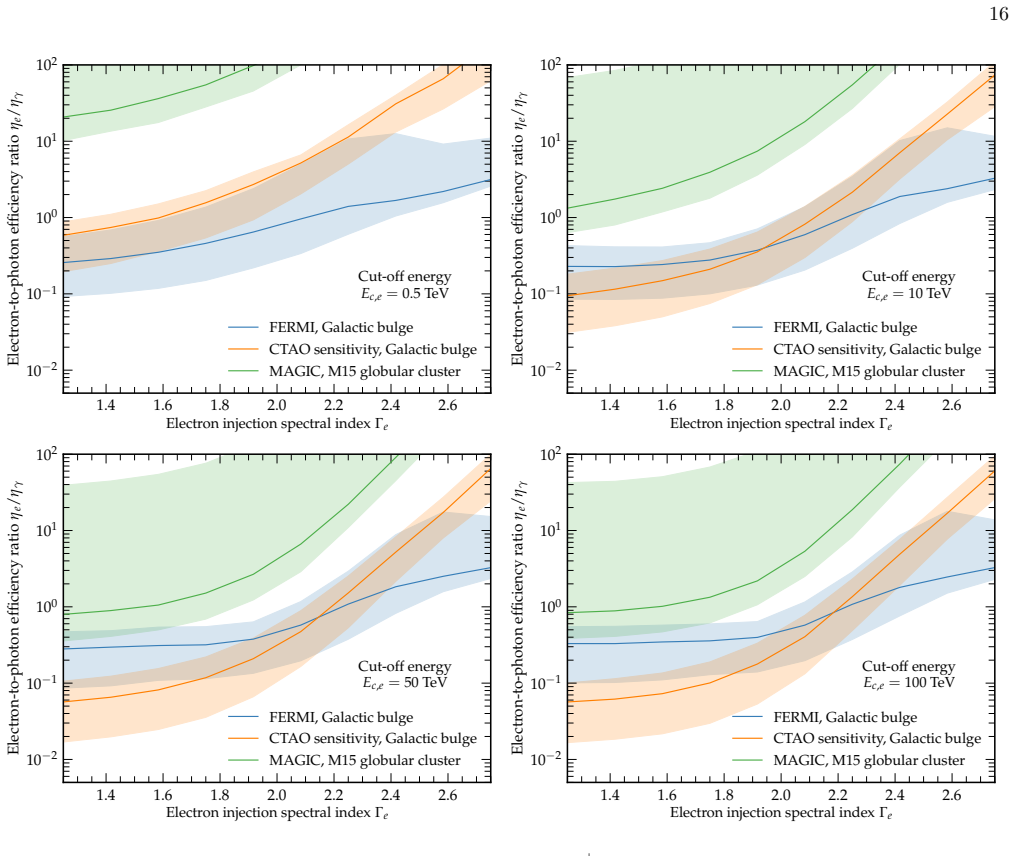
Fermi-LAT observations of the Galactic Center excess set strong upper limits on the electron-to-gamma-ray efficiency ratio for millisecond pulsars.
A machine-rendered reading of the paper's core claim, the machinery that carries it, and where it could break.
Core claim
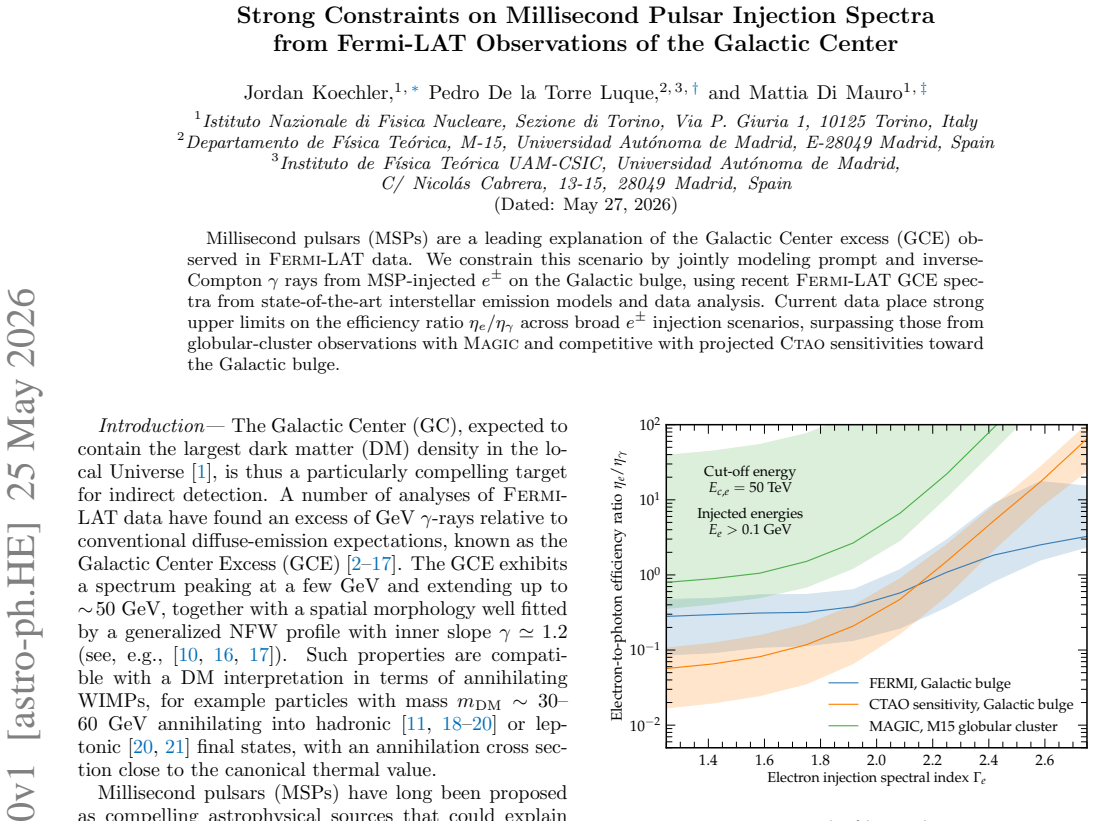
Current Fermi-LAT data on the Galactic Center excess place strong upper limits on the efficiency ratio η_e/η_γ across broad e± injection scenarios from millisecond pulsars, and these limits are tighter than those obtained from MAGIC observations of globular clusters while remaining competitive with projected CTAO sensitivities toward the Galactic bulge.
What carries the argument
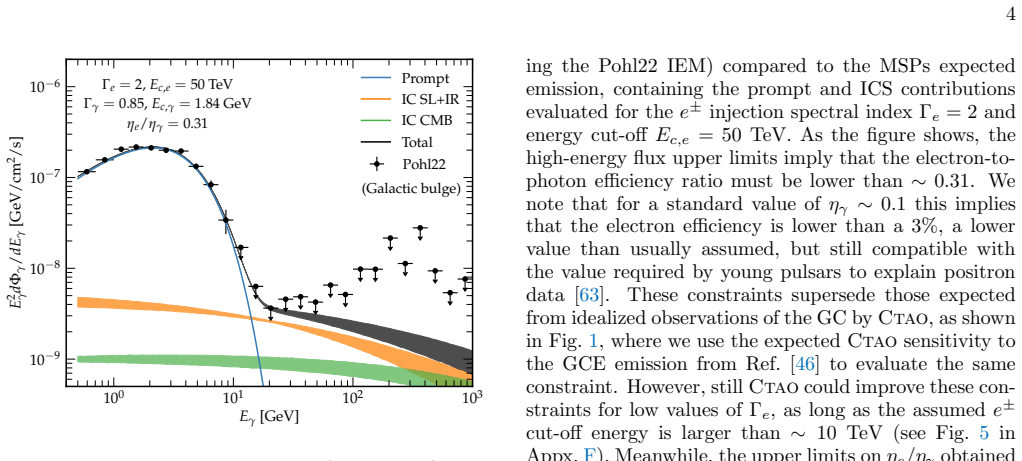
The efficiency ratio η_e/η_γ, which quantifies the relative energy injected by millisecond pulsars into electrons and positrons versus prompt gamma rays; joint modeling of prompt emission plus inverse-Compton scattering on the interstellar radiation field is used to translate observed excess spectra into bounds on this ratio.
If this is right
- The allowed values of η_e/η_γ are more restricted than those permitted by MAGIC globular-cluster data.
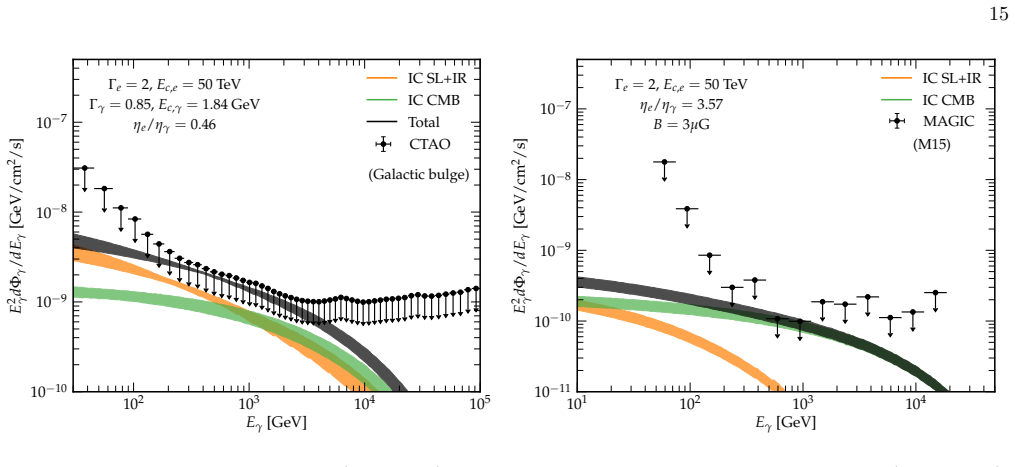
- The constraints remain competitive with the sensitivity expected from CTAO observations of the Galactic bulge.
- The joint prompt-plus-inverse-Compton modeling tightens the bounds relative to prompt emission alone.
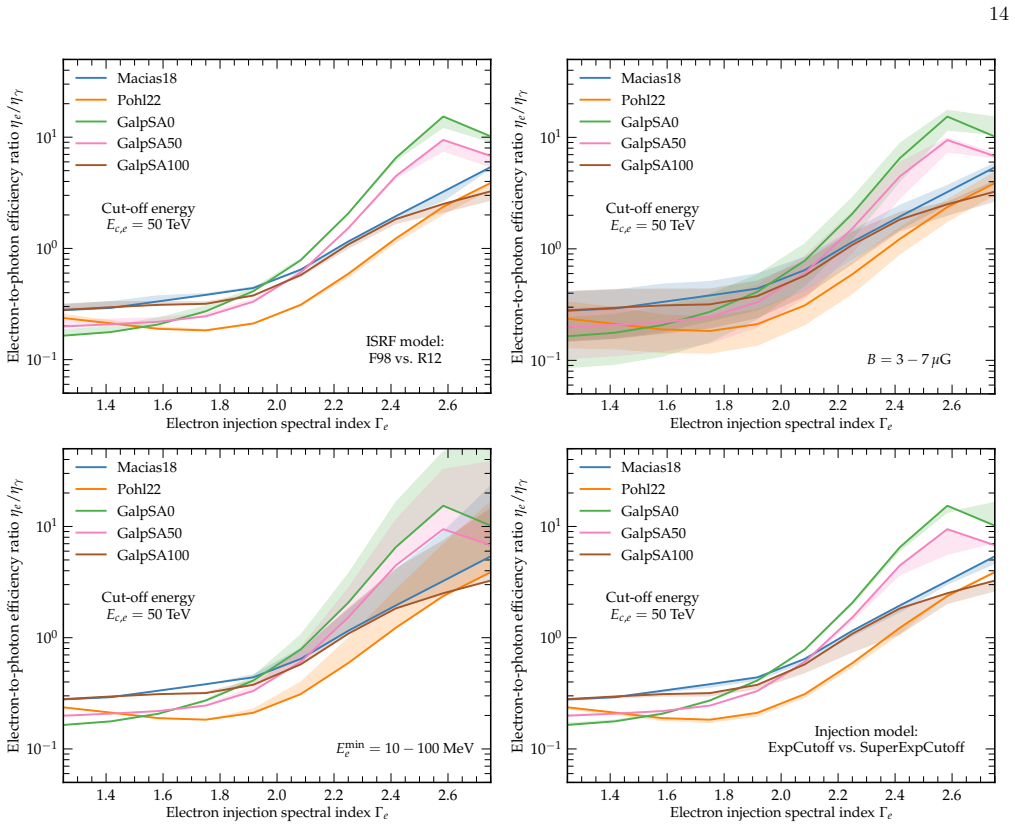
- The limits apply across a broad family of electron injection spectra.
Where Pith is reading between the lines
- If the limits prove robust, millisecond pulsar models of the excess would require lower electron injection efficiencies than many current scenarios assume.
- Improved interstellar emission modeling could either strengthen or relax the bounds depending on whether it increases or decreases the inferred excess flux.
- Future CTAO data could either confirm the current upper limits or reveal a detection that forces a revision of the millisecond pulsar population assumptions.
Load-bearing premise
The derived limits assume that state-of-the-art interstellar emission models are accurate and that the spatial distribution and total number of millisecond pulsars in the Galactic bulge are correctly estimated.
What would settle it
A future measurement of the Galactic Center excess spectrum that shows significantly less inverse-Compton emission than predicted for any value of η_e/η_γ within the current upper bounds would falsify the claimed constraints.
Figures
read the original abstract
Millisecond pulsars (MSPs) are a leading explanation of the Galactic Center excess (GCE) observed in Fermi-LAT data. We constrain this scenario by jointly modeling prompt and inverse-Compton $\gamma$ rays from MSP-injected $e^\pm$ on the Galactic bulge, using recent Fermi-LAT GCE spectra from state-of-the-art interstellar emission models and data analysis. Current data place strong upper limits on the efficiency ratio $\eta_e/\eta_\gamma$ across broad $e^\pm$ injection scenarios, surpassing those from globular-cluster observations with MAGIC and competitive with projected CTAO sensitivities toward the Galactic bulge.
Editorial analysis
A structured set of objections, weighed in public.
Referee Report
Summary. The manuscript claims that joint modeling of prompt and inverse-Compton gamma rays from MSP-injected e± in the Galactic bulge, using recent Fermi-LAT GCE spectra derived from state-of-the-art interstellar emission models, yields strong upper limits on the efficiency ratio η_e/η_γ across a range of e± injection spectra; these limits exceed those from MAGIC globular-cluster observations and are competitive with projected CTAO sensitivities.
Significance. If the central limits are robust, the result would tighten viable MSP parameter space for the GCE explanation and furnish a data-driven benchmark that improves on existing constraints from other wavebands.
major comments (2)
- [Abstract] Abstract: the headline upper limits on η_e/η_γ are obtained by subtracting a single state-of-the-art IEM from the GCE spectrum and attributing residuals to MSP prompt + IC emission. No quantitative assessment is provided of how the allowed η_e/η_γ interval changes under alternative IEMs (different cosmic-ray source distributions, gas maps, or propagation parameters), yet the skeptic note and abstract itself identify IEM fidelity as the dominant systematic; this directly rescales the reported bounds and must be shown explicitly.
- [Abstract] Abstract: the normalization of the predicted IC component (and therefore the derived η_e/η_γ limit) also depends on the assumed spatial density and total number of MSPs in the bulge. The manuscript provides no sensitivity study to variations in these population parameters; because they are load-bearing for the central claim, such tests are required before the limits can be regarded as data-driven rather than assumption-driven.
Simulated Author's Rebuttal
We thank the referee for their thorough review and valuable comments, which highlight important aspects of robustness for our claimed limits. We address each major comment below and agree that additional quantitative tests will strengthen the manuscript.
read point-by-point responses
-
Referee: [Abstract] Abstract: the headline upper limits on η_e/η_γ are obtained by subtracting a single state-of-the-art IEM from the GCE spectrum and attributing residuals to MSP prompt + IC emission. No quantitative assessment is provided of how the allowed η_e/η_γ interval changes under alternative IEMs (different cosmic-ray source distributions, gas maps, or propagation parameters), yet the skeptic note and abstract itself identify IEM fidelity as the dominant systematic; this directly rescales the reported bounds and must be shown explicitly.
Authors: We acknowledge that the primary results rely on one state-of-the-art IEM and that the skeptic note flags IEM uncertainties as dominant. While the manuscript emphasizes the use of recent, high-fidelity models, we agree a quantitative sensitivity study is warranted. In revision we will add explicit tests varying cosmic-ray source distributions, gas maps, and propagation parameters, reporting the resulting range in allowed η_e/η_γ to demonstrate how the bounds rescale. revision: yes
-
Referee: [Abstract] Abstract: the normalization of the predicted IC component (and therefore the derived η_e/η_γ limit) also depends on the assumed spatial density and total number of MSPs in the bulge. The manuscript provides no sensitivity study to variations in these population parameters; because they are load-bearing for the central claim, such tests are required before the limits can be regarded as data-driven rather than assumption-driven.
Authors: The manuscript adopts standard bulge MSP population parameters drawn from the literature. We recognize that the IC normalization (and thus η_e/η_γ) is sensitive to these choices. In the revised version we will include a dedicated sensitivity analysis exploring plausible variations in spatial density and total number, quantifying their impact on the reported upper limits. revision: yes
Circularity Check
No significant circularity; constraints are data-driven upper limits
full rationale
The paper derives upper limits on the efficiency ratio η_e/η_γ by subtracting state-of-the-art interstellar emission models from Fermi-LAT GCE spectra and attributing residuals to MSP prompt plus inverse-Compton emission. No step reduces by construction to a fitted parameter or self-citation chain; the limits are obtained from external IEMs and MSP population assumptions that are independent of the target ratio. The derivation remains falsifiable against the input data and does not rename or smuggle in its own outputs as predictions.
Axiom & Free-Parameter Ledger
free parameters (3)
- η_e/η_γ
- e± injection spectral index
- e± cutoff energy
axioms (2)
- domain assumption State-of-the-art interstellar emission models accurately subtract the Galactic diffuse background
- domain assumption MSP spatial distribution and total number in the bulge follow standard population-synthesis assumptions
Reference graph
Works this paper leans on
-
[1]
giveL γ,tot ∝L meas GCE/D. ExpressingL γ,tot in terms of Lmeas GCE therefore removes the explicit dependence onDin the predicted flux. This, in turn, allows us to avoid speci- fying a particular spatial model for the GB densityρ bulge in the theoretical prediction. That dependence is, how- ever, encoded in the extraction pipeline of theFermi- LAT data, an...
-
[2]
Implications of High-Resolution Simulations on Indirect Dark Matter Searches
L. Pieri, J. Lavalle, G. Bertone, and E. Branchini, Phys. Rev.D83, 023518 (2011), arXiv:0908.0195 [astro- ph.HE]
work page internal anchor Pith review Pith/arXiv arXiv 2011
-
[3]
L. Goodenough and D. Hooper, (2009), arXiv:0910.2998 [hep-ph]
work page internal anchor Pith review Pith/arXiv arXiv 2009
-
[4]
Dark Matter Annihilation in The Galactic Center As Seen by the Fermi Gamma Ray Space Telescope
D. Hooper and L. Goodenough, Phys. Lett.B697, 412 (2011), arXiv:1010.2752 [hep-ph]
work page internal anchor Pith review Pith/arXiv arXiv 2011
-
[5]
A comment on the emission from the Galactic Center as seen by the Fermi telescope
A. Boyarsky, D. Malyshev, and O. Ruchayskiy, Phys. Lett.B705, 165 (2011), arXiv:1012.5839 [hep-ph]
work page internal anchor Pith review Pith/arXiv arXiv 2011
-
[6]
On The Origin Of The Gamma Rays From The Galactic Center
D. Hooper and T. Linden, Phys. Rev.D84, 123005 (2011), arXiv:1110.0006 [astro-ph.HE]
work page internal anchor Pith review Pith/arXiv arXiv 2011
-
[7]
K. N. Abazajian and M. Kaplinghat, Phys. Rev.D86, 083511 (2012), [Erratum: Phys. Rev.D87,129902(2013)], arXiv:1207.6047 [astro-ph.HE]
work page internal anchor Pith review Pith/arXiv arXiv 2012
-
[8]
Dark Matter and Pulsar Model Constraints from Galactic Center Fermi-LAT Gamma Ray Observations
C. Gordon and O. Macias, Phys. Rev.D88, 083521 (2013), [Erratum: Phys. Rev.D89,no.4,049901(2014)], arXiv:1306.5725 [astro-ph.HE]
work page internal anchor Pith review Pith/arXiv arXiv 2013
-
[9]
K. N. Abazajian, N. Canac, S. Horiuchi, and M. Kapling- hat, Phys. Rev.D90, 023526 (2014), arXiv:1402.4090 [astro-ph.HE]
work page internal anchor Pith review Pith/arXiv arXiv 2014
-
[10]
T. Daylan, D. P. Finkbeiner, D. Hooper, T. Linden, S. K. N. Portillo, N. L. Rodd, and T. R. Slatyer, Phys. Dark Univ.12, 1 (2016), arXiv:1402.6703 [astro-ph.HE]
work page internal anchor Pith review Pith/arXiv arXiv 2016
-
[11]
F. Calore, I. Cholis, C. McCabe, and C. Weniger, Phys. Rev. D91, 063003 (2015), arXiv:1411.4647 [hep-ph]
work page internal anchor Pith review Pith/arXiv arXiv 2015
-
[12]
Background model systematics for the Fermi GeV excess
F. Calore, I. Cholis, and C. Weniger, JCAP1503, 038 (2015), arXiv:1409.0042 [astro-ph.CO]
work page internal anchor Pith review Pith/arXiv arXiv 2015
-
[13]
Fermi-LAT Observations of High-Energy Gamma-Ray Emission Toward the Galactic Center
M. Ajelloet al.(Fermi-LAT), Astrophys. J.819, 44 (2016), arXiv:1511.02938 [astro-ph.HE]
work page internal anchor Pith review Pith/arXiv arXiv 2016
-
[14]
The High-Energy Tail of the Galactic Center Gamma-Ray Excess
T. Linden, N. L. Rodd, B. R. Safdi, and T. R. Slatyer, Phys. Rev. D94, 103013 (2016), arXiv:1604.01026 [astro- ph.HE]
work page internal anchor Pith review Pith/arXiv arXiv 2016
-
[15]
The Fermi Galactic Center GeV Excess and Implications for Dark Matter
M. Ackermannet al.(Fermi-LAT), Astrophys. J.840, 43 (2017), arXiv:1704.03910 [astro-ph.HE]
work page internal anchor Pith review Pith/arXiv arXiv 2017
-
[16]
M. Di Mauro, X. Hou, C. Eckner, G. Zaharijas, and E. Charles, Phys. Rev. D99, 123027 (2019), arXiv:1904.10977 [astro-ph.HE]
Pith/arXiv arXiv 2019
-
[17]
M. Di Mauro, Phys. Rev. D103, 063029 (2021), arXiv:2101.04694 [astro-ph.HE]
arXiv 2021
-
[18]
I. Cholis, Y.-M. Zhong, S. D. McDermott, and J. P. Surdutovich, Phys. Rev. D105, 103023 (2022), arXiv:2112.09706 [astro-ph.HE]
arXiv 2022
-
[19]
M. Di Mauro and M. W. Winkler, Phys. Rev. D103, 123005 (2021), arXiv:2101.11027 [astro-ph.HE]
arXiv 2021
-
[20]
M. Di Mauro, C. Arina, N. Fornengo, J. Heisig, and D. Massaro, Phys. Rev. D108, 095008 (2023), arXiv:2305.11937 [hep-ph]
-
[21]
A Comprehensive Study of WIMP Models Explaining the Fermi-LAT Galactic Center Excess
C. Kong and M. Di Mauro, Phys. Rev. D113, 043031 6 (2026), arXiv:2511.21808 [hep-ph]
work page internal anchor Pith review Pith/arXiv arXiv 2026
-
[22]
J. Koechler and M. Di Mauro, Phys. Rev. D112, 115016 (2025), arXiv:2508.02775 [hep-ph]
-
[23]
V. A. Acciariet al.(MAGIC, MAGIC Finnish Consor- tium: Tuorla Observatory, Finnish Centre of Astron- omy with ESO), Mon. Not. Roy. Astron. Soc.484, 2876 (2019), arXiv:1901.04367 [astro-ph.HE]
work page internal anchor Pith review Pith/arXiv arXiv 2019
-
[24]
R. Bartels, S. Krishnamurthy, and C. Weniger, Phys. Rev. Lett.116, 051102 (2016), arXiv:1506.05104 [astro- ph.HE]
Pith/arXiv arXiv 2016
-
[25]
S. K. Lee, M. Lisanti, B. R. Safdi, T. R. Slatyer, and W. Xue, Phys. Rev. Lett.116, 051103 (2016), arXiv:1506.05124 [astro-ph.HE]
work page internal anchor Pith review Pith/arXiv arXiv 2016
- [26]
-
[27]
The Fermi-LAT GeV Excess Traces Stellar Mass in the Galactic Bulge
R. Bartels, E. Storm, C. Weniger, and F. Calore, Nat. Astron.2, 819 (2018), arXiv:1711.04778 [astro-ph.HE]
work page internal anchor Pith review Pith/arXiv arXiv 2018
-
[28]
S. Manconi, F. Calore, and F. Donato, Phys. Rev. D 109, 123042 (2024), arXiv:2402.04733 [astro-ph.HE]
arXiv 2024
- [29]
- [30]
-
[31]
R. K. Leane and T. R. Slatyer, Phys. Rev. Lett.123, 241101 (2019), arXiv:1904.08430 [astro-ph.HE]
arXiv 2019
-
[32]
L. J. Chang, S. Mishra-Sharma, M. Lisanti, M. Buschmann, N. L. Rodd, and B. R. Safdi, Phys. Rev. D101, 023014 (2020), arXiv:1908.10874 [astro-ph.CO]
arXiv 2020
- [33]
- [34]
-
[35]
F. List, Y. Park, N. L. Rodd, E. Schoen, and F. Wolf, (2025), arXiv:2507.17804 [astro-ph.HE]
arXiv 2025
-
[36]
Di Mauro, (2026), arXiv:2605.22913 [astro-ph.HE]
M. Di Mauro, (2026), arXiv:2605.22913 [astro-ph.HE]
Pith/arXiv arXiv 2026
-
[37]
M. Pohl, O. Macias, P. Coleman, and C. Gordon, As- trophys. J.929, 136 (2022), arXiv:2203.11626 [astro- ph.HE]
arXiv 2022
-
[38]
Abramowskiet al.(H.E.S.S.), Astron
A. Abramowskiet al.(H.E.S.S.), Astron. Astrophys.531, L18 (2011), arXiv:1106.4069 [astro-ph.HE]
Pith/arXiv arXiv 2011
-
[39]
Abramowskiet al.(H.E.S.S.), Astron
A. Abramowskiet al.(H.E.S.S.), Astron. Astrophys.551, A26 (2013), arXiv:1301.1678 [astro-ph.HE]
Pith/arXiv arXiv 2013
-
[40]
Anderhubet al.(MAGIC), Astrophys
H. Anderhubet al.(MAGIC), Astrophys. J.702, 266 (2009), arXiv:0905.2427 [astro-ph.HE]
Pith/arXiv arXiv 2009
-
[41]
McCutcheon (VERITAS), (2009), arXiv:0907.4974 [astro-ph.HE]
M. McCutcheon (VERITAS), (2009), arXiv:0907.4974 [astro-ph.HE]
arXiv 2009
-
[42]
H. Ndiyavala-Davids, C. Venter, A. Kopp, and M. Backes, Mon. Not. Roy. Astron. Soc.500, 4827 (2020), arXiv:2011.07486 [astro-ph.HE]
arXiv 2020
-
[43]
D. A. Smithet al.(Fermi-LAT), Astrophys. J.958, 191 (2023), arXiv:2307.11132 [astro-ph.HE]
arXiv 2023
-
[44]
M. Pierbattista, A. K. Harding, I. A. Grenier, T. J. John- son, P. A. Caraveo, M. Kerr, and P. L. Gonthier, As- tron. Astrophys.575, A3 (2015), arXiv:1403.3849 [astro- ph.HE]
Pith/arXiv arXiv 2015
-
[45]
Albertet al.(HAWC), The Astrophysical Journal 974, 246 (2024)
A. Albertet al.(HAWC), The Astrophysical Journal 974, 246 (2024)
2024
-
[46]
B. Olmi and N. Bucciantini, (2023), 10.1017/pasa.2023.5, arXiv:2301.12903 [astro-ph.HE]
-
[48]
W. Wang, Chin. J. Astron. Astrophys. Suppl.6, 02268 (2006), arXiv:astro-ph/0510461
Pith/arXiv arXiv 2006
-
[49]
C. Venter, A. Kopp, A. K. Harding, P. L. Gonthier, and I. B¨ usching, Adv. Space Res.55, 1529 (2015), arXiv:1410.6462 [astro-ph.HE]
Pith/arXiv arXiv 2015
-
[50]
J. Petrovi´ c, P. D. Serpico, and G. Zaharijas, JCAP02, 023 (2015), arXiv:1411.2980 [astro-ph.HE]
Pith/arXiv arXiv 2015
-
[51]
M. Cirelli and P. Panci, Nucl. Phys. B821, 399 (2009), arXiv:0904.3830 [astro-ph.CO]
Pith/arXiv arXiv 2009
-
[52]
M. Di Mauro and F. Donato, Phys. Rev. D91, 123001 (2015), arXiv:1501.05316 [astro-ph.HE]
Pith/arXiv arXiv 2015
-
[53]
S. Blanchet and J. Lavalle, JCAP11, 021 (2012), arXiv:1207.2476 [astro-ph.HE]
Pith/arXiv arXiv 2012
-
[54]
M. Di Mauro, F. Donato, M. Korsmeier, S. Man- coni, and L. Orusa, Phys. Rev. D108, 063024 (2023), arXiv:2304.01261 [astro-ph.HE]
arXiv 2023
-
[55]
C. Evoli, D. Gaggero, A. Vittino, G. Di Bernardo, M. Di Mauro, A. Ligorini, P. Ullio, and D. Grasso, JCAP 02, 015 (2017), arXiv:1607.07886 [astro-ph.HE]
Pith/arXiv arXiv 2017
-
[56]
A. W. Strong, I. V. Moskalenko, and O. Reimer, As- trophys. J.537, 763 (2000), [Erratum: Astrophys.J. 541, 1109 (2000)], arXiv:astro-ph/9811296
Pith/arXiv arXiv 2000
-
[57]
J. Buch, M. Cirelli, G. Giesen, and M. Taoso, JCAP09, 037 (2015), arXiv:1505.01049 [hep-ph]
Pith/arXiv arXiv 2015
-
[58]
T. A. Porter, G. Johannesson, and I. V. Moskalenko, Astrophys. J.846, 67 (2017), arXiv:1708.00816 [astro- ph.HE]
Pith/arXiv arXiv 2017
-
[59]
H. T. Freudenreich, Astrophys. J.492, 495 (1998), arXiv:astro-ph/9707340
Pith/arXiv arXiv 1998
-
[60]
T. P. Robitaille, E. Churchwell, R. A. Benjamin, B. A. Whitney, K. Wood, B. L. Babler, and M. R. Meade, Astron. Astrophys.545, A39 (2012), arXiv:1208.4606 [astro-ph.GA]
Pith/arXiv arXiv 2012
-
[61]
T. Bringmann, C. Eckner, A. Sokolenko, L. Yang, and G. Zaharijas, “Likelihoods for the cta sensitivity to a dark matter signal from the galactic centre (a. acharyya et al., [arxiv:2007.16129]),” (2020)
arXiv 2007
-
[62]
D. Foreman-Mackey, D. W. Hogg, D. Lang, and J. Goodman, Publ. Astron. Soc. Pac.125, 306 (2013), arXiv:1202.3665 [astro-ph.IM]
Pith/arXiv arXiv 2013
-
[63]
J. Ballet, P. Bruel, T. H. Burnett, and B. Lott (Fermi- LAT), (2023), arXiv:2307.12546 [astro-ph.HE]
Pith/arXiv arXiv 2023
- [64]
-
[65]
I. A. Grenier and A. K. Harding, Comptes Rendus Physique16, 641 (2015)
2015
-
[66]
Amato, Proceedings of ScienceHEPROVII, 011 (2020), arXiv:2001.04442 [astro-ph.HE]
E. Amato, Proceedings of ScienceHEPROVII, 011 (2020), arXiv:2001.04442 [astro-ph.HE]
arXiv 2020
-
[67]
D. F. Torres, J. Mart´ ın, E. de O˜ na Wilhelmi, and A. Cil- lis, Monthly Notices of the Royal Astronomical Society 436, 3112 (2014), arXiv:1402.5485 [astro-ph.HE]
Pith/arXiv arXiv 2014
-
[68]
R. W. Romani, M. Kerr, H. A. Craig, S. Johnston, I. Cog- nard, and D. A. Smith, Astrophys. J.738, 114 (2011), arXiv:1106.5762 [astro-ph.HE]
Pith/arXiv arXiv 2011
-
[69]
B. B. P. Perera, M. A. McLaughlin, J. M. Cordes, M. Kerr, T. H. Burnett, and A. K. Harding, Astrophys. J.776, 61 (2013), arXiv:1309.1982 [astro-ph.SR]
Pith/arXiv arXiv 2013
-
[70]
M. Di Mauro, S. Manconi, and F. Donato, Phys. Rev. D 100, 123015 (2019), [Erratum: Phys.Rev.D 104, 089903 (2021)], arXiv:1903.05647 [astro-ph.HE]
-
[71]
E. Amato and B. Olmi, Universe7, 448 (2021), arXiv:2111.07712 [astro-ph.HE]
-
[72]
D. Song, O. Macias, and S. Horiuchi, Phys. Rev. D99, 7 123020 (2019), arXiv:1901.07025 [astro-ph.HE]
work page internal anchor Pith review Pith/arXiv arXiv 2019
-
[73]
Galactic Center gamma-ray "excess" from an active past of the Galactic Centre?
J. Petrovi´ c, P. D. Serpico, and G. Zaharijaˇ s, JCAP1410, 052 (2014), arXiv:1405.7928 [astro-ph.HE]
work page internal anchor Pith review Pith/arXiv arXiv 2014
-
[74]
W. E. Harris, AJ112, 1487 (1996)
1996
-
[75]
High Energy Gamma-rays from Globular Clusters
W. Bednarek and J. Sitarek, Mon. Not. Roy. Astron. Soc. 377, 920 (2007), arXiv:astro-ph/0701522
work page internal anchor Pith review Pith/arXiv arXiv 2007
-
[76]
R. W. Michie, MNRAS125, 127 (1963)
1963
-
[77]
R. W. Michie and P. H. Bodenheimer, MNRAS126, 269 (1963)
1963
-
[78]
R. W. Michie, MNRAS126, 331 (1963)
1963
-
[79]
R. W. Michie, MNRAS126, 499 (1963)
1963
-
[80]
A. G. Kuranov and K. A. Postnov, Astron. Lett.32, 393 (2006), arXiv:astro-ph/0605115
work page internal anchor Pith review Pith/arXiv arXiv 2006
-
[81]
A. A. Abdoet al., Science325, 845 (2009)
2009
discussion (0)
Sign in with ORCID, Apple, or X to comment. Anyone can read and Pith papers without signing in.