REVIEW 2 major objections 2 minor 20 references
A physics-guided Transformer estimates mass and friction from one velocity-only push by embedding Newton's laws in its loss.
Reviewed by Pith at T0; open to challenge. T0 means a machine referee read the full paper against a public rubric. the ladder, T0–T4 →
T0 review · grok-4.3
2026-07-02 23:06 UTC pith:QUA7UZOM
load-bearing objection PhyPush claims single-push velocity-only estimation via physics-guided Transformer but the under-determination concern from the stress-test looks real and unresolved in the abstract. the 2 major comments →
PhyPush: One Push is All You Need for Sensorless Physical Property Estimation with Physics-Guided Transformers
The pith
A machine-rendered reading of the paper's core claim, the machinery that carries it, and where it could break.
Core claim
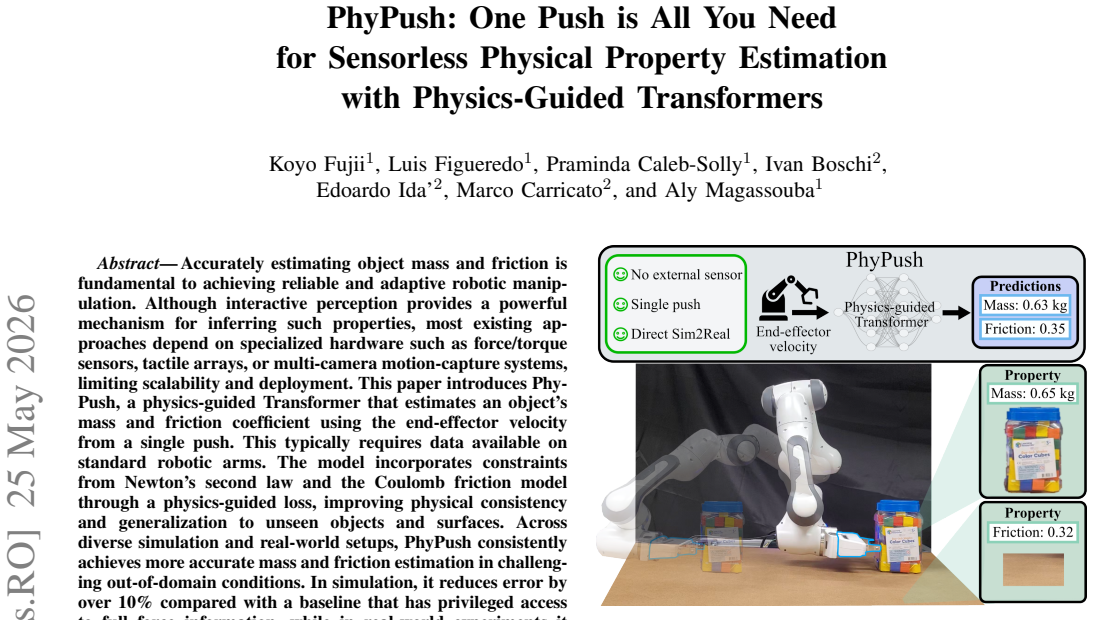
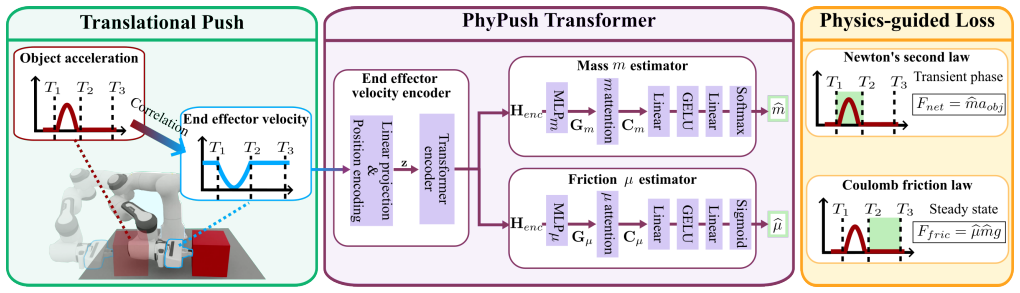
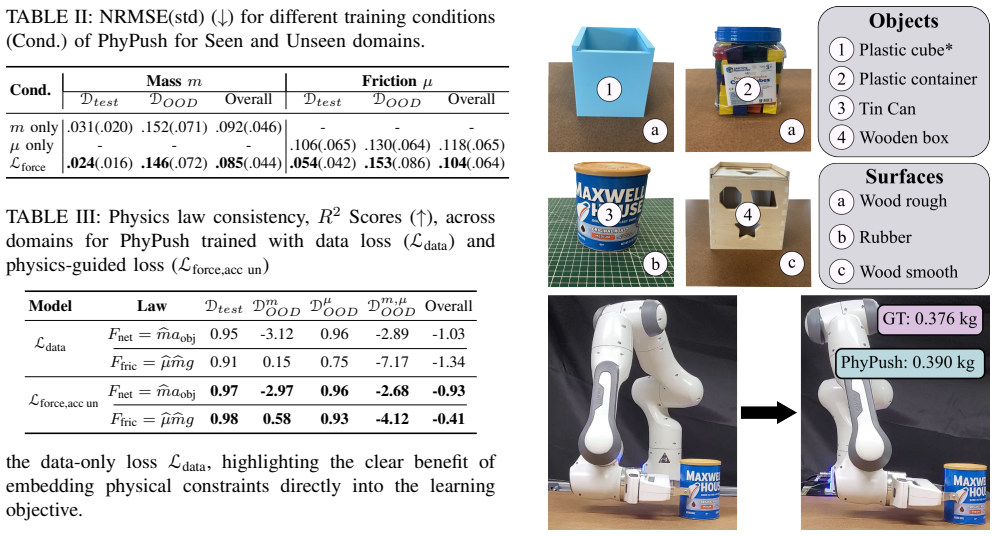
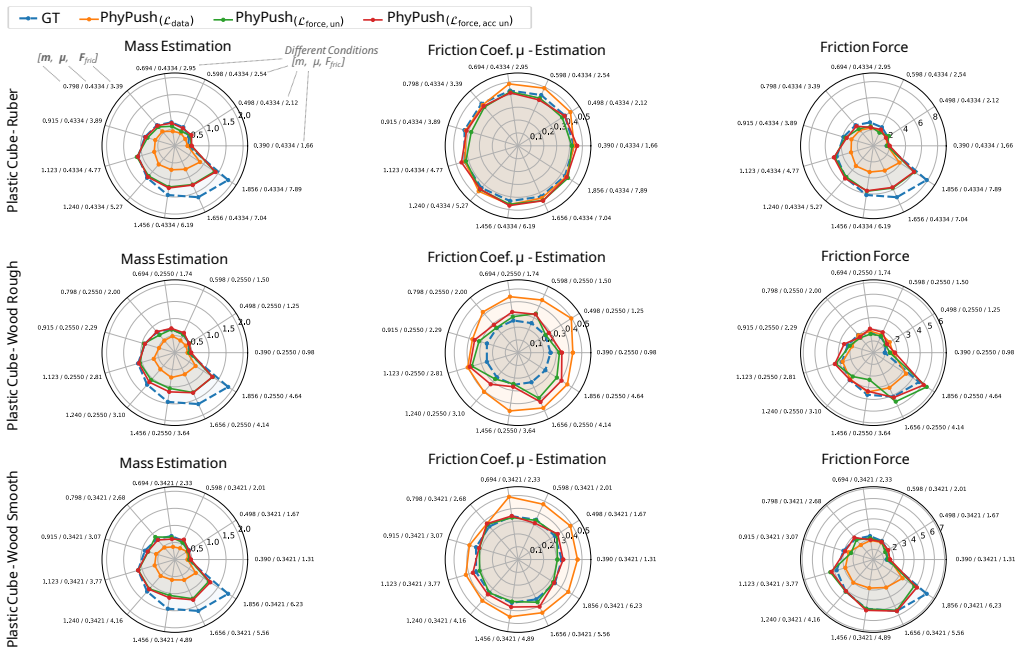
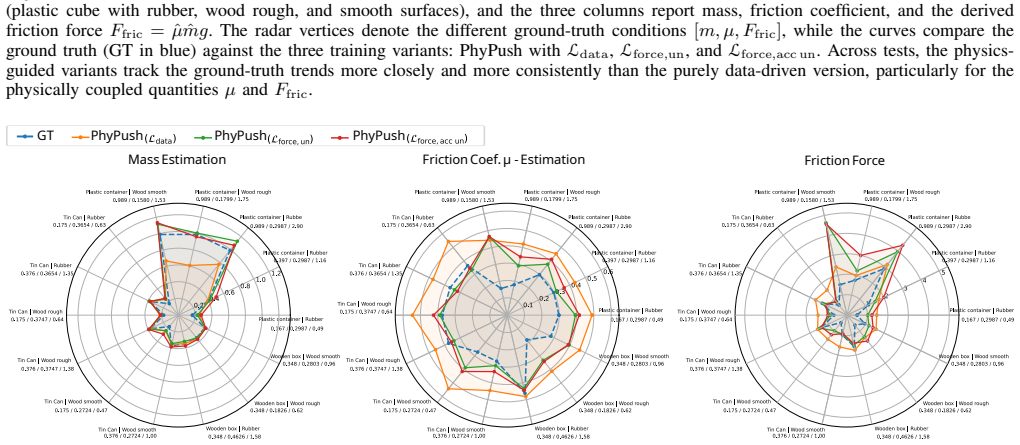
PhyPush is a physics-guided Transformer that estimates an object's mass and friction coefficient using only end-effector velocity from a single push. By incorporating Newton's second law and the Coulomb friction model through a physics-guided loss, the model improves physical consistency and generalizes to unseen objects and surfaces. Across diverse setups, PhyPush consistently achieves highly accurate estimations in challenging out-of-domain conditions. In simulation, it reduces error by over 10% compared to a baseline with privileged force data, while in real-world experiments, it successfully zero-shot transfers from simulation to outperform a purely data-driven baseline.
What carries the argument
The physics-guided loss that enforces consistency with Newton's second law and the Coulomb friction model while training the Transformer on velocity sequences.
Load-bearing premise
Velocity data alone, combined with the standard Newtonian and Coulomb models inside the loss, is sufficient to recover accurate mass and friction values without force measurements or additional sensing.
What would settle it
Collect velocity traces from pushes on a new surface whose friction deviates from the Coulomb model; if the model's mass and friction estimates produce large prediction errors when the equations of motion are integrated forward, the central claim is falsified.
If this is right
- Standard robotic arms without force sensors can still obtain reliable mass and friction estimates from one push.
- Estimation accuracy exceeds that of models given privileged force data in simulation.
- Models trained only in simulation produce usable estimates on real robots without fine-tuning.
- Performance remains high on objects and surfaces absent from the training distribution.
Where Pith is reading between the lines
- Robots could use the estimates to adjust grasp forces or push trajectories on the fly without extra hardware.
- The same loss-construction pattern might let velocity-only data support estimation of additional inertial parameters.
- The method highlights how physics constraints can substitute for missing sensor channels in other manipulation tasks.
Editorial analysis
A structured set of objections, weighed in public.
Referee Report
Summary. The paper introduces PhyPush, a physics-guided Transformer that estimates object mass and friction coefficient from a single push using only end-effector velocity data available on standard robotic arms. Newton's second law and the Coulomb friction model are incorporated via a physics-guided loss to enforce physical consistency and improve generalization to unseen objects and surfaces. The work reports over 10% error reduction versus a privileged-force baseline in simulation and successful zero-shot sim-to-real transfer that outperforms a purely data-driven baseline in real experiments.
Significance. If the central estimation result holds and the degeneracy concern is resolved, the approach would be significant for scalable sensorless manipulation, removing the need for force/torque sensors on commodity arms. The combination of a single-push protocol with physics-guided loss for out-of-domain generalization and zero-shot transfer would be a useful contribution if the identifiability of m and μ from velocity alone is demonstrated.
major comments (2)
- [Method / physics-guided loss] Method section (physics loss formulation): The central claim requires that velocity trajectories alone, under a physics loss enforcing F=ma and Coulomb friction, uniquely recover both m and μ. Because contact force is never measured and the robot is presumably velocity-controlled, the applied force is a reaction that depends on the unknown parameters. This creates a potential degeneracy in which multiple (m, μ) pairs produce indistinguishable velocity profiles. The manuscript must supply the explicit loss equation, weighting scheme, and either an identifiability analysis or empirical evidence (e.g., synthetic ablation showing unique recovery) that resolves this circularity.
- [Experiments / simulation] Simulation results (comparison to privileged-force baseline): The claim that PhyPush reduces error by over 10% relative to a baseline given privileged force data is load-bearing for the sensorless advantage. The paper should specify the exact baseline architecture, loss, and input features, and report per-object error distributions with standard deviations or confidence intervals to substantiate the improvement.
minor comments (2)
- [Abstract] Abstract: The phrase 'highly accurate estimations' is vague; replace with concrete metrics (mean absolute error, relative error, etc.) for mass and friction.
- [Method] Notation: Define all symbols (e.g., how the physics loss term is written) at first use rather than assuming familiarity with the Transformer architecture details.
Simulated Author's Rebuttal
We thank the referee for their thorough review and constructive comments on our manuscript. We address each of the major comments point by point below. We believe the concerns can be addressed through clarifications and additional details in the revised version.
read point-by-point responses
-
Referee: [Method / physics-guided loss] Method section (physics loss formulation): The central claim requires that velocity trajectories alone, under a physics loss enforcing F=ma and Coulomb friction, uniquely recover both m and μ. Because contact force is never measured and the robot is presumably velocity-controlled, the applied force is a reaction that depends on the unknown parameters. This creates a potential degeneracy in which multiple (m, μ) pairs produce indistinguishable velocity profiles. The manuscript must supply the explicit loss equation, weighting scheme, and either an identifiability analysis or empirical evidence (e.g., synthetic ablation showing unique recovery) that resolves this circularity.
Authors: We acknowledge the importance of demonstrating identifiability. In the revised manuscript, we will include the explicit formulation of the physics-guided loss, including the weighting scheme between data loss and physics loss terms. Additionally, we will provide an identifiability analysis based on the model dynamics and empirical evidence from synthetic experiments showing that the optimization converges to unique (m, μ) pairs for given velocity trajectories under the assumed physics model. revision: yes
-
Referee: [Experiments / simulation] Simulation results (comparison to privileged-force baseline): The claim that PhyPush reduces error by over 10% relative to a baseline given privileged force data is load-bearing for the sensorless advantage. The paper should specify the exact baseline architecture, loss, and input features, and report per-object error distributions with standard deviations or confidence intervals to substantiate the improvement.
Authors: We agree that more details are needed to substantiate the comparison. The privileged-force baseline uses the same Transformer architecture but takes force measurements as additional input features. The loss is the standard MSE on the parameter predictions. We will expand the manuscript to detail the baseline architecture, loss function, and input features. Furthermore, we will include per-object error distributions along with standard deviations and confidence intervals in the revised results section. revision: yes
Circularity Check
No circularity: standard external physics models used in loss without self-definition or fitted predictions
full rationale
The paper's central approach incorporates Newton's second law and the Coulomb friction model via a physics-guided loss to estimate mass and friction from velocity data. These are established external physical laws, not derived from or defined in terms of the model's outputs. No self-citations, ansatzes, or uniqueness theorems from prior author work are invoked in the provided text to justify the formulation. The estimation process is presented as using these independent models to enforce consistency, with no reduction of predictions to fitted inputs by construction. This is a normal non-finding for a paper relying on textbook mechanics.
Axiom & Free-Parameter Ledger
axioms (1)
- domain assumption Newton's second law and the Coulomb friction model accurately represent the contact dynamics during a push
Cite this review
Pith. "Pith review of PhyPush: One Push is All You Need for Sensorless Physical Property Estimation with Physics-Guided Transformers." pith.science (2026). https://pith.science/paper/QUA7UZOM
@misc{pith2026260526284,
  author       = {Pith},
  title        = {Pith review of: PhyPush: One Push is All You Need for Sensorless Physical Property Estimation with Physics-Guided Transformers},
  year         = {2026},
  howpublished = {\url{https://pith.science/paper/QUA7UZOM}},
  note         = {Machine review of arXiv:2605.26284}
}
read the original abstract
Accurately estimating object mass and friction is fundamental to reliable robotic manipulation. While interactive perception is powerful, most approaches rely on specialized hardware like force/torque sensors, limiting scalability. This paper introduces PhyPush, a physics-guided Transformer that estimates an object's mass and friction coefficient using only end-effector velocity from a single push, data readily available on standard robotic arms. By incorporating Newton's second law and the Coulomb friction model through a physics-guided loss, the model improves physical consistency and generalizes to unseen objects and surfaces. Across diverse setups, PhyPush consistently achieves highly accurate estimations in challenging out-of-domain conditions. In simulation, it reduces error by over 10% compared to a baseline with privileged force data, while in real-world experiments, it successfully zero-shot transfers from simulation to outperform a purely data-driven baseline.
Figures
Reference graph
Works this paper leans on
-
[1]
A review of particle damping modeling and testing,
L. Gagnon, M. Morandini, and G. L. Ghiringhelli, “A review of particle damping modeling and testing,”Journal of Sound and Vibration, vol. 459, p. 114865, Oct. 2019
work page 2019
-
[2]
Planar sliding with dry friction Part 1. Limit surface and moment function,
S. Goyal, A. Ruina, and J. Papadopoulos, “Planar sliding with dry friction Part 1. Limit surface and moment function,”Wear, vol. 143, pp. 307–330, Mar. 1991
work page 1991
-
[3]
Estimating An Object’s Inertial Parameters By Robotic Pushing: A Data-Driven Approach,
N. Mavrakis, A. M. Ghalamzan E., and R. Stolkin, “Estimating An Object’s Inertial Parameters By Robotic Pushing: A Data-Driven Approach,” in2020 IEEE/RSJ International Conference on Intelligent Robots and Systems (IROS), pp. 9537–9544, Oct. 2020
work page 2020
-
[4]
Predictive Visuo-Tactile Inter- active Perception Framework for Object Properties Inference,
A. Dutta, E. Burdet, and M. Kaboli, “Predictive Visuo-Tactile Inter- active Perception Framework for Object Properties Inference,”IEEE Transactions on Robotics, vol. 41, pp. 1386–1403, 2025
work page 2025
-
[5]
A. Kruzliak, J. Hartvich, S. P. Patni, L. Rustler, J. K. Behrens, F. J. Abu-Dakka, K. Mikolajczyk, V . Kyrki, and M. Hoffmann, “Interactive Learning of Physical Object Properties Through Robot Manipulation and Database of Object Measurements,” in2024 IEEE/RSJ Interna- tional Conference on Intelligent Robots and Systems (IROS), pp. 7596– 7603, Oct. 2024
work page 2024
-
[6]
A. Vaswani, N. Shazeer, N. Parmar, J. Uszkoreit, L. Jones, A. N. Gomez, Ł. Kaiser, and I. Polosukhin, “Attention is all you need,” Advances in neural information processing systems, vol. 30, 2017
work page 2017
-
[7]
Estimating material properties of interacting objects using sum-gp-ucb,
M. Y . Seker and O. Kroemer, “Estimating material properties of interacting objects using sum-gp-ucb,” in2024 IEEE International Conference on Robotics and Automation, pp. 16684–16690, IEEE, 2024
work page 2024
-
[8]
Galileo: Perceiving Physical Object Properties by Integrating a Physics Engine with Deep Learning,
J. Wu, I. Yildirim, J. J. Lim, B. Freeman, and J. Tenenbaum, “Galileo: Perceiving Physical Object Properties by Integrating a Physics Engine with Deep Learning,”
-
[9]
Estimating object physical properties from rgb-d vision and depth robot sensors using deep learning,
R. P. Cardoso and P. Moreno, “Estimating object physical properties from rgb-d vision and depth robot sensors using deep learning,” inIberian Conference on Pattern Recognition and Image Analysis, pp. 97–110, Springer, 2025
work page 2025
-
[10]
Physically grounded vision-language models for robotic manipulation,
J. Gao, B. Sarkar, F. Xia, T. Xiao, J. Wu, B. Ichter, A. Majumdar, and D. Sadigh, “Physically grounded vision-language models for robotic manipulation,” in2024 IEEE International Conference on Robotics and Automation (ICRA), pp. 12462–12469, IEEE, 2024
work page 2024
-
[11]
M. Wang, S. Tian, A. Swann, O. Shorinwa, J. Wu, and M. Schwa- ger, “Phys2real: Fusing vlm priors with interactive online adapta- tion for uncertainty-aware sim-to-real manipulation,”arXiv preprint arXiv:2510.11689, 2025
-
[12]
Omnipush: accurate, diverse, real-world dataset of pushing dynamics with rgb-d video,
M. Bauza, F. Alet, Y .-C. Lin, T. Lozano-P´erez, L. P. Kaelbling, P. Isola, and A. Rodriguez, “Omnipush: accurate, diverse, real-world dataset of pushing dynamics with rgb-d video,” in2019 IEEE/RSJ International Conference on Intelligent Robots and Systems (IROS), pp. 4265–4272, IEEE, 2019
work page 2019
-
[13]
M. Chareyre, P. Fournier, J. Moras, J.-M. Bourinet, and Y . Mezouar, “Unsupervised discovery of objects physical properties through maxi- mum entropy reinforcement learning,”IEEE Robotics and Automation Letters, 2025
work page 2025
-
[14]
DensePhysNet: Learning Dense Physical Object Representations via Multi-step Dynamic Interactions
Z. Xu, J. Wu, A. Zeng, J. B. Tenenbaum, and S. Song, “DensePhys- Net: Learning Dense Physical Object Representations via Multi-step Dynamic Interactions,” June 2019. arXiv:1906.03853 [cs]
work page internal anchor Pith review Pith/arXiv arXiv 2019
-
[15]
A. Dutta, E. Burdet, and M. Kaboli, “Push to Know! - Visuo-Tactile Based Active Object Parameter Inference with Dual Differentiable Filtering,” in2023 IEEE/RSJ International Conference on Intelligent Robots and Systems (IROS), pp. 3137–3144, Oct. 2023
work page 2023
-
[16]
Learning object properties using robot proprio- ception via differentiable robot-object interaction,
P. Y . Chen, C. Liu, P. Ma, J. Eastman, D. Rus, D. Randle, Y . Ivanov, and W. Matusik, “Learning object properties using robot proprio- ception via differentiable robot-object interaction,” in2025 IEEE International Conference on Robotics and Automation, pp. 5997–6004, IEEE, 2025
work page 2025
-
[17]
Physics- informed neural networks (PINNs) for fluid mechanics: A review,
S. Cai, Z. Mao, Z. Wang, M. Yin, and G. E. Karniadakis, “Physics- informed neural networks (PINNs) for fluid mechanics: A review,” Acta Mechanica Sinica, vol. 37, no. 12, pp. 1727–1738, 2021. Friction Coef. μ - Estimation Mass Estimation Friction Coef. μ - Estimation Mass Estimation Friction Coef. μ - Estimation Friction Force Friction Force Friction Forc...
work page 2021
-
[18]
Physics-informed learning for the friction modeling of high-ratio harmonic drives,
I. Sorrentino, G. Romualdi, F. Bergonti, G. L’Erario, S. Traversaro, and D. Pucci, “Physics-informed learning for the friction modeling of high-ratio harmonic drives,” in2024 IEEE-RAS 23rd International Conference on Humanoid Robots, pp. 505–512, IEEE, 2024
work page 2024
-
[19]
Physics-guided neural networks (pgnn): An application in lake tem- perature modeling,
A. Daw, A. Karpatne, W. D. Watkins, J. S. Read, and V . Kumar, “Physics-guided neural networks (pgnn): An application in lake tem- perature modeling,” inKnowledge guided machine learning, pp. 353– 372, Chapman and Hall/CRC, 2022
work page 2022
-
[20]
Isaac Lab: A GPU-Accelerated Simulation Framework for Multi-Modal Robot Learning
M. Mittal, P. Roth, J. Tigue,et al., “Isaac Lab: A GPU-Accelerated Simulation Framework for Multi-Modal Robot Learning,”arXiv preprint arXiv:2511.04831, 2025
work page internal anchor Pith review Pith/arXiv arXiv 2025
discussion (0)
Sign in with ORCID, Apple, or X to comment. Anyone can read and Pith papers without signing in.