Two-Parameter Flows for Learning Population Dynamics of Physical Systems
Pith reviewed 2026-06-29 22:39 UTC · model grok-4.3
The pith
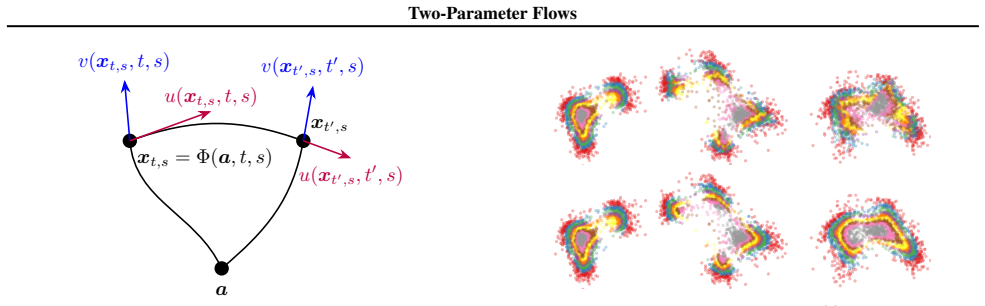
Two-parameter flows recover unique physics-time velocity fields for population dynamics by regressing on synthetic trajectories built from base-to-marginal transports.
A machine-rendered reading of the paper's core claim, the machinery that carries it, and where it could break.
Core claim
The paper claims that two-parameter flows, which learn sampling-time transports from a base distribution to successive marginals and then regress a velocity on the resulting synthetic trajectories, produce a unique physics-time dynamics that recovers the underlying population evolution and inherits regularity properties from the sampling-time maps.
What carries the argument
Two-parameter flows that first learn base-to-marginal transports at discrete sampling times via conditional flow matching and then regress a physics-time velocity field on coupled synthetic trajectories.
If this is right
- The extracted physics-time dynamics are unique.
- They inherit regularity from the sampling-time transports.
- The method scales to high dimensions without per-step optimal-transport couplings.
- It permits admissible non-gradient dynamics that can explain rotational or circulating phenomena.
Where Pith is reading between the lines
- The construction could be applied to any domain where only snapshot distributions are observed, such as certain experimental measurements in fluid or particle systems.
- Because it re-uses existing conditional flow matching implementations, the overhead of adding the regression step may be modest in practice.
- One could check whether the learned velocities satisfy additional physical constraints, such as divergence-free conditions in incompressible flow, on benchmark problems where ground-truth velocities are known.
Load-bearing premise
That regressing on coupled synthetic trajectories constructed from independently learned base-to-marginal transports yields a well-defined, unique physics-time velocity field that correctly recovers the underlying population dynamics.
What would settle it
A concrete case in which two distinct physics-time velocity fields generate identical sequences of marginal distributions, yet the regression procedure returns only one of them, or where the extracted velocity fails to reproduce the observed marginal evolution when integrated forward.
Figures
read the original abstract
This work addresses the problem of learning the dynamics of high-dimensional probability densities over time using unlabeled samples, without assuming access to trajectory information. We introduce two-parameter flows that learn only sampling-time transports from a base distribution to each marginal and then extract a physics-time velocity by regressing on coupled synthetic trajectories. We prove that the resulting physics-time dynamics are unique and inherit regularity from the sampling-time transports. Because we can build on standard, well-developed conditional flow matching techniques for learning the base-to-marginal transports, our approach scales to high dimensions and avoids per-step optimal-transport couplings, while allowing admissible non-gradient dynamics that can naturally explain rotational or circulating physics phenomena.
Editorial analysis
A structured set of objections, weighed in public.
Referee Report
Summary. The paper introduces two-parameter flows to learn the dynamics of high-dimensional probability densities over time from unlabeled samples. It learns sampling-time transports from a fixed base distribution to each time marginal via conditional flow matching, constructs coupled synthetic trajectories by pushing base samples through these maps, and regresses a physics-time velocity field on the resulting trajectories. The authors claim to prove that the resulting physics-time dynamics are unique and inherit regularity from the sampling-time transports; the method is positioned as scalable to high dimensions, free of per-step optimal-transport couplings, and permissive of admissible non-gradient dynamics.
Significance. If the uniqueness result and the correctness of the regression step hold, the work offers a practical route to continuous-time population dynamics that builds directly on mature conditional flow matching techniques, thereby inheriting their high-dimensional scalability. The explicit allowance for non-gradient flows is a genuine strength for modeling rotational or circulatory phenomena that gradient-based methods cannot capture. The avoidance of repeated optimal-transport solves per time step is a clear computational advantage.
major comments (1)
- [abstract, paragraph 2] Abstract, paragraph 2: the uniqueness claim for the physics-time velocity rests on regressing a single vector field onto synthetic trajectories that are assembled from independently learned base-to-marginal transport maps. Because each transport is trained separately, the induced trajectories need not lie on the integral curves of any single continuous velocity; the manuscript must supply the precise argument (presumably in the uniqueness proof) showing that regression nevertheless recovers a unique field whose continuity equation reproduces the observed marginal evolution. This step is load-bearing for the central claim.
Simulated Author's Rebuttal
We thank the referee for the careful reading and for identifying this load-bearing aspect of the uniqueness claim. We address the comment below and will revise the manuscript accordingly.
read point-by-point responses
-
Referee: [abstract, paragraph 2] Abstract, paragraph 2: the uniqueness claim for the physics-time velocity rests on regressing a single vector field onto synthetic trajectories that are assembled from independently learned base-to-marginal transport maps. Because each transport is trained separately, the induced trajectories need not lie on the integral curves of any single continuous velocity; the manuscript must supply the precise argument (presumably in the uniqueness proof) showing that regression nevertheless recovers a unique field whose continuity equation reproduces the observed marginal evolution. This step is load-bearing for the central claim.
Authors: We agree that the current presentation of the uniqueness argument is insufficiently explicit and requires expansion. The proof (Theorem 4.1 and its supporting lemmas in Section 4) proceeds by first noting that the synthetic trajectories are generated by transporting identical base samples through the family of learned maps; this common origin induces a consistent family of paths even though the maps are trained independently. The regression step then minimizes the expected squared residual between the finite-difference velocities along these paths and the candidate vector field v. Under the standing assumption that a Lipschitz velocity field exists whose continuity equation reproduces the observed marginals, we show that any other candidate field w that also satisfies the marginal evolution must coincide with v almost everywhere; the argument relies on integrating the difference (v - w) against the empirical measure of the synthetic trajectories and using the fact that the base-to-marginal maps converge (in the large-sample limit) to the true transport maps of the underlying dynamics. We will add a self-contained, step-by-step derivation of this regression-to-uniqueness implication in the revised main text, together with a short remark clarifying why independent training of the maps does not break consistency of the induced trajectories. revision: yes
Circularity Check
No significant circularity; derivation self-contained with internal uniqueness proof
full rationale
The paper defines two-parameter flows by first learning independent sampling-time transports from base to each marginal (via standard conditional flow matching), constructs synthetic trajectories, regresses a physics-time velocity field, and states that it proves uniqueness plus regularity inheritance. No quoted step reduces the claimed uniqueness or velocity field to a self-definition, a fitted parameter renamed as prediction, or a load-bearing self-citation chain. The proof is presented as an internal contribution rather than imported from prior author work, and the method explicitly builds on external flow-matching techniques. The derivation chain therefore remains self-contained against external benchmarks.
Axiom & Free-Parameter Ledger
Reference graph
Works this paper leans on
-
[1]
Alvarez-Melis, D., Schiff, Y ., and Mroueh, Y
URL https://openreview.net/forum? id=li7qeBbCR1t. Alvarez-Melis, D., Schiff, Y ., and Mroueh, Y . Optimizing functionals on the space of probabilities with input convex neural networks.Transactions on Machine Learning Research, 2022. ISSN 2835-8856. URL https:// openreview.net/forum?id=dpOYN7o8Jm. Ambrosio, L., Gigli, N., and Savar ´e, G.Gradient Flows. L...
2022
-
[2]
URL http://link.springer.com/10.1007/ s10208-019-09425-z
doi: 10.1007/s10208-019-09425-z. URL http://link.springer.com/10.1007/ s10208-019-09425-z. Berman, J., Blickhan, T., and Peherstorfer, B. Parametric model reduction of mean-field and stochastic systems via higher-order action matching. InProceedings of the 38th International Conference on Neural Information Processing Systems, NeurIPS ’24, Red Hook, NY , USA,
-
[3]
Curran Associates Inc. ISBN 979-8-3313-1438-5. Blickhan, T., Berman, J., Stuart, A., and Peherstorfer, B. DICE: Discrete inverse continuity equation for learning population dynamics.arXiv, 2507.05107, 2025. URL https://arxiv.org/abs/2507.05107. Bunne, C., Papaxanthos, L., Krause, A., and Cuturi, M. Proximal optimal transport modeling of popula- tion dynam...
-
[4]
Lipschitz-Guided Design of Interpolation Schedules in Generative Models
URL https://proceedings.mlr.press/ v151/bunne22a.html. Chen, T., Liu, G.-H., Tao, M., and Theodorou, E. Deep momentum multi-marginal schr¨odinger bridge. InThirty- seventh Conference on Neural Information Processing Systems, 2023. URL https://openreview.net/ forum?id=ykvvv0gc4R. Chen, Y ., Conforti, G., Georgiou, T. T., and Ripani, L. Multi-marginal Schr¨...
work page internal anchor Pith review Pith/arXiv arXiv doi:10.1007/978-3-030-26980-7_75 2023
-
[5]
URL https://proceedings.mlr.press/ v130/chewi21a.html. Daniels, M. On the Contractivity of Stochastic Interpola- tion Flow, 2025. URL https://arxiv.org/abs/ 2504.10653. Version Number: 2. 10 Two-Parameter Flows Gigli, N.Second order analysis on (P2(M), W2). Number 1018 in Memoirs of the American Mathematical Society. American Mathematical Society, Provide...
work page doi:10.1137/1 2025
-
[6]
cc/paper_files/paper/2020/file/ 4c5bcfec8584af0d967f1ab10179ca4b-Paper
URL https://proceedings.neurips. cc/paper_files/paper/2020/file/ 4c5bcfec8584af0d967f1ab10179ca4b-Paper. pdf. Hong, W., Shi, Y ., and Niles-Weed, J. Trajectory in- ference with smooth schr ¨odinger bridges. InForty- second International Conference on Machine Learning,
2020
-
[7]
Hoogeboom, E., Gritsenko, A
URL https://openreview.net/forum? id=GHyvvWu1XC. Hoogeboom, E., Gritsenko, A. A., Bastings, J., Poole, B., van den Berg, R., and Salimans, T. Autoregressive dif- fusion models. InInternational Conference on Learning Representations, 2022. URL https://openreview. net/forum?id=Lm8T39vLDTE. Hyv¨arinen, A. Estimation of non-normalized statistical models by sc...
2022
-
[8]
ISSN 0036-1410, 1095-7154. doi: 10.1137/ S0036141096303359. Kochkov, D., Smith, J. A., Alieva, A., Wang, Q., Brenner, M. P., and Hoyer, S. Machine learn- ing–accelerated computational fluid dynamics.Pro- ceedings of the National Academy of Sciences, 118(21):e2101784118, 2021. doi: 10.1073/pnas. 2101784118. URL https://www.pnas.org/doi/ abs/10.1073/pnas.21...
-
[9]
doi: https://doi.org/10.1016/bs.hna.2024.05
-
[10]
Lavenant, H., Zhang, S., Kim, Y .-H., and Schiebinger, G
URL https://www.sciencedirect.com/ science/article/pii/S1570865924000097. Lavenant, H., Zhang, S., Kim, Y .-H., and Schiebinger, G. Toward a mathematical theory of trajectory inference.The Annals of Applied Probability, 34(1A):428–500, February
-
[11]
doi: 10.1214/23-AAP1969. URL https://doi. org/10.1214/23-AAP1969. Li, L., Hurault, S., and Solomon, J. Self-consistent velocity matching of probability flows. In Oh, A., Naumann, T., Globerson, A., Saenko, K., Hardt, M., and Levine, S. (eds.),Advances in Neural Information Processing Sys- tems, volume 36, pp. 57038–57057. Curran Associates, Inc., 2023. Li...
-
[12]
Lipman, Y ., Chen, R
OpenReview.net, 2021. Lipman, Y ., Chen, R. T. Q., Ben-Hamu, H., Nickel, M., and Le, M. Flow matching for generative modeling. InThe Eleventh International Conference on Learning Represen- tations, 2023. URL https://openreview.net/ forum?id=PqvMRDCJT9t. Liu, X., Gong, C., and Liu, Q. Flow Straight and Fast: Learn- ing to Generate and Transfer Data with Re...
2021
-
[13]
doi: 10.3934/dcds.2014.34.1533
ISSN 1553-5231. doi: 10.3934/dcds.2014.34.1533. URL http://aimsciences.org//article/ doi/10.3934/dcds.2014.34.1533. McWilliams, J. C. The emergence of isolated coherent vortices in turbulent flow.Journal of Fluid Mechanics, 146:21–43, 1984. doi: 10.1017/S0022112084001750. Neklyudov, K., Brekelmans, R., Severo, D., and Makhzani, A. Action Matching: Learnin...
-
[14]
Peherstorfer, B., Willcox, K., and Gunzburger, M
URL https://proceedings.mlr.press/ v202/neklyudov23a.html. Peherstorfer, B., Willcox, K., and Gunzburger, M. Survey of multifidelity methods in uncertainty propagation, in- ference, and optimization.SIAM Review, 60(3):550–591, 2018. Persiianov, M., Chen, J., Mokrov, P., Tyurin, A., Burnaev, E., and Korotin, A. Learning of population dynamics: In- verse op...
2018
-
[15]
Petrovi´c, K., Atanackovic, L., Moro, V ., Kapusniak, K., Ceylan, I
URL https://openreview.net/forum? id=tVJIKd6CLF. Petrovi´c, K., Atanackovic, L., Moro, V ., Kapusniak, K., Ceylan, I. I., Bronstein, M., Bose, J., and Tong, A. Curly flow matching for learning non-gradient field dynamics. In Belgrave, D., Zhang, C., Lin, H., Pascanu, R., Ko- niusz, P., Ghassemi, M., and Chen, N. (eds.),Advances in Neural Information Proce...
2025
-
[16]
Sohl-Dickstein, J., Weiss, E., Maheswaranathan, N., and Ganguli, S
URL https://proceedings.mlr.press/ v258/shen25b.html. Sohl-Dickstein, J., Weiss, E., Maheswaranathan, N., and Ganguli, S. Deep unsupervised learning using nonequi- librium thermodynamics. In Bach, F. and Blei, D. (eds.), Proceedings of the 32nd International Conference on Ma- chine Learning, volume 37 ofProceedings of Machine Learning Research, pp. 2256–2...
2015
-
[17]
cc/paper_files/paper/2019/file/ 3001ef257407d5a371a96dcd947c7d93-Paper
URL https://proceedings.neurips. cc/paper_files/paper/2019/file/ 3001ef257407d5a371a96dcd947c7d93-Paper. pdf. Song, Y ., Garg, S., Shi, J., and Ermon, S. Sliced score matching: A scalable approach to density and score estimation. InProceedings of the Thirty-Fifth Conference on Uncertainty in Artificial Intelligence, UAI 2019, Tel Aviv, Israel, July 22-25,...
2019
-
[18]
Terpin, A., Lanzetti, N., Gadea, M., and Dorfler, F
URL https://openreview.net/forum? id=PxTIG12RRHS. Terpin, A., Lanzetti, N., Gadea, M., and Dorfler, F. Learn- ing diffusion at lightspeed. InThe Thirty-eighth Annual Conference on Neural Information Processing Systems,
-
[19]
Tong, A., Huang, J., Wolf, G., Van Dijk, D., and Krishnaswamy, S
URL https://openreview.net/forum? id=y10avdRFNK. Tong, A., Huang, J., Wolf, G., Van Dijk, D., and Krishnaswamy, S. TrajectoryNet: A dynamic opti- mal transport network for modeling cellular dynam- ics. In III, H. D. and Singh, A. (eds.),Proceed- ings of the 37th International Conference on Machine Learning, volume 119 ofProceedings of Machine Learning Res...
-
[20]
field difference
URL https://proceedings.mlr.press/ v119/tong20a.html. Villani, C.Optimal transport: old and new. Number 338 in Grundlehren der mathematischen Wissenschaften. Springer, Berlin, 2009. ISBN 978-3-540-71049-3. 12 Two-Parameter Flows A. Details about examples A.1. Evolving mixture of Gaussians A conditional flow matching model learns velocity fields to map a s...
2009
discussion (0)
Sign in with ORCID, Apple, or X to comment. Anyone can read and Pith papers without signing in.