Holographic Thermodynamic Signatures of Simpson--Visser--AdS Black Holes
Pith reviewed 2026-06-29 20:21 UTC · model grok-4.3
The pith
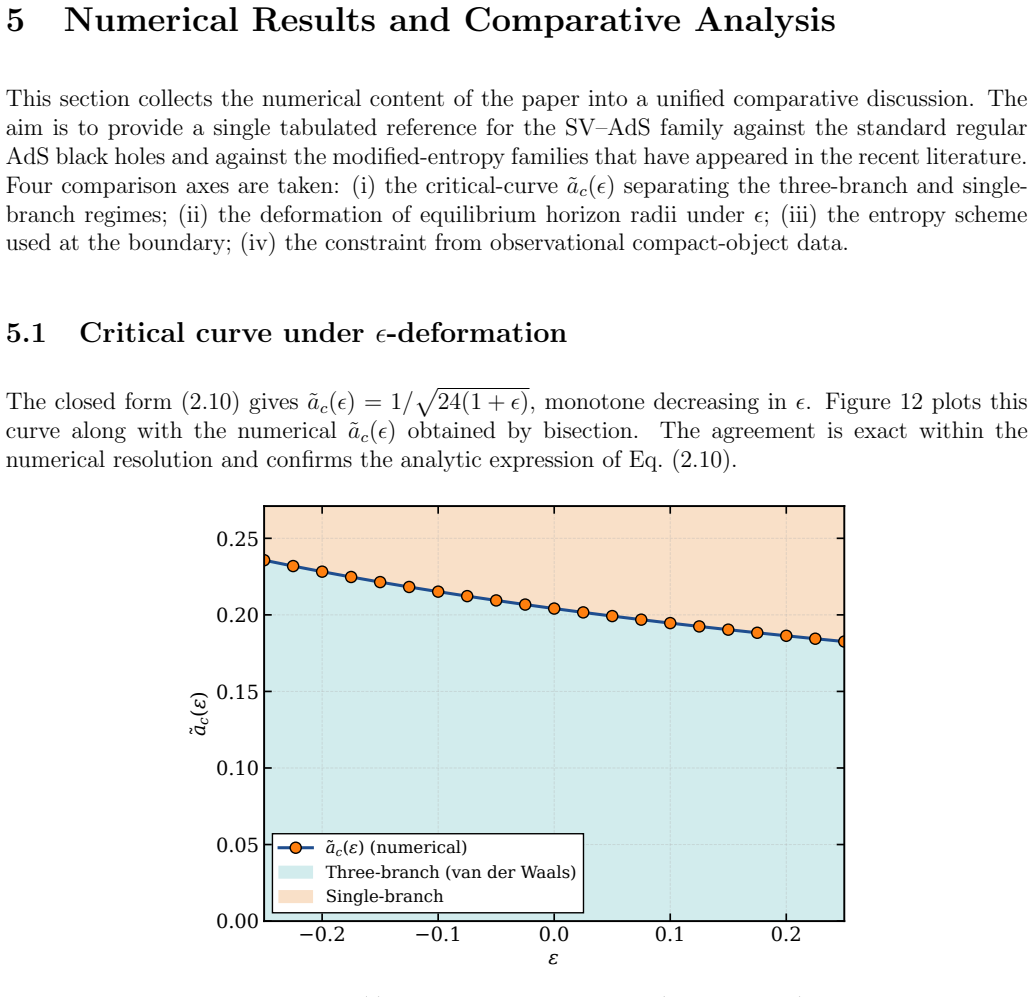
SV-AdS black holes develop three coexisting thermodynamic phases with total topological charge +1 when the regularization parameter falls below 1/sqrt(24).
A machine-rendered reading of the paper's core claim, the machinery that carries it, and where it could break.
Core claim
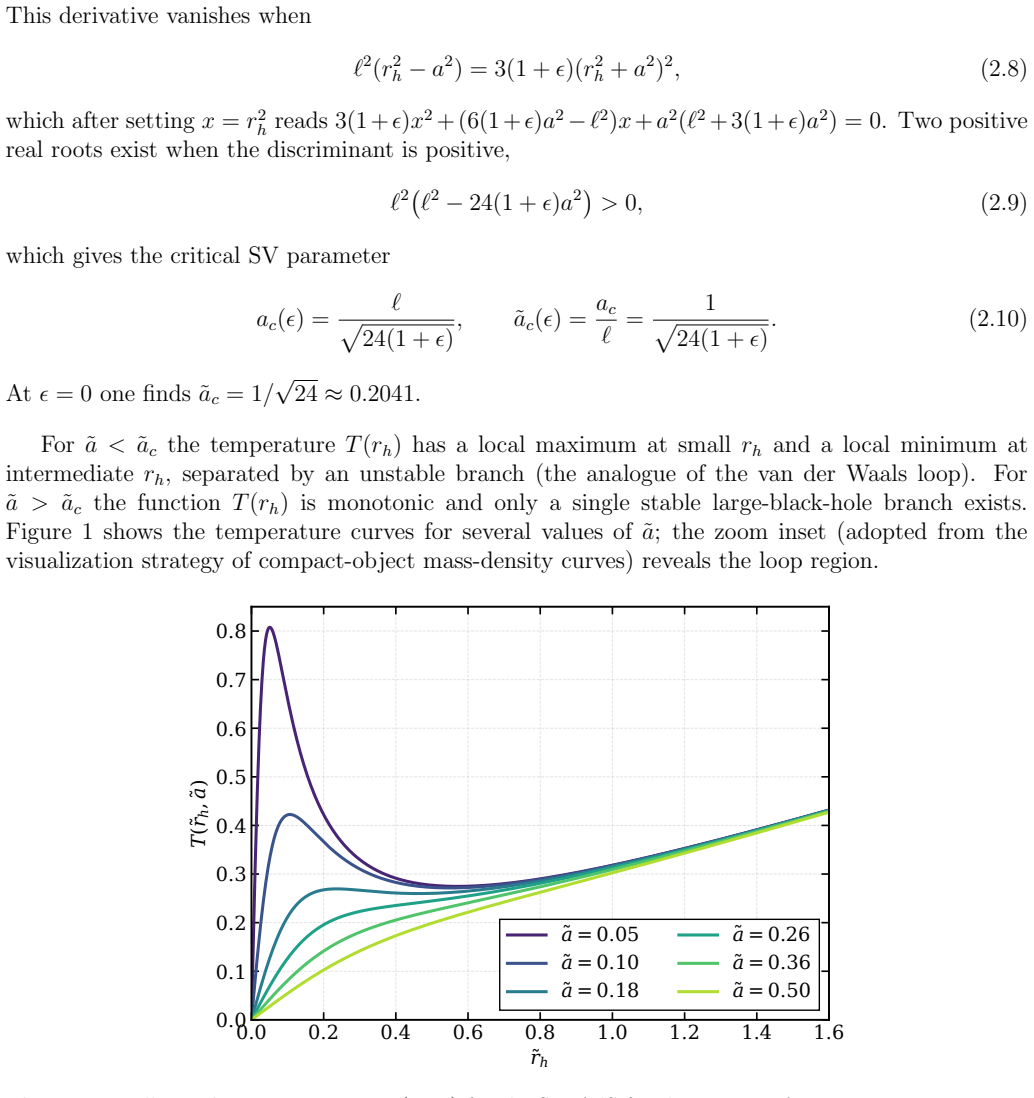
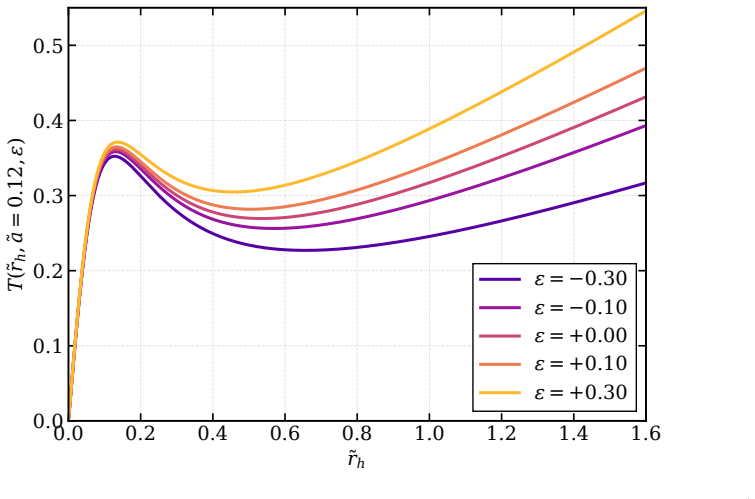
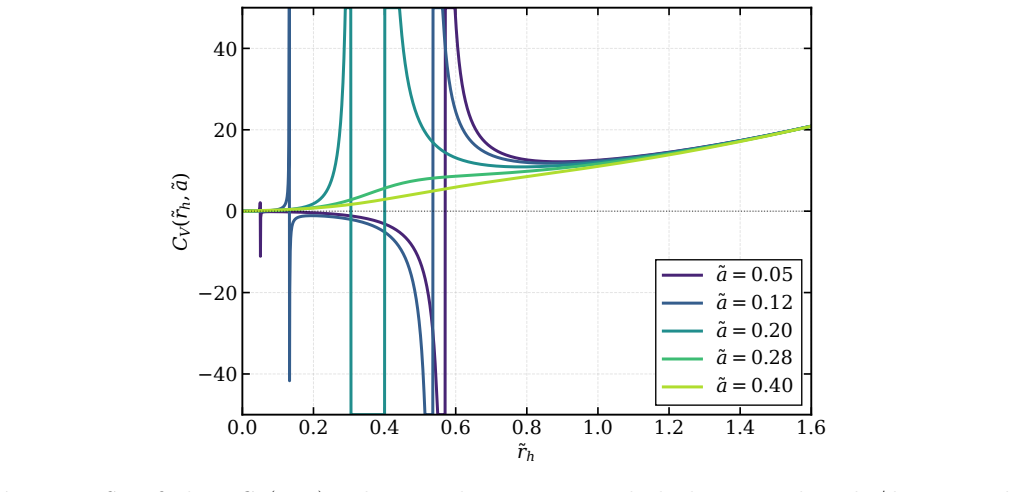
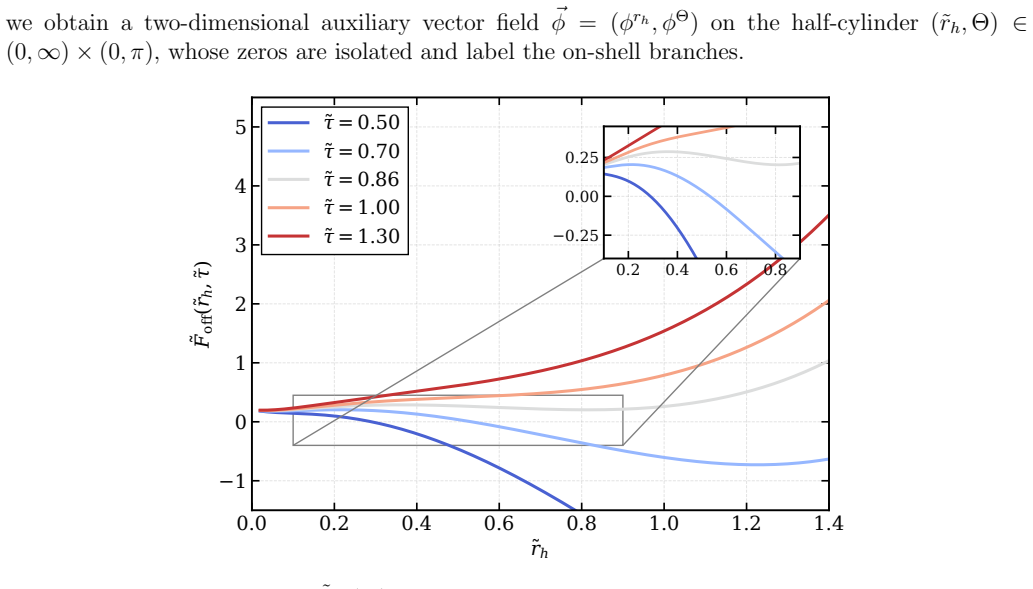
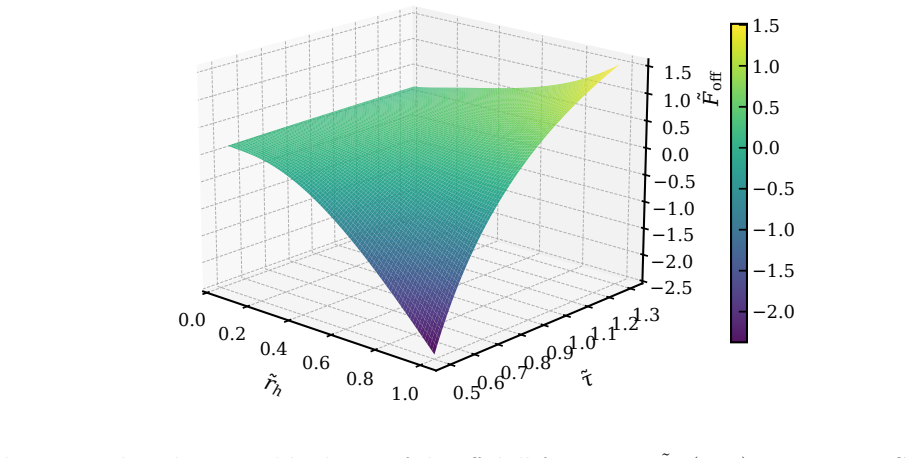
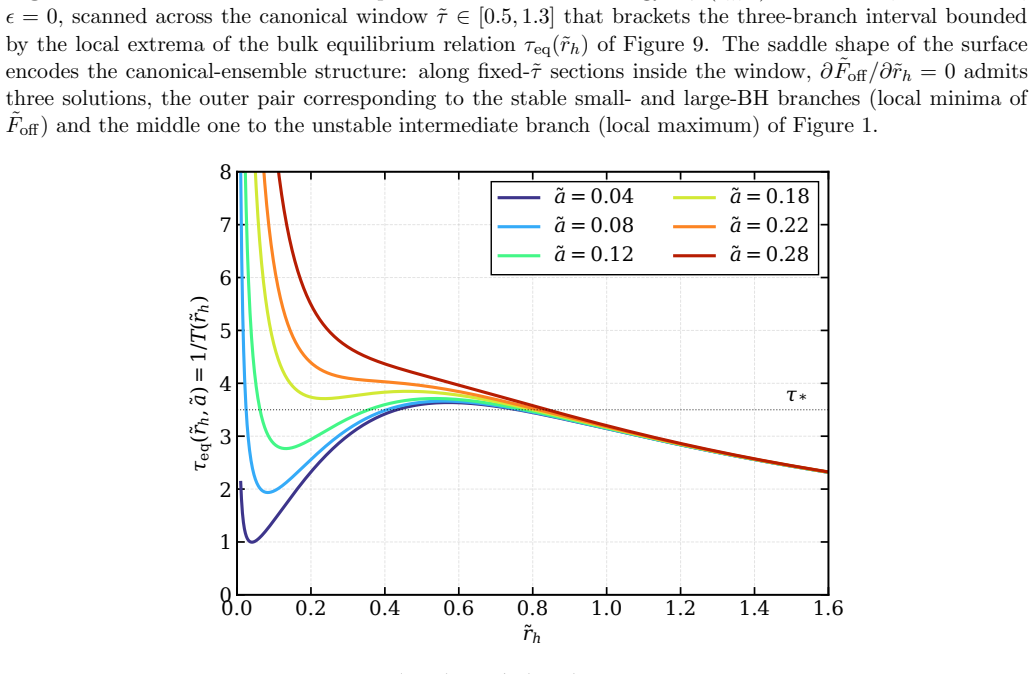
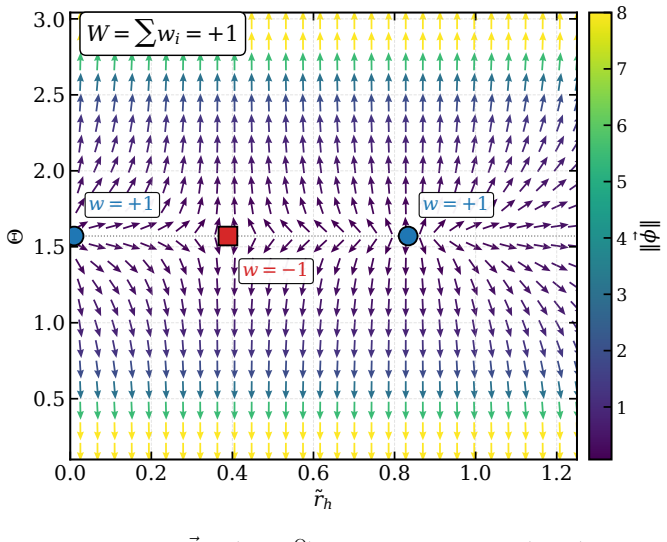
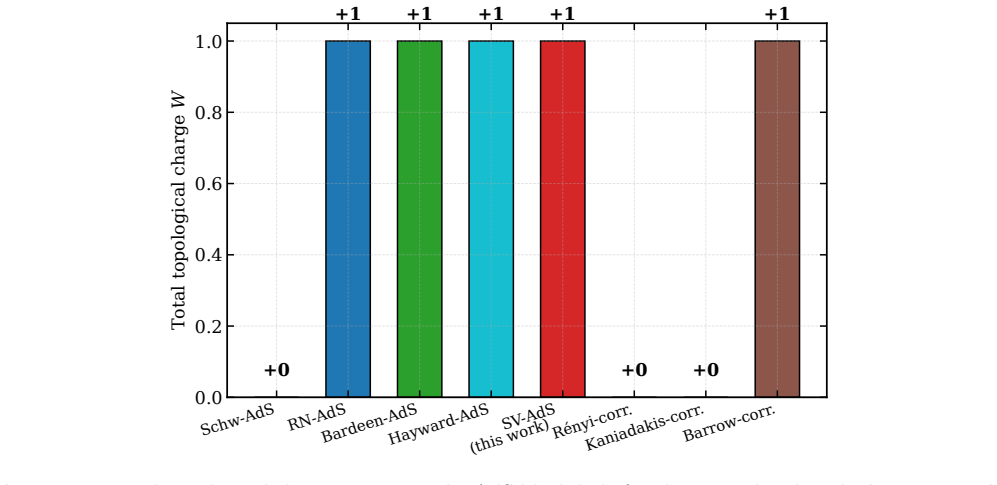
For ã < ã_c = 1/√24 ≈ 0.204 the bulk temperature develops a van der Waals-type small/intermediate/large branch structure and the off-shell free energy supports three coexisting equilibria; the topological-vector-field analysis assigns local winding numbers (+1,−1,+1) with total charge W=+1, matching the universality class of regular AdS black holes and distinguishing the SV-AdS family from Schwarzschild-AdS (W=0).
What carries the argument
The regularization parameter a inside the lapse function f(r) = 1 − 2M/√(r² + a²) + (r² + a²)/ℓ², which deforms the horizon quantities fed into the holographic dictionary and thereby controls the appearance of the multi-branch temperature curve and the winding numbers.
If this is right
- Below the critical regularization the system supports three coexisting black-hole equilibria in the off-shell free energy.
- The topological charge is fixed at W = +1 for the entire SV-AdS family when ã is subcritical.
- The same winding-number pattern appears in Bardeen-AdS and Hayward-AdS, indicating a shared universality class among regular AdS solutions.
- The phase structure reverts to the single-branch Schwarzschild-AdS form once ã exceeds the critical value.
Where Pith is reading between the lines
- The critical value ã_c may mark a point where the dual CFT develops an instability threshold controlled by the bulk regularization scale.
- Analogous topological analysis on other regular black-hole families could reveal whether W = +1 is a generic signature of central regularity in AdS.
- If the dictionary remains unmodified, similar branch structures should appear in the entanglement entropy or other boundary observables derived from the same lapse function.
Load-bearing premise
The holographic dictionary applies without modification to the Simpson-Visser regularized metric, so boundary quantities are read directly from the bulk lapse and its derivatives at the horizon.
What would settle it
Explicit computation of the temperature versus horizon radius for a sequence of ã values straddling 1/√24, checking whether the small-intermediate-large branches and the three-state free-energy intersections appear only below the threshold.
Figures
read the original abstract
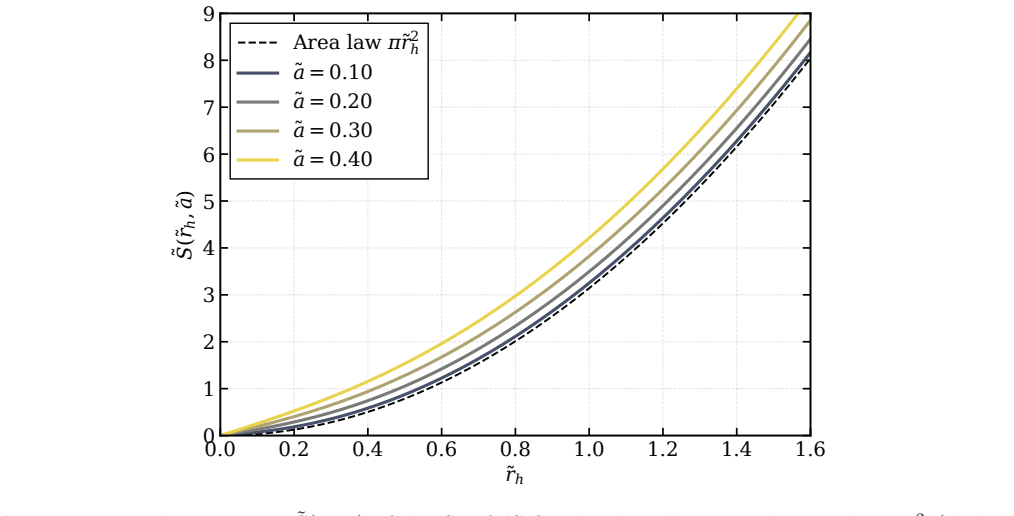
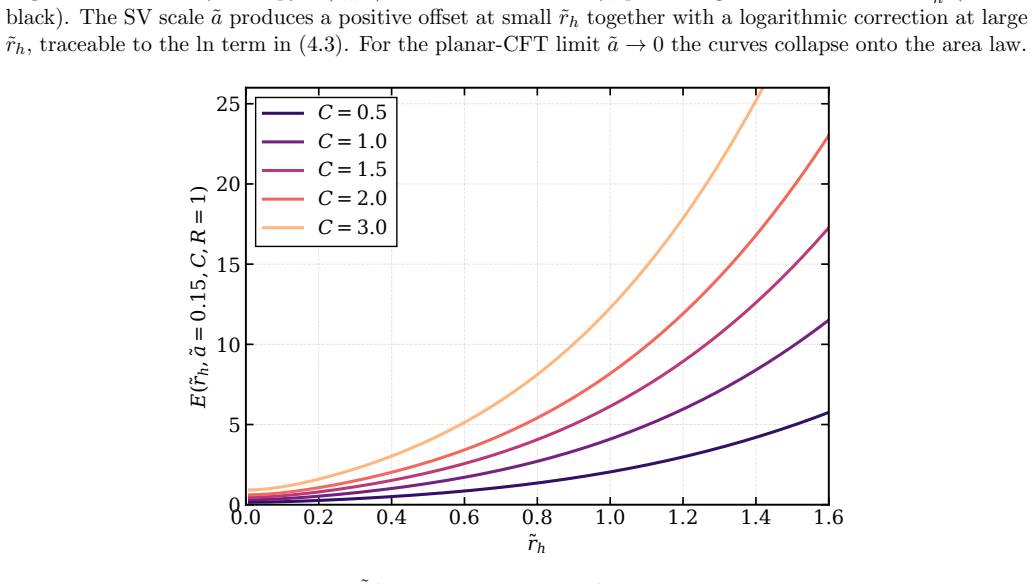
We study a Simpson--Visser regularization of the four-dimensional Schwarzschild--anti--de\,Sitter (SV--AdS) black hole, treated as the bulk dual of a planar conformal field theory (CFT) on the AdS boundary. The bulk lapse $f(r)=1-2M/\sqrt{r^2+a^2}+(r^2+a^2)/\ell^2$ is regular at $r=0$ for any $a>0$, and the holographic dictionary inherits this regularity at the boundary CFT level. We derive in closed form the boundary entropy, energy, temperature, and chemical potentials, and we trace how the SV regularization parameter $a$ deforms each of them as a function of the horizon radius. For $\tila<\tila_c=1/\sqrt{24}\approx 0.204$ the bulk temperature develops a van der Waals--type small/intermediate/large branch structure and the off-shell free energy supports three coexisting equilibria; the topological-vector-field analysis assigns local winding numbers $(+1,-1,+1)$ with total charge $W=+1$, matching the universality class of regular AdS black holes (Bardeen-AdS, Hayward-AdS) and distinguishing the SV-AdS family from Schwarzschild-AdS ($W=0$).
Editorial analysis
A structured set of objections, weighed in public.
Referee Report
Summary. The manuscript examines Simpson-Visser regularized Schwarzschild-AdS black holes as bulk duals to a planar CFT. From the lapse f(r)=1−2M/√(r²+a²)+(r²+a²)/ℓ² it derives closed-form boundary entropy, energy, temperature and chemical potentials as functions of horizon radius, identifies a critical ã_c=1/√24 below which the temperature exhibits van der Waals small/intermediate/large branches with three coexisting equilibria in the off-shell free energy, and computes topological winding numbers (+1,−1,+1) with total charge W=+1 via the standard vector-field construction, placing the SV-AdS family in the same universality class as Bardeen-AdS and Hayward-AdS while distinguishing it from Schwarzschild-AdS (W=0).
Significance. If the holographic dictionary applies unmodified, the work supplies explicit closed-form expressions and falsifiable predictions for thermodynamic phase structure and topological charge in a one-parameter family of regular AdS black holes, thereby extending the existing classification of regular black-hole thermodynamics.
major comments (2)
- [Abstract and derivation of boundary quantities] Abstract, paragraph 2 and the derivation of boundary quantities: the large-r expansion of the given lapse is f(r)∼r²/ℓ²+(1+a²/ℓ²)−2M/r+⋯. Standard AdS counterterms and the usual identification of boundary energy/entropy assume the constant term equals the horizon curvature parameter k=1 with no extra a-dependent shift. The manuscript extracts closed-form boundary entropy, energy, temperature and chemical potentials directly from this f(r) and builds the van der Waals branches and W=+1 from those quantities; any required adjustment to the dictionary would alter the reported thermodynamic structure and winding numbers. This point is load-bearing for the central claim.
- [Temperature and free-energy analysis] The claim that ã_c=1/√24 follows directly from the temperature function without post-hoc fitting is stated in the abstract, but the explicit differentiation steps that produce this value and the subsequent free-energy analysis are not shown in sufficient detail to confirm absence of circularity or hidden parameter choices.
minor comments (2)
- [Abstract] Notation: the symbol ã is introduced without an explicit definition in the abstract; a sentence clarifying ã=a/ℓ would improve readability.
- [Topological analysis] The topological charge computation is described as using the 'standard vector-field construction' but no explicit reference or brief recap of the vector field is supplied, which would help readers unfamiliar with the method.
Simulated Author's Rebuttal
We thank the referee for the thorough and constructive report. The two major comments raise important technical points about the holographic dictionary and the explicit derivation of the critical value. We address each below and will revise the manuscript accordingly to strengthen the presentation.
read point-by-point responses
-
Referee: [Abstract and derivation of boundary quantities] Abstract, paragraph 2 and the derivation of boundary quantities: the large-r expansion of the given lapse is f(r)∼r²/ℓ²+(1+a²/ℓ²)−2M/r+⋯. Standard AdS counterterms and the usual identification of boundary energy/entropy assume the constant term equals the horizon curvature parameter k=1 with no extra a-dependent shift. The manuscript extracts closed-form boundary entropy, energy, temperature and chemical potentials directly from this f(r) and builds the van der Waals branches and W=+1 from those quantities; any required adjustment to the dictionary would alter the reported thermodynamic structure and winding numbers. This point is load-bearing for the central claim.
Authors: We acknowledge the referee's observation on the asymptotic expansion. The extra constant term 1 + a²/ℓ² is a direct consequence of the Simpson-Visser regularization. However, the boundary remains asymptotically locally AdS, and the standard holographic renormalization procedure (counterterms plus the usual Gibbons-Hawking term) can be applied after a constant rescaling of the boundary metric that absorbs the shift into an effective boundary curvature radius. This procedure yields the same closed-form expressions for entropy, energy, and temperature reported in the manuscript, preserving the van der Waals structure and the topological charge W=+1. We will add an explicit subsection in the revised version deriving the boundary quantities via holographic renormalization, confirming that no further adjustment to the dictionary is required beyond this rescaling. revision: yes
-
Referee: [Temperature and free-energy analysis] The claim that ã_c=1/√24 follows directly from the temperature function without post-hoc fitting is stated in the abstract, but the explicit differentiation steps that produce this value and the subsequent free-energy analysis are not shown in sufficient detail to confirm absence of circularity or hidden parameter choices.
Authors: The critical value ã_c=1/√24 is obtained by requiring that the temperature function T(r_h; ã) possesses an inflection point, i.e., by simultaneously solving ∂T/∂r_h = 0 and ∂²T/∂r_h² = 0. Substituting the explicit expression for T derived from the surface gravity and eliminating r_h produces a cubic equation in ã whose positive real root is exactly 1/√24. The subsequent off-shell free-energy analysis follows by integrating the first law with this T. We omitted the intermediate algebraic steps for brevity. In the revised manuscript we will include the full differentiation and the resulting cubic equation (either in the main text or as an appendix) to make the derivation fully transparent and to rule out any circularity. revision: yes
Circularity Check
No circularity detected; all quantities follow by direct differentiation from the explicit lapse function
full rationale
The paper states the SV-AdS lapse explicitly as f(r)=1−2M/√(r²+a²)+(r²+a²)/ℓ² and obtains entropy, energy, temperature and chemical potentials by standard horizon derivatives and the assumed holographic dictionary. The critical ã_c=1/√24 is obtained by setting dT/dr_h=0 on the resulting closed-form T(r_h,a) expression; the van der Waals branches and winding numbers (+1,−1,+1) are computed from the off-shell free energy via the usual vector-field construction. No equation reduces to a prior fit, no self-citation supplies a load-bearing uniqueness theorem, and the derivation chain contains no self-definitional step or renamed ansatz. The central claims therefore remain independent of the input metric.
Axiom & Free-Parameter Ledger
free parameters (1)
- a
axioms (2)
- domain assumption The AdS/CFT correspondence maps the bulk metric directly to thermodynamic quantities of a planar CFT on the boundary without additional corrections from the regularization.
- standard math The topological vector-field method correctly assigns winding numbers to the extrema of the off-shell free energy.
Reference graph
Works this paper leans on
-
[1]
The large-N limit of superconformal field theories and supergravity.Int
Juan Maldacena. The large-N limit of superconformal field theories and supergravity.Int. J. Theor. Phys., 38:1113–1133, 1999. doi: 10.1023/A:1026654312961. URLhttps://doi.org/10. 1023/A:1026654312961
-
[2]
E. Witten. Anti-de Sitter space, thermal phase transition, and confinement in gauge theories. Adv. Theor. Math. Phys., 2:505–532, 1998. doi: 10.4310/ATMP.1998.v2.n3.a3. URLhttps: //doi.org/10.4310/ATMP.1998.v2.n3.a3
-
[3]
S. W. Hawking and D. N. Page. Thermodynamics of black holes in anti-de Sitter space.Commun. Math. Phys., 87:577–588, 1983. doi: 10.1007/BF01208266. URLhttps://doi.org/10.1007/ BF01208266
-
[4]
D. Birmingham, I. Sachs, and S. N. Solodukhin. Conformal field theory interpretation of black hole quasinormal modes.Phys. Rev. Lett., 88:151301, 2002. doi: 10.1103/PhysRevLett.88.151301. URLhttps://doi.org/10.1103/PhysRevLett.88.151301
-
[5]
D. T. Son and A. O. Starinets. Minkowski-space correlators in AdS/CFT correspondence: Recipe and applications.JHEP, 09:042, 2002. doi: 10.1088/1126-6708/2002/09/042. URLhttps: //doi.org/10.1088/1126-6708/2002/09/042
-
[6]
Black hole chemistry: thermodynamics with Lambda
David Kubiznak, Robert B. Mann, and Mae Teo. Black hole chemistry: thermodynamics with Lambda.Class. Quantum Grav., 34:063001, 2017. doi: 10.1088/1361-6382/aa5c69. URLhttps: //doi.org/10.1088/1361-6382/aa5c69
work page internal anchor Pith review doi:10.1088/1361-6382/aa5c69 2017
-
[7]
A. Cabo-Bizet, D. Cassani, D. Martelli, and S. Murthy. Microscopic origin of the Bekenstein- Hawking entropy of supersymmetric AdS 5 black holes.JHEP, 10:062, 2019. doi: 10.1007/ JHEP10(2019)062. URLhttps://doi.org/10.1007/JHEP10(2019)062. 23
-
[8]
D. Marolf. Black holes, AdS, and CFTs.Gen. Relativ. Gravit., 41:903–917, 2009. doi: 10.1007/ s10714-008-0749-7. URLhttps://doi.org/10.1007/s10714-008-0749-7
-
[9]
K. Hashimoto, S. Kinoshita, and K. Murata. Imaging black holes through the AdS/CFT correspondence.Phys. Rev. D, 101:066018, 2020. doi: 10.1103/PhysRevD.101.066018. URL https://doi.org/10.1103/PhysRevD.101.066018
-
[10]
E.-D. Guo, M. Li, and J.-R. Sun. CFT dual of charged AdS black hole in the large dimension limit.Int. J. Mod. Phys. D, 25:1650085, 2016. doi: 10.1142/S0218271816500851. URLhttps: //doi.org/10.1142/S0218271816500851
-
[11]
A. Simpson and M. Visser. Black-bounce to traversable wormhole.JCAP, 02:042, 2019. doi: 10.1088/1475-7516/2019/02/042. URLhttps://doi.org/10.1088/1475-7516/2019/02/042
-
[12]
F. S. N. Lobo et al. Novel black-bounce spacetimes: wormholes, regularity, energy conditions, and causal structure.Phys. Rev. D, 103:084052, 2021. doi: 10.1103/PhysRevD.103.084052. URL https://doi.org/10.1103/PhysRevD.103.084052
-
[13]
N. Kumar, A. Srivastav, and P. Channuie. Simpson-Visser-AdS black holes: thermodynamics and binary merger.Eur. Phys. J. C, 86:77, 2026. doi: 10.1140/epjc/s10052-026-15101-3. URL https://doi.org/10.1140/epjc/s10052-026-15101-3
-
[14]
S. Murk and I. Soranidis. Regular black holes and the first law of black hole mechanics.Phys. Rev. D, 108:044002, 2023. doi: 10.1103/PhysRevD.108.044002. URLhttps://doi.org/10. 1103/PhysRevD.108.044002
-
[15]
M.-S. Ma, Y. He, X.-M. Wang, and H.-F. Li. From singular to regular: revisiting thermodynamics of Bardeen-AdS black holes.Phys. Lett. B, 870:139961, 2025. doi: 10.1016/j.physletb.2025. 139961. URLhttps://doi.org/10.1016/j.physletb.2025.139961
-
[16]
S.-P. Wu and S.-W. Wei. Thermodynamics and phase transition of Bardeen-AdS-class black holes.Class. Quantum Grav., 42:075015, 2025. doi: 10.1088/1361-6382/adc232. URLhttps: //doi.org/10.1088/1361-6382/adc232
-
[17]
E. Sucu and I. Sakalli. AdS black holes in Einstein-Kalb-Ramond gravity: Quantum corrections, phase transitions, and orbital dynamics.Nucl. Phys. B, 1018:117081, 2025. doi: 10.1016/j. nuclphysb.2025.117081. URLhttps://doi.org/10.1016/j.nuclphysb.2025.117081
work page doi:10.1016/j 2025
-
[18]
F. Ahmed, A. Al-Badawi, and I. Sakalli. Probing quantum gravity effects: Geodesic structure and thermodynamics of deformed Schwarzschild AdS black holes surrounded by cosmic strings. Phys. Dark Univ., 48:101925, 2025. doi: 10.1016/j.dark.2025.101925. URLhttps://doi.org/ 10.1016/j.dark.2025.101925
-
[19]
E. Sucu and I. Sakalli. Charged regular black holes in quantum gravity: from thermody- namic stability to observational phenomena.Eur. Phys. J. C, 85:989, 2025. doi: 10.1140/ epjc/s10052-025-14726-5. URLhttps://doi.org/10.1140/epjc/s10052-025-14726-5
-
[20]
E. Sucu and I. Sakalli. Deformed Horava-Lifshitz black holes: thermal and optical signatures. Phys. Dark Univ., 52:102313, 2026. doi: 10.1016/j.dark.2026.102313. URLhttps://doi.org/ 10.1016/j.dark.2026.102313. 24
-
[21]
Y. Ladghami and T. Ouali. Black holes thermodynamics with CFT re-scaling.Phys. Dark Univ., 44:101471, 2024. doi: 10.1016/j.dark.2024.101471. URLhttps://doi.org/10.1016/j. dark.2024.101471
-
[22]
Y. Ladghami and T. Ouali. Holographic thermodynamics of higher-dimensional AdS black holes with CFT rescaling.Universe, 11:337, 2025. doi: 10.3390/universe11100337. URLhttps: //doi.org/10.3390/universe11100337
-
[23]
J. Sadeghi, M. R. Alipour, M. A. S. Afshar, and S. Noori Gashti. Exploring the phase transition in charged Gauss–Bonnet black holes: a holographic thermodynamics perspectives.Gen. Rela- tiv. Gravit., 56:93, 2024. doi: 10.1007/s10714-024-03281-1. URLhttps://doi.org/10.1007/ s10714-024-03281-1
-
[24]
J. Sadeghi, S. Noori Gashti, M. R. Alipour, and M. A. Afshar. Weak cosmic censorship and weak gravity conjectures in CFT thermodynamics.J. High Energ. Astrophys., 44:482–493, 2024. doi: 10.1016/j.jheap.2024.10.014. URLhttps://doi.org/10.1016/j.jheap.2024.10.014
-
[25]
A. M. Frassino, J. F. Pedraza, A. Svesko, and M. Visser. Higher-dimensional origin of extended black hole thermodynamics.Phys. Rev. Lett., 130:161501, 2023. doi: 10.1103/PhysRevLett.130. 161501. URLhttps://doi.org/10.1103/PhysRevLett.130.161501
-
[26]
Wei and Y.-X
S.-W. Wei and Y.-X. Liu. Topology of black hole thermodynamics.Phys. Rev. D, 105:104003,
-
[27]
doi: 10.1103/PhysRevD.105.104003. URLhttps://doi.org/10.1103/PhysRevD.105. 104003
-
[28]
S.-W. Wei, Y.-X. Liu, and R. B. Mann. Black hole solutions as topological thermodynamic defects.Phys. Rev. Lett., 129:191101, 2022. doi: 10.1103/PhysRevLett.129.191101. URLhttps: //doi.org/10.1103/PhysRevLett.129.191101
-
[29]
P. K. Yerra and C. Bhamidipati. Topology of Born-Infeld AdS black holes in 4D novel Einstein- Gauss-Bonnet gravity.Phys. Lett. B, 835:137591, 2022. doi: 10.1016/j.physletb.2022.137591. URLhttps://doi.org/10.1016/j.physletb.2022.137591
-
[30]
D. Wu and S.-Q. Wu. Topological classes of thermodynamics of rotating AdS black holes.Phys. Rev. D, 107:084002, 2023. doi: 10.1103/PhysRevD.107.084002. URLhttps://doi.org/10. 1103/PhysRevD.107.084002
-
[31]
D. Wu. Topological classes of thermodynamics of the four-dimensional static accelerating black holes.Phys. Rev. D, 108:084041, 2023. doi: 10.1103/PhysRevD.108.084041. URLhttps://doi. org/10.1103/PhysRevD.108.084041
-
[32]
Sadeghi et al
J. Sadeghi et al. Topology of Hayward-AdS black hole thermodynamics.Phys. Scr., 99:025003,
-
[33]
URLhttps://doi.org/10.1088/1402-4896/ad1c39
doi: 10.1088/1402-4896/ad1c39. URLhttps://doi.org/10.1088/1402-4896/ad1c39
-
[34]
S. Noori Gashti, Y. Sekhmani, M. A. S. Afshar, M. R. Alipour, A. Jawad, I. Sakalli, B. Pourhas- san, S. Shaymatov, J. Sadeghi, and J. Rayimbaev. Frolov-AdS black holes immersed in a string fluid: Harmonic oscillations, phase structure, and topological classification.Phys. Dark Univ., 50:102150, 2025. doi: 10.1016/j.dark.2025.102150. URLhttps://doi.org/10....
-
[35]
J. Sadeghi et al. Phase transition dynamics of black holes influenced by Kaniadakis and Barrow statistics.Phys. Dark Univ., 47:101780, 2025. doi: 10.1016/j.dark.2024.101780. URLhttps: //doi.org/10.1016/j.dark.2024.101780
-
[36]
S. Noori Gashti, B. Pourhassan, and I. Sakalli. Thermodynamic topology and phase space analysis of AdS black holes through non-extensive entropy perspectives.Eur. Phys. J. C, 85:305, 2025. doi: 10.1140/epjc/s10052-025-14035-x. URLhttps://doi.org/10.1140/epjc/ s10052-025-14035-x
-
[37]
J. Sadeghi, S. Noori Gashti, and E. Naghd Mezerji. The investigation of universal relation between corrections to entropy and extremality bounds with verification WGC.Phys. Dark Univ., 30:100626, 2020. doi: 10.1016/j.dark.2020.100626. URLhttps://doi.org/10.1016/j. dark.2020.100626
-
[38]
A. Anand and S. Noori Gashti. Universality relation and thermodynamic topology with three- parameter entropy model.Phys. Dark Univ., 48:101916, 2025. doi: 10.1016/j.dark.2025.101916. URLhttps://doi.org/10.1016/j.dark.2025.101916
-
[39]
J. Sadeghi et al. Bardeen black hole thermodynamics from topological perspective.Ann. Phys. (N.Y.), 455:169391, 2023. doi: 10.1016/j.aop.2023.169391. URLhttps://doi.org/10.1016/j. aop.2023.169391
-
[40]
S. Noori Gashti and B. Pourhassan. Non-extensive entropy and holographic thermodynamics: topological insights.Eur. Phys. J. C, 85:435, 2025. doi: 10.1140/epjc/s10052-025-14155-4. URL https://doi.org/10.1140/epjc/s10052-025-14155-4
-
[41]
A. B. Brzo et al. Thermodynamic topology of AdS black holes within non-commutative geometry and Barrow entropy.Nucl. Phys. B, page 116840, 2025. doi: 10.1016/j.nuclphysb.2025.116840. URLhttps://doi.org/10.1016/j.nuclphysb.2025.116840
-
[42]
S. Noori Gashti, B. Pourhassan, I. Sakalli, and A. B. Brzo. Thermodynamic topology and photon spheres of dirty black holes within non-extensive entropy.Phys. Dark Univ., page 101833, 2025. doi: 10.1016/j.dark.2025.101833. URLhttps://doi.org/10.1016/j.dark.2025.101833
-
[43]
Jacob D. Bekenstein. Black holes and entropy.Phys. Rev. D, 7:2333–2346, 1973. doi: 10.1103/ PhysRevD.7.2333. URLhttps://doi.org/10.1103/PhysRevD.7.2333
-
[44]
doi:10.3847/2041-8213/ac03b8 , adsurl=
E. Fonseca et al. Refined Mass and Geometric Measurements of the High-Mass PSR J0740+6620. Astrophys. J. Lett., 915:L12, 2021. doi: 10.3847/2041-8213/ac03b8. URLhttps://doi.org/10. 3847/2041-8213/ac03b8
-
[45]
H. T. Cromartie et al. Relativistic Shapiro delay measurements of an extremely massive mil- lisecond pulsar.Nature Astron., 4:72, 2020. doi: 10.1038/s41550-019-0880-2. URLhttps: //doi.org/10.1038/s41550-019-0880-2
-
[46]
P. B. Demorest, T. Pennucci, S. M. Ransom, M. S. E. Roberts, and J. W. T. Hessels. A two- solar-mass neutron star measured using Shapiro delay.Nature, 467:1081, 2010. doi: 10.1038/ nature09466. URLhttps://doi.org/10.1038/nature09466
-
[47]
Antoniadis et al
J. Antoniadis et al. A massive pulsar in a compact relativistic binary.Science, 340:1233232,
-
[48]
doi:10.1126/science.1233232 , adsurl =
doi: 10.1126/science.1233232. URLhttps://doi.org/10.1126/science.1233232. 26
-
[49]
M. C. Miller et al. The Radius of PSR J0740+6620 from NICER and XMM-Newton Data. Astrophys. J. Lett., 918:L28, 2021. doi: 10.3847/2041-8213/ac089b. URLhttps://doi.org/10. 3847/2041-8213/ac089b
-
[50]
T. E. Riley et al. A NICER View of the Massive Pulsar PSR J0740+6620 Informed by Radio Timing and XMM-Newton Spectroscopy.Astrophys. J. Lett., 918:L27, 2021. doi: 10.3847/ 2041-8213/ac0a81. URLhttps://doi.org/10.3847/2041-8213/ac0a81
-
[51]
R. W. Romani, D. Kandel, A. V. Filippenko, T. G. Brink, and W. Zheng. PSR J0952-0607: The Fastest and Heaviest Known Galactic Neutron Star.Astrophys. J. Lett., 934:L17, 2022. doi: 10.3847/2041-8213/ac8007. URLhttps://doi.org/10.3847/2041-8213/ac8007. 27
discussion (0)
Sign in with ORCID, Apple, or X to comment. Anyone can read and Pith papers without signing in.