Thermodynamics and quasinormal modes of the regular Dymnikova-Letelier black hole
Pith reviewed 2026-06-29 20:15 UTC · model grok-4.3
The pith
The string fluid parameter controls phase transitions and quasinormal mode shifts in the regular Dymnikova-Letelier black hole while maintaining stability under scalar perturbations.
A machine-rendered reading of the paper's core claim, the machinery that carries it, and where it could break.
Core claim
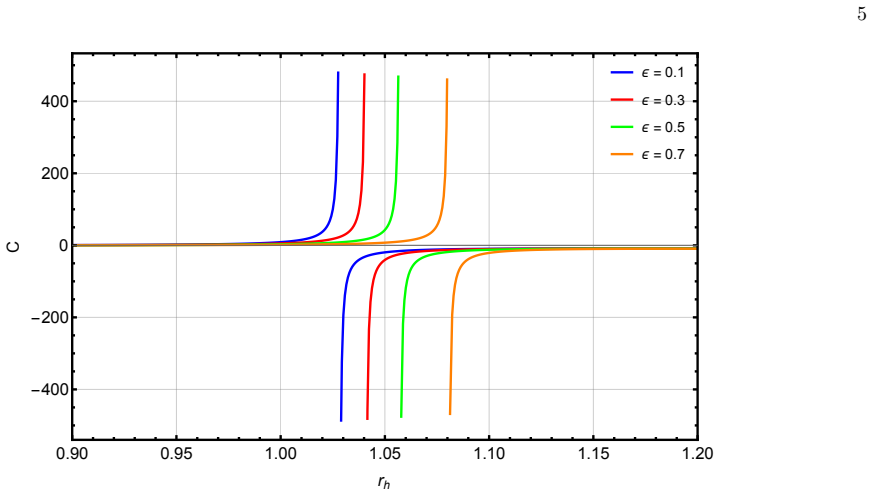
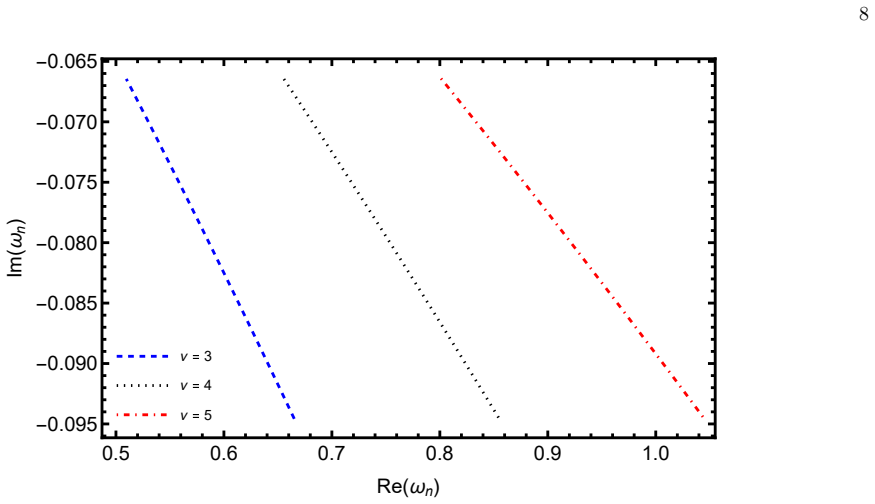
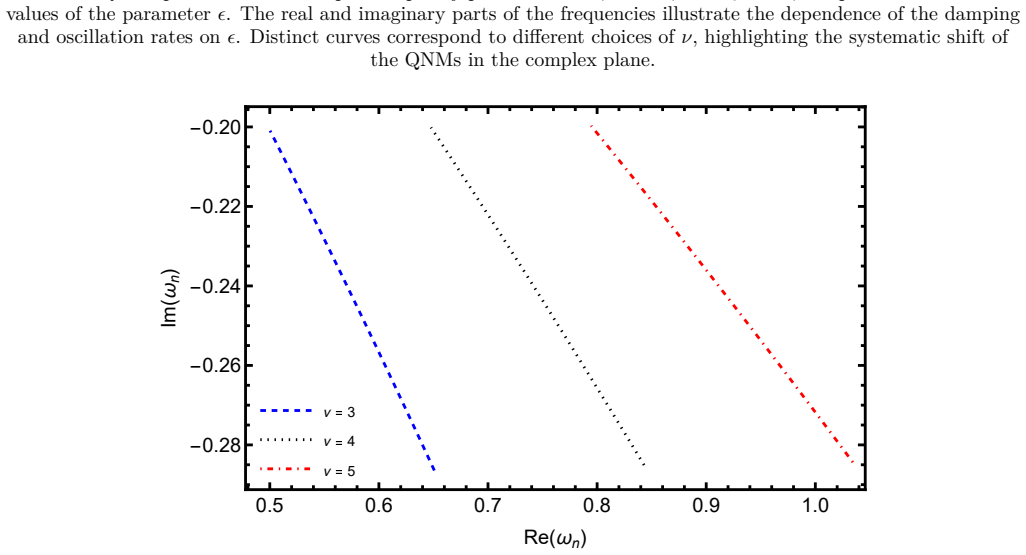
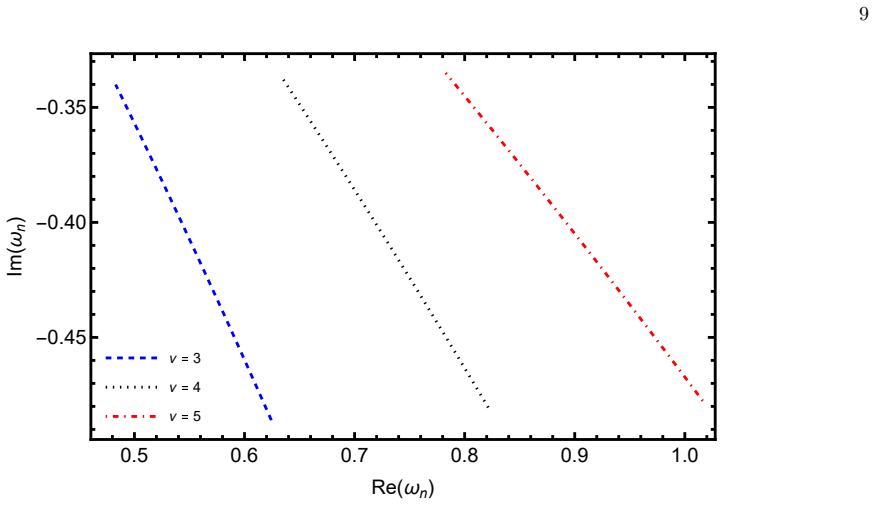
Starting from the Einstein field equations sourced by an effective anisotropic fluid, the Dymnikova-Letelier spacetime is analyzed for its thermodynamic quantities, revealing phase transitions via divergences in heat capacity that depend on the string fluid parameter. The quasinormal mode spectrum under scalar perturbations is computed using the sixth-order WKB approximation, showing positive real parts and negative imaginary parts for all parameter values, which indicates stability, and the string fluid induces systematic shifts in both oscillation frequencies and damping rates.
What carries the argument
The Dymnikova-Letelier metric derived from an anisotropic fluid stress-energy tensor including a string fluid term, which enables calculation of thermodynamic potentials and the master equation for scalar perturbations solved via WKB.
If this is right
- Heat capacity exhibits divergences whose positions depend on the string fluid parameter, indicating phase transitions.
- Quasinormal frequencies have positive real and negative imaginary parts for all considered parameters, confirming stability under scalar perturbations.
- The string fluid leads to systematic shifts in both the real and imaginary parts of the quasinormal frequencies.
- Both the thermodynamic behavior and the dynamical stability of the spacetime are significantly affected by the string fluid parameter.
Where Pith is reading between the lines
- Stability under scalar perturbations may extend to other field types if the WKB signs are reliable.
- The parameter-dependent phase transitions could influence the black hole's evaporation process or its response to accretion.
- The approach could be applied to other regular black hole models to see if string fluids generically stabilize them.
- Numerical solution of the wave equation could test the WKB results for high overtones.
Load-bearing premise
The sixth-order WKB approximation is sufficiently accurate to determine that the imaginary part of the quasinormal frequencies is negative for all parameter values examined.
What would settle it
A full numerical integration of the scalar perturbation equation that finds a positive imaginary frequency for some value of the string fluid parameter would falsify the stability result.
Figures
read the original abstract
In this work, we investigate the thermodynamic properties and quasinormal modes of a regular Dymnikova-Letelier black hole. Starting from the Einstein field equations sourced by an effective anisotropic fluid, we analyze the resulting spacetime geometry and derive the associated thermodynamic quantities, including the Hawking temperature, heat capacity, and Gibbs free energy. The thermodynamic analysis reveals the existence of phase transitions characterized by divergences in the heat capacity, whose location depends sensitively on the string fluid parameter. We then study the dynamical response of the system under scalar perturbations by computing the quasinormal mode spectrum using the sixth-order WKB approximation. Our results show that, for all considered values of the parameters, the imaginary part of the quasinormal frequencies remains negative, while the real part stays positive, indicating the stability of the black hole under scalar perturbations. Furthermore, the presence of the string fluid leads to systematic shifts in both the oscillation frequencies and damping rates. These results demonstrate that the string fluid significantly affects both the thermodynamic behavior and the dynamical stability of the Dymnikova-Letelier spacetime.
Editorial analysis
A structured set of objections, weighed in public.
Referee Report
Summary. The paper derives the metric of a regular Dymnikova-Letelier black hole sourced by an anisotropic fluid that includes a string-fluid parameter, computes the associated thermodynamic quantities (Hawking temperature, heat capacity, Gibbs free energy), identifies parameter-dependent phase transitions via divergences in heat capacity, and calculates scalar quasinormal modes via the sixth-order WKB approximation, concluding that Im(ω) < 0 and Re(ω) > 0 for all examined parameter values, with the string fluid producing systematic shifts in the frequencies and damping rates.
Significance. If the thermodynamic phase transitions and the sign of Im(ω) are confirmed, the work would contribute to the study of regular black-hole spacetimes by showing how an additional string-fluid parameter simultaneously controls critical points in the thermodynamic phase diagram and shifts in the quasinormal spectrum, thereby linking thermodynamic stability and dynamical stability in a single model.
major comments (2)
- [Metric and field equations] The manuscript supplies neither the explicit line element nor the components of the effective stress-energy tensor that define the Dymnikova-Letelier geometry with the string fluid; without these expressions the thermodynamic derivations (temperature, heat capacity) and the effective potential for scalar perturbations cannot be reproduced or checked.
- [Quasinormal modes] The central stability claim (Im(ω) remains negative for all string-fluid parameter values) rests exclusively on the sixth-order WKB formula applied to the scalar effective potential, with no error bounds, no comparison to eighth-order WKB, and no cross-check against numerical integration of the wave equation; truncation error in WKB can alter the sign of the imaginary part for the fundamental mode when the potential peak is broad.
minor comments (1)
- [Abstract and results] The abstract and results section should state the numerical range of the string-fluid parameter that was scanned and the overtone numbers considered.
Simulated Author's Rebuttal
We thank the referee for the thorough review and constructive criticism. The comments highlight important issues regarding reproducibility and the robustness of the stability conclusions. We address each major comment below and commit to revisions that will strengthen the manuscript.
read point-by-point responses
-
Referee: [Metric and field equations] The manuscript supplies neither the explicit line element nor the components of the effective stress-energy tensor that define the Dymnikova-Letelier geometry with the string fluid; without these expressions the thermodynamic derivations (temperature, heat capacity) and the effective potential for scalar perturbations cannot be reproduced or checked.
Authors: We agree that the explicit line element and the components of the effective stress-energy tensor (including the string-fluid contribution) were not presented with sufficient detail. In the revised version we will add the full metric ansatz together with the explicit expressions for the anisotropic fluid stress-energy tensor, allowing direct verification of the thermodynamic quantities and the scalar effective potential. revision: yes
-
Referee: [Quasinormal modes] The central stability claim (Im(ω) remains negative for all string-fluid parameter values) rests exclusively on the sixth-order WKB formula applied to the scalar effective potential, with no error bounds, no comparison to eighth-order WKB, and no cross-check against numerical integration of the wave equation; truncation error in WKB can alter the sign of the imaginary part for the fundamental mode when the potential peak is broad.
Authors: The referee correctly identifies that the stability conclusion relies solely on sixth-order WKB without error estimates or independent verification. We will revise the manuscript to include eighth-order WKB results for direct comparison, provide truncation-error estimates, and discuss the applicability of the WKB method given the shape of the effective potential. revision: yes
Circularity Check
No circularity: standard derivation from metric to thermodynamics and WKB QNMs
full rationale
The paper begins with the Einstein equations sourced by a chosen anisotropic fluid that yields the Dymnikova-Letelier metric by construction; thermodynamic quantities (temperature, heat capacity, Gibbs energy) are then obtained from the standard first law and horizon area formulas applied to that metric, while QNMs follow from the scalar wave equation on the same background using the sixth-order WKB method. These steps are independent calculations whose outputs (phase-transition locations, sign of Im(ω)) are not equivalent to the input fluid parameter by definition or by renaming a fit. No self-citations are invoked as load-bearing uniqueness theorems, and no fitted parameters are relabeled as predictions. The string-fluid parameter is an explicit model input whose computed effects on observables do not constitute circularity.
Axiom & Free-Parameter Ledger
free parameters (1)
- string fluid parameter
axioms (1)
- domain assumption Einstein field equations sourced by effective anisotropic fluid
invented entities (1)
-
regular Dymnikova-Letelier black hole with string fluid
no independent evidence
Reference graph
Works this paper leans on
-
[1]
Identify the maximum of the effective potential Veff (r) and compute its derivatives at this point, since the WKB approximation is constructed around this maximum
-
[2]
Apply the WKB formula at the desired order (sixth order), which relates the complex frequency ω to the value and derivatives of the potential at its peak
-
[3]
Solve the resulting algebraic equation for ω, obtaining the quasinormal frequencies for a given overtone number n
-
[4]
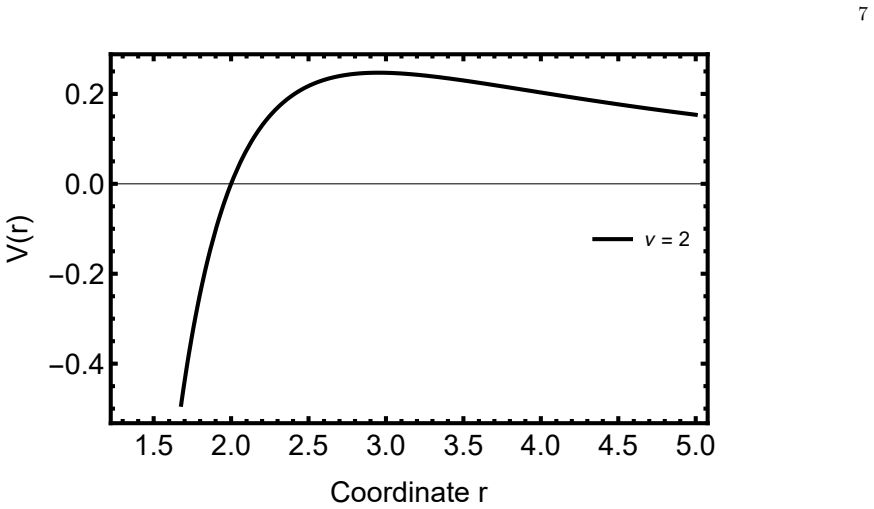
Repeat the procedure for different values of the parameters of the model in order to analyze the behavior of the quasinormal spectrum. We begin the analysis of the results by examining the effective potential associated with the radial equation for a massless scalar field. For the set of parameters considered, it is clearly seen in Fig. 2 that the effecti...
arXiv 2024
-
[5]
I. G. Dymnikova. Vacuum nonsingular black hole. General Relativity and Gravitation , 24:235–242, 1992
1992
-
[6]
Revisiting black holes surrounded by cloud and fluid of strings in general relativity
Luis C N Santos. Revisiting black holes surrounded by cloud and fluid of strings in general relativity. Physical Review D , 111(6):064032, 2025. 10
2025
-
[7]
Ibraheem, Asifa Ashraf, and Rana Muhammad Zulqarnain
Allah Ditta, Farzan Mushtaq, Phongpichit Channuie, Awad A. Ibraheem, Asifa Ashraf, and Rana Muhammad Zulqarnain. Studying the properties of particle motion and plasma lensing in regular black holes from multi-polytropic equations of state. Eur. Phys. J. C , 85(7):762, 2025. doi:10.1140/epjc/s10052-025-14482-6
-
[8]
Mustafa, Asalkhon Alimova, Farruh Atamurotov, Awad A
G. Mustafa, Asalkhon Alimova, Farruh Atamurotov, Awad A. Ibraheem, Phongpichit Channuie, and Gunel Bahaddinova. Testing regular black holes in the framework of asymptotically safe gravity using particle dynamics, QPOs, and shadow constraints. Eur. Phys. J. C , 85(7):741, 2025. doi:10.1140/epjc/s10052-025-14431-3
-
[9]
Thermodynamic curvature and topological insights of Hayward black holes with string fluids
Ankit Anand, Saeed Noori Gashti, and Aditya Singh. Thermodynamic curvature and topological insights of Hayward black holes with string fluids. Phys. Dark Univ. , 49:101994, 2025. arXiv:2506.23736, doi:10.1016/j.dark.2025.101994
-
[10]
Arfa Waseem, Faisal Javed, G. Mustafa, S. K. Maurya, Farruh Atamurotov, and Mansour Shrahili. Joule–Thomson expansion of Hayward-AdS black hole surrounded by fluid of strings. Annals Phys. , 480:170087, 2025. doi:10.1016/j. aop.2025.170087
work page doi:10.1016/j 2025
-
[11]
Alkahtani, and G
Sojida Mannobova, Farruh Atamurotov, Ahmadjon Abdujabbarov, Badr S. Alkahtani, and G. Mustafa. Spinning particle motion around asymptotically safe gravity exhibiting regular black holes. Eur. Phys. J. C , 85(5):586, 2025. doi:10.1140/ epjc/s10052-025-14305-8
2025
-
[12]
Umair Shahzad, Nazek Alessa, Aqsa Mehmood, and Shahin Mamedov
M. Umair Shahzad, Nazek Alessa, Aqsa Mehmood, and Shahin Mamedov. Topological Photon Spheres of Regular Non- Minimal Magnetic Black Holes. Int. J. Theor. Phys. , 64(6):161, 2025. doi:10.1007/s10773-025-06029-y
-
[13]
Ovalle, Warped vacuum energy by black holes, Eur
Sergiu I. Vacaru and Elşen Veli Veliev. Off-diagonal deformations of regular Schwarzschild black holes and general relativistic G. Perelman thermodynamics. Eur. Phys. J. C , 85(5):560, 2025. arXiv:2505.18208, doi:10.1140/epjc/ s10052-025-14271-1
-
[14]
Topological regular black holes without a Cauchy horizon
Marco Calzá, Massimiliano Rinaldi, and Sergio Zerbini. Topological regular black holes without a Cauchy horizon. Phys. Rev. D , 112(2):024024, 2025. arXiv:2505.04427, doi:10.1103/dyy8-qjnd
-
[15]
Umair Shahzad, Aqsa Mehmood, and Muhammad Zeshan Ashraf
Abdelhay Salah Mohamed, M. Umair Shahzad, Aqsa Mehmood, and Muhammad Zeshan Ashraf. Thermodynamic topology of rotating regular black hole in conformal massive gravity in CMG. Int. J. Mod. Phys. A , 40(18):2550022, 2025. doi: 10.1142/S0217751X25500228
-
[16]
Quantum gravity corrections to the thermodynamics of noncommutative regular black holes
Jianjun Song and Chengzhou Liu. Quantum gravity corrections to the thermodynamics of noncommutative regular black holes. Int. J. Mod. Phys. A , 40(17):2550045, 2025. doi:10.1142/S0217751X25500459
-
[17]
Harpreet Singh and Malay K. Nandy. Imprint of Operator Ordering on the Quantum Nature of DeWitt-regular Black Holes. Int. J. Theor. Phys. , 64(5):113, 2025. doi:10.1007/s10773-025-05982-y
-
[18]
Radiative properties of a nonsingular black hole: Hawking radiation and gray-body factor
Asier Alonso-Bardaji, David Brizuela, and Marc Schneider. Radiative properties of a nonsingular black hole: Hawking radiation and gray-body factor. JHEP, 07:189, 2025. arXiv:2504.13050, doi:10.1007/JHEP07(2025)189
-
[19]
Diverse regular spacetimes using a parametrised density profile
Anjan Kar and Sayan Kar. Diverse regular spacetimes using a parametrised density profile. Eur. Phys. J. C , 85(7):773,
-
[20]
arXiv:2504.12042, doi:10.1140/epjc/s10052-025-14483-5
-
[21]
Observational properties of regular black holes in asymptotic safety
Abdybek Urmanov, Hrishikesh Chakrabarty, and Daniele Malafarina. Observational properties of regular black holes in asymptotic safety. Eur. Phys. J. C , 85(6):642, 2025. arXiv:2504.12072, doi:10.1140/epjc/s10052-025-14377-6
-
[22]
Analyzing the gravitational lensing and epicyclic oscillations around a regular charged black hole
Farzan Mushtaq, Xia Tiecheng, Allah Ditta, Shalini Singh, and Asif Mahmood. Analyzing the gravitational lensing and epicyclic oscillations around a regular charged black hole. Nucl. Phys. B , 1015:116901, 2025. doi:10.1016/j.nuclphysb. 2025.116901
-
[23]
Kai Lin, A. B. Pavan, Amilcar Rabelo de Queiroz, and Elcio Abdalla. Quasinormal modes correspondence between hori- zonless asymptotically regular flat spacetimes and asymptotically anti–de Sitter black holes. Phys. Rev. D , 111(8):084076,
-
[24]
doi:10.1103/PhysRevD.111.084076
-
[25]
B. C. Lütfüoğlu. Long-lived quasinormal modes around regular black holes and wormholes in Covariant Effective Quantum Gravity. JCAP, 06:057, 2025. arXiv:2504.09323, doi:10.1088/1475-7516/2025/06/057
-
[26]
Pedro G. S. Fernandes. Regular BTZ black holes from an infinite tower of corrections. Phys. Lett. B , 868:139772, 2025. arXiv:2504.08565, doi:10.1016/j.physletb.2025.139772
-
[27]
Regular black hole models in the transition from baryonic matter to quark matter
Vitalii Vertogradov and Ali Övgün. Regular black hole models in the transition from baryonic matter to quark matter. JCAP, 06:051, 2025. arXiv:2504.07561, doi:10.1088/1475-7516/2025/06/051
-
[28]
Comparing Bondi and Novikov–Thorne accretion disk luminosity around regular black holes
Salvatore Capozziello, Serena Gambino, and Orlando Luongo. Comparing Bondi and Novikov–Thorne accretion disk luminosity around regular black holes. Phys. Dark Univ. , 48:101950, 2025. arXiv:2503.21987, doi:10.1016/j.dark. 2025.101950
-
[29]
Thermodynamics of Bardeen black holes in restricted phase space
Yahya Ladghami, Brahim Asfour, Amine Bouali, Ahmed Errahmani, and Taoufik Ouali. Thermodynamics of Bardeen black holes in restricted phase space. Phys. Lett. B , 864:139418, 2025. doi:10.1016/j.physletb.2025.139418
-
[30]
Regular black holes and their singular families
Hyat Huang and Xiao-Ping Rao. Regular black holes and their singular families. Phys. Rev. D , 111(10):104040, 2025. arXiv:2503.13133, doi:10.1103/PhysRevD.111.104040
-
[31]
Scalar quasinormal modes of rotating regular black holes
Fech Scen Khoo. Scalar quasinormal modes of rotating regular black holes. Phys. Rev. D , 111(12):124025, 2025. arXiv: 2503.09390, doi:10.1103/f35l-m8n5
-
[32]
Ghosh, and Ahmadjon Abdujabbarov
Ziyodulla Turakhonov, Farruh Atamurotov, Sushant G. Ghosh, and Ahmadjon Abdujabbarov. Probing effects of plasma on shadow and weak gravitational lensing by regular black holes in asymptotically safe gravity. Phys. Dark Univ. , 48:101880,
-
[33]
doi:10.1016/j.dark.2025.101880
-
[34]
Tidal response of regular black holes
Chiara Coviello, Vania Vellucci, and Luis Lehner. Tidal response of regular black holes. Phys. Rev. D , 111(10):104073,
-
[35]
arXiv:2503.04287, doi:10.1103/PhysRevD.111.104073
-
[36]
Jonathan Barenboim, Andrei V. Frolov, and Gabor Kunstatter. Evaporation of regular black holes in 2D dilaton gravity. Phys. Rev. D , 111(10):104068, 2025. arXiv:2503.03191, doi:10.1103/PhysRevD.111.104068
-
[37]
K. Ghaderi, B. Malekolkalami, Anirudh Pradhan, and Archana Dixit. On new regular quadratic Gaussian black hole: Photon sphere, shadow and gravitational lensing. Results Phys. , 70:108168, 2025. doi:10.1016/j.rinp.2025.108168. 11
-
[38]
Exploring Absolute Retract in Regular Hayward Black Holes and Their Implica- tions for Astrophysics
Mohammad Abu-Saleem and Ali Taani. Exploring Absolute Retract in Regular Hayward Black Holes and Their Implica- tions for Astrophysics. Astron. Nachr., 346(3-4):e20240148, 2025. doi:10.1002/asna.20240148
-
[39]
Tomohiro Harada, Chiang-Mei Chen, and Rituparna Mandal. Singularity resolution and regular black hole formation in gravitational collapse in asymptotically safe gravity. Phys. Rev. D , 111(12):126017, 2025. arXiv:2502.16787, doi: 10.1103/pt9s-jqjz
-
[40]
Revisiting black holes surrounded by cloud and fluid of strings in general relativity
Luis Cesar Nunes Santos. Revisiting black holes surrounded by cloud and fluid of strings in general relativity. Phys. Rev. D, 111(6):064032, 2025. arXiv:2502.15846, doi:10.1103/PhysRevD.111.064032
-
[41]
Regular Schwarzschild black holes and cosmological models
Roberto Casadio, Alexander Kamenshchik, and Jorge Ovalle. Regular Schwarzschild black holes and cosmological models. Phys. Rev. D , 111(6):064036, 2025. arXiv:2502.13627, doi:10.1103/PhysRevD.111.064036
-
[42]
Zeeshan Gul, and Bander Almutairi
Faisal Javed, Arfa Waseem, M. Zeeshan Gul, and Bander Almutairi. Wormholes stability from a class of (2 + 1)-dimensional regular black holes. Annals Phys. , 476:169956, 2025. doi:10.1016/j.aop.2025.169956
-
[43]
R. A. Konoplya and O. S. Stashko. Transition from regular black holes to wormholes in covariant effective quantum gravity: Scattering, quasinormal modes, and Hawking radiation. Phys. Rev. D , 111(8):084031, 2025. arXiv:2502.05689, doi:10.1103/PhysRevD.111.084031
-
[44]
Violations of the null convergence condition in kinematical transi- tions between singular and regular black holes, horizonless compact objects, and bounces
Johanna Borissova, Stefano Liberati, and Matt Visser. Violations of the null convergence condition in kinematical transi- tions between singular and regular black holes, horizonless compact objects, and bounces. Phys. Rev. D , 111(10):104054,
-
[45]
arXiv:2502.00548, doi:10.1103/PhysRevD.111.104054
-
[46]
Regular Kerr-like spacetime to interpret the observations for black hole candidates
Bakhtiyor Narzilloev, Odilbek Kholmuminov, and Ahmadjon Abdujabbarov. Regular Kerr-like spacetime to interpret the observations for black hole candidates. Chin. J. Phys. , 94:457–470, 2025. doi:10.1016/j.cjph.2025.01.022
-
[47]
Atazadeh, and Hossein Motavalli
Minou Khoshrangbaf, Amin Rezaei Akbarieh, K. Atazadeh, and Hossein Motavalli. Accretion disk around the regular black holes with a nonlinear electrodynamics source. New Astron., 117:102354, 2025. doi:10.1016/j.newast.2025.102354
-
[48]
Shahid Chaudhary, Muhammad Danish Sultan, Adnan Malik, Asifa Ashraf, Yousef Mohammad Alanazi, Abdulrahman Bin Jumah, and Ali M. Mubaraki. Greybody factor and accretion disk around regular black holes in Verlinde emergent gravity. JHEAp, 46:339, 2025. doi:10.1016/j.jheap.2025.01.011
-
[49]
Black holes surrounded by generic dark matter profiles: Appearance and gravitational-wave emission
Enzo Figueiredo, Andrea Maselli, and Vitor Cardoso. Black holes surrounded by generic dark matter profiles: Appearance and gravitational-wave emission. Physical Review D , 107(10):104033, 2023
2023
-
[50]
Quasinormal modes of regular black holes surrounded by skewed dark matter distributions
Chen Lan, Ying-Lei Tian, Hao Yang, Zhen-Xiao Zhang, and Yan-Gang Miao. Quasinormal modes of regular black holes surrounded by skewed dark matter distributions. Nucl. Phys. B , 1022:117264, 2026. arXiv:2507.21414, doi: 10.1016/j.nuclphysb.2025.117264
-
[51]
Faizuddin Ahmed, Saeed Noori Gashti, Abdelmalek Bouzenada, and Behnam Pourhassan. Schwarzschild-AdS black holes with cloud of strings and quintessence: Geodesics, and quasinormal modes. Nucl. Phys. B , 1022:117260, 2026. arXiv: 2508.07438, doi:10.1016/j.nuclphysb.2025.117260
-
[52]
Scalar-gravitational quasinormal modes and echoes in a five dimensional thick brane
Weike Deng, Sheng Long, Qin Tan, Zu-Cheng Chen, and Jiliang Jing. Scalar-gravitational quasinormal modes and echoes in a five dimensional thick brane. JHEP, 01:066, 2026. arXiv:2508.20937, doi:10.1007/JHEP01(2026)066
-
[53]
Scalar quasinormal modes in black hole gravitational lensing
Chengjiang Yin, Zihao Lin, and Jian-hua He. Scalar quasinormal modes in black hole gravitational lensing. Phys. Rev. D , 113(2):024045, 2026. arXiv:2601.14303, doi:10.1103/gg33-r64q
-
[54]
Jia Liu, Mengjie Wang, Zishuo Wang, Haoyu Liu, Jinshan An, and Jiliang Jing. Charged Dirac perturbations on Reissner– Nordström black holes in a cavity: quasinormal modes with Robin boundary conditions. Eur. Phys. J. C , 86(1):64, 2026. arXiv:2512.24006, doi:10.1140/epjc/s10052-025-15262-y
-
[55]
B. C. Lütfüoğlu. Long-lived quasinormal modes, grey-body factors and absorption cross-section of the black hole immersed in the Hernquist galactic halo. Phys. Lett. B , 872:140082, 2026. arXiv:2510.25969, doi:10.1016/j.physletb.2025. 140082
-
[56]
Gravitational quasinormal modes of Dymnikova black holes
Bekir Can Lütfüoğlu, Erdinç Ulaş Saka, Abubakir Shermatov, Javlon Rayimbaev, Inomjon Ibragimov, and Sokhibjan Muminov. Gravitational quasinormal modes of Dymnikova black holes. Annals Phys., 487:170360, 2026. arXiv:2509.24633, doi:10.1016/j.aop.2026.170360
-
[57]
Jeferson de Oliveira, A. B. Pavan, Kai Lin, and Yu-Hao Cui. Scalar quasinormal modes, late-time tails and op- tical appearance of charged black holes in Bumblebee gravity. Class. Quant. Grav. , 42(23):235018, 2025. doi: 10.1088/1361-6382/ae2378
-
[58]
Y. Sekhmani, A. Baruah, A. Al-Badawi, S. K. Maurya, M. K. Jasim, M. Altanji, and S. N. Gashti. Quasinormal spectra, greybody factors, optical shadows, and light deflection by dyonically charged black holes in metric-affine gravity with torsion and nonmetricity. Chin. J. Phys. , 99:177–198, 2026. doi:10.1016/j.cjph.2025.11.037
-
[59]
Y. Sekhmani, S. K. Maurya, J. Rayimbaev, M. Altanji, I. Ibragimov, and S. Muminov. Black hole quasinormal modes, greybody factors and quasi-periodic oscillations in teleparallel Born-Infeld gravity. Nucl. Phys. B , 1021:117210, 2025. doi:10.1016/j.nuclphysb.2025.117210
-
[60]
Rotating Yukawa-modified black holes: QNM and shadow studies
Muhammad Zahid, Chao Shen, Javlon Rayimbaev, Bekzod Rahmatov, Inomjon Ibragimov, Sokhibjan Muminov, and Maksud Umaraliyev. Rotating Yukawa-modified black holes: QNM and shadow studies. Phys. Dark Univ. , 50:102124,
-
[61]
doi:10.1016/j.dark.2025.102124
-
[62]
Hao Hu and Guoxiong Zhu. Quasinormal modes and dynamical evolution of scalar fields in the Einstein-bumblebee theory with a cosmological constant. Comptes Rendus Physique , 26(G1):571–586, 2025. doi:10.5802/crphys.260
-
[63]
Proper-time approach in asymptotic safety via black hole quasinormal modes and grey-body factors
Bekir Can Lütfüoğlu, Erdinç Ulaş Saka, Abubakir Shermatov, Javlon Rayimbaev, Inomjon Ibragimov, and Sokhibjan Muminov. Proper-time approach in asymptotic safety via black hole quasinormal modes and grey-body factors. Eur. Phys. J. C , 85(10):1190, 2025. arXiv:2509.15923, doi:10.1140/epjc/s10052-025-14950-z
-
[64]
Bolokhov and Milena Skvortsova
Sergei V. Bolokhov and Milena Skvortsova. Review of Analytic Results on Quasinormal Modes of Black Holes. Grav. Cosmol., 31(4):423–446, 2025. doi:10.1134/S0202289325700306. 12
-
[65]
Jacob D. Bekenstein. Black holes and entropy. Physical Review D , 7(8):2333, 1973. doi:10.1142/9789811203961_0023
-
[66]
Stephen W. Hawking. Black hole explosions? Nature, 248(5443):30–31, 1974. doi:10.1038/248030a0
-
[67]
V. V. Kiselev. Quintessence and black holes. Classical and Quantum Gravity, 20:1187–1198, 2003. doi:10.1088/0264-9381/ 20/6/310
-
[68]
Leonardo G. Barbosa, Victor Hugo M. Ramos, Luis Cesar N. dos Santos, and Celso C. Barros. Kiselev black strings: the charged rotating solutions. Classical and Quantum Gravity , 42(9):095016, 2025. doi:10.1088/1361-6382/add078
-
[69]
M. H. Macêdo, J. Furtado, G. Alencar, and R. R. Landim. Thermodynamics and quasinormal modes of the Dymnikova black hole in higher dimensions. Annals Phys. , 471:169833, 2024. arXiv:2404.02818, doi:10.1016/j.aop.2024.169833
-
[70]
A. Errehymy, Y. Khedif, M. Daoud, K. Myrzakulov, B. Turimov, and T. Myrzakul. Quantum corrections to Dymnikova- Schwinger black holes in Einstein-Gauss-Bonnet gravity. Phys. Lett. B , 870:139915, 2025. arXiv:2509.17630, doi: 10.1016/j.physletb.2025.139915
-
[71]
P. C. W. Davies. Thermodynamics of Black Holes. Proc. Roy. Soc. Lond. A , 353:499–521, 1977. doi:10.1098/rspa.1977. 0047
-
[72]
R. A. Konoplya, A. Zhidenko, and A. F. Zinhailo. Higher order WKB formula for quasinormal modes and grey-body factors: recipes for quick and accurate calculations. Class. Quant. Grav. , 36:155002, 2019. doi:10.1088/1361-6382/ab2e25
-
[73]
R. A. Konoplya. Quasinormal behavior of the d-dimensional Schwarzschild black hole and higher order WKB approach. Phys. Rev. D , 68:024018, 2003. doi:10.1103/PhysRevD.68.024018
-
[74]
Sai Iyer and Clifford M. Will. Black Hole Normal Modes: A WKB Approach. 1. Foundations and Application of a Higher Order WKB Analysis of Potential Barrier Scattering. Phys. Rev. D , 35:3621, 1987. doi:10.1103/PhysRevD.35.3621
discussion (0)
Sign in with ORCID, Apple, or X to comment. Anyone can read and Pith papers without signing in.