FM-fMRI: Event Conditioned Flow Matching for Rest-to-Task fMRI Time-Series Synthesis
Pith reviewed 2026-06-29 18:58 UTC · model grok-4.3
The pith
An event-conditioned flow matching model synthesizes task fMRI time series from resting-state data and event timings.
A machine-rendered reading of the paper's core claim, the machinery that carries it, and where it could break.
Core claim
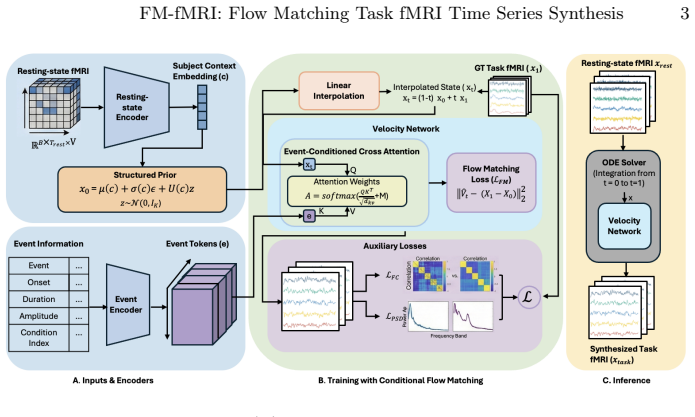
FM-fMRI learns a continuous-time conditional vector field to generate task ROI time series from resting-state fMRI and task event information, delivering stronger spectral and connectivity agreement plus improved distribution-level matching than conditional diffusion, GAN, and VAE baselines on the Human Connectome Project and BioPoint cohorts while raising autism classification performance when used to augment the smaller cohort.
What carries the argument
Event-conditioned flow-matching model that learns a continuous-time conditional vector field enabling fast ODE sampling of task fMRI time series.
If this is right
- Synthesized signals match real task data more closely in temporal and spectral structure than prior generative baselines.
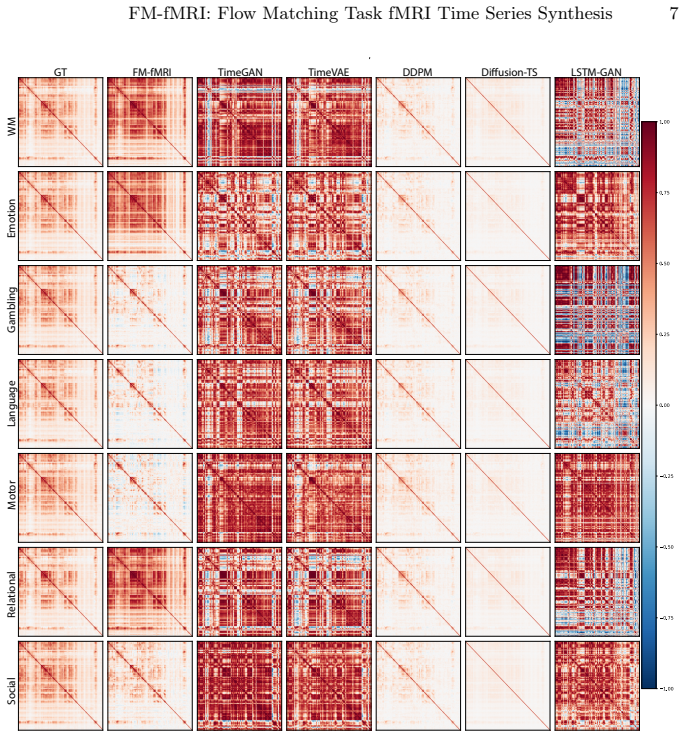
- Subject and group-level connectomes from the generated series align better with those from actual task scans.
- Distribution-level statistics of the outputs are closer to real task-fMRI distributions.
- Augmenting small clinical cohorts with these series raises accuracy on downstream tasks such as autism classification.
Where Pith is reading between the lines
- The flexible conditioning on arbitrary event schedules could allow reuse across experimental designs without retraining.
- Reducing reliance on costly task-fMRI acquisition might enable larger-scale clinical studies that currently lack such data.
- The same conditioning approach could be tested on other clinical cohorts or task types to check transfer of the observed gains.
Load-bearing premise
That agreement on spectral content, connectivity patterns, and distributional statistics is sufficient to ensure the synthetic signals preserve the task-evoked neural dynamics required for clinical prediction tasks.
What would settle it
A test in which classifiers trained on real task data versus synthetic-augmented data yield statistically different predictions on an independent set of real task-fMRI recordings.
Figures
read the original abstract
Task-based fMRI provides a direct readout of task-evoked neural dynamics, but it is expensive and difficult to acquire at scale, motivating rest-to-task synthesis from widely available resting-state fMRI (rsfMRI). We propose FM-fMRI, an event-conditioned flow-matching model that learns a continuous-time conditional vector field to generate task ROI time series from a subject's rsfMRI and the task event information. The formulation enables fast ODE-based sampling and flexible conditioning over heterogeneous event schedules. Rather than optimizing for pointwise reconstruction, we evaluated generated signals using complementary criteria that probe temporal and spectral structure, subject and group-level connectome consistency, and distributional alignment. On the public Human Connectome Project and internal BioPoint autism cohort, FM-fMRI achieves the strongest spectral and connectivity agreement and improved distribution-level matching over conditional diffusion, generative adversarial networks (GANs), and variational autoencoders (VAEs) baselines. Furthermore, we augment the BioPoint cohort by synthesizing task-fMRI ROI time series with our method, improving downstream autism classification and demonstrating practical utility in data-limited clinical settings. The code will be available on GitHub.
Editorial analysis
A structured set of objections, weighed in public.
Referee Report
Summary. The manuscript introduces FM-fMRI, an event-conditioned flow-matching model that learns a continuous-time conditional vector field to synthesize task-evoked fMRI ROI time series from a subject's rsfMRI and task event schedules. It reports superior performance over conditional diffusion, GAN, and VAE baselines on spectral structure, subject/group connectome consistency, and distributional alignment using the Human Connectome Project and BioPoint autism cohorts, and further claims that augmenting the BioPoint cohort with the synthesized series improves downstream autism classification.
Significance. If the central claims hold, the work would be significant for practical data augmentation in clinical neuroimaging settings where task-fMRI acquisition is limited. The flow-matching formulation enables fast ODE sampling and flexible conditioning on heterogeneous events, and the public release of code is a clear strength that supports reproducibility.
major comments (2)
- [Evaluation and downstream task sections] The downstream autism classification improvement (reported in the results on the BioPoint cohort) is load-bearing for the claim of practical utility, yet the evaluation relies exclusively on proxy metrics (temporal/spectral structure, connectome consistency, distributional alignment) without a direct check that synthesized signals preserve event-locked BOLD responses. No event-related averaging, peak timing fidelity, or HRF comparison between real and generated task series is described, leaving open the possibility that classification gains arise from consistent non-neural structure rather than veridical task-evoked dynamics.
- [Abstract and Results] The abstract and results claim 'strongest spectral and connectivity agreement' and 'improved distribution-level matching,' but the provided text supplies no quantitative values, statistical tests, error bars, or dataset sizes. Without these, it is impossible to assess whether the reported gains are statistically meaningful or practically relevant relative to the baselines.
minor comments (2)
- [Methods] Implementation details (network architecture, training hyperparameters, exact conditioning mechanism for event schedules, and ODE solver settings) are referenced but not fully specified in the text; these should be expanded or linked to the promised GitHub release.
- [Methods] Notation for the conditional vector field and the flow-matching objective should be introduced with an explicit equation early in the methods to improve readability for readers unfamiliar with the framework.
Simulated Author's Rebuttal
We thank the referee for the constructive feedback on our manuscript. The comments highlight important aspects of evaluation and reporting that we address point by point below, with plans for revision where appropriate.
read point-by-point responses
-
Referee: [Evaluation and downstream task sections] The downstream autism classification improvement (reported in the results on the BioPoint cohort) is load-bearing for the claim of practical utility, yet the evaluation relies exclusively on proxy metrics (temporal/spectral structure, connectome consistency, distributional alignment) without a direct check that synthesized signals preserve event-locked BOLD responses. No event-related averaging, peak timing fidelity, or HRF comparison between real and generated task series is described, leaving open the possibility that classification gains arise from consistent non-neural structure rather than veridical task-evoked dynamics.
Authors: We agree this is a substantive gap. Our proxy metrics, including spectral structure, were chosen to capture frequency-domain properties relevant to BOLD responses, but we did not include explicit event-related averaging, peak timing, or HRF comparisons. To strengthen the evidence that synthesized signals preserve task-evoked dynamics (and that classification gains are not due to non-neural artifacts), we will add these analyses in the revised manuscript, reporting event-related averages and HRF fidelity metrics for real versus generated series on the BioPoint cohort. revision: yes
-
Referee: [Abstract and Results] The abstract and results claim 'strongest spectral and connectivity agreement' and 'improved distribution-level matching,' but the provided text supplies no quantitative values, statistical tests, error bars, or dataset sizes. Without these, it is impossible to assess whether the reported gains are statistically meaningful or practically relevant relative to the baselines.
Authors: The full results section contains the quantitative metrics, statistical tests, error bars, and cohort sizes supporting the claims. However, we acknowledge that the abstract and main text could more explicitly foreground these values for immediate assessment. We will revise the abstract to include key quantitative results and ensure the results section text explicitly references the statistical comparisons and dataset details. revision: yes
Circularity Check
No significant circularity; empirical claims rest on external baselines and datasets
full rationale
The paper introduces an event-conditioned flow-matching generative model and reports empirical superiority on spectral, connectivity, and distributional metrics versus independent baselines (conditional diffusion, GANs, VAEs) on public HCP and internal BioPoint data, plus a downstream classification improvement. No equations or claims reduce by construction to fitted inputs, self-definitions, or self-citation chains; the central results are falsifiable comparisons against external methods and held-out data rather than self-referential definitions or renamings.
Axiom & Free-Parameter Ledger
Reference graph
Works this paper leans on
-
[1]
Magnetic Resonance in Medicine34(4), 537–541 (1995)
Biswal, B., Yetkin, F.Z., Haughton, V.M., Hyde, J.S.: Functional con- nectivity in the motor cortex of resting human brain using echo- planar MRI. Magnetic Resonance in Medicine34(4), 537–541 (1995). https://doi.org/10.1002/mrm.1910340409
-
[2]
In: Advances in Neural Information Processing Systems
Chen, R.T.Q., Rubanova, Y., Bettencourt, J., Duvenaud, D.K.: Neural ordinary differential equations. In: Advances in Neural Information Processing Systems. vol. 31 (2018)
2018
-
[3]
In: Advances in Neural Information Processing Systems
Heusel,M.,Ramsauer,H.,Unterthiner,T.,Nessler,B.,Hochreiter,S.:Ganstrained by a two time-scale update rule converge to a local nash equilibrium. In: Advances in Neural Information Processing Systems. vol. 30 (2017)
2017
-
[4]
In: Advances in Neural Information Processing Systems (2020)
Ho, J., Jain, A., Abbeel, P.: Denoising diffusion probabilistic models. In: Advances in Neural Information Processing Systems (2020)
2020
-
[5]
NeuroImage62(2), 782–790 (2012)
Jenkinson, M., Beckmann, C.F., Behrens, T.E.J., Woolrich, M.W., Smith, S.M.: FSL. NeuroImage62(2), 782–790 (2012). https://doi.org/10.1016/j.neuroimage.2011.09.015
-
[6]
Proceedings of the National Academy of Sciences107(49), 21223–21228 (2010)
Kaiser, M.D., Hudac, C.M., Shultz, S., Lee, S.M., Cheung, C., Berken, A.M., Deen, B., Pitskel, N.B., Sugrue, D.R., Voos, A.C., Saulnier, C.A., Ventola, P., Wolf, J.M., Klin, A., Vander Wyk, B.C., Pelphrey, K.A.: Neural signatures of autism. Proceedings of the National Academy of Sciences107(49), 21223–21228 (2010). https://doi.org/10.1073/pnas.1010412107
-
[7]
In: Advances in Neural Information Processing Systems
Kim, B.H., Ye, J.C., Kim, J.J.: Learning dynamic graph representation of brain connectome with spatio-temporal attention. In: Advances in Neural Information Processing Systems. vol. 34, pp. 4314–4327 (2021)
2021
-
[8]
Kingma,D.P.,Welling,M.:Auto-encodingvariationalbayes.In:InternationalCon- ference on Learning Representations (2014)
2014
-
[9]
In: 5th International Conference on Learning Representations (ICLR) 2017, Conference Track Proceedings (2017)
Kipf, T.N., Welling, M.: Semi-supervised classification with graph convolutional networks. In: 5th International Conference on Learning Representations (ICLR) 2017, Conference Track Proceedings (2017)
2017
-
[10]
Kwon, J., Seo, J., Wang, H., Moon, T., Yoo, S., Cha, J.: Predicting task-related brain activity from resting-state brain dynamics with fMRI transformer. Imaging Neuroscience (2025). https://doi.org/10.1162/imag_a_00440
-
[11]
Control-Flow Refinement for Com- plexity Analysis of Probabilistic Programs inKoAT(Short Paper)
Li, Y., Wu, X., Zhang, X., Jiang, H., Wu, W., Shen, D., Zhang, J.: Task-aligned fMRI generation model for brain disorder diagnosis. In: Medical Image Computing and Computer Assisted Intervention – MICCAI 2025. Lecture Notes in Computer Science, vol. 15971, pp. 638–648. Springer (2025). https://doi.org/10.1007/978-3- 032-05162-2_61
-
[12]
arXiv (2022)
Lipman, Y., Chen, R.T.Q., Ben-Hamu, H., Nickel, M., Le, M.: Flow matching for generative modeling. arXiv (2022)
2022
-
[13]
arXiv (2024) 10 P
Lipman, Y., et al.: A guide to flow matching and its extensions. arXiv (2024) 10 P. Duan et al
2024
-
[14]
In: Advances in Neural Information Processing Systems (2024)
Liu, X., et al.: Retrieval-augmented diffusion models for time series generation. In: Advances in Neural Information Processing Systems (2024)
2024
-
[15]
arXiv (2022)
Liu, X., Gong, C., Liu, Q.: Rectified flow: A marginal preserving approach to optimal transport. arXiv (2022)
2022
-
[16]
arXiv (2020)
Ngo, G., Huang, Y., Zhang, Y., Raj, A.: Connectomic deep learning for predicting functional activation from resting-state fMRI. arXiv (2020)
2020
-
[17]
NeuroImage246, 118703 (2022)
Ngo, G., Seeley, W.W., Raj, A.: Predicting task activation from resting-state func- tional connectivity using deep learning. NeuroImage246, 118703 (2022)
2022
-
[18]
NeuroImage: Clinical 13, 378–385 (2017)
Parker Jones, O., Voets, N.L., Adcock, J.E., Stacey, R., Jbabdi, S.: Resting con- nectivity predicts task activation in pre-surgical populations. NeuroImage: Clinical 13, 378–385 (2017). https://doi.org/10.1016/j.nicl.2016.12.028
-
[19]
In: International Conference on Learning Representations (2024)
Shen, L., Chen, W., Kwok, J.T.: Multi-resolution diffusion models for time series forecasting. In: International Conference on Learning Representations (2024)
2024
-
[20]
Neu- roImage82, 403–415 (2013)
Shen, X., Tokoglu, F., Papademetris, X., Constable, R.T.: Groupwise whole-brain parcellation from resting-state fMRI data for network node identification. Neu- roImage82, 403–415 (2013)
2013
-
[21]
In: Advances in Neural Information Processing Sys- tems (2015)
Sohn, K., Lee, H., Yan, X.: Learning structured output representation using deep conditional generative models. In: Advances in Neural Information Processing Sys- tems (2015)
2015
-
[22]
Science352(6282), 216–220 (2016)
Tavor, I., Jones, O.P., Mars, R.B., Smith, S.M., Behrens, T.E., Jbabdi, S.: Task- free MRI predicts individual differences in brain activity during task performance. Science352(6282), 216–220 (2016)
2016
-
[23]
NeuroImage15(1), 273–289 (2002)
Tzourio-Mazoyer, N., Landeau, B., Papathanassiou, D., Crivello, F., Etard, O., Delcroix, N., Mazoyer, B., Joliot, M.: Automated anatomical labeling of activations inSPMusingamacroscopicanatomicalparcellationoftheMNIMRIsingle-subject brain. NeuroImage15(1), 273–289 (2002)
2002
-
[24]
https://doi.org/10.1016/j.neuroimage.2012.02.018
Van Essen, D.C., Ugurbil, K., Auerbach, E., Barch, D., Behrens, T.E.J., Bucholz, R., Chang, A., Chen, L., Corbetta, M., Curtiss, S.W., Della Penna, S., Fein- berg, D., Glasser, M.F., Harel, N., Heath, A.C., Larson-Prior, L., Marcus, D., Michalareas, G., Moeller, S., Oostenveld, R., Petersen, S.E., Prior, F., Schlag- gar, B.L., Smith, S.M., Snyder, A.Z., X...
-
[25]
In: Advances in Neural Information Processing Systems
Vaswani,A.,Shazeer,N.,Parmar,N.,Uszkoreit,J.,Jones,L.,Gomez,A.N.,Kaiser, L., Polosukhin, I.: Attention is all you need. In: Advances in Neural Information Processing Systems. vol. 30 (2017)
2017
-
[26]
In: 6th International Conference on Learning Representations (ICLR) 2018, Conference Track Proceedings (2018)
Velickovic, P., Cucurull, G., Casanova, A., Romero, A., Liò, P., Bengio, Y.: Graph attention networks. In: 6th International Conference on Learning Representations (ICLR) 2018, Conference Track Proceedings (2018)
2018
-
[27]
arXiv (2024)
Wang, J., Dvornek, N.C., Duan, P., Staib, L.H., Ventola, P., Duncan, J.S.: STNAGNN: Spatiotemporal node attention graph neural network for task-based fMRI analysis. arXiv (2024)
2024
-
[28]
IEEE Transactions on Audio and Electroacoustics15(2), 70–73 (1967)
Welch, P.D.: The use of fast fourier transform for the estimation of power spec- tra: A method based on time averaging over short, modified periodograms. IEEE Transactions on Audio and Electroacoustics15(2), 70–73 (1967)
1967
-
[29]
Nature Neuroscience20(3), 365– 377 (Mar 2017)
Woo, C.W., Chang, L.J., Lindquist, M.A., Wager, T.D.: Building better biomark- ers: brain models in translational neuroimaging. Nature Neuroscience20(3), 365– 377 (Mar 2017). https://doi.org/10.1038/nn.4478, epub 2017-02-23
-
[30]
In: Advances in Neural Information Processing Systems (2019) FM-fMRI: Flow Matching Task fMRI Time Series Synthesis 11
Yoon, J., Jarrett, D., van der Schaar, M.: Time-series generative adversarial net- works. In: Advances in Neural Information Processing Systems (2019) FM-fMRI: Flow Matching Task fMRI Time Series Synthesis 11
2019
-
[31]
In: International Con- ference on Learning Representations (2024)
Yuan, Y., et al.: Diffusion models for time series generation. In: International Con- ference on Learning Representations (2024)
2024
-
[32]
In: 2019 Prognostics and System Health Management Confer- ence
Zhu, G., Zhao, H., Liu, H., Sun, H.: A novel LSTM-GAN algorithm for time series anomaly detection. In: 2019 Prognostics and System Health Management Confer- ence. pp. 1–6. IEEE (2019)
2019
-
[33]
NeuroImage49(2), 1432–1445 (2010)
Zuo, X.N., et al.: The oscillating brain: Complex and reliable. NeuroImage49(2), 1432–1445 (2010). https://doi.org/10.1016/j.neuroimage.2009.09.037
discussion (0)
Sign in with ORCID, Apple, or X to comment. Anyone can read and Pith papers without signing in.