Structural Alter-Phononics: Sublattice-Momentum Locking in Spinless Lattice Dynamics
Pith reviewed 2026-06-29 17:36 UTC · model grok-4.3
The pith
Nonmagnetic crystals can host momentum-dependent sublattice polarization and frequency splitting in phonon modes when an alter-generator symmetry is present.
A machine-rendered reading of the paper's core claim, the machinery that carries it, and where it could break.
Core claim
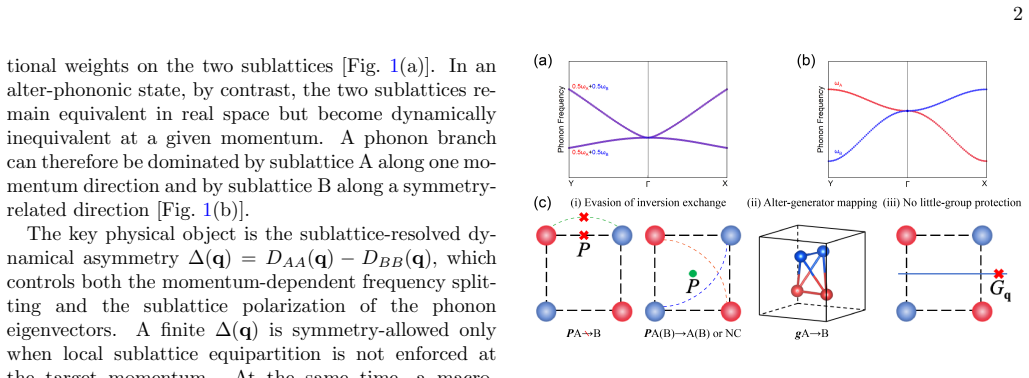
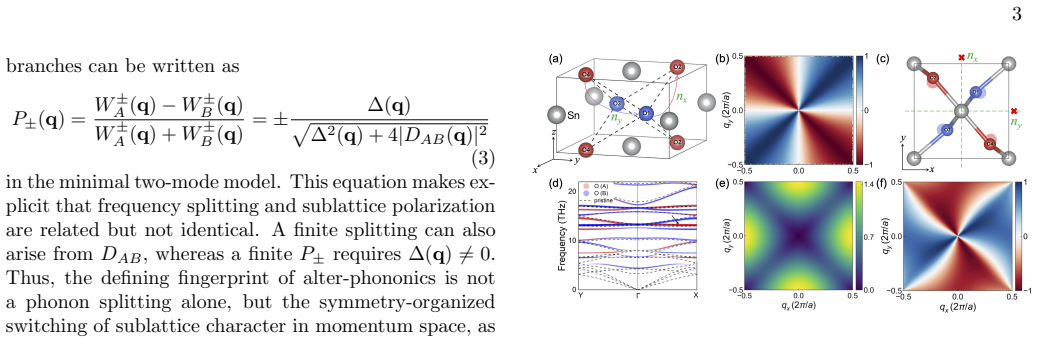
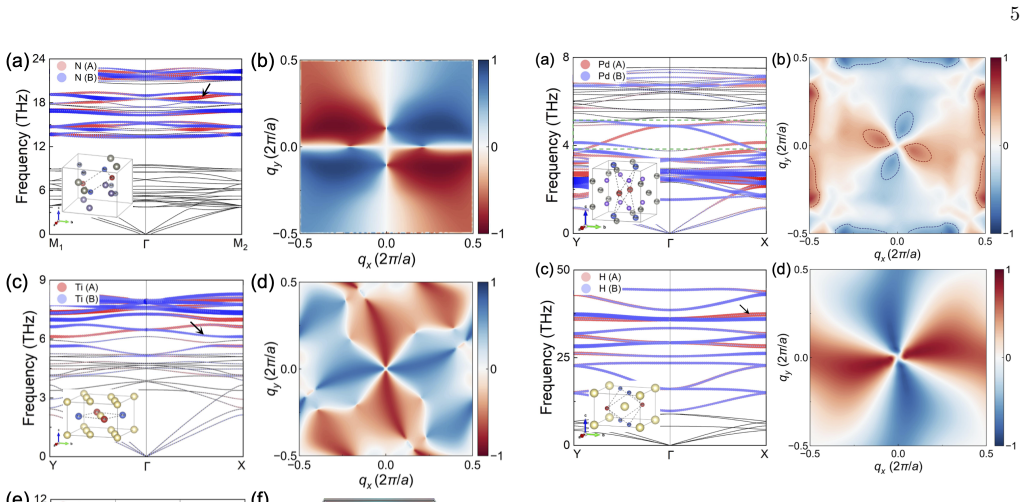
Phonon eigenmodes formed from structurally equivalent sublattices acquire momentum-dependent sublattice polarization and frequency splitting in nonmagnetic crystals. The central quantity is the sublattice-resolved dynamical asymmetry Δ(q)=D_AA(q)−D_BB(q), which controls the associated eigenvector polarization. This requires an alter-generator that maps equivalent sublattices onto one another while rotating the wave vector, together with the absence of inversion exchange and little-group sublattice-exchange constraints that would otherwise enforce sublattice equipartition. These symmetry rules generate nematic d-wave, tetragonal d/g-wave, and tripartite six-lobe phonon textures.
What carries the argument
The alter-generator symmetry, which maps equivalent sublattices onto one another while rotating the wave vector and thereby produces a nonzero sublattice-resolved dynamical asymmetry Δ(q).
If this is right
- The symmetry rules produce nematic d-wave, tetragonal d/g-wave, and tripartite six-lobe phonon textures.
- A symmetry-preserving structural distortion can unlock a hidden d_{x^2-y^2}-type texture by removing glide-induced equipartition while keeping the screw-axis alter-generator.
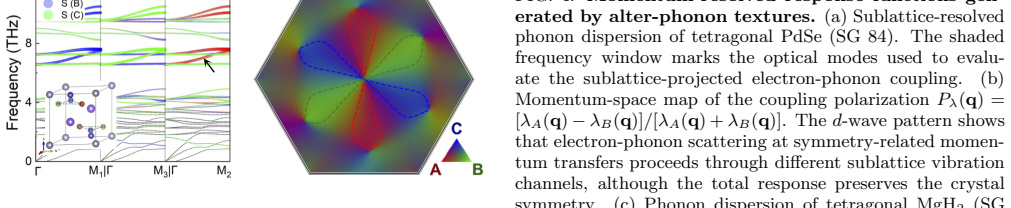
- The eigenvector texture is inherited by sublattice-projected electron-phonon coupling and anharmonic response functions.
- First-principles calculations confirm the mechanism in representative nonmagnetic crystals.
Where Pith is reading between the lines
- The same symmetry rules may impose new selection rules on finite-q phonon scattering processes that could be checked in inelastic X-ray or neutron experiments.
- Because the polarization is structural rather than magnetic, it could persist to higher temperatures than altermagnetic analogs and affect lattice thermal conductivity in layered or distorted materials.
- Extension to surfaces or interfaces might produce momentum-locked surface phonon modes usable for phonon waveguides or filters.
Load-bearing premise
An alter-generator symmetry that maps equivalent sublattices while rotating the wave vector exists, and the absence of inversion exchange or little-group sublattice-exchange constraints is enough to allow polarization without further equipartition rules.
What would settle it
A first-principles or neutron-scattering measurement on one of the representative crystals that finds no frequency splitting or sublattice polarization at a finite-q point where the calculated Δ(q) is nonzero would falsify the mechanism.
Figures
read the original abstract
The discovery of altermagnetism has shown that crystal symmetry can generate momentum-dependent internal polarization without net magnetization. Whether an analogous form of symmetry-organized momentum-space order can exist for spinless lattice vibrations remains unresolved. Here we identify a structural mechanism for $alter$-$phononics$, in which phonon eigenmodes formed from structurally equivalent sublattices acquire momentum-dependent sublattice polarization and frequency splitting in nonmagnetic crystals. The central quantity is the sublattice-resolved dynamical asymmetry $\Delta(\mathbf q)=D_{AA}(\mathbf q)-D_{BB}(\mathbf q)$, which controls the associated eigenvector polarization. We show that this effect requires an alter-generator that maps equivalent sublattices onto one another while rotating the wave vector, together with the absence of inversion exchange and little-group sublattice-exchange constraints that would otherwise enforce sublattice equipartition. These symmetry rules generate nematic $d$-wave, tetragonal $d/g$-wave, and tripartite six-lobe phonon textures. First-principles calculations demonstrate the mechanism in representative nonmagnetic crystals and show how a symmetry-preserving structural distortion can unlock a hidden $d_{x^2-y^2}$-type texture by removing glide-induced equipartition traps while retaining the screw-axis alter-generator. We further show that the eigenvector texture is inherited by sublattice-projected electron-phonon coupling and anharmonic response functions. Our results establish structural alter-phononics as a spinless counterpart to altermagnetic momentum-space order and provide experimentally testable signatures in finite-$\mathbf q$ phonon spectra and displacement patterns.
Editorial analysis
A structured set of objections, weighed in public.
Referee Report
Summary. The manuscript introduces structural alter-phononics as a mechanism by which phonon eigenmodes from structurally equivalent sublattices in nonmagnetic crystals develop momentum-dependent sublattice polarization and frequency splitting. The central quantity is the dynamical asymmetry Δ(q) = D_AA(q) − D_BB(q), which is shown to arise when an alter-generator symmetry maps equivalent sublattices while rotating q, provided inversion exchange and little-group sublattice-exchange symmetries are absent. The work classifies resulting textures (nematic d-wave, tetragonal d/g-wave, tripartite six-lobe), demonstrates the effect via first-principles calculations on representative crystals, shows that a symmetry-preserving distortion can unlock hidden textures by lifting glide-induced equipartition, and traces the eigenvector texture into sublattice-projected electron-phonon coupling and anharmonic response functions.
Significance. If the symmetry conditions are sufficient as stated, the paper establishes a spinless counterpart to altermagnetic momentum-space order, grounded in crystal symmetry rather than magnetism. Strengths include the explicit, parameter-free symmetry rules, the concrete first-principles examples, and the extension to measurable response functions. The demonstration that a structural distortion can selectively remove equipartition traps while preserving the alter-generator is a notable mechanistic insight with clear experimental implications for finite-q phonon spectra.
major comments (1)
- [Symmetry rules for alter-phononics] The central claim that an alter-generator plus absence of inversion exchange and little-group sublattice-exchange constraints is sufficient to permit nonzero Δ(q) and the resulting polarization requires an explicit argument or exhaustive check that no additional little-group symmetries enforce equipartition; this sufficiency is load-bearing for the mechanism and should be demonstrated beyond the listed conditions (see the paragraph defining the symmetry rules).
minor comments (4)
- [Abstract] The abstract introduces 'alter-generator' without an inline definition; a brief parenthetical gloss would aid readers new to the altermagnetism analogy.
- [First-principles validation] The first-principles section should list the specific space groups or compounds examined, together with key computational settings (k-mesh, cutoff, functional), to support reproducibility of the reported textures.
- [Figures] Figure captions for the phonon texture plots should explicitly state the Brillouin-zone path or high-symmetry points sampled and the color-scale range.
- [Discussion] A short comparison table or paragraph contrasting the phonon textures with known altermagnetic spin textures would clarify the analogy without lengthening the main text.
Simulated Author's Rebuttal
We thank the referee for the positive assessment and the constructive comment on the symmetry rules. We address the concern directly below and will revise the manuscript accordingly.
read point-by-point responses
-
Referee: [Symmetry rules for alter-phononics] The central claim that an alter-generator plus absence of inversion exchange and little-group sublattice-exchange constraints is sufficient to permit nonzero Δ(q) and the resulting polarization requires an explicit argument or exhaustive check that no additional little-group symmetries enforce equipartition; this sufficiency is load-bearing for the mechanism and should be demonstrated beyond the listed conditions (see the paragraph defining the symmetry rules).
Authors: We agree that an explicit demonstration of sufficiency strengthens the presentation. In the revised manuscript we will expand the symmetry-rules paragraph with a derivation showing that, for a given alter-generator G that interchanges sublattices A↔B while rotating q, the only little-group operations capable of forcing D_AA(q)=D_BB(q) are precisely the inversion-exchange and sublattice-exchange elements already identified. All other little-group elements either (i) preserve the sublattice distinction under the action of G or (ii) are incompatible with the presence of the alter-generator itself. This argument will be made concrete for the point groups underlying the classified textures (nematic d-wave, tetragonal d/g-wave, tripartite six-lobe) and will be cross-checked against the first-principles examples. No change to the central claims is required. revision: yes
Circularity Check
Symmetry analysis and explicit calculations are independent
full rationale
The derivation defines Δ(q) directly from the dynamical matrix elements and states the necessary symmetry conditions (alter-generator mapping sublattices while rotating q, plus absence of inversion exchange and little-group sublattice-exchange) using standard group-theoretic arguments. These conditions are external to the target polarization effect and are not derived from it. First-principles examples are presented as direct numerical support rather than fits. No self-citations, fitted parameters renamed as predictions, or self-definitional reductions appear in the load-bearing steps. The central claim therefore remains self-contained against external benchmarks.
Axiom & Free-Parameter Ledger
axioms (1)
- domain assumption Crystal symmetry operations can produce momentum-dependent order without net magnetization, as established in altermagnetism.
Reference graph
Works this paper leans on
-
[1]
RASHBA, Properties of semiconductors with an ex- tremum loop
E. RASHBA, Properties of semiconductors with an ex- tremum loop. i. cyclotron and combinational resonance in a magnetic field perpendicular to the plane of the loop, Sov. Phys.-Solid State2, 1109 (1960)
1960
-
[2]
Dresselhaus, Spin-orbit coupling effects in zinc blende structures, Phys
G. Dresselhaus, Spin-orbit coupling effects in zinc blende structures, Phys. Rev.100, 580 (1955)
1955
-
[3]
LaShell, B
S. LaShell, B. A. McDougall, and E. Jensen, Spin split- ting of an au(111) surface state band observed with angle resolved photoelectron spectroscopy, Phys. Rev. Lett.77, 3419 (1996)
1996
-
[4]
Manchon, H
A. Manchon, H. C. Koo, J. Nitta, S. M. Frolov, and R. A. Duine, New perspectives for rashba spin–orbit coupling, Nat. Mater.14, 871 (2015)
2015
-
[5]
Kittel,Introduction to Solid State Physics(8th Edi- tion, John Wiley & Sons, Inc., Hoboken., 2004)
C. Kittel,Introduction to Solid State Physics(8th Edi- tion, John Wiley & Sons, Inc., Hoboken., 2004)
2004
-
[6]
ˇSmejkal, J
L. ˇSmejkal, J. Sinova, and T. Jungwirth, Beyond conven- tional ferromagnetism and antiferromagnetism: A phase with nonrelativistic spin and crystal rotation symmetry, Phys. Rev. X12, 031042 (2022)
2022
-
[7]
ˇSmejkal, J
L. ˇSmejkal, J. Sinova, and T. Jungwirth, Emerging re- search landscape of altermagnetism, Phys. Rev. X12, 040501 (2022)
2022
-
[8]
I. a. Mazin, Editorial: Altermagnetism—a new punch line of fundamental magnetism, Phys. Rev. X12, 040002 (2022)
2022
-
[9]
L. Bai, W. Feng, S. Liu, L. ˇSmejkal, Y. Mokrousov, and Y. Yao, Altermagnetism: Exploring new frontiers in mag- netism and spintronics, Adv. Funct. Mater.34, 2409327 (2024)
2024
-
[10]
D. Guo, C. Zong, W. Zhang, C. Wang, J. Liu, and W. Ji, Tunable altermagnetism via interchain engineering in parallel-assembled atomic chains, Phys. Rev. B112, L041404 (2025)
2025
-
[11]
Huang, Z
S. Huang, Z. Qin, F. Zhan, D.-H. Xu, D.-S. Ma, and R. Wang, Light-induced odd-parity magnetism in con- ventional antiferromagnetism, Phys. Rev. Lett.136, 126703 (2026)
2026
-
[12]
T. Zhu, D. Zhou, H. Wang, S.-H. Wei, and J. Ruan, Floquet odd-parity collinear magnets, Phys. Rev. Lett. 136, 126704 (2026)
2026
-
[13]
Hayami, Y
S. Hayami, Y. Yanagi, and H. Kusunose, Momentum- dependent spin splitting by collinear antiferromagnetic ordering, J. Phys. Soc. Japan88, 123702 (2019)
2019
-
[14]
K.-H. Ahn, A. Hariki, K.-W. Lee, and J. Kuneˇ s, Antifer- romagnetism in ruo2 as d -wave pomeranchuk instability, Phys. Rev. B99, 184432 (2019)
2019
-
[15]
Gonz´ alez-Hern´ andez, L.ˇSmejkal, K
R. Gonz´ alez-Hern´ andez, L.ˇSmejkal, K. V´ yborn´ y, Y. Ya- hagi, J. Sinova, T. Jungwirth, and J. ˇZelezn´ y, Ef- ficient electrical spin splitter based on nonrelativis- tic collinear antiferromagnetism, Phys. Rev. Lett.126, 127701 (2021)
2021
-
[16]
V. Leeb, A. Mook, L. ˇSmejkal, and J. Knolle, Sponta- neous formation of altermagnetism from orbital ordering, Phys. Rev. Lett.132, 236701 (2024)
2024
-
[17]
Krempask´ y, L
J. Krempask´ y, L. ˇSmejkal, S. W. D’Souza, M. Ha- jlaoui, G. Springholz, K. Uhl´ ıˇ rov´ a, F. Alarab, P. C. Constantinou, V. Strocov, D. Usanov, W. R. Pudelko, R. Gonz´ alez-Hern´ andez, A. Birk Hellenes, Z. Jansa, H. Reichlov´ a, Z. ˇSob´ aˇ n, R. D. Gonzalez Betancourt, P. Wadley, J. Sinova, D. Kriegner, J. Min´ ar, J. H. Dil, and T. Jungwirth, Alterm...
2024
-
[18]
S. Lee, S. Lee, S. Jung, J. Jung, D. Kim, Y. Lee, B. Seok, J. Kim, B. G. Park, L. ˇSmejkal, C.-J. Kang, and C. Kim, Broken kramers degeneracy in altermagnetic mnte, Phys. Rev. Lett.132, 036702 (2024). 7
2024
-
[19]
Reimers, L
S. Reimers, L. Odenbreit, L. ˇSmejkal, V. N. Strocov, P. Constantinou, A. B. Hellenes, R. Jaeschke Ubiergo, W. H. Campos, V. K. Bharadwaj, A. Chakraborty, T. Denneulin, W. Shi, R. E. Dunin-Borkowski, S. Das, M. Kl¨ aui, J. Sinova, and M. Jourdan, Direct observation of altermagnetic band splitting in crsb thin films, Nat. Commun.15, 2116 (2024)
2024
-
[20]
Jiang, M
B. Jiang, M. Hu, J. Bai, Z. Song, C. Mu, G. Qu, W. Li, W. Zhu, H. Pi, Z. Wei, Y.-J. Sun, Y. Huang, X. Zheng, Y. Peng, L. He, S. Li, J. Luo, Z. Li, G. Chen, H. Li, H. Weng, and T. Qian, A metallic room-temperature d- wave altermagnet, Nat. Phys.21, 754 (2025)
2025
-
[21]
J. D. Cao, K. S. Denisov, Y. Liu, and I. ˇZuti´ c, Symmetry classification for alternating excitons in two-dimensional altermagnets, Phys. Rev. Lett.135, 266703 (2025)
2025
-
[22]
Zhang, Z
T. Zhang, Z. Song, A. Alexandradinata, H. Weng, C. Fang, L. Lu, and Z. Fang, Double-weyl phonons in transition-metal monosilicides, Phys. Rev. Lett.120, 016401 (2018)
2018
-
[23]
Y. J. Jin, Z. J. Chen, B. W. Xia, Y. J. Zhao, R. Wang, and H. Xu, Ideal intersecting nodal-ring phonons in bcc c8, Phys. Rev. B98, 220103 (2018)
2018
-
[24]
Y. Liu, X. Chen, and Y. Xu, Topological phononics: From fundamental models to real materials, Adv. Funct. Mater.30, 1904784 (2020)
2020
-
[25]
Y. Xu, M. G. Vergniory, D.-S. Ma, J. L. Ma˜ nes, Z.-D. Song, B. A. Bernevig, N. Regnault, and L. Elcoro, Cat- alog of topological phonon materials, Science384, 638 (2024)
2024
-
[26]
Zhang and Q
L. Zhang and Q. Niu, Angular momentum of phonons and the einstein–de haas effect, Phys. Rev. Lett.112, 085503 (2014)
2014
-
[27]
H. Zhu, J. Yi, M.-Y. Li, J. Xiao, L. Zhang, C.-W. Yang, R. A. Kaindl, L.-J. Li, Y. Wang, and X. Zhang, Obser- vation of chiral phonons, Science359, 579 (2018)
2018
-
[28]
Ishito, H
K. Ishito, H. Mao, Y. Kousaka, Y. Togawa, S. Iwasaki, T. Zhang, S. Murakami, J.-i. Kishine, and T. Satoh, Truly chiral phonons inα-hgs, Nat. Phys.19, 35 (2023)
2023
-
[29]
Strohm, G
C. Strohm, G. L. J. A. Rikken, and P. Wyder, Phe- nomenological evidence for the phonon hall effect, Phys. Rev. Lett.95, 155901 (2005)
2005
-
[30]
Sheng, D
L. Sheng, D. N. Sheng, and C. S. Ting, Theory of the phonon hall effect in paramagnetic dielectrics, Phys. Rev. Lett.96, 155901 (2006)
2006
-
[31]
M. Mori, A. Spencer-Smith, O. P. Sushkov, and S. Maekawa, Origin of the phonon hall effect in rare-earth garnets, Phys. Rev. Lett.113, 265901 (2014)
2014
-
[32]
X. Li, B. Fauqu´ e, Z. Zhu, and K. Behnia, Phonon thermal hall effect in strontium titanate, Phys. Rev. Lett.124, 105901 (2020)
2020
-
[33]
Grissonnanche, S
G. Grissonnanche, S. Th´ eriault, A. Gourgout, M.-E. Boulanger, E. Lefran¸ cois, A. Ataei, F. Lalibert´ e, M. Dion, J.-S. Zhou, S. Pyon, T. Takayama, H. Takagi, N. Doiron- Leyraud, and L. Taillefer, Chiral phonons in the pseudo- gap phase of cuprates, Nat. Phys.16, 1108 (2020)
2020
-
[34]
J.-Y. Chen, S. A. Kivelson, and X.-Q. Sun, Enhanced thermal hall effect in nearly ferroelectric insulators, Phys. Rev. Lett.124, 167601 (2020)
2020
- [35]
-
[36]
Coh, Classification of materials with phonon angular momentum and microscopic origin of angular momen- tum, Phys
S. Coh, Classification of materials with phonon angular momentum and microscopic origin of angular momen- tum, Phys. Rev. B108, 134307 (2023)
2023
-
[37]
C. R. W. Steward, R. M. Fernandes, and J. Schmalian, Dynamic paramagnon-polarons in altermagnets, Phys. Rev. B108, 144418 (2023)
2023
- [38]
-
[39]
Giustino, Electron-phonon interactions from first prin- ciples, Rev
F. Giustino, Electron-phonon interactions from first prin- ciples, Rev. Mod. Phys.89, 015003 (2017)
2017
-
[40]
Gerber, S.-L
S. Gerber, S.-L. Yang, D. Zhu, H. Soifer, J. A. Sobota, S. Rebec, J. J. Lee, T. Jia, B. Moritz, C. Jia, A. Gau- thier, Y. Li, D. Leuenberger, Y. Zhang, L. Chaix, W. Li, H. Jang, J.-S. Lee, M. Yi, G. L. Dakovski, S. Song, J. M. Glownia, S. Nelson, K. W. Kim, Y.-D. Chuang, Z. Hussain, R. G. Moore, T. P. Devereaux, W.-S. Lee, P. S. Kirchmann, and Z.-X. Shen,...
2017
-
[41]
Valla, A
T. Valla, A. V. Fedorov, P. D. Johnson, and S. L. Hul- bert, Many-body effects in angle-resolved photoemission: Quasiparticle energy and lifetime of a mo(110) surface state, Phys. Rev. Lett.83, 2085 (1999)
2085
-
[42]
Lanzara, P
A. Lanzara, P. V. Bogdanov, X. J. Zhou, S. A. Kellar, D. L. Feng, E. D. Lu, T. Yoshida, H. Eisaki, A. Fujimori, K. Kishio, J.-I. Shimoyama, T. Noda, S. Uchida, Z. Hus- sain, and Z.-X. Shen, Evidence for ubiquitous strong elec- tron–phonon coupling in high-temperature superconduc- tors, Nature412, 510 (2001)
2001
-
[43]
F¨ orst, C
M. F¨ orst, C. Manzoni, S. Kaiser, Y. Tomioka, Y. Tokura, R. Merlin, and A. Cavalleri, Nonlinear phononics as an ultrafast route to lattice control, Nat. Phys.7, 854 (2011)
2011
-
[44]
Mankowsky, M
R. Mankowsky, M. F¨ orst, and A. Cavalleri, Non- equilibrium control of complex solids by nonlinear phononics, Rep. Progr. Phys.79, 064503 (2016)
2016
-
[45]
N. Li, J. Ren, L. Wang, G. Zhang, P. H¨ anggi, and B. Li, Colloquium: Phononics: Manipulating heat flow with electronic analogs and beyond, Rev. Mod. Phys.84, 1045 (2012)
2012
-
[46]
Wehmeyer, T
G. Wehmeyer, T. Yabuki, C. Monachon, J. Wu, and C. Dames, Thermal diodes, regulators, and switches: Physical mechanisms and potential applications, Appl. Phys. Rev.4, 041304 (2017)
2017
-
[47]
H. Miao, T. Zhang, L. Wang, D. Meyers, A. Said, Y. Wang, Y. Shi, H. Weng, Z. Fang, and M. Dean, Ob- servation of double weyl phonons in parity-breaking fesi, Phys. Rev. Lett.121, 035302 (2018)
2018
- [48]
-
[49]
Senga, K
R. Senga, K. Suenaga, P. Barone, S. Morishita, F. Mauri, and T. Pichler, Position and momentum mapping of vi- brations in graphene nanostructures, Nature573, 247 (2019)
2019
discussion (0)
Sign in with ORCID, Apple, or X to comment. Anyone can read and Pith papers without signing in.