An SMA Molecular Inventory of the Edge-on Protoplanetary Disk Gomez's Hamburger
Pith reviewed 2026-07-01 16:59 UTC · model grok-4.3
The pith
Gomez's Hamburger protoplanetary disk shows a molecular inventory consistent with other large disks and no definitive signs of gravitational instability.
A machine-rendered reading of the paper's core claim, the machinery that carries it, and where it could break.
Core claim
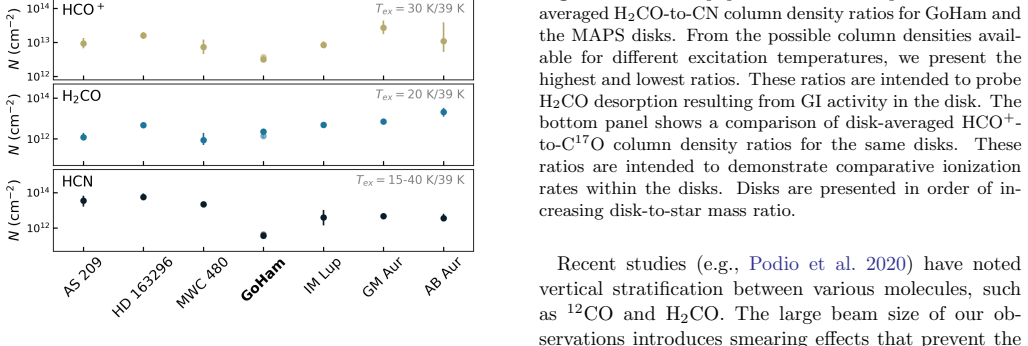
The molecular inventory of GoHam and the inferred column densities for select molecules are broadly consistent with the general population of large protoplanetary disks. We find no definitive evidence of GI.
What carries the argument
Disk-integrated molecular line fluxes from SMA wideband survey observations at ~1 arcsecond resolution, used to infer column densities over fixed excitation temperatures.
If this is right
- The results can guide future higher-resolution studies of GoHam.
- The data support efforts to characterize the giant protoplanet candidate GoHam b.
- The lack of clear GI signatures suggests the overdensity may not be driven by gravitational instability in a detectable way at this resolution.
- Molecular abundances match typical values, implying standard chemistry rather than unusual conditions from instability.
Where Pith is reading between the lines
- Similar surveys on other edge-on disks could test whether consistency with the general population holds across viewing angles.
- If higher resolution reveals localized H2CO enhancements, it would strengthen the case for GI in this source.
- The edge-on geometry might allow better constraints on vertical structure in future modeling of these lines.
Load-bearing premise
That the one arcsecond resolution and chosen range of fixed excitation temperatures are sufficient to detect or rule out enhancements in gas-phase H2CO that would indicate gravitational instability.
What would settle it
A higher angular resolution observation that measures the gas-phase H2CO abundance in the overdense region and compares it directly to the rest of the disk.
Figures
read the original abstract
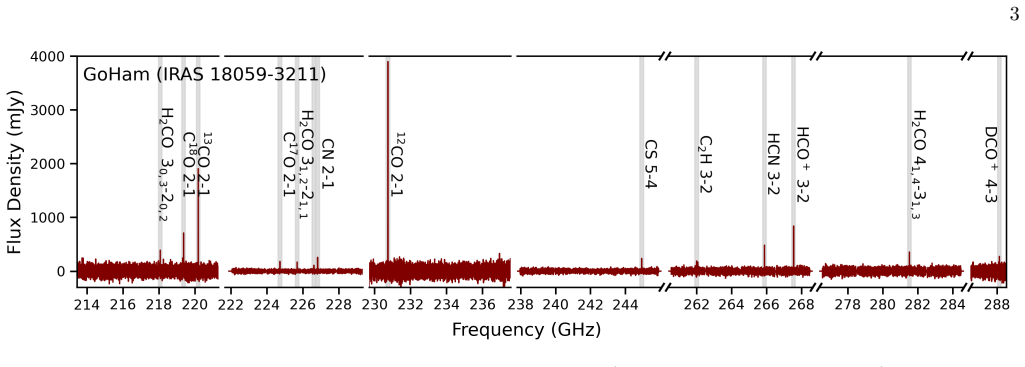
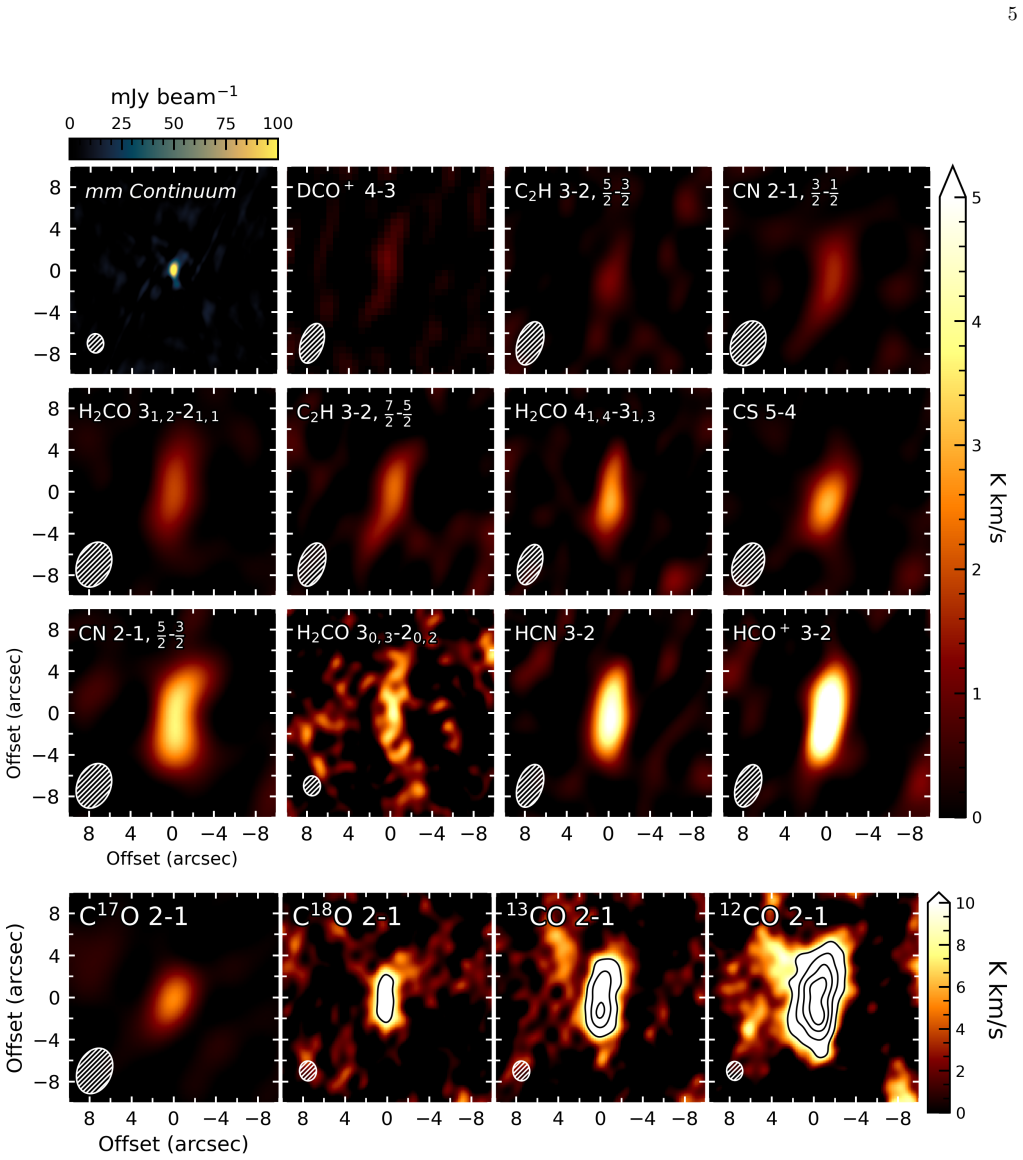
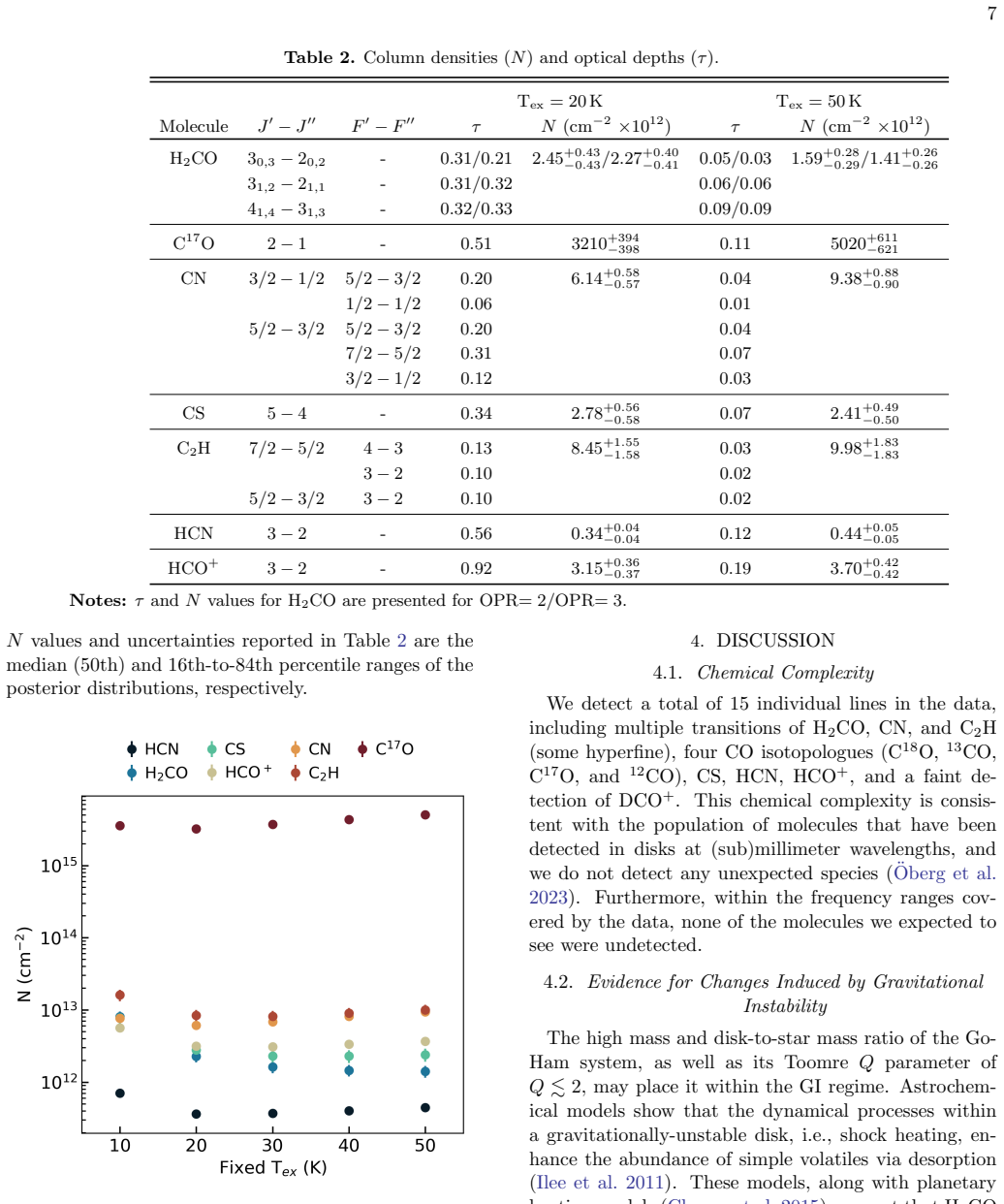
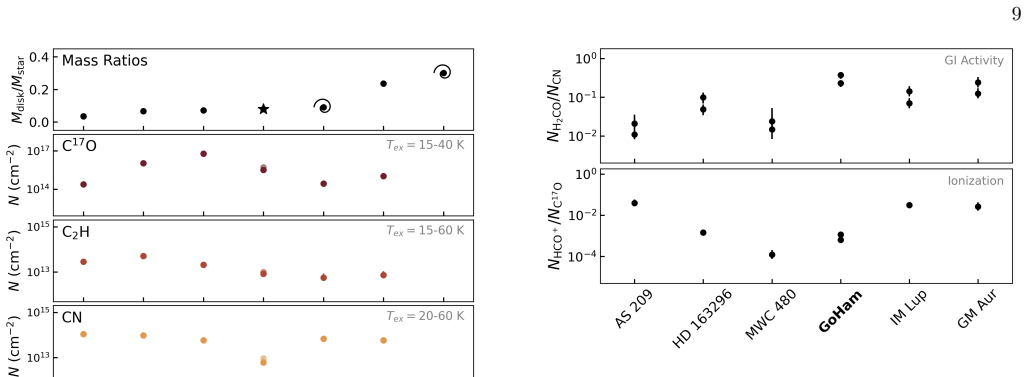
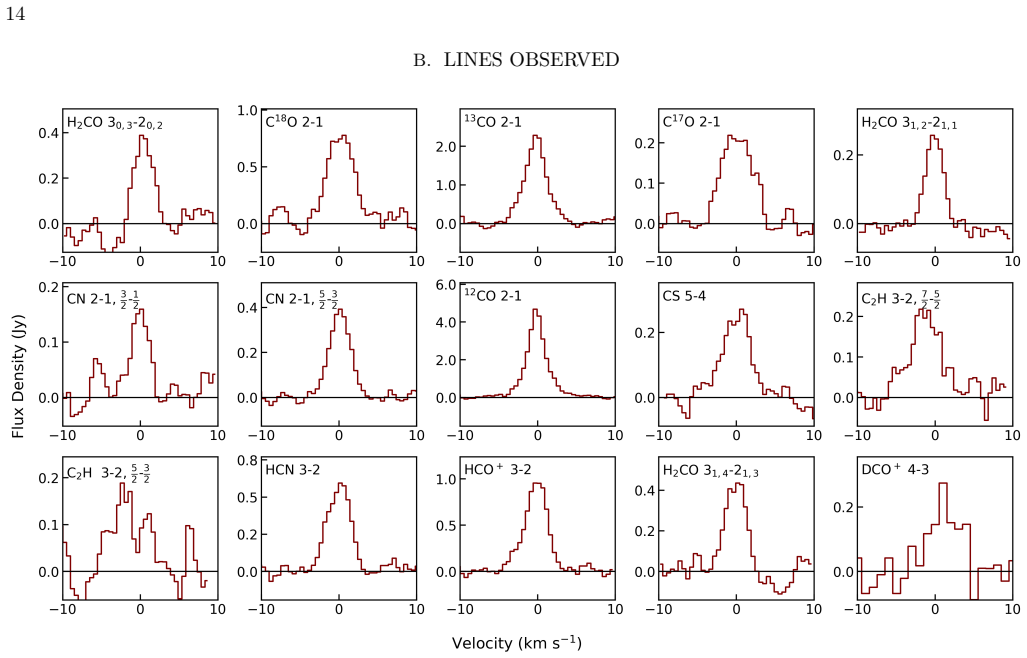
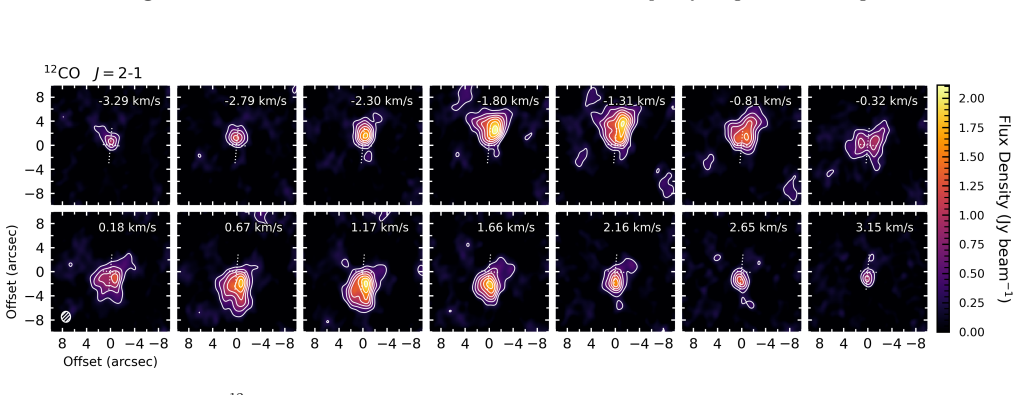
Gomez's Hamburger (IRAS 18059-3211, GoHam) is a massive, edge-on protoplanetary disk that is potentially gravitationally unstable and hosts an overdensity that may be the site of a forming giant planet, making it a particularly interesting source for the study of planet formation in the direct collapse scenario. In this study, we present a molecular inventory of GoHam's disk combining several Submillimeter Array observations for a wideband survey at an angular resolution on the order of ~1 arcsecond. We detect 11 different molecules, including 15 individual lines, and measure their disk-integrated fluxes. We also infer column densities for several species over a range of fixed excitation temperatures. We find that the molecular inventory of GoHam and the inferred column densities for select molecules are broadly consistent with the general population of large protoplanetary disks. We explore the putative gravitational instability (GI) in GoHam's disk via possible enhancements in the gas-phase H$_2$CO abundance, but find no definitive evidence of GI. The results of this study can guide future, higher-resolution studies of GoHam, as well as efforts to characterize the giant protoplanet candidate GoHam b.
Editorial analysis
A structured set of objections, weighed in public.
Referee Report
Summary. The manuscript reports Submillimeter Array (SMA) wideband observations of the edge-on protoplanetary disk Gomez's Hamburger at ~1 arcsec resolution. It detects 11 molecules (15 lines total), measures their disk-integrated fluxes, and derives column densities for several species assuming a range of fixed excitation temperatures. The molecular inventory and column densities are stated to be broadly consistent with the population of large protoplanetary disks; an exploratory search for gravitational instability signatures via gas-phase H2CO enhancements yields no definitive evidence. The results are framed as a baseline to guide future higher-resolution work on the disk and the candidate protoplanet GoHam b.
Significance. If the reported detections and column-density trends hold, the work supplies a useful molecular inventory for a massive, edge-on disk that is a candidate site for gravitational instability and direct-collapse planet formation. The consistency statements with other large disks and the cautious framing of the GI test provide a reference point for chemical studies of protoplanetary disks, particularly those observed at moderate resolution.
minor comments (3)
- The abstract and introduction should explicitly state the specific SMA datasets (project codes, frequencies, and integration times) used in the combined survey so that the flux measurements can be reproduced from the archive.
- The methods section should quantify the impact of the chosen fixed Tex range on the derived column densities (e.g., via a brief sensitivity test or error envelope) rather than simply reporting values at multiple discrete Tex.
- Figure captions and the text should clarify whether the reported column densities are beam-averaged or corrected for the ~1 arcsec beam filling factor, as this affects direct comparison with other disk surveys.
Simulated Author's Rebuttal
We thank the referee for their constructive review and recommendation of minor revision. The summary accurately captures the scope and conclusions of our work on the SMA molecular inventory of Gomez's Hamburger. No major comments were provided in the report.
Circularity Check
No significant circularity
full rationale
This is a purely observational paper reporting SMA detections of 11 molecules, disk-integrated fluxes, and column densities derived from standard LTE assumptions over fixed Tex values. The central claims (inventory consistent with other large disks; no definitive GI signature in H2CO) rest on direct comparison to external literature benchmarks rather than any internal derivation, fitted parameter renamed as prediction, or self-citation chain. No equations or steps reduce by construction to the paper's own inputs.
Axiom & Free-Parameter Ledger
free parameters (1)
- excitation temperature
Reference graph
Works this paper leans on
-
[1]
, " * write output.state after.block = add.period write newline
ENTRY address archivePrefix author booktitle chapter doi edition editor eprint howpublished institution journal key month number organization pages publisher school series title misctitle type volume year version url label extra.label sort.label short.list INTEGERS output.state before.all mid.sentence after.sentence after.block FUNCTION init.state.consts ...
-
[2]
write newline
" write newline "" before.all 'output.state := FUNCTION format.url url empty "" new.block "" url * "" * if FUNCTION format.eprint eprint empty "" archivePrefix empty "" archivePrefix "arXiv" = new.block " " eprint * " " * new.block " " eprint * " " * if if if FUNCTION format.doi doi empty "" " " doi * " " * if FUNCTION format.pid doi empty eprint empty ur...
-
[3]
thebibliography [1] 20pt to REFERENCES 6pt =0pt -12pt 10pt plus 3pt =0pt =0pt =1pt plus 1pt =0pt =0pt -12pt =13pt plus 1pt =20pt =13pt plus 1pt \@M =10000 =-1.0em =0pt =0pt 0pt =0pt =1.0em @enumiv\@empty 10000 10000 `\.\@m \@noitemerr \@latex@warning Empty `thebibliography' environment \@ifnextchar \@reference \@latexerr Missing key on reference command E...
discussion (0)
Sign in with ORCID, Apple, or X to comment. Anyone can read and Pith papers without signing in.