REVIEW 2 major objections 2 minor 1 cited by
NestedKV: Nested Memory Routing for Long-Context KV Cache Compression
T0 review · 2 major / 2 minor · reviewed 2026-06-29 · grok-4.3
Pith's one-line read NestedKV routes KV cache tokens through nested global, block and window anchors scored by multi-scale cosine anomaly to preserve performance at low retention ratios.
desk verdict NestedKV layers global/block/window key anchors with multi-scale cosine anomaly and head-adaptive mixing to beat KeyDiff at tight cache budgets on Qwen3, but the gains rest on untested alignment between key similarity and token utility. read the letter →
The pith
A machine-rendered reading of the paper's core claim, the machinery that carries it, and where it could break.
The reading
What carries the argument
Nested memory routing that scores tokens by multi-time-scale cosine anomaly from global, block-level and sliding-window key anchors then combines them with head-adaptive mixing and surprise-gated token routing.
What would settle it
On a new model architecture or benchmark where attention patterns differ markedly from Qwen3 and Llama-3.2, the method shows no gain over KeyDiff at retention ratio 0.75 on RULER or LongBench.
Extended reading notes
Core claim
NestedKV maintains global, block-level, and sliding-window key anchors, scores tokens by multi-time-scale cosine anomaly, and combines the resulting rankings with a training-free outer learner using head-adaptive mixing and surprise-gated token routing. The score is paired with adaptive per-head budgets and requires no training or LLM modification.
Load-bearing premise
The combination of global, block-level, and sliding-window key anchors scored by multi-time-scale cosine anomaly and routed via head-adaptive mixing and surprise-gating will reliably identify the most useful tokens across diverse contexts and models without any model-specific tuning or training.
Editorial extensions
If this is right
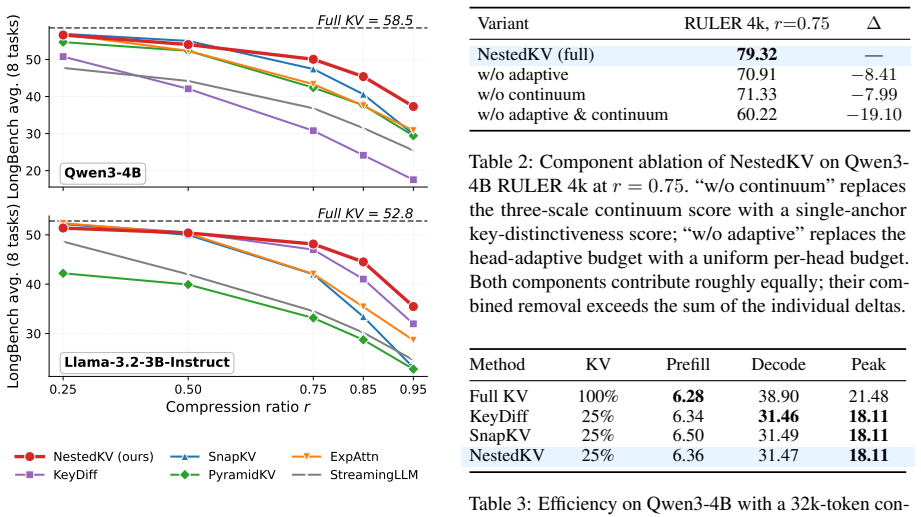
- At retention ratio 0.75 the method yields up to 19-point gains on RULER and LongBench over KeyDiff on Qwen3-4B.
- At retention ratio 0.95 it still keeps substantially higher LongBench scores than KeyDiff.
- The same routing works without modification on both Qwen3 and Llama-3.2 families.
- No training or architecture change is required for the gains.
- The method is strongest precisely when the retained cache fraction is smallest.
Reading between the lines
- The nested-anchor approach might extend to compressing other sequence memories such as replay buffers in reinforcement learning.
- Multi-scale anomaly scoring could be tested as a drop-in replacement for single-scale importance metrics in retrieval-augmented generation.
- If the routing proves robust, it opens the possibility of dynamically adjusting retention per head during inference rather than fixing budgets in advance.
Signed reviews
Editorial analysis
A structured set of objections, weighed in public.
Referee Report
Summary. The manuscript introduces NestedKV, a training-free KV cache compression method for long-context LLMs. It maintains key anchors at global, block-level, and sliding-window scales, scores tokens using multi-time-scale cosine anomaly, and combines rankings via head-adaptive mixing and surprise-gating with adaptive per-head budgets. The approach is evaluated on Qwen3 and Llama-3.2 models across RULER (4k-32k), LooGLE, LongBench, LongBench-E, InfiniteBench, and MMLU-Pro, claiming to outperform baselines such as KeyDiff especially at low retention ratios (e.g., up to 19.10 points on RULER and 19.29 on LongBench at r=0.75 on Qwen3-4B; 37.32 vs 17.55 on LongBench at r=0.95).
Significance. If the results hold, NestedKV would advance training-free KV compression by integrating multiple time scales in a nested routing scheme, addressing brittleness in single-signal methods. The empirical gains on multiple benchmarks at small cache sizes represent a practical contribution for efficient long-context inference without model changes or training. The training-free nature and head-adaptive components are notable strengths if robustly validated.
major comments (2)
- [Method (NestedKV routing description)] The core claim that global/block/sliding-window key anchors scored by multi-time-scale cosine anomaly, then routed via head-adaptive mixing and surprise-gating, reliably identify useful tokens (as stated in the method and supported by the Qwen3-4B results) rests on an untested assumption that key-vector cosine distances align with semantic importance. No ablation or counterexample analysis is provided for cases where importance derives from value vectors, cross-head interactions, or long-range patterns invisible in key similarity; this directly bears on the generalizability of the reported gains.
- [Experiments (benchmark tables)] Table reporting Qwen3-4B results at r=0.75 and r=0.95: the headline improvements (19.10 RULER, 19.29 LongBench) lack error bars, run counts, or statistical tests, making it impossible to assess whether gains exceed variance or benchmark selection effects; this undermines confidence in the central performance claim.
minor comments (2)
- [Abstract] The abstract uses 'r' for retention ratio without an immediate definition or reference to the equation defining it.
- [Experiments] Benchmark names such as LooGLE and LongBench-E would benefit from a one-sentence description or citation on first use for readers unfamiliar with the suite.
Simulated Author's Rebuttal
We thank the referee for the constructive feedback and for recognizing the potential practical contribution of NestedKV. We address each major comment below.
read point-by-point responses
-
Referee: [Method (NestedKV routing description)] The core claim that global/block/sliding-window key anchors scored by multi-time-scale cosine anomaly, then routed via head-adaptive mixing and surprise-gating, reliably identify useful tokens (as stated in the method and supported by the Qwen3-4B results) rests on an untested assumption that key-vector cosine distances align with semantic importance. No ablation or counterexample analysis is provided for cases where importance derives from value vectors, cross-head interactions, or long-range patterns invisible in key similarity; this directly bears on the generalizability of the reported gains.
Authors: NestedKV is explicitly a key-only method, chosen to support efficient, training-free compression that does not require access to value vectors at compression time. We agree that value-based signals or cross-head interactions could matter in some settings and that the paper does not include targeted ablations or counterexamples for those cases. In revision we will add a limitations paragraph explicitly discussing the key-only design choice, its rationale, and the scope of generalizability. We do not plan new experiments for this revision. revision: partial
-
Referee: [Experiments (benchmark tables)] Table reporting Qwen3-4B results at r=0.75 and r=0.95: the headline improvements (19.10 RULER, 19.29 LongBench) lack error bars, run counts, or statistical tests, making it impossible to assess whether gains exceed variance or benchmark selection effects; this undermines confidence in the central performance claim.
Authors: We agree that the absence of error bars and statistical tests weakens confidence in the headline numbers. In the revised manuscript we will report results over multiple random seeds (where the benchmark permits stochasticity), include standard deviations, and add paired statistical tests comparing NestedKV against the strongest baseline. revision: yes
Circularity Check
No circularity; heuristic method with external benchmark validation
full rationale
The paper describes NestedKV as a training-free heuristic that combines global/block/sliding-window key anchors scored by multi-time-scale cosine anomaly, then routed via head-adaptive mixing and surprise-gating. No equations, derivations, or self-citations are shown that reduce the performance claims to fitted quantities or self-defined inputs by construction. Reported gains on RULER, LongBench, and other external benchmarks are presented as empirical outcomes rather than tautological predictions, satisfying the criteria for a self-contained, non-circular approach.
Assumptions & free parameters
Cite this review
Pith. "Pith review of NestedKV: Nested Memory Routing for Long-Context KV Cache Compression." pith.science (2026). https://pith.science/paper/7CFGKJQA
@misc{pith2026260526678,
  author       = {Pith},
  title        = {Pith review of: NestedKV: Nested Memory Routing for Long-Context KV Cache Compression},
  year         = {2026},
  howpublished = {\url{https://pith.science/paper/7CFGKJQA}},
  note         = {Machine review of arXiv:2605.26678}
}
abstract
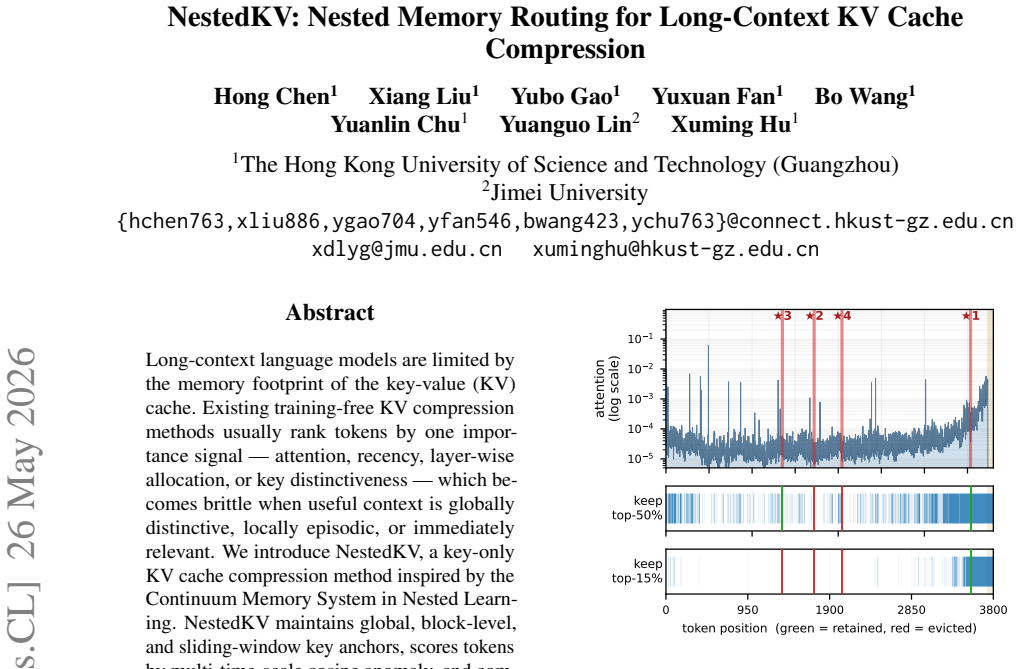
Long-context language models are limited by the memory footprint of the key-value (KV) cache. Existing training-free KV compression methods usually rank tokens by one importance signal -- attention, recency, layer-wise allocation, or key distinctiveness -- which becomes brittle when useful context is globally distinctive, locally episodic, or immediately relevant. We introduce NestedKV, a key-only KV cache compression method inspired by the Continuum Memory System in Nested Learning. NestedKV maintains global, block-level, and sliding-window key anchors, scores tokens by multi-time-scale cosine anomaly, and combines the resulting rankings with a training-free outer learner using head-adaptive mixing and surprise-gated token routing. The score is paired with adaptive per-head budgets and requires no training or LLM modification. Across RULER (4k--32k), LooGLE, LongBench, LongBench-E, InfiniteBench, and MMLU-Pro on Qwen3 and Llama-3.2 models, NestedKV is strongest when the retained cache is small. On Qwen3-4B, it improves over KeyDiff by up to 19.10 points on RULER and 19.29 on LongBench at $r=0.75$; at $r=0.95$, it retains 37.32 on LongBench versus 17.55 for KeyDiff.
Figures


Figures from the paper (6 more)



Forward citations
Cited by 1 Pith paper
-
Seen, Said, or Forgotten? A Causal Audit of Visual KV Memory Across Dialog Turns
Current attention is not a safe-forgetting signal for visual KV memory; damage from eviction concentrates in visually dependent turns, and only explicitly verbalized facts are reliably rescued by assistant text.
Reference graph
Works this paper leans on
-
[1]
Pradeep Dasigi, Kyle Lo, Iz Beltagy, Arman Cohan, Noah A Smith, and Matt Gardner
Sonic: Segmented optimized nexus for in- formation compression in key-value caching.arXiv preprint arXiv:2601.21927. Pradeep Dasigi, Kyle Lo, Iz Beltagy, Arman Cohan, Noah A Smith, and Matt Gardner. 2021. A dataset of information-seeking questions and answers an- chored in research papers. InProceedings of the 2021 Conference of the North American Chapter...
-
[2]
Expected attention: Kv cache compression by estimating attention from future queries distribution. arXiv preprint arXiv:2510.00636. Alessio Devoto, Yu Zhao, Simone Scardapane, and Pasquale Minervini. 2024. A simple and effective l_2 norm-based strategy for kv cache compression. InProceedings of the 2024 Conference on Empiri- cal Methods in Natural Languag...
-
[3]
Flowkv: Enhancing multi-turn conversational coherence in llms via isolated key-value cache man- agement.arXiv preprint arXiv:2505.15347. Xiang Liu, Zhenheng Tang, Hong Chen, Peijie Dong, Zeyu Li, Xiuze Zhou, Bo Li, Xuming Hu, and Xi- aowen Chu. 2026. Semantic integrity matters: Bench- marking and preserving high-density reasoning in kv cache compression.P...
-
[4]
Guangxuan Xiao, Yuandong Tian, Beidi Chen, Song Han, and Mike Lewis
Mmlu-pro: A more robust and challenging multi-task language understanding benchmark.Ad- vances in Neural Information Processing Systems, 37:95266–95290. Guangxuan Xiao, Yuandong Tian, Beidi Chen, Song Han, and Mike Lewis. 2024. Efficient streaming lan- guage models with attention sinks. InInternational Conference on Learning Representations, volume 2024, ...
2024
-
[5]
Qwen3 technical report.arXiv preprint arXiv:2505.09388. Xinrong Zhang, Yingfa Chen, Shengding Hu, Zi- hang Xu, Junhao Chen, Moo Khai Hao, Xu Han, Zhen Leng Thai, Shuo Wang, Zhiyuan Liu, and 1 others. 2024. Infty bench: Extending long con- text evaluation beyond 100k tokens.arXiv preprint arXiv:2402.13718. Zhenyu Zhang, Ying Sheng, Tianyi Zhou, Tianlong Ch...
work page Pith review arXiv 2024
Reviewed June 29, 2026 · model on record in the stance chip above.
Discussion (0). Continue with ORCID to comment.