REVIEW 2 major objections 2 minor 111 references
Interior-Atmosphere Coupling on TRAPPIST-1 f, g, and h: Cryovolcanic Water Exospheres and Infrared Detectability
T0 review · 2 major / 2 minor · reviewed 2026-07-01 · grok-4.3
Pith's one-line read Localized cryovolcanic plumes on TRAPPIST-1f can produce detectable water-vapor signals in roughly 20 JWST transits, while uniform exospheres are harder to see.
desk verdict The paper applies standard interior models to TRAPPIST-1 f,g,h and produces a conditional JWST detectability estimate for water plumes on f, but the outgassing rates sit outside the Monte Carlo results. read the letter →
The pith
A machine-rendered reading of the paper's core claim, the machinery that carries it, and where it could break.
The reading
What carries the argument
Layered interior model (silicate plus ice shells) coupled to Monte Carlo heat-partitioning simulations and synthetic transmission spectra of water exospheres.
What would settle it
A null detection of water absorption features in TRAPPIST-1f transmission spectra after 20 or more JWST/NIRISS transits would falsify the detectability claim for the adopted rates and plume geometry.
Extended reading notes
Core claim
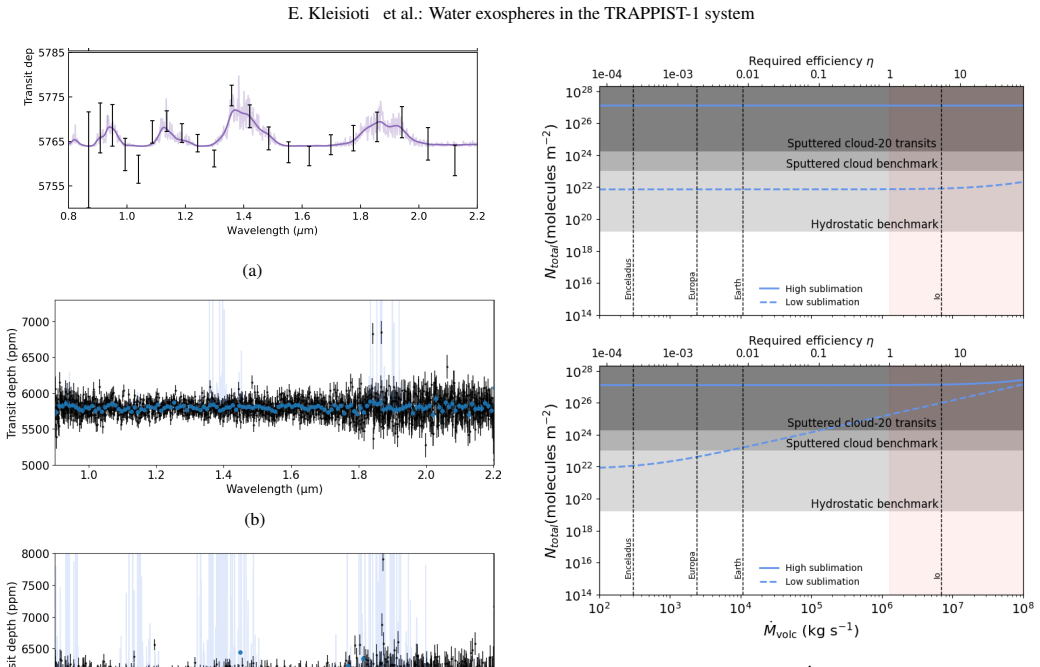
Internal heat budgets of TRAPPIST-1f, g, and h are dominated by radiogenic heating and tidal dissipation in high-pressure ice layers. Thermal-equilibrium solutions favor thin outer ice shells and shallow subsurface oceans on f and g, and thicker shells on h. Localized plume-like outgassing produces stronger JWST/NIRISS transmission signals than globally distributed exospheres. Under favorable assumptions, outgassing on TRAPPIST-1f may be detectable within about 20 transits.
Load-bearing premise
Cryovolcanic water outgassing rates and the formation of localized plumes are assumed high enough to produce observable signals.
Editorial extensions
If this is right
- Subsurface oceans remain possible across a wide range of interior configurations for all three planets.
- The spatial distribution of outgassed water (plume versus global) directly controls the strength of the transmission signal.
- Interior heat budgets set both the ocean depth and the outgassing rate, linking geology to atmosphere.
- TRAPPIST-1f is the most promising target among the three for infrared detection of cryovolcanic activity.
Reading between the lines
- Similar interior-atmosphere coupling models could be applied to other icy exoplanets around M dwarfs to predict which ones might show plume signatures.
- If plumes are confirmed, repeated observations could track changes in outgassing activity over time.
- Non-detection on f would tighten upper limits on cryovolcanic rates rather than rule out oceans entirely.
Signed reviews
Editorial analysis
A structured set of objections, weighed in public.
Referee Report
Summary. The paper uses a layered interior model and Monte Carlo sampling of radiogenic plus tidal heat sources to identify thermal-equilibrium configurations with subsurface oceans on TRAPPIST-1 f, g, and h. It separately estimates cryovolcanic water outgassing rates, generates synthetic transmission spectra, and concludes that thin ice shells and shallow oceans are favored for f and g, that plume-like outgassing yields stronger NIRISS signals than global exospheres, and that under favorable assumptions the outgassing on f could be detectable in ~20 transits.
Significance. If the outgassing rates can be shown to follow from the interior heat budgets, the work supplies a concrete framework linking interior structure to observable exospheres on icy exoplanets and supplies falsifiable predictions for JWST observations of the TRAPPIST-1 system. The Monte Carlo exploration of heat partitioning is a methodological strength.
major comments (2)
- [§4] §4 (cryovolcanic outgassing estimation): the mass fluxes fed into the transmission spectra are stated as separate estimates rather than computed from the Monte Carlo-sampled heat fluxes, ice-shell thicknesses, or ocean depths; because transmission amplitude scales linearly with column density, this decoupling makes the 20-transit detectability threshold an input rather than a model output.
- [§5] §5 (synthetic spectra): the comparison between plume and global distributions is presented without an explicit mapping from the interior thermal-equilibrium solutions to the choice of spatial distribution, so the claim that plumes produce stronger signals rests on an assumption whose consistency with the Monte Carlo results is not demonstrated.
minor comments (2)
- [Abstract] Abstract: the phrase 'under favorable assumptions' should be accompanied by the numerical range of outgassing rates actually used.
- Figure captions: units and scaling factors for the transmission spectra should be stated explicitly so that the column-density dependence can be checked.
Simulated Author's Rebuttal
We thank the referee for their insightful comments, which help improve the clarity and rigor of our work. Below we respond to each major comment.
read point-by-point responses
-
Referee: [§4] §4 (cryovolcanic outgassing estimation): the mass fluxes fed into the transmission spectra are stated as separate estimates rather than computed from the Monte Carlo-sampled heat fluxes, ice-shell thicknesses, or ocean depths; because transmission amplitude scales linearly with column density, this decoupling makes the 20-transit detectability threshold an input rather than a model output.
Authors: We agree that the cryovolcanic mass fluxes were estimated separately from the Monte Carlo results. Our interior model determines the conditions for subsurface oceans but does not directly compute outgassing rates, which require additional assumptions about volcanic efficiency. We will revise the manuscript to explicitly state this separation and to link the estimated rates to the range of heat fluxes obtained from the Monte Carlo sampling, thereby making the detectability assessment more directly tied to the interior results. revision: yes
-
Referee: [§5] §5 (synthetic spectra): the comparison between plume and global distributions is presented without an explicit mapping from the interior thermal-equilibrium solutions to the choice of spatial distribution, so the claim that plumes produce stronger signals rests on an assumption whose consistency with the Monte Carlo results is not demonstrated.
Authors: The choice of plume versus global distribution is presented as two end-member scenarios for outgassing. While our Monte Carlo results constrain ice shell thickness and heat budget, they do not specify the spatial distribution, which is a separate geological question. We will revise §5 to provide an explicit discussion mapping the thin ice shell solutions (favored for f and g) to the plausibility of localized plumes, while noting that global distribution is also possible. This will demonstrate the consistency with the interior models. revision: yes
Circularity Check
No significant circularity; detectability presented as conditional on separate outgassing estimates
full rationale
The paper's Monte Carlo sampling identifies thermal-equilibrium interior configurations and heat partitioning from radiogenic and tidal terms. Cryovolcanic outgassing rates and spatial distributions (plume vs. global) are then estimated separately to generate synthetic transmission spectra, with detectability stated under favorable assumptions. No equation or step reduces the reported detectability threshold to a fitted parameter or self-citation by construction. The chain from interior model to observational prediction contains an explicit decoupling acknowledged via the 'favorable assumptions' qualifier, but this is a limitation of scope rather than circularity. No self-definitional, fitted-input-renamed-as-prediction, or load-bearing self-citation patterns are exhibited.
Assumptions & free parameters
free parameters (3)
- ice shell thickness
- cryovolcanic outgassing rate
- spatial distribution of outgassing (plume vs global)
assumptions (2)
- domain assumption Planets consist of silicate and ice layers with thermal equilibrium possible between radiogenic heating, tidal dissipation, and heat loss
- domain assumption High-pressure ice layers can host significant tidal dissipation
Cite this review
Pith. "Pith review of Interior-Atmosphere Coupling on TRAPPIST-1 f, g, and h: Cryovolcanic Water Exospheres and Infrared Detectability." pith.science (2026). https://pith.science/paper/QRA7DM5R
@misc{pith2026260526694,
  author       = {Pith},
  title        = {Pith review of: Interior-Atmosphere Coupling on TRAPPIST-1 f, g, and h: Cryovolcanic Water Exospheres and Infrared Detectability},
  year         = {2026},
  howpublished = {\url{https://pith.science/paper/QRA7DM5R}},
  note         = {Machine review of arXiv:2605.26694}
}
read the original abstract
We investigate the interior structures and cryovolcanic observability of the exoplanets TRAPPIST-1f, g, and h. Our aim is to determine which interior configurations can sustain subsurface liquid water oceans in thermal equilibrium and to assess whether the resulting cryovolcanic outgassing could be detectable with current and future observatories. Using a layered interior model with silicate and ice layers, we identify thermal equilibrium configurations and quantify internal heat partitioning through Monte Carlo simulations. We also estimate cryovolcanic water outgassing and assess its detectability using synthetic transmission spectra of atmospheres and exospheres. We find that the internal heat budgets of all three planets are dominated by radiogenic heating and tidal dissipation in high-pressure ice layers. Thermal equilibrium solutions for TRAPPIST-1f and g favor thin outer ice shells and shallow subsurface oceans, whereas TRAPPIST-1h permits thicker ice shells, in agreement with previous work. Localized plume-like outgassing produces stronger JWST/NIRISS transmission signals than globally distributed exospheres. Under favorable assumptions, outgassing on TRAPPIST-1f may be detectable within about 20 transits. Overall, our results show that subsurface oceans can be sustained across a broad range of interior configurations and constrain the detectability of cryovolcanic water vapor on the TRAPPIST-1f, g, and h planets. Interior heat budgets and the spatial distribution of outgassed material emerge as key factors controlling detectability. This framework motivates future transmission studies of Europa-like exoplanets.
Figures


Figures from the paper (5 more)



Reference graph
Works this paper leans on
- [1]
- [2]
-
[3]
Alei, E., Konrad, B. S., Angerhausen, D., et al. 2022, A&A, 665, A106 Astropy Collaboration, Robitaille, T. P., Tollerud, E. J., et al. 2013, A&A, 558, A33
work page 2022
-
[4]
Barr, A. C., Dobos, V ., & Kiss, L. L. 2018, Astronomy I& Astrophysics, 613, A37
work page 2018
-
[5]
E., Mandell, A., Pontoppidan, K., et al
Batalha, N. E., Mandell, A., Pontoppidan, K., et al. 2017, PASP, 129, 064501
work page 2017
- [6]
- [7]
-
[8]
Bierson, C. J. & Steinbrügge, G. 2021, The Planetary Science Journal, 2, 89
work page 2021
Show all 111 references
-
[9]
2026, arXiv e- prints, arXiv:2601.03408
Bolmont, E., Sastre, M., Revol, A., Kervazo, M., & Tobie, G. 2026, arXiv e- prints, arXiv:2601.03408
2026
-
[10]
E., et al
Bolmont, E., Selsis, F., Owen, J. E., et al. 2017, MNRAS, 464, 3728
2017
-
[11]
C., O’Brien, D
Bond, J. C., O’Brien, D. P., & Lauretta, D. S. 2010, The Astrophysical Journal, 715, 1050
2010
-
[12]
2017, AJ, 154, 121
Bourrier, V ., de Wit, J., Bolmont, E., et al. 2017, AJ, 154, 121
2017
-
[13]
Burgasser, A. J. & Mamajek, E. E. 2017, The Astrophysical Journal, 845, 110
2017
-
[14]
H., Schneider, N
Burger, M. H., Schneider, N. M., de Pater, I., et al. 2001, ApJ, 563, 1063
2001
-
[15]
J., et al
Cadieux, C., Doyon, R., MacDonald, R. J., et al. 2024, The Astrophysical Journal Letters, 970, L2
2024
-
[16]
1985, Icarus, 64, 285
Cameron, A. 1985, Icarus, 64, 285
1985
-
[17]
Cassidy, T. A. & Johnson, R. E. 2010, Icarus, 209, 696
2010
-
[18]
K., Kargel, J
Croft, S. K., Kargel, J. S., Kirk, R. L., et al. 1995, in Neptune and Triton, ed. D. P. Cruikshank, M. S. Matthews, & A. M. Schumann, 879–947 de Wit, J., Wakeford, H. R., Lewis, N. K., et al. 2018, Nature Astronomy, 2, 214–219
1995
-
[19]
Delrez, L., Gillon, M., Triaud, A. H. M. J., et al. 2018, Monthly Notices of the Royal Astronomical Society, 475, 3577
2018
-
[20]
2019, AI&A, 624, A2
Dobos, Barr, Amy C., & Kiss, László L. 2019, AI&A, 624, A2
2019
-
[21]
& Turner, E
Dobos, V . & Turner, E. L. 2015, The Astrophysical Journal, 804, 41
2015
-
[22]
L., & Alibert, Y
Dorn, C., Mosegaard, K., Grimm, S. L., & Alibert, Y . 2018, The Astrophysical Journal, 865, 20
2018
-
[23]
K., Khurana, K
Dougherty, M. K., Khurana, K. K., Neubauer, F. M., et al. 2006, Science, 311, 1406
2006
-
[24]
L., Beaulieu, J.-P., & Grasset, O
Ehrenreich, D., des Etangs, A. L., Beaulieu, J.-P., & Grasset, O. 2006, The As- trophysical Journal, 651, 535
2006
-
[25]
2012, Icarus, 221, 859
Elser, S., Meyer, M., & Moore, B. 2012, Icarus, 221, 859
2012
-
[26]
Fagents, S. A. 2003, Journal of Geophysical Research: Planets, 108, 5139
2003
-
[27]
A., Greeley, R., Sullivan, R
Fagents, S. A., Greeley, R., Sullivan, R. J., et al. 2000, Icarus, 144, 54
2000
-
[28]
A., Lopes, R
Fagents, S. A., Lopes, R. M., Quick, L. C., & Gregg, T. K. 2022, in Comparative
2022
-
[29]
& Spohn, T
Fischer, H.-J. & Spohn, T. 1990, Icarus, 83, 39
1990
-
[30]
& Oza, A
Gebek, A. & Oza, A. V . 2020, MNRAS, 497, 5271
2020
-
[31]
Geissler, P. E. 2015, in The Encyclopedia of V olcanoes, 2nd edn., ed. H. Sigurds- son, B. Houghton, S. R. McNutt, H. Rymer, & J. Stix (Amsterdam: Academic Press), 763–778
2015
-
[32]
T., Barnes, R., Meadows, V
Gialluca, M. T., Barnes, R., Meadows, V . S., et al. 2024, The Planetary Science Journal, 5, 137
2024
-
[33]
Gillon, M., Triaud, A. H. M. J., Demory, B.-O., et al. 2017, Nature, 542, 456
2017
-
[34]
2000, Planetary and Space Science, 48, 617
Grasset, O., Sotin, C., & Deschamps, F. 2000, Planetary and Space Science, 48, 617
2000
-
[35]
P., Montesi, L
Green, A. P., Montesi, L. G. J., & Cooper, C. M. 2021, Journal of Geophysical Research: Planets, 126, e2020JE006677
2021
-
[36]
P., Bell, T
Greene, T. P., Bell, T. J., Ducrot, E., et al. 2023, Nature, 618, 39–42
2023
-
[37]
2018, A&A, 613, A68
Grimm, Demory, Brice-Olivier, Gillon, Michaël, et al. 2018, A&A, 613, A68
2018
-
[38]
Guenther, E. W. & Kislyakova, K. G. 2019, Monthly Notices of the Royal As- tronomical Society, 491, 3974
2019
-
[39]
P., Phillips, C
Hand, K. P., Phillips, C. B., Murray, A., et al. 2022, The Planetary Science Jour- nal, 3, 22
2022
-
[40]
Hay, H. C. F. C. & Matsuyama, I. 2019, The Astrophysical Journal, 875, 22
2019
-
[41]
2013, Nature, 500, 182
Hedman, M., Gosmeyer, C., Nicholson, P., et al. 2013, Nature, 500, 182
2013
-
[42]
Hemingway, D. J. & Mittal, T. 2019, Icarus, 332, 111
2019
-
[43]
Henning, W. G. & Hurford, T. 2014, The Astrophysical Journal, 789, 30
2014
-
[44]
2022, Nature Communications, 13, 3303
Hernandez, J.-A., Caracas, R., & Labrosse, S. 2022, Nature Communications, 13, 3303
2022
-
[45]
Hunter, J. D. 2007, Computing In Science & Engineering, 9, 90
2007
-
[46]
& Spohn, T
Hussmann, H. & Spohn, T. 2004, Icarus, 171, 391
2004
-
[47]
2002, Icarus, 156, 143
Hussmann, H., Spohn, T., & Wieczerkowski, K. 2002, Icarus, 156, 143
2002
-
[48]
J., Parisi, M., et al
Iess, L., Stevenson, D. J., Parisi, M., et al. 2014, Science, 344, 78
2014
-
[49]
P., Ewald, S
Ingersoll, A. P., Ewald, S. P., & Trumbo, S. K. 2020, Icarus, 344, 113345, cassini Mission Science Results
2020
-
[50]
1976, Journal of Glaciology, 17, 155–156
Jaccard, C. 1976, Journal of Glaciology, 17, 155–156
1976
-
[51]
G., Khurana, K
Jia, X., Kivelson, M. G., Khurana, K. K., & Provan, G. T. 2018, Nature Astron- omy, 2, 459
2018
-
[52]
Johnson, R. E. 1990, Energetic Charged-Particle Interactions with Atmospheres and Surfaces (Berlin, Heidelberg: Springer-Verlag)
1990
-
[53]
E., Lanzerotti, L
Johnson, R. E., Lanzerotti, L. J., Brown, W. L., & Armstrong, T. P. 1981, Science, 212, 1027
1981
-
[54]
E., Oza, A., Young, L
Johnson, R. E., Oza, A., Young, L. A., V olkov, A. N., & Schmidt, C. 2015, ApJ, 809, 43
2015
-
[55]
Kleisioti, Dirkx, D., Rovira-Navarro, M., & Kenworthy, M. A. 2023, A&A, 675, A57
2023
-
[56]
Kleisioti, Dirkx, D., Tan, X., & Kenworthy, M. A. 2024, A&A, 687, A125
2024
-
[57]
& Fortney, J
Krissansen-Totton, J. & Fortney, J. J. 2022, The Astrophysical Journal, 933, 115
2022
-
[58]
Lau, H. C. P., Mitrovica, J. X., Austermann, J., et al. 2016, Journal of Geophysi- cal Research: Solid Earth, 121, 6991 Article number, page 13 of 15 A&A proofs:manuscript no. aanda
2016
-
[59]
V ., Leclercq, L., et al
Leblanc, F., Oza, A. V ., Leclercq, L., et al. 2017, Icarus, 293, 185
2017
-
[60]
2023, Icarus, 399, 115557
Leblanc, F., Roth, L., Chaufray, J., et al. 2023, Icarus, 399, 115557
2023
-
[61]
2021, Planetary Science Journal, 2, 29
Leone, G., Bieger, K., & Soto, M. 2021, Planetary Science Journal, 2, 29
2021
-
[62]
H., Shields, A
Lobo, A. H., Shields, A. L., Palubski, I. Z., & Wolf, E. 2023, The Astrophysical Journal, 945, 161
2023
-
[63]
& Barnes, R
Luger, R. & Barnes, R. 2015, Astrobiology, 15, 119
2015
-
[64]
2017, Nature Astronomy, 1, 0129
Luger, R., Sestovic, M., Kruse, E., et al. 2017, Nature Astronomy, 1, 0129
2017
-
[65]
& Wang, C.-Y
Manga, M. & Wang, C.-Y . 2007, Geophysical Research Letters, 34, L07202
2007
-
[66]
G., Bower, D
Meier, T. G., Bower, D. J., Lichtenberg, T., Tackley, P. J., & Demory, B.-O. 2021, The Astrophysical Journal Letters, 908, L48 Meyer zu Westram, M., Oza, A. V ., & Galli, A. 2024, Journal of Geophysical Research: Planets, 129, e2023JE007935, e2023JE007935 2023JE007935 Mollière...
2021
-
[67]
& Rhoden, A
Neveu, M. & Rhoden, A. R. 2019, Nature Astronomy, 3, 543
2019
-
[68]
& Pappalardo, R
Nimmo, F. & Pappalardo, R. T. 2016, Journal of Geophysical Research: Planets, 121, 1378 Öberg, K. I., Murray-Clay, R., & Bergin, E. A. 2011, ApJ, 743, L16
2016
-
[69]
2017, PhD thesis, Sorbonne Université
Oza, A. 2017, PhD thesis, Sorbonne Université
2017
-
[70]
V ., Leblanc, F., Johnson, R
Oza, A. V ., Leblanc, F., Johnson, R. E., et al. 2019, Planet. Space Sci., 167, 23
2019
-
[71]
L., Roth, L., et al
Paganini, L., Villanueva, G. L., Roth, L., et al. 2020, Nature Astronomy, 4, 266
2020
-
[72]
Peltier, W. R. 1974, Reviews of Geophysics, 12, 649
1974
-
[73]
B., McEwen, A
Phillips, C. B., McEwen, A. S., Hoppa, G. V ., et al. 2000, Journal of Geophysical Research: Planets, 105, 22579
2000
-
[74]
2024, Nature Astronomy, 8, 1408
Pichierri, G., Morbidelli, A., Batygin, K., et al. 2024, Nature Astronomy, 8, 1408
2024
-
[75]
L., Kyuberis, A
Polyansky, O. L., Kyuberis, A. A., Zobov, N. F., et al. 2018, MNRAS, 480, 2597
2018
-
[76]
2014, The Astronomical Journal, 148, 45
Porco, C., DiNino, D., & Nimmo, F. 2014, The Astronomical Journal, 148, 45
2014
-
[77]
C., Helfenstein, P., Thomas, P
Porco, C. C., Helfenstein, P., Thomas, P. C., et al. 2006, Science, 311, 1393
2006
-
[78]
2011, Nature, 474, 620
Postberg, F., Schmidt, J., Hillier, J., Kempf, S., & Srama, R. 2011, Nature, 474, 620
2011
-
[79]
Quick, L. C. & Marsh, B. D. 2015, Icarus, 253, 16
2015
-
[80]
C., Roberge, A., Mendoza, G
Quick, L. C., Roberge, A., Mendoza, G. T., Quintana, E. V ., & Youngblood, A. A. 2023, The Astrophysical Journal, 956, 29
2023
-
[81]
C., Roberge, A., Mlinar, A
Quick, L. C., Roberge, A., Mlinar, A. B., & Hedman, M. M. 2020, Publications of the Astronomical Society of the Pacific, 132, 084402
2020
-
[82]
Renaud, J. P. & Henning, W. G. 2018, The Astrophysical Journal, 857, 98
2018
-
[83]
Roberts, J. H. & Nimmo, F. 2008, Icarus, 194, 675
2008
-
[84]
1995, Python Reference Manual, Tech
Rossum, G. 1995, Python Reference Manual, Tech. rep., Centrum voor Wiskunde en Informatica (CWI), Amsterdam, The Netherlands, The Nether- lands
1995
-
[85]
2021, Geophysical Research Letters, 48, e2021GL094289, e2021GL094289 2021GL094289
Roth, L. 2021, Geophysical Research Letters, 48, e2021GL094289, e2021GL094289 2021GL094289
2021
-
[86]
D., Saur, J., et al
Roth, L., Retherford, K. D., Saur, J., et al. 2026, A&A, 709, A59
2026
-
[87]
D., et al
Roth, L., Saur, J., Retherford, K. D., et al. 2014, Science, 343, 171
2014
-
[88]
F., Liao, Y ., van der Wal, W., & Nimmo, F
Rovira-Navarro, M., Katz, R. F., Liao, Y ., van der Wal, W., & Nimmo, F. 2022, Journal of Geophysical Research: Planets, 127, e2021JE007117, e2021JE007117 2021JE007117
2022
-
[89]
2024, The Planetary Science Journal, 5, 129
Rovira-Navarro, M., Matsuyama, I., & Berne, A. 2024, The Planetary Science Journal, 5, 129
2024
-
[90]
2021, The Plane- tary Science Journal, 2, 119
Rovira-Navarro, M., van der Wal, W., Steinke, T., & Dirkx, D. 2021, The Plane- tary Science Journal, 2, 119
2021
-
[91]
L., Manga, M., Walker, M., & Rhoden, A
Rudolph, M. L., Manga, M., Walker, M., & Rhoden, A. R. 2022, in LPI Contri- butions, V ol. 2678, 53rd Lunar and Planetary Science Conference, 2562
2022
-
[92]
Sabadini, Vermeersen B., . C. G. 2016, Global Dynamics of the Earth: Appli- cations of Viscoelastic Relaxation Theory to Solid-Earth and Planetary Geo- physics (2nd ed.; Berlin: Springer)
2016
-
[93]
2019, A&A, 627, A149
Schoonenberg, Djoeke, Liu, Beibei, Ormel, Chris W., & Dorn, Caroline. 2019, A&A, 627, A149
2019
-
[94]
1979, Icarus, 38, 192
Schubert, G., Cassen, P., & Young, R. 1979, Icarus, 38, 192
1979
-
[95]
Schubert, G., Spohn, T., & Reynolds, R. T. 1986, in IAU Colloq. 77: Some Back- ground about Satellites, ed. J. A. Burns & M. S. Matthews (University of Arizona Press), 224–292
1986
-
[96]
N., & Schubert, G
Segatz, M., Spohn, T., Ross, M. N., & Schubert, G. 1988, Icarus, 75, 187
1988
-
[97]
2005, Icarus, 173, 480
Shematovich, V ., Johnson, R., Cooper, J., & Wong, M. 2005, Icarus, 173, 480
2005
-
[98]
L., Meadows, V
Shields, A. L., Meadows, V . S., Bitz, C. M., et al. 2013, Astrobiology, 13, 715, pMID: 23855332
2013
-
[99]
& Kurita, K
Shoji, D. & Kurita, K. 2014, The Astrophysical Journal, 789, 3
2014
-
[100]
Smyth, W. H. & Marconi, M. L. 2006, Icarus, 181, 510
2006
-
[101]
Sohl, F., Hussmann, H., Schwentker, B., Spohn, T., & Lorenz, R. D. 2003, Jour- nal of Geophysical Research: Planets, 108 Souˇcek, O., B ˇehounková, M., Lanzendörfer, M., et al. 2024, Nature Communi- cations, 15, 7405
2003
-
[102]
B., Schmidt, B
Sparks, W. B., Schmidt, B. E., McGrath, M. A., et al. 2017, The Astrophysical Journal Letters, 839, L18
2017
-
[103]
R., Nimmo, F., Ingersoll, A
Spencer, J. R., Nimmo, F., Ingersoll, A. P., et al. 2018, in Enceladus and the Icy Moons of Saturn, ed. P. M. Schenk, R. N. Clark, C. J. A. Howett, A. J. Verbiscer, & J. H. Waite (University of Arizona Press), 163
2018
-
[104]
& Schubert, G
Spohn, T. & Schubert, G. 2003, Icarus, 161, 456
2003
-
[105]
2022, A&A, 658, A170
Teyssandier, Libert, A.-S., & Agol, E. 2022, A&A, 658, A170
2022
-
[106]
2019, A&A, 630, A70
Tobie, G., Grasset, O., Dumoulin, C., & Mocquet, A. 2019, A&A, 630, A70
2019
-
[107]
2018, A&A, 612, A86 van der Walt, S., Colbert, S
Turbet, Bolmont, Emeline, Leconte, Jeremy, et al. 2018, A&A, 612, A86 van der Walt, S., Colbert, S. C., & Varoquaux, G. 2011, Computing in Science & Engineering, 13, 22 van Woerkom, Q. B. & Kleisioti, E. 2024, A&A, 684, A72
2018
-
[109]
L., Hammel, H
Villanueva, G. L., Hammel, H. B., Milam, S. N., et al. 2023, Nature Astronomy, 7, 1056
2023
-
[110]
D., Schaefer, L
Wordsworth, R. D., Schaefer, L. K., & Fischer, R. A. 2018, The Astronomical Journal, 155, 195
2018
-
[111]
B., Sasselov, D
Zeng, L., Jacobsen, S. B., Sasselov, D. D., et al. 2019, Proceedings of the Na- tional Academy of Sciences, 116, 9723
2019
-
[112]
2023, Nature, 620, 746–749 Öberg, K
Zieba, S., Kreidberg, L., Ducrot, E., et al. 2023, Nature, 620, 746–749 Öberg, K. I. & Bergin, E. A. 2016, The Astrophysical Journal Letters, 831, L19 Article number, page 14 of 15 E. Kleisioti et al.: Water exospheres in the TRAPPIST-1 system Appendix A: Melting temperature a...
2023
Reviewed July 1, 2026 · model on record in the stance chip above.
Discussion (0). Continue with ORCID to comment.