Attractors in a Generalized Relativistic Second Order Spin Hydrodynamics
Pith reviewed 2026-06-29 17:17 UTC · model grok-4.3
The pith
Source-like driving terms modify leading corrections to spin attractors without changing fixed points, while rotational stress self-feedback alters early-time fixed point structure.
A machine-rendered reading of the paper's core claim, the machinery that carries it, and where it could break.
Core claim
Using Zubarev's non-equilibrium statistical operator formalism in the spin probe limit, the authors derive (0+1)D Bjorken flow equations for spin hydrodynamics retaining second-order corrections including nonlinear response and nonlocal memory effects. They analyze the early time fixed point structure and find that source-like driving terms modify the leading correction to the attractor solution without changing the fixed point structure, whereas self feedback terms involving the rotational stress tensor modify the dominant balance and the early time fixed point structure. In the conformal limit, the newly added terms affect the first subleading asymptotics without changing the leading late
What carries the argument
The attractor equation obtained from the relaxation constitutive relations for spin density, together with its early-time and late-time fixed-point analysis.
If this is right
- Early-time attractor solutions and branch selection depend on whether corrections are source-like or involve rotational stress self-feedback.
- Late-time leading asymptotic branches remain unchanged by the additional second-order terms.
- Subleading corrections to late-time behavior are modified by the new terms in the conformal limit.
- A single framework now connects early-time and late-time attractor dynamics for spin density.
Where Pith is reading between the lines
- Similar term-by-term distinctions may guide which second-order contributions to retain in full 3+1D numerical simulations of spin hydrodynamics.
- The separation of source versus feedback effects could help isolate initial-condition dependence from dynamical evolution in spin polarization observables.
- Testing the same equations with non-conformal equations of state would show whether late-time leading branches stay robust beyond the conformal case.
Load-bearing premise
The spin probe limit holds and Zubarev's non-equilibrium statistical operator formalism correctly captures second-order gradient corrections that include nonlinear response and nonlocal memory effects.
What would settle it
Numerical solution of the derived attractor equation that either confirms or fails to confirm a change in the early-time fixed points when self-feedback terms from the rotational stress tensor are included.
Figures
read the original abstract
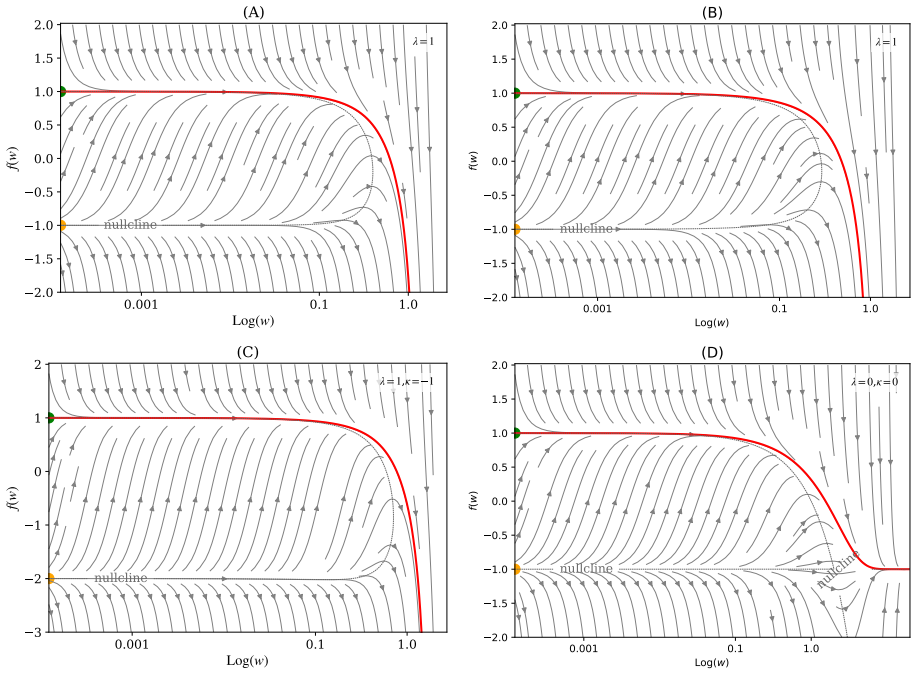
We investigate the attractor of spin density in relativistic spin hydrodynamics using Zubarev's non-equilibrium statistical operator formalism in the spin probe limit. We derive the (0+1)D Bjorken flow equations and the associated attractor equation while retaining second order gradient corrections in the relevant relaxation constitutive equations including couplings associated with nonlinear response and nonlocal memory effects. We analyze the early time fixed point structure and analytically determine the early time attractor solution, thereby clarifying branch selection and the role of different dynamical corrections. We find that source-like driving terms modify the leading correction to the attractor solution without changing the fixed point structure, whereas self feedback terms involving the rotational stress tensor modify the dominant balance and modify the early time fixed point structure. We further study the late time asymptotic behavior in the conformal limit and show that the newly added terms affect the first subleading asymptotics without changing the leading late time branches. These results provide a unified picture of early and late time attractor dynamics in the conformal limit.
Editorial analysis
A structured set of objections, weighed in public.
Referee Report
Summary. The paper derives (0+1)D Bjorken flow equations and the associated attractor equation for spin density in relativistic second-order spin hydrodynamics within Zubarev's non-equilibrium statistical operator formalism, restricted to the spin probe limit. It retains second-order gradient corrections including nonlinear response and nonlocal memory effects, analytically determines the early-time fixed-point structure and attractor solution, and examines late-time asymptotics in the conformal limit. The central results are that source-like driving terms modify only the leading correction to the attractor without altering fixed points, while self-feedback terms involving the rotational stress tensor modify the dominant balance and early-time fixed-point structure, and the new terms affect only first subleading late-time asymptotics without changing leading branches.
Significance. If the derivations are internally consistent, the work provides an analytical classification of how distinct classes of second-order corrections influence early- and late-time attractor dynamics in spin hydrodynamics. The explicit early-time fixed-point analysis and late-time branch identification constitute a concrete advance for modeling spin polarization observables.
major comments (2)
- [Derivation of the attractor equation and early-time fixed-point analysis] The central distinction between source-like driving terms and self-feedback terms from the rotational stress tensor (which are reported to modify the early-time fixed-point structure) is drawn under the spin probe limit. No explicit ordering argument is supplied showing that the rotational stress contributions remain at leading order when spin density is parametrically small, nor that the probe expansion commutes with the gradient expansion used to construct the attractor equation. This ordering must be demonstrated for the reported change in fixed-point structure to be robust.
- [Late-time asymptotics in the conformal limit] The late-time asymptotic analysis in the conformal limit asserts that newly added terms affect only the first subleading correction without altering the leading branches. The manuscript should supply the explicit subleading expansion (including the coefficient of the first correction) to substantiate this claim.
minor comments (2)
- Notation for the relaxation constitutive relations should be introduced with explicit reference to the underlying Zubarev operator expansion to avoid ambiguity in the nonlinear and memory terms.
- Figure captions for the early-time attractor trajectories should state the precise initial conditions and parameter values used.
Simulated Author's Rebuttal
We thank the referee for the careful reading and constructive comments on our manuscript. We address the two major comments point by point below, indicating the revisions we will make.
read point-by-point responses
-
Referee: [Derivation of the attractor equation and early-time fixed-point analysis] The central distinction between source-like driving terms and self-feedback terms from the rotational stress tensor (which are reported to modify the early-time fixed-point structure) is drawn under the spin probe limit. No explicit ordering argument is supplied showing that the rotational stress contributions remain at leading order when spin density is parametrically small, nor that the probe expansion commutes with the gradient expansion used to construct the attractor equation. This ordering must be demonstrated for the reported change in fixed-point structure to be robust.
Authors: We thank the referee for identifying this gap in the presentation. While the spin probe limit treats the spin density as parametrically small and the rotational stress tensor enters at the same gradient order in the constitutive relations, we agree that an explicit ordering argument is required to confirm robustness. In the revised manuscript we will insert a new paragraph immediately following the definition of the spin probe limit, demonstrating that the probe expansion commutes with the gradient expansion for the attractor equation and that the self-feedback terms remain leading-order contributions to the fixed-point structure. revision: yes
-
Referee: [Late-time asymptotics in the conformal limit] The late-time asymptotic analysis in the conformal limit asserts that newly added terms affect only the first subleading correction without altering the leading branches. The manuscript should supply the explicit subleading expansion (including the coefficient of the first correction) to substantiate this claim.
Authors: We agree that the claim would be strengthened by an explicit subleading expansion. In the revised manuscript we will derive and display the first subleading correction to the late-time attractor solution in the conformal limit, including the explicit coefficient multiplying the leading correction term, and we will update the text to reference this expansion directly. revision: yes
Circularity Check
No circularity; derivation self-contained from formalism
full rationale
The paper derives the (0+1)D Bjorken flow and attractor equations from Zubarev's non-equilibrium statistical operator in the spin probe limit, retaining second-order gradient corrections including nonlinear and memory effects. Early-time fixed-point analysis and late-time asymptotics are obtained analytically from these constitutive relations. No self-definitional steps, fitted parameters presented as predictions, or load-bearing self-citations appear. The central claims follow directly from the chosen equations and expansions without reduction to inputs by construction. The spin probe limit is an explicit modeling assumption, not a derived result.
Axiom & Free-Parameter Ledger
Reference graph
Works this paper leans on
-
[1]
Globally Polarized Quark-gluon Plasma in Non-central A+A Collisions
Z.-T. Liang and X.-N. Wang, Phys. Rev. Lett.94, 102301 (2005), [Erratum: Phys.Rev.Lett. 96, 039901 (2006)], arXiv:nucl-th/0410079
work page internal anchor Pith review Pith/arXiv arXiv 2005
-
[2]
Spin Alignment of Vector Mesons in Non-central A+A Collisions
Z.-T. Liang and X.-N. Wang, Phys. Lett. B629, 20 (2005), arXiv:nucl-th/0411101
work page internal anchor Pith review Pith/arXiv arXiv 2005
-
[3]
Relativistic distribution function for particles with spin at local thermodynamical equilibrium
F. Becattini, V. Chandra, L. Del Zanna, and E. Grossi, Annals Phys.338, 32 (2013), arXiv:1303.3431 [nucl-th]. 21
work page internal anchor Pith review Pith/arXiv arXiv 2013
-
[4]
Global $\Lambda$ hyperon polarization in nuclear collisions: evidence for the most vortical fluid
L. Adamczyket al.(STAR), Nature548, 62 (2017), arXiv:1701.06657 [nucl-ex]
work page internal anchor Pith review Pith/arXiv arXiv 2017
-
[5]
J. Adamet al.(STAR), Phys. Rev. Lett.126, 162301 (2021), [Erratum: Phys.Rev.Lett. 131, 089901 (2023)], arXiv:2012.13601 [nucl-ex]
- [6]
- [7]
- [8]
- [9]
-
[10]
Study of Lambda polarization in relativistic nuclear collisions at sqrt{s}_NN = 7.7-200 GeV
I. Karpenko and F. Becattini, Eur. Phys. J. C77, 213 (2017), arXiv:1610.04717 [nucl-th]
work page internal anchor Pith review Pith/arXiv arXiv 2017
-
[11]
S. Acharyaet al.(ALICE), Phys. Rev. Lett.131, 042303 (2023), arXiv:2204.10171 [nucl-ex]
- [12]
-
[13]
F. Becattini and M. A. Lisa, Ann. Rev. Nucl. Part. Sci.70, 395 (2020), arXiv:2003.03640 [nucl-ex]
-
[14]
F. Becattini, Rept. Prog. Phys.85, 122301 (2022), arXiv:2204.01144 [nucl-th]
- [15]
-
[16]
F. Becattini, M. Buzzegoli, T. Niida, S. Pu, A.-H. Tang, and Q. Wang, Int. J. Mod. Phys. E33, 2430006 (2024), arXiv:2402.04540 [nucl-th]
-
[17]
Relativistic fluid dynamics with spin
W. Florkowski, B. Friman, A. Jaiswal, and E. Speranza, Phys. Rev. C97, 041901 (2018), arXiv:1705.00587 [nucl-th]
work page internal anchor Pith review Pith/arXiv arXiv 2018
-
[18]
W. Florkowski, A. Kumar, and R. Ryblewski, Prog. Part. Nucl. Phys.108, 103709 (2019), arXiv:1811.04409 [nucl-th]
-
[19]
S. Li and H.-U. Yee, Phys. Rev. D100, 056022 (2019), arXiv:1905.10463 [hep-ph]
-
[20]
M. Hongo, X.-G. Huang, M. Kaminski, M. Stephanov, and H.-U. Yee, JHEP08, 263 (2022), arXiv:2201.12390 [hep-th]
-
[21]
N. Weickgenannt, D. Wagner, E. Speranza, and D. H. Rischke, Phys. Rev. D106, 096014 (2022), arXiv:2203.04766 [nucl-th]
-
[22]
S. Bhadury, W. Florkowski, A. Jaiswal, A. Kumar, and R. Ryblewski, Phys. Lett. B814, 136096 (2021), arXiv:2002.03937 [hep-ph]
- [23]
-
[24]
S. Bhadury, W. Florkowski, A. Jaiswal, A. Kumar, and R. Ryblewski, Phys. Rev. D103, 014030 (2021), arXiv:2008.10976 [nucl-th]
-
[25]
H.-H. Peng, J.-J. Zhang, X.-L. Sheng, and Q. Wang, Chin. Phys. Lett.38, 116701 (2021), arXiv:2107.00448 [hep-th]
-
[26]
N. Weickgenannt, D. Wagner, and E. Speranza, Phys. Rev. D105, 116026 (2022), arXiv:2204.01797 [nucl-th]
-
[27]
N. Weickgenannt, D. Wagner, E. Speranza, and D. H. Rischke, Phys. Rev. D106, L091901 (2022), arXiv:2208.01955 [nucl-th]
-
[28]
Fate of spin polarization in a relativistic fluid: An entropy-current analysis
K. Hattori, M. Hongo, X.-G. Huang, M. Matsuo, and H. Taya, Phys. Lett. B795, 100 (2019), arXiv:1901.06615 [hep-th]
work page internal anchor Pith review Pith/arXiv arXiv 2019
-
[29]
K. Fukushima and S. Pu, Phys. Lett. B817, 136346 (2021), arXiv:2010.01608 [hep-th]
- [30]
- [31]
-
[32]
M. Hongo, X.-G. Huang, M. Kaminski, M. Stephanov, and H.-U. Yee, JHEP11, 150 (2021), arXiv:2107.14231 [hep-th]
- [33]
- [34]
- [35]
- [36]
-
[37]
M. Garbiso and M. Kaminski, JHEP12, 112 (2020), arXiv:2007.04345 [hep-th]
- [38]
- [39]
-
[40]
The ideal relativistic fluid limit for a medium with polarization
D. Montenegro, L. Tinti, and G. Torrieri, Phys. Rev. D96, 056012 (2017), [Addendum: Phys. Rev. D 96, 079901 (2017)], arXiv:1701.08263 [hep-th]
work page internal anchor Pith review Pith/arXiv arXiv 2017
-
[41]
D. Montenegro and G. Torrieri, Phys. Rev. D102, 036007 (2020), arXiv:2004.10195 [hep-th]
- [42]
- [43]
- [44]
-
[45]
M. P. Heller and M. Spalinski, Phys. Rev. Lett.115, 072501 (2015), arXiv:1503.07514 [hep-th]
work page internal anchor Pith review Pith/arXiv arXiv 2015
-
[46]
M. P. Heller and M. Spali´ nski, Phys. Rev. Lett.115, 072501 (2015)
2015
-
[47]
G. S. Denicol and J. Noronha, (2016), arXiv:1608.07869 [nucl-th]
work page internal anchor Pith review Pith/arXiv arXiv 2016
- [48]
-
[49]
M. P. Heller, A. Kurkela, M. Spali´ nski, and V. Svensson, Phys. Rev. D97, 091503 (2018), arXiv:1609.04803 [nucl-th]
work page internal anchor Pith review Pith/arXiv arXiv 2018
-
[50]
C. Chattopadhyay, S. Jaiswal, L. Du, U. Heinz, and S. Pal, Phys. Lett. B824, 136820 (2022), arXiv:2107.05500 [nucl-th]
-
[51]
S. Jaiswal, S. Pal, C. Chattopadhyay, L. Du, and U. Heinz, Acta Phys. Polon. Supp.16, 1 (2023), arXiv:2208.00744 [nucl-th]
-
[52]
S. Jaiswal, J.-P. Blaizot, R. S. Bhalerao, Z. Chen, A. Jaiswal, and L. Yan, Phys. Rev. C106, 044912 (2022), arXiv:2208.02750 [nucl-th]
-
[53]
The anisotropic non-equilibrium hydrodynamic attractor
M. Strickland, J. Noronha, and G. Denicol, Phys. Rev. D97, 036020 (2018), arXiv:1709.06644 [nucl-th]
work page internal anchor Pith review Pith/arXiv arXiv 2018
-
[54]
Romatschke, Phys
P. Romatschke, Phys. Rev. Lett.120, 012301 (2018)
2018
-
[55]
G. S. Denicol and J. Noronha, Phys. Rev. D99, 116004 (2019)
2019
-
[56]
Du, X.-G
Z. Du, X.-G. Huang, and H. Taya, Phys. Rev. D104, 056022 (2021)
2021
-
[57]
Romatschke, JHEP12, 079 (2017)
P. Romatschke, JHEP12, 079 (2017)
2017
-
[58]
Chen and L
Z. Chen and L. Yan, Phys. Rev. C105, 024910 (2022)
2022
-
[59]
Strickland, JHEP12, 128 (2018), arXiv:1809.01200 [nucl-th]
M. Strickland, JHEP12, 128 (2018), arXiv:1809.01200 [nucl-th]
-
[60]
D. Almaalol, A. Kurkela, and M. Strickland, Phys. Rev. Lett.125, 122302 (2020), arXiv:2004.05195 [hep-ph]
- [61]
-
[62]
Fluid dynamics of out of equilibrium boost invariant plasmas
J.-P. Blaizot and L. Yan, Phys. Lett. B780, 283 (2018), arXiv:1712.03856 [nucl-th]
work page internal anchor Pith review Pith/arXiv arXiv 2018
-
[63]
J.-P. Blaizot and L. Yan, Phys. Rev. C104, 055201 (2021), arXiv:2106.10508 [nucl-th]. 23
-
[64]
G. S. Denicol and J. Noronha, Phys. Rev. D97, 056021 (2018), arXiv:1711.01657 [nucl-th]
work page internal anchor Pith review Pith/arXiv arXiv 2018
-
[65]
A. Behtash, C. N. Cruz-Camacho, S. Kamata, and M. Martinez, Phys. Lett. B797, 134914 (2019), arXiv:1805.07881 [hep-th]
-
[66]
Far-from-equilibrium attractors and nonlinear dynamical systems approach to the Gubser flow
A. Behtash, C. N. Cruz-Camacho, and M. Martinez, Phys. Rev. D97, 044041 (2018), arXiv:1711.01745 [hep-th]
work page internal anchor Pith review Pith/arXiv arXiv 2018
-
[67]
Dynamical systems and nonlinear transient rheology of the far-from-equilibrium Bjorken flow
A. Behtash, S. Kamata, M. Martinez, and H. Shi, Phys. Rev. D99, 116012 (2019), arXiv:1901.08632 [hep-th]
work page internal anchor Pith review Pith/arXiv arXiv 2019
-
[68]
K. Boguslavski, A. Kurkela, T. Lappi, F. Lindenbauer, and J. Peuron, Phys. Lett. B852, 138623 (2024), arXiv:2312.11252 [hep-ph]
-
[69]
K. Boguslavski, A. Kurkela, T. Lappi, F. Lindenbauer, and J. Peuron, (2024), arXiv:2401.09088 [hep-ph]
-
[70]
Brewer, L
J. Brewer, L. Yan, and Y. Yin, Phys. Lett. B816, 136189 (2021)
2021
-
[71]
K. Rajagopal, B. Scheihing-Hitschfeld, and R. Steinhorst, (2024), arXiv:2405.17545 [hep-ph]
-
[72]
M. P. Heller, R. Jefferson, M. Spali´ nski, and V. Svensson, Phys. Rev. Lett.125, 132301 (2020)
2020
-
[73]
Spali´ nski, (2025), arXiv:2508.21039 [nucl-th]
M. Spali´ nski, (2025), arXiv:2508.21039 [nucl-th]
- [74]
-
[75]
P. Romatschke and U. Romatschke,Relativistic Fluid Dynamics In and Out of Equilibrium(Cam- bridge University Press, 2019) arXiv:1712.05815 [nucl-th]
work page internal anchor Pith review Pith/arXiv arXiv 2019
-
[76]
A. Soloviev, Eur. Phys. J. C82, 319 (2022), arXiv:2109.15081 [hep-th]
-
[77]
J. Jankowski and M. Spali´ nski, Prog. Part. Nucl. Phys.132, 104048 (2023), arXiv:2303.09414 [nucl-th]
- [78]
- [79]
- [80]
discussion (0)
Sign in with ORCID, Apple, or X to comment. Anyone can read and Pith papers without signing in.