REVIEW 3 major objections 2 minor 48 references
Biophoton Emission from Palm during Meditation: A Multi-Method Complexity Analysis
T0 review · 3 major / 2 minor · reviewed 2026-06-29 · grok-4.3
Pith's one-line read Meditation produces a consistent reduction in the intermittency of biophoton emissions from the palm.
desk verdict Single-subject palm UPE study finds consistent drop in intermittency during meditation across four methods, but fixed-order design leaves the cause untested. read the letter →
The pith
A machine-rendered reading of the paper's core claim, the machinery that carries it, and where it could break.
The reading
What carries the argument
Multi-method complexity analysis of photon count time series, with stripe-filtered diffusion entropy analysis tracking the non-ergodic renewal regime and scaling exponent, plus Renyi entropy with time-reversal testing for amplitude and sequential effects.
What would settle it
A follow-up experiment on multiple subjects that includes sham meditation sessions at randomized times and finds no reduction in intermittency during the breathing phase.
Extended reading notes
Core claim
Biophoton emission from the palm enters a less intermittent state during structured meditation, shown by a Pre-to-Meditation drop in the scaling exponent from stripe-filtered diffusion entropy analysis together with reduced marginal burstiness and increased sequential structure in Renyi entropy, all replicated across the three independent sessions.
Load-bearing premise
Observed changes in photon count statistics are caused by the meditation protocol rather than by time of day, subject expectations, or measurement artifacts in a single-subject design without sham controls.
Editorial extensions
If this is right
- Photon emission intermittency from the palm tracks physiological modulation by voluntary breathing practices.
- The same multi-method framework can be applied to other body sites or meditation styles to map the spatial and practice-specific extent of the effect.
- Human ultraweak photon emission responds to internal state changes in a manner consistent with cardiac and neural complexity shifts.
- Complementary statistical, scaling, and entropy measures can converge on a single coherent description of biological intermittency changes.
Reading between the lines
- If the reduction proves replicable across subjects, palm biophoton counts could become a non-contact readout for certain meditative or relaxed states.
- The single-subject limitation means the result could still reflect an idiosyncratic response rather than a general feature of the meditation protocol.
- Testing whether the intermittency drop appears under other rhythmic interventions, such as paced breathing without meditative framing, would clarify the role of attention versus rhythm alone.
Signed reviews
Editorial analysis
A structured set of objections, weighed in public.
Referee Report
Summary. The manuscript reports ultra-weak photon emission (UPE) measurements from the right palm of a single human subject across three independent sessions, each with fixed 15-min phases (Dark, Pre, Meditation via Sama Vritti box-breathing, Post). Four complementary methods—distributional statistics (Fano factor, skewness, Expected Shortfall), multiscale Fano factor/Allan deviation, stripe-filtered Diffusion Entropy Analysis (DEA), and Renyi entropy with time-reversal test—are applied to photon count series. The central claim is that these methods converge on a systematic reduction of emission intermittency during the meditation phase, with DEA indicating a shift in the non-ergodic renewal regime and Renyi metrics showing reduced burstiness plus increased sequential structure, interpreted as entrainment to the breathing rhythm and consistent with prior cardiac/EEG findings.
Significance. If the observed intermittency reduction can be causally attributed to the meditation protocol, the work supplies a proof-of-concept multi-method complexity framework for human UPE under physiological modulation, with explicit links to cardiac complexity transitions (Tuladhar et al.) and EEG reorganization during Sama Vritti (Zaccaro et al.). The complementary sensitivities of the four analysis families constitute a methodological strength; however, the single-subject design without controls limits generalizability and immediate physiological interpretation.
major comments (3)
- [Abstract/Methods description] Abstract/Methods description: The headline claim of a 'systematic reduction of emission intermittency during meditation' attributable to the Sama Vritti protocol rests on a single-subject design with three non-randomized sessions in fixed phase order (Dark-Pre-Med-Post) and no sham breathing condition, blinded measurement, or time-matched control sessions. This leaves the Pre-to-Med drop in Fano factor, DEA scaling exponent, and Renyi Tdir/Tseq open to diurnal variation, expectation, or instrument drift, directly undermining the attribution required for the stated physiological interpretation.
- [Abstract/Results] Abstract/Results: No error bars, sample-size justification, or statistical tests (e.g., session-by-phase interaction) are reported despite the claim of 'consistent' effects across the three sessions; the abstract provides only directional statements, which is load-bearing for the convergence narrative.
- [Abstract] Abstract: The interpretation that Renyi Tseq increase reflects 'entrainment to the Sama Vritti rhythm' is presented without a quantitative test linking the breathing period to the observed sequential structure, weakening the entrainment claim that supports the multi-channel physiological response narrative.
minor comments (2)
- [Abstract] Abstract: The phrase 'parameter-free' is not used, but the methods section should explicitly state whether any thresholds in stripe-filtered DEA or Renyi time-reversal are chosen post-hoc or fixed a priori.
- The manuscript would benefit from a table summarizing the direction and magnitude of change for each metric (Fano, DEA exponent, Tdir, Tseq) across the three sessions to allow direct assessment of consistency.
Simulated Author's Rebuttal
We thank the referee for the constructive feedback. We respond point-by-point to the major comments below. Revisions have been made to the abstract and discussion to better qualify the preliminary nature of the findings and to moderate interpretive claims.
read point-by-point responses
-
Referee: [Abstract/Methods description] The headline claim of a 'systematic reduction of emission intermittency during meditation' attributable to the Sama Vritti protocol rests on a single-subject design with three non-randomized sessions in fixed phase order (Dark-Pre-Med-Post) and no sham breathing condition, blinded measurement, or time-matched control sessions. This leaves the Pre-to-Med drop in Fano factor, DEA scaling exponent, and Renyi Tdir/Tseq open to diurnal variation, expectation, or instrument drift, directly undermining the attribution required for the stated physiological interpretation.
Authors: We agree that the single-subject design with fixed phase ordering precludes definitive causal attribution to the meditation protocol. The study is framed as a proof-of-concept demonstration of the multi-method complexity framework applied to human UPE. We have revised the abstract and discussion to state that reductions in intermittency were observed consistently during the meditation phase across the three sessions, while explicitly noting that alternative explanations such as order effects cannot be ruled out and that controlled studies with larger samples are required for physiological interpretation. revision: partial
-
Referee: [Abstract/Results] No error bars, sample-size justification, or statistical tests (e.g., session-by-phase interaction) are reported despite the claim of 'consistent' effects across the three sessions; the abstract provides only directional statements, which is load-bearing for the convergence narrative.
Authors: We have revised the abstract to include the sample size (three sessions) and to qualify the consistency as directional agreement across sessions. In the results section we now report session-to-session variability (mean and range) for the primary metrics and include error bars on summary plots where feasible. With only three sessions, formal interaction tests lack power; we therefore retain the emphasis on directional convergence while acknowledging the small sample as a limitation. revision: yes
-
Referee: [Abstract] The interpretation that Renyi Tseq increase reflects 'entrainment to the Sama Vritti rhythm' is presented without a quantitative test linking the breathing period to the observed sequential structure, weakening the entrainment claim that supports the multi-channel physiological response narrative.
Authors: We have revised the abstract wording to present the Tseq increase as consistent with possible entrainment to the breathing rhythm rather than as direct evidence of entrainment. A quantitative test linking the specific 4-second breathing cycle to the observed sequential structure is not performed in the current data set and is noted as a direction for future work. revision: partial
Circularity Check
No circularity: purely empirical data analysis with no self-referential derivations
full rationale
The manuscript applies four standard statistical methods (Fano factor, multiscale Allan deviation, stripe-filtered DEA, Renyi entropy with time-reversal test) directly to raw photon-count time series collected in fixed-order phases. No equations are presented whose outputs are defined in terms of their own inputs, no parameters are fitted to a subset and then relabeled as predictions, and no uniqueness theorems or ansatzes are imported via self-citation. The central observation—a Pre-to-Meditation drop in intermittency metrics—is a direct empirical comparison of measured distributions and scaling exponents; it does not reduce to any of the enumerated circular patterns. External citations to Tuladhar et al. and Zaccaro et al. supply physiological context but are not required for the UPE statistics themselves.
Assumptions & free parameters
Cite this review
Pith. "Pith review of Biophoton Emission from Palm during Meditation: A Multi-Method Complexity Analysis." pith.science (2026). https://pith.science/paper/TGEPTBUQ
@misc{pith2026260526758,
  author       = {Pith},
  title        = {Pith review of: Biophoton Emission from Palm during Meditation: A Multi-Method Complexity Analysis},
  year         = {2026},
  howpublished = {\url{https://pith.science/paper/TGEPTBUQ}},
  note         = {Machine review of arXiv:2605.26758}
}
read the original abstract
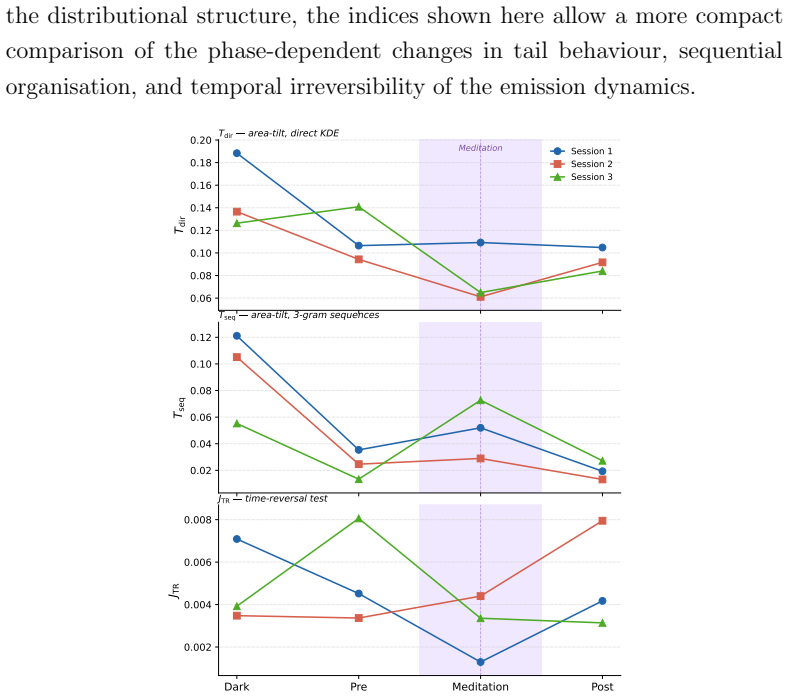
Biophotons are ultra-weak photon emissions in the visible spectrum produced by living organisms. While extensively studied in plants, germinating seeds, and cell cultures, no systematic multi-method complexity analysis of human ultraweak photon emission (UPE) under physiological modulation has been reported. We address this gap by applying a comprehensive analytical framework to UPE measurements from the right palm of a human subject. Three independent sessions were conducted on different days, each comprising four consecutive 15-minute phases: Dark reference, pre-meditation resting state (Pre), structured meditation based on the Sama Vritti box-breathing protocol, and post-meditation recovery (Post). Photon count series are analysed with four complementary methods: distributional statistics (Fano factor, skewness, tail Expected Shortfall); multiscale Fano factor and Allan deviation; stripe-filtered Diffusion Entropy Analysis (DEA); and Renyi entropy with a Time Reversal test. The methods show complementary sensitivities, converging on a coherent picture: a systematic reduction of emission intermittency during meditation, consistently detected across all three sessions. Stripe-filtered DEA places the emission in the non-ergodic renewal regime with a Pre-to-Meditation decrease of the scaling exponent. Renyi analysis reveals two effects: reduced marginal amplitude burstiness (Tdir) and increased sequential pattern structure (Tseq), interpreted as entrainment to the Sama Vritti rhythm. These findings are consistent with cardiac complexity transitions during meditation reported by Tuladhar et al. and with EEG reorganization during Sama Vritti breathing by Zaccaro et al., suggesting a coordinated multi-channel physiological response. The results establish a proof-of-concept framework for complexity analysis of human UPE under physiological modulation.
Figures


Figures from the paper (5 more)




Reference graph
Works this paper leans on
-
[1]
F. A. Popp, Q. Gu, and K. H. Li. Biophoton emission: Experimental background and theoretical approaches.Mod. Phys. Lett. B, 8:1269–1296, 1994
1994
-
[2]
Van Wijk.Light in Shaping Life: Biophotons in Biology and Medicine
R. Van Wijk.Light in Shaping Life: Biophotons in Biology and Medicine. Boekenservice, Almere, The Netherlands, 2014
2014
-
[3]
Cifra and P
M. Cifra and P. Posp´ ıˇ sil. Ultra-weak photon emission from biological samples: Definition, mechanisms, properties, detection and applications. J. Photochem. Photobiol. B, 139:2–10, 2014
2014
-
[4]
Slawinski
J. Slawinski. Biophotons from stressed and dying organisms: Toxicologi- cal aspects.Indian J. Exp. Biol., 41(5):483–493, 2003
2003
-
[5]
Janusz Slawinski.Photon Emission from Perturbed and Dying Organisms — The Concept of Photon Cycling in Biological Systems, pages 307–329. 01 2003
2003
-
[6]
Colli and U
L. Colli and U. Facchini. Light emission by germinating plant.Il Nuovo Cimento, 12(1):150–153, 1954
1954
-
[7]
Colli, U
L. Colli, U. Facchini, G. Guidotti, R. D. Lonati, M. Orsenigo, and O. Sommariva. Further measurements on the bioluminescence of the seedlings.Experientia, 11:479–481, 1955
1955
-
[8]
C. M. Gallep and S. R. Dos Santos. Photon-count during germination of wheat (triticum aestivum) in wastewater sediment solution correlated with seedling growth.Seed Sci. Technol., 35:607–614, 2007
2007
Show all 48 references
-
[9]
L. V. Beloussov, A. B. Burlakov, and N. N. Louchinskaia. Biophotonic pattern of optical interaction between fish eggs and embryos.Indian J. Exp. Biol., 41(5):424–430, 2003
2003
-
[10]
Benfatto, E
M. Benfatto, E. Pace, C. Curceanu, A. Scordo, A. Clozza, I. Davoli, M. Lucci, R. Francini, F. De Matteis, M. Grandi, R. Tuladhar, and 44 P. Grigolini. Biophotons and emergence of quantum coherence—a diffu- sion entropy analysis.Entropy, 23:554, 2021
2021
-
[11]
De Paolis, R
L. De Paolis, R. Francini, I. Davoli, F. De Matteis, A. Scordo, A. Clozza, M. Grandi, E. Pace, C. Curceanu, P. Grigolini, and M. Benfatto. Bio- photons: A hard problem.Applied Sciences, 14(13):5496, 2024
2024
-
[12]
De Paolis, E
L. De Paolis, E. Pace, C. M. Mazzanti, M. Morelli, F. Di Lorenzo, I. Davoli, L. Tonello, C. Curceanu, A. Clozza, M. Grandi, P. Grigolini, and M. Benfatto. First experimental measurements of biophotons from astrocytes and glioblastoma cell cultures.Entropy, 28(1):112, 2026
2026
-
[13]
J. Li, C. Xia, Y. Wang, L. Chen, and J. Dai. In vivo imaging of biophoton emission in the whole brain of mice.Natural Science, 13(2):407–411, 2021
2021
-
[14]
Salari, H
V. Salari, H. Valian, H. Bassereh, I. B´ okkon, and A. Barkhordari. Ultra- weak photon emission in the brain.Journal of Integrative Neuroscience, 14(3):419–429, 2015
2015
-
[15]
Salari, V
V. Salari, V. Seshan, L. Frankle, D. England, C. Simon, and D. Oblak. Imaging ultraweak photon emission from living and dead mice and from plants under stress.The Journal of Physical Chemistry Letters, 16(17):4354–4362, 2025
2025
-
[16]
Tsuchida, T
K. Tsuchida, T. Iwasa, and M. Kobayashi. Imaging of ultraweak photon emission for evaluating the oxidative stress of human skin.Journal of Photochemistry and Photobiology B: Biology, 198:111562, 2019
2019
-
[17]
L. W. E. Tessaro, B. T. Dotta, and M. A. Persinger. Bacterial biophotons as non-local information carriers: Species-specific spectral characteristics of a stress response.Microbiol. Open, 8:761, 2019
2019
-
[18]
F. A. Popp. Cancer growth and its inhibition in terms of coherence. Electromag. Biol. Med., 28:53–60, 2009. 45
2009
-
[19]
The concept of biopho- tonic signaling in the human body and brain: rationale, problems and directions.Frontiers in systems neuroscience, 19:1597329, 2025
Ganna Nevoit, Kristina Poderiene, Maksim Potyazhenko, Ozar Mintser, Gediminas Jarusevicius, and Alfonsas Vainoras. The concept of biopho- tonic signaling in the human body and brain: rationale, problems and directions.Frontiers in systems neuroscience, 19:1597329, 2025
2025
-
[20]
Spatial characterization of human ultra-weak photon emission
Roeland Van Wijk, Masaki Kobayashi, and Eduard PA Van Wijk. Spatial characterization of human ultra-weak photon emission. InBiophotonics and coherent systems in biology, pages 177–189. Springer, 2007
2007
-
[21]
Light emission from the human body.Complement Med Res, 3:16–19, 1989
R Edwards, MC Ibison, J Jessel-Kenyon, and RB Taylor. Light emission from the human body.Complement Med Res, 3:16–19, 1989
1989
-
[22]
Multi-site recording and spectral analysis of spontaneous photon emission from human body
Eduard PA Van Wijk and Roeland Van Wijk. Multi-site recording and spectral analysis of spontaneous photon emission from human body. Forsch. Komplement¨ armed. Klass. Naturheilkd, 12:96–106, 2005
2005
-
[23]
Roeland Van Wijk, Masaki Kobayashi, and Eduard PA Van Wijk. Anatomic characterization of human ultra-weak photon emission with a moveable photomultiplier and ccd imaging.Journal of Photochemistry and Photobiology B: Biology, 83(1):69–76, 2006
2006
-
[24]
Roeland Van Wijk, Eduard P. A. Van Wijk, and Michal Cifra. Sponta- neous ultra-weak photon emission from human hands varies diurnally. In Markus Faupel and Henricus J. C. M. Sterenborg, editors,Photonics in Dermatology and Plastic Surgery, volume 6633 ofProc. SPIE, page 66330L, 2007
2007
-
[25]
Imaging of ultraweak spontaneous photon emission from human body displaying diurnal rhythm.PLoS one, 4(7):e6256, 2009
Masaki Kobayashi, Daisuke Kikuchi, and Hitoshi Okamura. Imaging of ultraweak spontaneous photon emission from human body displaying diurnal rhythm.PLoS one, 4(7):e6256, 2009
2009
-
[26]
Year-long biophoton measurements: normalized frequency count analysis and seasonal dependency.Journal of Photochemistry and Photobiology B: Biology, 78(2):149–154, 2005
Hyun-Hee Jung, Joon-Mo Yang, Won-Myung Woo, Chunho Choi, Jong- Soo Yang, and Kwang-Sup Soh. Year-long biophoton measurements: normalized frequency count analysis and seasonal dependency.Journal of Photochemistry and Photobiology B: Biology, 78(2):149–154, 2005. 46
2005
-
[27]
Year long measurement of biophoton emission of hands and feet.NeuroQuantology, 6(4):464–471, 2008
Fr´ ed´ eric Laager, JC Choi, Sang-Hyun Park, Joon-Mo Yang, and Kwang- Sup Soh. Year long measurement of biophoton emission of hands and feet.NeuroQuantology, 6(4):464–471, 2008
2008
-
[28]
Whole-body counting of biophotons and its relation to biological rhythms
S Cohen and FA Popp. Whole-body counting of biophotons and its relation to biological rhythms. InBiophotons, pages 183–191. Springer, 1998
1998
-
[29]
Investigation on the biophysical features of strong luminescence phenomena in the 14 channel of human body
ZQ Yan, YQ Shi, and YZ Wang. Investigation on the biophysical features of strong luminescence phenomena in the 14 channel of human body. Zhen ci yan jiu= Acupuncture Research, 14(3):389–394, 1989
1989
-
[30]
Jun-Mo Yang, Hyun-Hee Jung, Won-Myung Woo, Seung-Ho Lee, Jong- Su Yang, Kwang-Sup Soh, and Gil-Won Yoon. Investigation of the correlation between left and right biophotons and between the palms and backs of the hands (in korean).Journal of the Optical Society of Korea, 15(4):3...
2004
-
[31]
Left-right asymmetry of biophoton emission from hemiparesis patients
Hyun Hee Jung, Won-Myung Woo, Joon-Mo Yang, Chunho Choi, Jong- han Lee, Gilwon Yoon, Jong S Yang, Sungmuk Lee, and Kwang-Sup Soh. Left-right asymmetry of biophoton emission from hemiparesis patients. Indian Journal of Experimental Biology, 41(5):452–456, 2003
2003
-
[32]
Effects of exercises on biophoton emission of the wrist
Fr´ ed´ eric Laager, Sang-Hyun Park, Joon-Mo Yang, Wook Song, and Kwang-Sup Soh. Effects of exercises on biophoton emission of the wrist. European journal of applied physiology, 102(4):463–469, 2008
2008
-
[33]
Yin/yang polarization: quantitative diagnostic evaluation using biophoton measurement from human hands and feet
Joon-Mo Yang, Chunho Choi, Ji Hun Yu, Kwang-Sup Soh, Sun Mi Choi, and Yeonhee Ryu. Yin/yang polarization: quantitative diagnostic evaluation using biophoton measurement from human hands and feet. The Journal of Alternative and Complementary Medicine: Paradigm, Practice, and Po...
2006
-
[34]
Eduard P. A. Van Wijk, John Ackerman, and Roeland Van Wijk. Ef- fect of meditation on ultraweak photon emission from hands and fore- head.Forschende Komplement¨ armedizin und Klassische Naturheilkunde, 12(2):107–112, 2005. 47
2005
-
[35]
Eduard P. A. Van Wijk, Heike Koch, Saskia Bosman, and Roeland Van Wijk. Anatomic characterization of human ultra-weak photon emis- sion in practitioners of transcendental meditation and control subjects. The Journal of Alternative and Complementary Medicine, 12(1):31–38, 2006
2006
-
[36]
Changes in biofield measures and experienced states during meditation and breathwork practices: an uncontrolled feasibility study.Frontiers in Psychology, 17:1623301, 2026
Natalie L Dyer, Meredith L Sprengel, Ivo Stuldreher, Koen van der Sanden, Anne-Marie Brouwer, S´ ebastien Velut, John A Ives, Yu Yan, and Eduard van Wijk. Changes in biofield measures and experienced states during meditation and breathwork practices: an uncontrolled feasibilit...
2026
-
[37]
Neural correlates of non-ordinary states of consciousness in Pranayama practitioners: the role of slow nasal breathing
Andrea Zaccaro, Andrea Piarulli, Lorenza Melosini, Danilo Menicucci, and Angelo Gemignani. Neural correlates of non-ordinary states of consciousness in Pranayama practitioners: the role of slow nasal breathing. Frontiers in Systems Neuroscience, 16:803904, 2022
2022
-
[38]
Rohisha Tuladhar, Gyanendra Bohara, Paolo Grigolini, and Bruce J. West. Meditation-induced coherence and crucial events.Frontiers in Physiology, 9:626, 2018
2018
-
[39]
Jelinek, Rohisha Tuladhar, Garland Culbreth, Gyanendra Bohara, David Cornforth, Bruce J
Herbert F. Jelinek, Rohisha Tuladhar, Garland Culbreth, Gyanendra Bohara, David Cornforth, Bruce J. West, and Paolo Grigolini. Diffu- sion entropy vs. multiscale and R´ enyi entropy to detect progression of autonomic neuropathy.Frontiers in Physiology, 11:607324, 2021
2021
-
[40]
Advanced data analysis of spontaneous biophoton emission: A multi- method approach.arXiv, arXiv:2511.11080, 2025
Maurizio Benfatto, Luca De Paolis, Lucio Tonello, and Paolo Grigolini. Advanced data analysis of spontaneous biophoton emission: A multi- method approach.arXiv, arXiv:2511.11080, 2025
2025
-
[41]
S. B. Lowen and M. C. Teich.Fractal-Based Point Processes. Wiley- Interscience, Hoboken, NJ, 2005
2005
-
[42]
D. W. Allan. Statistics of atomic frequency standards.Proc. IEEE, 54(2):221–230, 1966. 48
1966
-
[43]
Scafetta and P
N. Scafetta and P. Grigolini. Scaling detection in time series: Diffusion entropy analysis.Phys. Rev. E, 66:036130, 2002
2002
-
[44]
Allegrini, P
P. Allegrini, P. Grigolini, P. Hamilton, L. Palatella, and G. Raffaelli. Memory beyond memory in heart beating, a sign of a healthy physiological condition.Phys. Rev. E, 65:041926, 2002
2002
-
[45]
Allegrini, V
P. Allegrini, V. Benci, P. Grigolini, P. Hamilton, G. Menconi, L. Palatella, G. Raffaelli, N. Scafetta, and M. Virgilio. Compression and diffusion: A joint approach to detect complexity.Chaos Solitons Fractals, 15(3):517– 535, 2003
2003
-
[46]
Grigolini
P. Grigolini. Emergence of biological complexity: Criticality, renewal and memory.Chaos Solitons Fractal, 81:575–588, 2015
2015
-
[47]
Culbreth, B
G. Culbreth, B. J. West, and P. Grigolini. Entropic approach to the detection of crucial events.Entropy, 21(2):178, 2019
2019
-
[48]
Allegrini, D
P. Allegrini, D. Menicucci, R. Bedini, L. Fronzoni, A. Gemignani, P. Par- adisi, and P. Grigolini. Spontaneous brain activity as a source of ideal 1/f noise.Phys. Rev. E, 80(6):061914, 2009. 49
2009
Reviewed June 29, 2026 · model on record in the stance chip above.
Discussion (0). Continue with ORCID to comment.