Tunable competing optical excitation pathways in the topological surface states of Bi₂Te₃
Pith reviewed 2026-06-29 17:15 UTC · model grok-4.3
The pith
Two coherent optical excitation pathways compete in the topological surface states of Bi2Te3, with their competition tunable by temperature via chemical potential shifts.
A machine-rendered reading of the paper's core claim, the machinery that carries it, and where it could break.
Core claim
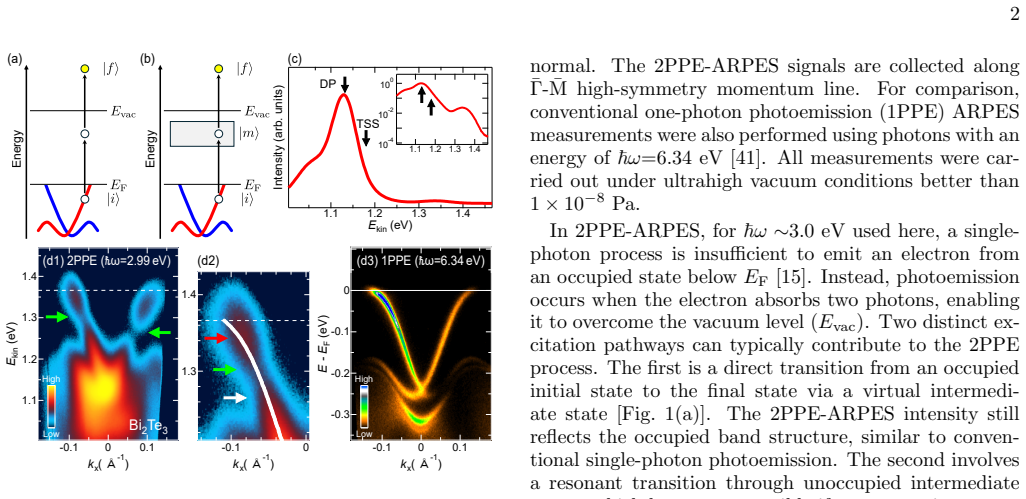
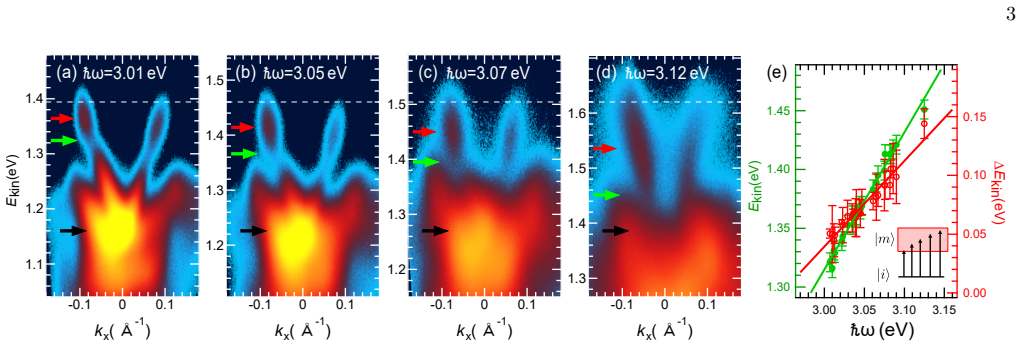
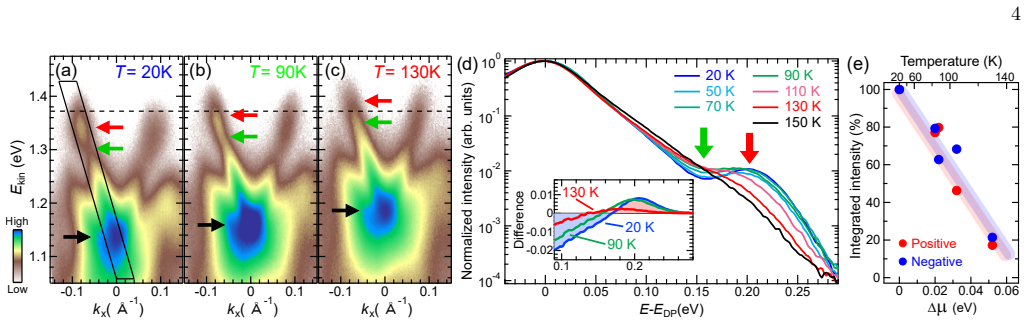
In the topological surface states of Bi2Te3, angle-resolved two-photon photoemission spectroscopy identifies two distinct excitation pathways: an off-resonant transition via virtual states and a resonant transition via unoccupied intermediate states. A pronounced modulation of the spectral response reveals competition between these two coherent pathways. This competition is tunable via temperature-induced shifts of the chemical potential, which selectively modify the resonant channel.
What carries the argument
Competition between an off-resonant pathway through virtual states and a resonant pathway through unoccupied intermediate states during two-photon excitation of topological surface states.
If this is right
- The spectral response of topological surface states can be modulated by changing temperature.
- Shifts in chemical potential selectively modify the resonant excitation channel.
- Microscopic control over optical excitation mechanisms in topological surface states becomes possible.
- These mechanisms are relevant for designing optical responses in future spintronic devices.
Where Pith is reading between the lines
- Similar pathway competitions might appear in other topological insulators and could be tuned by external gates rather than temperature alone.
- Device concepts that use temperature or doping to switch between resonant and off-resonant optical responses in surface states could be tested.
- The results raise the question of whether the same competition affects spin texture or photocurrent generation in these materials.
Load-bearing premise
The spectral modulation arises specifically from competition between the identified off-resonant virtual-state and resonant intermediate-state pathways rather than from other temperature-dependent effects such as scattering rates, matrix elements, or bulk-state contributions.
What would settle it
An observation that the spectral modulation remains unchanged when chemical potential is held fixed (via gating or doping) while temperature is varied would show the tuning is not due to chemical potential shifts affecting the resonant channel.
Figures
read the original abstract
Understanding coherent optical responses of topological surface states (TSSs) requires disentangling excitation pathways from the electronic band structure. Here, using angle-resolved two-photon photoemission spectroscopy, we identify two distinct excitation pathways in the TSSs of Bi$_2$Te$_3$: an off-resonant transition via virtual states and a resonant transition via unoccupied intermediate states. A pronounced modulation of the spectral response is observed, revealing a competition between the two coherent pathways. This competition is tunable via temperature-induced shifts of the chemical potential, which selectively modify the resonant channel. These results provide microscopic insight into the optical excitation mechanisms of TSSs and highlight the potential for controlling their optical responses, relevant for future spintronic devices.
Editorial analysis
A structured set of objections, weighed in public.
Referee Report
Summary. The manuscript uses angle-resolved two-photon photoemission spectroscopy on Bi₂Te₃ to identify two coherent excitation pathways in the topological surface states: an off-resonant channel via virtual states and a resonant channel via unoccupied intermediate states. It reports a pronounced modulation of the spectral response attributed to competition between these pathways, with the competition made tunable by temperature-induced shifts of the chemical potential that selectively affect the resonant channel.
Significance. If the central attribution holds, the work supplies microscopic insight into optical excitation mechanisms of topological surface states and demonstrates a route to control their responses, with potential relevance to spintronic devices. The experimental approach employs an established technique on a canonical material; however, the abstract supplies no supporting spectra, error bars, or controls, preventing evaluation of whether the result is robust.
major comments (2)
- [Abstract] The central claim (abstract) that the observed spectral modulation arises specifically from tunable competition between the off-resonant virtual-state and resonant intermediate-state pathways is load-bearing but unsupported by quantitative separation from other temperature-dependent effects. The manuscript must demonstrate that the modulation vanishes when the resonant channel is detuned by an independent means (e.g., doping or photon-energy tuning) while holding temperature fixed, or provide a model that isolates the pathway-competition contribution from changes in scattering rates, matrix elements, or bulk-state population.
- [Abstract] No data, error bars, reproducibility criteria, or exclusion analysis are referenced in the abstract or described in the provided text; without these, the claim that temperature acts only via μ(T) to modify the resonant channel cannot be assessed against alternative mechanisms.
minor comments (1)
- Notation for the two pathways should be defined consistently (e.g., explicit labels for virtual vs. intermediate states) when first introduced.
Simulated Author's Rebuttal
We thank the referee for the constructive comments on our manuscript. Below we respond point by point to the major comments, indicating where revisions will be incorporated to address the concerns raised.
read point-by-point responses
-
Referee: [Abstract] The central claim (abstract) that the observed spectral modulation arises specifically from tunable competition between the off-resonant virtual-state and resonant intermediate-state pathways is load-bearing but unsupported by quantitative separation from other temperature-dependent effects. The manuscript must demonstrate that the modulation vanishes when the resonant channel is detuned by an independent means (e.g., doping or photon-energy tuning) while holding temperature fixed, or provide a model that isolates the pathway-competition contribution from changes in scattering rates, matrix elements, or bulk-state population.
Authors: We agree that quantitative isolation of the pathway competition is essential. The manuscript presents a model in which the temperature dependence enters exclusively through the chemical potential shift μ(T) that moves the resonant intermediate state into or out of resonance while the off-resonant virtual pathway remains essentially unaffected. This model reproduces the observed spectral modulation. To strengthen the separation from other effects, we will add in the revised manuscript an explicit discussion with order-of-magnitude estimates showing that changes in scattering rates and matrix elements are too small to account for the measured temperature dependence, together with a brief comparison to a hypothetical temperature-independent detuning scenario. Independent experimental detuning at fixed temperature would require new measurements (doping series or photon-energy tuning) that are outside the scope of the present work. revision: partial
-
Referee: [Abstract] No data, error bars, reproducibility criteria, or exclusion analysis are referenced in the abstract or described in the provided text; without these, the claim that temperature acts only via μ(T) to modify the resonant channel cannot be assessed against alternative mechanisms.
Authors: The abstract is a concise summary and does not contain figures or quantitative details; all supporting spectra, error bars, reproducibility across multiple samples, and exclusion of alternative mechanisms are presented in the main text and supplementary information. We will revise the abstract to include a short clause referencing the supporting analysis in the main manuscript so that readers are immediately directed to the relevant data. revision: yes
- Independent experimental verification by detuning the resonant channel at fixed temperature (via doping or photon-energy change) is not available in the current dataset and would require additional measurements.
Circularity Check
No circularity: purely observational experimental study with no derivation chain
full rationale
The paper reports angle-resolved two-photon photoemission spectroscopy measurements on Bi2Te3 surface states. It identifies two excitation pathways from spectral features and observes temperature-dependent modulation attributed to chemical potential shifts. No equations, fitted parameters, or first-principles derivations are presented that could reduce to inputs by construction. The central claim is an empirical interpretation of data rather than a self-referential prediction or theorem. No self-citations are invoked as load-bearing uniqueness results. The work is self-contained against external benchmarks as standard spectroscopy with direct observation.
Axiom & Free-Parameter Ledger
axioms (1)
- domain assumption Standard assumptions of angle-resolved photoemission spectroscopy regarding transition pathways and spectral interpretation hold for the topological surface states.
Reference graph
Works this paper leans on
-
[1]
M. Z. Hasan and C. L. Kane, Colloquium: Topological insulators, Rev. Mod. Phys.82, 3045 (2010)
2010
-
[2]
Ando, Topological Insulator Materials, Journal of the Physical Society of Japan82, 102001 (2013)
Y. Ando, Topological Insulator Materials, Journal of the Physical Society of Japan82, 102001 (2013)
2013
-
[3]
Zhang, C.-X
H. Zhang, C.-X. Liu, X.-L. Qi, X. Dai, Z. Fang, and S.- C. Zhang, Topological insulators in Bi 2Se3, Bi 2Te3 and Sb2Te3 with a single Dirac cone on the surface, Nature Physics5, 438 (2009)
2009
-
[4]
Y. Xia, D. Qian, D. Hsieh, L. Wray, A. Pal, H. Lin, A. Bansil, D. Grauer, Y. S. Hor, R. J. Cava, and M. Z. Hasan, Observation of a large-gap topological-insulator class with a single Dirac cone on the surface, Nature Physics5, 398 (2009)
2009
-
[5]
Y. L. Chen, J. G. Analytis, J.-H. Chu, Z. K. Liu, S.- K. Mo, X. L. Qi, H. J. Zhang, D. H. Lu, X. Dai, Z. Fang, S. C. Zhang, I. R. Fisher, Z. Hussain, and Z.-X. Shen, Experimental Realization of a Three-Dimensional Topological Insulator Bi 2Te3, Science325, 178 (2009)
2009
-
[6]
Okuda and A
T. Okuda and A. Kimura, Spin- and Angle-Resolved Photoemission of Strongly Spin-Orbit Coupled Systems, Journal of the Physical Society of Japan82, 021002 (2013)
2013
-
[7]
J. H. Dil, Spin- and angle-resolved photoemission on topological materials, Electronic Structure1, 023001 (2019)
2019
-
[8]
Vald´ es Aguilar, A
R. Vald´ es Aguilar, A. V. Stier, W. Liu, L. S. Bilbro, D. K. George, N. Bansal, L. Wu, J. Cerne, A. G. Markelz, S. Oh, and N. P. Armitage, Terahertz Response and Colos- sal Kerr Rotation from the Surface States of the Topo- logical Insulator Bi 2Se3, Phys. Rev. Lett.108, 087403 (2012)
2012
-
[9]
J. W. McIver, D. Hsieh, H. Steinberg, P. Jarillo-Herrero, and N. Gedik, Control over topological insulator pho- tocurrents with light polarization, Nature Nanotechnol- ogy7, 96 (2011)
2011
-
[11]
Ogawa, R
N. Ogawa, R. Yoshimi, K. Yasuda, A. Tsukazaki, M. Kawasaki, and Y. Tokura, Zero-bias photocurrent in fer- romagnetic topological insulator, Nature Communica- tions7, (2016)
2016
-
[12]
Hsieh, J
D. Hsieh, J. W. McIver, D. H. Torchinsky, D. R. Gard- ner, Y. S. Lee, and N. Gedik, Nonlinear Optical Probe of Tunable Surface Electrons on a Topological Insulator, Phys. Rev. Lett.106, 057401 (2011)
2011
-
[13]
Y. Bai, F. Fei, S. Wang, N. Li, X. Li, F. Song, R. Li, Z. Xu, and P. Liu, High-harmonic generation from topolog- ical surface states, Nature Physics17, 311 (2020)
2020
-
[14]
Schmid, C. P. and Weigl, L. and Gr¨ ossing, P. and Junk, V. and Gorini, C. and Schlauderer, S. and Ito, S. and Meierhofer, M. and Hofmann, N. and Afanasiev, D. and Crewse, J. and Kokh, K. A. and Tereshchenko, O. E. and G¨ udde, J. and Evers, F. and Wilhelm, J. and Richter, K. and H¨ ofer, U. and Huber, R., Tunable non-integer high- harmonic generation in ...
2021
-
[15]
Bovensiepen, H
U. Bovensiepen, H. Petek, and M. Wolf,Dynamics at Solid State Surfaces and Interfaces: Current Develop- ments(Wiley-VCH, Berlin, 2010)
2010
-
[16]
Petek and S
H. Petek and S. Ogawa, Femtosecond time-resolved two- photon photoemission studies of electron dynamics in metals, Progress in Surface Science56, 239 (1997)
1997
-
[17]
Ogawa, H
S. Ogawa, H. Nagano, H. Petek, and A. P. Heberle, Op- tical Dephasing in Cu(111) Measured by Interferometric Two-Photon Time-Resolved Photoemission, Phys. Rev. Lett.78, 1339 (1997)
1997
-
[18]
Ueba and T
H. Ueba and T. Mii, Transition to fixed final states in two-photon photoemission from adsorbate-metal sys- tems, Applied Surface Science169, 63 (2001)
2001
-
[19]
G¨ udde, M
J. G¨ udde, M. Rohleder, T. Meier, S. W. Koch, and U. H¨ ofer, Time-Resolved Investigation of Coherently Con- trolled Electric Currents at a Metal Surface, Science318, 1287 (2007)
2007
-
[20]
Eickhoff, M
C. Eickhoff, M. Teichmann, and M. Weinelt, Two-State 6 Double-Continuum Fano Resonance at the Si(100) Sur- face, Phys. Rev. Lett.107, 176804 (2011)
2011
-
[21]
X. Cui, C. Wang, A. Argondizzo, S. Garrett-Roe, B. Gumhalter, and H. Petek, Transient excitons at metal surfaces, Nature Physics10, 505 (2014)
2014
-
[22]
Reutzel, A
M. Reutzel, A. Li, Z. Wang, and H. Petek, Coherent multidimensional photoelectron spectroscopy of ultrafast quasiparticle dressing by light, Nature Communications 11, (2020)
2020
-
[23]
J. A. Sobota, S. Yang, J. G. Analytis, Y. L. Chen, I. R. Fisher, P. S. Kirchmann, and Z.-X. Shen, Ultrafast Opti- cal Excitation of a Persistent Surface-State Population in the Topological Insulator Bi 2Se3, Phys. Rev. Lett.108, 117403 (2012)
2012
-
[24]
Hajlaoui, E
M. Hajlaoui, E. Papalazarou, J. Mauchain, G. Lantz, N. Moisan, D. Boschetto, Z. Jiang, I. Miotkowski, Y. P. Chen, A. Taleb-Ibrahimi, L. Perfetti, and M. Marsi, Ul- trafast Surface Carrier Dynamics in the Topological In- sulator Bi2Te3, Nano Letters12, 3532 (2012)
2012
-
[25]
Reimann, J
J. Reimann, J. G¨ udde, K. Kuroda, E. V. Chulkov, and U. H¨ ofer, Spectroscopy and dynamics of unoccupied elec- tronic states of the topological insulators Sb 2Te3 and Sb2Te2S, Phys. Rev. B90, 081106 (2014)
2014
-
[26]
S. Zhu, Y. Ishida, K. Kuroda, K. Sumida, M. Ye, J. Wang, H. Pan, M. Taniguchi, S. Qiao, S. Shin, and A. Kimura, Ultrafast electron dynamics at the Dirac node of the topological insulator Sb 2Te3, Scientific Reports5, 13213 (2015)
2015
-
[27]
Cacho, A
C. Cacho, A. Crepaldi, M. Battiato, J. Braun, F. Cilento, M. Zacchigna, M. C. Richter, O. Heckmann, E. Springate, Y. Liu, S. S. Dhesi, H. Berger, P. Bugnon, K. Held, M. Grioni, H. Ebert, K. Hricovini, J. Min´ ar, and F. Parmigiani, Momentum-Resolved Spin Dynamics of Bulk and Surface Excited States in the Topological Insulator Bi2Se3, Phys. Rev. Lett.114, ...
2015
-
[28]
Jozwiak, J
C. Jozwiak, J. A. Sobota, K. Gotlieb, A. F. Kemper, C. R. Rotundu, R. J. Birgeneau, Z. Hussain, D.-H. Lee, Z.-X. Shen, and A. Lanzara, Spin-polarized surface reso- nances accompanying topological surface state formation, Nature Communications7, (2016)
2016
-
[29]
S´ anchez-Barriga, E
J. S´ anchez-Barriga, E. Golias, A. Varykhalov, J. Braun, L. V. Yashina, R. Schumann, J. Min´ ar, H. Ebert, O. Ko- rnilov, and O. Rader, Ultrafast spin-polarization control of Dirac fermions in topological insulators, Phys. Rev. B 93, 155426 (2016)
2016
-
[30]
R. Mori, S. Ciocys, K. Takasan, P. Ai, K. Currier, T. Morimoto, J. E. Moore, and A. Lanzara, Spin-polarized spatially indirect excitons in a topological insulator, Na- ture614, 249 (2023)
2023
-
[31]
Kawaguchi, K
K. Kawaguchi, K. Kuroda, Z. Zhao, S. Tani, A. Hara- sawa, Y. Fukushima, H. Tanaka, R. Noguchi, T. Iimori, K. Yaji, M. Fujisawa, S. Shin, F. Komori, Y. Kobayashi, and T. Kondo, Time-, spin-, and angle-resolved photoe- mission spectroscopy with a 1-MHz 10.7-eV pulse laser, Review of Scientific Instruments94, 083902 (2023)
2023
-
[32]
J. A. Sobota, S.-L. Yang, D. Leuenberger, A. F. Kem- per, J. G. Analytis, I. R. Fisher, P. S. Kirchmann, T. P. Devereaux, and Z.-X. Shen, Distinguishing Bulk and Sur- face Electron-Phonon Coupling in the Topological Insu- lator Bi 2Se3 Using Time-Resolved Photoemission Spec- troscopy, Phys. Rev. Lett.113, 157401 (2014)
2014
-
[33]
Aeschlimann, J
M. Aeschlimann, J. P. Bange, M. Bauer, U. Bovensiepen, H.-J. Elmers, T. Fauster, L. Gierster, U. H¨ ofer, R. Hu- ber, A. Li, X. Li, S. Mathias, K. Morgenstern, H. Petek, M. Reutzel, K. Rossnagel, G. Sch¨ onhense, M. Scholz, B. Stadtm¨ uller, J. St¨ ahler, S. Tan, B. Wang, Z. Wang, and M. Weinelt, Time-resolved photoelectron spectroscopy at surfaces, Surfa...
2025
-
[34]
Kuroda, J
K. Kuroda, J. Reimann, J. G¨ udde, and U. H¨ ofer, Gener- ation of Transient Photocurrents in the Topological Sur- face State of Sb 2Te3 by Direct Optical Excitation with Midinfrared Pulses, Phys. Rev. Lett.116, 076801 (2016)
2016
-
[35]
Kuroda, J
K. Kuroda, J. Reimann, K. A. Kokh, O. E. Tereshchenko, A. Kimura, J. G¨ udde, and U. H¨ ofer, Ultrafast energy- and momentum-resolved surface Dirac photocurrents in the topological insulator Sb 2Te3, Phys. Rev. B95, 081103 (2017)
2017
-
[36]
Soifer, A
H. Soifer, A. Gauthier, A. F. Kemper, C. R. Rotundu, S.-L. Yang, H. Xiong, D. Lu, M. Hashimoto, P. S. Kirch- mann, J. A. Sobota, and Z.-X. Shen, Band-Resolved Imaging of Photocurrent in a Topological Insulator, Physical Review Letters122, 167401 (2019)
2019
-
[37]
Reimann, S
J. Reimann, S. Schlauderer, C. P. Schmid, F. Langer, S. Baierl, K. A. Kokh, O. E. Tereshchenko, A. Kimura, C. Lange, J. G¨ udde, U. H¨ ofer, and R. Huber, Subcycle observation of lightwave-driven Dirac currents in a topo- logical surface band, Nature562, 396 (2018)
2018
-
[38]
Y. H. Wang, H. Steinberg, P. Jarillo-Herrero, and N. Gedik, Observation of Floquet-Bloch States on the Sur- face of a Topological Insulator, Science342, 453 (2013)
2013
-
[39]
Mahmood, C.-K
F. Mahmood, C.-K. Chan, Z. Alpichshev, D. Gardner, Y. Lee, P. A. Lee, and N. Gedik, Selective scattering between Floquet-Bloch and Volkov states in a topological insulator, Nature Physics12, 306 (2016)
2016
-
[40]
S. Ito, M. Sch¨ uler, M. Meierhofer, S. Schlauderer, J. Freudenstein, J. Reimann, D. Afanasiev, K. A. Kokh, O. E. Tereshchenko, J. G¨ udde, M. A. Sentef, U. H¨ ofer, and R. Huber, Build-up and dephasing of Floquet-Bloch bands on subcycle timescales, Nature616, 696 (2023)
2023
-
[41]
Iwata, T
T. Iwata, T. Kousa, Y. Nishioka, K. Ohwada, K. Sum- ida, E. Annese, M. Kakoki, K. Kuroda, H. Iwasawa, M. Arita, S. Kumar, A. Kimura, K. Miyamoto, and T. Okuda, Laser-based angle-resolved photoemission spec- troscopy with micrometer spatial resolution and detec- tion of three-dimensional spin vector, Scientific Reports 14, (2024)
2024
-
[42]
J. A. Sobota, S.-L. Yang, A. F. Kemper, J. J. Lee, F. T. Schmitt, W. Li, R. G. Moore, J. G. Analytis, I. R. Fisher, P. S. Kirchmann, T. P. Devereaux, and Z.-X. Shen, Di- rect Optical Coupling to an Unoccupied Dirac Surface State in the Topological Insulator Bi 2Se3, Phys. Rev. Lett.111, 136802 (2013)
2013
-
[43]
Brouet, P.-H
V. Brouet, P.-H. Lin, Y. Texier, J. Bobroff, A. Taleb- Ibrahimi, P. Le F` evre, F. Bertran, M. Casula, P. Werner, S. Biermann, F. Rullier-Albenque, A. Forget, and D. Col- son, Large Temperature Dependence of the Number of Carriers in Co-Doped BaFe 2As2, Phys. Rev. Lett.110, 167002 (2013)
2013
-
[44]
W. Song, L. Zhao, X. Wu, Z. Wang, Q. Liu, M. Li, H. Ma, P. Ding, G.-D. Gu, G.-F. Chen, and S.-C. Wang, Tem- perature dependence of band shifts induced by impurity ionization in ZrTe5, Phys. Rev. B106, 115124 (2022)
2022
-
[45]
Yamamoto, K
A. Yamamoto, K. Ogawa, and T. Takeuchi, Effect of Chemical Potential on Thermoelectric Power of Bi 2Te3 and Bi2Se3, Materials Transactions52, 1539 (2011)
2011
-
[46]
Fu, Hexagonal Warping Effects in the Surface States of the Topological Insulator Bi 2Te3, Phys
L. Fu, Hexagonal Warping Effects in the Surface States of the Topological Insulator Bi 2Te3, Phys. Rev. Lett.103, 266801 (2009). 7
2009
-
[47]
J. Duan, N. Tang, X. He, Y. Yan, S. Zhang, X. Qin, X. Wang, X. Yang, F. Xu, Y. Chen, W. Ge, and B. Shen, Identification of Helicity-Dependent Photocurrents from Topological Surface States in Bi2Se3 Gated by Ionic Liq- uid, Scientific Reports4, 4889 (2014)
2014
-
[48]
Kastl, C
C. Kastl, C. Karnetzky, H. Karl, and A. W. Holleitner, Ultrafast helicity control of surface currents in topologi- cal insulators with near-unity fidelity, Nature Communi- cations6, 6617 (2015)
2015
-
[49]
Sinha, K
A. Sinha, K. P. Mithun, and A. K. Sood, Time-Resolved Second-Harmonic Generation in Topological Insulator Bi2Te3: Competing Contributions from Dirac Surface States, Surface Photovoltage, and Band Bending, ACS Photonics10, 3944 (2023)
2023
-
[50]
Di Gaspare, S
A. Di Gaspare, S. Ghayeb Zamharir, C. Knox, A. Yag- mur, S. Sasaki, M. Salih, L. Li, E. H. Linfield, J. Freeman, and M. S. Vitiello, Second and third harmonic generation in topological insulator-based van der Waals metamate- rials, Light: Science & Applications14, 337 (2025). 8 Supplementary Information for Tunable competing optical excitation pathways in...
2025
discussion (0)
Sign in with ORCID, Apple, or X to comment. Anyone can read and Pith papers without signing in.