PATE-TabTransGAN: Differentially Private Synthetic Tabular Data Generation via Transformer-Based Student Discrimination
Pith reviewed 2026-06-29 19:30 UTC · model grok-4.3
The pith
PATE-TabTransGAN pairs a PATE teacher ensemble with a Transformer student discriminator to generate formally private synthetic tabular data that matches or exceeds baselines on AUROC.
A machine-rendered reading of the paper's core claim, the machinery that carries it, and where it could break.
Core claim
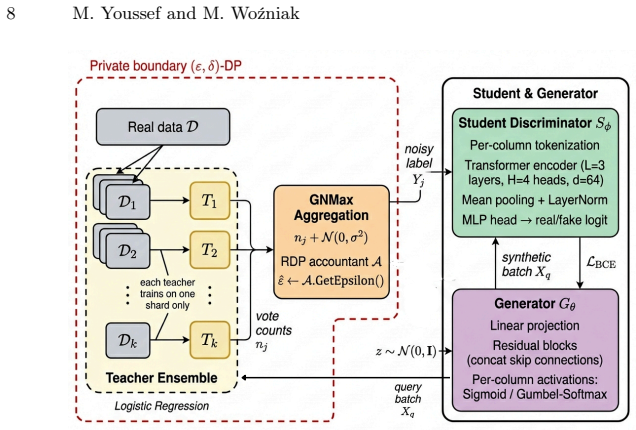
PATE-TabTransGAN integrates the Private Aggregation of Teacher Ensembles mechanism with a Transformer-based student discriminator and GNMax RDP accounting; the resulting student supplies a differentially private training signal to a residual generator, producing synthetic tabular data that attains the best or tied-best AUROC on all four tested datasets while satisfying formal privacy.
What carries the argument
The Transformer student discriminator trained on noisy PATE-aggregated labels, which transfers formal differential privacy to the generator by post-processing.
If this is right
- Downstream models trained on the synthetic tables inherit formal privacy protection without additional noise injection.
- The residual generator can be swapped for other architectures while the privacy guarantee remains intact by post-processing.
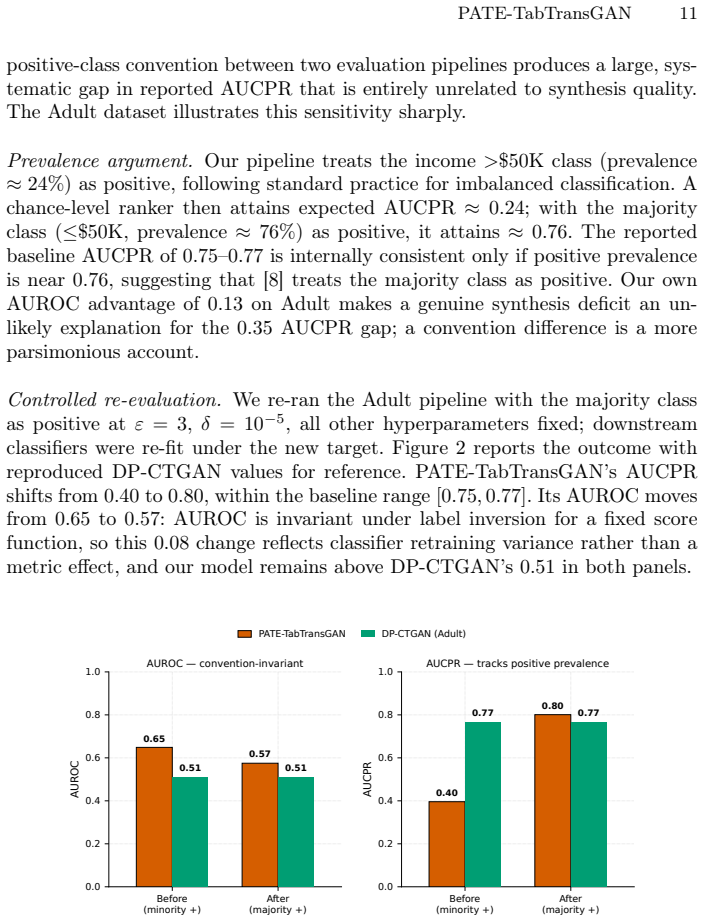
- AUCPR sensitivity to class-label convention implies that utility comparisons across pipelines require explicit alignment of evaluation rules.
- The GNMax accountant enables numerically stable tracking of privacy loss across multiple teacher queries.
Where Pith is reading between the lines
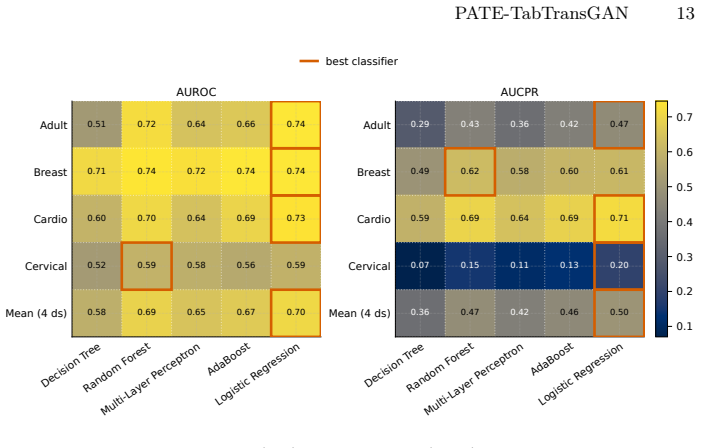
- Replacing logistic regression teachers with more expressive models could increase label signal and further improve downstream AUROC.
- The same PATE-student pattern could be tested on sequential or graph-structured tabular data to check whether the Transformer advantage generalizes.
- Tighter privacy accounting or adaptive teacher partitioning might reduce the noise level required for a target ε without changing the student architecture.
Load-bearing premise
The noisy labels supplied by the PATE teacher ensemble still contain enough signal for the Transformer student to learn inter-feature dependencies.
What would settle it
On the same four datasets, a re-evaluation that uses an identical positive-class convention for Adult would remove the reported AUCPR gap if that gap is caused only by convention rather than by synthesis quality.
Figures
read the original abstract
Generating high-fidelity synthetic tabular data under formal differential privacy guarantees remains an open challenge. Methods that provide strong theoretical protection typically sacrifice the modeling of inter-feature dependencies required for realistic synthesis, while architectures that excel at capturing complex column relationships offer only empirical privacy guarantees. We present PATE-TabTransGAN, a generative framework that integrates the Private Aggregation of Teacher Ensembles (PATE) mechanism with a Transformer-based student discriminator to jointly address both requirements, and employs a GNMax RDP accountant for numerically stable privacy accounting. An ensemble of Logistic Regression teachers trained on disjoint partitions supervise the student via noisy-aggregated labels, and a residual generator is optimized against this differentially private student, inheriting formal ({\epsilon}, {\delta})-DP guarantees by post-processing. PATE-TabTransGAN was compared with PATE-GAN, DP-GAN, and DP-CTGAN, considered state-of-the-art in differentially private tabular synthesis. Experiments conducted on four tabular benchmarks (Adult, Breast, Cardio, Cervical) confirmed the high quality of the proposed method: PATE-TabTransGAN attains the best or tied-best AUROC on all four datasets. On AUCPR it matches the strongest baseline on Cardio, leads on Cervical, and trails on Breast; on Adult, we demonstrate that AUCPR is highly sensitive to positive-class convention, and that the observed gap is consistent with a convention difference between evaluation pipelines rather than a synthesis deficit.
Editorial analysis
A structured set of objections, weighed in public.
Referee Report
Summary. The paper introduces PATE-TabTransGAN, a framework integrating PATE (using an ensemble of Logistic Regression teachers on disjoint partitions) with a Transformer-based student discriminator supervised via GNMax-noisy aggregated labels; a residual generator is then trained against this student to produce synthetic tabular data inheriting (ε, δ)-DP guarantees by post-processing. It reports that the method attains the best or tied-best AUROC on all four benchmarks (Adult, Breast, Cardio, Cervical) versus PATE-GAN, DP-GAN, and DP-CTGAN, with mixed AUCPR results and a note on AUCPR sensitivity to positive-class convention.
Significance. If the empirical results hold under rigorous validation, the work would demonstrate a viable route to formal DP tabular synthesis that leverages Transformer capacity for inter-feature dependencies while using GNMax for stable RDP accounting; this addresses a key tension between privacy theory and modeling power. The explicit use of GNMax for numerically stable privacy accounting is a concrete technical strength that aids reproducibility of the guarantees.
major comments (3)
- [Abstract; Experiments section] Abstract and experimental results: the central claim of best/tied-best AUROC on all four datasets is reported without error bars, standard deviations across runs, or statistical significance tests. This directly weakens confidence in whether the observed wins are robust or attributable to the claimed architecture.
- [Method description (PATE integration and student discriminator)] Method (PATE teacher-student setup): the student is a Transformer trained on noisy labels from linear LR teachers, yet no ablation, dependency analysis, or diagnostic is provided showing that higher-order column relationships survive the linear supervision plus GNMax perturbation. This assumption is load-bearing for attributing gains to the Transformer rather than implementation details.
- [Abstract; Privacy accounting subsection] Privacy accounting: although GNMax RDP is invoked for formal guarantees, the manuscript supplies neither the concrete noise multiplier, teacher count, resulting (ε, δ) values, nor the full accounting trace for the reported experiments. These details are required to substantiate the post-processing DP claim.
minor comments (2)
- [Experiments; AUCPR analysis] The discussion of AUCPR convention sensitivity on Adult is helpful; extend it by stating the exact positive-class convention applied to every baseline for transparency.
- [Experimental setup] Hyper-parameter choices (e.g., number of teachers, noise scale, Transformer depth) should be collected in a single table rather than scattered in text.
Simulated Author's Rebuttal
We thank the referee for the constructive and detailed comments. We address each major comment point-by-point below, indicating planned revisions where appropriate.
read point-by-point responses
-
Referee: [Abstract; Experiments section] Abstract and experimental results: the central claim of best/tied-best AUROC on all four datasets is reported without error bars, standard deviations across runs, or statistical significance tests. This directly weakens confidence in whether the observed wins are robust or attributable to the claimed architecture.
Authors: We agree that the absence of error bars and statistical tests reduces confidence in the robustness of the reported AUROC improvements. In the revised manuscript we will report means and standard deviations over multiple independent runs (with fixed seeds) and include paired statistical significance tests (e.g., Wilcoxon or t-tests) against the baselines to substantiate the claims. revision: yes
-
Referee: [Method description (PATE integration and student discriminator)] Method (PATE teacher-student setup): the student is a Transformer trained on noisy labels from linear LR teachers, yet no ablation, dependency analysis, or diagnostic is provided showing that higher-order column relationships survive the linear supervision plus GNMax perturbation. This assumption is load-bearing for attributing gains to the Transformer rather than implementation details.
Authors: The linear teachers supply only noisy binary labels; the Transformer student still receives the full feature vectors and must learn a decision boundary that captures higher-order interactions to minimize the discrimination loss. Nevertheless, we acknowledge that an explicit ablation would strengthen attribution. We will add a controlled comparison of Transformer versus linear student discriminators (keeping teachers and GNMax fixed) to quantify the contribution of non-linear capacity. revision: yes
-
Referee: [Abstract; Privacy accounting subsection] Privacy accounting: although GNMax RDP is invoked for formal guarantees, the manuscript supplies neither the concrete noise multiplier, teacher count, resulting (ε, δ) values, nor the full accounting trace for the reported experiments. These details are required to substantiate the post-processing DP claim.
Authors: We will include the exact experimental parameters (number of teachers, noise multiplier σ, and the resulting (ε, δ) values) together with the complete GNMax RDP accounting trace for each dataset in a new subsection of the revised manuscript, ensuring full reproducibility of the privacy guarantees. revision: yes
Circularity Check
No circularity in derivation or performance claims
full rationale
The paper describes an empirical construction (PATE ensemble of LR teachers + Transformer student + residual generator + GNMax accountant) and reports AUROC/AUCPR from direct experimental comparison against external baselines on four public datasets. No equations, derivations, or fitted quantities are shown that reduce the reported metrics to internal definitions or self-citations by construction. The central claims rest on external benchmark results rather than any self-referential reduction.
Axiom & Free-Parameter Ledger
free parameters (2)
- number of teachers
- noise multiplier for GNMax
axioms (2)
- standard math Differential privacy post-processing property
- standard math Rényi DP composition via GNMax accountant
Reference graph
Works this paper leans on
-
[1]
In: Proceedings of the 2016 ACM SIGSAC Conference on Computer and Communications Security
Abadi, M., Chu, A., Goodfellow, I., McMahan, H.B., Mironov, I., Talwar, K., Zhang, L.: Deep learning with differential privacy. In: Proceedings of the 2016 ACM SIGSAC Conference on Computer and Communications Security. pp. 308– 318 (2016)
2016
-
[2]
IEEE Transactions on Knowledge and Data Engineering19(11), 1450–1464 (2007)
Angiulli, F.: Fast nearest neighbor condensation for large data sets classification. IEEE Transactions on Knowledge and Data Engineering19(11), 1450–1464 (2007)
2007
-
[3]
In: The Eleventh International Conference on Learning Representations (2022) PATE-TabTransGAN 15
Carlini, N., Ippolito, D., Jagielski, M., Lee, K., Tramer, F., Zhang, C.: Quantify- ing memorization across neural language models. In: The Eleventh International Conference on Learning Representations (2022) PATE-TabTransGAN 15
2022
-
[4]
In: 30th USENIX security symposium (USENIX Se- curity 21)
Carlini, N., Tramer, F., Wallace, E., Jagielski, M., Herbert-Voss, A., Lee, K., Roberts, A., Brown, T., Song, D., Erlingsson, U., et al.: Extracting training data from large language models. In: 30th USENIX security symposium (USENIX Se- curity 21). pp. 2633–2650 (2021)
2021
-
[5]
Communications of the ACM54(1), 86–95 (2011)
Dwork, C.: A firm foundation for private data analysis. Communications of the ACM54(1), 86–95 (2011)
2011
-
[6]
In: Theory of Cryptography Conference
Dwork, C., McSherry, F., Nissim, K., Smith, A.: Calibrating noise to sensitivity in private data analysis. In: Theory of Cryptography Conference. pp. 265–284. Springer (2006)
2006
-
[7]
Founda- tions and trends®in theoretical computer science9(3-4), 211–487 (2014)
Dwork, C., Roth, A.: The algorithmic foundations of differential privacy. Founda- tions and trends®in theoretical computer science9(3-4), 211–487 (2014)
2014
-
[8]
In: International conference on artificial intelligence in medicine
Fang, M.L., Dhami, D.S., Kersting, K.: Dp-ctgan: Differentially private medical data generation using ctgans. In: International conference on artificial intelligence in medicine. pp. 178–188. Springer (2022)
2022
-
[9]
In: Proceedingsofthe52ndannualACMSIGACTsymposiumontheoryofcomputing
Feldman, V.: Does learning require memorization? a short tale about a long tail. In: Proceedingsofthe52ndannualACMSIGACTsymposiumontheoryofcomputing. pp. 954–959 (2020)
2020
-
[10]
In: Proceedings of the 22nd ACM SIGSAC Conference on Computer and Communications Security
Fredrikson, M., Jha, S., Ristenpart, T.: Model inversion attacks that exploit con- fidence information and basic countermeasures. In: Proceedings of the 22nd ACM SIGSAC Conference on Computer and Communications Security. pp. 1322–1333 (2015)
2015
-
[11]
In: International Conference on Machine Learning
Gaboardi, M., Arias, E.J.G., Hsu, J., Roth, A., Wu, Z.S.: Dual query: Practical private query release for high dimensional data. In: International Conference on Machine Learning. pp. 1170–1178. PMLR (2014)
2014
-
[12]
Advances in Neural Information Processing Systems36, 46245–46254 (2023)
Gulati, M., Roysdon, P.: Tabmt: Generating tabular data with masked transform- ers. Advances in Neural Information Processing Systems36, 46245–46254 (2023)
2023
-
[13]
Categorical Reparameterization with Gumbel-Softmax
Jang, E., Gu, S., Poole, B.: Categorical reparameterization with gumbel-softmax. arXiv preprint arXiv:1611.01144 (2016)
work page internal anchor Pith review Pith/arXiv arXiv 2016
-
[14]
In: International Conference on Learning Represen- tations (2018)
Jordon, J., Yoon, J., Van Der Schaar, M.: Pate-gan: Generating synthetic data with differential privacy guarantees. In: International Conference on Learning Represen- tations (2018)
2018
-
[15]
In: 2017 IEEE 30th computer security foun- dations symposium (CSF)
Mironov, I.: Rényi differential privacy. In: 2017 IEEE 30th computer security foun- dations symposium (CSF). pp. 263–275. IEEE (2017)
2017
-
[16]
Semi-supervised Knowledge Transfer for Deep Learning from Private Training Data
Papernot, N., Abadi, M., Erlingsson, U., Goodfellow, I., Talwar, K.: Semi- supervised knowledge transfer for deep learning from private training data. arXiv preprint arXiv:1610.05755 (2016)
work page internal anchor Pith review Pith/arXiv arXiv 2016
-
[17]
Scalable Private Learning with PATE
Papernot, N., Song, S., Mironov, I., Raghunathan, A., Talwar, K., Erlingsson, Ú.: Scalable private learning with pate. arXiv preprint arXiv:1802.08908 (2018)
work page internal anchor Pith review Pith/arXiv arXiv 2018
-
[18]
Differentially Private Generative Adversarial Network
Xie, L., Lin, K., Wang, S., Wang, F., Zhou, J.: Differentially private generative adversarial network. arXiv preprint arXiv:1802.06739 (2018)
work page internal anchor Pith review Pith/arXiv arXiv 2018
-
[19]
Advances in neural information processing systems32 (2019)
Xu,L.,Skoularidou,M.,Cuesta-Infante,A.,Veeramachaneni,K.:Modelingtabular data using conditional gan. Advances in neural information processing systems32 (2019)
2019
-
[20]
Information Processing & Management62(5), 104220 (2025)
Zhang, H., Jing, Y., Zhang, F., Li, Z., Wang, X.S., Chen, Z., Lv, C.: Tabtransgan: A hybrid approach integrating gan and transformer architectures for tabular data synthesis. Information Processing & Management62(5), 104220 (2025)
2025
-
[21]
In: 30th USENIX Security Sympo- sium (USENIX Security 21)
Zhang, Z., Wang, T., Li, N., Honorio, J., Backes, M., He, S., Chen, J., Zhang, Y.: Privsyn: Differentially private data synthesis. In: 30th USENIX Security Sympo- sium (USENIX Security 21). pp. 929–946 (2021) 16 M. Youssef and M. Woźniak
2021
-
[22]
In: Proceed- ings of the IEEE/CVF winter conference on applications of computer vision
Zhao, B., Bilen, H.: Dataset condensation with distribution matching. In: Proceed- ings of the IEEE/CVF winter conference on applications of computer vision. pp. 6514–6523 (2023)
2023
discussion (0)
Sign in with ORCID, Apple, or X to comment. Anyone can read and Pith papers without signing in.