RAGEAR: Retrieval-Augmented Graph-Enhanced Academic Recommender
Pith reviewed 2026-06-29 15:57 UTC · model grok-4.3
The pith
RAGEAR aggregates transcript chunks via a knowledge graph to improve course recommendation rankings over simple sum baselines.
A machine-rendered reading of the paper's core claim, the machinery that carries it, and where it could break.
Core claim
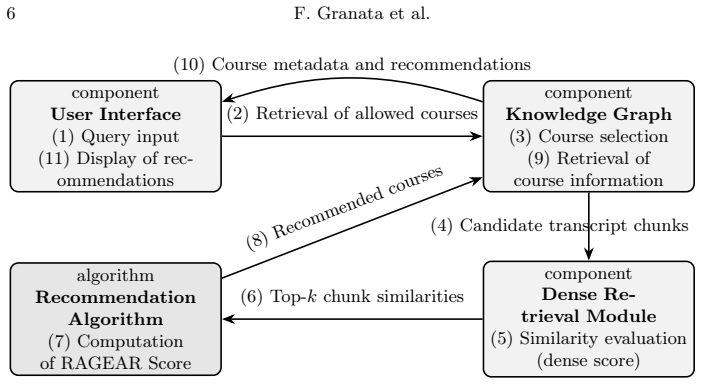
RAGEAR's graph-aware aggregation function propagates chunk-level evidence to course-level recommendations by combining the share of retrieved similarity associated with a course, the rank-based strength of its relevant chunks, and the distribution of evidence across lessons; this produces higher ranking quality than a transcript-based normalized SumP baseline, especially for top-ranked items, as measured on 152 student-like queries via human and LLM assessments.
What carries the argument
Graph-aware aggregation function that scores courses from transcript chunks by combining similarity share, rank strength, and lesson distribution.
If this is right
- Lecture transcripts yield stronger retrieval signals than metadata alone.
- The aggregation step improves top-ranked precision compared with normalized sum-of-similarities.
- Symbolic filtering on the graph can be applied without discarding content-based evidence.
- Recommendations become sensitive to study-plan and credit constraints while still using fine-grained lesson content.
Where Pith is reading between the lines
- The same chunk-to-entity aggregation pattern could be tested in other constrained recommendation settings such as treatment planning.
- Adding longitudinal student performance data to the aggregation might further sharpen the evidence distribution term.
- The hybrid retrieval-plus-graph design suggests that purely neural or purely symbolic academic recommenders are each missing part of the signal.
Load-bearing premise
The human and LLM evaluations on 152 queries serve as valid proxies for real student satisfaction, and the knowledge graph captures all relevant curricular constraints and prerequisites.
What would settle it
A controlled study in which actual students receive either RAGEAR or baseline recommendations, then report satisfaction or enrollment follow-through rates after one semester.
Figures
read the original abstract
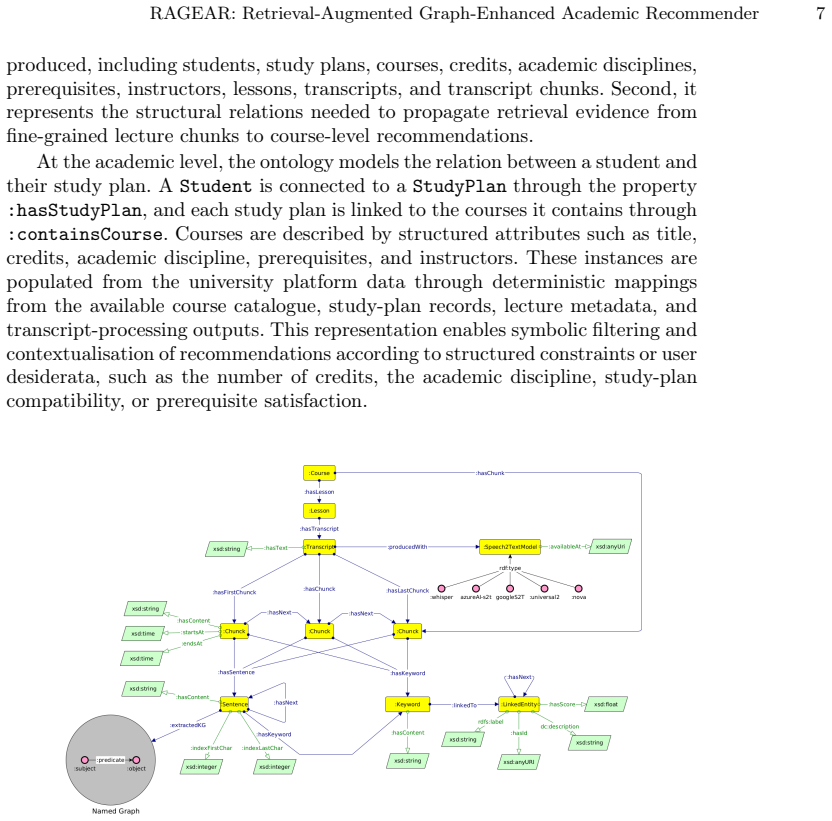
We present RAGEAR (Retrieval-Augmented Graph-Enhanced Academic Recommender), a neurosymbolic recommender system for academic course recommendation. RAGEAR combines dense retrieval over full lecture transcripts with a symbolic Knowledge Graph modelling courses, lessons, transcript chunks, credits, study plans, and curricular information. The Knowledge Graph supports symbolic filtering and contextualisation based on structured constraints, such as credits, academic disciplines, study plans, and prerequisites. Unlike metadata-based approaches, it exploits fine-grained instructional content by retrieving transcript chunks semantically aligned with a student's query. The main contribution is a graph-aware aggregation function that propagates chunk-level evidence to course-level recommendations. The score combines three factors: the share of retrieved similarity associated with a course, the rank-based strength of its relevant chunks, and the distribution of evidence across lessons. We evaluate RAGEAR on 152 student-like queries through a human evaluation sample and a large-scale LLM-based relevance assessment. Results show that lecture transcripts improve over metadata-only retrieval, and that RAGEAR further improves ranking quality over a transcript-based normalized SumP baseline, especially for top-ranked recommendations.
Editorial analysis
A structured set of objections, weighed in public.
Referee Report
Summary. The paper claims to introduce RAGEAR, a neurosymbolic academic course recommender combining dense retrieval over lecture transcripts with a symbolic knowledge graph (modeling courses, lessons, chunks, credits, study plans, and prerequisites) for filtering and contextualization. Its main technical contribution is a graph-aware aggregation function that propagates chunk-level evidence to course recommendations via three factors: share of retrieved similarity, rank-based chunk strength, and evidence distribution across lessons. Evaluation on 152 student-like queries via human sample and LLM-based relevance assessment reports that transcripts outperform metadata-only retrieval and that RAGEAR further improves ranking quality over a transcript-based normalized SumP baseline, especially at top ranks.
Significance. If the empirical improvements hold under rigorous validation, the work offers a concrete example of neurosymbolic integration in educational IR, where the KG enables structured constraints while the aggregation function provides an explicit mechanism for evidence propagation from fine-grained content. The explicit evaluation protocol on 152 queries and the parameter-free character of the aggregation (once defined) are strengths that support reproducibility and falsifiability in the domain.
minor comments (3)
- [Abstract] Abstract: the directional claims of improvement would be more informative if accompanied by the key numerical metrics, confidence intervals, or statistical test results that appear in the evaluation section.
- [Evaluation] Evaluation section: clarify the exact construction of the 152 queries and the normalization procedure applied to the SumP baseline so that the reported gains can be directly reproduced.
- [Results] Figure or table presenting the ranking results: ensure error bars or significance markers are included to allow readers to assess whether the top-rank improvements are statistically distinguishable from the baseline.
Simulated Author's Rebuttal
We thank the referee for the positive summary, significance assessment, and recommendation of minor revision. No specific major comments appear in the provided report, so we have no individual points requiring detailed rebuttal or revision at this stage. We remain available to address any minor suggestions that may be supplied separately.
Circularity Check
No significant circularity
full rationale
The paper describes an empirical neurosymbolic recommender with a graph-aware aggregation function evaluated on 152 queries against a normalized SumP baseline. No equations, derivations, or first-principles predictions are presented that could reduce to inputs by construction. The central claims rest on explicit experimental comparisons rather than self-referential fitting or self-citation chains. This is the expected non-finding for an applied systems paper whose contributions are architectural and evaluative.
Axiom & Free-Parameter Ledger
Reference graph
Works this paper leans on
-
[1]
Machine Learning and Knowledge Extraction5(2), 560–596 (2023)
Algarni, S., Sheldon, F.: Systematic review of recommendation systems for course selection. Machine Learning and Knowledge Extraction5(2), 560–596 (2023). https://doi.org/10.3390/make5020033
-
[2]
In: Hitzler, P., Gangemi, A., Janowicz, K., Krisnadhi, A., Presutti, V
Blomqvist, E., Hammar, K., Presutti, V.: Engineering Ontologies with Patterns - The eXtreme Design Methodology. In: Hitzler, P., Gangemi, A., Janowicz, K., Krisnadhi, A., Presutti, V. (eds.) Ontology Engineering with Ontology Design Patterns, Studies on the Semantic Web, vol. 25, pp. 23–50. IOS Press (2016). https://doi.org/10.3233/978-1-61499-676-7-23
-
[3]
In: Journal of Web Semantics (2005).https://doi.org/10.1016/j.websem.2005.09.001
Carroll, J.J., Bizer, C., Hayes, P., Stickler, P.: Named graphs. In: Journal of Web Semantics (2005).https://doi.org/10.1016/j.websem.2005.09.001
-
[4]
Dai, Z., Callan, J.: Deeper text understanding for ir with contextual neural lan- guagemodeling.p.985–988(2019).https://doi.org/10.1145/3331184.3331303
-
[5]
Knowledge-Based Systems194, 105385 (2020).https://doi.org/10
Esteban, A., Zafra, A., Romero, C.: Helping university students to choose elective courses by using a hybrid multi-criteria recommendation system with genetic op- timization. Knowledge-Based Systems194, 105385 (2020).https://doi.org/10. 1016/j.knosys.2019.105385
-
[6]
Explosion AI: spaCy: Industrial-Strength Natural Language Processing in Python (2023),https://spacy.io, version 3.7.2
2023
-
[7]
Falco, R., Gangemi, A., Peroni, S., Shotton, D., Vitali, F.: Modelling owl ontologies with graffoo. In: Lecture Notes in Computer Science (including subseries Lecture Notes in Artificial Intelligence and Lecture Notes in Bioinformatics). vol. 8798, p. 320 – 325 (2014).https://doi.org/10.1007/978-3-319-11955-7_42
-
[8]
IEEE Access8, 189069– 189088 (2020).https://doi.org/10.1109/ACCESS.2020.3031572
Fernández-García, A.J., Rodríguez-Echeverría, R., Preciado, J.C., Manzano, J.M.C., Sánchez-Figueroa, F.: Creating a recommender system to support higher education students in the subject enrollment decision. IEEE Access8, 189069– 189088 (2020).https://doi.org/10.1109/ACCESS.2020.3031572
-
[9]
In: The Second Text REtrieval Conference (TREC-2)
Fox, E.A., Shaw, J.A.: Combination of multiple searches. In: The Second Text REtrieval Conference (TREC-2). pp. 243–252. NIST (1994)
1994
-
[10]
Knowledge and Information Sys- tems68(1) (2026).https://doi.org/10.1007/s10115-025-02631-y
Gangemi, A., Graciotti, A., Meloni, A., Nuzzolese, A.G., Presutti, V., Refor- giato Recupero, D., Russo, A.: Text2amr2fred, converting text into rdf/owl knowl- edge graphs via abstract meaning representation. Knowledge and Information Sys- tems68(1) (2026).https://doi.org/10.1007/s10115-025-02631-y
-
[11]
In: 2013 IEEE 13th International Conference on Ad- vanced Learning Technologies
Hu, L., Du, Z., Tong, Q., Liu, Y.: Context-aware recommendation of learning resources using rules engine. In: 2013 IEEE 13th International Conference on Ad- vanced Learning Technologies. pp. 181–183 (2013).https://doi.org/10.1109/ ICALT.2013.56
2013
-
[12]
https://doi.org/10.1109/ACCESS.2018.2889635
Ibrahim, M.E., Yang, Y., Ndzi, D.L., Yang, G., Al-Maliki, M.: Ontology-based personalizedcourserecommendationframework.IEEEAccess7,5180–5199(2019). https://doi.org/10.1109/ACCESS.2018.2889635
-
[13]
Journal of Web Semantics85, 100857 (2025).https://doi.org/ 10.1016/j.websem.2024.100857
Jaldi, C.D., Ilkou, E., Schroeder, N., Shimizu, C.: Education in the era of neu- rosymbolic ai. Journal of Web Semantics85, 100857 (2025).https://doi.org/ 10.1016/j.websem.2024.100857
-
[14]
In: Proceedings of the International Conference on Educational Data Mining
Li,Z.,Wang,M.,Zhao,L.:Coursekg:Aknowledge-graphapproachforpersonalised course and learning-path recommendation. In: Proceedings of the International Conference on Educational Data Mining. pp. 512–524. EDM (2024).https:// doi.org/10.3390/app14072710 RAGEAR: Retrieval-Augmented Graph-Enhanced Academic Recommender 17
-
[15]
In: 2022 9th International Con- ference on Computing for Sustainable Global Development (INDIACom)
Malhotra, I., Chandra, P., Lavanya, R.: Course recommendation using domain- based cluster knowledge and matrix factorization. In: 2022 9th International Con- ference on Computing for Sustainable Global Development (INDIACom). pp. 12–
2022
-
[16]
IEEE (2022).https://doi.org/10.23919/INDIACom54597.2022.9763281
-
[17]
In: Nguyen, N.T., Iliadis, L., Ma- glogiannis, I., Trawiński, B
Nguyen, T.T.M., Tran, T.P.Q.: A knowledge graph embedding based approach for learning path recommendation for career goals. In: Nguyen, N.T., Iliadis, L., Ma- glogiannis, I., Trawiński, B. (eds.) Computational Collective Intelligence. pp. 66–
-
[18]
Springer International Publishing, Cham (2021).https://doi.org/10.1007/ 978-3-030-88081-1_6
2021
-
[19]
In: Proceedings of the International Conference on Ad- vanced Learning Technologies
Obeid, N., Lahoud, C., El Khoury, R.: An ontology-based recommender system for higher education. In: Proceedings of the International Conference on Ad- vanced Learning Technologies. pp. 45–49. IEEE (2018).https://doi.org/10. 1145/3184558.3191533
-
[20]
In: International conference on machine learning
Radford,A.,Kim,J.W.,Xu,T.,Brockman,G.,McLeavey,C.,Sutskever,I.:Robust speech recognition via large-scale weak supervision. In: International conference on machine learning. pp. 28492–28518. PMLR (2023).https://doi.org/10.5555/ 3618408.3619590
-
[21]
In: 2020 IEEE International Conference on Computing, Power and Communication Technologies (GUCON)
Sankhe, V., Shah, J., Paranjape, T., Shankarmani, R.: Skill based course rec- ommendation system. In: 2020 IEEE International Conference on Computing, Power and Communication Technologies (GUCON). pp. 573–576 (2020).https: //doi.org/10.1109/GUCON48875.2020.9231074
-
[22]
Multilingual E5 Text Embeddings: A Technical Report
Wang, L., Yang, N., Huang, X., Yang, L., Majumder, R., Wei, F.: Multilingual e5 text embeddings: A technical report. arXiv preprint arXiv:2402.05672 (2024). https://doi.org/10.48550/arXiv.2402.05672
work page internal anchor Pith review Pith/arXiv arXiv doi:10.48550/arxiv.2402.05672 2024
-
[23]
Lecture Notes in Com- puter Science12657 LNCS, 150 – 163 (2021).https://doi.org/10.1007/ 978-3-030-72240-1_11
Zhang, X., Yates, A., Lin, J.: Comparing score aggregation approaches for document retrieval with pretrained transformers. Lecture Notes in Com- puter Science12657 LNCS, 150 – 163 (2021).https://doi.org/10.1007/ 978-3-030-72240-1_11
2021
discussion (0)
Sign in with ORCID, Apple, or X to comment. Anyone can read and Pith papers without signing in.