A High-Contrast Bragg Atom Interferometer for Testing Continuous Spontaneous Localization
Pith reviewed 2026-06-29 14:52 UTC · model grok-4.3
The pith
Bragg atom interferometer with 99% contrast sets new upper limit on continuous spontaneous localization rate.
A machine-rendered reading of the paper's core claim, the machinery that carries it, and where it could break.
Core claim
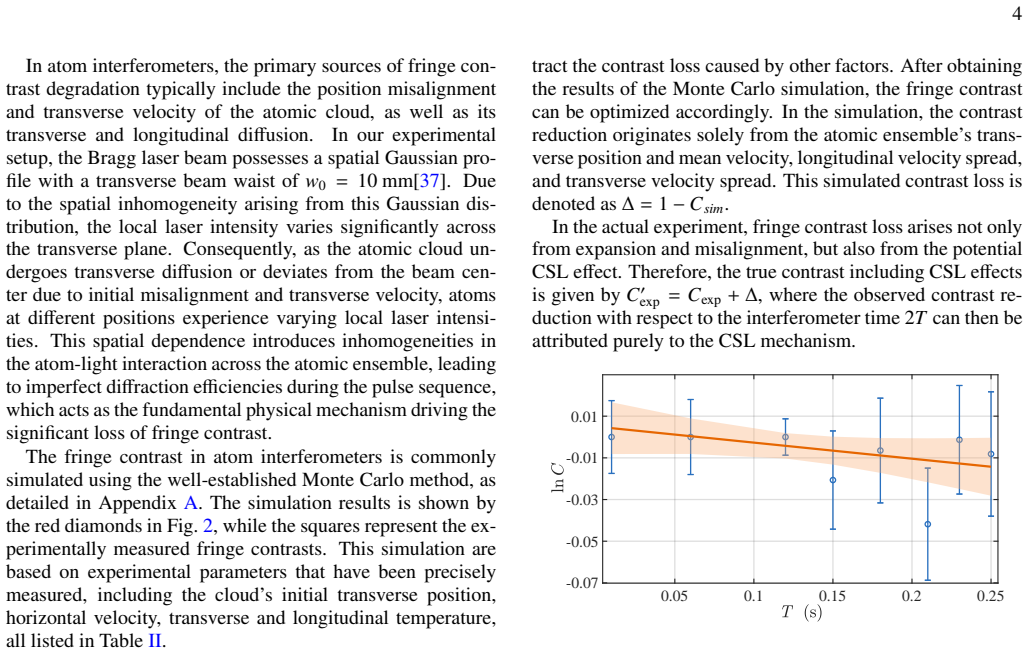
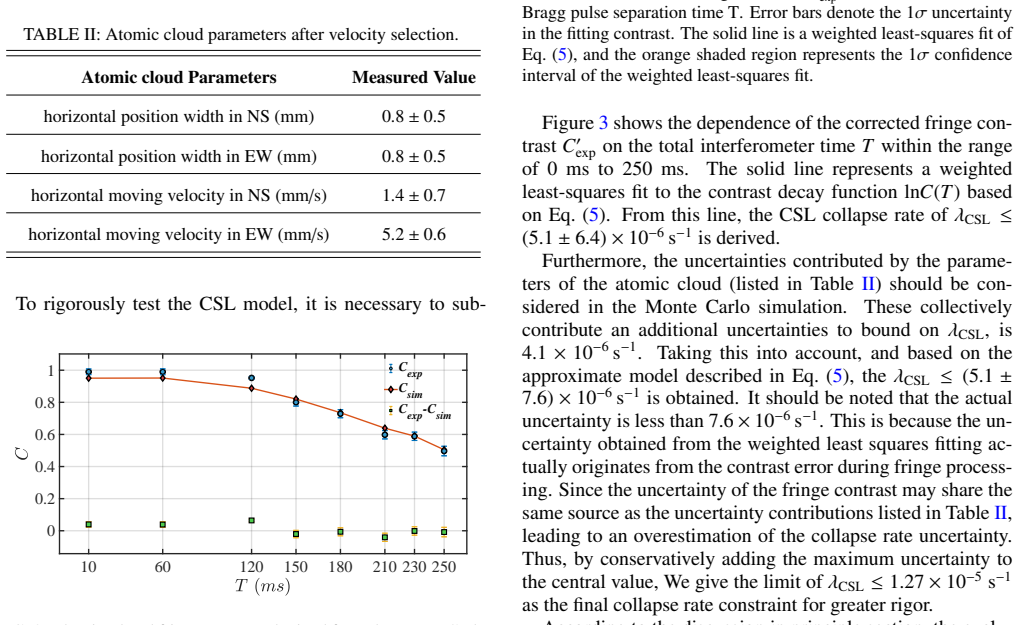
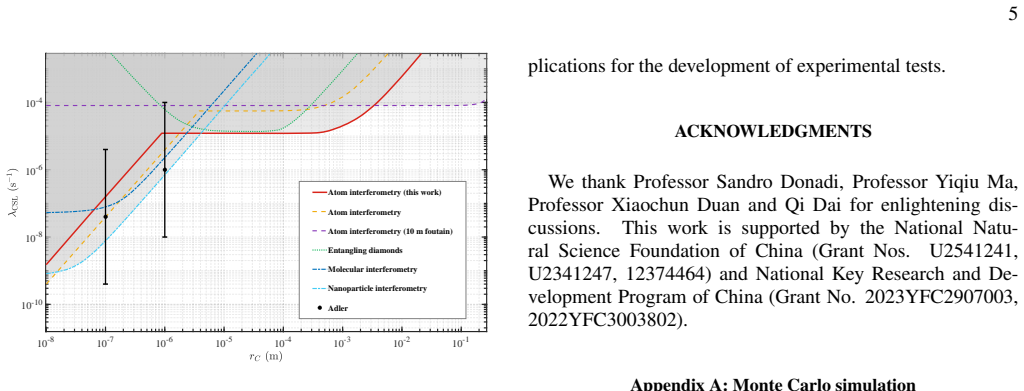
A Bragg atom interferometer is shown to reach 99% fringe contrast sustained to 60 ms interrogation time. Systematic correction of technical contrast-loss mechanisms produces an upper limit λ_CSL = 1.27 × 10^{-5} s^{-1} at r_C = 10^{-5} m, approximately four times stronger than earlier atom-interferometric results.
What carries the argument
Fringe contrast in the Bragg atom interferometer, serving as a direct sensor of CSL-induced decoherence.
If this is right
- The derived CSL bound is roughly four times tighter than previous atom-interferometer constraints.
- Interrogation times of 60 ms become usable without dominant technical contrast loss.
- Future runs can search for CSL signatures once the same corrections are applied at still longer times.
- The same contrast-analysis method can be reused to test other parameter values of the CSL model.
Where Pith is reading between the lines
- The technique could be combined with interferometers using larger atomic ensembles or different atomic species to probe additional regions of CSL parameter space.
- If contrast remains high at significantly longer interrogation times, the approach would further restrict the viable CSL models without requiring new hardware principles.
- The same contrast budget analysis might be adapted to bound other proposed sources of objective collapse or environmental decoherence.
Load-bearing premise
All residual contrast loss after the listed technical corrections arises solely from known experimental effects and not from CSL or any unmodeled decoherence.
What would settle it
Measurement of additional contrast loss, after all technical corrections, that matches the magnitude predicted by CSL at λ_CSL = 1.27 × 10^{-5} s^{-1} and r_C = 10^{-5} m.
Figures
read the original abstract
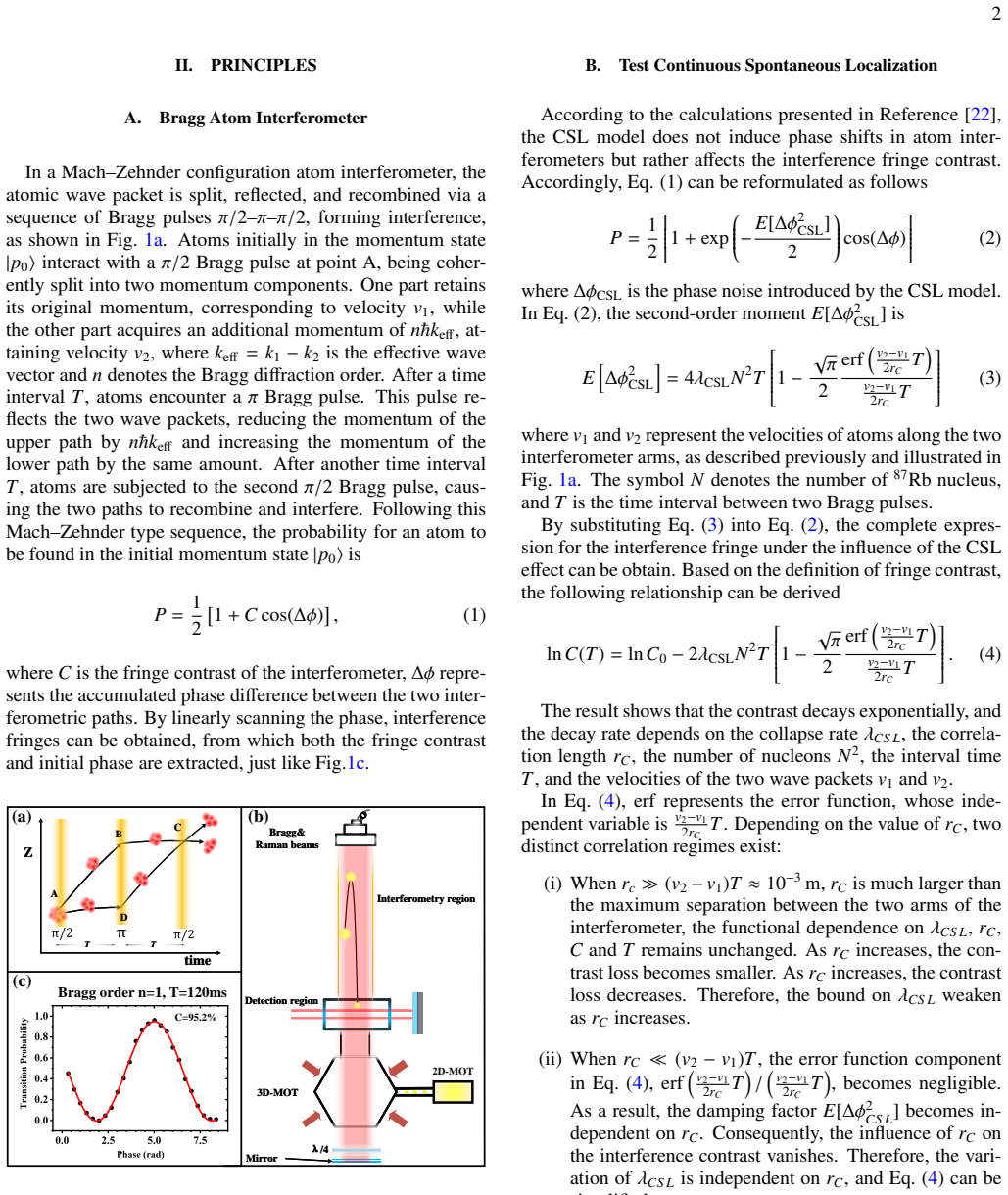
The continuous spontaneous localization (CSL) model is one of the most promising approaches to address the wave function collapse problem in the measurement process of standard quantum mechanics. In this work, the effect of the CSL model on a Bragg atom interferometer was investigated. A Bragg interferometer achieving high fringe contrast of 99$\%$ has been demonstrated, maintaining this performance level at interrogation time up to $T=60~\mathrm{ms}$. The primary factors responsible for fringe contrast loss in the atom interferometer were systematically analyzed and corrected. This improvement established a new upper limit of $\lambda_{\rm CSL}=1.27\times10^{-5}~\mathrm{s}^{-1}$ at $r_C=10^{-5}~\mathrm{m}$ for the CSL collapse rate, representing approximately 4 times enhancement over previous atom-interferometric constraints.
Editorial analysis
A structured set of objections, weighed in public.
Referee Report
Summary. The manuscript reports the demonstration of a Bragg atom interferometer with 99% fringe contrast maintained up to T=60 ms interrogation time. After systematic analysis and correction of technical factors responsible for contrast loss, the authors extract a new upper limit λ_CSL = 1.27×10^{-5} s^{-1} at r_C=10^{-5} m, representing a factor-of-4 improvement over prior atom-interferometric CSL constraints.
Significance. If the central bound is robust, the result would tighten experimental limits on the CSL model using atom interferometry, a technique sensitive to decoherence over macroscopic separations. The high-contrast achievement itself demonstrates technical progress in Bragg interferometers, though the overall impact depends on the completeness of the CSL modeling and error analysis.
major comments (2)
- [Abstract] Abstract (and implied contrast analysis section): The quoted CSL bound is obtained by attributing all post-correction residual contrast loss to technical sources with zero CSL contribution. No explicit master-equation term or contrast-loss formula for CSL in the Bragg two-arm geometry is provided, nor is there a quantitative demonstration that the technical model exhausts the observed T-dependence or that a CSL effect at the quoted level would have been distinguishable in the data. This assumption is load-bearing for the numerical limit.
- [Abstract] Abstract: No error budget, uncertainty propagation, or data-exclusion criteria are stated for the 99% contrast measurement, preventing assessment of how modeling uncertainties or unaccounted systematics would affect the derived λ_CSL bound.
Simulated Author's Rebuttal
We thank the referee for their careful reading and constructive comments on our manuscript. We address each major comment below and will incorporate revisions to strengthen the presentation of the CSL modeling and error analysis.
read point-by-point responses
-
Referee: [Abstract] Abstract (and implied contrast analysis section): The quoted CSL bound is obtained by attributing all post-correction residual contrast loss to technical sources with zero CSL contribution. No explicit master-equation term or contrast-loss formula for CSL in the Bragg two-arm geometry is provided, nor is there a quantitative demonstration that the technical model exhausts the observed T-dependence or that a CSL effect at the quoted level would have been distinguishable in the data. This assumption is load-bearing for the numerical limit.
Authors: We acknowledge that the manuscript does not include an explicit master-equation derivation or contrast-loss formula specific to CSL in the Bragg two-arm geometry. The bound relies on attributing residual contrast loss (after technical corrections) to non-CSL sources. In the revised manuscript we will add the CSL master-equation term for the Bragg geometry, provide the expected contrast-loss formula, and include a quantitative comparison demonstrating that the technical model accounts for the observed T-dependence while a CSL contribution at the quoted λ level would produce a distinguishable deviation. revision: yes
-
Referee: [Abstract] Abstract: No error budget, uncertainty propagation, or data-exclusion criteria are stated for the 99% contrast measurement, preventing assessment of how modeling uncertainties or unaccounted systematics would affect the derived λ_CSL bound.
Authors: We agree that an explicit error budget, uncertainty propagation, and data-exclusion criteria for the 99% contrast measurement are necessary to evaluate the robustness of the derived λ_CSL bound. The revised manuscript will include a detailed error analysis section covering these elements, allowing assessment of how modeling uncertainties or systematics propagate to the CSL limit. revision: yes
Circularity Check
No significant circularity; CSL bound is a standard experimental exclusion from measured contrast
full rationale
The upper limit λ_CSL ≤ 1.27×10^{-5} s^{-1} is obtained by attributing residual contrast loss (after technical corrections) to zero CSL contribution at the quoted level, using the external CSL master-equation prediction for decoherence in the Bragg geometry. This is a conventional non-observation bound, not a self-definition, fitted input renamed as prediction, or load-bearing self-citation chain. The provided text shows no equations or steps that reduce the claimed result to the authors' own prior definitions or ansatzes by construction. The derivation remains self-contained against external CSL models and measured data.
Axiom & Free-Parameter Ledger
axioms (1)
- domain assumption CSL model produces additional decoherence in atom interferometers that reduces fringe contrast proportionally to λ_CSL and the spatial separation.
Reference graph
Works this paper leans on
-
[1]
S. L. Adler,Quantum theory as an emergent phenomenon: The statistical mechanics of matrix models as the precursor of quan- tum field theory(Cambridge University Press, 2004)
2004
-
[2]
A. J. Leggett, science307, 871 (2005)
2005
-
[3]
Bassi, K
A. Bassi, K. Lochan, S. Satin, T. P. Singh, and H. Ulbricht, Reviews of Modern Physics85, 471 (2013)
2013
-
[4]
G. C. Ghirardi, A. Rimini, and T. Weber, Physical Review D 34, 470 (1986)
1986
-
[5]
Pearle, Physical Review D13, 857 (1976)
P. Pearle, Physical Review D13, 857 (1976)
1976
-
[6]
Di ´osi, Physical Review A40, 1165 (1989)
L. Di ´osi, Physical Review A40, 1165 (1989)
1989
-
[7]
G. C. Ghirardi, P. Pearle, and A. Rimini, Physical Review A42, 78 (1990)
1990
-
[8]
Bassi and G
A. Bassi and G. Ghirardi, Physics Reports379, 257 (2003)
2003
-
[10]
S. L. Adler, A. Bassi, M. Carlesso, and A. Vinante, Physical Review D99, 103001 (2019)
2019
-
[11]
Bassi and S
A. Bassi and S. Donadi, Physics Letters A378, 761 (2014)
2014
-
[12]
Piscicchia, A
K. Piscicchia, A. Bassi, C. Curceanu, R. Del Grande, S. Donadi, B. C. Hiesmayr, and A. Pichler, Entropy19, 319 (2017)
2017
-
[13]
B. P. Abbott, R. Abbott, T. Abbott, M. Abernathy, F. Acernese, K. Ackley, C. Adams, T. Adams, P. Addesso, R. Adhikari, et al., Physical Review Letters116, 131103 (2016)
2016
-
[14]
Armano, H
M. Armano, H. Audley, G. Auger, J. T. Baird, M. Bassan, P. Bi- netruy, M. Born, D. Bortoluzzi, N. Brandt, M. Caleno, et al., Physical Review Letters116, 231101 (2016)
2016
-
[15]
Armano, H
M. Armano, H. Audley, J. Baird, P. Binetruy, M. Born, D. Bor- toluzzi, E. Castelli, A. Cavalleri, A. Cesarini, A. Cruise, et al., Physical Review Letters120, 061101 (2018)
2018
-
[16]
Bono, M.-J
S. Bono, M.-J. W. Weiss, B. Stoeber, and S. Konishi, Japanese Journal of Applied Physics (2025)
2025
-
[17]
D. G. A. Altamura, M. Carlesso, S. Donadi, and A. Bassi, Phys- ical Review A109, 062212 (2024)
2024
-
[19]
Toroˇs and A
M. Toroˇs and A. Bassi, Journal of Physics A51, 115302 (2018)
2018
-
[20]
Y . Y . Fein, P. Geyer, and P. Zwick, Nature Physics15, 1242 (2019)
2019
-
[21]
Pedalino, B
S. Pedalino, B. E. Ram ´ırez-Galindo, R. Ferstl, K. Hornberger, M. Arndt, and S. Gerlich, Nature649, 866 (2026)
2026
-
[22]
V owe, S
S. V owe, S. Donadi, V . Schkolnik, A. Peters, B. Leykauf, and M. Krutzik, Physical Review A106, 043317 (2022)
2022
-
[24]
Carlesso, S
M. Carlesso, S. Donadi, L. Ferialdi, M. Paternostro, H. Ul- bricht, and A. Bassi, Nature Physics18, 243 (2022)
2022
-
[25]
J. Debs, P. Altin, T. Barter, D. Doering, G. Dennis, G. McDon- ald, R. Anderson, J. Close, and N. Robins, Physical Review A 84, 033610 (2011)
2011
-
[26]
Gillot, O
P. Gillot, O. Francis, A. Landragin, F. P. Dos Santos, and S. Merlet, Metrologia51, L15 (2014)
2014
-
[27]
M ´enoret, P
V . M ´enoret, P. Vermeulen, N. Le Moigne, S. Bonvalot, P. Bouyer, A. Landragin, and B. Desruelle, Scientific Reports 8, 12300 (2018)
2018
-
[28]
Zhou, Z.-K
M.-K. Zhou, Z.-K. Hu, X.-C. Duan, B.-L. Sun, J.-B. Zhao, and J. Luo, Physical Review A82, 061602 (2010)
2010
-
[29]
Stray, A
B. Stray, A. Lamb, A. Kaushik, J. V ovrosh, A. Rodgers, J. Winch, F. Hayati, D. Boddice, A. Stabrawa, A. Niggebaum, et al., Nature602, 590 (2022)
2022
-
[30]
Lamporesi, A
G. Lamporesi, A. Bertoldi, L. Cacciapuoti, M. Prevedelli, and G. M. Tino, Physical Review Letters100, 050801 (2008)
2008
-
[31]
G. Rosi, F. Sorrentino, L. Cacciapuoti, M. Prevedelli, and G. Tino, Nature510, 518 (2014)
2014
-
[32]
Burrage, E
C. Burrage, E. J. Copeland, and E. Hinds, Journal of Cosmol- ogy and Astroparticle Physics2015, 042 (2015)
2015
-
[33]
Y .-B. Shu, T. Zhang, L.-L. Chen, Q. Luo, X.-B. Deng, W.-J. Xu, X.-C. Duan, X.-T. Fang, L.-S. Cao, Z.-K. Hu, et al., Physical Review Letters133, 213401 (2024)
2024
-
[34]
Englert, C
B.-G. Englert, C. Miniatura, and J. Baudon, Journal de Physique II4, 2043 (1994)
2043
-
[35]
Zaugg, P
T. Zaugg, P. Meystre, G. Lenz, and M. Wilkens, Physical Re- view A49, 3011 (1994)
1994
-
[36]
A. J. Kerman, V . Vuleti´c, C. Chin, and S. Chu, Physical Review Letters84, 439 (2000)
2000
-
[37]
Zhang, L.-L
T. Zhang, L.-L. Chen, Y .-B. Shu, W.-J. Xu, Y . Cheng, Q. Luo, Z.-K. Hu, and M.-K. Zhou, Physical Review Applied20, 014067 (2023)
2023
-
[38]
Cheng, K
Y . Cheng, K. Zhang, L.-L. Chen, T. Zhang, W.-J. Xu, X.- C. Duan, M.-K. Zhou, and Z.-K. Hu, Physical Review A98, 043611 (2018)
2018
-
[39]
Hu, B.-L
Z.-K. Hu, B.-L. Sun, X.-C. Duan, M.-K. Zhou, L.-L. Chen, S. Zhan, Q.-Z. Zhang, and J. Luo, Physical Review A88, 043610 (2013)
2013
-
[40]
Zhou, Z.-K
M.-K. Zhou, Z.-K. Hu, X.-C. Duan, B.-L. Sun, L.-L. Chen, Q.- Z. Zhang, and J. Luo, Physical Review A86, 043630 (2012)
2012
-
[41]
Kovachy, P
T. Kovachy, P. Asenbaum, C. Overstreet, C. A. Donnelly, S. M. Dickerson, A. Sugarbaker, J. M. Hogan, and M. A. Kasevich, Nature528, 530 (2015)
2015
-
[42]
K. C. Lee, M. R. Sprague, B. J. Sussman, J. Nunn, N. K. Lang- ford, X.-M. Jin, T. Champion, P. Michelberger, K. F. Reim, D. England, et al., Science334, 1253 (2011)
2011
-
[43]
Belli, R
S. Belli, R. Bonsignori, G. D’Auria, L. Fant, M. Martini, S. Peirone, S. Donadi, and A. Bassi, Physical Review A94, 012108 (2016)
2016
-
[44]
Nimmrichter, K
S. Nimmrichter, K. Hornberger, P. Haslinger, and M. Arndt, Physical Review A83, 043621 (2011)
2011
-
[45]
Toro ˇs, G
M. Toro ˇs, G. Gasbarri, and A. Bassi, Physics Letters A381, 3921 (2017)
2017
-
[46]
S. L. Adler and A. Bassi, Journal of Physics A40, 15083 (2007)
2007
-
[47]
J. C. Saywell, M. S. Carey, P. S. Light, S. S. Szigeti, A. R. Milne, K. S. Gill, M. L. Goh, V . S. Perunicic, N. M. Wilson, C. D. Macrae, et al., Nature Communications14, 7626 (2023)
2023
-
[48]
L. Zhou, S. Long, B. Tang, X. Chen, F. Gao, W. Peng, W. Duan, J. Zhong, Z. Xiong, J. Wang, et al., Physical Review Letters 115, 013004 (2015)
2015
-
[49]
C. D. Panda, M. Tao, J. Egelhoff, M. Ceja, V . Xu, and H. M¨uller, Nature Physics20, 1234 (2024)
2024
-
[50]
Piccione and A
N. Piccione and A. Bassi, Physical Review A112, 012212 (2025)
2025
-
[51]
Y . Yang, T. Zhang, Y . Cheng, X. Deng, M. Zhou, Z. Hu, Q. Luo, and L. Chen, Optics Express31, 43462 (2023)
2023
discussion (0)
Sign in with ORCID, Apple, or X to comment. Anyone can read and Pith papers without signing in.