Ultrafast signatures of Dirac / flat-band hybrid states from time-resolved ARPES
Pith reviewed 2026-06-29 17:00 UTC · model grok-4.3
The pith
Interlayer hybridization between Dirac electrons and flat bands produces accelerated carrier relaxation, transient charging, and ultrafast charge back-transfer in epitaxial graphene.
A machine-rendered reading of the paper's core claim, the machinery that carries it, and where it could break.
Core claim
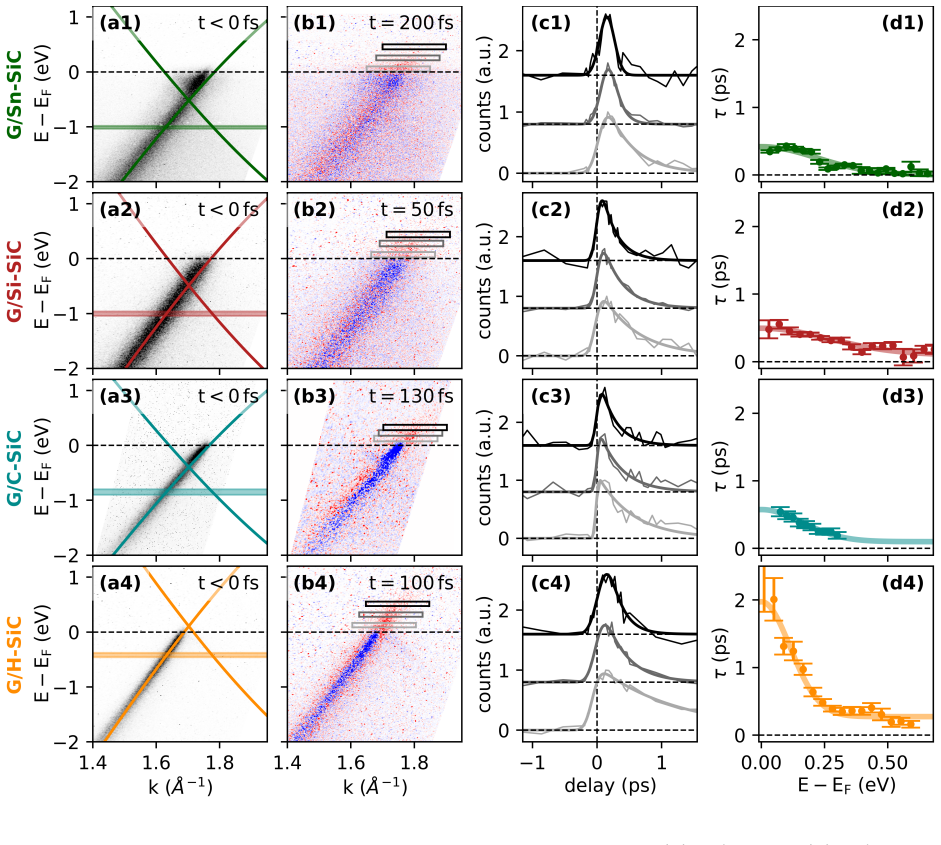
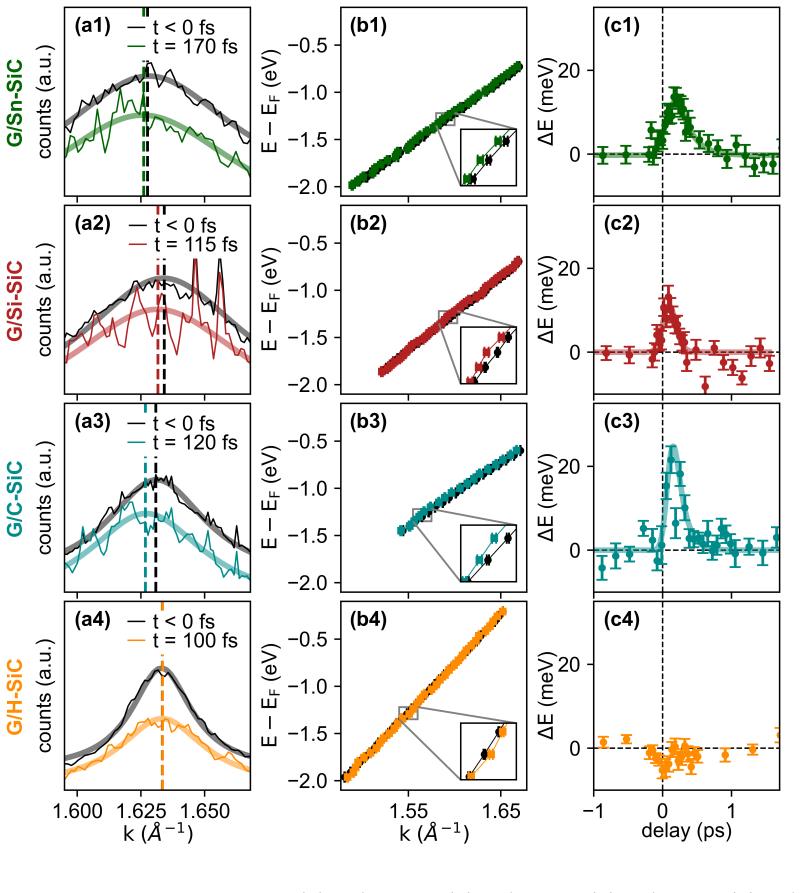
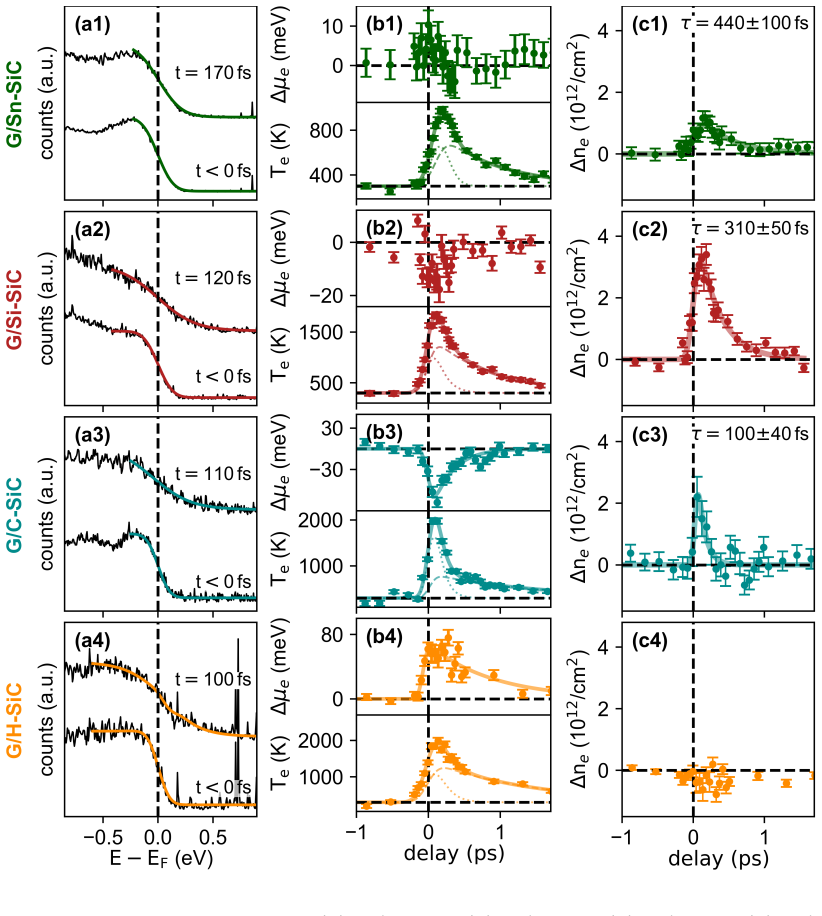
Interlayer hybridization manifests in three key observations: accelerated Dirac-carrier relaxation arising from additional electronic and phononic decay channels provided by the flat-band subsystem, transient charging of the Dirac cone enabled by direct optical excitation from the flat bands, and ultrafast back-transfer of charge into the flat bands on timescales governed by the interlayer coupling strength. The degree of hybridization can be tuned via the atomic number of the atoms intercalated at the graphene-SiC interface.
What carries the argument
Interlayer hybridization between Dirac electrons in graphene and flat-band states in the 2D adsorbate layer, detected through three ultrafast signatures in trARPES.
If this is right
- Dirac carriers gain extra electronic and phononic decay channels from the flat-band subsystem and therefore relax faster.
- Direct optical excitation from the flat bands produces transient charging of the Dirac cone.
- Charge returns to the flat bands on an ultrafast timescale set by the interlayer coupling strength.
- Varying the atomic number of intercalated atoms changes the observed hybridization strength.
Where Pith is reading between the lines
- The platform could be used to test whether hybridization strength correlates quantitatively with predicted heavy-fermion-like quasiparticle masses.
- Similar trARPES signatures might appear in other Dirac-flat band heterostructures if the interlayer coupling can be made comparable.
- Tuning via intercalant atomic number offers a route to map how hybridization strength affects other correlated phenomena such as gap opening or magnetic ordering.
Load-bearing premise
The observed ultrafast dynamics arise specifically from hybridization with flat bands hosted by the 2D adsorbate structures rather than other mechanisms such as substrate phonons or defects.
What would settle it
The same three ultrafast signatures appearing in a control sample that lacks the flat-band-hosting adsorbate layer, or failing to change when the intercalated atom species is varied, would indicate the dynamics have another origin.
Figures
read the original abstract
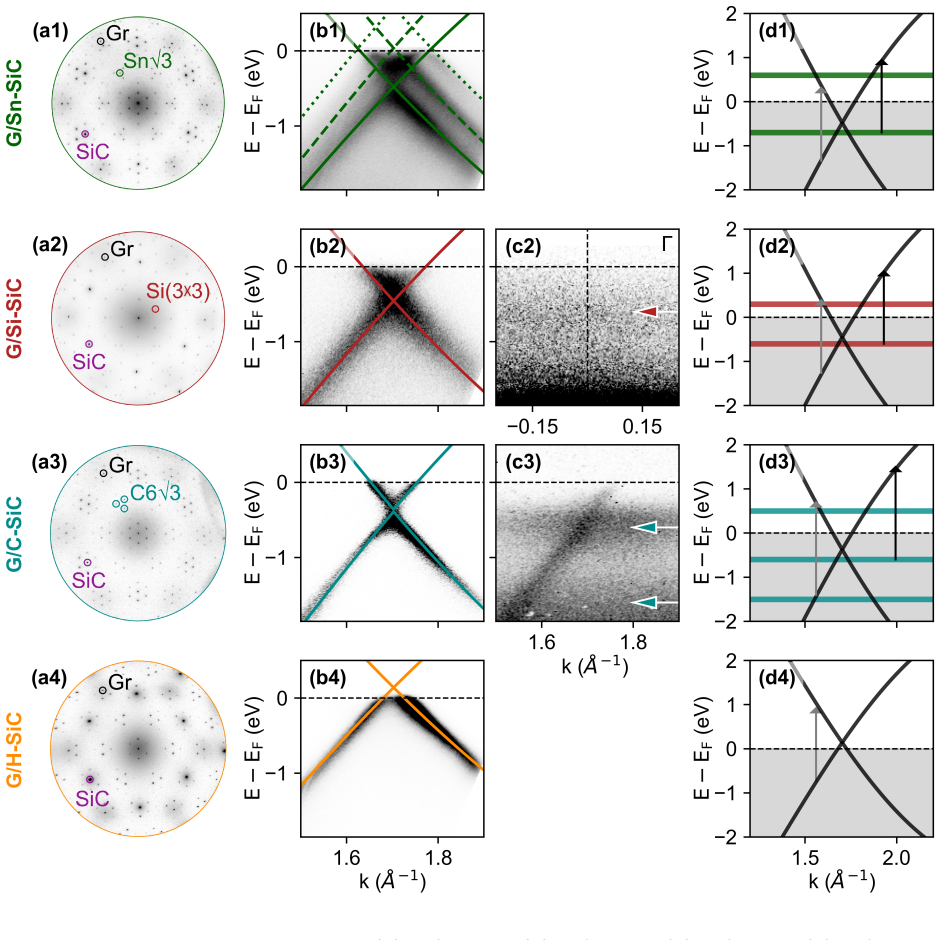
Hybridization of highly itinerant Dirac electrons with localized flat-band states is predicted to yield emergent phenomena such as exotic heavy-fermion behaviour. Epitaxial graphene on two-dimensional adsorbate structures on SiC(0001), which host flat bands, offers a promising platform to explore these effects. However, direct experimental evidence of interlayer hybridization in such systems has so far been lacking. Here, we address this gap using time- and angle-resolved photoemission spectroscopy (trARPES) where interlayer hybridization manifests in three key observations: (1) accelerated Dirac-carrier relaxation arising from additional electronic and phononic decay channels provided by the flat-band subsystem, (2) transient charging of the Dirac cone enabled by direct optical excitation from the flat bands, and (3) ultrafast back-transfer of charge into the flat bands on timescales governed by the interlayer coupling strength. We further demonstrate that the degree of hybridization can be tuned via the atomic number of the atoms intercalated at the graphene-SiC interface, establishing a controllable platform for investigating exotic correlated ground states.
Editorial analysis
A structured set of objections, weighed in public.
Referee Report
Summary. The manuscript uses time- and angle-resolved photoemission spectroscopy (trARPES) on epitaxial graphene on 2D adsorbate structures on SiC(0001) to claim direct evidence of interlayer hybridization between Dirac electrons and flat-band states. Hybridization is said to manifest in three observations: (1) accelerated Dirac-carrier relaxation from additional electronic/phononic channels, (2) transient charging of the Dirac cone via direct optical excitation from flat bands, and (3) ultrafast back-transfer of charge on timescales set by interlayer coupling strength. The degree of hybridization is further claimed to be tunable by the atomic number of intercalated atoms at the graphene-SiC interface.
Significance. If the three observations can be shown to arise specifically from flat-band hybridization rather than generic interface effects, the work would supply the first direct experimental signature of such hybridization in this platform and establish a tunable system for exploring predicted emergent phenomena such as heavy-fermion behavior. This would be a meaningful contribution to the study of Dirac/flat-band hybrids in 2D materials.
major comments (1)
- [Abstract / Results] The central interpretation—that the three listed trARPES observations arise specifically from interlayer hybridization with the adsorbate flat bands—requires explicit discrimination from alternative mechanisms (substrate phonons, defects, or generic interface states). The manuscript does not describe control samples without adsorbates, momentum-resolved signatures unique to flat-band coupling, or quantitative modeling of the coupling strength that would exclude those alternatives; this is load-bearing for the hybridization claim.
minor comments (1)
- The abstract refers to 'two-dimensional adsorbate structures' and 'atoms intercalated at the graphene-SiC interface' without naming the specific adsorbates or intercalants used in the presented data sets.
Simulated Author's Rebuttal
We thank the referee for their careful reading of the manuscript and for highlighting the need to strengthen the case for hybridization-specific signatures. We address the major comment below and indicate the revisions we will undertake.
read point-by-point responses
-
Referee: [Abstract / Results] The central interpretation—that the three listed trARPES observations arise specifically from interlayer hybridization with the adsorbate flat bands—requires explicit discrimination from alternative mechanisms (substrate phonons, defects, or generic interface states). The manuscript does not describe control samples without adsorbates, momentum-resolved signatures unique to flat-band coupling, or quantitative modeling of the coupling strength that would exclude those alternatives; this is load-bearing for the hybridization claim.
Authors: We agree that ruling out generic interface effects is essential. The central evidence we present is the systematic tunability of all three observations with intercalant atomic number, which modulates the flat-band energy, density of states, and interlayer coupling in a manner predicted by theory; substrate phonons or static defects would not exhibit such atomic-number dependence. We will add an explicit paragraph in the discussion section comparing our relaxation timescales to literature values for bare epitaxial graphene on SiC (which lack the accelerated component) and will reference prior ARPES studies on the same platform without intercalants. Momentum-resolved trARPES intensity maps already show charge accumulation and depletion features aligned with the flat-band dispersion rather than generic interface states; we will highlight these in a new figure panel. Quantitative extraction of the interlayer coupling from the back-transfer time constants is given in the supplementary information; we will move a concise version of this analysis into the main text. These additions constitute a partial revision that directly addresses the concern without requiring new experiments. revision: partial
Circularity Check
No circularity: purely observational experimental claims
full rationale
The paper reports trARPES measurements on epitaxial graphene with adsorbate flat bands, attributing three observed ultrafast dynamics (accelerated relaxation, transient charging, back-transfer) to interlayer hybridization. No equations, derivations, fitted parameters, or predictions are presented that could reduce to inputs by construction. The abstract and claims rest on direct experimental signatures rather than any self-referential modeling or self-citation chains. This is a standard experimental report with no load-bearing theoretical steps to inspect for circularity.
Axiom & Free-Parameter Ledger
axioms (2)
- domain assumption Flat bands are hosted by the two-dimensional adsorbate structures on SiC(0001)
- domain assumption trARPES signals of relaxation, charging, and back-transfer directly indicate interlayer hybridization strength
Reference graph
Works this paper leans on
-
[1]
All measurements were performed at room temperature using a primary electron energy of 150 eV
was used to characterize the interface structures. All measurements were performed at room temperature using a primary electron energy of 150 eV. The G/Sn-SiC sample was measured in situ. The G/Si-SiC sample was transferred to the SPA-LEED apparatus using a vacuum suitcase. The G/H-SiC sample was transferred in ambient conditions and subsequently cleaned ...
2020
-
[2]
P. R. Wallace, The band theory of graphite, Phys. Rev.71, 622 (1947)
1947
-
[3]
K. S. Novoselov, A. K. Geim, S. V. Morozov, D. Jiang, Y. Zhang, S. V. Dubonos, I. V. Grigorieva, and A. A. Firsov, Electric field effect in atomically thin carbon films, Science306, 666 (2004)
2004
-
[4]
Berger, Z
C. Berger, Z. Song, T. Li, X. Li, A. Y. Ogbazghi, R. Feng, Z. Dai, A. N. Marchenkov, E. H. Conrad, P. N. First,et al., Ultrathin epitaxial graphite: 2D electron gas properties and a route toward graphene-based nanoelectronics, The Journal of Physical Chemistry B108, 19912 (2004)
2004
-
[5]
K. S. Novoselov, A. K. Geim, S. V. Morozov, D. Jiang, M. I. Katsnelson, I. V. Grigorieva, S. V. Dubonos, and A. A. Firsov, Two-dimensional gas of massless Dirac fermions in graphene, Nature438, 197 (2005)
2005
-
[6]
K. Sun, Z. Gu, H. Katsura, and S. Das Sarma, Nearly Flatbands with Nontrivial Topology, Phys. Rev. Lett.106, 236803 (2011)
2011
-
[7]
Leykam, A
D. Leykam, A. Andreanov, and S. Flach, Artificial flat band systems: from lattice models to experiments, Adv. Phys.: X3, 1473052 (2018)
2018
-
[8]
Song and B
Z.-D. Song and B. A. Bernevig, Magic-angle twisted bilayer graphene as a topological heavy fermion problem, Phys. Rev. Lett.129, 047601 (2022)
2022
-
[9]
C˘ alug˘ aru, M
D. C˘ alug˘ aru, M. Borovkov, L. L. Lau, P. Coleman, Z.-D. Song, and B. A. Bernevig, Twisted bilayer graphene as topological heavy fermion: II. Analytical approximations of the model parameters, Low Temp. Phys.49, 640 (2023)
2023
-
[10]
Herzog-Arbeitman, J
J. Herzog-Arbeitman, J. Yu, D. C˘ alug˘ aru, H. Hu, N. Regnault, O. Vafek, J. Kang, and B. A. Bernevig, Topological heavy fermion model as an efficient representation of atomistic strain and relaxation in twisted bilayer graphene, Phys. Rev. B112, 125128 (2025)
2025
-
[11]
N. Witt, S. Ryee, L. Klebl, J. Cano, G. Sangiovanni, and T. O. Wehling, Real-Space Switching of Local Moments Driven by Quantum Geometry in Correlated Graphene Heterostructures, Phys. Rev. Lett.136, 046505 (2026). 11
2026
-
[12]
B. R. Ortiz, L. C. Gomes, J. R. Morey, M. Winiarski, M. Bordelon, J. S. Mangum, I. W. H. Oswald, J. A. Rodriguez-Rivera, J. R. Neilson, S. D. Wilson, E. Ertekin, T. M. McQueen, and E. S. Toberer, New kagome prototype materials: discovery of KV 3Sb5, RbV 3Sb5, and CsV3Sb5, Phys. Rev. Mater.3, 094407 (2019)
2019
-
[13]
B. R. Ortiz, S. M. L. Teicher, Y. Hu, J. L. Zuo, P. M. Sarte, E. C. Schueller, A. M. M. Abeykoon, M. J. Krogstad, S. Rosenkranz, R. Osborn, R. Seshadri, L. Balents, J. He, and S. D. Wilson, CsV 3Sb5: AZ 2 Topological Kagome Metal with a Superconducting Ground State, Phys. Rev. Lett.125, 247002 (2020)
2020
-
[14]
Balents, Spin liquids in frustrated magnets, Nature464, 199 (2010)
L. Balents, Spin liquids in frustrated magnets, Nature464, 199 (2010)
2010
-
[15]
Lin, J.-H
Z. Lin, J.-H. Choi, Q. Zhang, W. Qin, S. Yi, P. Wang, L. Li, Y. Wang, H. Zhang, Z. Sun, L. Wei, S. Zhang, T. Guo, Q. Lu, J.-H. Cho, C. Zeng, and Z. Zhang, Flatbands and Emergent Ferromagnetic Ordering in Fe3Sn2 Kagome Lattices, Phys. Rev. Lett.121, 096401 (2018)
2018
-
[16]
L. Ye, M. Kang, J. Liu, F. von Cube, C. R. Wicker, T. Suzuki, C. Jozwiak, A. Bostwick, E. Rotenberg, D. C. Bell, L. Fu, R. Comin, and J. G. Checkelsky, Massive Dirac fermions in a ferromagnetic kagome metal, Nature555, 638 (2018)
2018
-
[17]
E. H. Lieb, Two theorems on the Hubbard model, Phys. Rev. Lett.62, 1201 (1989)
1989
-
[18]
Guzm´ an-Silva, C
D. Guzm´ an-Silva, C. Mej´ ıa-Cort´ es, M. A. Bandres, M. C. Rechtsman, S. Weimann, S. Nolte, M. Segev, A. Szameit, and R. A. Vicencio, Experimental observation of bulk and edge trans- port in photonic Lieb lattices, New J. Phys.16, 063061 (2014)
2014
-
[19]
Mukherjee, A
S. Mukherjee, A. Spracklen, D. Choudhury, N. Goldman, P. ¨Ohberg, E. Andersson, and R. R. Thomson, Observation of a Localized Flat-Band State in a Photonic Lieb Lattice, Phys. Rev. Lett.114, 245504 (2015)
2015
-
[20]
S. Taie, H. Ozawa, T. Ichinose, T. Nishio, S. Nakajima, and Y. Takahashi, Coherent driving and freezing of bosonic matter wave in an optical Lieb lattice, Sci. Adv.1, e1500854 (2015)
2015
-
[21]
Y. Cao, V. Fatemi, A. Demir, S. Fang, S. L. Tomarken, J. Y. Luo, J. D. Sanchez-Yamagishi, K. Watanabe, T. Taniguchi, E. Kaxiras, R. C. Ashoori, and P. Jarillo-Herrero, Correlated in- sulator behaviour at half-filling in magic-angle graphene superlattices, Nature556, 80 (2018)
2018
-
[22]
Y. Cao, V. Fatemi, S. Fang, K. Watanabe, T. Taniguchi, E. Kaxiras, and P. Jarillo-Herrero, Unconventional superconductivity in magic-angle graphene superlattices, Nature556, 43 (2018). 12
2018
-
[23]
S. Lisi, X. Lu, T. Benschop, T. A. de Jong, P. Stepanov, J. R. Duran, F. Margot, I. Cucchi, E. Cappelli, A. Hunter, A. Tamai, V. Kandyba, A. Giampietri, A. Barinov, J. Jobst, V. Stal- man, M. Leeuwenhoek, K. Watanabe, T. Taniguchi, L. Rademaker, S. J. van der Molen, M. P. Allan, D. K. Efetov, and F. Baumberger, Observation of flat bands in twisted bilayer...
2021
-
[24]
Starke, J
U. Starke, J. Schardt, J. Bernhardt, M. Franke, K. Reuter, H. Wedler, K. Heinz, J. Furthm¨ uller, P. K¨ ackell, and F. Bechstedt, Novel reconstruction mechanism for dangling- bond minimization: combined method surface structure determination of SiC(111)-(3×3), Phys. Rev. Lett.80, 758 (1998)
1998
-
[25]
Johansson, L
L. Johansson, L. Duda, M. Laurenzis, M. Krieftewirth, and B. Reihl, Electronic structure of the 6H–SiC(0001)-3×3 surface studied with angle-resolved inverse and direct photoemission, Surf. Sci.445, 109 (2000)
2000
-
[26]
Visikovskiy, S.-i
A. Visikovskiy, S.-i. Kimoto, T. Kajiwara, M. Yoshimura, T. Iimori, F. Komori, and S. Tanaka, Graphene/SiC(0001) interface structures induced by Si intercalation and their influence on electronic properties of graphene, Phys. Rev. B94, 245421 (2016)
2016
-
[27]
Tilgner, Z
N. Tilgner, Z. Mamiyev, S. Wolff, P. Sch¨ adlich, F. G¨ ohler, C. Tegenkamp, and T. Seyller, Si intercalation beneath epitaxial graphene: screening Mott states at the SiC(0001) interface, 2D Mater.12, 045022 (2025)
2025
-
[28]
Ghosal, S
C. Ghosal, S. Ryee, Z. Mamiyev, M.-E. Federl, N. Witt, T. Wehling, and C. Tegenkamp, Mott states proximitized to a relativistic electron gas in epitaxial graphene, Phys. Rev. B111, 235426 (2025)
2025
-
[29]
Riedl, C
C. Riedl, C. Coletti, and U. Starke, Structural and electronic properties of epitaxial graphene on SiC(0001): a review of growth, characterization, transfer doping and hydrogen intercala- tion, J. Phys. D: Appl. Phys.43, 374009 (2010)
2010
-
[30]
Emtsev, F
K. Emtsev, F. Speck, T. Seyller, L. Ley, and J. D. Riley, Interaction, growth, and ordering of epitaxial graphene on SiC{0001}surfaces: A comparative photoelectron spectroscopy study, Phys. Rev. B77, 155303 (2008)
2008
-
[31]
Riedl, C
C. Riedl, C. Coletti, T. Iwasaki, A. Zakharov, and U. Starke, Quasi-free-standing epitaxial graphene on SiC obtained by hydrogen intercalation, Phys. Rev. Lett.103, 246804 (2009)
2009
-
[32]
Speck, J
F. Speck, J. Jobst, F. Fromm, M. Ostler, D. Waldmann, M. Hundhausen, H. B. Weber, and T. Seyller, The quasi-free-standing nature of graphene on H-saturated SiC(0001), Appl. Phys. 13 Lett.99, 122106 (2011)
2011
-
[33]
Forti, K
S. Forti, K. Emtsev, C. Coletti, A. Zakharov, C. Riedl, and U. Starke, Large-area homogeneous quasifree standing epitaxial graphene on SiC(0001): Electronic and structural characteriza- tion, Phys. Rev. B84, 125449 (2011)
2011
-
[34]
C. L. Frewin, C. Coletti, C. Riedl, U. Starke, and S. E. Saddow, A Comprehensive Study of Hydrogen Etching on the Major SiC Polytypes and Crystal Orientations, inSilicon Carbide and Related Materials 2008, Materials Science Forum, Vol. 615 (Trans Tech Publications Ltd,
2008
-
[35]
K. V. Emtsev, A. Bostwick, K. Horn, J. Jobst, G. L. Kellogg, L. Ley, J. L. McChesney, T. Ohta, S. A. Reshanov, J. R¨ ohrl, E. Rotenberg, A. K. Schmid, D. Waldmann, H. B. Weber, and T. Seyller, Towards wafer-size graphene layers by atmospheric pressure graphitization of silicon carbide, Nature Materials8, 203 (2009)
2009
-
[36]
Kruskopf, D
M. Kruskopf, D. M. Pakdehi, K. Pierz, S. Wundrack, R. Stosch, T. Dziomba, M. G¨ otz, J. Baringhaus, J. Aprojanz, C. Tegenkamp, J. Lidzba, T. Seyller, F. Hohls, F. J. Ahlers, and H. W. Schumacher, Comeback of epitaxial graphene for electronics: large-area growth of bilayer-free graphene on SiC, 2D Materials3, 041002 (2016)
2016
-
[37]
Chatterjee, M
A. Chatterjee, M. Kruskopf, S. Wundrack, P. Hinze, K. Pierz, R. Stosch, and H. Scherer, Impact of Polymer-Assisted Epitaxial Graphene Growth on Various Types of SiC Substrates, ACS Applied Electronic Materials4, 5317 (2022)
2022
-
[38]
Scheithauer, G
U. Scheithauer, G. Meyer, and M. Henzler, A new LEED instrument for quantitative spot profile analysis, Surface Science178, 441 (1986)
1986
-
[39]
E. L. Shirley, L. J. Terminello, A. Santoni, and F. J. Himpsel, Brillouin-zone-selection effects in graphite photoelectron angular distributions, Phys. Rev. B51, 13614 (1995)
1995
-
[40]
Gierz, J
I. Gierz, J. Henk, H. H¨ ochst, C. R. Ast, and K. Kern, Illuminating the dark corridor in graphene: Polarization dependence of angle-resolved photoemission spectroscopy on graphene, Phys. Rev. B83, 121408 (2011)
2011
-
[41]
Mamiyev and C
Z. Mamiyev and C. Tegenkamp, Sn intercalation into the BL/SiC(0001) interface: A detailed SPA-LEED investigation, Surf. Interfaces34, 102304 (2022)
2022
-
[42]
Mamiyev and C
Z. Mamiyev and C. Tegenkamp, Exploring graphene-substrate interactions: plasmonic exci- tation in Sn-intercalated epitaxial graphene, 2D Mater.11, 025013 (2024). 14
2024
-
[43]
H. Kim, O. Dugerjav, A. Lkhagvasuren, and J. M. Seo, Charge neutrality of quasi-free-standing monolayer graphene induced by the intercalated Sn layer, J. Phys. D: Appl. Phys.49, 135307 (2016)
2016
-
[44]
Hayashi, A
S. Hayashi, A. Visikovskiy, T. Kajiwara, T. Iimori, T. Shirasawa, K. Nakastuji, T. Miya- machi, S. Nakashima, K. Yaji, K. Mase,et al., Triangular lattice atomic layer of Sn(1×1) at graphene/SiC(0001) interface, Appl. Phys. Express11, 015202 (2017)
2017
-
[45]
Federl, N
M.-E. Federl, N. Witt, B. Yang, L. Weigl, N. Hofmann, J. Gradl, I. Piquero-Zulaica, J. V. Barth, N. Mishra, C. Coletti,et al., Nonequilibrium carrier dynamics and band structure of graphene on two-dimensional tin, Phys. Rev. B111, 125158 (2025)
2025
-
[46]
A. Visikovskiy, S. Hayashi, T. Kajiwara, F. Komori, K. Yaji, and S. Tanaka, Computational study of heavy group IV elements (Ge, Sn, Pb) triangular lattice atomic layers on SiC(0001) surface, arXiv:1809.00829 (2018)
work page internal anchor Pith review Pith/arXiv arXiv 2018
-
[47]
Li, Stanene on a SiC(0001) surface: a candidate for realizing quantum anomalous Hall effect, Phys
P. Li, Stanene on a SiC(0001) surface: a candidate for realizing quantum anomalous Hall effect, Phys. Chem. Chem. Phys.21, 11150 (2019)
2019
-
[48]
C. Xia, S. Watcharinyanon, A. Zakharov, R. Yakimova, L. Hultman, L. I. Johansson, and C. Virojanadara, Si intercalation/deintercalation of graphene on 6 H-SiC(0001), Phys. Rev. B85, 045418 (2012)
2012
-
[49]
Goler, C
S. Goler, C. Coletti, V. Piazza, P. Pingue, F. Colangelo, V. Pellegrini, K. V. Emtsev, S. Forti, U. Starke, F. Beltram, and S. Heun, Revealing the atomic structure of the buffer layer between SiC(0001) and epitaxial graphene, Carbon51, 249 (2013)
2013
-
[50]
Breusing, C
M. Breusing, C. Ropers, and T. Elsaesser, Ultrafast Carrier Dynamics in Graphite, Phys. Rev. Lett.102, 086809 (2009)
2009
-
[51]
J. C. Johannsen, S. Ulstrup, A. Crepaldi, F. Cilento, M. Zacchigna, J. A. Miwa, C. Cacho, R. T. Chapman, E. Springate, F. Fromm,et al., Tunable carrier multiplication and cooling in graphene, Nano Lett.15, 326 (2015)
2015
-
[52]
Kampfrath, L
T. Kampfrath, L. Perfetti, F. Schapper, C. Frischkorn, and M. Wolf, Strongly Coupled Op- tical Phonons in the Ultrafast Dynamics of the Electronic Energy and Current Relaxation in Graphite, Phys. Rev. Lett.95, 187403 (2005)
2005
-
[53]
H. Yan, D. Song, K. F. Mak, I. Chatzakis, J. Maultzsch, and T. F. Heinz, Time-resolved Raman spectroscopy of optical phonons in graphite: Phonon anharmonic coupling and anomalous stiffening, Phys. Rev. B80, 121403 (2009). 15
2009
-
[54]
J. C. Johannsen, S. Ulstrup, F. Cilento, A. Crepaldi, M. Zacchigna, C. Cacho, I. C. E. Turcu, E. Springate, F. Fromm, C. Raidel, T. Seyller, F. Parmigiani, M. Grioni, and P. Hofmann, Direct view of hot carrier dynamics in graphene, Phys. Rev. Lett.111, 027403 (2013)
2013
-
[55]
Weigl, J
L. Weigl, J. Gradl, P. Richter, D. Convertino, S. Forti, T. Seyller, C. Coletti, and I. Gierz, Influence of doping on non-equilibrium carrier dynamics in graphene, 2D Mater.13, 015010 (2025)
2025
-
[56]
L. Li, R. Long, and O. V. Prezhdo, Charge Separation and Recombination in Two-Dimensional MoS2/WS2: Time-Domain ab Initio Modeling, Chem. Mater.29, 2466 (2017)
2017
-
[57]
Zhu, W.-H
Y. Zhu, W.-H. Fang, A. Rubio, R. Long, and O. V. Prezhdo, The twist angle has weak influence on charge separation and strong influence on recombination in the MoS2/WS2 bilayer: ab initio quantum dynamics, J. Mater. Chem. A10, 8324 (2022)
2022
-
[58]
Hofmann, L
N. Hofmann, L. Weigl, J. Gradl, N. Mishra, G. Orlandini, S. Forti, C. Coletti, S. Latini, L. Xian, A. Rubio,et al., Link between interlayer hybridization and ultrafast charge transfer in WS2-graphene heterostructures, 2D Mater.10, 035025 (2023)
2023
-
[59]
Gierz, S
I. Gierz, S. Link, U. Starke, and A. Cavalleri, Non-equilibrium Dirac carrier dynamics in graphene investigated with time- and angle-resolved photoemission spectroscopy, Faraday Discuss.171, 311 (2014)
2014
-
[60]
Gierz, M
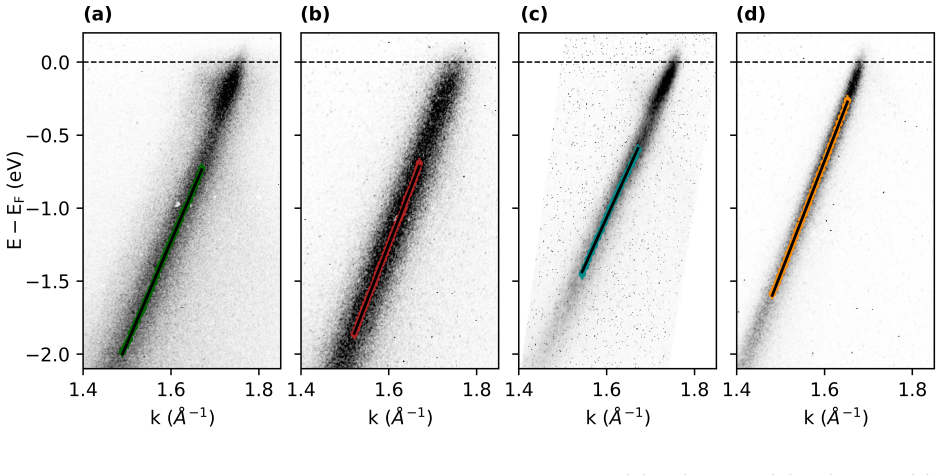
I. Gierz, M. Mitrano, J. C. Petersen, C. Cacho, I. E. Turcu, E. Springate, A. St¨ ohr, A. K¨ ohler, U. Starke, and A. Cavalleri, Population inversion in monolayer and bilayer graphene, J. Phys.: Condens. Matter27, 164204 (2015). 16 FIG. 1.Sample characterization. (1)G/Sn-SiC.(2)G/Si-SiC.(3)G/C-SiC.(4)G/H-SiC. (a)SPA-LEED images taken at a kinetic energy o...
2015
discussion (0)
Sign in with ORCID, Apple, or X to comment. Anyone can read and Pith papers without signing in.