Privacy-Preserving Screening for Record Linkage
Pith reviewed 2026-06-29 16:47 UTC · model grok-4.3
The pith
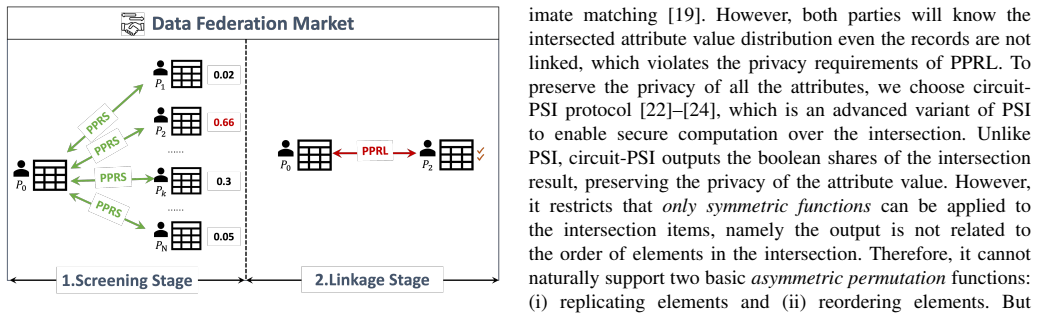
The Screening-then-Linkage framework adds a lightweight secure screening phase before full privacy-preserving record linkage to handle far larger sets of candidate collaborators.
A machine-rendered reading of the paper's core claim, the machinery that carries it, and where it could break.
Core claim
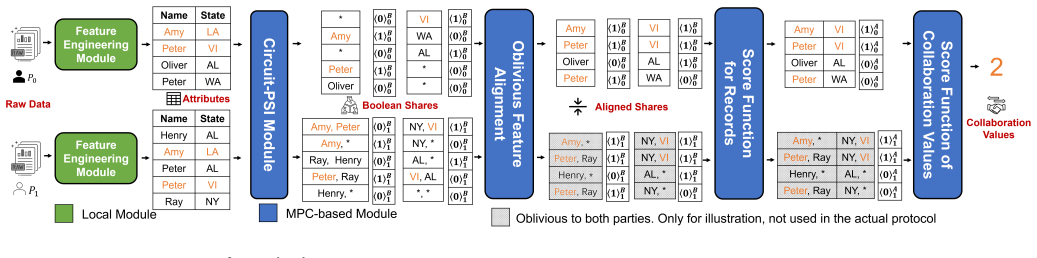
The authors establish the Screening-then-Linkage framework and realize it in Appraisal, a circuit-PSI system for privacy-preserving record screening. The Oblivious Attribute/Feature Alignment protocol reconciles approximate matching requirements with circuit-PSI's symmetric-function limits, cutting communication by a factor of 14. Rigorous analysis and experiments show Appraisal accommodates up to 850 times more records than the prior PPRS system SFour under identical constraints and runs 165 times faster than state-of-the-art PPRL, confirming that the screening stage substantially reduces the time to identify valuable collaborators from large pools.
What carries the argument
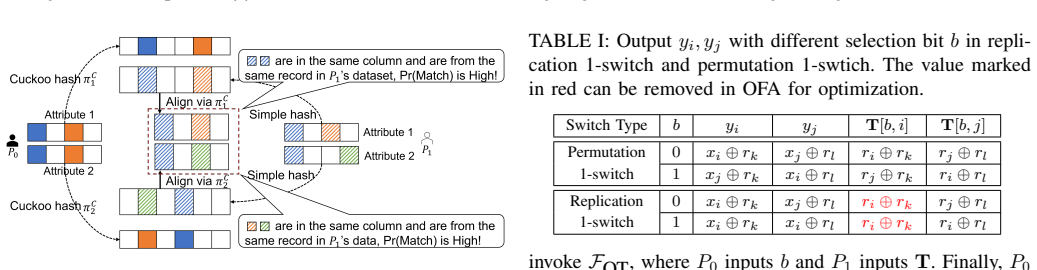
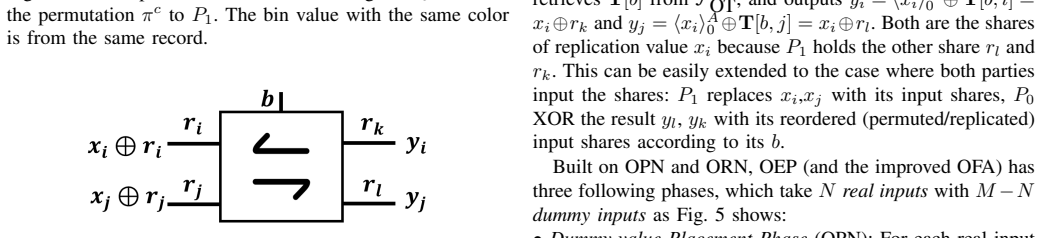
Screening-then-Linkage framework that runs circuit-PSI-based privacy-preserving record screening first, using the Oblivious Attribute/Feature Alignment protocol to support non-symmetric comparisons before full linkage.
If this is right
- The framework reduces overall computation time needed to find the most valuable collaborators from large candidate pools.
- Appraisal supports 850 times more records than the prior PPRS system within the same resource limits.
- The alignment protocol lowers communication costs by a factor of 14 relative to conventional methods.
- Security guarantees hold while effectiveness and efficiency are demonstrated in comprehensive evaluations.
Where Pith is reading between the lines
- The hybrid screening approach could be adapted to other secure multi-party tasks that currently scale poorly with many candidates.
- Data markets might adopt such filters to shortlist partners quickly before investing in full linkages.
- Accuracy-speed trade-offs could be quantified further by testing on additional real-world datasets with known match distributions.
Load-bearing premise
The screening phase must retain low false-negative rates for valuable matches even though it is restricted to symmetric functions from circuit-PSI.
What would settle it
Running Appraisal on a dataset with known valuable collaborator pairs and measuring whether the screening phase discards more than a small fraction of those pairs would show whether accuracy is preserved at scale.
Figures
read the original abstract
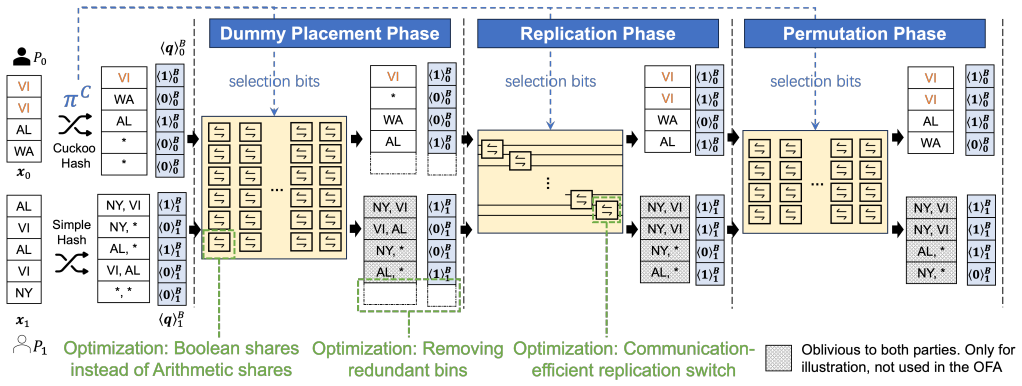
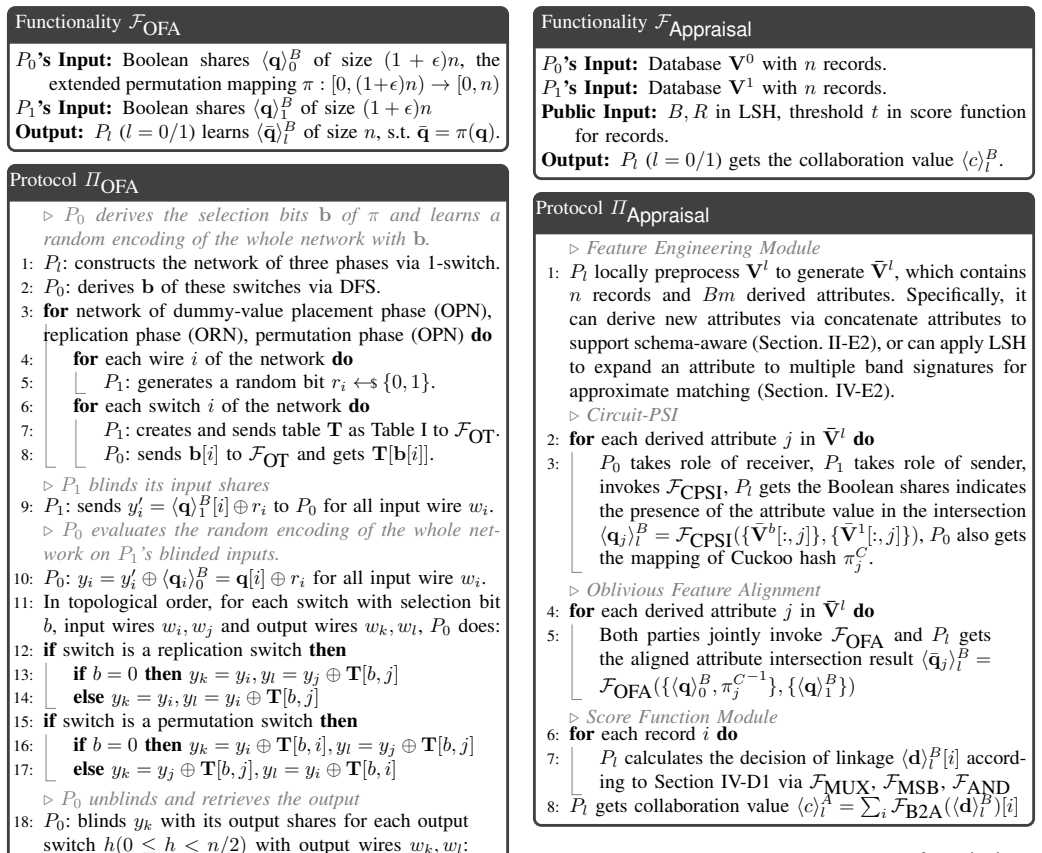
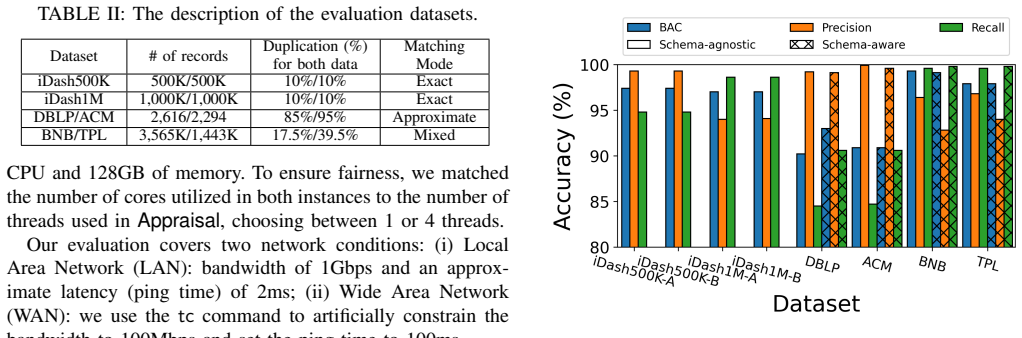
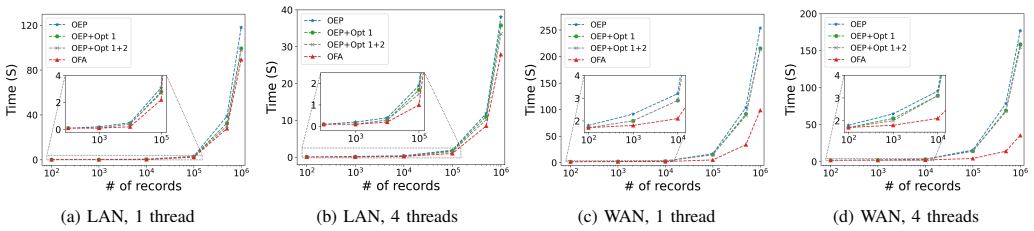
In an era dominated by big data and machine learning, establishing valuable data collaboration has never been more critical. However, such collaborations must operate under regulatory and legal constraints. Two-party Privacy-Preserving Record Linkage (PPRL) emerges to assess the potential collaboration value and also ensure the privacy and security of the involved data. Nevertheless, the substantial computational and communication overheads associated with PPRL hinder its practical adoption in data markets with numerous potential collaborators. Therefore, we present the Screening-then-Linkage framework, which incorporates a lightweight Screening phase prior to the resource-intensive PPRL phase, i.e., PPRS, to mitigate the scalability issue of PPRL. We propose a circuit-PSI-based system, named Appraisal to realize a secure, effective, and efficient PPRS. To reconcile the approximate matching and/or schema-aware setting required in PPRS with the limitations of the circuit-PSI supporting only symmetric functions, we propose a more communication-efficient secure permutation, i.e., Oblivious Attribute/Feature Alignment protocol tailored for PPRS. This protocol supports a broader range of comparison functions and significantly improves efficiency, i.e., reducing communication costs by a factor of 14 compared to the conventional protocol. Our rigorous analysis and comprehensive empirical evaluations demonstrate the security, effectiveness, and efficiency of Appraisal. Appraisal can accommodate up to $850\times$ more records than the SOTA PPRS system, SFour, within the same constraints. Moreover, it is $165 \times$ faster than SOTA PPRL, indicating the Screening-then-Linkage framework substantially decreases the computation time required to identify the most valuable collaborators from a large pool of candidates.
Editorial analysis
A structured set of objections, weighed in public.
Referee Report
Summary. The paper proposes a Screening-then-Linkage framework to address scalability limitations in two-party Privacy-Preserving Record Linkage (PPRL). It introduces Appraisal, a circuit-PSI-based system for Privacy-Preserving Record Screening (PPRS), and an Oblivious Attribute/Feature Alignment protocol to enable approximate/schema-aware matching under circuit-PSI's symmetric-function restriction. The central claims are that Appraisal supports up to 850× more records than the SOTA PPRS system SFour under equivalent constraints, achieves 165× speedup over SOTA PPRL, reduces communication by 14× via the new protocol, and provides security/effectiveness/efficiency via rigorous analysis and empirical evaluations.
Significance. If the empirical scalability claims hold after supplying the missing quantitative bounds, the Screening-then-Linkage approach could meaningfully expand practical deployment of PPRL in data markets by allowing larger candidate pools to be screened before full linkage. The Oblivious Attribute/Feature Alignment protocol's reported 14× communication reduction is a concrete efficiency contribution that stands independently of the headline multipliers.
major comments (2)
- [Abstract] Abstract: The headline claim that Appraisal accommodates up to 850× more records than SFour (and 165× faster than SOTA PPRL) is load-bearing for the Screening-then-Linkage framework, yet the screening phase supplies no closed-form bound on recall loss, no worst-case similarity threshold, and no dataset property (e.g., match-score distribution or schema heterogeneity) that would guarantee the filtered set retains the top collaborators. Without this, the capacity multiplier remains conditional on unstated empirical behavior.
- [Abstract] Abstract / empirical evaluations section: The assertions of 'rigorous analysis and comprehensive empirical evaluations' supporting the 850× and 165× gains are presented without visible error bars, full dataset descriptions, baseline implementation details, or explicit false-negative rates for the screening phase, leaving the central performance claims on unverified empirical statements.
Simulated Author's Rebuttal
We thank the referee for the careful reading and constructive feedback on the abstract claims. We address each major comment below and will make revisions to improve clarity on the empirical basis of our results.
read point-by-point responses
-
Referee: [Abstract] Abstract: The headline claim that Appraisal accommodates up to 850× more records than SFour (and 165× faster than SOTA PPRL) is load-bearing for the Screening-then-Linkage framework, yet the screening phase supplies no closed-form bound on recall loss, no worst-case similarity threshold, and no dataset property (e.g., match-score distribution or schema heterogeneity) that would guarantee the filtered set retains the top collaborators. Without this, the capacity multiplier remains conditional on unstated empirical behavior.
Authors: The 850× and 165× figures are empirical results obtained under the specific datasets, similarity thresholds, and match-score distributions described in the evaluation section. We acknowledge that a general closed-form bound on recall loss is not feasible, as it depends on the underlying data distribution and schema heterogeneity, which are application-specific. In the revision we will explicitly restate these dataset properties, the chosen similarity thresholds, and the observed false-negative rates in both the abstract and the main text so that the conditional nature of the multipliers is clear. revision: yes
-
Referee: [Abstract] Abstract / empirical evaluations section: The assertions of 'rigorous analysis and comprehensive empirical evaluations' supporting the 850× and 165× gains are presented without visible error bars, full dataset descriptions, baseline implementation details, or explicit false-negative rates for the screening phase, leaving the central performance claims on unverified empirical statements.
Authors: We will revise the manuscript to make the supporting details more prominent: error bars will be added to all performance plots, full dataset descriptions and preprocessing steps will be expanded, baseline implementation details (including library versions and hardware) will be listed in a dedicated table, and explicit false-negative rates for the screening phase will be reported alongside the headline multipliers. These elements exist in the full evaluation but will be highlighted in the abstract and evaluation section for easier verification. revision: yes
Circularity Check
No circularity: scalability claims are empirical comparisons to external SOTA systems
full rationale
The paper's central results (850× capacity vs SFour, 165× speedup vs prior PPRL) are presented as outcomes of empirical evaluations and analysis of the Screening-then-Linkage framework plus the new Oblivious Attribute/Feature Alignment protocol. No equations, fitted parameters, or self-citations are shown that reduce these multipliers to internal definitions or prior author work by construction. The protocol is introduced to address circuit-PSI limitations, with efficiency gains (e.g., 14× communication reduction) claimed via direct comparison rather than tautology. This is a standard non-circular empirical contribution.
Axiom & Free-Parameter Ledger
Reference graph
Works this paper leans on
-
[1]
Towards distribution-aware query answer- ing in data markets,
A. Asudeh and F. Nargesian, “Towards distribution-aware query answer- ing in data markets,”Proceedings of the VLDB Endowment, vol. 15, no. 11, pp. 3137–3144, 2022
2022
-
[2]
Deeper: A data enrichment system powered by deep web,
P. Wang, Y . He, R. Shea, J. Wang, and E. Wu, “Deeper: A data enrichment system powered by deep web,” inProceedings of the 2018 International Conference on Management of Data, 2018, pp. 1801–1804
2018
-
[3]
S. Hardy, W. Henecka, H. Ivey-Law, R. Nock, G. Patrini, G. Smith, and B. Thorne, “Private federated learning on vertically partitioned data via entity resolution and additively homomorphic encryption,”arXiv preprint arXiv:1711.10677, 2017
work page internal anchor Pith review Pith/arXiv arXiv 2017
-
[4]
The impact of record linkage on learning from feature partitioned data,
R. Nock, S. Hardy, W. Henecka, H. Ivey-Law, J. Nabaglo, G. Patrini, G. Smith, and B. Thorne, “The impact of record linkage on learning from feature partitioned data,” inInternational Conference on Machine Learning. PMLR, 2021, pp. 8216–8226
2021
-
[5]
Fincom, modernizing banking technologies - real time aml sanctions screening & entity resolution,
Fincom, “Fincom, modernizing banking technologies - real time aml sanctions screening & entity resolution,” 2016, available at: https://fincom.co (2025)
2016
-
[6]
Cohort profile: the swiss childhood cancer survivor study,
C. E. Kuehni, C. S. Rueegg, G. Michel, C. E. Rebholz, M.-P. F. Strippoli, F. K. Niggli, M. Egger, N. X. von der Weid, and S. P. O. G. (SPOG), “Cohort profile: the swiss childhood cancer survivor study,” International journal of epidemiology, vol. 41, no. 6, pp. 1553–1564, 2012
2012
-
[7]
Datavant match: High accuracy, fit-for-purpose record linkage for any research need,
Datavant, “Datavant match: High accuracy, fit-for-purpose record linkage for any research need,” 2023, available at: https://datavant.com/resources/product-sheet/matching-patient-records- with-datavant (2025)
2023
-
[8]
Amazon publisher service,
Amazon, “Amazon publisher service,” 2024, available at: https://aps.amazon.com/aps/index.html (2025)
2024
-
[9]
Unlock data insights across multi-party datasets using aws entity resolution on aws clean rooms without sharing underlying data,
Amazon, “Unlock data insights across multi-party datasets using aws entity resolution on aws clean rooms without sharing underlying data,” 2024, available at: https://aws.amazon.com/blogs/industries/unlock- data-insights-across-multi-party-datasets-using-aws-entity-resolution- on-aws-clean-rooms-without-sharing-underlying-data (2025)
2024
-
[10]
Datavant - a data platform company for healthcare,
Datavant, “Datavant - a data platform company for healthcare,” 2025, available at: https://www.datavant.com (2025)
2025
-
[11]
Datavant connect: Linkage solutions,
Datavant, “Datavant connect: Linkage solutions,” 2025, available at: https://www.datavant.com/products/connect-linkage (2025)
2025
-
[12]
Datavant - data and analytics thought leader: Paul petraro, boehringer ingelheim,
Datavant, “Datavant - data and analytics thought leader: Paul petraro, boehringer ingelheim,” 2022, available at: https://www.datavant.com/real-world-data-rwd/data-analytics-thought- leader-series-paul-petraro-boehringer-ingelheim (2025)
2022
-
[13]
Privacy- preserving record linkage for cardinality counting,
N. Wu, D. Vatsalan, M. A. K ˆaafar, and S. K. Ramesh, “Privacy- preserving record linkage for cardinality counting,” inProceedings of the 2023 ACM Asia Conference on Computer and Communications Security, ASIA CCS 2023, Melbourne, VIC, Australia, July 10-14, 2023. ACM, 2023, pp. 53–64
2023
-
[14]
Privacy-preserving similarity coefficients for binary data,
K.-S. Wong and M. H. Kim, “Privacy-preserving similarity coefficients for binary data,”Computers & Mathematics with Applications, vol. 65, no. 9, pp. 1280–1290, 2013
2013
-
[15]
Secure approximate string matching for privacy-preserving record linkage,
A. Essex, “Secure approximate string matching for privacy-preserving record linkage,”IEEE transactions on information forensics and secu- rity, vol. 14, no. 10, pp. 2623–2632, 2019
2019
-
[16]
Resilient identity crime detection,
C. Phua, K. Smith-Miles, V . Lee, and R. Gayler, “Resilient identity crime detection,”IEEE transactions on knowledge and data engineering, vol. 24, no. 3, pp. 533–546, 2010
2010
-
[17]
Modern privacy-preserving record linkage techniques: An overview,
A. Gkoulalas-Divanis, D. Vatsalan, D. Karapiperis, and M. Kantarcioglu, “Modern privacy-preserving record linkage techniques: An overview,” IEEE Transactions on Information Forensics and Security, vol. 16, pp. 4966–4987, 2021
2021
-
[18]
Sfour: a protocol for cryptographi- cally secure record linkage at scale,
B. Khurram and F. Kerschbaum, “Sfour: a protocol for cryptographi- cally secure record linkage at scale,” in2020 IEEE 36th International Conference on Data Engineering (ICDE). IEEE, 2020, pp. 277–288
2020
-
[19]
Privacy-preserving record linkage using local sensitive hash and private set intersection,
A. Adir, E. Aharoni, N. Drucker, E. Kushnir, R. Masalha, M. Mirkin, and O. Soceanu, “Privacy-preserving record linkage using local sensitive hash and private set intersection,” inApplied Cryptography and Network Security Workshops: ACNS 2022 Satellite Workshops, AIBlock, AIHWS, AIoTS, CIMSS, Cloud S&P , SCI, SecMT, SiMLA, Rome, Italy, June 20– 23, 2022, P...
2022
-
[20]
Cryptographically secure private record linkage using locality-sensitive hashing,
R. Wei and F. Kerschbaum, “Cryptographically secure private record linkage using locality-sensitive hashing,”Proceedings of the VLDB Endowment, vol. 17, no. 2, pp. 79–91, 2023
2023
-
[21]
Composing differential privacy and secure computation: A case study on scaling private record linkage,
X. He, A. Machanavajjhala, C. Flynn, and D. Srivastava, “Composing differential privacy and secure computation: A case study on scaling private record linkage,” inProceedings of the 2017 ACM SIGSAC conference on computer and communications security, 2017, pp. 1389– 1406
2017
-
[22]
Efficient circuit- based psi with linear communication,
B. Pinkas, T. Schneider, O. Tkachenko, and A. Yanai, “Efficient circuit- based psi with linear communication,” inAdvances in Cryptology– EUROCRYPT 2019: 38th Annual International Conference on the Theory and Applications of Cryptographic Techniques, Darmstadt, Ger- many, May 19–23, 2019, Proceedings, Part III 38. Springer, 2019, pp. 122–153
2019
-
[23]
Circuit-psi with linear complexity via relaxed batch opprf,
N. Chandran, D. Gupta, and A. Shah, “Circuit-psi with linear complexity via relaxed batch opprf,”Proceedings on Privacy Enhancing Technolo- gies, no. 1, pp. 353–372, 2022
2022
-
[24]
V ole-psi: fast oprf and circuit-psi from vector-ole,
P. Rindal and P. Schoppmann, “V ole-psi: fast oprf and circuit-psi from vector-ole,” inAdvances in Cryptology–EUROCRYPT 2021: 40th Annual International Conference on the Theory and Applications of Cryptographic Techniques, Zagreb, Croatia, October 17–21, 2021, Pro- ceedings, Part II. Springer, 2021, pp. 901–930
2021
-
[25]
How to hide circuits in mpc an efficient framework for private function evaluation,
P. Mohassel and S. Sadeghian, “How to hide circuits in mpc an efficient framework for private function evaluation,” inAdvances in Cryptology– EUROCRYPT 2013: 32nd Annual International Conference on the Theory and Applications of Cryptographic Techniques, Athens, Greece, May 26-30, 2013. Proceedings 32. Springer, 2013, pp. 557–574
2013
-
[26]
An analysis of one-to-one matching algorithms for entity resolution,
G. Papadakis, V . Efthymiou, E. Thanos, O. Hassanzadeh, and P. Christen, “An analysis of one-to-one matching algorithms for entity resolution,” The VLDB Journal, vol. 32, no. 6, pp. 1369–1400, 2023
2023
-
[27]
Benchmarking filtering techniques for entity resolution,
G. Papadakis, M. Fisichella, F. Schoger, G. Mandilaras, N. Augsten, and W. Nejdl, “Benchmarking filtering techniques for entity resolution,” in 2023 IEEE 39th International Conference on Data Engineering (ICDE). IEEE, 2023
2023
-
[28]
Approximate nearest neighbors: towards removing the curse of dimensionality,
P. Indyk and R. Motwani, “Approximate nearest neighbors: towards removing the curse of dimensionality,” inProceedings of the thirtieth annual ACM symposium on Theory of computing, 1998, pp. 604–613
1998
-
[29]
Practical and optimal lsh for angular distance,
A. Andoni, P. Indyk, T. Laarhoven, I. Razenshteyn, and L. Schmidt, “Practical and optimal lsh for angular distance,”Advances in neural information processing systems, vol. 28, 2015
2015
-
[30]
Goldreich,The Foundations of Cryptography - Volume 2: Basic Applications
O. Goldreich,The Foundations of Cryptography - Volume 2: Basic Applications. Cambridge University Press, 2004
2004
-
[31]
How to exchange secrets by oblivious transfer,
M. RABIN, “How to exchange secrets by oblivious transfer,”Tech. Memo TR-81, Aiken Computation Laboratory, Harvard University, 1981
1981
-
[32]
Aby-a framework for efficient mixed-protocol secure two-party computation
D. Demmler, T. Schneider, and M. Zohner, “Aby-a framework for efficient mixed-protocol secure two-party computation.” inNDSS, 2015
2015
-
[33]
Efficient multiparty protocols using circuit randomization,
D. Beaver, “Efficient multiparty protocols using circuit randomization,” inAdvances in Cryptology—CRYPTO’91: Proceedings 11. Springer, 1992, pp. 420–432
1992
-
[34]
Cryptflow2: Practical 2-party secure inference,
D. Rathee, M. Rathee, N. Kumar, N. Chandran, D. Gupta, A. Rastogi, and R. Sharma, “Cryptflow2: Practical 2-party secure inference,” in Proceedings of the 2020 ACM SIGSAC Conference on Computer and Communications Security, 2020, pp. 325–342
2020
-
[35]
Secret-shared shuffle,
M. Chase, E. Ghosh, and O. Poburinnaya, “Secret-shared shuffle,” inAd- vances in Cryptology–ASIACRYPT 2020: 26th International Conference on the Theory and Application of Cryptology and Information Security, Daejeon, South Korea, December 7–11, 2020, Proceedings, Part III 26. Springer, 2020, pp. 342–372
2020
-
[36]
Large-scale secure xgb for vertical federated learning,
W. Fang, D. Zhao, J. Tan, C. Chen, C. Yu, L. Wang, L. Wang, J. Zhou, and B. Zhang, “Large-scale secure xgb for vertical federated learning,” in Proceedings of the 30th ACM International Conference on Information & Knowledge Management, 2021, pp. 443–452
2021
-
[37]
Cheetah: Lean and fast secure{two-party}deep neural network inference,
Z. Huang, W.-j. Lu, C. Hong, and J. Ding, “Cheetah: Lean and fast secure{two-party}deep neural network inference,” in31st USENIX Security Symposium (USENIX Security 22), 2022, pp. 809–826
2022
-
[38]
Shuffle-based private set union: Faster and more secure,
Y . Jia, S.-F. Sun, H.-S. Zhou, J. Du, and D. Gu, “Shuffle-based private set union: Faster and more secure,” in31st USENIX Security Symposium (USENIX Security 22), 2022, pp. 2947–2964
2022
-
[39]
Private set operations from oblivious switching,
G. Garimella, P. Mohassel, M. Rosulek, S. Sadeghian, and J. Singh, “Private set operations from oblivious switching,” inIACR International Conference on Public-Key Cryptography. Springer, 2021, pp. 591–617
2021
-
[40]
iDASH Privacy & Security Workshop. Se- cure genome analysis competition,
iDash, “iDASH Privacy & Security Workshop. Se- cure genome analysis competition,” 2022, available at: http://www.humangenomeprivacy.org/2022/ (2025)
2022
-
[41]
Evaluation of entity resolution approaches on real-world match problems,
H. K ¨opcke, A. Thor, and E. Rahm, “Evaluation of entity resolution approaches on real-world match problems,”Proceedings of the VLDB Endowment, vol. 3, no. 1-2, pp. 484–493, 2010
2010
-
[42]
Github - gpapadis/continuousfilteringbenchmark: Continuous benchmark of filtering methods for entity resolution,
G. Papadakis, M. Fisichella, F. Schoger, G. Mandilaras, N. Augsten, and W. Nejdl, “Github - gpapadis/continuousfilteringbenchmark: Continuous benchmark of filtering methods for entity resolution,” 2022, available at:https://github.com/gpapadis/ContinuousFilteringBenchmark/ (2025)
2022
-
[43]
British national bibliography,
The British Library, “British national bibliography,” 2023, available at: https://www.bl.uk/collection-metadata/metadata-services (2025)
2023
-
[44]
The toronto public library open dataset,
The Toronto Public Library, “The toronto public library open dataset,” 2023, available at: http://www.torontopubliclibrary.ca/opendata/ (2025)
2023
-
[45]
Strengthening privacy- preserving record linkage using diffusion,
F. Armknecht, Y . Heng, and R. Schnell, “Strengthening privacy- preserving record linkage using diffusion,”Proceedings on Privacy Enhancing Technologies, vol. 2, pp. 298–311, 2023
2023
-
[46]
Github - youzheheng/2022 popets: Strengthening privacy- preserving record linkage using diffusion,
“Github - youzheheng/2022 popets: Strengthening privacy- preserving record linkage using diffusion,” 2022, available at: https://github.com/youzheheng/2022 PoPETS (2025)
2022
-
[47]
Perfectly secure and efficient two-party electronic-health-record linkage,
F. Chen, X. Jiang, S. Wang, L. M. Schilling, D. Meeker, T. Ong, M. E. Matheny, J. N. Doctor, L. Ohno-Machado, and J. Vaidya, “Perfectly secure and efficient two-party electronic-health-record linkage,”IEEE internet computing, vol. 22, no. 2, pp. 32–41, 2018
2018
-
[48]
Private record matching using differential privacy,
A. Inan, M. Kantarcioglu, G. Ghinita, and E. Bertino, “Private record matching using differential privacy,” inProceedings of the 13th Interna- tional Conference on Extending Database Technology, 2010, pp. 123– 134
2010
-
[49]
A hybrid private record linkage scheme: Separating differentially private synopses from matching records,
J. Cao, F.-Y . Rao, E. Bertino, and M. Kantarcioglu, “A hybrid private record linkage scheme: Separating differentially private synopses from matching records,” in2015 IEEE 31st International Conference on Data Engineering. IEEE, 2015, pp. 1011–1022
2015
-
[50]
Efficient privacy-aware record integration,
M. Kuzu, M. Kantarcioglu, A. Inan, E. Bertino, E. Durham, and B. Malin, “Efficient privacy-aware record integration,” inProceedings of the 16th International Conference on Extending Database Technology, 2013, pp. 167–178
2013
-
[51]
Hybrid private record linkage: Separating differentially private synopses from matching records,
F.-Y . Rao, J. Cao, E. Bertino, and M. Kantarcioglu, “Hybrid private record linkage: Separating differentially private synopses from matching records,”ACM Transactions on Privacy and Security (TOPS), vol. 22, no. 3, pp. 1–36, 2019
2019
-
[52]
Privacy-preserving record linkage using bloom filters,
R. Schnell, T. Bachteler, and J. Reiher, “Privacy-preserving record linkage using bloom filters,”BMC medical informatics and decision making, vol. 9, no. 1, pp. 1–11, 2009
2009
-
[53]
Application of privacy- preserving techniques in operational record linkage centres,
J. H. Boyd, S. M. Randall, and A. M. Ferrante, “Application of privacy- preserving techniques in operational record linkage centres,”Medical data privacy handbook, pp. 267–287, 2015
2015
-
[54]
A constraint satisfaction cryptanalysis of bloom filters in private record linkage,
M. Kuzu, M. Kantarcioglu, E. Durham, and B. Malin, “A constraint satisfaction cryptanalysis of bloom filters in private record linkage,” inPrivacy Enhancing Technologies: 11th International Symposium, PETS 2011, Waterloo, ON, Canada, July 27-29, 2011. Proceedings 11. Springer, 2011, pp. 226–245
2011
-
[55]
Cryptanalysis of basic bloom filters used for privacy preserving record linkage,
F. Niedermeyer, S. Steinmetzer, M. Kroll, and R. Schnell, “Cryptanalysis of basic bloom filters used for privacy preserving record linkage,” German Record Linkage Center, Working Paper Series, No. WP-GRLC- 2014-04, 2014
2014
-
[56]
Efficient pattern mining based cryptanalysis for privacy-preserving record link- age,
A. Vidanage, T. Ranbaduge, P. Christen, and R. Schnell, “Efficient pattern mining based cryptanalysis for privacy-preserving record link- age,” in2019 IEEE 35th International Conference on Data Engineering (ICDE). IEEE, 2019, pp. 1698–1701
2019
-
[57]
A graph matching attack on privacy-preserving record linkage,
A. Vidanage, P. Christen, T. Ranbaduge, and R. Schnell, “A graph matching attack on privacy-preserving record linkage,” inProceedings of the 29th ACM International Conference on Information & Knowledge Management, 2020, pp. 1485–1494
2020
-
[58]
Linking sensitive data,
P. Christen, T. Ranbaduge, and R. Schnell, “Linking sensitive data,” Methods and techniques for practical privacy-preserving information sharing. Cham: Springer, 2020
2020
-
[59]
Securing bloom filters for privacy- preserving record linkage,
T. Ranbaduge and R. Schnell, “Securing bloom filters for privacy- preserving record linkage,” inProceedings of the 29th ACM Interna- tional Conference on Information & Knowledge Management, 2020, pp. 2185–2188
2020
-
[60]
Evaluation of hardening techniques for privacy-preserving record linkage
M. Franke, Z. Sehili, F. Rohde, and E. Rahm, “Evaluation of hardening techniques for privacy-preserving record linkage.” inEDBT, 2021, pp. 289–300
2021
-
[61]
A taxonomy of privacy- preserving record linkage techniques,
D. Vatsalan, P. Christen, and V . S. Verykios, “A taxonomy of privacy- preserving record linkage techniques,”Information Systems, vol. 38, no. 6, pp. 946–969, 2013
2013
-
[62]
Privacy-preserving record linkage for big data: Current approaches and research challenges,
D. Vatsalan, Z. Sehili, P. Christen, and E. Rahm, “Privacy-preserving record linkage for big data: Current approaches and research challenges,” Handbook of big data technologies, pp. 851–895, 2017
2017
discussion (0)
Sign in with ORCID, Apple, or X to comment. Anyone can read and Pith papers without signing in.