Nuclear structure within the relativistic mean field approach including chiral symmetry and quark confinement effects
Pith reviewed 2026-07-01 15:52 UTC · model grok-4.3
The pith
A relativistic mean field model with chiral symmetry breaking and quark confinement describes binding energies and charge radii well for medium and heavy nuclei.
A machine-rendered reading of the paper's core claim, the machinery that carries it, and where it could break.
Core claim
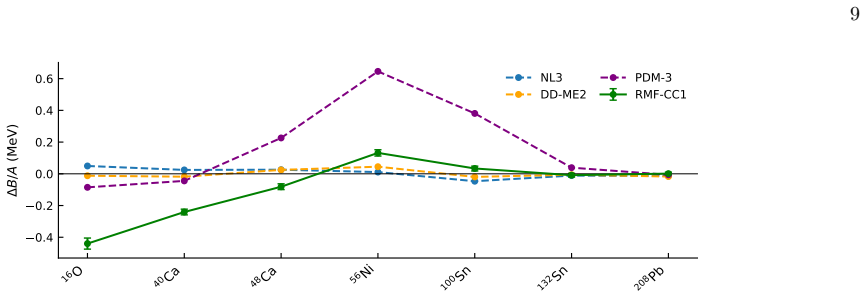
Within the chiral confining model the relativistic mean-field equations yield a satisfactory account of binding energies and charge radii for medium and heavy nuclei once parameters are calibrated to empirical saturation properties and doubly magic data; the same framework produces enhanced pairing in open-shell nuclei through an enlarged Dirac effective mass, reduced spin-orbit splittings, and higher single-particle level density at the Fermi surface, while departures from the linear sigma-model form of the potential improve light nuclei at the cost of a smaller Dirac mass.
What carries the argument
The chiral confining potential, which incorporates both chiral symmetry breaking and quark confinement effects inside the relativistic mean-field Lagrangian for nucleons.
If this is right
- Binding energies and charge radii of medium and heavy nuclei are reproduced to good accuracy.
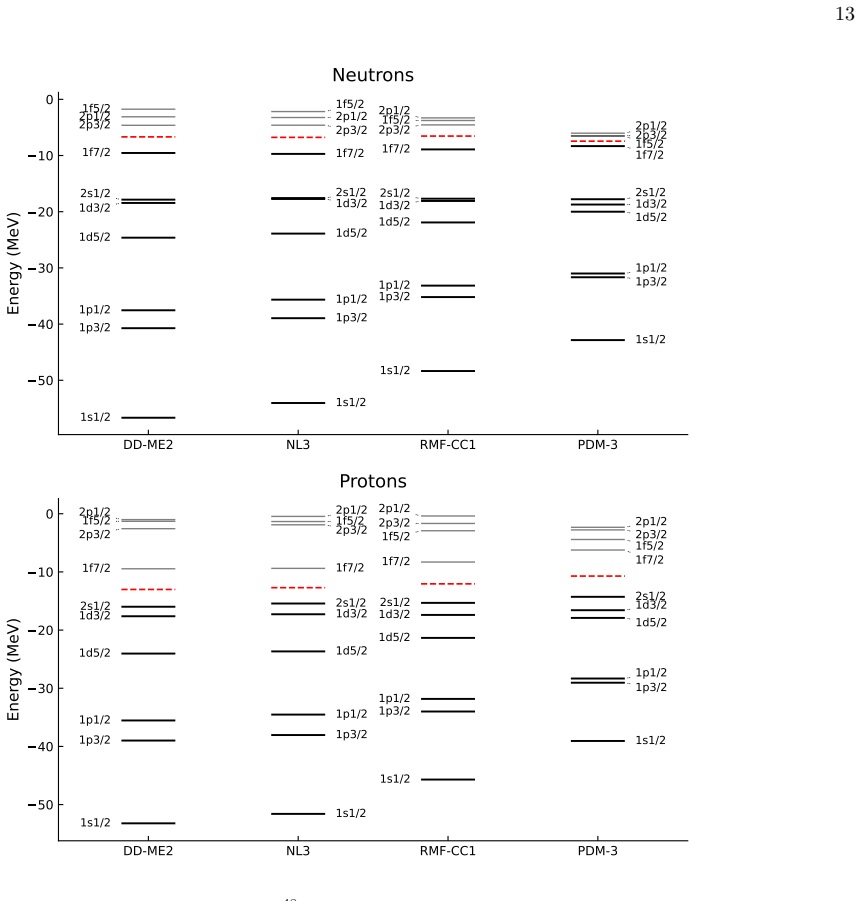
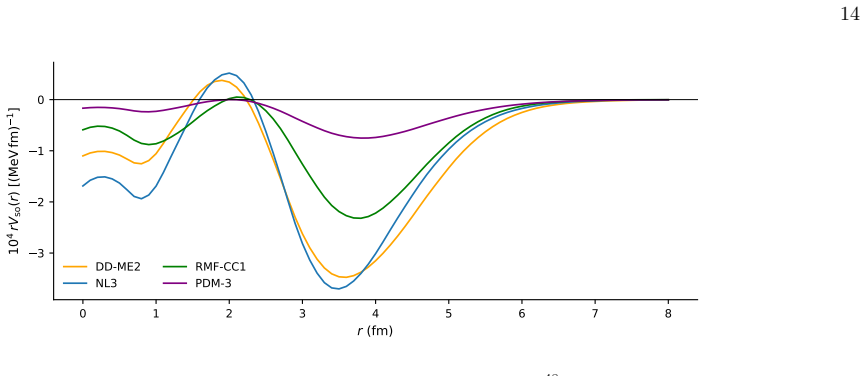
- Open-shell nuclei display enhanced pairing correlations driven by the large Dirac effective mass and increased level density near the Fermi surface.
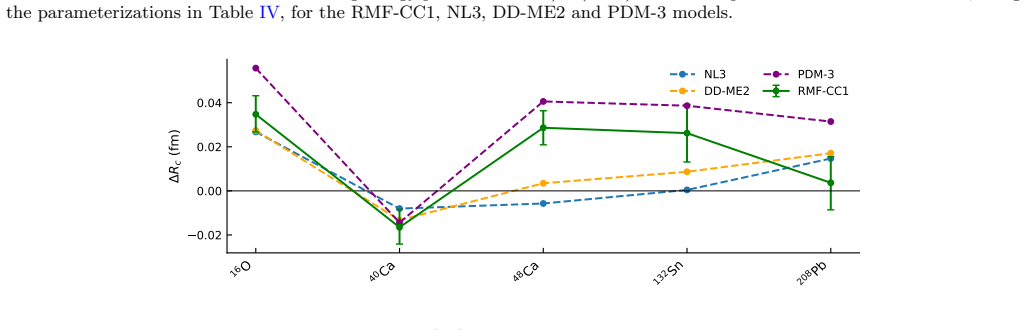
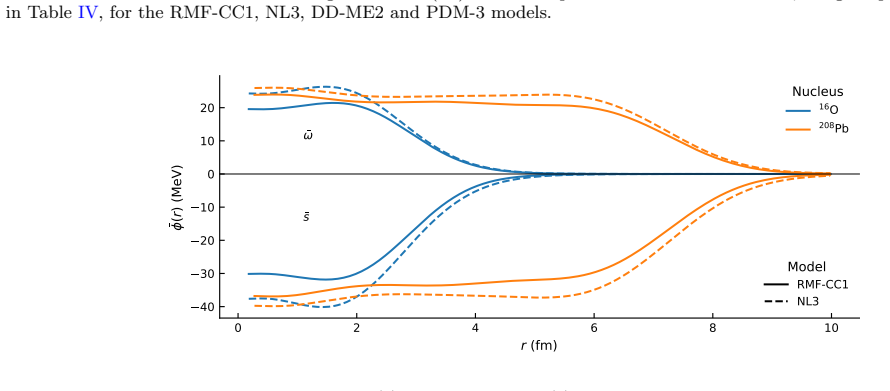
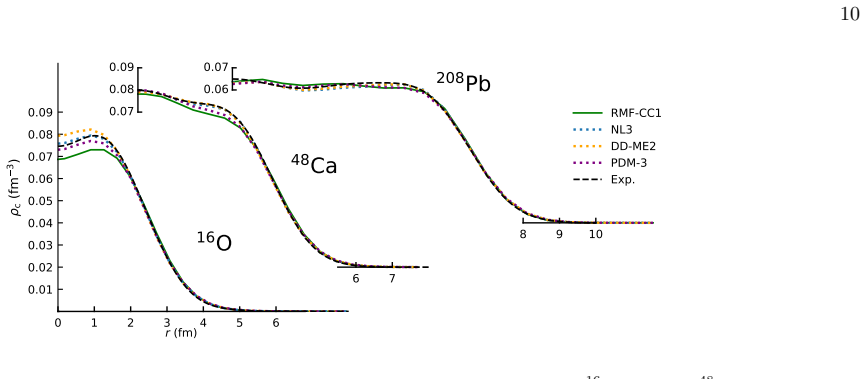
- Charge density profiles are slightly more diffuse than experiment while radii remain accurate.
- Additional flexibility in the chiral potential reduces the Dirac mass and suppresses the anomalous pairing strength.
- The description of light nuclei improves when the potential is allowed to deviate from the linear sigma-model form.
Where Pith is reading between the lines
- The framework could be used to predict properties of exotic nuclei far from stability where pairing and shell structure compete.
- The reduced spin-orbit strength may alter predicted magic numbers in the superheavy region.
- Direct comparison of calculated single-particle spectra with transfer-reaction data would test the link between the chiral potential and level density.
- The model supplies a concrete route to connect quark-level dynamics to nuclear phenomenology without introducing new parameters beyond the chiral potential shape.
Load-bearing premise
The constrained shape of the chiral potential remains adequate when the model is applied to finite nuclei whose densities differ from saturation.
What would settle it
A systematic under- or over-prediction of measured charge radii or pairing gaps in a set of light or open-shell nuclei that cannot be removed by modest re-calibration would falsify the central claim.
Figures
read the original abstract
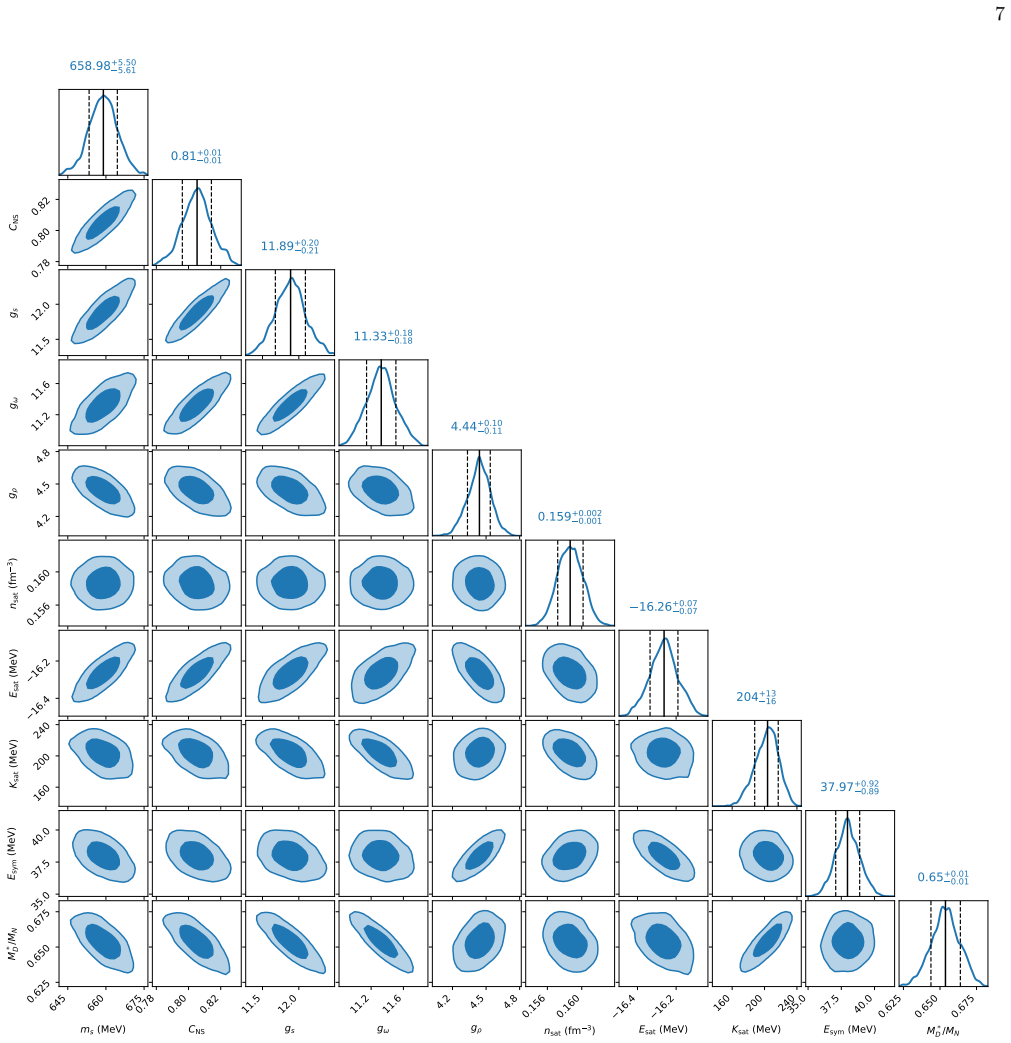
The relativistic mean field approach, within a theoretical framework known as the chiral confining model incorporating chiral symmetry breaking and quark confinement effects, is applied for the first time to finite nuclei. Model parameters are calibrated through a Bayesian approach using nuclear empirical properties and doubly magic nuclei. The model provides a satisfactory description of binding energies and charge radii for medium and heavy nuclei, while larger discrepancies are observed in light nuclei. This behavior is linked to the constrained form of the chiral potential, which reduces flexibility away from saturation density. Charge radii are reproduced with very good accuracy, although density profiles remain slightly more diffuse than experimental ones. The extension to open-shell nuclei with a separable Gogny pairing interaction reveals enhanced pairing correlations associated with the large Dirac effective mass, reduced spin-orbit splittings, and increased single-particle level density around the Fermi surface. Finally, departures from the linear sigma model potential motivated by the Nambu-Jona-Lasinio framework are explored. Allowing additional flexibility in the chiral potential improves the description of light nuclei and reduces the Dirac mass, which in turn suppresses the anomalous pairing. These results highlight the sensitivity of finite nuclei properties to the structure of the chiral potential and the associated single-particle spectrum.
Editorial analysis
A structured set of objections, weighed in public.
Referee Report
Summary. The manuscript presents the first application of the chiral confining model (incorporating chiral symmetry breaking and quark confinement) within the relativistic mean field framework to finite nuclei. Model parameters are calibrated via a Bayesian approach using nuclear empirical properties and doubly magic nuclei. The model is reported to provide a satisfactory description of binding energies and charge radii for medium and heavy nuclei (with larger discrepancies in light nuclei attributed to the constrained chiral potential), while extensions to open-shell nuclei using a separable Gogny pairing interaction reveal enhanced pairing correlations linked to large Dirac effective mass, reduced spin-orbit splittings, and increased single-particle level density. Departures from the linear sigma model potential (motivated by the Nambu-Jona-Lasinio framework) are explored to improve light-nuclei descriptions and suppress anomalous pairing.
Significance. If the results hold, this constitutes a novel extension of an existing RMF framework to finite nuclei, with the Bayesian calibration providing a systematic parameter determination and the explicit relaxation of the chiral-potential constraint demonstrating sensitivity of nuclear observables to that structure. The work connects quark-level effects to nuclear structure in a controlled way, though the calibration procedure limits claims of independent predictive power.
major comments (1)
- [Abstract] Abstract: the central claim of a 'satisfactory description' of binding energies and charge radii for medium and heavy nuclei rests on Bayesian calibration to nuclear empirical properties and doubly magic nuclei; this means the reported agreement largely reflects the fit to the calibration data rather than independent predictions, even though the paper correctly flags larger discrepancies in light nuclei due to reduced flexibility away from saturation density.
minor comments (2)
- [Abstract] Abstract: the statements 'very good accuracy' for charge radii and 'slightly more diffuse' density profiles are qualitative; quantitative rms deviations or direct comparisons to data would improve precision.
- The connection between the linear sigma model potential and the Nambu-Jona-Lasinio framework is mentioned but not elaborated; a brief additional reference or one-sentence explanation would aid readers.
Simulated Author's Rebuttal
We thank the referee for their careful review and constructive feedback on our manuscript. We address the major comment below and have prepared revisions to improve clarity.
read point-by-point responses
-
Referee: [Abstract] Abstract: the central claim of a 'satisfactory description' of binding energies and charge radii for medium and heavy nuclei rests on Bayesian calibration to nuclear empirical properties and doubly magic nuclei; this means the reported agreement largely reflects the fit to the calibration data rather than independent predictions, even though the paper correctly flags larger discrepancies in light nuclei due to reduced flexibility away from saturation density.
Authors: We agree that the reported agreement for binding energies and charge radii of the medium and heavy nuclei in the calibration set is a direct consequence of the Bayesian fit to nuclear empirical properties and doubly magic nuclei. The abstract phrasing is meant to summarize the overall performance achieved within the calibrated regime, while the text already notes the reduced flexibility and larger discrepancies for light nuclei. To address the referee's point, we will revise the abstract to explicitly indicate that the satisfactory description follows from the calibration procedure and to more clearly separate fitted observables from those tested beyond the calibration set. This change will be made in the next version of the manuscript. revision: yes
Circularity Check
No circularity; explicit calibration to data with no claimed independent derivation
full rationale
The paper explicitly states that model parameters are calibrated via Bayesian methods to nuclear empirical properties and doubly magic nuclei, then reports that the model provides a satisfactory description of binding energies and charge radii. This is a standard phenomenological fit, not a derivation chain that reduces to its inputs by construction. No self-citations, uniqueness theorems, or ansatzes are invoked as load-bearing in the provided text; the extension to open-shell nuclei uses an explicit separable Gogny pairing interaction. The central results are therefore self-contained applications rather than tautological predictions.
Axiom & Free-Parameter Ledger
free parameters (1)
- Model parameters
axioms (1)
- domain assumption Chiral symmetry breaking and quark confinement effects are incorporated via the chiral confining model framework
Reference graph
Works this paper leans on
-
[1]
For the binding energy, we observe a bigger deviation from experiments for the light nuclei, especially 16O and 40Ca
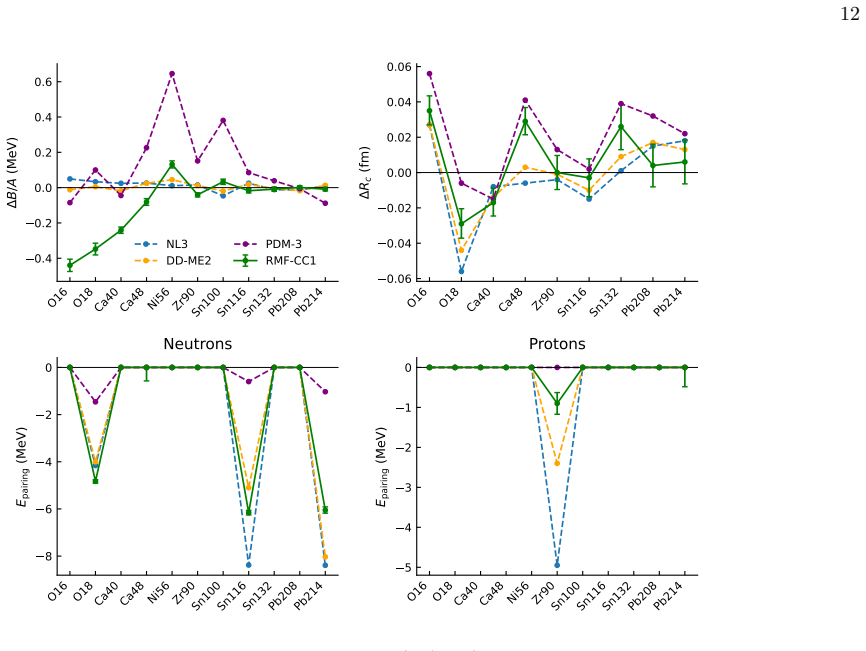
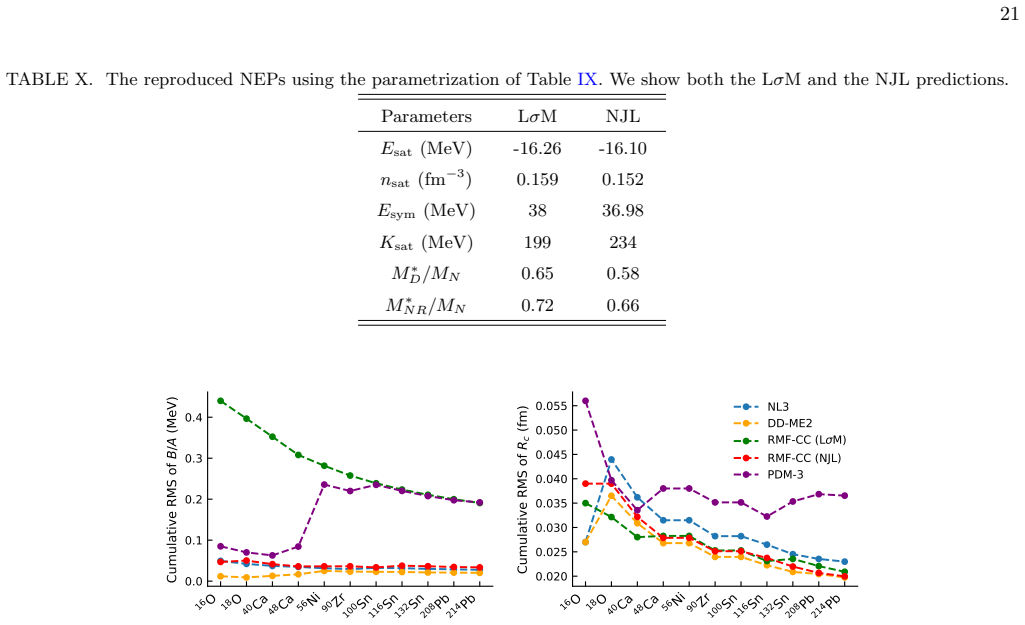
The error bars are defined asσ ± = q σ±2 model +σ 2exp. For the binding energy, we observe a bigger deviation from experiments for the light nuclei, especially 16O and 40Ca. In contrast, NL3 and DD-ME2 provide more flexibility through either free parameters in the non-linear scalar potential or density-dependent couplings, and are fitted to both light and...
2020
-
[2]
Y. Nambu, G. Jona-Lasinio, Phys. Rev.124, 246 (1961). doi:10.1103/PhysRev.124.246 23
-
[3]
S. Weinberg, Phys. Lett. B251, 288 (1990). doi:10.1016/0370-2693(90)90938-3
-
[4]
P. Ring, Prog. Part. Nucl. Phys.37, 193 (1996). doi:10.1016/0146-6410(96)00054-3
-
[5]
D. Vretenar, A. Afanasjev, G. Lalazissis, P. Ring, Physics Reports409(3), 101 (2005). doi: https://doi.org/10.1016/j.physrep.2004.10.001
-
[6]
J. Meng, H. Toki, S.G. Zhou, S.Q. Zhang, W.H. Long, L.S. Geng, Progress in Particle and Nuclear Physics57(2), 470 (2006). doi:10.1016/j.ppnp.2005.06.001
-
[7]
G. Chanfray, M. Ericson, Eur. Phys. J. A25, 151 (2005). doi:10.1140/epja/i2005-10074-6
-
[8]
E. Massot, G. Chanfray, Phys. Rev. C78, 015204 (2008). doi:10.1103/PhysRevC.78.015204
-
[9]
R. Somasundaram, J. Margueron, G. Chanfray, H. Hansen, Eur. Phys. J. A58(5), 84 (2022). doi:10.1140/epja/s10050- 022-00733-7
-
[10]
M. Chamseddine, J. Margueron, G. Chanfray, H. Hansen, R. Somasundaram, The European Physical Journal A59(8) (2023). doi:10.1140/epja/s10050-023-01089-2. URLhttp://dx.doi.org/10.1140/epja/s10050-023-01089-2
-
[11]
M. Chamseddine, J. Margueron, H. Hansen, G. Chanfray, The European Physical Journal A60, 137 (2024). doi: 10.1140/epja/s10050-024-01358-8
-
[12]
G. Chanfray, M. Ericson, P.A.M. Guichon, Phys. Rev. C63, 055202 (2001). doi:10.1103/PhysRevC.63.055202
-
[13]
P.A.M. Guichon, Phys. Lett. B200, 235 (1988). doi:10.1016/0370-2693(88)90762-9
-
[14]
G. Chanfray, D. Davesne, M. Ericson, M. Martini, Eur. Phys. J. A27, 191 (2006). doi:10.1140/epja/i2005-10245-5
-
[15]
M.C. Birse, Phys. Rev. C53, R2048 (1996). doi:10.1103/PhysRevC.53.R2048
-
[16]
G. Chanfray, Eur. Phys. J. A60(1), 7 (2024). doi:10.1140/epja/s10050-023-01221-2
-
[17]
G. Chanfray, M. Ericson, Phys. Rev. C75, 015206 (2007). doi:10.1103/PhysRevC.75.015206
-
[18]
E. Massot, G. Chanfray, Phys. Rev. C80, 015202 (2009). doi:10.1103/PhysRevC.80.015202
-
[19]
G. Chanfray, M. Ericson, Phys. Rev. C83, 015204 (2011). doi:10.1103/PhysRevC.83.015204
-
[20]
G. Chanfray, M. Ericson, M. Martini, Universe9(7) (2023). doi:10.3390/universe9070316. URLhttps://www.mdpi.com/ 2218-1997/9/7/316
-
[21]
K. Hebeler, J.M. Lattimer, C.J. Pethick, A. Schwenk, Astrophys. J.773, 11 (2013). doi:10.1088/0004-637X/773/1/11
-
[22]
J. Margueron, R. Hoffmann Casali, F. Gulminelli, Phys. Rev. C97(2), 025805 (2018). doi:10.1103/PhysRevC.97.025805
-
[23]
J. Margueron, F. Gulminelli, Physical Review C99(2019). doi:10.1103/PhysRevC.99.025806
-
[24]
J. Dobaczewski, W. Nazarewicz, P.G. Reinhard, Journal of Physics G: Nuclear and Particle Physics41(7), 074001 (2014). doi:10.1088/0954-3899/41/7/074001. URLhttps://dx.doi.org/10.1088/0954-3899/41/7/074001
-
[25]
T. Nikˇ si´ c, N. Paar, D. Vretenar, P. Ring, Computer Physics Communications185(6), 1808 (2014). doi: https://doi.org/10.1016/j.cpc.2014.02.027. URLhttps://www.sciencedirect.com/science/article/pii/ S0010465514000836
-
[26]
G. Audi, F. Kondev, M. Wang, W. Huang, S. Naimi, Chinese Physics C41, 030001 (2017). doi:10.1088/1674- 1137/41/3/030001
-
[27]
I. Angeli, K. Marinova, Atomic Data and Nuclear Data Tables99, 69 (2013). doi:10.1016/j.adt.2011.12.006
-
[28]
B.V. Carlson, M. Dutra, O. Louren¸ co, J. Margueron, Phys. Rev. C107, 035805 (2023). doi:10.1103/PhysRevC.107.035805. URLhttps://link.aps.org/doi/10.1103/PhysRevC.107.035805
-
[29]
M. Bender, P.H. Heenen, P.G. Reinhard, Rev. Mod. Phys.75, 121 (2003). doi:10.1103/RevModPhys.75.121. URLhttps: //link.aps.org/doi/10.1103/RevModPhys.75.121
-
[30]
G.A. Lalazissis, J. Konig, P. Ring, Phys. Rev. C55, 540 (1997). doi:10.1103/PhysRevC.55.540
-
[31]
G.A. Lalazissis, T. Niksic, D. Vretenar, P. Ring, Phys. Rev. C71, 024312 (2005). doi:10.1103/PhysRevC.71.024312
-
[32]
M.H. Mun, I.J. Shin, W.G. Paeng, M. Harada, Y. Kim, Eur. Phys. J. A59(7), 149 (2023). doi:10.1140/epja/s10050-023- 01064-x
-
[33]
M. Jaminon, C. Mahaux, Phys. Rev. C40, 354 (1989). doi:10.1103/PhysRevC.40.354
-
[34]
Z.y. Ma, J. Rong, B.Q. Chen, Z.Y. Zhu, H.Q. Song, Phys. Lett. B604, 170 (2004). doi:10.1016/j.physletb.2004.11.004
-
[35]
E.N.E.v. Dalen, C. Fuchs, A. Faessler, Phys. Rev. C72, 065803 (2005). doi:10.1103/PhysRevC.72.065803
-
[36]
J.M. Yao, S. Baroni, M. Bender, P.H. Heenen, Phys. Rev. C86, 014310 (2012). doi:10.1103/PhysRevC.86.014310
-
[37]
H. De Vries, C. De Jager, C. De Vries, Atomic Data and Nuclear Data Tables36(3), 495 (1987). doi:https://doi.org/10.1016/0092-640X(87)90013-1. URLhttps://www.sciencedirect.com/science/article/pii/ 0092640X87900131
-
[38]
J. Berger, M. Girod, D. Gogny, Computer Physics Communications63(1), 365 (1991). doi:https://doi.org/10.1016/0010- 4655(91)90263-K. URLhttps://www.sciencedirect.com/science/article/pii/001046559190263K
-
[39]
J.P. Ebran, A. Mutschler, E. Khan, D. Vretenar, Phys. Rev. C94, 024304 (2016). doi:10.1103/PhysRevC.94.024304. URL https://link.aps.org/doi/10.1103/PhysRevC.94.024304
-
[40]
F. Mercier, J.P. Ebran, E. Khan, Phys. Rev. C107, 034309 (2023). doi:10.1103/PhysRevC.107.034309. URLhttps: //link.aps.org/doi/10.1103/PhysRevC.107.034309
-
[41]
G. Chanfray, J. Margueron, Phys. Rev. C102, 024331 (2020). doi:10.1103/PhysRevC.102.024331. URLhttps://link. aps.org/doi/10.1103/PhysRevC.102.024331
-
[42]
G. Chanfray, H. Hansen, J. Margueron, Eur.Phys.J.A59(11), 264 (2023). doi:10.1140/epja/s10050-023-01179-1. URL https://hal.science/hal-04074564
-
[43]
P.A.M. Guichon, A.W. Thomas, Phys. Rev. Lett.93, 132502 (2004). doi:10.1103/PhysRevLett.93.132502
-
[44]
Pradhan, et al., Relativistic mean field approach with chiral symmetry breaking and quark1 confinement in the light of astrophysical constraints (2026)
B.K. Pradhan, et al., Relativistic mean field approach with chiral symmetry breaking and quark1 confinement in the light of astrophysical constraints (2026). In Preparation
2026
discussion (0)
Sign in with ORCID, Apple, or X to comment. Anyone can read and Pith papers without signing in.