Pairwise Liouvillian learning from randomized measurements: practical aspects and guidelines for operating the protocol in large-scale experiments
Pith reviewed 2026-06-29 16:54 UTC · model grok-4.3
The pith
Randomized Pauli measurements learn Liouvillian coefficients pairwise, keeping classical memory independent of system size.
A machine-rendered reading of the paper's core claim, the machinery that carries it, and where it could break.
Core claim
In the two-body long-range interaction and single-body noise setting, the coefficients of the Liouvillian can be recovered through a complete workflow that processes randomized Pauli measurement data in a pairwise manner, so that the required classical memory remains independent of system size while parameter choices for acquisition and post-processing minimize the overall reconstruction error.
What carries the argument
Pairwise decomposition of the learning task, which isolates each two-body interaction term and single-body noise term so that each coefficient is extracted from local data without reference to the global state.
If this is right
- Reconstruction of the Liouvillian becomes feasible on systems with hundreds of qubits without exponential classical storage.
- Guidelines for measurement count and post-processing cutoffs can be used directly to control error in actual experiments.
- The same workflow applies to any platform whose dominant interactions are two-body and long-range under local noise.
Where Pith is reading between the lines
- The memory independence may allow the protocol to serve as a building block for learning higher-order or time-dependent generators if the pairwise assumption is relaxed in controlled ways.
- Hardware experiments could test whether the reported parameter guidelines remain optimal when readout errors and finite sampling are added on top of the ideal model.
- If the two-body assumption holds only approximately, the method could still provide useful estimates of the dominant coefficients before full tomography becomes intractable.
Load-bearing premise
The physical system must contain only two-body long-range interactions together with single-body noise, because only then does the learning task factor into independent pairs.
What would settle it
A numerical or experimental test in which the classical memory or runtime required for reconstruction grows with system size when the pairwise protocol is applied to a two-body long-range plus single-body noise model.
Figures
read the original abstract
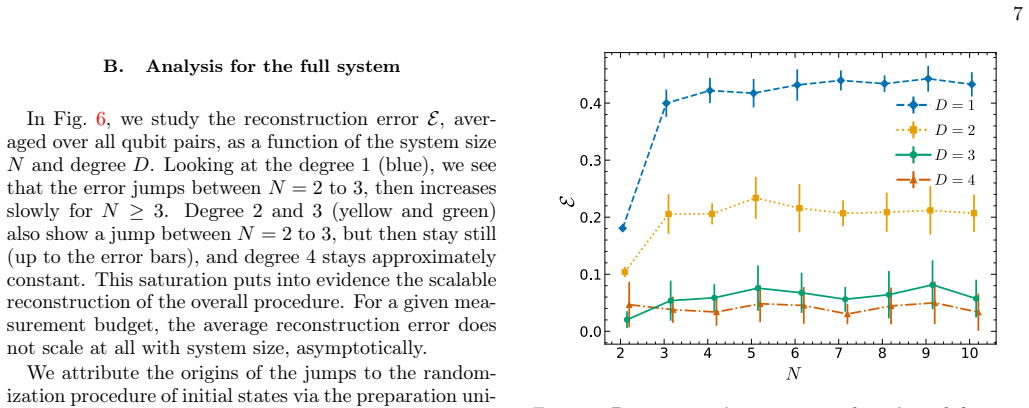
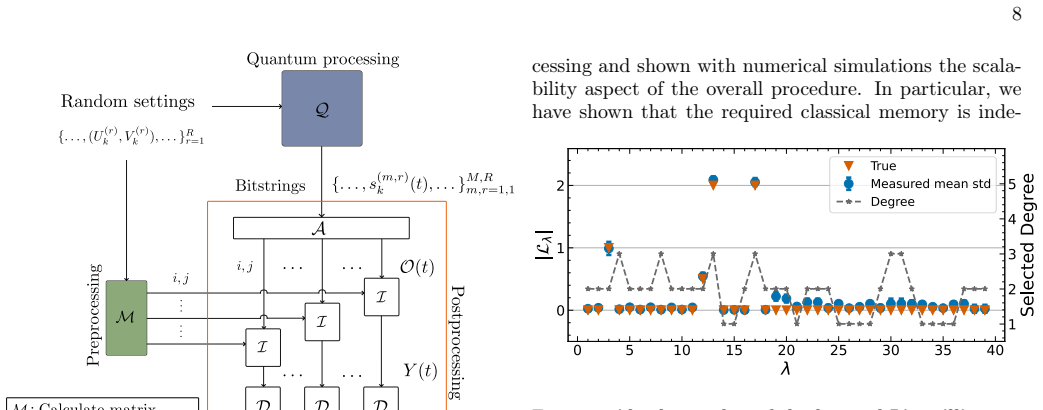
We review and numerically study a protocol for Liouvillian learning based on randomized Pauli states and measurements. In particular, in the two-body, long-range interactions, and single-body noise setting, we describe the complete workflow to obtain the coefficients of the Liouvillian in an efficient and pairwise manner, meaning that the required classical memory is independent of the system size. We also provide guidelines for choosing the parameters for data acquisition and postprocessing that minimize the total reconstruction error.
Editorial analysis
A structured set of objections, weighed in public.
Referee Report
Summary. The manuscript reviews and numerically studies a protocol for Liouvillian learning based on randomized Pauli states and measurements. In the two-body long-range interactions plus single-body noise setting, it describes a complete workflow to obtain the Liouvillian coefficients in an efficient and pairwise manner, with the claim that required classical memory is independent of system size, and supplies guidelines for choosing data-acquisition and post-processing parameters that minimize total reconstruction error.
Significance. A protocol that achieves pairwise decomposition while controlling reconstruction error could supply practical guidance for scaling Liouvillian tomography beyond small systems. If the memory-independence statement can be reconciled with the quadratic output size, the numerical error-minimization results would constitute a useful contribution to experimental design.
major comments (1)
- [Abstract] Abstract: the assertion that 'the required classical memory is independent of the system size' is in tension with the Θ(N²) independent coefficients that parameterize the two-body long-range Liouvillian. Any procedure returning the complete set of coefficients must allocate Ω(N²) storage for the output; the pairwise decomposition may reduce intermediate or per-step memory but does not remove the quadratic output size. This point is load-bearing for the central efficiency claim and requires explicit clarification or qualification.
minor comments (1)
- The abstract states that numerical studies were performed but supplies no information on system sizes, error metrics, or comparison baselines; these details should be summarized or cross-referenced to specific sections/figures.
Simulated Author's Rebuttal
We thank the referee for their careful reading and for highlighting the need to clarify the memory-efficiency claim. We address the single major comment below and will revise the manuscript accordingly.
read point-by-point responses
-
Referee: [Abstract] Abstract: the assertion that 'the required classical memory is independent of the system size' is in tension with the Θ(N²) independent coefficients that parameterize the two-body long-range Liouvillian. Any procedure returning the complete set of coefficients must allocate Ω(N²) storage for the output; the pairwise decomposition may reduce intermediate or per-step memory but does not remove the quadratic output size. This point is load-bearing for the central efficiency claim and requires explicit clarification or qualification.
Authors: We agree with the referee that any complete reconstruction must store Θ(N²) coefficients and therefore requires Ω(N²) output memory. The original abstract phrasing was imprecise; our intent was to emphasize that the protocol reconstructs each two-body term independently using only local randomized measurements and classical post-processing whose per-pair memory footprint does not grow with total system size N (in contrast to methods that require global state reconstruction scaling exponentially). We will revise the abstract to state explicitly that per-pair classical memory is independent of N while the total output scales quadratically, thereby removing the ambiguity. This change will appear in the revised manuscript. revision: yes
Circularity Check
No circularity detected; derivation self-contained against external benchmarks
full rationale
The provided abstract and skeptic notes describe a workflow for pairwise Liouvillian learning under restricted two-body long-range + single-body noise assumptions, with a claim of memory-independent classical processing. No equations, self-citations, fitted parameters renamed as predictions, or ansatzes are quoted that reduce the central result to its inputs by construction. The memory-independence phrasing may conflict with output size, but this is a potential correctness or interpretation issue rather than a circular derivation step. Per rules, absent explicit reduction via quoted paper text, the finding is no significant circularity.
Axiom & Free-Parameter Ledger
Reference graph
Works this paper leans on
-
[1]
Trivedi, A
R. Trivedi, A. Franco Rubio, and J. I. Cirac, Nat Com- mun15, 6507 (2024)
2024
- [2]
-
[3]
Kashyap, G
V. Kashyap, G. Styliaris, S. Mouradian, J. I. Cirac, and R. Trivedi, Phys. Rev. X15, 021017 (2025)
2025
-
[4]
J. Rao, J. Eisert, and T. Guaita, Stability of digital and analog quantum simulations under noise (2025), arXiv:2510.08467 [quant-ph]
work page internal anchor Pith review Pith/arXiv arXiv 2025
-
[5]
Bounded- Error Quantum Simulation via Hamiltonian and Lindbladian Learning
T. Kraft, M. K. Joshi, W. Lam, T. Olsacher, F. Kranzl, J. Franke, L. K. Joshi, R. Blatt, A. Smerzi, D. S. França, B. Vermersch, B. Kraus, C. F. Roos, and P. Zoller, Bounded-Error Quantum Simulation via Hamiltonian and Lindbladian Learning (2025), arXiv:2511.23392 [quant-ph]
-
[6]
Stilck França, L
D. Stilck França, L. A. Markovich, V. V. Dobrovitski, A. H. Werner, and J. Borregaard, Nat Commun15, 311 (2024)
2024
- [7]
- [8]
-
[9]
P. Ivashkov, N. Romanov, W. Gong, A. Gu, H.-Y. Hu, and S. F. Yelin, Ansatz-Free Learning of Lindbladian Dy- namics In Situ (2026), arXiv:2603.05492 [quant-ph]
-
[10]
Olsacher, T
T. Olsacher, T. Kraft, C. Kokail, B. Kraus, and P. Zoller, Quantum Science and Technology10, 015065 (2025)
2025
-
[11]
Huang, Y
H.-Y. Huang, Y. Tong, D. Fang, and Y. Su, Physical Review Letters130, 200403 (2023)
2023
-
[12]
W. Yu, J. Sun, Z. Han, and X. Yuan, Quantum7, 1045 (2023)
2023
-
[13]
A. Zhao, Learning the structure of any hamiltonian from minimal assumptions (2025), arXiv:2410.21635 [quant- ph]
- [14]
-
[15]
Structure learning of Hamiltonians from real-time evolution
A. Bakshi, A. Liu, A. Moitra, and E. Tang, Structure learning of hamiltonians from real-time evolution (2024), arXiv:2405.00082 [quant-ph]
work page internal anchor Pith review Pith/arXiv arXiv 2024
-
[16]
H.-Y. Hu, M. Ma, W. Gong, Q. Ye, Y. Tong, S. T. Flam- mia, and S. F. Yelin, PRX Quantum6, 040315 (2025)
2025
-
[17]
S. Brahmachari, S. Zhu, I. Marvian, and Y. Tong, Learn- ing Hamiltonians in the Heisenberg limit with static single-qubit fields (2026), arXiv:2601.10380 [quant-ph]
-
[18]
J. B. Severin, M. A. Marciniak, R. T. Birke, E. Hogedal, A. Nylander, I. Ahmad, A. Osman, J. Biznárová, M. Rommel, A. F. Roudsari, J. Bylander, G. Tancredi, C. W. Warren, S. Krøjer, J. Hastrup, and M. Kjaer- gaard, Learning Lindblad Dynamics of a Superconduct- ing Quantum Processor (2026), arXiv:2605.00626 [quant- ph]
work page internal anchor Pith review Pith/arXiv arXiv 2026
-
[19]
R. T. Birke, J. B. Severin, M. A. Marciniak, E. Hogedal, A. Nylander, I. Ahmad, A. Osman, J. Biznárová, M. Rommel, A. F. Roudsari, J. Bylander, G. Tan- credi, D. S. França, A. Werner, C. W. Warren, J. Has- trup, S. Krøjer, and M. Kjaergaard, Demonstrating and benchmarking classical shadows for lindblad tomography (2026), arXiv:2602.14694 [quant-ph]
-
[20]
Guo, Y.-K
S.-A. Guo, Y.-K. Wu, J. Ye, L. Zhang, Y. Wang, W.-Q. Lian, R. Yao, Y.-L. Xu, C. Zhang, Y.-Z. Xu, B.-X. Qi, P.-Y. Hou, L. He, Z.-C. Zhou, and L.-M. Duan, Science Advances11, eadt4713 (2025)
2025
-
[21]
G. Franceschetto, E. Pagliaro, L. Pereira, L. Zambrano, and A. Acín, Hamiltonian learning via quantum zeno ef- fect (2025), arXiv:2509.15713 [quant-ph]
- [22]
-
[23]
Hangleiter, I
D. Hangleiter, I. Roth, J. Fuksa, J. Eisert, and P. Roushan, Nature Communications15, 9595 (2024)
2024
-
[24]
Elben, S
A. Elben, S. T. Flammia, H.-Y. Huang, R. Kueng, J. Preskill, B. Vermersch, and P. Zoller, Nature Reviews Physics5, 9 (2022)
2022
-
[25]
Monroe, W
C. Monroe, W. Campbell, L.-M. Duan, Z.-X. Gong, A. Gorshkov, P. Hess, R. Islam, K. Kim, N. Linke, G. Pagano, P. Richerme, C. Senko, and N. Yao, Reviews of Modern Physics93, 025001 (2021)
2021
-
[26]
Browaeys and T
A. Browaeys and T. Lahaye, Nature Physics16, 132 (2020)
2020
-
[27]
Blatt and C
R. Blatt and C. F. Roos, Nature Physics8, 277 (2012)
2012
-
[28]
Preskill, Lecture notes for ph219/cs219: Quantum in- formation, chapter 3 (2018)
J. Preskill, Lecture notes for ph219/cs219: Quantum in- formation, chapter 3 (2018)
2018
-
[29]
M. A. Nielsen and I. L. Chuang, Quantum Computation and Quantum Information, 10th ed. (Cambridge University Press, Cambridge, 2010)
2010
-
[30]
J. G. Bohnet, B. C. Sawyer, J. W. Britton, M. L. Wall, A. M. Rey, M. Foss-Feig, and J. J. Bollinger, Science352, 1297 (2016)
2016
-
[31]
E. G. Carnio, A. Buchleitner, and M. Gessner, New Jour- nal of Physics18, 073010 (2016)
2016
-
[32]
M. M. Wolf, Quantum channels and operations guided tour, lecture notes, chap 7 (2012)
2012
-
[33]
Joshi et al, manuscript in preparation
M.K. Joshi et al, manuscript in preparation
-
[34]
Huang, R
H.-Y. Huang, R. Kueng, and J. Preskill, Nature Physics 16, 1050 (2020)
2020
-
[35]
Cotler and F
J. Cotler and F. Wilczek, Physical Review Letters124, 100401 (2020)
2020
-
[36]
J. F. Trevor Hastie, Robert Tibshirani, The Elements of Statistical Learning, 2nd ed. (Springer, 2009)
2009
-
[37]
Gautschi, Asymptotic and Computational Analysis, 1st ed., edited by R
W. Gautschi, Asymptotic and Computational Analysis, 1st ed., edited by R. Wong (CRC Press, 2020) pp. 193– 210
2020
-
[38]
Lam, Pairwise liouvillian learning,https: //gitlab.com/williamterrance.lam/pairwise_ liouvillian_learning(2026)
W. Lam, Pairwise liouvillian learning,https: //gitlab.com/williamterrance.lam/pairwise_ liouvillian_learning(2026). Appendix A: Estimation of the observables from randomized measurements This appendix provides estimation formulas for the ob- servables⟨O(t)⟩based on the measured bitstrings of the randomized procedure described in the main text. We start by...
2026
discussion (0)
Sign in with ORCID, Apple, or X to comment. Anyone can read and Pith papers without signing in.