x-periodic Quasi One Dimensional Anomalous (Rogue) Waves in Multidimensional Nonlinear Schr\"odinger Equations: Fission, Fusion, and Recurrence
Pith reviewed 2026-06-29 14:30 UTC · model grok-4.3
The pith
Recurrence of x-periodic rogue waves in multidimensional NLS equations shows O(1) model-specific differences and increasingly complex fission-fusion after a universal first stage.
A machine-rendered reading of the paper's core claim, the machinery that carries it, and where it could break.
Core claim
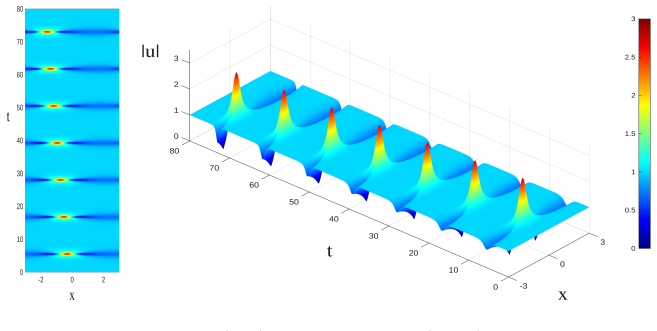
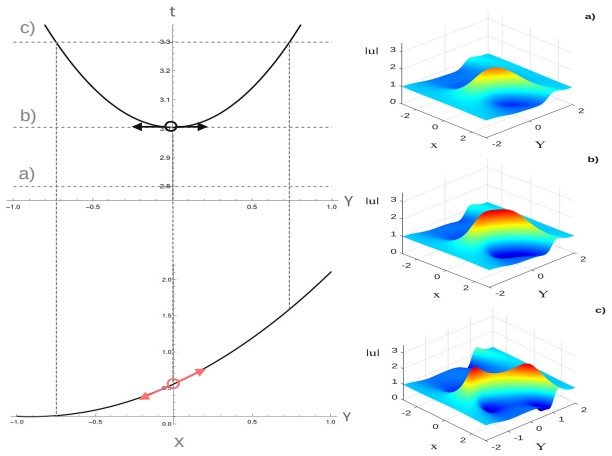
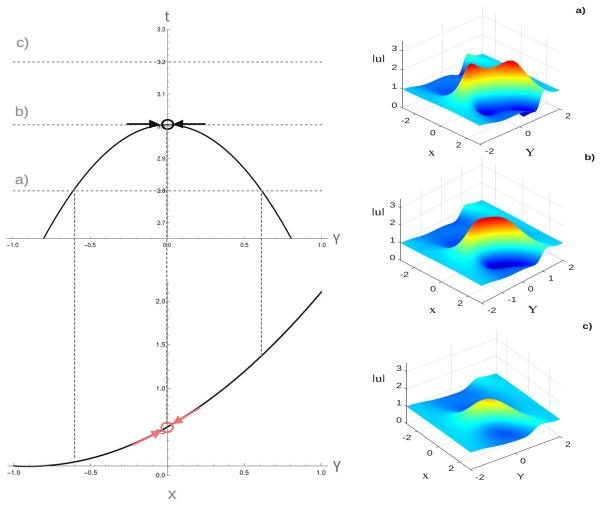
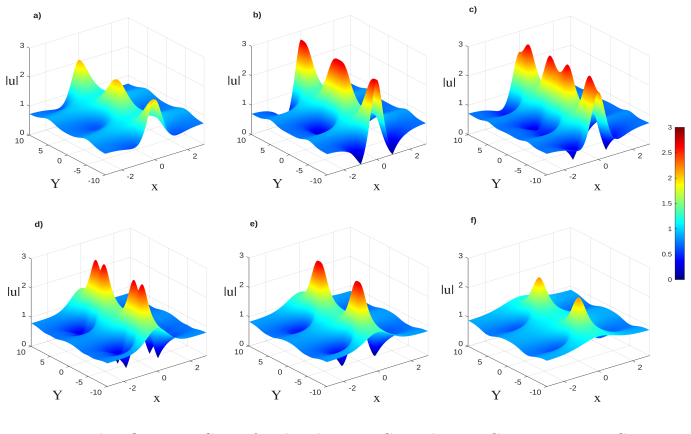
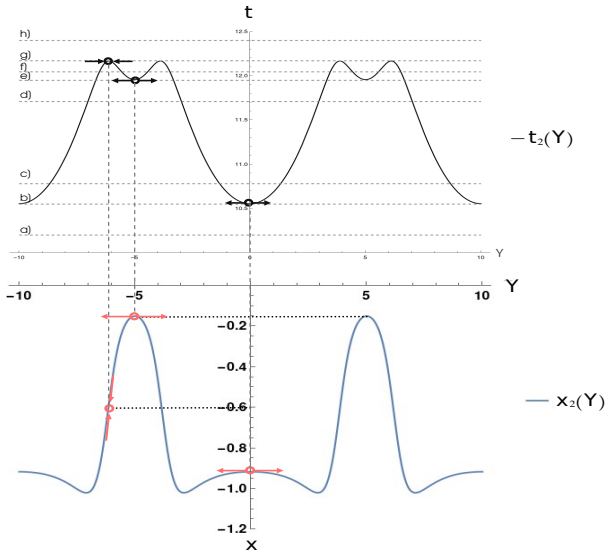
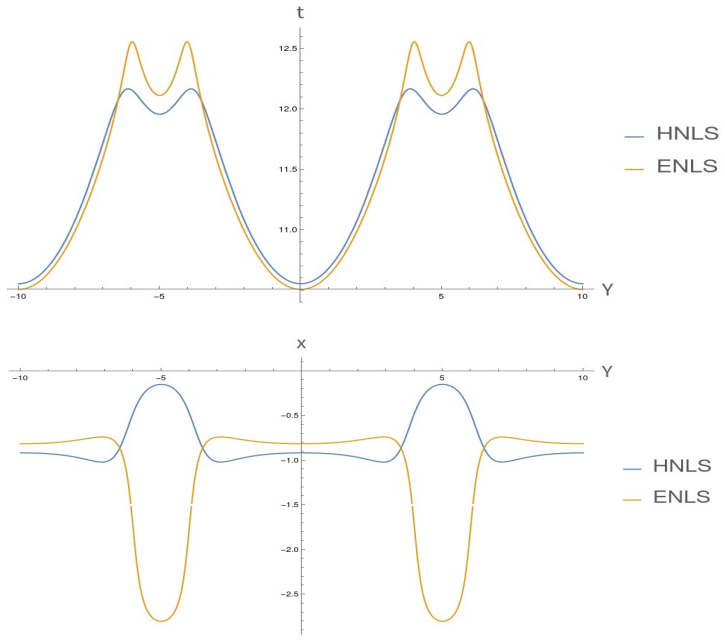
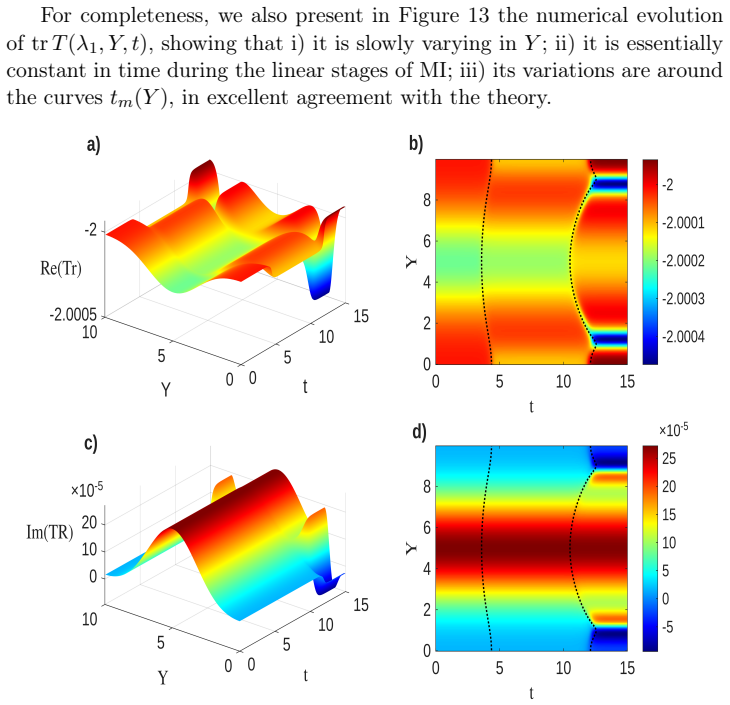
Although the first nonlinear stage of MI is essentially universal for all MNLS equations, the recurrence dynamics exhibit significant O(1) differences among different models. Moreover, successive nonlinear stages generally display increasingly complex combinations of fission and fusion processes, leading to progressively richer dynamical choreographies. Since MNLS equations in the Q1D regime can be viewed as multidimensional perturbations of the integrable NLS equation, the recently developed finite gap perturbation theory of NLS AWs gives an analytic and quantitative description of the recurrence of Q1D AWs, in excellent agreement with numerical simulations.
What carries the argument
Finite-gap perturbation theory of NLS anomalous waves, used to describe multidimensional perturbations in the Q1D regime and track recurrence via fission and fusion.
If this is right
- Recurrence dynamics exhibit O(1) differences among different MNLS models after the shared initial stage.
- Successive nonlinear stages display increasingly complex fission and fusion choreographies.
- The finite-gap perturbation theory supplies an analytic description that matches numerical simulations of the recurrence.
- The described processes are plausible to observe in water waves, nonlinear optics, plasma physics and Bose-Einstein condensates.
Where Pith is reading between the lines
- Long-term rogue-wave behavior may be more sensitive to the precise form of the MNLS model than the onset of instability itself.
- The same perturbation approach could be applied to other regimes or higher-dimensional perturbations to predict similar choreography changes.
- Experiments could distinguish between candidate MNLS models by measuring the detailed recurrence patterns rather than only the first instability.
Load-bearing premise
MNLS equations in the Q1D regime can be treated as multidimensional perturbations of the integrable NLS equation.
What would settle it
Numerical evolution of recurrence in a specific MNLS model that deviates by more than O(1) from the finite-gap perturbation predictions while the first MI stage remains universal.
Figures

read the original abstract
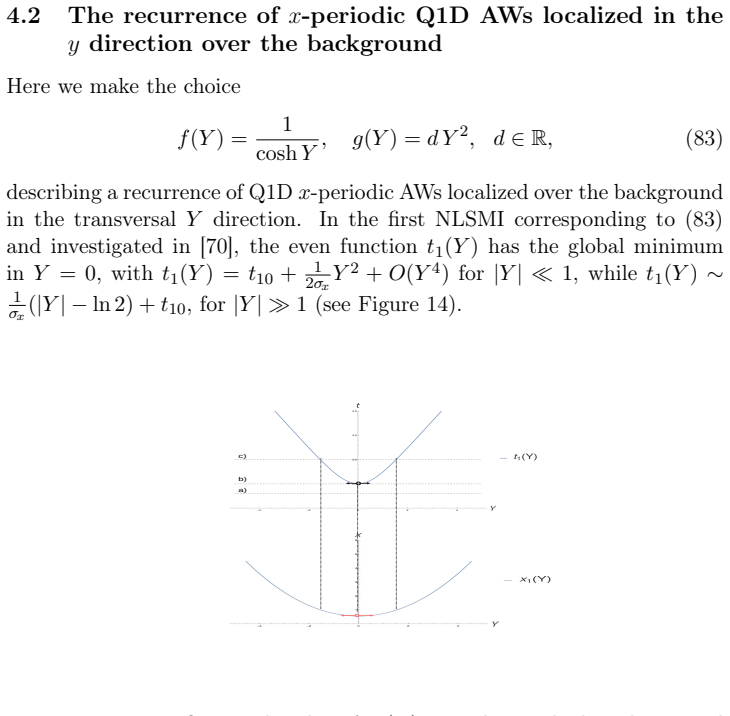
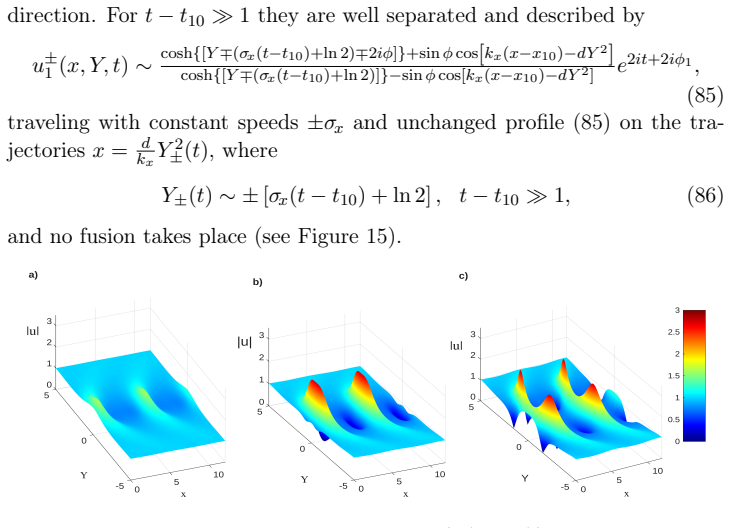
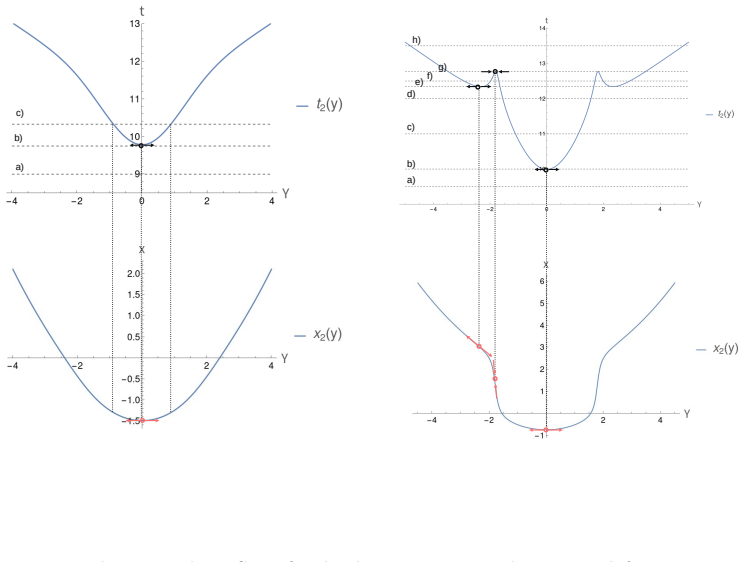
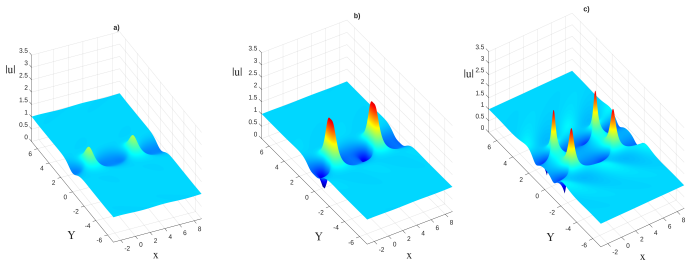
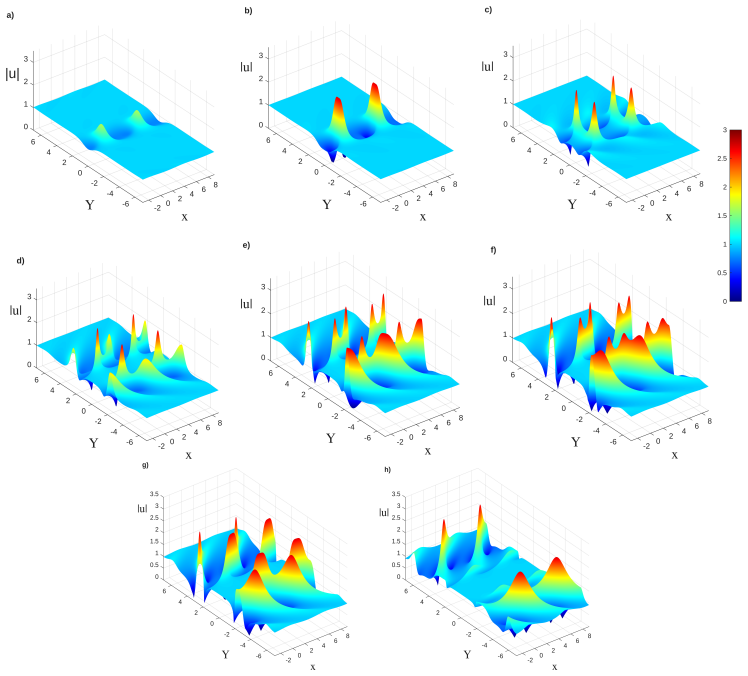
In a recent work we studied the first nonlinear stage of modulation instability (NLSMI) of x-periodic anomalous (rogue, freak, extreme) waves (AWs) of physically relevant multidimensional (generalizations of the focusing) nonlinear Schr\"odinger (MNLS) equation, like the non integrable elliptic and hyperbolic nonlinear Schr\"odinger (NLS) equations in d+1 dimensions, d = 2, 3, in the quasi one dimensional (Q1D) regime in which the wavelength in the direction of propagation x is small with respect to the wavelengths in the transversal directions. We showed that, at leading order, the first NLSMI is universal, independent of the particular MNLS model, and described by suitable adiabatic deformations of the quasi-homoclinic Akhmediev breather solution of NLS, in excellent agreement with numerical simulations. In the present work we focus on the recurrence of x-periodic AWs in the Q1D regime. We show that, although the first nonlinear stage of MI is essentially universal for all MNLS equations, the recurrence dynamics exhibit significant O(1) differences among different models. Moreover, successive nonlinear stages generally display increasingly complex combinations of fission and fusion processes, leading to progressively richer dynamical choreographies. Since MNLS equations in the Q1D regime can be viewed as multidimensional perturbations of the integrable NLS equation, we use the recently developed finite gap perturbation theory of NLS AWs to give an analytic and quantitative description of the recurrence of Q1D AWs, in excellent agreement with numerical simulations. Due to the physical relevance of the MNLS equations considered in this work, and due to the universality of the processes discussed in this paper, it is plausible that they be observable in many fields of physics, like water waves, nonlinear optics, plasma physics, Bose-Einstein condensates, etc . . .
Editorial analysis
A structured set of objections, weighed in public.
Referee Report
Summary. The manuscript studies recurrence of x-periodic anomalous (rogue) waves in multidimensional nonlinear Schrödinger equations (including non-integrable elliptic and hyperbolic cases) in the quasi-one-dimensional (Q1D) regime. It asserts that the first nonlinear stage of modulation instability remains essentially universal across models and is captured by adiabatic deformations of the Akhmediev breather, while recurrence exhibits significant O(1) model-dependent differences, with successive stages displaying increasingly complex fission/fusion processes. The authors apply recently developed finite-gap perturbation theory of NLS anomalous waves to furnish an analytic, quantitative description of these recurrence dynamics, claiming excellent agreement with numerical simulations.
Significance. If the finite-gap perturbation remains controlled over multiple recurrence stages, the work would supply a concrete analytic framework distinguishing universal from model-specific features of rogue-wave recurrence in physically relevant MNLS systems, with plausible observability in water waves, optics, plasmas, and BECs. The explicit demonstration of O(1) differences among models and the use of perturbation theory for quantitative recurrence predictions constitute the main potential contributions.
major comments (1)
- [Sections applying finite-gap perturbation theory to recurrence dynamics] The central claim that finite-gap perturbation theory yields a quantitative description of recurrence (including multi-stage fission/fusion choreographies) rests on the assumption that MNLS equations in the Q1D regime act as controlled perturbations of the integrable NLS. However, no a-priori estimate is given for the size of the transversal perturbation parameter or for the number of nonlinear stages over which the leading-order description remains valid. Each recurrence stage can amplify the perturbation, so the absence of such control directly affects the asserted excellent agreement beyond the first stage.
minor comments (1)
- [Abstract] The abstract states that the first NLSMI stage is 'essentially universal' while recurrence shows 'significant O(1) differences'; a brief clarification of the precise sense in which the perturbation remains small enough for the leading-order theory to capture O(1) model differences would improve readability.
Simulated Author's Rebuttal
We thank the referee for the careful reading and constructive comments on our manuscript. We address the major comment below.
read point-by-point responses
-
Referee: [Sections applying finite-gap perturbation theory to recurrence dynamics] The central claim that finite-gap perturbation theory yields a quantitative description of recurrence (including multi-stage fission/fusion choreographies) rests on the assumption that MNLS equations in the Q1D regime act as controlled perturbations of the integrable NLS. However, no a-priori estimate is given for the size of the transversal perturbation parameter or for the number of nonlinear stages over which the leading-order description remains valid. Each recurrence stage can amplify the perturbation, so the absence of such control directly affects the asserted excellent agreement beyond the first stage.
Authors: We agree that the manuscript provides no a priori estimates for the size of the transversal perturbation parameter or the number of nonlinear stages over which the leading-order finite-gap perturbation description remains valid. The Q1D MNLS equations are viewed as perturbations of the integrable NLS, but error accumulation across recurrence stages is not controlled rigorously. The quantitative agreement is demonstrated numerically for the specific models, parameters, and stages simulated in the figures. We will revise the manuscript to add an explicit discussion of this limitation, qualifying the applicability of the perturbation theory to the observed recurrence stages rather than claiming general control. revision: yes
Circularity Check
Recurrence description reduces to self-cited finite-gap perturbation theory of NLS AWs
specific steps
-
self citation load bearing
[Abstract]
"Since MNLS equations in the Q1D regime can be viewed as multidimensional perturbations of the integrable NLS equation, we use the recently developed finite gap perturbation theory of NLS AWs to give an analytic and quantitative description of the recurrence of Q1D AWs, in excellent agreement with numerical simulations."
The quantitative analytic description of recurrence (the paper's main result beyond the first stage) is obtained by direct application of the finite-gap theory developed in prior work. The step reduces the claimed description to that self-cited framework by construction; no independent derivation or a-priori error bound for multi-stage dynamics is supplied in the quoted text.
full rationale
The paper's central analytic claim for recurrence (including model-dependent O(1) differences and fission/fusion sequences) is obtained by viewing MNLS as perturbations of NLS and directly applying the 'recently developed finite gap perturbation theory of NLS AWs'. This theory is invoked as the source of the quantitative description without re-derivation or external verification in the present work. The abstract explicitly states the reduction: the Q1D regime 'can be viewed as multidimensional perturbations' and 'we use the recently developed finite gap perturbation theory' to describe recurrence. This matches self-citation load-bearing (pattern 3) because the load-bearing step for the claimed analytic results is the prior theory whose authors overlap. No independent bounds or machine-checked support for multi-stage validity is quoted. The first-stage universality is stated separately and does not rescue the recurrence claim. Score 6 reflects one load-bearing self-citation chain with partial independence in the numerical comparisons.
Axiom & Free-Parameter Ledger
axioms (1)
- domain assumption MNLS equations in the Q1D regime can be viewed as multidimensional perturbations of the integrable NLS equation
Reference graph
Works this paper leans on
-
[1]
Stability of Periodic Waves of Finite Amplitude on the Surface of a Deep Fluid
V. E. Zakharov, “Stability of Periodic Waves of Finite Amplitude on the Surface of a Deep Fluid”, Journal of Applied Mechanics and Technical Physics, 9:2 (1968) 190–194
1968
-
[2]
M. J. Ablowitz and H. Segur,Solitons and the Inverse Scattering Trans- form, SIAM, Philadelphia, 1981
1981
-
[3]
Optical rogue waves
D.R. Solli, C. Ropers, P. Koonath and B. Jalali, “Optical rogue waves”, Nature,450(2007), 1054–1057
2007
-
[4]
Spatiotemporal pulses in a liquid crystal optical oscillator
U. Bortolozzo, A. Montina, F.T. Arecchi, J.P. Huignard, S. Residori, “Spatiotemporal pulses in a liquid crystal optical oscillator”,Phys. Rev. Lett.,99:2 (2007), 023901. 40
2007
-
[5]
Spatial Rogue Waves in Photorefractive Ferroelectrics
D. Pierangeli, F. Di Mei, C. Conti, A.J. Agranat, E. DelRe, “Spatial Rogue Waves in Photorefractive Ferroelectrics”,Phys. Rev. Lett.,115:9 (2015), 093901
2015
-
[6]
Nonlinear Schrödinger Equations
B. Malomed, "Nonlinear Schrödinger Equations", in Encyclopedia of Nonlinear Science, edited by A. Scott, Routledge, New York 2005, pp. 639–643
2005
-
[7]
Matter rogue waves
Y. V. Bludov, V. V. Konotop, N. Akhmediev, “Matter rogue waves”, Physical Review A,80:3 (2009), 033610
2009
-
[8]
Pitaevskii, S
L.P. Pitaevskii, S. Stringari,Bose-Einstein Condensation(Clarendon, Oxford, 2003)
2003
-
[9]
On the theory of oscillatory waves
G. Stokes, “On the theory of oscillatory waves”, Transactions of the Cambridge Philosophical SocietyVIII441–455; and “Supplement to a paper on the theory of oscillatory waves", Mathematical and Physical Papers, Volume I, Cambridge University Press, 314–326, 1880
-
[10]
Filamentary Structure of Light Beams in Nonlinear Liquids
V. I. Bespalov, V. I. Talanov, “Filamentary Structure of Light Beams in Nonlinear Liquids”,JETP Letters,3:12 (1966), 307-310
1966
-
[11]
The disintegration of wave trains on deep water. Part 1. Theory
T.B. Benjamin, J.E. Feir, “The disintegration of wave trains on deep water. Part 1. Theory”,Journal of Fluid Mechanics,27:3 (1967) 417– 430
1967
-
[12]
Kharif, E
C. Kharif, E. Pelinovsky, and A. Slunyaev,Rogue Waves in the Ocean, Springer-Verlag Berlin Heidelberg 2009
2009
-
[13]
Rogue waves and their generating mechanisms in different physical con- texts
M. Onorato, S. Residori, U. Bortolozzo, A. Montina, F.T. Arecchi, “Rogue waves and their generating mechanisms in different physical con- texts”, Physics Reports 528 (2013) 47–89
2013
-
[14]
Exact theory of two-dimensional self- focusing and one-dimensional self-modulation of waves in nonlinear me- dia
V.E. Zakharov, A.B. Shabat, “Exact theory of two-dimensional self- focusing and one-dimensional self-modulation of waves in nonlinear me- dia”,Sov. Phys. JETP,34:1 (1972), 62–69
1972
-
[15]
C. S. Gardner, J. M. Greene, M. D. Kruskal, and R. M. Miura, “Method for solving the Korteweg-de Vries equation“, Phys. Rev. Lett. 19, 1095, 1967
1967
-
[16]
The periodic problem for the Korteweg–de Vries equa- tion
S.P. Novikov, “The periodic problem for the Korteweg–de Vries equa- tion”,Funct. Anal. Appl.,8:3, 236–246, 1974. 41
1974
-
[17]
Inverse problem for periodic finite-zoned potentials in the theory of scattering
B.A. Dubrovin, “Inverse problem for periodic finite-zoned potentials in the theory of scattering”,Funct. Anal. Appl.,9:1, 61–62, 1975
1975
-
[18]
Hill’s operator with finitely many gaps
A.R. Its, V.B. Matveev, “Hill’s operator with finitely many gaps”,Funct. Anal. Appl.,9:1, 65–66, 1975
1975
-
[19]
Periodic solutions of the KdV equation
P.D. Lax, “Periodic solutions of the KdV equation”,Lectures in Appl. Math.,15, 85–96, 1974
1974
-
[20]
The Spectrum of Hill’s Equation
P. Van Moerbeke, H.P. McKean, “The Spectrum of Hill’s Equation”, Invent. Math.,30:3, 217–274, 1975
1975
-
[21]
Methods of algebraic geometry in the theory of non- linear equations
I.M. Krichever, “Methods of algebraic geometry in the theory of non- linear equations”,Russian Math. Surv.,32, 185–213, 1977
1977
-
[22]
Generation of periodic trains of picosecond pulses in an optical fiber: exact solutions
N. N. Akhmediev, V.M. Eleonskii, and N.E. Kulagin, “Generation of periodic trains of picosecond pulses in an optical fiber: exact solutions”, Sov. Phys. JETP,62:5 (1985), 894–899
1985
-
[23]
Water Waves, Nonlinear Schrödinger Equations and Their Solutions
D.H. Peregrine, “Water Waves, Nonlinear Schrödinger Equations and Their Solutions”,J. Austral. Math. Soc. Ser. B,25(1983), 16–43
1983
-
[24]
Exact integration of nonlinear Schrödinger equation
A. R. Its, A. V. Rybin and M. A. Sall, “Exact integration of nonlinear Schrödinger equation”, Theor. Math. Phys.7420–32 (1988)
1988
-
[25]
On multi-rogue wave solutions of the NLS equation and positon solutions of the KdV equa- tion
P. Dubard, P. Gaillard, C. Klein and V. Matveev, “On multi-rogue wave solutions of the NLS equation and positon solutions of the KdV equa- tion”, Eur. Phys. J. Spe. Top.185, 247-258, 2010
2010
-
[26]
Nonlinear Dynamics of Deep-Water Gravity Waves
H. Yuen, B. Lake, “Nonlinear Dynamics of Deep-Water Gravity Waves”, Advances in Applied Mechanics,22(1982) 67–229
1982
-
[27]
Rogue Wave Observation in a Water Wave Tank
A. Chabchoub, N. Hoffmann, N. Akhmediev, “Rogue Wave Observation in a Water Wave Tank”,Physical Review Letters,106:20 (2011), 204502
2011
-
[28]
The Peregrine soliton in nonlinear fibre optics
B. Kibler, J. Fatome, C. Finot, G. Millot, F. Dias, G. Genty, N. Akhme- diev, J. Dudley, “The Peregrine soliton in nonlinear fibre optics”,Nature Physics,6:10 (2010)
2010
-
[29]
Modulation Instability and Phase-Shifted Fermi-Pasta-Ulam re- currence
O. Kimmoun, H. C. Hsu, H. Branger, M. S. Li, Y. Y. Chen, C. Kharif, M. Onorato, E. J. R. Kelleher, B. Kibler, N. Akhmediev, and A. Chab- choub. “Modulation Instability and Phase-Shifted Fermi-Pasta-Ulam re- currence”, Scientific Reports, 6:28516, 2016. 42
2016
-
[30]
Fibre multiwave mixing combs reveal the bro- ken symmetry of Fermi-Pasta-Ulam recurrence
A. Mussot, C. Naveau, M. Conforti, A. Kudlinski, P. Szriftgiser, F. Copie, and S. Trillo, “Fibre multiwave mixing combs reveal the bro- ken symmetry of Fermi-Pasta-Ulam recurrence”, Nature Photonics, 12(5):303–308, 2018
2018
-
[31]
Observation of exact Fermi-Pasta-Ulam-Tsingou recurrence and its exact dynamics
D. Pierangeli, M. Flammini, L. Zhang, G. Marcucci, A. J. Agranat, P. G. Grinevich, P. M. Santini, C. Conti, and E. DelRe, “Observation of exact Fermi-Pasta-Ulam-Tsingou recurrence and its exact dynamics” Phys. Rev. X, 8(4):041017, 2018
2018
-
[32]
Inverse scattering transform for the focus- ing nonlinear Schrödinger equation with nonzero boundary conditions
G. Biondini and G. Kovacic, “Inverse scattering transform for the focus- ing nonlinear Schrödinger equation with nonzero boundary conditions”, J. Math. Phys.,55:3, (2014), 031506
2014
-
[33]
Oscillation structure of localized perturbations in modulationally unstable media
G. Biondini, S. Li, D. Mantzavinos, “Oscillation structure of localized perturbations in modulationally unstable media”,Phys. Rev. E,94:6 (2016), 060201(R)
2016
-
[34]
The finite gap method and the analytic description of the exact rogue wave recurrence in the periodic NLS Cauchy problem. 1
P.G. Grinevich, P.M. Santini, “The finite gap method and the analytic description of the exact rogue wave recurrence in the periodic NLS Cauchy problem. 1”,Nonlinearity,31, No.11, 5258–5308, 2018
2018
-
[35]
The finite-gap method and the periodic NLS Cauchy problem of anomalous waves for a finite number of unstable modes
P.G. Grinevich, P.M. Santini, “The finite-gap method and the periodic NLS Cauchy problem of anomalous waves for a finite number of unstable modes”,Russian Math. Surveys,74(2), 211–263, 2019
2019
-
[36]
The exact rogue wave recurrence in the NLS periodic setting via matched asymptotic expansions, for 1 and 2 unstable modes
P.G. Grinevich, P.M. Santini, “The exact rogue wave recurrence in the NLS periodic setting via matched asymptotic expansions, for 1 and 2 unstable modes”,Phys. Lett. A,382(14), 973–979, 2018
2018
-
[37]
Relationship between Benjamin-Feir instability and recurrence in the Nonlinear Schrödinger equation
H. C. Yuen and W. E. Ferguson, “Relationship between Benjamin-Feir instability and recurrence in the Nonlinear Schrödinger equation”, Phys. Fluids, 21(8):1275–1278, 1978
1978
-
[38]
On the Fermi-Pasta- Ulam-Tsingou recurrence of anomalous (rogue) waves in partial differ- ential equations of nonlinear Schrödinger type
F. Coppini, P. G. Grinevich, and P. M. Santini, “On the Fermi-Pasta- Ulam-Tsingou recurrence of anomalous (rogue) waves in partial differ- ential equations of nonlinear Schrödinger type”, Mechanics Research Communications 153 (2026) 104639
2026
-
[39]
The Fermi-Pasta-Ulam problem: Fifty years of progress
G. P. Berman and F. M. Izrailev, “The Fermi-Pasta-Ulam problem: Fifty years of progress”, Chaos,15, 015104 (2005)
2005
-
[40]
The Fermi-Pasta-Ulam problem: a status report
G. Gallavotti (Ed.), “The Fermi-Pasta-Ulam problem: a status report”, Lecture Notes in Physics, Vol. 728, Springer, Berlin Heidelberg, 2008. 43
2008
-
[41]
Numerical instability of the Akhmediev breather and a finite gap model of it
P. G. Grinevich and P. M. Santini: “Numerical instability of the Akhmediev breather and a finite gap model of it”, inRecent de- velopments in Integrable Systems and related topics of Mathematical Physics, V. M. Buchstaber et al. (eds.), Springer Proceedings in Math- ematics and Statistics, Vol. 273, Springer, Berlin, pp. 3–23, 2018. doi.org/10.1007/978-3-...
-
[42]
The linear and nonlinear insta- bility of the Akhmediev breather
P. G. Grinevich and P. M. Santini: “The linear and nonlinear insta- bility of the Akhmediev breather”, Nonlinearity34(2021) 8331–8358. https://doi.org/10.1088/1361-6544/ac3143. arXiv:2011.11402
-
[43]
Phase resonances of the NLS rogue wave recurrence in the quasi-symmetric case
P.G. Grinevich, P.M. Santini: “Phase resonances of the NLS rogue wave recurrence in the quasi-symmetric case”,Theoretical and Mathematical Physics,196:3, 1294–1306, 2018. doi:10.1134/S0040577918090040
-
[44]
The periodic Cauchy problem for PT-symmetric NLS, I: The first appearance of rogue waves, regular behavior or blow up at finite times
P.M. Santini, “The periodic Cauchy problem for PT-symmetric NLS, I: The first appearance of rogue waves, regular behavior or blow up at finite times”,J. Phys. A: Math. Theor.,51:49 (2018), 495207 (21pp)
2018
-
[45]
Modulation instability, periodic anoma- lous wave recurrence and blow up in the Ablowitz - Ladik lattices
F. Coppini and P. M. Santini, “Modulation instability, periodic anoma- lous wave recurrence and blow up in the Ablowitz - Ladik lattices”, J. Phys. A: Math. Theor. 57 (2024) 015202 (28pp)
2024
-
[46]
Towards the theory of anomalous waves in nature and nonlinear Schrödinger type equations
F. Coppini, “Towards the theory of anomalous waves in nature and nonlinear Schrödinger type equations”. PhD Thesis 2020, La Sapienza, University of Roma
2020
-
[47]
Integrable nonlocal nonlinear Schrödinger equation
M. J. Ablowitz, Z. H. Musslimani, “Integrable nonlocal nonlinear Schrödinger equation”,Phys. Rev. Lett.,110:6 (2013), 064105
2013
-
[48]
Nonlinear differential-difference equations
M.J. Ablowitz, J.F. Ladik, “Nonlinear differential-difference equations”, J. Math. Phys.,16:3 (1975), 598–603
1975
-
[49]
A soluble relativistic field theory
W. E. Thirring, “A soluble relativistic field theory”. Annals of Physics, 3(1958) 91–112. doi:10.1016/0003-4916(58)90015-0
-
[50]
The effect of a small loss or gain in the periodic NLS anomalous wave dynamics
F. Coppini, P. G. Grinevich and P. M. Santini, “The effect of a small loss or gain in the periodic NLS anomalous wave dynamics”.I. Phys. Rev. E,101(2020), 032204
2020
-
[51]
Adiabatic transfor- mation of continuous waves into trains of pulses
J.M. Soto-Crespo, N. Devine, and N. Akhmediev, “Adiabatic transfor- mation of continuous waves into trains of pulses”,Physical Review A, 96(2017), 023825. 44
2017
-
[52]
Periodic Rogue Waves and Perturbation Theory
F. Coppini, P.G. Grinevich, P.M. Santini, “Periodic Rogue Waves and Perturbation Theory”. In: Meyers R.A. (eds) Encyclopedia of Com- plexity and Systems Science. Springer, Berlin, Heidelberg, (2021). https://doi.org/10.1007/978-3-642-27737-5_762-1
-
[53]
A perturbation expansion for the Zakharov-Shabat inverse scattering transform
D. J. Kaup, “A perturbation expansion for the Zakharov-Shabat inverse scattering transform”, SIAM J. Appl. Math. 31, 121 (1976)
1976
-
[54]
The Fermi-Pasta-Ulam-Tsingou recurrence of periodic anomalous waves in the complex Ginzburg-Landau and in the Lugiato-Lefever equations
F. Coppini, P.M. Santini, “The Fermi-Pasta-Ulam-Tsingou recurrence of periodic anomalous waves in the complex Ginzburg-Landau and in the Lugiato-Lefever equations”,Phys. Rev. E,102(2020), 062207
2020
-
[55]
Control-Flow Refinement for Com- plexity Analysis of Probabilistic Programs inKoAT(Short Paper)
A. C. Newell and J. A. Whitehead, “Review of the Finite Bandwidth Concept”, Proc. I.U.T.A.M.Symposium on Instability of Continuous Systems, Springer-Verlag, Berlin, 1969, pp. 284-289; doi:10.1007/978-3- 642-65073-4_39
-
[56]
Spatial Dissipative Structures in Passive Optical Systems
L. A. Lugiato and R. Lefevre, “Spatial Dissipative Structures in Passive Optical Systems”,Phys. Rev. Letters85(1987), pp. 2209–2211
1987
-
[57]
The effect of loss/gain and hamilto- nian perturbations on the recurrence of periodic anomalous waves of the Ablowitz - Ladik lattice
F. Coppini and P. M. Santini, “The effect of loss/gain and hamilto- nian perturbations on the recurrence of periodic anomalous waves of the Ablowitz - Ladik lattice”, 2024, J. Phys. A: Math. Theor. 57 075701
2024
-
[58]
On Three-Dimensional Packets of Surface Waves
A. Davey, K. Stewartson, “On Three-Dimensional Packets of Surface Waves”,Proc. R. Soc. Lond. A,338(1974), 101–110
1974
-
[59]
E. I. Shulman, On the integrability of equations of Davey- Stewartson type, TMF, 1983, Volume 56, Number 1, 131–136. https://www.mathnet.ru/eng/tmf2197
1983
-
[60]
P. G. Grinevich, P. M. Santini: “The finite-gap method and the periodic Cauchy problem of (2+1)-dimensional anomalous waves for the focusing Davey-Stewartson 2 equation”, Russian Mathematical Surveys, 2022, Volume 77, Issue 6(468), 102–1059, https://doi.org/10.4213/rm10077 (in russian). Online english version: https://doi.org/10.4213/rm10077e
-
[61]
TheperiodicNbreather anomalous wave solution of the Davey-Stewartson equations; first ap- pearance, recurrence, and blow up properties
F.Coppini, P.G.Grinevich, andP.M.Santini, “TheperiodicNbreather anomalous wave solution of the Davey-Stewartson equations; first ap- pearance, recurrence, and blow up properties”, J. Phys. A: Math. Theor. 57 (2024) 015208 (26pp)
2024
-
[62]
Anomalous(rogue)wavesinmultidimensions, a phenomenological study
F.Coppini, P.M.Santini, “Anomalous(rogue)wavesinmultidimensions, a phenomenological study”, Preprint 2026, in preparation. 45
2026
-
[63]
On the periodic solutions of the Davey Stewartson system
G. Biondini and D. Kireyev, “On the periodic solutions of the Davey Stewartson system”, East Asian J. Appl. Math. 12 1–21, 2022
2022
-
[64]
Soliton resonance and web structure in the Davey-Stewartson system
G. Biondini, D. Kireyev and K. Maruno, “Soliton resonance and web structure in the Davey-Stewartson system”, J. Phys. A: Math. Theor. 55 305701, 2022
2022
-
[65]
New rational homoclinic and rogue wavesforDavey-Stewartsonequation
C. Liu, C. Wang, Z. Dai and J. Liu, “New rational homoclinic and rogue wavesforDavey-Stewartsonequation” Abstr.Appl.Anal., 572863, 2014
2014
-
[66]
Rogue waves and hybrid so- lutions of the Davey-Stewartson I equation
Y. Liu, C. Qian, D. Mihalache, and J. He, “Rogue waves and hybrid so- lutions of the Davey-Stewartson I equation”, Nonlinear Dyn. 95 839–57, 2019
2019
-
[67]
Rogue waves in the Davey-Stewartson equation
Y. Ohta and J. Yang, “Rogue waves in the Davey-Stewartson equation”, Phys. Rev. E 86 036604, 2012
2012
-
[68]
DynamicsofroguewavesintheDavey-Stewartson II equation
Y.OhtaandJ.Yang, “DynamicsofroguewavesintheDavey-Stewartson II equation”, J. Phys. A: Math. Theor. 46 105202, 2013
2013
-
[69]
Growing-and-decaying mode solution to the Davey-Stewartson equation
M. Tajiri and T. Arai, “Growing-and-decaying mode solution to the Davey-Stewartson equation”, Phys. Rev. E 60 2297–305, 1999
1999
-
[70]
F. Coppini, P. M. Santini, “Quasi one dimensional anomalous (rogue) waves in multidimensional nonlinear Schrödinger equa- tions: fission and fusion”, Eur. Phys. J. Plus (2026) 141:99. https://doi.org/10.1140/epjp/s13360-025-07276-y. arXiv:2508.18120v2
-
[71]
Self-focusing of optical beams
P. L. Kelley, “Self-focusing of optical beams”, Phys. Rev. Lett.151005 (1965)
1965
-
[72]
Wave Instabilities
D.J. Benney, G.J. Roskes, “Wave Instabilities”,Stud. Appl. Math.,48 (1969), 377–385
1969
-
[73]
Nonlinear Schrödinger equations with mean terms in nonresonant multidimensional quadratic materials
M. J. Ablowitz, G. Biondini, S. Blair, “Nonlinear Schrödinger equations with mean terms in nonresonant multidimensional quadratic materials”, Physical Review E,63, 046605
-
[74]
Sulem, P.-L
C. Sulem, P.-L. Sulem,The Nonlinear Schrödinger Equation. Self- Focusing and Collapse, Springer-Verlag, New York, 1999
1999
-
[75]
Wave collapse in physics: principles and applications to light and plasma waves
L. Bergé, “Wave collapse in physics: principles and applications to light and plasma waves”, Physics Reports 303 (1998) 259–370. 46
1998
-
[76]
Parisi,Statistical field theory, Addison-Wesley Longman, Incorpo- rated, 1988
G. Parisi,Statistical field theory, Addison-Wesley Longman, Incorpo- rated, 1988
1988
-
[77]
Inverse scattering problem for vec- tor fields and the Cauchy problem for the heavenly equation
S. V. Manakov and P. M. Santini, “Inverse scattering problem for vec- tor fields and the Cauchy problem for the heavenly equation”, Physics Letters A 359 (2006) 613–619
2006
-
[78]
OnthesolutionsofthedKPequation: the nonlinear Riemann Hilbert problem, longtime behaviour, implicit solutionsandwavebreaking
S.V.ManakovandP.M.Santini, “OnthesolutionsofthedKPequation: the nonlinear Riemann Hilbert problem, longtime behaviour, implicit solutionsandwavebreaking”, J.Phys.A:Math.Theor.41(2008)055204 (23pp)
2008
-
[79]
Wave breaking in solutions of the dis- persionless Kadomtsev-Petviashvili equation at finite time
S. V. Manakov and P. M. Santini, “Wave breaking in solutions of the dis- persionless Kadomtsev-Petviashvili equation at finite time”, Theoretical and Mathematical Physics, 172(2): 1118–1126 (2012)
2012
-
[80]
J. Javanainen, J. Ruostekoski, “Symbolic calculation in development of algorithms: split-step methods for the Gross-Pitaevskii equation”, J. Phys. A 39:12 (2006), L179-L184; “Split-step Fourier methods for the Gross-Pitaevskii equation”, 2004, 3 pp., ArXiv:cond-math/0411154 47
discussion (0)
Sign in with ORCID, Apple, or X to comment. Anyone can read and Pith papers without signing in.