Toward Scalable Heterogeneous Quantum Networks: Microwave-Optical Transduction Across Platforms
Pith reviewed 2026-06-29 16:46 UTC · model grok-4.3
The pith
A review proposes internal efficiency and magnon decay rate as normalized metrics to compare microwave-optical transducers across optomechanical, electro-optic, and magneto-optic platforms.
A machine-rendered reading of the paper's core claim, the machinery that carries it, and where it could break.
Core claim
The paper surveys recent progress in microwave-to-optical quantum transduction, proposes eta_in and kappa_m/2pi as normalized parameters that enable fairer comparison across heterogeneous implementations, reports platform-specific figures including 93 percent internal phonon-to-photon efficiency in optomechanics and 99.5 percent in electro-optics, and argues that heterogeneous microwave-optical transduction is emerging as a key enabling technology for distributed quantum computing and large-scale quantum networks.
What carries the argument
Internal efficiency eta_in and magnon decay rate kappa_m/2pi, which normalize performance figures for direct comparison across optomechanical, electro-optic, and magneto-optic transduction platforms.
Load-bearing premise
Performance figures drawn from the cited literature can be directly compared using the proposed internal efficiency and magnon decay rate without systematic differences in experimental definitions, calibration, or unaccounted noise sources.
What would settle it
An experiment that applies both conventional metrics and the new eta_in plus kappa_m/2pi to the same set of devices and produces inconsistent platform rankings because of differing noise calibrations would falsify the utility of the normalized parameters.
Figures
read the original abstract
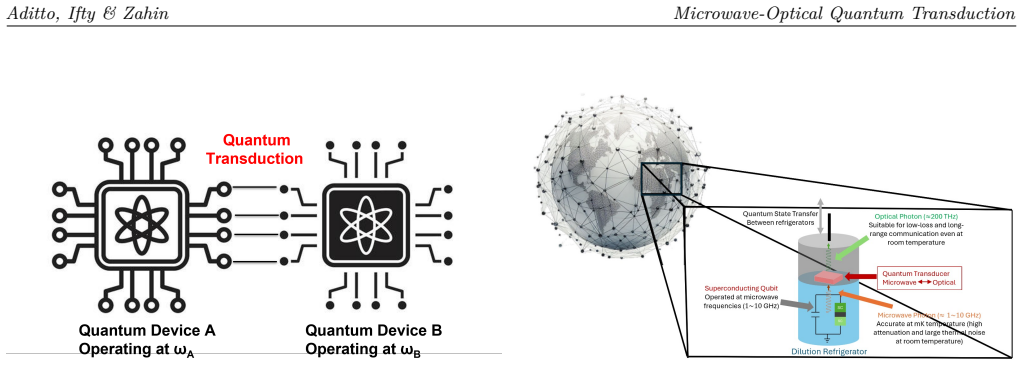
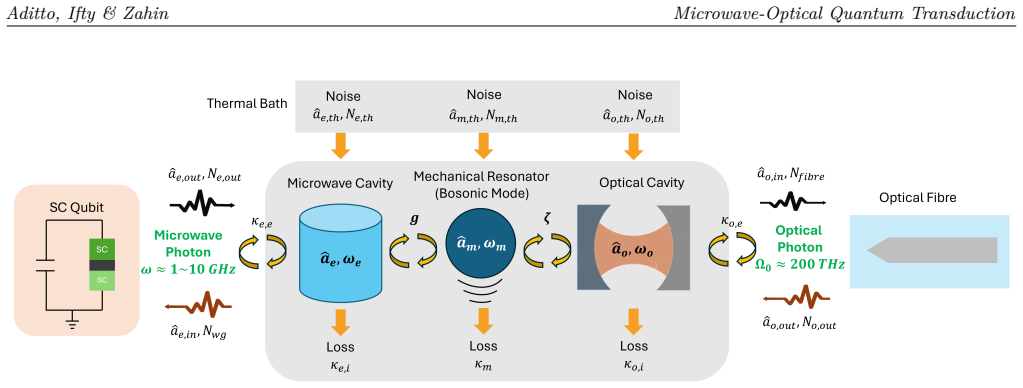
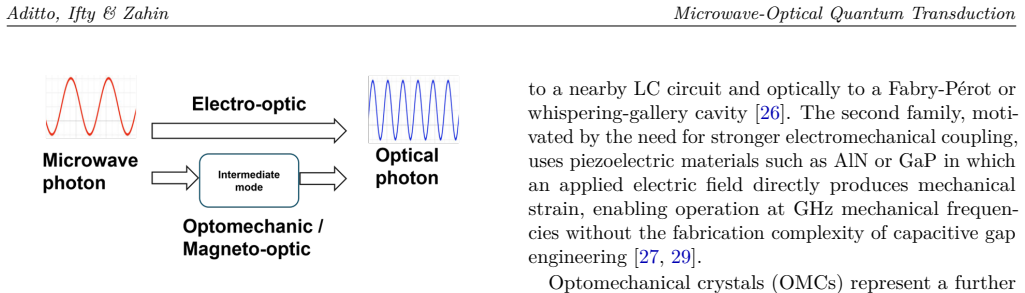
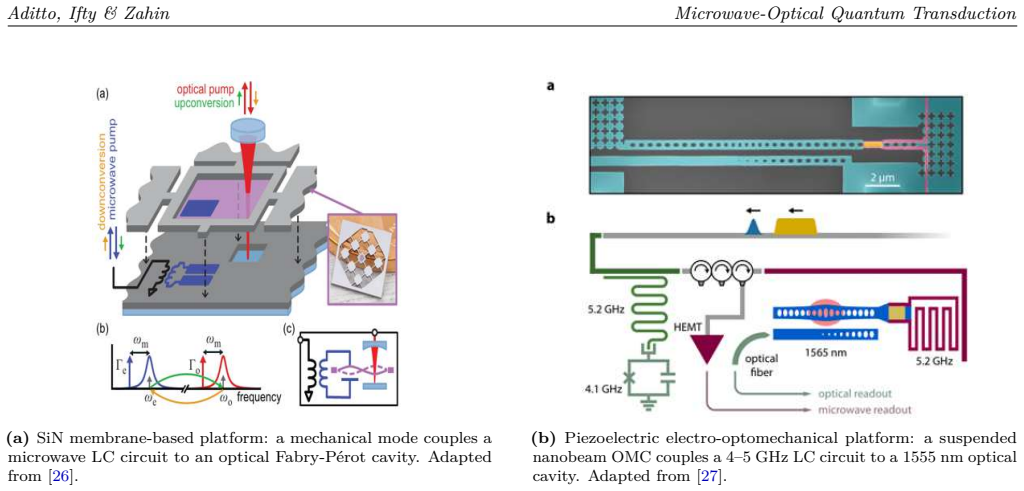
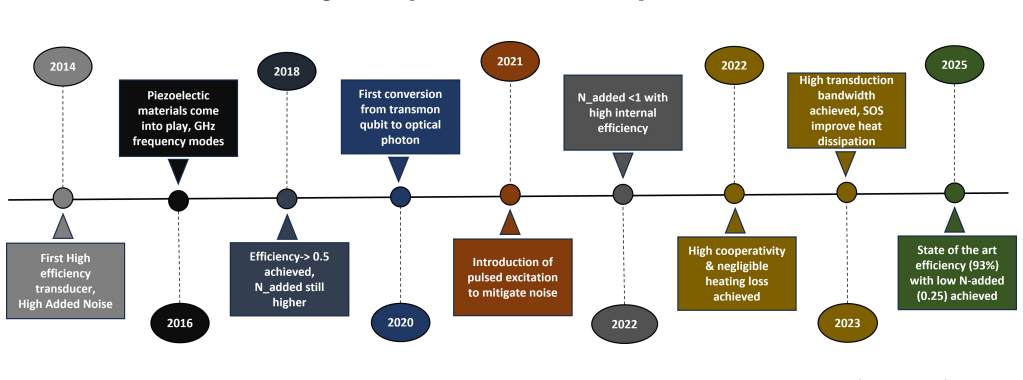
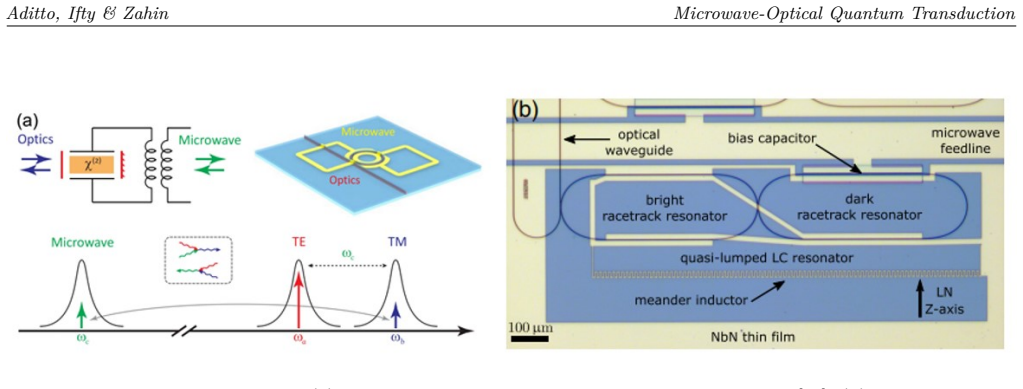
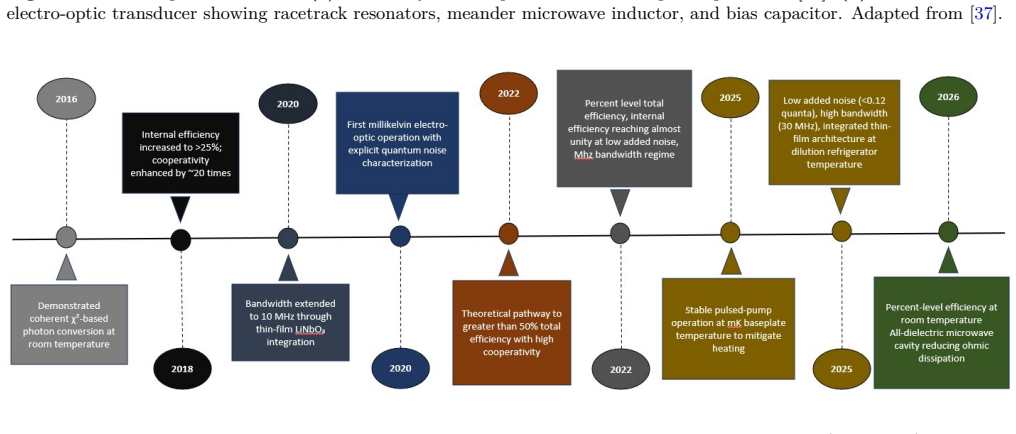
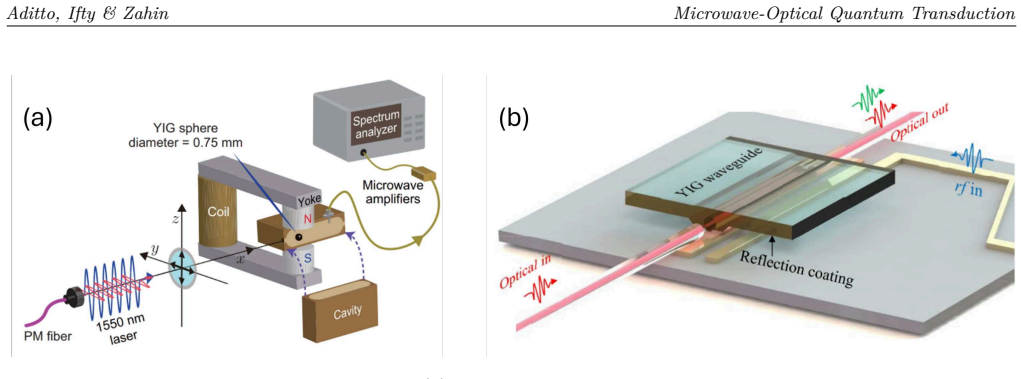
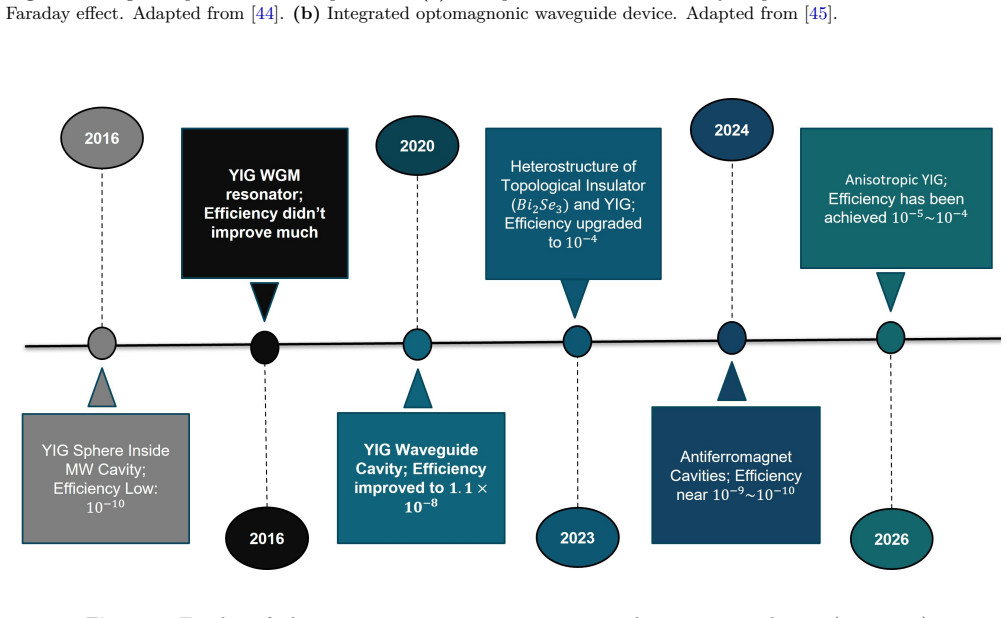
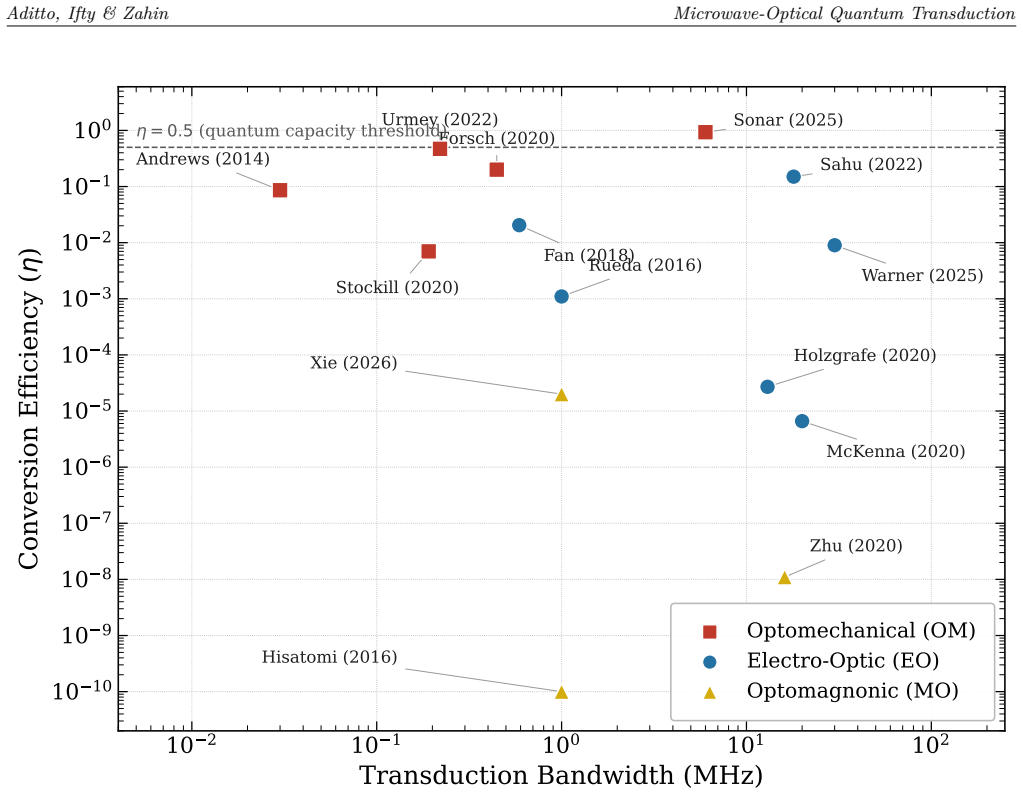
The development of scalable quantum networks requires coherent interfaces capable of converting microwave photons used in superconducting quantum processors into optical photons suitable for long-distance fiber transmission. This review surveys recent progress in microwave-to-optical quantum transduction across optomechanical, electro-optic, and magneto-optic platforms, with emphasis on conversion efficiency, bandwidth, added noise, and operating temperature. In addition to standard metrics, we propose the internal efficiency eta_in and the magnon decay rate kappa_m/2pi as normalized parameters that enable fairer comparison across heterogeneous implementations. Optomechanical systems achieve internal phonon-to-photon efficiencies of 93% with sub-quantum added noise of 0.25 quanta at millikelvin temperatures. Electro-optic devices based on LiNbO3 and AlN have advanced from room-temperature efficiencies below 1% to millikelvin systems with internal efficiencies approaching 99.5%, added noise as low as 0.16 quanta at 60 mK, and bandwidths extending to several tens of megahertz. Magneto-optic (optomagnonic) platforms exhibit the lowest efficiencies (typically $10^{-10}$ to $10^{-8})$, but offer intrinsic non-reciprocity and broadband magnonic operation, with emerging approaches based on topological heterostructures and magnon squeezing predicting enhancements up to $10^{-4}$. Optomechanical systems appear promising for high-fidelity quantum state transfer, electro-optic transducers for high-bandwidth coherent links, and magneto-optic devices for non-reciprocal network components. We discuss the fundamental trade-off between efficiency and added noise across all three platforms, and argue that heterogeneous microwave-optical transduction is emerging as a key enabling technology for distributed quantum computing and large-scale quantum networks.
Editorial analysis
A structured set of objections, weighed in public.
Referee Report
Summary. This review surveys microwave-to-optical quantum transduction across optomechanical, electro-optic, and magneto-optic platforms, reporting literature values for conversion efficiency, bandwidth, added noise, and temperature. It proposes internal efficiency η_in and magnon decay rate κ_m/2π as normalized metrics for cross-platform comparison, assigns platform roles (optomechanics for high-fidelity transfer, electro-optics for bandwidth, magneto-optics for non-reciprocity), and discusses efficiency-noise trade-offs for scalable quantum networks.
Significance. If the proposed normalized metrics prove robust to experimental variations, the compilation could aid platform selection for heterogeneous quantum networks. The review restates external results without new derivations, data, or falsifiable predictions, limiting its impact to synthesis rather than advancing the central claims.
major comments (2)
- [Abstract] Abstract: The assertion that η_in and κ_m/2π 'enable fairer comparison across heterogeneous implementations' is load-bearing for the platform role assignments (e.g., 93% internal efficiency and 0.25 quanta noise for optomechanics; 99.5% efficiency and 0.16 quanta noise for electro-optics), yet the text provides no analysis showing how these parameters correct for inconsistent calibrations, loss treatments, or noise floors in the cited source experiments.
- [Abstract] Abstract: The central claim that optomechanical systems are 'promising for high-fidelity quantum state transfer' rests on re-expressed literature values; without evidence that the new metrics remove systematic differences, the role assignments do not follow from the reported numbers.
Simulated Author's Rebuttal
We thank the referee for the thoughtful review and for identifying areas where the justification of the proposed metrics requires further elaboration. We address the two major comments point by point below. In both cases we agree that additional explanation is warranted and will revise the manuscript accordingly.
read point-by-point responses
-
Referee: [Abstract] Abstract: The assertion that η_in and κ_m/2π 'enable fairer comparison across heterogeneous implementations' is load-bearing for the platform role assignments (e.g., 93% internal efficiency and 0.25 quanta noise for optomechanics; 99.5% efficiency and 0.16 quanta noise for electro-optics), yet the text provides no analysis showing how these parameters correct for inconsistent calibrations, loss treatments, or noise floors in the cited source experiments.
Authors: We acknowledge that the current manuscript does not contain an explicit analysis or derivation demonstrating how η_in and κ_m/2π quantitatively mitigate the cited sources of experimental inconsistency. The internal efficiency η_in is intended to isolate the transduction process from external coupling losses, while κ_m/2π is proposed as an intrinsic magnonic figure of merit independent of optical or microwave port parameters. However, without a dedicated discussion of how these choices interact with calibration variations across the referenced works, the claim remains insufficiently supported. We will add a new subsection (likely in Section II or III) that (i) defines the metrics with explicit formulas, (ii) discusses their sensitivity to common calibration and loss-treatment differences, and (iii) notes remaining limitations where the normalization is only partial. This revision will also include a short table comparing raw versus normalized values for a subset of the cited experiments. revision: yes
-
Referee: [Abstract] Abstract: The central claim that optomechanical systems are 'promising for high-fidelity quantum state transfer' rests on re-expressed literature values; without evidence that the new metrics remove systematic differences, the role assignments do not follow from the reported numbers.
Authors: The platform role assignments are indeed derived from the re-expressed literature values under the proposed normalization. Because the manuscript currently provides no quantitative demonstration that the chosen metrics eliminate the systematic differences mentioned, the assignments rest on an unverified assumption. We will revise the abstract and the concluding discussion to (a) qualify the role assignments as provisional and dependent on the robustness of the normalizations, (b) cross-reference the new subsection on metric justification, and (c) add a brief caveats paragraph acknowledging that direct head-to-head experiments under identical conditions would be required for definitive platform ranking. These changes will be made without altering the underlying literature compilation. revision: yes
Circularity Check
No circularity: review reports external literature values without derivations or self-referential reductions
full rationale
This is a survey paper with no derivations, fits, equations, or predictions. It cites external performance figures from the literature, proposes eta_in and kappa_m/2pi as new comparison parameters, and assigns platform roles on the basis of those reported values. None of the enumerated circularity patterns apply: there are no self-definitional loops, fitted inputs renamed as predictions, load-bearing self-citations, uniqueness theorems, smuggled ansatzes, or renamings of known results. The central claims rest on external data rather than reducing to quantities defined inside the paper itself.
Axiom & Free-Parameter Ledger
axioms (1)
- domain assumption Reported efficiencies, noise levels, and bandwidths in the cited literature accurately reflect device performance under the stated conditions.
Reference graph
Works this paper leans on
-
[1]
M. H. Devoret and R. J. Schoelkopf. Supercon- ducting circuits for quantum information: An out- look.Science, 339(6124):1169–1174, 2013. doi: 10.1126/science.1231930
-
[2]
Quantum information with continuous vari- ables
A. Blais, A. L. Grimsmo, S. M. Girvin, and A. Wall- raff. Circuit quantum electrodynamics.Rev. Mod. Phys., 93:025005, 2021. doi: 10.1103/RevModPhys. 93.025005
-
[3]
Marcello Caleffi, Laura d’Avossa, Xu Han, and An- gela Sara Cacciapuoti. Quantum transduction: En- abling quantum networking.IEEE Communica- tions Surveys & Tutorials, 28:4195–4214, 2026. doi: 10.1109/COMST.2025.3631150
- [4]
-
[5]
Gottesman
D. Gottesman. An introduction to quantum error correction. InProc. Symposia in Applied Mathemat- ics, volume 68, pages 13–58. American Mathematical Society, 2010
2010
-
[6]
A. N. Cleland.Foundations of Nanomechanics. Springer, Berlin, 2003
2003
-
[7]
H. J. Kimble. The quantum internet.Nature, 453: 1023–1030, 2008. doi: 10.1038/nature07127
-
[8]
E. Knill, R. Laflamme, and G. J. Milburn. A scheme for efficient quantum computation with lin- ear optics.Nature, 409(6816):46–52, 2001. doi: 10.1038/35051009
-
[9]
Teleportation Systems Toward a Quantum Internet,
David Awschalom, Karl K. Berggren, Hannes Bernien, Sunil Bhave, Lincoln D. Carr, Paul Davids, Sophia E. Economou, Dirk Englund, Andrei Faraon, Martin Fejer, Saikat Guha, Martin V. Gustafsson, Evelyn Hu, Liang Jiang, Jungsang Kim, Boris Ko- rzh, Prem Kumar, Paul G. Kwiat, Marko Lončar, Mikhail D. Lukin, David A.B. Miller, Christopher Monroe, Sae Woo Nam, P...
-
[10]
W. K. Wootters and W. H. Zurek. A single quantum cannot be cloned.Nature, 299:802–803, 1982. doi: 10.1038/299802a0
-
[11]
M. A. Nielsen and I. L. Chuang.Quantum Compu- tation and Quantum Information. Cambridge Uni- versity Press, 2000
2000
-
[12]
N. J. Lauk, N. Sinclair, S. Barzanjeh, J. P. Covey, M. Saffman, M. Spiropulu, and C. Simon. Per- spectives on quantum transduction.Quantum Sci. Technol., 5:020501, 2020. doi: 10.1088/2058-9565/ ab743c
-
[13]
K. C. Fong, M. C. Collodo, M. Pechal, M. E. Schwartz, A. F. van Loo, and A. Wallraff. Hy- brid quantum systems for microwave–optical con- version.Adv. Quantum Technol., 3:1900077, 2020. doi: 10.1002/qute.201900077
-
[14]
Bardeen, L
J. Bardeen, L. N. Cooper, and J. R. Schrieffer. The- ory of superconductivity.Phys. Rev., 108:1175, 1957
1957
-
[15]
B. D. Josephson. Possible new effects in supercon- ductive tunnelling.Phys. Lett., 1:251, 1962
1962
-
[16]
N. J. Lambert, A. Rueda, F. Sedlmeir, and H. G. Schwefel. Coherent conversion between microwave and optical photons: an overview.Adv. Quantum Technol., 2020
2020
-
[17]
X. Han, W. Fu, C.-L. Zou, L. Jiang, and H. X. Tang. Microwave-optical quantum frequency conversion. Optica, 8:1050–1064, 2021
2021
-
[18]
J. G. Bartholomew, J. Rochman, and T. Xie. On- chip coherent microwave-to-optical transduction me- diated by silicon photonic nanomechanics.Nat. Com- mun., 2020
2020
-
[19]
C. Wang, I. Gonin, A. Grassellino, S. Kazakov, A. Romanenko, V. P. Yakovlev, and S. Zorzetti. High-efficiency microwave-optical quantum transduc- tion based on a cavity electro-optic superconduct- ing system.npj Quantum Inf., 8:149, 2022. doi: 10.1038/s41534-022-00664-7
-
[20]
Rochman, T
J. Rochman, T. Xie, K. C. Schwab, and A. Faraon. Microwave-to-optical transduction with erbium ions. Commun. Phys., 2023
2023
-
[21]
C. W. Gardiner and P. Zoller.Quantum Noise. Springer, 2004
2004
-
[22]
D. F. Walls and G. J. Milburn.Quantum Optics. Springer, 2008
2008
-
[23]
Caruso, V
F. Caruso, V. Giovannetti, and A. S. Holevo. One-mode bosonic gaussian channels: a full weak- degradability classification.New J. Phys., 8:310, 2006
2006
-
[24]
A. S. Holevo and R. F. Werner. Evaluating capacities of bosonic gaussian channels.Phys. Rev. A, 63: 032312, 2001
2001
- [25]
-
[26]
R. W. Andrews, R. W. Peterson, T. P. Purdy, K. Ci- cak, R. W. Simmonds, C. A. Regal, and K. W. Lehn- ert. Bidirectional and efficient conversion between microwave and optical light.Nat. Phys., 10:321–326,
-
[27]
doi: 10.1038/nphys2911
-
[28]
Vainsencher, K
A. Vainsencher, K. J. Satzinger, G. A. Peairs, and A. N. Cleland. Bi-directional conversion between microwave and optical frequencies in a piezoelectric optomechanicaldevice.Appl. Phys. Lett., 109:033107,
-
[29]
doi: 10.1063/1.4955408
-
[30]
A. P. Higginbotham, P. S. Burns, M. D. Urmey, R. W. Peterson, N. S. Kampel, B. M. Brubaker, G. Smith, K. W. Lehnert, and C. A. Regal. Harness- ing electro-optic correlations in an efficient mechani- cal converter.Nat. Phys., 14:1038–1042, 2018. doi: 10.1038/s41567-018-0210-0
-
[31]
R. Stockill, M. Forsch, F. Hijazi, G. Beaudoin, K. Pantzas, I. Sagnes, R. Braive, and S. Groeblacher. Ultra-low-noise microwave to optics conversion in gallium phosphide.Nat. Commun., 13:6583, 2022. doi: 10.1038/s41467-022-34338-x
-
[32]
M. Mirhosseini, A. Sipahigil, M. Kalaee, and O. Painter. Superconducting qubit to optical pho- ton transduction.Nature, 588:599–603, 2020. doi: 10.1038/s41586-020-3038-6
-
[33]
R. Sahu, W. Hease, A. Rueda, G. Arnold, and J. M. Fink. Quantum-enabled operation of a microwave-optical transducer on thin-film lithium niobate.Nat. Commun., 12:5433, 2021. doi: 10.1038/s41467-021-25740-y
-
[34]
R. D. Delaney, M. D. Urmey, S. Mittal, B. M. Brubaker, J. M. Kindem, P. S. Burns, C. A. Re- gal, and K. W. Lehnert. Superconducting-qubit readout via low-backaction electro-optic transduc- tion.Nature, 606:489–493, 2022. doi: 10.1038/ s41586-022-04720-2
2022
-
[35]
Blésin, W
T. Blésin, W. Kao, A. Siddharth, T. J. Kippen- berg, and S. A. Bhave. Bidirectional microwave- optical transduction based on integration of high- overtone bulk acoustic resonators and photonic cir- cuits.Nat. Commun., 15:6096, 2024. doi: 10.1038/ s41467-024-49467-8. 15 Aditto, Ifty & Zahin Microwave-Optical Quantum Transduction
2024
-
[36]
H. Zhao, W. D. Chen, A. Kejriwal, and M. Mirhos- seini. Quantum-enabled microwave-to-optical trans- duction via silicon nanomechanics.Nat. Nan- otechnol., 20:602–608, 2025. doi: 10.1038/ s41565-025-01874-8
2025
-
[37]
S. Sonar, U. Hatipoglu, S. Meesala, D. Lake, H. Ren, and O. Painter. High-efficiency low-noise optome- chanical crystal photon-phonon transducers.Optica, 12:99–104, 2025. doi: 10.1364/OPTICA.534881
-
[38]
Superconducting cavity electro-optics: a platform for coherent photon conversion between superconducting and photonic circuits.Science ad- vances, 4(8):eaar4994, 2018
Linran Fan, Chang-Ling Zou, Risheng Cheng, Xi- ang Guo, Xu Han, Zheng Gong, Sihao Wang, and Hong X Tang. Superconducting cavity electro-optics: a platform for coherent photon conversion between superconducting and photonic circuits.Science ad- vances, 4(8):eaar4994, 2018
2018
-
[39]
J. Holzgrafe, N. Sinclair, D. Zhu, A. Shams-Ansari, M. Colangelo, Y. Hu, M. Zhang, K. K. Berggren, and M. Lončar. Cavity electro-optics in thin-film lithium niobate for efficient microwave-to-optical transduction.Optica, 7:1714–1720, 2020. doi: 10.1364/OPTICA.397513
-
[40]
H. K. Warner, J. Holzgrafe, B. Yankelevich, D. Bar- ton, S.Poletto, C.J.Xin, N.Sinclair, D.Zhu, E.Sete, B. Langley, E. Batson, M. Colangelo, A. Shams- Ansari, G. Joe, K. K. Berggren, L. Jiang, M. J. Reagor, and M. Lončar. Coherent control of a super- conducting qubit using light.Nat. Phys., 21:831–838,
-
[41]
doi: 10.1038/s41567-025-02812-0
-
[42]
Arnold, T
G. Arnold, T. Werner, R. Sahu, L. N. Kapoor, L. Qiu, and J. M. Fink. All-optical superconducting qubit readout.Nat. Phys., 21:393–400, 2025. doi: 10.1038/ s41567-024-02741-4
2025
-
[43]
R. Sahu, W. Hease, A. Rueda, G. Arnold, L. Qiu, and J. M. Fink. Quantum-enabled operation of a microwave-optical interface.Nat. Commun., 13:1276,
-
[44]
doi: 10.1038/s41467-022-28924-2
-
[45]
T. P. McKenna, J. D. Witmer, R. N. Patel, W. Jiang, R. Van Laer, P. Arrangoiz-Arriola, E. A. Wollack, J. F. Herrmann, and A. H. Safavi-Naeini. Cryogenic microwave-to-optical conversion using a triply reso- nant lithium-niobate-on-sapphire transducer.Optica, 7:1737–1745, 2020. doi: 10.1364/OPTICA.397235
-
[46]
W. Hease, A. Rueda, R. Sahu, M. Wulf, G. Arnold, H. G. L. Schwefel, and J. M. Fink. Bidirectional electro-optic wavelength conversion in the quantum ground state.PRX Quantum, 1:020315, 2020. doi: 10.1103/PRXQuantum.1.020315
-
[47]
A. Rueda, F. Sedlmeir, M. C. Collodo, U. Vogl, B. Stiller, G. Schunk, D. V. Strekalov, C. Marquardt, J. M. Fink, O. Painter, G. Leuchs, and H. G. L. Schwefel. Efficient microwave to optical photon con- version: an electro-optical realization.Optica, 3: 597–604, 2016. doi: 10.1364/OPTICA.3.000597
-
[48]
R. Hisatomi, A. Osada, Y. Tabuchi, T. Ishikawa, A. Noguchi, R. Yamazaki, K. Usami, and Y. Naka- mura. Bidirectional conversion between microwave and light via ferromagnetic magnons.Phys. Rev. B, 93:174427, 2016. doi: 10.1103/PhysRevB.93.174427
-
[49]
N.Zhu, X.Zhang, X.Han, C.-L.Zou, C.Zhong, C.-H. Wang, L. Jiang, and H. X. Tang. Waveguide cavity optomagnonics for microwave-to-optics conversion. Optica, 7:1291–1297, 2020. doi: 10.1364/OPTICA. 401466
-
[50]
A. Osada, R. Hisatomi, A. Noguchi, Y. Tabuchi, R. Yamazaki, K. Usami, M. Sadgrove, R. Yalla, M. Nomura, and Y. Nakamura. Cavity optomagnon- ics with spin-orbit coupled photons.Phys. Rev. Lett., 116:223601, 2016. doi: 10.1103/PhysRevLett.116. 223601
-
[51]
Zhang, N
X. Zhang, N. Zhu, C.-L. Zou, and H. X. Tang. Optomagnonic whispering gallery microresonators. Phys. Rev. Lett., 117:123605, 2016. doi: 10.1103/ PhysRevLett.117.123605
2016
-
[52]
Microwave-to-optical quantum transduction utilizing the topological faraday effect of topological-insulator heterostructures.Physical Review Applied, 22(2): 024071, 2024
Akihiko Sekine, Mari Ohfuchi, and Yoshiyasu Doi. Microwave-to-optical quantum transduction utilizing the topological faraday effect of topological-insulator heterostructures.Physical Review Applied, 22(2): 024071, 2024
2024
-
[53]
A. Sekine and Y. Doi. Microwave-to-optical quantum transduction with antiferromagnets. arXiv:2412.12907 [quant-ph], 2024. Preprint
-
[54]
H. Xie, L.-W. He, X. Lin, et al. Enhancement of opto- magnonic coupling and microwave-optical conversion via magnetic anisotropy.EPJ Quantum Technol., 13: 11, 2026. doi: 10.1140/epjqt/s40507-025-00458-8
-
[55]
Y. Tabuchi, S. Ishino, T. Ishikawa, R. Yamazaki, K. Usami, and Y. Nakamura. Hybridizing ferro- magnetic magnons and microwave photons in the quantum limit.Phys. Rev. Lett., 113:083603, 2014. doi: 10.1103/PhysRevLett.113.083603
-
[56]
X. Zhang, C.-L. Zou, L. Jiang, and H. X. Tang. Strongly coupled magnons and cavity microwave photons.Phys. Rev. Lett., 113:156401, 2014. doi: 10.1103/PhysRevLett.113.156401
-
[57]
B. Z. Rameshti, S. V. Kusminskiy, J. A. Haigh, K. Usami, D. Lachance-Quirion, Y. Nakamura, C.- M. Hu, H. X. Tang, G. E. W. Bauer, and Y. M. Blanter. Cavity magnonics.Phys. Rep., 979:1–61,
-
[58]
doi: 10.1016/j.physrep.2022.06.001
-
[59]
N. Zhu, X. Han, C.-L. Zou, M. Xu, and H. X. Tang. Magnon-photon strong coupling for tunable microwave circulators.Phys. Rev. A, 101:043842,
-
[60]
doi: 10.1103/PhysRevA.101.043842
-
[61]
C. Möhl, A. Riedhauser, M. Glantschnig, D. Caimi, U. Drechsler, A. Olziersky, D. Sabonis, D. I. In- dolese, T. M. Karg, and P. Seidler. Bidirectional 16 Aditto, Ifty & Zahin Microwave-Optical Quantum Transduction microwave-optical conversion with an integrated soft- ferroelectric barium titanate transducer.Phys. Rev. X, 15:041044, 2025. doi: 10.1103/1gvf-w6lx. 17
discussion (0)
Sign in with ORCID, Apple, or X to comment. Anyone can read and Pith papers without signing in.