ORCA: An End-to-End Interactive Copilot for Optimized Root Cause Analysis
Pith reviewed 2026-06-29 16:38 UTC · model grok-4.3
The pith
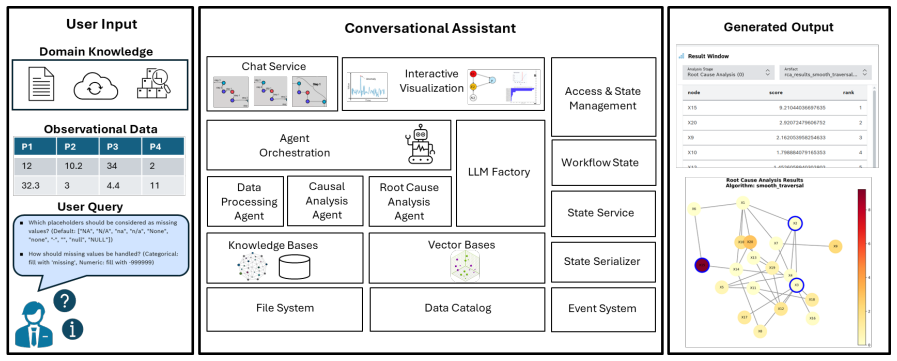
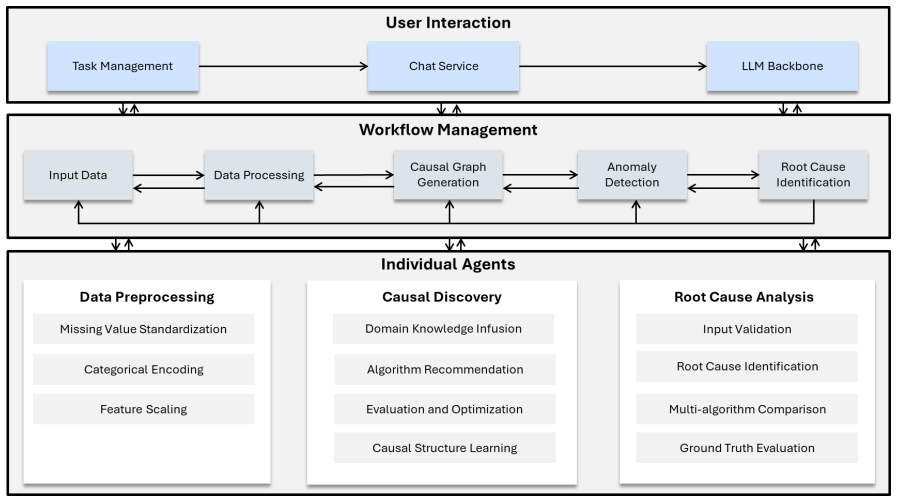
ORCA orchestrates agents to guide users through causal analysis workflows from automatic to user-guided.
A machine-rendered reading of the paper's core claim, the machinery that carries it, and where it could break.
Core claim
ORCA orchestrates agents to understand the user's goals and guide them through the most appropriate causal analysis workflow, from fully automatic to highly user-guided execution. It features causal discovery, causal effect estimation, explainability and Root-Cause-Analysis (RCA). ORCA evaluates and compares performance, generates key metrics and diagrams, and generates insights through structured reports.
What carries the argument
Multi-agent orchestration that interprets user goals and selects and executes the appropriate causal workflow.
If this is right
- Users gain access to both fully automatic execution and highly interactive guidance within one system.
- The copilot produces performance evaluations and comparisons across causal methods.
- Structured reports with metrics and diagrams communicate findings to non-experts.
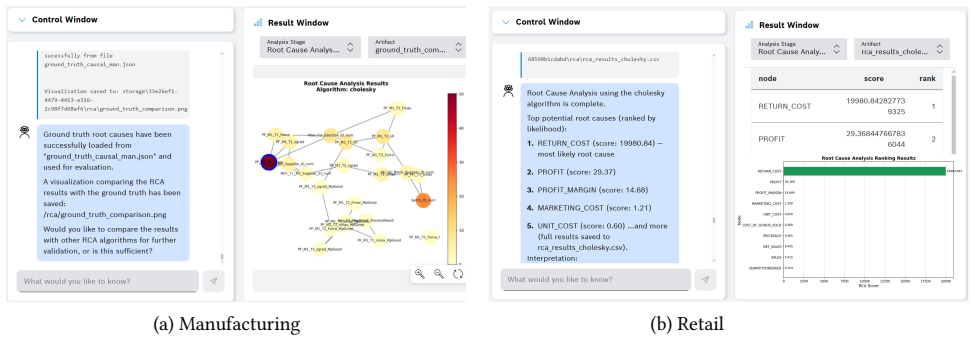
- Effectiveness is demonstrated on several real-world use cases across domains.
Where Pith is reading between the lines
- The same orchestration pattern could be adapted to guide users through other families of analytical methods beyond causal inference.
- Interactive mode might surface and correct modeling choices that pure automation would miss on noisy industrial data.
- If the agent layer generalizes, similar copilots could lower the barrier for validating new causal techniques when real data access is restricted.
Load-bearing premise
The multi-agent orchestration can reliably choose and run valid causal methods on real data without introducing errors or biases.
What would settle it
Apply ORCA to a dataset with known ground-truth causal structure and check whether its selected workflow and final root-cause report recover the correct relationships.
Figures
read the original abstract
Causal analysis is a crucial task in many domains, including manufacturing, social science, and medicine. However, despite recent progress, the conceptual and methodological complexity of causal methods makes them largely inaccessible to domain experts. This gap prevents experts from leveraging these advances and hinders researchers who lack access to real-world data for validation. To bridge this divide, we introduce ORCA, a copilot for end-to-end causal analysis. ORCA orchestrates agents to understand the user's goals and guide them through the most appropriate causal analysis workflow, from fully automatic to highly user-guided execution. It features causal discovery, causal effect estimation, explainability and Root-Cause-Analysis (RCA). ORCA evaluates and compares performance, generates key metrics and diagrams, and generates insights through structured reports. We highlight its effectiveness across several real-world use-cases.
Editorial analysis
A structured set of objections, weighed in public.
Referee Report
Summary. The manuscript introduces ORCA, an end-to-end interactive copilot for root cause analysis that orchestrates multiple agents to interpret user goals and guide execution of causal workflows ranging from fully automatic to highly user-guided. The system incorporates causal discovery, causal effect estimation, explainability, and RCA, while also performing performance evaluation and comparison, generating metrics and diagrams, and producing structured insight reports. The authors assert effectiveness across several real-world use-cases in domains such as manufacturing, social science, and medicine.
Significance. If the multi-agent orchestration and workflow execution were shown to reliably produce accurate causal results without introducing selection errors or biases, ORCA could meaningfully lower the barrier for domain experts to apply causal methods, enabling broader use of discovery, effect estimation, and RCA on real-world data where methodological expertise is limited.
major comments (2)
- [Abstract] Abstract: The claim that the system 'highlight[s] its effectiveness across several real-world use-cases' is unsupported, as the manuscript supplies no description of the use-cases, datasets, evaluation metrics, validation procedures, error analysis, or comparisons against non-agent baselines.
- [Abstract] Abstract: The central assumption that multi-agent orchestration 'reliably selects and executes valid causal workflows' without agent-induced errors or biases is untestable, because no architecture details, decision rules for workflow selection, or safeguards are provided.
Simulated Author's Rebuttal
We thank the referee for the constructive feedback and the recommendation for major revision. We address each of the two major comments below.
read point-by-point responses
-
Referee: [Abstract] Abstract: The claim that the system 'highlight[s] its effectiveness across several real-world use-cases' is unsupported, as the manuscript supplies no description of the use-cases, datasets, evaluation metrics, validation procedures, error analysis, or comparisons against non-agent baselines.
Authors: We agree that the abstract claim is unsupported by the details listed. We will revise the abstract to remove this sentence. We will also add a new evaluation section to the manuscript body that describes the use-cases, datasets, metrics, validation procedures, error analysis, and comparisons against non-agent baselines. revision: yes
-
Referee: [Abstract] Abstract: The central assumption that multi-agent orchestration 'reliably selects and executes valid causal workflows' without agent-induced errors or biases is untestable, because no architecture details, decision rules for workflow selection, or safeguards are provided.
Authors: We acknowledge that the manuscript currently lacks the architecture details, decision rules, and safeguards needed to evaluate this assumption. We will add a dedicated section describing the multi-agent architecture, the workflow selection logic, and any safeguards against selection errors or biases. revision: yes
Circularity Check
No circularity: system description without derivations or fitted predictions
full rationale
The paper is a high-level description of an interactive multi-agent copilot system for causal analysis workflows. It contains no equations, no parameter fitting, no 'predictions' of derived quantities, and no load-bearing self-citations that reduce a central claim to an unverified prior result by the same authors. The contribution is architectural and descriptive; effectiveness is asserted via real-world use-cases without any mathematical derivation chain that could be circular. This matches the default non-circular case for system papers.
Axiom & Free-Parameter Ledger
Reference graph
Works this paper leans on
-
[1]
Spirtes, C
P. Spirtes, C. Glymour, R. Scheines, Causation, Prediction, and Search, 2 ed., MIT Press, Cambridge, MA, 2000
2000
-
[2]
K. M. Kellogg, Z. Hettinger, M. Shah, R. L. Wears, C. R. Sellers, M. Squires, R. J. Fairbanks, Our current approach to root cause analysis: is it contributing to our failure to improve patient safety?, BMJ Quality & Safety 26 (2017) 381–387
2017
-
[3]
M. C. F. Prosperi, Y. Guo, M. Sperrin, J. S. Koopman, J. Min, X. He, S. N. Rich, M. Wang, I. E. Buchan, J. Bian, Causal inference and counterfactual prediction in machine learning for actionable healthcare, Nature Machine Intelligence 2 (2020) 369 – 375
2020
-
[4]
A. W. Wu, A. K. M. Lipshutz, P. J. Pronovost, Effectiveness and efficiency of root cause analysis in medicine, Journal of the American Medical Association 299 (2008) 685–687
2008
-
[5]
Imbens, Potential outcome and directed acyclic graph approaches to causality: Relevance for empirical practice in economics, NBER Working Paper Series (2019)
G. Imbens, Potential outcome and directed acyclic graph approaches to causality: Relevance for empirical practice in economics, NBER Working Paper Series (2019)
2019
-
[6]
Kleinberg, G
S. Kleinberg, G. Hripcsak, A review of causal inference for biomedical informatics, Journal of biomedical informatics 44 6 (2011) 1102–12
2011
-
[7]
J. Li, B. B. Chu, I. F. Scheller, J. Gagneur, M. H. Maathuis, Root cause discovery via permutations and cholesky decomposition, Journal of the Royal Statistical Society Series B: Statistical Methodology (2025)
2025
-
[8]
Glymour, K
C. Glymour, K. Zhang, P. Spirtes, Review of causal discovery methods based on graphical models, Frontiers in Genetics 10 (2019)
2019
-
[9]
e Oliveira, V
E. e Oliveira, V. L. Miguéis, J. L. Borges, Automatic root cause analysis in manufacturing: an overview & conceptualization, Journal of Intelligent Manufacturing 34 (2022) 2061–2078
2022
-
[10]
Papageorgiou, T
K. Papageorgiou, T. Theodosiou, A. Rapti, E. I. Papageorgiou, N. Dimitriou, D. Tzovaras, G. Margetis, A systematic review on machine learning methods for root cause analysis towards zero-defect manufacturing, Frontiers in Manufacturing Technology 2 (2022) 972712
2022
-
[11]
M. Solé, V. Muntés-Mulero, A. I. Rana, G. Estrada, Survey on models and techniques for root-cause analysis, arXiv:1701.08546 (2017).arXiv:1701.08546
work page internal anchor Pith review Pith/arXiv arXiv 2017
-
[12]
Soldani, A
J. Soldani, A. Brogi, Anomaly detection and failure root cause analysis in (micro) service-based cloud applications: A survey, ACM Computing Surveys 55 (2022)
2022
-
[13]
A. L. Cochrane, Effectiveness and efficiency: random reflections on health services (1972)
1972
-
[14]
Pearl, Causality, 2 ed., Cambridge University Press, 2009
J. Pearl, Causality, 2 ed., Cambridge University Press, 2009
2009
-
[15]
Cheng, R
L. Cheng, R. Guo, R. Moraffah, P. Sheth, K. S. Candan, H. Liu, Evaluation methods and measures for causal learning algorithms, IEEE Transactions on Artificial Intelligence 3 (2022) 924–943
2022
-
[16]
Gentzel, D
A. Gentzel, D. Garant, D. Jensen, The case for evaluating causal models using interventional measures and empirical data, in: H. Wallach, H. Larochelle, A. Beygelzimer, F. d'Alché-Buc, E. Fox, R. Garnett (Eds.), Advances in Neural Information Processing Systems, volume 32, Curran Associates, Inc., 2019
2019
-
[17]
W. R. Orchard, N. Okati, S. H. G. Mejia, P. Blöbaum, D. Janzing, Root cause analysis of outliers with missing structural knowledge, in: The Annual Conference on Neural Information Processing Systems, 2025
2025
- [18]
-
[19]
M. J. Vowels, N. C. Camgoz, R. Bowden, D’ya like dags? a survey on structure learning and causal discovery, ACM Computing Surveys 55 (2021) 1 – 36
2021
-
[20]
A. R. Nogueira, A. Pugnana, S. Ruggieri, D. Pedreschi, J. Gama, Methods and tools for causal discovery and causal inference, Wiley Interdisciplinary Reviews: Data Mining and Knowledge Discovery 12 (2022)
2022
-
[21]
M. Zecevic, M. Willig, D. S. Dhami, K. Kersting, Causal parrots: Large language models may talk causality but are not causal, ArXiv abs/2308.13067 (2023)
- [22]
-
[23]
E. Kıcıman, R. O. Ness, A. Sharma, C. Tan, Causal reasoning and large language models: Opening a new frontier for causality, ArXiv abs/2305.00050 (2023)
-
[24]
Efficient Causal Graph Discovery Using Large Language Models
T. Jiralerspong, X. Chen, Y. More, V. Shah, Y. Bengio, Efficient causal graph discovery using large language models, ArXiv abs/2402.01207 (2024)
work page internal anchor Pith review Pith/arXiv arXiv 2024
-
[25]
Hasan, M
U. Hasan, M. O. Gani, Optimizing data-driven causal discovery using knowledge-guided search,
- [26]
- [27]
-
[28]
H. Du, Y. Zheng, B. Jing, Y. Zhao, G. Kou, G. Liu, T. Gu, W. Li, C. Yang, Causal discovery through synergizing large language model and data-driven reasoning, in: Proceedings of the 31st ACM SIGKDD Conference on Knowledge Discovery and Data Mining V.2, KDD ’25, Association for Computing Machinery, New York, NY, USA, 2025, p. 543–554. URL: https://doi.org/...
-
[29]
T. Ban, L. Chen, D. Lyu, X. Wang, Q. Zhu, H. Chen, Llm-driven causal discovery via harmonized prior, IEEE Transactions on Knowledge and Data Engineering 37 (2025) 1943–1960
2025
-
[30]
A. Vashishtha, A. Kumar, A. Pandey, A. G. Reddy, K. Ahuja, V. N. Balasubramanian, A. Sharma, Teaching transformers causal reasoning through axiomatic training, 2025. URL: https://arxiv.org/ abs/2407.07612.arXiv:2407.07612
-
[31]
A. Antonucci, G. Piqué, M. Zaffalon, Zero-shot causal graph extrapolation from text via llms, 2023. URL: https://arxiv.org/abs/2312.14670.arXiv:2312.14670
-
[32]
E. Saveliev, J. Liu, N. Seedat, A. Boyd, M. van der Schaar, Towards human-guided, data-centric llm co-pilots, 2025. URL: https://arxiv.org/abs/2501.10321.arXiv:2501.10321
-
[33]
J. Berrevoets, J. Piskorz, R. Davis, H. Amad, J. Weatherall, M. van der Schaar, Technical report: Facilitating the adoption of causal inference methods through llm-empowered co-pilot, 2025. URL: https://arxiv.org/abs/2508.10581.arXiv:2508.10581
- [34]
-
[35]
A. Shan, J. Kaur, R. Singh, T. Banka, R. Yavatkar, T. Sridhar, Rca copilot: Transforming network data into actionable insights via large language models, ICC 2025 - IEEE International Conference on Communications (2025) 1566–1571
2025
-
[36]
C. W. J. Granger, Investigating causal relations by econometric models and cross-spectral methods, 1969
1969
-
[37]
C. Shyalika, A. Sharma, F. E. Kalach, U. Jaimini, C. Henson, R. F. Harik, A. P. Sheth, Causaltrace: A neurosymbolic causal analysis agent for smart manufacturing, ArXiv abs/2510.12033 (2025)
-
[38]
Shyalika, R
C. Shyalika, R. Prasad, A. T. A. Ghazo, D. Eswaramoorthi, S. S. Muthuselvam, A. P. Sheth, Smartpilot: Agent-based copilot for intelligent manufacturing, in: Adaptive Agents and Multi-Agent Systems, 2025
2025
-
[39]
Verma, S
V. Verma, S. Acharya, S. Simko, D. Bhardwaj, A. Haghighat, M. Sachan, D. Janzing, B. Schölkopf, Z. Jin, Causal ai scientist: Facilitating causal data science with large language models, 2025
2025
-
[40]
J. L. Gamella, J. Peters, P. Bühlmann, Causal chambers as a real-world physical testbed for AI methodology, Nature Machine Intelligence (2025)
2025
-
[41]
N. Tagliapietra, J. Luettin, L. Halilaj, M. Willig, T. Pychynski, K. Kersting, Causalman: A physics- based simulator for large-scale causality, arXiv:2502.12707 (2025).arXiv:2502.12707
- [42]
-
[43]
Ikram, S
A. Ikram, S. Chakraborty, S. Mitra, S. K. Saini, S. Bagchi, M. Kocaoglu, Root cause analysis of failures in microservices through causal discovery, in: Neural Inf. Processing Systems, 2022
2022
- [44]
-
[45]
Erdös, A
P. Erdös, A. Rényi, On random graphs i, Publicationes Mathematicae Debrecen 6 (1959) 290
1959
-
[46]
Barabási, R
A.-L. Barabási, R. Albert, Emergence of scaling in random networks, Science 286 (1999) 509–512
1999
-
[47]
Spirtes, C
P. Spirtes, C. Meek, T. S. Richardson, Causal inference in the presence of latent variables and selection bias, in: Conference on Uncertainty in Artificial Intelligence, 1995
1995
-
[48]
D. M. Chickering, Optimal structure identification with greedy search, J. Mach. Learn. Res. 3 (2002) 507–554
2002
-
[49]
Nazaret, D
A. Nazaret, D. Blei, Extremely greedy equivalence search, in: Proceedings of Conference on Uncertainty in Artificial Intelligence, 2024
2024
-
[50]
W. yin Lam, B. Andrews, J. Ramsey, Greedy relaxations of the sparsest permutation algorithm, ArXiv abs/2206.05421 (2022)
-
[51]
Zheng, B
X. Zheng, B. Aragam, P. K. Ravikumar, E. P. Xing, Dags with no tears: Continuous optimization for structure learning, in: Advances in Neural Information Processing Systems, 2018
2018
-
[52]
I. Ng, A. Ghassami, K. Zhang, On the role of sparsity and dag constraints for learning linear dags,
- [53]
-
[54]
X. Wang, Y. Du, S. Zhu, L. Ke, Z. Chen, J. Hao, J. Wang, Ordering-based causal discovery with reinforcement learning, in: International Joint Conference on Artificial Intelligence, 2021
2021
-
[55]
Shimizu, P
S. Shimizu, P. O. Hoyer, A. Hyvarinen, A. Kerminen, A linear non-gaussian acyclic model for causal discovery, Journal of Machine Learning Research 7 (2006) 2003–2030
2006
-
[56]
P. O. Hoyer, D. Janzing, J. M. Mooij, J. Peters, B. Scholkopf, Nonlinear causal discovery with additive noise models, in: Neural Information Processing Systems, 2008
2008
-
[57]
Zhang, A
K. Zhang, A. Hyvärinen, On the identifiability of the post-nonlinear causal model, in: Conference on Uncertainty in Artificial Intelligence, 2009
2009
-
[58]
Tagliapietra, G
N. Tagliapietra, G. L. Marchioni, M. Willig, J. Luettin, L. Halilaj, K. Kersting, Causalsteward: An agentic divide-conquer-combine copilot for causal discovery, 2026. URL: https://openreview.net/ forum?id=3lFAyPa9Fe
2026
-
[59]
Runge, P
J. Runge, P. J. Nowack, M. Kretschmer, S. Flaxman, D. Sejdinovic, Detecting and quantifying causal associations in large nonlinear time series datasets, Science Advances 5 (2017)
2017
-
[60]
A. Tank, I. Covert, N. J. Foti, A. Shojaie, E. B. Fox, Neural granger causality, IEEE Transactions on Pattern Analysis and Machine Intelligence 44 (2021) 4267–4279
2021
-
[61]
D. Liu, C. He, X. Peng, F. Lin, C. Zhang, S. Gong, Z. Li, J. Ou, Z. Wu, Microhecl: High-efficient root cause localization in large-scale microservice systems, in: IEEE/ACM International Conference on Software Engineering: Software Engineering in Practice, 2021, pp. 338–347
2021
-
[62]
M. Li, Z. Li, K. Yin, X. Nie, W. Zhang, K. Sui, D. Pei, Causal inference-based root cause analysis for online service systems with intervention recognition, Proceedings of the 28th ACM SIGKDD Conference on Knowledge Discovery and Data Mining (2022)
2022
-
[63]
Budhathoki, L
K. Budhathoki, L. Minorics, P. Blöbaum, D. Janzing, Causal structure-based root cause analysis of outliers, in: International conference on machine learning, PMLR, 2022, pp. 2357–2369
2022
discussion (0)
Sign in with ORCID, Apple, or X to comment. Anyone can read and Pith papers without signing in.