Semiclassical foundation of universality in chaotic quantum circuits
Pith reviewed 2026-06-29 16:40 UTC · model grok-4.3
The pith
Spectral correlations in chaotic quantum circuits arise from breaking individual time translation invariance of subsystem periodic orbits into residual synchronous translations only.
A machine-rendered reading of the paper's core claim, the machinery that carries it, and where it could break.
Core claim
Many-body systems with explicit subsystem structure possess periodic orbit families arising exclusively in the many-body setting. A central limit theorem characterizes their correlations. Spectral correlations in chaotic quantum circuits are thereby characterized by the breaking of individual time translation invariance of periodic orbits in the subsystems into residual synchronous time translations only. This supplies a systematic semiclassical approach to confirming random matrix universality in deterministic many-body systems.
What carries the argument
Periodic orbit families that arise exclusively in the many-body setting, with their correlations governed by a central limit theorem that enforces residual synchronous time translations across subsystems.
If this is right
- Spectral correlations in many-body chaotic systems differ systematically from those in single-particle systems because of the subsystem decomposition.
- Random matrix universality in deterministic many-body systems can be derived from the central limit theorem applied to many-body orbit families.
- The same breaking of individual time translations into synchronous residuals applies to any chaotic quantum circuit with a semiclassical limit and explicit subsystem structure.
- Periodic orbit theory for many-body systems must account for orbit families that have no single-particle counterpart.
Where Pith is reading between the lines
- The mechanism may extend to other many-body systems such as spin chains or lattices that admit a subsystem decomposition and semiclassical limit.
- Universality could depend on the choice of subsystem partition rather than on the global dynamics alone.
- Systems lacking a clear subsystem structure might exhibit different correlation patterns not captured by residual synchronous translations.
Load-bearing premise
Many-body systems with explicit subsystem structure possess a well-defined semiclassical limit that permits identification of periodic orbit families arising exclusively in the many-body setting.
What would settle it
Numerical computation of the spectral form factor or two-point correlations in a concrete chaotic quantum circuit that fails to display the predicted residual synchronous time translations would falsify the claimed characterization.
Figures
read the original abstract
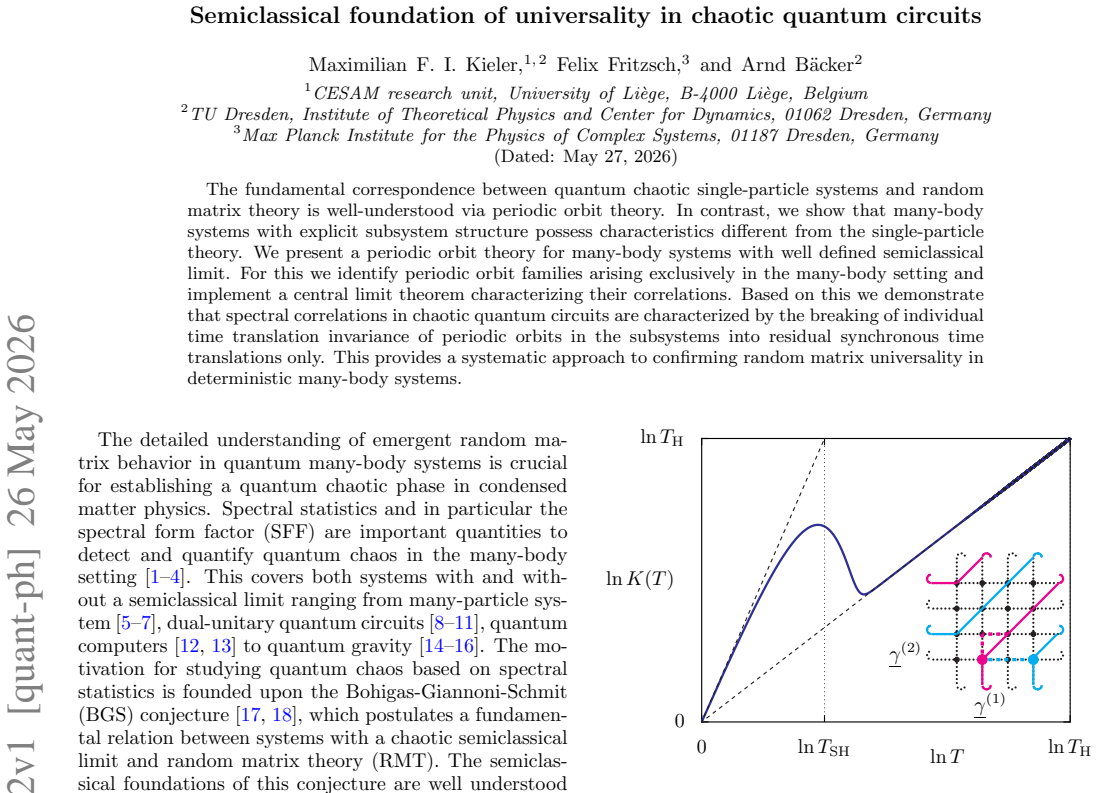
The fundamental correspondence between quantum chaotic single-particle systems and random matrix theory is well-understood via periodic orbit theory. In contrast, we show that many-body systems with explicit subsystem structure possess characteristics different from the single-particle theory. We present a periodic orbit theory for many-body systems with well defined semiclassical limit. For this we identify periodic orbit families arising exclusively in the many-body setting and implement a central limit theorem characterizing their correlations. Based on this we demonstrate that spectral correlations in chaotic quantum circuits are characterized by the breaking of individual time translation invariance of periodic orbits in the subsystems into residual synchronous time translations only. This provides a systematic approach to confirming random matrix universality in deterministic many-body systems.
Editorial analysis
A structured set of objections, weighed in public.
Referee Report
Summary. The paper develops a periodic orbit theory for many-body chaotic quantum circuits with explicit subsystem structure. It identifies families of periodic orbits that arise exclusively in the many-body setting, applies a central limit theorem to their correlations, and concludes that spectral correlations are characterized by the breaking of individual subsystem time-translation invariance down to residual synchronous translations only, thereby furnishing a semiclassical foundation for random-matrix universality in deterministic many-body systems.
Significance. If the derivation is sound, the result would supply a concrete periodic-orbit mechanism that distinguishes many-body spectral statistics from the single-particle case and directly links subsystem structure to the observed universality class. This would constitute a systematic extension of Gutzwiller-type theory into the many-body regime.
major comments (1)
- [Abstract] The load-bearing step is the assertion of a well-defined semiclassical limit in which many-body-exclusive periodic orbit families can be unambiguously identified. The abstract states that such families exist and that a CLT is then applied to their correlations, but provides no construction of the orbits, no demonstration that the semiclassical limit commutes with the subsystem decomposition, and no verification that the resulting families have no single-particle counterpart. Without these objects the subsequent CLT step has no concrete input.
Simulated Author's Rebuttal
We thank the referee for their report and the opportunity to clarify the manuscript. We address the single major comment below, pointing to the explicit constructions already present in the full text.
read point-by-point responses
-
Referee: [Abstract] The load-bearing step is the assertion of a well-defined semiclassical limit in which many-body-exclusive periodic orbit families can be unambiguously identified. The abstract states that such families exist and that a CLT is then applied to their correlations, but provides no construction of the orbits, no demonstration that the semiclassical limit commutes with the subsystem decomposition, and no verification that the resulting families have no single-particle counterpart. Without these objects the subsequent CLT step has no concrete input.
Authors: The abstract is a concise summary; the required constructions appear in the body of the manuscript. Section II defines the semiclassical limit for quantum circuits with explicit subsystem structure and shows that this limit is compatible with the subsystem decomposition (the total action and stability matrix factorize into subsystem contributions while preserving the synchronous time-translation symmetry). Section III constructs the many-body-exclusive periodic-orbit families explicitly, demonstrates that they have no single-particle counterpart by direct comparison with the standard Gutzwiller sum, and verifies that the families arise only when the subsystem time-translation invariances are broken down to the residual synchronous translations. Section IV then applies the central-limit theorem to the correlations of these families, supplying the concrete input for the spectral statistics. We can add a short clarifying sentence to the abstract if the referee prefers. revision: partial
Circularity Check
No circularity: derivation builds independent semiclassical framework
full rationale
The abstract and description outline a construction of periodic orbit families exclusive to the many-body semiclassical limit, followed by a central limit theorem on their correlations to derive the breaking of time-translation invariance. No equations, self-citations, fitted parameters, or ansatzes are quoted that reduce the target result to its own inputs by definition. The steps are presented as a systematic approach rather than a renaming or self-referential fit, making the derivation self-contained against the stated assumptions.
Axiom & Free-Parameter Ledger
axioms (2)
- domain assumption Existence of a well-defined semiclassical limit in many-body systems with subsystem structure
- standard math Central limit theorem characterizes correlations of many-body periodic orbits
Reference graph
Works this paper leans on
-
[1]
Therefore, by the same arguments of [70, 72], we havef([ ⃗0])≥0, with equality if and only ifwis cohomologous to a con- stant. We show thatf([ ⃗0])>0 follows directly from the more general assumption thatv ⃗ s=w−w◦ϕ ⃗ s 0 is coho- mologous to a constant if and only if⃗ s∝ ⃗1: For the sake of contradiction, we assumewis cohomologous to a con- stantd, i.e.,...
-
[2]
P. Kos, M. Ljubotina, and T. Prosen,Many-body quan- tum chaos: Analytic connection to random matrix theory, Phys. Rev. X8, 021062 (2018)
2018
-
[3]
ˇSuntajs, J
J. ˇSuntajs, J. Bonˇ ca, T. Prosen, and L. Vid- mar,Quantum chaos challenges many-body localization, Phys. Rev. E102, 062144 (2020)
2020
-
[4]
A. Chan, A. De Luca, and J. T. Chalker,Spectral Lyapunov exponents in chaotic and localized many-body quantum systems, Phys. Rev. Res.3, 023118 (2021)
2021
-
[5]
Bertini, P
B. Bertini, P. Kos, and T. Prosen,Exact spectral statistics in strongly localized circuits, Phys. Rev. B105, 165142 (2022)
2022
-
[6]
Roy and T
D. Roy and T. Prosen,Random matrix spectral form fac- tor in kicked interacting fermionic chains, Phys. Rev. E 102, 060202 (2020)
2020
-
[7]
D. Roy, D. Mishra, and T. Prosen,Spectral form factor in a minimal bosonic model of many-body quantum chaos, Phys. Rev. E106, 024208 (2022)
2022
-
[8]
T. N. Ikeda, L. Vidmar, and M. O. Flynn,Exact spec- tral form factors of noninteracting fermions with Dyson statistics, Phys. Rev. B111, 144312 (2025)
2025
-
[9]
Akila, D
M. Akila, D. Waltner, B. Gutkin, and T. Guhr,Particle- time duality in the kicked Ising spin chain, J. Phys. A 49, 375101 (2016)
2016
-
[10]
Bertini, P
B. Bertini, P. Kos, and T. Prosen,Exact spectral form factor in a minimal model of many-body quantum chaos, Phys. Rev. Lett.121, 264101 (2018)
2018
-
[11]
Flack, B
A. Flack, B. Bertini, and T. Prosen,Statistics of the spectral form factor in the self-dual kicked Ising model, Phys. Rev. Res.2, 043403 (2020)
2020
-
[12]
Bertini, P
B. Bertini, P. Kos, and T. Prosen,Random matrix spec- tral form factor of dual-unitary quantum circuits, Com- mun. Math. Phys.387, 597 (2021)
2021
-
[13]
Dong et al.,Measuring the spectral form factor in many-body chaotic and localized phases of quantum pro- cessors, Phys
H. Dong et al.,Measuring the spectral form factor in many-body chaotic and localized phases of quantum pro- cessors, Phys. Rev. Lett.134, 010402 (2025)
2025
-
[14]
D. V. Vasilyev, A. Grankin, M. A. Baranov, L. M. Sieberer, and P. Zoller,Monitoring quantum simulators via quantum nondemolition couplings to atomic clock qubits, PRX Quantum1, 020302 (2020)
2020
-
[15]
P. Saad, S. H. Shenker, and D. Stanford,A semiclassical ramp in SYK and in gravity, (2019)
2019
-
[16]
P. Saad, D. Stanford, Z. Yang, and S. Yao,A convergent genus expansion for the plateau, J. High Energy Phys. 2024, 33 (2024)
2024
-
[17]
Haneder, J
F. Haneder, J. D. Urbina, C. Moreno, T. Weber, and K. Richter,Beyond the ensemble paradigm in low- dimensional quantum gravity: Schwarzian density, quan- tum chaos, and wormhole contributions, Phys. Rev. D 111, 126015 (2025)
2025
-
[18]
Bohigas, M
O. Bohigas, M. J. Giannoni, and C. Schmit,Character- ization of chaotic quantum spectra and universality of level fluctuation laws, Phys. Rev. Lett.52, 1 (1984)
1984
-
[19]
Bohigas, M.-J
O. Bohigas, M.-J. Giannoni, and C. Schmit,Spectral properties of the Laplacian and random matrix theories, J. Physique Lett.45, L1015 (1984)
1984
-
[20]
Haake, S
F. Haake, S. Gnutzmann, and M. Ku´ s,Quantum Signa- tures of Chaos, Springer Series in Synergetics, Springer International Publishing, Cham (2018)
2018
-
[21]
M. C. Gutzwiller,Periodic orbits and classical quantiza- tion conditions, J. Math. Phys.12, 343 (1971)
1971
-
[22]
Tabor,A semiclassical quantization of area-preserving maps, Physica D6, 195 (1983)
M. Tabor,A semiclassical quantization of area-preserving maps, Physica D6, 195 (1983)
1983
-
[23]
J. H. Hannay and A. M. Ozorio De Almeida,Periodic or- bits and a correlation function for the semiclassical den- sity of states, J. Phys. A17, 3429 (1984)
1984
-
[24]
M. V. Berry,Semiclassical theory of spectral rigidity, Proc. R. Soc. Lon. A400, 229 (1985)
1985
-
[25]
Sieber and K
M. Sieber and K. Richter,Correlations between periodic orbits and their rˆ ole in spectral statistics, Phys. Scripta 2001, 128 (2001)
2001
-
[26]
M¨ uller, S
S. M¨ uller, S. Heusler, P. Braun, F. Haake, and A. Alt- land,Semiclassical foundation of universality in quantum chaos, Phys. Rev. Lett.93, 014103 (2004)
2004
-
[27]
M¨ uller, S
S. M¨ uller, S. Heusler, P. Braun, F. Haake, and A. Al- tland,Periodic-orbit theory of universality in quantum chaos, Phys. Rev. E72, 046207 (2005)
2005
-
[28]
M¨ uller, S
S. M¨ uller, S. Heusler, A. Altland, P. Braun, and 10 F. Haake,Periodic-orbit theory of universal level correla- tions in quantum chaos, New J. Phys.11, 103025 (2009)
2009
-
[29]
T. Engl, J. D. Urbina, and K. Richter,Periodic mean- field solutions and the spectra of discrete bosonic fields: Trace formula for Bose-Hubbard models, Phys. Rev. E 92, 062907 (2015)
2015
-
[30]
Dubertrand and S
R. Dubertrand and S. M¨ uller,Spectral statistics of chaotic many-body systems, New J. Phys.18, 033009 (2016)
2016
-
[31]
Richter, J
K. Richter, J. D. Urbina, and S. Tomsovic,Semiclas- sical roots of universality in many-body quantum chaos, J. Phys. A55, 453001 (2022)
2022
-
[32]
Liao and V
Y. Liao and V. Galitski,Universal dephasing mechanism of many-body quantum chaos, Phys. Rev. Res.4, L012037 (2022)
2022
-
[33]
Altland, J
A. Altland, J. Telles de Miranda, and T. Micklitz,Ten- sor product random matrix theory, Phys. Rev. Res.6, L042029 (2024)
2024
-
[34]
Path integral approach to quantum thermalization,
A. Altland, K. W. Kim, and T. Micklitz,Path integral approach to quantum thermalization, arXiv:2509.06028 [cond-mat.mes-hall] (2025)
-
[35]
A. Chan, A. De Luca, and J. T. Chalker,Spectral statis- tics in spatially extended chaotic quantum many-body sys- tems, Phys. Rev. Lett.121, 060601 (2018)
2018
-
[36]
A. Chan, A. De Luca, and J. T. Chalker,Solution of a minimal model for many-body quantum chaos, Phys. Rev. X8, 041019 (2018)
2018
-
[37]
A. J. Friedman, A. Chan, A. De Luca, and J. T. Chalker, Spectral statistics and many-body quantum chaos with conserved charge, Phys. Rev. Lett.123, 210603 (2019)
2019
-
[38]
S. J. Garratt and J. T. Chalker,Local pairing of Feynman histories in many-body Floquet models, Phys. Rev. X11, 021051 (2021)
2021
-
[39]
A. Chan, S. Shivam, D. A. Huse, and A. De Luca,Many- body quantum chaos and space-time translational invari- ance, Nat. Commun.13, 7484 (2022)
2022
- [40]
-
[41]
Yoshimura, S
T. Yoshimura, S. J. Garratt, and J. T. Chalker,Operator dynamics in Floquet many-body systems, Phys. Rev. B 111, 094316 (2025)
2025
-
[42]
Fritzsch and M
F. Fritzsch and M. F. I. Kieler,Universal spectral corre- lations in interacting chaotic few-body quantum systems, Phys. Rev. E109, 014202 (2024)
2024
-
[43]
Winer and B
M. Winer and B. Swingle,Hydrodynamic theory of the connected spectral form factor, Phys. Rev. X12, 021009 (2022)
2022
-
[44]
M. V. Berry, N. L. Balazs, M. Tabor, and A. Voros, Quantum maps, Ann. Phys. (N.Y.)122, 26 (1979)
1979
-
[45]
A. J. Lichtenberg and M. A. Lieberman,Regular and Chaotic Dynamics, Springer–Verlag, New York, second edition (1992)
1992
-
[46]
R. E. Prange,The spectral form factor is not self- averaging, Phys. Rev. Lett.78, 2280 (1997)
1997
-
[47]
Bowen,Periodic orbits for hyperbolic flows, Amer
R. Bowen,Periodic orbits for hyperbolic flows, Amer. J. Math.94, 1 (1972)
1972
-
[48]
Parry and M
W. Parry and M. Pollicott,An analogue of the prime number theorem for closed orbits of axiom a flows, Ann. Math.118, 573 (1983)
1983
-
[49]
Parry,Synchronisation of canonical measures for hyperbolic attractors, Commun
W. Parry,Synchronisation of canonical measures for hyperbolic attractors, Commun. Math. Phys.106, 267 (1986)
1986
-
[50]
Dynamical Systems
W. Parry,Equilibrium states and weighted uniform dis- tribution of closed orbits, in J. C. Alexander (editor) “Dynamical Systems”, 617, Springer, Berlin, Heidelberg (1988)
1988
-
[51]
Dynamics, Games and Science II
M. Pollicott and R. Sharp,On the hannay – ozorio de almeida sum formula, in M. M. Peixoto, A. A. Pinto, and D. A. Rand (editors) “Dynamics, Games and Science II”, volume 2, 575, Springer, Berlin, Heidelberg (2011)
2011
-
[52]
Tkocz, M
T. Tkocz, M. Smaczy´ nski, M. Ku´ s, O. Zeitouni, and K. ˙Zyczkowski,Tensor products of random unitary matri- ces, Random Matrices: Theory Appl.1, 1250009 (2012)
2012
-
[53]
S. C. L. Srivastava, S. Tomsovic, A. Lakshminarayan, R. Ketzmerick, and A. B¨ acker,Universal scaling of spec- tral fluctuation transitions for interacting chaotic sys- tems, Phys. Rev. Lett.116, 054101 (2016)
2016
-
[54]
Lakshminarayan, S
A. Lakshminarayan, S. C. L. Srivastava, R. Ketzmerick, A. B¨ acker, and S. Tomsovic,Entanglement and localiza- tion transitions in eigenstates of interacting chaotic sys- tems, Phys. Rev. E94, 010205(R) (2016)
2016
-
[55]
Tomsovic, A
S. Tomsovic, A. Lakshminarayan, S. C. L. Srivastava, and A. B¨ acker,Eigenstate entanglement between quan- tum chaotic subsystems: Universal transitions and power laws in the entanglement spectrum, Phys. Rev. E98, 032209 (2018)
2018
-
[56]
J. J. Pulikkottil, A. Lakshminarayan, S. C. L. Srivastava, A. B¨ acker, and S. Tomsovic,Entanglement production by interaction quenches of quantum chaotic subsystems, Phys. Rev. E101, 032212 (2020)
2020
-
[57]
Herrmann, M
T. Herrmann, M. F. I. Kieler, F. Fritzsch, and A. B¨ acker, Entanglement in coupled kicked tops with chaotic dynam- ics, Phys. Rev. E101, 022221 (2020)
2020
-
[58]
J. J. Pulikkottil, A. Lakshminarayan, S. C. L. Srivastava, M. F. I. Kieler, A. B¨ acker, and S. Tomsovic,Quantum co- herence controls the nature of equilibration and thermal- ization in coupled chaotic systems, Phys. Rev. E107, 024124 (2023)
2023
-
[59]
Meyer, G
K. Meyer, G. Hall, and D. Offin,Introduction to Hamil- tonian Dynamical Systems and the N-Body Problem, Springer-Verlag, New York (2009)
2009
-
[60]
Cantrell and R
S. Cantrell and R. Sharp,A central limit theorem for periodic orbits of hyperbolic flows, Dynamical Systems 36, 142 (2021)
2021
-
[61]
Ya. G. Sinai,Gibbs measures in ergodic theory, Russ. Math. Surv.27, 21 (1972)
1972
-
[62]
Bowen,Equilibrium States and the Ergodic Theory of Anosov Diffeomorphisms, volume 470 ofLect
R. Bowen,Equilibrium States and the Ergodic Theory of Anosov Diffeomorphisms, volume 470 ofLect. Notes Math., Springer Berlin Heidelberg (1975)
1975
-
[63]
Ruelle,Thermodynamic Formalism, Addison-Wesley, Reading (1978)
D. Ruelle,Thermodynamic Formalism, Addison-Wesley, Reading (1978)
1978
-
[64]
F. Y. Wu,The Potts model, Rev. Mod. Phys.54, 235 (1982)
1982
-
[65]
Waltner, S
D. Waltner, S. Heusler, J. D. Urbina, and K. Richter, The semiclassical origin of curvature effects in universal spectral statistics, J. Phys. A42, 292001 (2009)
2009
-
[66]
Braun and F
P. Braun and F. Haake,Chaotic maps and flows: Ex- act Riemann–Siegel lookalike for spectral fluctuations, J. Phys. A45, 425101 (2012)
2012
-
[67]
M¨ uller and M
S. M¨ uller and M. Novaes,Semiclassical calculation of spectral correlation functions of chaotic systems, Phys. Rev. E98, 052207 (2018)
2018
-
[68]
M¨ uller and M
S. M¨ uller and M. Novaes,Full perturbative calculation of spectral correlation functions for chaotic systems in the unitary symmetry class, Phys. Rev. E98, 052208 (2018)
2018
-
[69]
Waltner and K
D. Waltner and K. Richter,Towards a semiclassical un- 11 derstanding of chaotic single- and many-particle quantum dynamics at post-Heisenberg time scales, Phys. Rev. E 100, 042212 (2019)
2019
-
[70]
E. A. Robinson,Sums of stationary random variables, Proc. Amer. Math. Soc.11, 77 (1960)
1960
-
[71]
Ratner,The central limit theorem for geodesic flows onn-dimensional manifolds of negative curvature, Israel Journal of Mathematics16, 181 (1973)
M. Ratner,The central limit theorem for geodesic flows onn-dimensional manifolds of negative curvature, Israel Journal of Mathematics16, 181 (1973)
1973
-
[72]
Parry and M
W. Parry and M. Pollicott,Zeta functions and the peri- odic orbit structure of hyperbolic dynamics, Ast´ erisque, Soci´ et´ e math´ ematique de France (1990)
1990
-
[73]
V. P. Leonov,On the dispersion of time-dependent means of a stationary stochastic process, Theory Probab. Appl. 6, 87 (1961)
1961
discussion (0)
Sign in with ORCID, Apple, or X to comment. Anyone can read and Pith papers without signing in.