Quantum Geometric Origin of Hall Viscosity and Nonlocal Hall Conductivity in Lattice Bands
Pith reviewed 2026-06-29 15:58 UTC · model grok-4.3
The pith
Hall viscosity in lattice bands is governed by a band-projected electric quadrupole encoded in quantum geometry.
A machine-rendered reading of the paper's core claim, the machinery that carries it, and where it could break.
Core claim
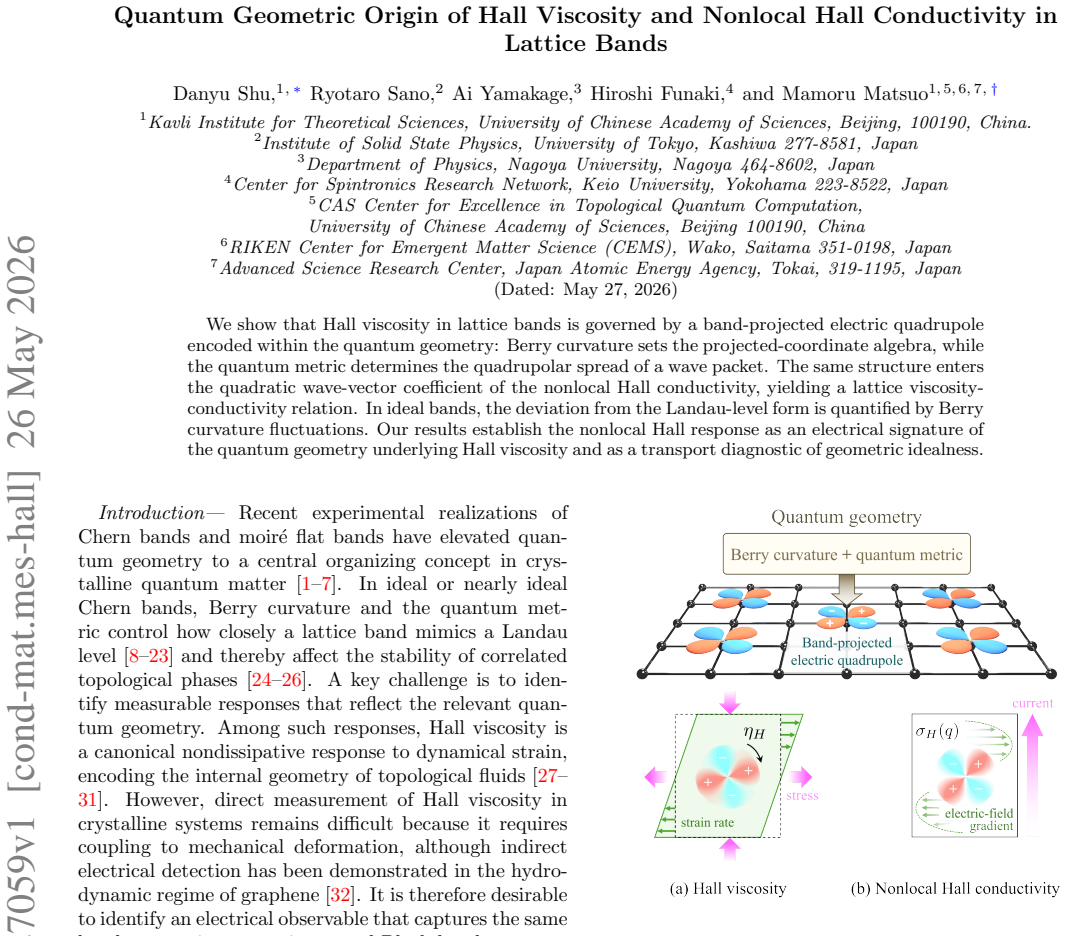
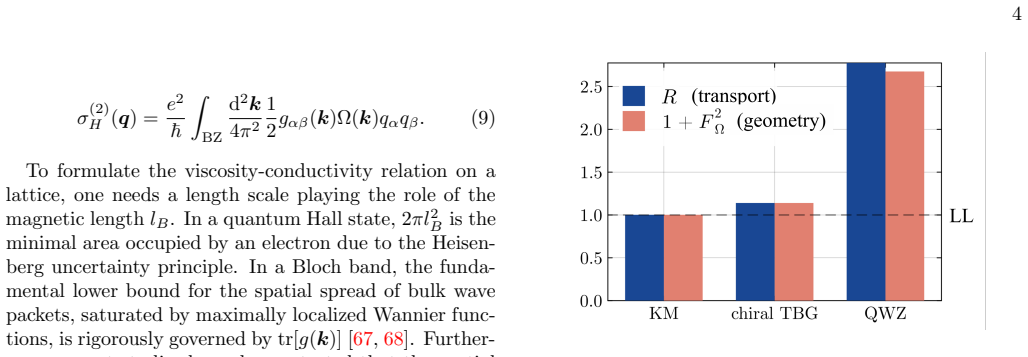
We show that Hall viscosity in lattice bands is governed by a band-projected electric quadrupole encoded within the quantum geometry: Berry curvature sets the projected-coordinate algebra, while the quantum metric determines the quadrupolar spread of a wave packet. The same structure enters the quadratic wave-vector coefficient of the nonlocal Hall conductivity, yielding a lattice viscosity-conductivity relation. In ideal bands, the deviation from the Landau-level form is quantified by Berry curvature fluctuations. Our results establish the nonlocal Hall response as an electrical signature of the quantum geometry underlying Hall viscosity and as a transport diagnostic of geometric idealness.
What carries the argument
band-projected electric quadrupole encoded within the quantum geometry
If this is right
- The quadratic wave-vector coefficient of nonlocal Hall conductivity is directly proportional to Hall viscosity.
- Deviations of lattice Hall viscosity from the Landau-level value are fixed by Berry curvature fluctuations.
- Nonlocal Hall conductivity acts as an electrical signature of the quantum geometry that produces Hall viscosity.
- Nonlocal Hall response serves as a transport diagnostic of geometric idealness in lattice bands.
Where Pith is reading between the lines
- The viscosity-conductivity relation supplies a route to extract Hall viscosity from electrical transport data alone.
- The same geometric object may connect Hall viscosity to other quadratic-response coefficients in lattice systems.
- Testing the relation in moiré superlattices would directly probe how close real bands come to geometric idealness.
Load-bearing premise
The band-projected electric quadrupole fully accounts for Hall viscosity and the quadratic coefficient of nonlocal Hall conductivity with no additional lattice or interaction terms that would break the viscosity-conductivity relation.
What would settle it
A calculation or measurement in a specific lattice band that finds a mismatch between the Hall viscosity and the value inferred from the quadratic term of the nonlocal Hall conductivity.
Figures
read the original abstract
We show that Hall viscosity in lattice bands is governed by a band-projected electric quadrupole encoded within the quantum geometry: Berry curvature sets the projected-coordinate algebra, while the quantum metric determines the quadrupolar spread of a wave packet. The same structure enters the quadratic wave-vector coefficient of the nonlocal Hall conductivity, yielding a lattice viscosity-conductivity relation. In ideal bands, the deviation from the Landau-level form is quantified by Berry curvature fluctuations. Our results establish the nonlocal Hall response as an electrical signature of the quantum geometry underlying Hall viscosity and as a transport diagnostic of geometric idealness.
Editorial analysis
A structured set of objections, weighed in public.
Referee Report
Summary. The manuscript claims that Hall viscosity in lattice bands is governed by a band-projected electric quadrupole encoded in quantum geometry, with Berry curvature setting the projected-coordinate algebra and the quantum metric fixing the quadrupolar spread of a wave packet. The same geometric structure determines the quadratic wave-vector coefficient of the nonlocal Hall conductivity, yielding a viscosity-conductivity relation. In ideal bands, deviations from the Landau-level form are quantified by Berry curvature fluctuations, positioning the nonlocal Hall response as an electrical signature of the underlying quantum geometry and a diagnostic of geometric idealness.
Significance. If the central identification holds, the work supplies a quantum-geometric unification of Hall viscosity and nonlocal conductivity that extends continuum results to lattice bands and supplies a concrete transport probe of ideal-band geometry. The absence of free parameters in the geometric definitions and the explicit link to measurable nonlocal conductivity are strengths.
major comments (2)
- [Main derivation (around the quadrupole identification)] The central claim equates Hall viscosity to the band-projected electric quadrupole whose algebra is fixed by Berry curvature and spread by the quantum metric. However, single-band projection does not automatically eliminate interband virtual processes or umklapp scattering that survive at finite lattice spacing; these could supply additive corrections to both viscosity and the quadratic-k coefficient, breaking the reported relation. This assumption is load-bearing for the viscosity-conductivity relation and requires explicit bounds or cancellation arguments.
- [Ideal-band section] The statement that 'in ideal bands the deviation from the Landau-level form is quantified by Berry curvature fluctuations' is used to characterize geometric idealness. The manuscript must show that these fluctuations enter the viscosity and conductivity coefficients in a manner that preserves the relation without additional lattice-dependent terms; otherwise the diagnostic value of the nonlocal Hall response is compromised.
minor comments (2)
- Notation for the band-projected quadrupole and the nonlocal conductivity tensor should be introduced with explicit definitions and indices to avoid ambiguity when comparing to continuum limits.
- The abstract states the results for lattice bands but the introduction would benefit from a short paragraph contrasting the lattice case with the continuum Landau-level limit to clarify the scope of the new relation.
Simulated Author's Rebuttal
We thank the referee for the careful reading and constructive comments on our manuscript. We address the two major comments point by point below, indicating planned revisions where appropriate.
read point-by-point responses
-
Referee: [Main derivation (around the quadrupole identification)] The central claim equates Hall viscosity to the band-projected electric quadrupole whose algebra is fixed by Berry curvature and spread by the quantum metric. However, single-band projection does not automatically eliminate interband virtual processes or umklapp scattering that survive at finite lattice spacing; these could supply additive corrections to both viscosity and the quadratic-k coefficient, breaking the reported relation. This assumption is load-bearing for the viscosity-conductivity relation and requires explicit bounds or cancellation arguments.
Authors: Our derivation is performed strictly within the single-band projector, with all operators (including the electric quadrupole) defined using the band Bloch states and their quantum geometry. Interband virtual processes are suppressed by the assumed band gap, consistent with the standard treatment of geometric responses in gapped bands. Umklapp processes involve large reciprocal-lattice momentum transfers and lie outside the long-wavelength (small-q) expansion used for both the viscosity and the quadratic coefficient of the nonlocal conductivity. We agree that an explicit discussion of the validity regime strengthens the result and will add a dedicated paragraph (or short subsection) providing order-of-magnitude bounds on corrections in terms of the gap and lattice constant, confirming they remain sub-leading and do not violate the reported relation at the order considered. revision: yes
-
Referee: [Ideal-band section] The statement that 'in ideal bands the deviation from the Landau-level form is quantified by Berry curvature fluctuations' is used to characterize geometric idealness. The manuscript must show that these fluctuations enter the viscosity and conductivity coefficients in a manner that preserves the relation without additional lattice-dependent terms; otherwise the diagnostic value of the nonlocal Hall response is compromised.
Authors: In the ideal-band limit the quantum metric is completely determined by the Berry curvature, so both the Hall viscosity and the quadratic-k coefficient of the nonlocal Hall conductivity are expressed solely in terms of the Berry curvature and its spatial fluctuations. These fluctuations therefore enter the two quantities proportionally, preserving the viscosity-conductivity relation without extra lattice-dependent contributions. We will revise the ideal-band section to insert the explicit substitution of the ideal-band metric into the derived expressions, thereby demonstrating the cancellation of any residual lattice terms and reinforcing the diagnostic utility of the nonlocal response. revision: yes
Circularity Check
No significant circularity; derivation self-contained from quantum geometry
full rationale
The paper derives Hall viscosity from the band-projected electric quadrupole whose algebra follows from Berry curvature and spread from the quantum metric, then shows the same structure determines the quadratic-k term in nonlocal Hall conductivity to obtain the viscosity-conductivity relation. This is presented as an emergent consequence of the shared geometric encoding rather than a definitional identity or fitted input renamed as prediction. No self-citation chains, ansatzes smuggled via prior work, or uniqueness theorems imported from the authors appear as load-bearing steps. The central result is externally falsifiable via transport measurements and independent of any tautological redefinition of the inputs.
Axiom & Free-Parameter Ledger
Reference graph
Works this paper leans on
-
[1]
Signatures of fractional quantum anomalous Hall states in twisted MoTe2,
Jiaqi Cai, Eric Anderson, Chong Wang, Xiaowei Zhang, Xiaoyu Liu, William Holtzmann, Yinong Zhang, Fen- gren Fan, Takashi Taniguchi, Kenji Watanabe, Ying Ran, Ting Cao, Liang Fu, Di Xiao, Wang Yao, and Xiaodong Xu, “Signatures of fractional quantum anomalous Hall states in twisted MoTe2,” Nature622, 63–68 (2023)
2023
-
[2]
Observation of fractionally quantized anomalous Hall effect,
Heonjoon Park, Jiaqi Cai, Eric Anderson, Yinong Zhang, Jiayi Zhu, Xiaoyu Liu, Chong Wang, William Holtz- mann, Chaowei Hu, Zhaoyu Liu, Takashi Taniguchi, Kenji Watanabe, Jiun-Haw Chu, Ting Cao, Liang Fu, Wang Yao, Cui-Zu Chang, David Cobden, Di Xiao, and Xiaodong Xu, “Observation of fractionally quantized anomalous Hall effect,” Nature622, 74–79 (2023)
2023
-
[3]
Observa- tion of Integer and Fractional Quantum Anomalous Hall Effects in Twisted Bilayer MoTe 2,
Fan Xu, Zheng Sun, Tongtong Jia, Chang Liu, Cheng Xu, Chushan Li, Yu Gu, Kenji Watanabe, Takashi Taniguchi, Bingbing Tong, Jinfeng Jia, Zhiwen Shi, Shengwei Jiang, Yang Zhang, Xiaoxue Liu, and Tingxin Li, “Observa- tion of Integer and Fractional Quantum Anomalous Hall Effects in Twisted Bilayer MoTe 2,” Physical Review X 13, 031037 (2023)
2023
-
[4]
Fractional quantum anomalous Hall effect in multilayer graphene,
Zhengguang Lu, Tonghang Han, Yuxuan Yao, Aidan P. Reddy, Jixiang Yang, Junseok Seo, Kenji Watanabe, Takashi Taniguchi, Liang Fu, and Long Ju, “Fractional quantum anomalous Hall effect in multilayer graphene,” Nature626, 759–764 (2024)
2024
-
[5]
Local probe of bulk and edge states in a fractional Chern insulator,
Zhurun Ji, Heonjoon Park, Mark E. Barber, Chaowei Hu, Kenji Watanabe, Takashi Taniguchi, Jiun-Haw Chu, Xiaodong Xu, and Zhi-Xun Shen, “Local probe of bulk and edge states in a fractional Chern insulator,” Nature 635, 578–583 (2024)
2024
-
[6]
Direct magnetic imaging of fractional Chern insulators in twisted MoTe2,
Evgeny Redekop, Canxun Zhang, Heonjoon Park, Jiaqi Cai, Eric Anderson, Owen Sheekey, Trevor Arp, Grig- ory Babikyan, Samuel Salters, Kenji Watanabe, Takashi Taniguchi, Martin E. Huber, Xiaodong Xu, and An- drea F. Young, “Direct magnetic imaging of fractional Chern insulators in twisted MoTe2,” Nature635, 584– 589 (2024)
2024
-
[7]
Trion sensing of a zero-field composite Fermi liq- uid,
Eric Anderson, Jiaqi Cai, Aidan P. Reddy, Heonjoon Park, William Holtzmann, Kai Davis, Takashi Taniguchi, Kenji Watanabe, Tomasz Smolenski, Ata¸ c Imamo˘ glu, Ting Cao, Di Xiao, Liang Fu, Wang Yao, and Xiaodong Xu, “Trion sensing of a zero-field composite Fermi liq- uid,” Nature635, 590–595 (2024)
2024
-
[8]
High- Temperature Fractional Quantum Hall States,
Evelyn Tang, Jia-Wei Mei, and Xiao-Gang Wen, “High- Temperature Fractional Quantum Hall States,” Physical Review Letters106, 236802 (2011)
2011
-
[9]
Nearly Flatbands with Nontrivial Topology,
Kai Sun, Zhengcheng Gu, Hosho Katsura, and S. Das Sarma, “Nearly Flatbands with Nontrivial Topology,” Physical Review Letters106, 236803 (2011)
2011
-
[10]
Fractional Chern Insulator,
N. Regnault and B. Andrei Bernevig, “Fractional Chern Insulator,” Physical Review X1, 021014 (2011)
2011
-
[11]
Fractional Quantum Hall States at Zero Magnetic Field,
Titus Neupert, Luiz Santos, Claudio Chamon, and Christopher Mudry, “Fractional Quantum Hall States at Zero Magnetic Field,” Physical Review Letters106, 236804 (2011)
2011
-
[12]
Exact Parent Hamilto- nian for the Quantum Hall States in a Lattice,
Eliot Kapit and Erich Mueller, “Exact Parent Hamilto- nian for the Quantum Hall States in a Lattice,” Physical Review Letters105, 215303 (2010)
2010
-
[13]
Band geometry of fractional topological in- sulators,
Rahul Roy, “Band geometry of fractional topological in- sulators,” Physical Review B90, 165139 (2014)
2014
-
[14]
Position- Momentum Duality and Fractional Quantum Hall Ef- fect in Chern Insulators,
Martin Claassen, Ching Hua Lee, Ronny Thomale, Xiao-Liang Qi, and Thomas P. Devereaux, “Position- Momentum Duality and Fractional Quantum Hall Ef- fect in Chern Insulators,” Physical Review Letters114, 236802 (2015)
2015
-
[15]
Origin of Magic Angles in Twisted Bilayer Graphene,
Grigory Tarnopolsky, Alex Jura Kruchkov, and Ashvin Vishwanath, “Origin of Magic Angles in Twisted Bilayer Graphene,” Physical Review Letters122, 106405 (2019)
2019
-
[16]
Fractional Chern insu- lator states in twisted bilayer graphene: An analytical approach,
Patrick J. Ledwith, Grigory Tarnopolsky, Eslam Kha- laf, and Ashvin Vishwanath, “Fractional Chern insu- lator states in twisted bilayer graphene: An analytical approach,” Physical Review Research2, 023237 (2020)
2020
-
[17]
Engineering geometri- cally flat Chern bands with Fubini-Study K¨ ahler struc- ture,
Bruno Mera and Tomoki Ozawa, “Engineering geometri- cally flat Chern bands with Fubini-Study K¨ ahler struc- ture,” Physical Review B104, 115160 (2021)
2021
-
[18]
Exact Landau Level Description of Ge- ometry and Interaction in a Flatband,
Jie Wang, Jennifer Cano, Andrew J. Millis, Zhao Liu, and Bo Yang, “Exact Landau Level Description of Ge- ometry and Interaction in a Flatband,” Physical Review Letters127, 246403 (2021)
2021
-
[19]
K¨ ahler geometry and Chern insulators: Relations between topology and the quantum metric,
Bruno Mera and Tomoki Ozawa, “K¨ ahler geometry and Chern insulators: Relations between topology and the quantum metric,” Physical Review B104, 045104 (2021)
2021
-
[20]
Patrick J. Ledwith, Ashvin Vishwanath, and Eslam Khalaf, “Family of ideal Chern flat bands with arbi- trary Chern number in chiral twisted graphene multi- layers,” Physical Review Letters128, 176404 (2022), 6 arXiv:2109.11514 [cond-mat]
-
[21]
Vortexability: A unifying criterion for ideal frac- tional Chern insulators,
Patrick J. Ledwith, Ashvin Vishwanath, and Daniel E. Parker, “Vortexability: A unifying criterion for ideal frac- tional Chern insulators,” Physical Review B108, 205144 (2023)
2023
-
[22]
Higher Vortexability: Zero-Field Realization of Higher Landau Levels,
Manato Fujimoto, Daniel E. Parker, Junkai Dong, Es- lam Khalaf, Ashvin Vishwanath, and Patrick Ledwith, “Higher Vortexability: Zero-Field Realization of Higher Landau Levels,” Physical Review Letters134, 106502 (2025)
2025
-
[23]
Theory of Generalized Landau Levels and Implication for non-Abelian States,
Zhao Liu, Bruno Mera, Manato Fujimoto, Tomoki Ozawa, and Jie Wang, “Theory of Generalized Landau Levels and Implication for non-Abelian States,” Physi- cal Review X15, 031019 (2025), arXiv:2405.14479 [cond- mat]
-
[24]
Fractional quantum Hall physics in topolog- ical flat bands,
Siddharth A. Parameswaran, Rahul Roy, and Shivaji L. Sondhi, “Fractional quantum Hall physics in topolog- ical flat bands,” Comptes Rendus. Physique14, 816–839 (2013)
2013
-
[25]
Ge- ometric stability of topological lattice phases,
T. S. Jackson, Gunnar M¨ oller, and Rahul Roy, “Ge- ometric stability of topological lattice phases,” Nature Communications6, 8629 (2015)
2015
-
[26]
Stable Topology in Exactly Flat Bands,
Yan-Qi Li, Yi-Jie Wang, Pei-Han Lin, Bin Wang, and Zhi-Da Song, “Stable Topology in Exactly Flat Bands,” (2026), arXiv:2603.12258 [cond-mat]
-
[27]
Viscosity of Quantum Hall Fluids,
J. E. Avron, R. Seiler, and P. G.Zograf, “Viscosity of Quantum Hall Fluids,” Physical Review Letters75, 697– 700 (1995)
1995
-
[28]
J. E. Avron, “Odd Viscosity,” J. Stat. Phys.92, 543 (1998), arXiv:physics/9712050
work page internal anchor Pith review Pith/arXiv arXiv 1998
-
[29]
Non-Abelian adiabatic statistics and Hall vis- cosity in quantum Hall states and p x + i p y paired superfluids,
N. Read, “Non-Abelian adiabatic statistics and Hall vis- cosity in quantum Hall states and p x + i p y paired superfluids,” Physical Review B79, 045308 (2009)
2009
-
[30]
Hall viscosity, orbital spin, and geometry: Paired superfluids and quantum Hall sys- tems,
N. Read and E. H. Rezayi, “Hall viscosity, orbital spin, and geometry: Paired superfluids and quantum Hall sys- tems,” Physical Review B84, 085316 (2011)
2011
-
[31]
Carolina Paiva, Jie Wang, Tomoki Ozawa, and Bruno Mera, “Geometrical Responses of Generalized Landau Levels: Structure Factor and the Quantized Hall Viscos- ity,” (2025), arXiv:2501.11519 [cond-mat]
-
[32]
Measuring Hall viscos- ity of graphene’s electron fluid,
A. I. Berdyugin, S. G. Xu, F. M. D. Pellegrino, R. Kr- ishna Kumar, A. Principi, I. Torre, M. Ben Shalom, T. Taniguchi, K. Watanabe, I. V. Grigorieva, M. Polini, A. K. Geim, and D. A. Bandurin, “Measuring Hall viscos- ity of graphene’s electron fluid,” Science364, 162–165 (2019)
2019
-
[33]
Geometrical Description of the Frac- tional Quantum Hall Effect,
F. D. M. Haldane, “Geometrical Description of the Frac- tional Quantum Hall Effect,” Physical Review Letters 107, 116801 (2011)
2011
-
[34]
Incompressible Quantum Hall fluids as Electric Quadrupole fluids,
F. D. M. Haldane, “Incompressible Quantum Hall fluids as Electric Quadrupole fluids,” (2023), arXiv:2302.12472 [cond-mat]
-
[35]
Viscosity of strongly interacting quantum fluids: Spectral functions and sum rules,
Edward Taylor and Mohit Randeria, “Viscosity of strongly interacting quantum fluids: Spectral functions and sum rules,” Physical Review A81, 053610 (2010)
2010
-
[36]
Hall Viscosity and Electromagnetic Response,
Carlos Hoyos and Dam Thanh Son, “Hall Viscosity and Electromagnetic Response,” Physical Review Letters 108, 066805 (2012)
2012
-
[37]
Kubo formulas for viscosity: Hall viscosity, Ward identities, and the relation with conductivity,
Barry Bradlyn, Moshe Goldstein, and N. Read, “Kubo formulas for viscosity: Hall viscosity, Ward identities, and the relation with conductivity,” Physical Review B86, 245309 (2012)
2012
-
[38]
Hall viscosity revealed via density re- sponse,
Biao Huang, “Hall viscosity revealed via density re- sponse,” Physical Review B91, 235101 (2015)
2015
-
[39]
Transport Sig- natures of the Hall Viscosity,
Luca V. Delacr´ etaz and Andrey Gromov, “Transport Sig- natures of the Hall Viscosity,” Physical Review Letters 119(2017), 10.1103/physrevlett.119.226602
-
[40]
Nonlocal transport and the Hall viscosity of two-dimensional hydrodynamic electron liquids,
Francesco M. D. Pellegrino, Iacopo Torre, and Marco Polini, “Nonlocal transport and the Hall viscosity of two-dimensional hydrodynamic electron liquids,” Phys- ical Review B96, 195401 (2017)
2017
-
[41]
Hydrody- namic Electron Flow and Hall Viscosity,
Thomas Scaffidi, Nabhanila Nandi, Burkhard Schmidt, Andrew P. Mackenzie, and Joel E. Moore, “Hydrody- namic Electron Flow and Hall Viscosity,” Physical Re- view Letters118, 226601 (2017)
2017
-
[42]
Magnetic Translation Group,
J. Zak, “Magnetic Translation Group,” Physical Review 134, A1602–A1606 (1964)
1964
-
[43]
Magneto-roton theory of collective excitations in the fractional quantum Hall effect,
S. M. Girvin, A. H. MacDonald, and P. M. Platzman, “Magneto-roton theory of collective excitations in the fractional quantum Hall effect,” Physical Review B33, 2481–2494 (1986)
1986
-
[44]
Electronic Properties of Graphene in a Strong Magnetic Field
M. O. Goerbig, “Electronic Properties of Graphene in a Strong Magnetic Field,” Reviews of Modern Physics83, 1193–1243 (2011), arXiv:1004.3396 [cond-mat]
work page internal anchor Pith review Pith/arXiv arXiv 2011
-
[45]
Riemannian structure on manifolds of quantum states,
J. P. Provost and G. Vallee, “Riemannian structure on manifolds of quantum states,” Communications in Math- ematical Physics76, 289–301 (1980)
1980
-
[46]
Quantal phase factors accompanying adia- batic changes,
M V Berry, “Quantal phase factors accompanying adia- batic changes,”
-
[47]
Holonomy, the Quantum Adiabatic The- orem, and Berry’s Phase,
Barry Simon, “Holonomy, the Quantum Adiabatic The- orem, and Berry’s Phase,” Physical Review Letters51, 2167–2170 (1983)
1983
-
[48]
5 (WORLD SCIENTIFIC, 1989)
F Wilczek and A Shapere, Geometric Phases in Physics, Advanced Series in Mathematical Physics, Vol. 5 (WORLD SCIENTIFIC, 1989)
1989
-
[49]
Momentum space metric, nonlocal operator, and topological insulators,
Shunji Matsuura and Shinsei Ryu, “Momentum space metric, nonlocal operator, and topological insulators,” Physical Review B82, 245113 (2010)
2010
-
[50]
Relations between topology and the quantum metric for Chern insulators,
Tomoki Ozawa and Bruno Mera, “Relations between topology and the quantum metric for Chern insulators,” Physical Review B104, 045103 (2021)
2021
-
[51]
(Oxford university press, Oxford, 2015)
Etienne Guyon, Jean-Pierre Hulin, Luc Petit, and Catalin D.Mitescu, Physical Hydrodynamics, 2nd ed. (Oxford university press, Oxford, 2015)
2015
-
[52]
Statistical-Mechanical Theory of Irreversible Processes 1 - General Theory and Simple Applications to magnetic and Conduction Problems,
R. Kubo, “Statistical-Mechanical Theory of Irreversible Processes 1 - General Theory and Simple Applications to magnetic and Conduction Problems,” J. Phys. Soc. Jpn. 12, 570–586 (1957)
1957
-
[53]
The Boltzmann Equation in the The- ory of Electrical Conduction in Metals,
D. A. Greenwood, “The Boltzmann Equation in the The- ory of Electrical Conduction in Metals,” Proceedings of the Physical Society71, 585–596 (1958)
1958
-
[54]
I for a detailed deriva- tion
See Supplemental Material Sec. I for a detailed deriva- tion
-
[55]
New Collective Mode in the Fractional Quantum Hall Liquid,
I. V. Tokatly and G. Vignale, “New Collective Mode in the Fractional Quantum Hall Liquid,” Physical Review Letters98, 026805 (2007)
2007
-
[56]
Nonlinear optical suscep- tibilities of semiconductors: Results with a length-gauge analysis,
Claudio Aversa and J. E. Sipe, “Nonlinear optical suscep- tibilities of semiconductors: Results with a length-gauge analysis,” Physical Review B52, 14636–14645 (1995)
1995
-
[57]
Hall Viscosity in Quan- tum Systems with Discrete Symmetry: Point Group and Lattice Anisotropy,
Pranav Rao and Barry Bradlyn, “Hall Viscosity in Quan- tum Systems with Discrete Symmetry: Point Group and Lattice Anisotropy,” Physical Review X10(2020), 10.1103/physrevx.10.021005
-
[58]
We show in the Supplemental Ma- terial that this basis is consistent with Eq
In previous work [57], Hall viscosity was expanded in a wedge-product basis. We show in the Supplemental Ma- terial that this basis is consistent with Eq. (6)
-
[59]
Wave-packet dynam- ics in slowly perturbed crystals: Gradient corrections and 7 Berry-phase effects,
Ganesh Sundaram and Qian Niu, “Wave-packet dynam- ics in slowly perturbed crystals: Gradient corrections and 7 Berry-phase effects,” Physical Review B59, 14915–14925 (1999)
1999
-
[60]
Berry phase effects on electronic properties,
Di Xiao, Ming-Che Chang, and Qian Niu, “Berry phase effects on electronic properties,” Reviews of Modern Physics82, 1959–2007 (2010)
1959
-
[61]
Semi-classical wave packet dynamics in non-uniform electric fields
Matthew F. Lapa and Taylor L. Hughes, “Semi-classical wave packet dynamics in non-uniform electric fields,” Physical Review B99, 121111 (2019), arXiv:1812.10497 [cond-mat]
work page internal anchor Pith review Pith/arXiv arXiv 2019
-
[62]
Intrinsic Anomalous Hall Conduc- tivity in a Nonuniform Electric Field,
Vladyslav Kozii, Alexander Avdoshkin, Shudan Zhong, and Joel E. Moore, “Intrinsic Anomalous Hall Conduc- tivity in a Nonuniform Electric Field,” Physical Review Letters126, 156602 (2021)
2021
-
[63]
Hall viscosity and momentum transport in lattice and continuum mod- els of the integer quantum Hall effect in strong magnetic fields,
Thomas I. Tuegel and Taylor L. Hughes, “Hall viscosity and momentum transport in lattice and continuum mod- els of the integer quantum Hall effect in strong magnetic fields,” Physical Review B92, 165127 (2015)
2015
-
[64]
Hall and spin Hall viscosity ratio in 2d topological insulators,
Taro Kimura, “Hall and spin Hall viscosity ratio in 2d topological insulators,” Journal of the Physical Society of Japan90, 064705 (2021), arXiv:1004.2688 [cond-mat]
-
[65]
Lorentz shear modulus of fractional quantum Hall states
I. V. Tokatly and G. Vignale, “Lorentz shear modulus of fractional quantum Hall states,” (2008), arXiv:0812.4331 [cond-mat]
work page internal anchor Pith review Pith/arXiv arXiv 2008
-
[66]
Hall viscosity and electromagnetic re- sponse of electrons in graphene,
Mohammad Sherafati, Alessandro Principi, and Gio- vanni Vignale, “Hall viscosity and electromagnetic re- sponse of electrons in graphene,” Phys. Rev. B94(2016), 10.1103/PhysRevB.94.125427
-
[67]
Maximally local- ized generalized Wannier functions for composite energy bands,
Nicola Marzari and David Vanderbilt, “Maximally local- ized generalized Wannier functions for composite energy bands,” Physical Review B56, 12847–12865 (1997)
1997
-
[68]
Maximally localized Wannier functions: Theory and applications,
Nicola Marzari, Arash A. Mostofi, Jonathan R. Yates, Ivo Souza, and David Vanderbilt, “Maximally localized Wannier functions: Theory and applications,” Reviews of Modern Physics84, 1419–1475 (2012)
2012
-
[69]
Univer- sal Boundary-Modes Localization from Quantum Metric Length,
Xing-Lei Ma, Jin-Xin Hu, and K. T. Law, “Univer- sal Boundary-Modes Localization from Quantum Metric Length,” (2025), arXiv:2509.05114 [cond-mat]
-
[70]
See Supplemental Material for the model Hamiltonians, parameters, numerical evaluations ofC,F Ω, andRused in Fig. 2
-
[71]
Landau levels in lattices with long-range hopping,
Hakan Ataki¸ si and M.¨O. Oktel, “Landau levels in lattices with long-range hopping,” Physical Review A88, 033612 (2013)
2013
-
[72]
Topological quantization of the spin hall effect in two- dimensional paramagnetic semiconductors,
Xiao-Liang Qi, Yong-Shi Wu, and Shou-Cheng Zhang, “Topological quantization of the spin hall effect in two- dimensional paramagnetic semiconductors,” Phys. Rev. B74, 085308 (2006)
2006
-
[73]
"Hall viscosity" and intrinsic metric of incompressible fractional Hall fluids
F. D. M. Haldane, “”Hall viscosity” and intrinsic met- ric of incompressible fractional Hall fluids,” (2009), arXiv:0906.1854 [cond-mat]
work page internal anchor Pith review Pith/arXiv arXiv 2009
-
[74]
Topological quantization of the spin Hall effect in two- dimensional paramagnetic semiconductors,
Xiao-Liang Qi, Yong-Shi Wu, and Shou-Cheng Zhang, “Topological quantization of the spin Hall effect in two- dimensional paramagnetic semiconductors,” Physical Re- view B74, 085308 (2006). 1 Supplemental Material for “Quantum Geometric Origin of Hall Viscosity and Nonlocal Hall Conductivity in Lattice Bands” KUBO FORMULA FOR HALL VISCOSITY We consider the ...
2006
discussion (0)
Sign in with ORCID, Apple, or X to comment. Anyone can read and Pith papers without signing in.