Flow-Based Global Proposals for Monte Carlo Sampling in SU(2) Lattice Gauge Theory
Pith reviewed 2026-06-29 14:32 UTC · model grok-4.3
The pith
A coupling-flow update on active links supplies a formally valid global proposal for Monte Carlo sampling in SU(2) lattice gauge theory.
A machine-rendered reading of the paper's core claim, the machinery that carries it, and where it could break.
Core claim
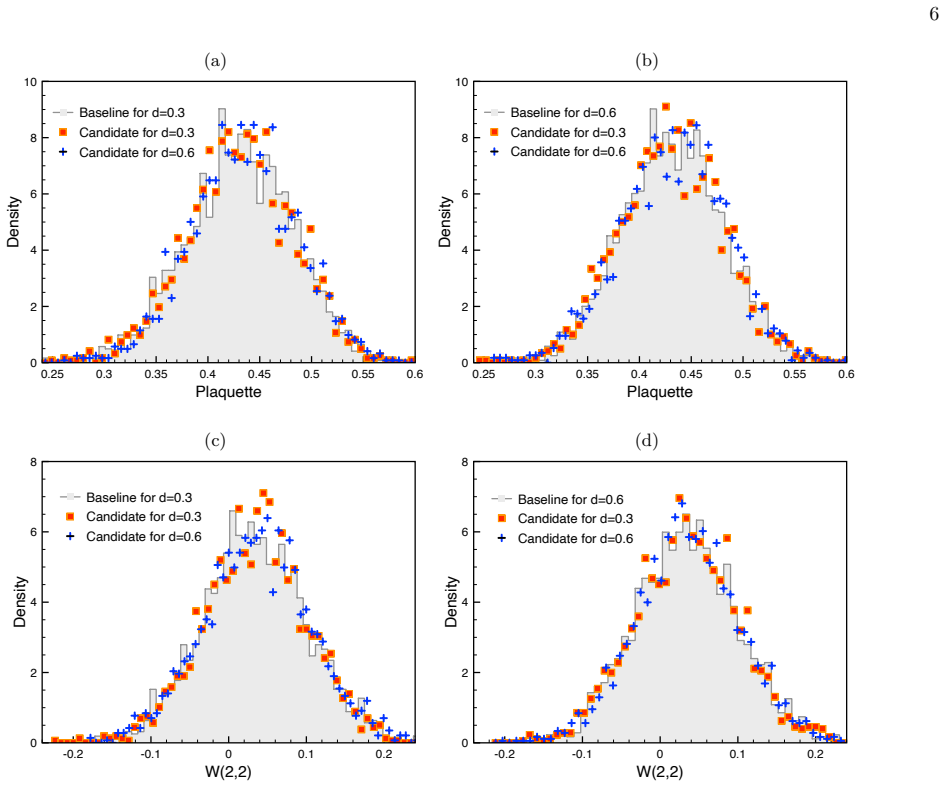
The construction is based on a coupling-flow update on the SU(2) lattice-link manifold, in which active links are transformed conditionally on a frozen-link background. For fixed frozen links, the proposal is explicitly invertible and preserves the product Haar measure, so it can be embedded into a Metropolis-Hastings correction without requiring an explicit model of the full proposal density. In the present testbed the learned proposal reproduces the target ensemble within statistical resolution across the tested configurations, while a mixed-step hybrid yields a modest improvement in effective sample size per unit runtime.
What carries the argument
coupling-flow update on the SU(2) lattice-link manifold that transforms active links conditionally on a frozen-link background while preserving the product Haar measure
If this is right
- The learned proposal reproduces the target ensemble within statistical resolution across the tested configurations.
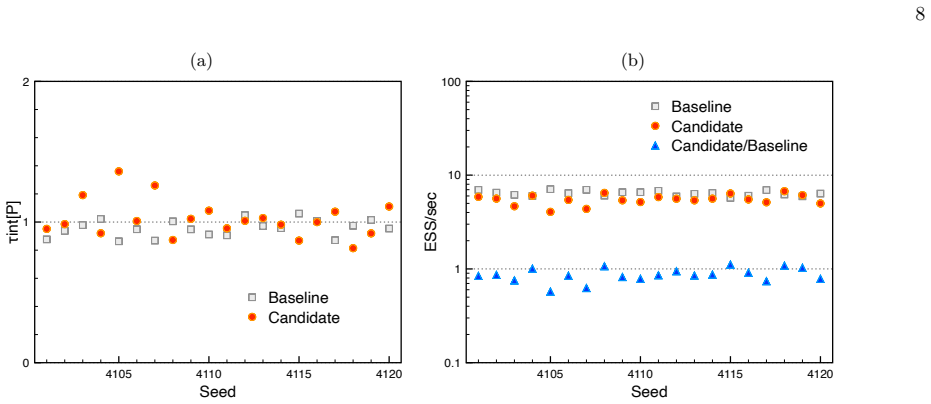
- In matched local-step comparisons the learned proposal performs at a quality comparable to the baseline local Metropolis algorithm.
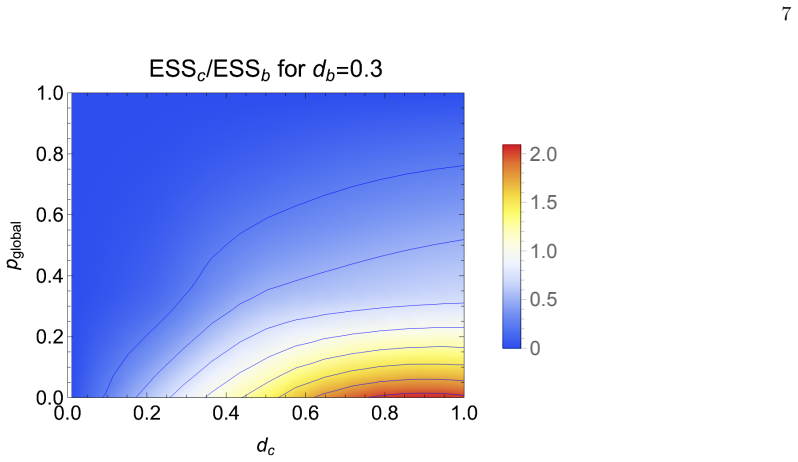
- A favorable mixed-step hybrid configuration yields a modest improvement in effective sample size per unit runtime.
- The method supplies a concrete foundation for extending machine-learned nonlocal updates to larger lattices and non-Abelian gauge theories.
Where Pith is reading between the lines
- The near-identity regime observed in the present flows indicates that architectural scaling may be needed before the method produces large moves on bigger volumes.
- Hybridizing the global flow proposal with heat-bath or over-relaxation steps could further reduce autocorrelation beyond the modest gain already reported.
- Application to theories with dynamical fermions would test whether the same invertibility property holds when the action includes fermion determinants.
Load-bearing premise
The coupling-flow transformation on active links, conditioned on a frozen-link background, is explicitly invertible and exactly preserves the product Haar measure.
What would settle it
A simulation on a small lattice in which the histogram of generated configurations deviates from the known Boltzmann weight of the target action by more than statistical fluctuations would falsify the claim.
Figures
read the original abstract
We propose a formally valid machine-learning-assisted global proposal mechanism for Monte Carlo sampling in lattice gauge theory. The construction is based on a coupling-flow update on the SU(2) lattice-link manifold, in which active links are transformed conditionally on a frozen-link background. For fixed frozen links, the proposal is explicitly invertible and preserves the product Haar measure, so it can be embedded into a Metropolis-Hastings correction without requiring an explicit model of the full proposal density. We implement the method in two-dimensional pure SU(2) lattice gauge theory and benchmark it against a baseline local Metropolis algorithm used as a controlled reference kernel. In the present testbed, the learned proposal reproduces the target ensemble within statistical resolution across the tested configurations. In matched local-step comparisons, the learned proposal reproduces the target ensemble at a quality comparable to the baseline, but does not outperform the pure local baseline in the conservative matched-step case examined with seed-level statistics within this proof-of-principle setup. At the same time, a favorable mixed-step hybrid configuration yields a modest improvement in effective sample size per unit runtime. Because the learned transformation remains in a near-identity regime, the present results should be interpreted as a proof-of-principle demonstration of formal correctness and limited, configuration-dependent efficiency gain within a controlled comparison, rather than as evidence of superiority over optimized conventional update schemes. This work provides a concrete foundation for extending machine-learned nonlocal updates to larger lattices and non-Abelian gauge theories relevant to lattice QCD.
Editorial analysis
A structured set of objections, weighed in public.
Referee Report
Summary. The paper proposes a coupling-flow-based global proposal for Monte Carlo sampling in SU(2) lattice gauge theory. Active links are transformed conditionally on a frozen-link background; the transformation is constructed to be explicitly invertible and to preserve the product Haar measure exactly, permitting embedding into a Metropolis-Hastings step that uses only the target density ratio. In two-dimensional pure SU(2), the resulting chain reproduces the target ensemble within statistical resolution, performs comparably to a local Metropolis baseline in matched-step tests, and yields a modest improvement in effective sample size per runtime in a favorable hybrid configuration. The work is presented as a proof-of-principle demonstration within a near-identity regime.
Significance. If the formal invertibility and measure-preservation properties hold, the construction supplies a concrete, reversible global proposal that can be corrected by standard Metropolis-Hastings without an explicit model of the proposal density. This supplies a foundation for extending machine-learned nonlocal updates to larger lattices and non-Abelian theories. The controlled comparison against a local baseline and the explicit qualification of results as proof-of-principle are strengths that reduce over-claiming risk.
major comments (1)
- [Abstract] Abstract: the central empirical claim that the learned proposal 'reproduces the target ensemble within statistical resolution across the tested configurations' is load-bearing for the validation of the method, yet the abstract supplies no quantitative error bars, specific observables, or statistical tests (e.g., integrated autocorrelation times or effective sample sizes with uncertainties). This information is required to judge whether the reproduction is within resolution or merely consistent at low precision.
minor comments (1)
- [Abstract] The abstract is lengthy and contains several qualifying clauses; a shorter version that isolates the formal construction, the empirical reproduction result, and the hybrid-configuration gain would improve readability.
Simulated Author's Rebuttal
We thank the referee for the careful reading and constructive suggestion regarding the abstract. We address the point below and will incorporate the requested quantitative details in a revised version.
read point-by-point responses
-
Referee: [Abstract] Abstract: the central empirical claim that the learned proposal 'reproduces the target ensemble within statistical resolution across the tested configurations' is load-bearing for the validation of the method, yet the abstract supplies no quantitative error bars, specific observables, or statistical tests (e.g., integrated autocorrelation times or effective sample sizes with uncertainties). This information is required to judge whether the reproduction is within resolution or merely consistent at low precision.
Authors: We agree that the abstract would benefit from greater quantitative specificity to support the validation claim. In the revised manuscript we will expand the abstract to name the primary observables (plaquette expectation value and Polyakov loop), report the level of agreement with statistical uncertainties, and explicitly reference the integrated autocorrelation times and effective sample sizes (with uncertainties) that are already computed and shown in the main text and figures. This change will make the statement of 'reproduction within statistical resolution' more precise without altering the proof-of-principle framing of the work. revision: yes
Axiom & Free-Parameter Ledger
free parameters (1)
- coupling-flow neural-network parameters
axioms (1)
- domain assumption A coupling flow on active SU(2) links conditioned on frozen links can be constructed to be bijective and to preserve the product Haar measure.
invented entities (1)
-
conditional coupling-flow global proposal
no independent evidence
Reference graph
Works this paper leans on
-
[1]
Kanwar, [arXiv:2401.01297 [hep-lat]]
G. Kanwar, [arXiv:2401.01297 [hep-lat]]. 12 Parameter Local Metropolis (Baseline) ML training ML-flow-assisted (Candidate) Lattice size 8×8 — 8×8 Gauge couplingβ= 2.0 —β= 2.0 Training data — Baseline — Thermalization sweeps 2000 — 2000 Saved configurations 2000 — 2000 Sweeps between measurements 20 — 20 Batch size — 64 — Epochs — 40 — Learning rate — 1.0×...
-
[2]
Bulgarelli, E
A. Bulgarelli, E. Cellini and A. Nada, PoSLATTICE2024, 040 (2025)
2025
-
[3]
Schaeferet al.[ALPHA], Nucl
S. Schaeferet al.[ALPHA], Nucl. Phys. B845, 93-119 (2011)
2011
-
[4]
Foreman, X
S. Foreman, X. Y. Jin and J. C. Osborn, PoSLATTICE2023, 036 (2024)
2024
-
[5]
Cranmer, G
K. Cranmer, G. Kanwar, S. Racan` ere, D. J. Rezende and P. E. Shanahan, Nat. Rev. Phys.5, 526 (2023)
2023
-
[6]
M. S. Albergo, G. Kanwar and P. E. Shanahan, Phys. Rev. D100, no.3, 034515 (2019)
2019
- [7]
-
[8]
Kanwaret al., Phys
G. Kanwaret al., Phys. Rev. Lett.125, no.12, 121601 (2020)
2020
-
[9]
Boydaet al., Phys
D. Boydaet al., Phys. Rev. D103, no.7, 074504 (2021)
2021
-
[10]
Abbottet al., arXiv:2305.02402 [hep-lat]
R. Abbottet al., arXiv:2305.02402 [hep-lat]
-
[11]
Abbottet al., PoSLATTICE2023, 035 (2024)
R. Abbottet al., PoSLATTICE2023, 035 (2024)
2024
-
[12]
Tierney, Ann
L. Tierney, Ann. Appl. Probab.8, 1–9 (1998)
1998
-
[13]
K. G. Wilson, Phys. Rev. D10, 2445 (1974)
1974
-
[14]
L. Dinh, J. Sohl-Dickstein and S. Bengio, arXiv:1605.08803 [cs.LG]
work page internal anchor Pith review Pith/arXiv arXiv
-
[15]
Papamakarioset al., J
G. Papamakarioset al., J. Mach. Learn. Res.22, 1 (2021)
2021
-
[16]
Abbottet al., Phys
R. Abbottet al., Phys. Rev. D109, 094514 (2024)
2024
-
[17]
Bacchio, P
S. Bacchio, P. Kessel, S. Schaefer and L. Vaitl, Phys. Rev. D107, L051504 (2023)
2023
discussion (0)
Sign in with ORCID, Apple, or X to comment. Anyone can read and Pith papers without signing in.