Electron Polaron at Neutral 180^circ Domain Wall in PbTiO₃: Stability, Trapping Energies, and Transverse Polarization
Pith reviewed 2026-06-29 16:39 UTC · model grok-4.3
The pith
Neutral 180° domain walls in PbTiO₃ do not substantially alter the stability of Ti-centered electron polarons.
A machine-rendered reading of the paper's core claim, the machinery that carries it, and where it could break.
Core claim
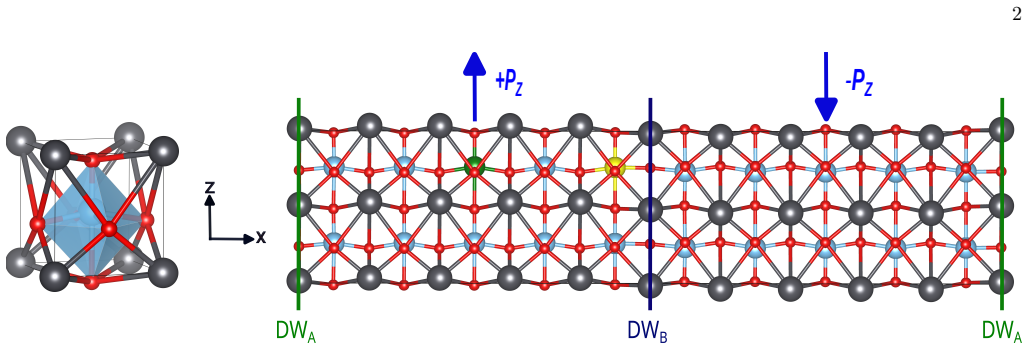
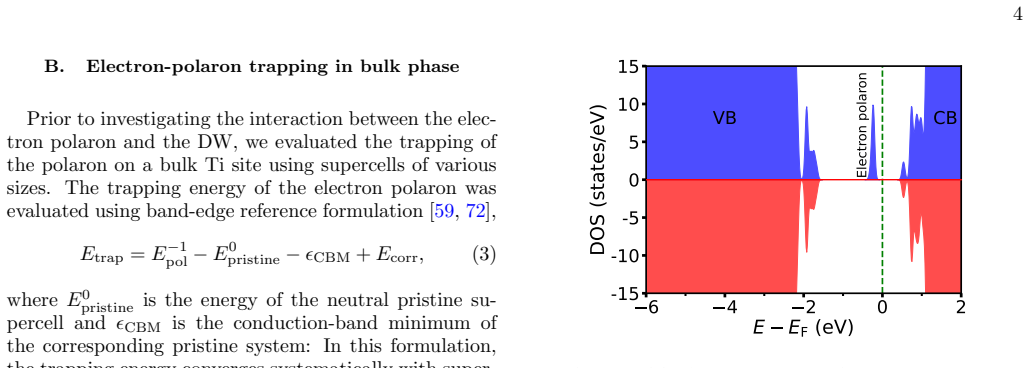
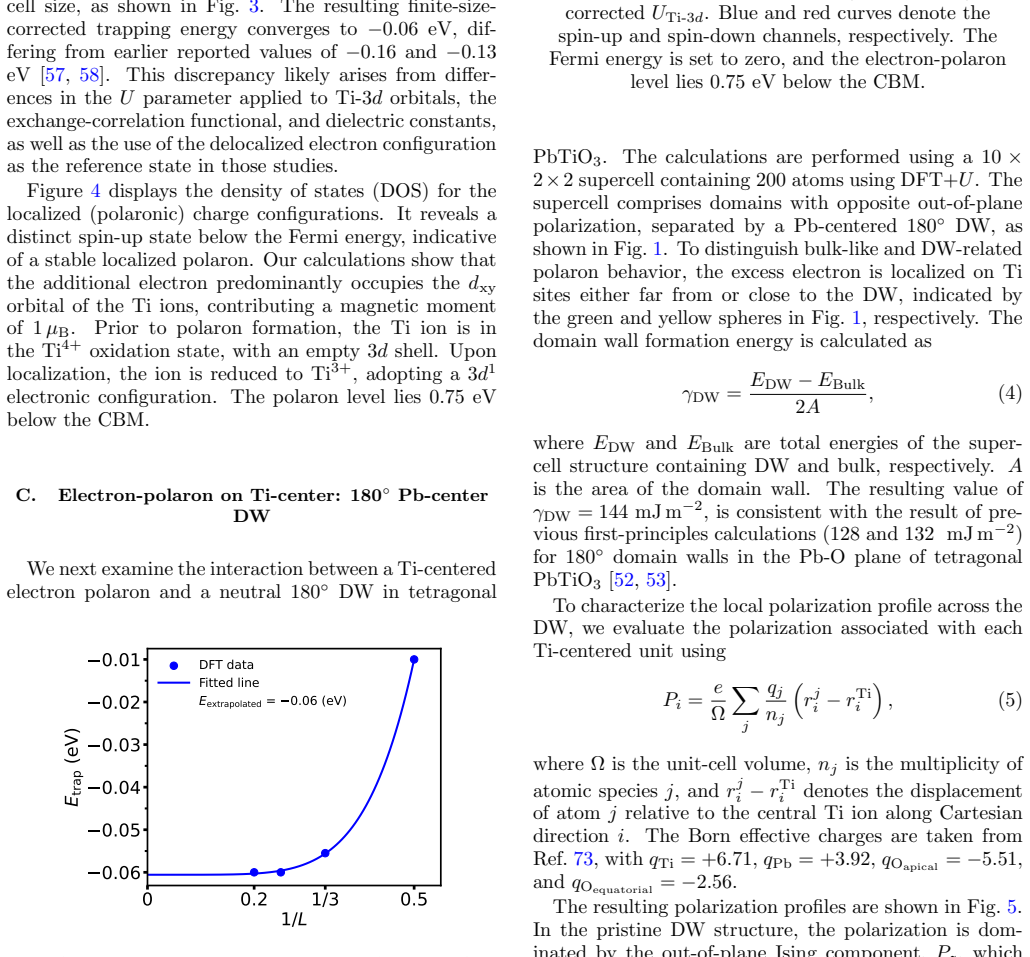
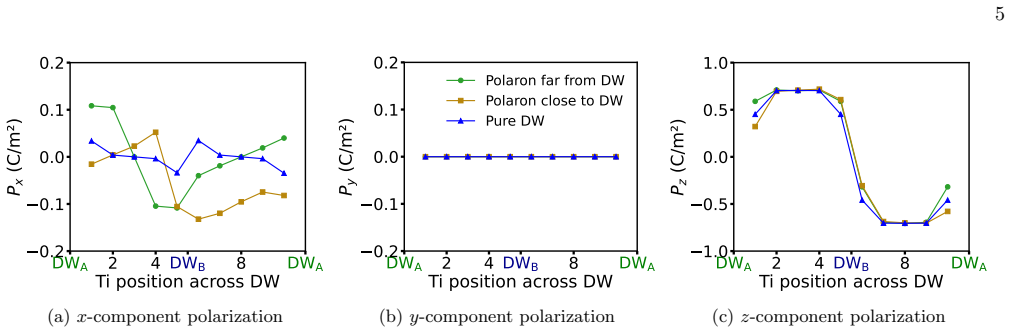
Density-functional theory with a Hubbard correction for Ti 3d states shows stable electron-polaron formation in bulk PbTiO₃ with trapping energy of -0.06 eV. At neutral 180° domain walls the excess electron localizes on Ti to form a Ti³⁺ center with occupied d_xy in-gap state. Trapping energies differ by only 0.01 eV between bulk-like and near-wall sites, showing no significant thermodynamic driving force for segregation. The out-of-plane polarization reversal stays Ising-like while the polaron adds a transverse polarization component normal to the wall, strongest at the wall itself.
What carries the argument
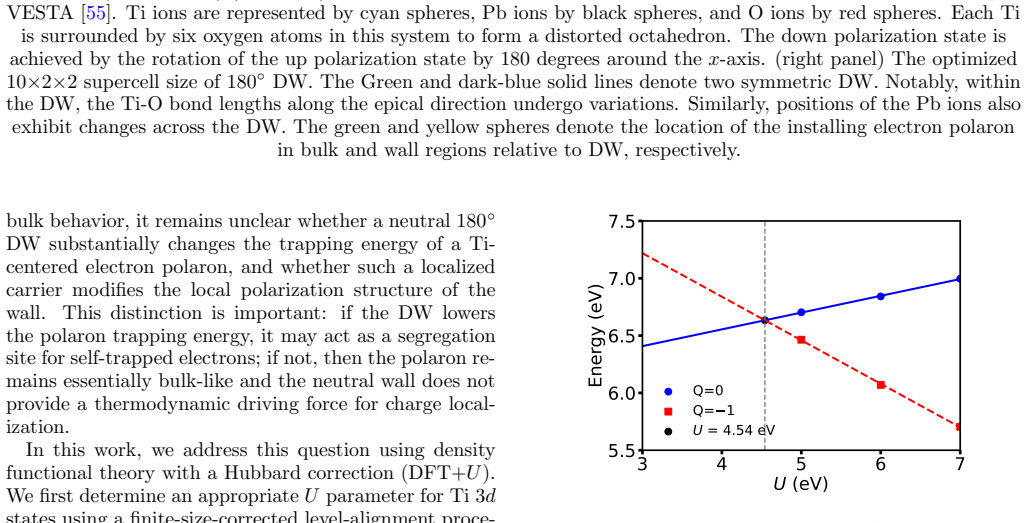
Hubbard U parameter set by finite-size-corrected polaronic energy-level alignment, applied to compare trapping energies and polarization responses at different Ti sites relative to the domain wall.
If this is right
- Neutral domain walls provide no significant thermodynamic driving force for electron-polaron segregation.
- Polaron-induced transverse polarization enhances Néel-like distortions most strongly at the wall.
- The Ising-like reversal of out-of-plane polarization remains intact with the polaron present.
- Electron polarons form with similar stability whether in bulk or at the neutral wall.
Where Pith is reading between the lines
- This result suggests electron polarons can traverse neutral 180° walls without strong energetic preference for one side.
- Models of polaron dynamics in ferroelectric devices may treat neutral domain walls as neutral for trapping purposes.
- The transverse polarization effect could be tested in scanning probe experiments measuring local lattice responses.
Load-bearing premise
The finite-size-corrected procedure for choosing the Hubbard parameter for Ti 3d states correctly describes stable polaron formation both away from and at the domain wall.
What would settle it
Direct measurement or higher-level calculation showing a trapping energy difference larger than 0.05 eV at the domain wall compared to bulk would disprove the lack of significant driving force.
Figures
read the original abstract
We use density-functional theory with a Hubbard correction to investigate Ti-centered electron polarons at neutral PbO-centered $180^\circ$ domain walls in tetragonal PbTiO$_{3}$. The Hubbard parameter for Ti $3d$ states is determined using the finite-size-corrected polaronic energy-level alignment procedure, yielding stable electron-polaron formation in bulk PbTiO$_3$ with a trapping energy of $-$0.06 eV. In the domain-wall supercell, the excess electron localizes on Ti and forms a Ti$^{3+}$ center with an occupied $d_{xy}$ orbital in-gap state. Comparison of bulk-like and near-wall Ti sites shows that their trapping energies differ by only about 0.01 eV, indicating that this neutral domain wall does not provide a significant thermodynamic driving force for electron-polaron segregation. While the Ising-like reversal of the out-of-plane polarization is preserved, the localized electron induces a finite transverse polarization component normal to the wall, enhancing a local N\'eel-like distortion that is strongest when the polaron is located at the wall. These results show that neutral $180^\circ$ domain walls in PbTiO$_3$ do not substantially alter the stability of Ti-centered electron polarons, but they can couple to the polaron-induced lattice distortion through a localized transverse polarization response.
Editorial analysis
A structured set of objections, weighed in public.
Referee Report
Summary. The manuscript uses DFT+U to study Ti-centered electron polarons at neutral PbO-centered 180° domain walls in tetragonal PbTiO3. The Hubbard U for Ti 3d is obtained from a finite-size-corrected polaronic energy-level alignment procedure in bulk, giving a trapping energy of -0.06 eV. In the domain-wall supercell the excess electron localizes on Ti as a Ti3+ center with an occupied d_xy in-gap state. Trapping energies at bulk-like versus near-wall Ti sites differ by ~0.01 eV, from which the authors conclude that the neutral domain wall supplies no significant thermodynamic driving force for electron-polaron segregation. The localized electron is also shown to induce a finite transverse polarization component normal to the wall, strongest when the polaron sits at the wall, while the out-of-plane Ising reversal is preserved.
Significance. If the reported 0.01 eV energy ordering is robust, the work indicates that neutral 180° walls in PbTiO3 neither strongly attract nor repel Ti-centered electron polarons, which bears on models of charge transport and defect chemistry in ferroelectrics. The observation of polaron-induced transverse (Néel-like) polarization supplies a concrete local structural signature that could be tested experimentally. The finite-size-corrected procedure used to fix U is a methodological strength that improves transferability of the bulk result.
major comments (2)
- [Abstract] Abstract: the central claim that bulk-like and near-wall trapping energies differ by only ~0.01 eV (and therefore that the wall supplies 'no significant thermodynamic driving force') rests on a total-energy difference smaller than typical DFT+U numerical uncertainties; no supercell dimensions, k-point convergence data, or error estimates are supplied, so it is impossible to judge whether the reported ordering is outside the numerical noise floor.
- [Abstract] Abstract: the Hubbard U is fixed once from the bulk finite-size-corrected polaronic alignment procedure and then applied uniformly inside the domain-wall supercell. Because the neutral 180° wall introduces a polarization discontinuity and altered local dielectric screening, the effective U (or the reference level alignment) can shift; without a site-specific validation or sensitivity test the 0.01 eV difference cannot be regarded as reliable.
minor comments (1)
- [Abstract] The abstract states that the out-of-plane polarization reversal is 'preserved' but supplies no quantitative measure (e.g., layer-resolved polarization profile) or reference to a figure or section that demonstrates this preservation.
Simulated Author's Rebuttal
We thank the referee for the careful reading and constructive comments on numerical robustness and U transferability. We address both points below and have revised the manuscript to incorporate additional convergence data and a sensitivity analysis, which strengthen the reliability of the reported energy ordering.
read point-by-point responses
-
Referee: [Abstract] Abstract: the central claim that bulk-like and near-wall trapping energies differ by only ~0.01 eV (and therefore that the wall supplies 'no significant thermodynamic driving force') rests on a total-energy difference smaller than typical DFT+U numerical uncertainties; no supercell dimensions, k-point convergence data, or error estimates are supplied, so it is impossible to judge whether the reported ordering is outside the numerical noise floor.
Authors: We agree that explicit documentation of numerical convergence is required to substantiate a small energy difference. In the revised manuscript we add the supercell dimensions, k-point sampling, and dedicated convergence tests with respect to supercell size and k-point density. These tests show that the 0.01 eV ordering is stable to within an estimated numerical uncertainty of 0.005 eV, placing the difference outside the noise floor. revision: yes
-
Referee: [Abstract] Abstract: the Hubbard U is fixed once from the bulk finite-size-corrected polaronic alignment procedure and then applied uniformly inside the domain-wall supercell. Because the neutral 180° wall introduces a polarization discontinuity and altered local dielectric screening, the effective U (or the reference level alignment) can shift; without a site-specific validation or sensitivity test the 0.01 eV difference cannot be regarded as reliable.
Authors: The neutral wall preserves overall charge neutrality and the local Ti coordination environment, supporting transferability of the bulk-derived U. To address the referee's concern directly, the revised manuscript includes a sensitivity analysis in which trapping energies are recomputed with U varied by ±1 eV; the relative difference between bulk-like and near-wall sites remains below 0.02 eV and the conclusion is unchanged. A full site-specific recalculation of U at every Ti site would require substantial extra effort beyond the present scope. revision: partial
Circularity Check
No load-bearing circularity; trapping energies from direct total-energy differences
full rationale
The Hubbard U is fixed from the bulk finite-size-corrected polaronic energy-level alignment procedure (yielding the -0.06 eV bulk trapping energy), then applied uniformly to compute site-specific trapping energies in the domain-wall supercell via total-energy differences. The 0.01 eV difference between bulk-like and near-wall sites is obtained directly from these DFT supercell calculations and does not reduce by the paper's equations or any self-citation to a quantity defined by the bulk fit. The central claim of no significant thermodynamic driving force follows from these independent energy comparisons, rendering the derivation self-contained.
Axiom & Free-Parameter Ledger
free parameters (1)
- Hubbard U for Ti 3d states
axioms (1)
- domain assumption The finite-size-corrected polaronic energy-level alignment procedure yields a physically appropriate Hubbard U for Ti 3d states in PbTiO3
Reference graph
Works this paper leans on
-
[1]
J. F. Scott, Science315, 954 (2007)
2007
-
[2]
Acosta, N
M. Acosta, N. Novak, V. Rojas, S. Patel, R. Vaish, J. Ko- ruza, J. Rossetti, G. A., and J. R¨ odel, Appl. Phys. Rev. 4, 041305 (2017)
2017
-
[3]
Muralt, IEEE Trans
P. Muralt, IEEE Trans. Ultrason. Ferroelectr. Freq. Con- trol.47, 903 (2002)
2002
-
[4]
A. K. Tagantsev, L. E. Cross, and J. Fousek,Domains in Ferroic Crystals and Thin Films(Springer New York)
-
[5]
E. K. Salje, Phase Trans.86, 2 (2013)
2013
-
[6]
Meier and S
D. Meier and S. M. Selbach, Nat. Rev. Mat.7, 157 (2022)
2022
-
[7]
D. Lee, H. Xu, V. Dierolf, V. Gopalan, and S. R. Phillpot, Appl. Phys. Lett.98, 092903 (2011)
2011
-
[8]
G. F. Nataf, M. Guennou, J. M. Gregg, D. Meier, J. Hlinka, E. K. H. Salje, and J. Kreisel, Nat. Rev. Mat. 2, 634 (2020)
2020
-
[9]
Chandrasekaran, D
A. Chandrasekaran, D. Damjanovic, N. Setter, and N. Marzari, Phys Rev B88, 214116 (2013)
2013
-
[10]
Bencan, G
A. Bencan, G. Drazic, H. Ursic, M. Makarovic, M. Komelj, and T. Rojac, Nat. Commun.11, 1762 (2020)
2020
-
[11]
A. J. Klomp, R. Khachaturyan, T. Wallis, K. Albe, and A. Gr¨ unebohm, Phys. Rev. Mater.6, 104411 (2022)
2022
-
[12]
Marton, M
P. Marton, M. Pa´ sciak, M. A. P. Gon¸ calves, O. Nov´ ak, J. Hlinka, R. Beanland, and M. Alexe, Comm. Mat.6, 161 (2025)
2025
-
[13]
Catalan, J
G. Catalan, J. Seidel, R. Ramesh, and J. F. Scott, Rev. Mod. Phys.84, 119 (2012)
2012
-
[14]
Meier, J
D. Meier, J. Phys.: Condens. Matter27, 463003 (2015)
2015
-
[15]
Maksymovych, J
P. Maksymovych, J. Seidel, Y. H. Chu, P. Wu, A. P. Bad- dorf, L.-Q. Chen, S. V. Kalinin, and R. Ramesh, Nano Lett.11, 1906 (2011)
1906
-
[16]
G. Tian, W. Yang, X. Song, D. Zheng, L. Zhang, C. Chen, P. Li, H. Fan, J. Yao, D. Chen, Z. Fan, Z. Hou, Z. Zhang, S. Wu, M. Zeng, X. Gao, and J.-M. Liu, Adv. Funct. Mater.29, 1807276 (2019)
2019
-
[17]
Y. Zuo, Y. A. Genenko, and B.-X. Xu, J. Appl. Phys. 116, 044109 (2014)
2014
-
[18]
Sluka, A
T. Sluka, A. K. Tagantsev, D. Damjanovic, M. Gureev, and N. Setter, Nat. Commun.3, 748 (2012)
2012
-
[19]
Seidel, L
J. Seidel, L. W. Martin, Q. He, Q. Zhan, Y.-H. Chu, A. Rother, M. E. Hawkridge, P. Maksymovych, P. Yu, M. Gajek, N. Balke, S. V. Kalinin, S. Gemming, F. Wang, G. Catalan, J. F. Scott, N. A. Spaldin, J. Orenstein, and R. Ramesh, Nat. Mater.8, 229 (2009)
2009
-
[20]
N. S. Bein, P. Machado, M. Coll, F. Chen, M. Makarovic, T. Rojac, and A. Klein, J. Chem. Phys. Lett.10, 7071 (2019)
2019
-
[21]
Rojac, A
T. Rojac, A. Bencan, G. Drazic, N. Sakamoto, H. Ursic, B. Jancar, G. Tavcar, M. Makarovic, J. Walker, B. Malic, and D. Damjanovic, Nat. Mater.16, 322 (2017)
2017
-
[22]
Franchini, M
C. Franchini, M. Reticcioli, M. Setvin, and U. Diebold, Nat. Rev. Mat.6, 560 (2021)
2021
-
[23]
Klein, K
A. Klein, K. Albe, N. Bein, O. Clemens, K. A. Creutz, P. Erhart, M. Frericks, E. Ghorbani, J. P. Hofmann, B. Huang, B. Kaiser, U. Kolb, J. Koruza, C. K¨ ubel, K. N. S. Lohaus, J. R¨ odel, J. Rohrer, W. Rheinheimer, R. A. D. Souza, V. Streibel, A. Weidenkaff, M. Widen- meyer, B.-X. Xu, and H. Zhang, J. Electroceram.51, 147 (2023)
2023
-
[24]
J. B. Varley, A. Janotti, C. Franchini, and C. G. Van de Walle, Phys Rev B85, 081109 (2012)
2012
-
[25]
Faust, H
B. Faust, H. M¨ uller, and O. Schirmer, Ferroelectrics153, 297 (1994)
1994
-
[26]
Ambrosio, J
F. Ambrosio, J. Wiktor, F. De Angelis, and A. Pasquarello, Energy & Env. Sci.11, 101 (2018)
2018
-
[27]
Friedrich, W
M. Friedrich, W. G. Schmidt, A. Schindlmayr, and S. Sanna, Phys. Rev. Mater.1, 054406 (2017)
2017
-
[28]
O. F. Schirmer, J. Phys.: Condens. Matter18, R667 (2006)
2006
-
[29]
O. F. Schirmer, M. Imlau, C. Merschjann, and B. Schoke, J. Phys.: Condens. Matter21, 123201 (2009)
2009
-
[30]
V. S. Vikhnin, R. I. Eglitis, S. E. Kapphan, G. Borstel, and E. A. Kotomin, Phys Rev B65, 104304 (2002)
2002
-
[31]
Ambrosio and J
F. Ambrosio and J. Wiktor, J. Chem. Phys. Lett.10, 7113 (2019)
2019
-
[32]
Y. Xu, P. Sharma, H. Wen, D. Zhang, C. Kong, Z. Yan, S. L. Chang, and J. Seidel, Adv. Funct. Mater.34, 2400420 (2024)
2024
-
[33]
K¨ orbel, J
S. K¨ orbel, J. Hlinka, and S. Sanvito, Phys Rev B98, 100104 (2018)
2018
-
[34]
S. Y. Xiao, T. K¨ ampfe, Y. M. Jin, A. Haußmann, X. M. Lu, and L. M. Eng, Phys. Rev. Appl.10, 034002 (2018)
2018
-
[35]
Schr¨ oder, A
M. Schr¨ oder, A. Haußmann, A. Thiessen, E. Soergel, T. Woike, and L. M. Eng, Adv. Funct. Mater.22, 3936 (2012)
2012
-
[36]
Meier, J
D. Meier, J. Seidel, A. Cano, K. Delaney, Y. Kumagai, M. Mostovoy, N. A. Spaldin, R. Ramesh, and M. Fiebig, Nat. Mater.11, 284 (2012). 7
2012
-
[37]
E. A. Eliseev, A. N. Morozovska, G. S. Svechnikov, P. Maksymovych, and S. V. Kalinin, Phys Rev B85, 045312 (2012)
2012
-
[38]
Kluibenschedl, G
F. Kluibenschedl, G. M. Koutentakis, R. Alhyder, and M. Lemeshko, Phys Rev Lett134, 096302 (2025)
2025
-
[39]
Sicron, B
N. Sicron, B. Ravel, Y. Yacoby, E. A. Stern, F. Dogan, and J. J. Rehr, Phys Rev B50, 13168 (1994)
1994
-
[40]
A. M. Glazer and S. A. Mabud, Acta Cryst. B34, 1065 (1978)
1978
-
[41]
Garc´ ıa and D
A. Garc´ ıa and D. Vanderbilt, Phys Rev B54, 3817 (1996)
1996
-
[42]
R. J. Nelmes, R. O. Piltz, W. F. Kuhs, Z. Tun, and R. R. and, Ferroelectrics108, 165 (1990)
1990
-
[43]
M. D. Fontana, H. Idrissi, and K. Wojcik, Europhys. Lett. 11, 419 (1990)
1990
-
[44]
Burns and B
G. Burns and B. A. Scott, Phys Rev B7, 3088 (1973)
1973
-
[45]
D. I. Bilc, R. Orlando, R. Shaltaf, G.-M. Rignanese, J. ´I˜ niguez, and P. Ghosez, Phys Rev B77, 165107 (2008)
2008
-
[46]
Schafranek, S
R. Schafranek, S. Li, F. Chen, W. Wu, and A. Klein, Phys Rev B84, 045317 (2011)
2011
-
[47]
van Benthem, C
K. van Benthem, C. Els¨ asser, and R. H. French, J. Appl. Phys.90, 6156 (2001)
2001
-
[48]
Joseph, T
J. Joseph, T. M. Vimala, V. Sivasubramanian, and V. R. K. Murthy, J. Mater. Sci.35, 1571 (2000)
2000
-
[49]
Dmowski, T
W. Dmowski, T. Egami, L. Farber, and P. K. Davies, AIP Conf. Prof.582, 33 (2001)
2001
-
[50]
J. A. Rodriguez, A. Etxeberria, L. Gonz´ alez, and A. Maiti, J. Chem. Phys.117, 2699 (2002)
2002
-
[51]
Yamanaka, Y
T. Yamanaka, Y. Nakamoto, M. Ahart, and H.-k. Mao, Phys Rev B97, 144109 (2018)
2018
-
[52]
Meyer and D
B. Meyer and D. Vanderbilt, Phys Rev B65, 104111 (2002)
2002
-
[53]
R. K. Behera, C. W. Lee, D. Lee, A. N. Morozovska, S. B. Sinnott, A. Asthagiri, V. Gopalan, and S. R. Phillpot, J. Phys.: Condens. Matter23, 175902 (2011)
2011
-
[54]
P¨ oykk¨ o and D
S. P¨ oykk¨ o and D. Chadi, Appl. Phys. Lett.75, 2830 (1999)
1999
-
[55]
Momma and F
K. Momma and F. Izumi, J. Appl. Crystallogr.44, 1272 (2011)
2011
-
[56]
R. I. Eglitis, E. A. Kotomin, V. A. Trepakov, S. E. Kap- phan, and G. Borstel, J. Phys.: Condens. Matter14, L647 (2002)
2002
-
[57]
Ghorbani, L
E. Ghorbani, L. Villa, P. Erhart, A. Klein, and K. Albe, Phys. Rev. Mater.6, 074410 (2022)
2022
-
[58]
Windsor and H
D. Windsor and H. Xu, Phys. Rev. Mater.8, 094406 (2024)
2024
-
[59]
Erhart, A
P. Erhart, A. Klein, D. ˚Aberg, and B. Sadigh, Phys Rev B90, 035204 (2014)
2014
-
[60]
Cococcioni and S
M. Cococcioni and S. de Gironcoli, Phys Rev B71, 035105 (2005)
2005
-
[61]
Falletta, J
S. Falletta, J. Wiktor, and A. Pasquarello, Phys Rev B 102, 041115 (2020)
2020
-
[62]
Falletta and A
S. Falletta and A. Pasquarello, npj Computational Ma- terials8, 263 (2022)
2022
-
[63]
Kresse and J
G. Kresse and J. Furthm¨ uller, Comp. Mat. Sci.6, 15 (1996)
1996
-
[64]
Kresse and D
G. Kresse and D. Joubert, Phys Rev B59, 1758 (1999)
1999
-
[65]
P. E. Bl¨ ochl, Phys Rev B50, 17953 (1994)
1994
-
[66]
J. P. Perdew, K. Burke, and M. Ernzerhof, Phys Rev Lett 77, 3865 (1996)
1996
-
[67]
J. P. Perdew, A. Ruzsinszky, G. I. Csonka, O. A. Vydrov, G. E. Scuseria, L. A. Constantin, X. Zhou, and K. Burke, Phys Rev Lett100, 136406 (2008)
2008
-
[68]
J. P. Allen and G. W. Watson, Phys. Chem. Chem. Phys. 16, 21016 (2014)
2014
-
[69]
Freysoldt, J
C. Freysoldt, J. Neugebauer, and C. G. Van de Walle, Phys Rev Lett102, 016402 (2009)
2009
-
[70]
Freysoldt, B
C. Freysoldt, B. Grabowski, T. Hickel, J. Neugebauer, G. Kresse, A. Janotti, and C. G. Van de Walle, Rev. Mod. Phys.86, 253 (2014)
2014
-
[71]
C. M. Foster, Z. Li, M. Grimsditch, S.-K. Chan, and D. J. Lam, Phys Rev B48, 10160 (1993)
1993
-
[72]
¨Osterbacka, P
N. ¨Osterbacka, P. Erhart, S. Falletta, A. Pasquarello, and J. Wiktor, Chem. Mater.32, 8393 (2020)
2020
-
[73]
Zhong, R
W. Zhong, R. D. King-Smith, and D. Vanderbilt, Phys Rev Lett72, 3618 (1994)
1994
-
[74]
M. E. Lines and A. M. Glass,Principles and Applications of Ferroelectrics and Related Materials(Oxford Univer- sity Press, 2001)
2001
-
[75]
T. Abe, S. Kim, C. Moriyoshi, Y. Kitanaka, Y. Noguchi, H. Tanaka, and Y. Kuroiwa, Appl. Phys. Lett.117, 252905 (2020)
2020
-
[76]
Tadmor, U
E. Tadmor, U. Waghmare, G. Smith, and E. Kaxiras, Acta Mater.50, 2989 (2002)
2002
-
[77]
S´ aghi-Szab´ o, R
G. S´ aghi-Szab´ o, R. E. Cohen, and H. Krakauer, Phys Rev Lett80, 4321 (1998)
1998
-
[78]
Kingsland, K
M. Kingsland, K. A. Lynch, S. Lisenkov, X. He, and I. Ponomareva, Phys. Rev. Mater.4, 073802 (2020)
2020
-
[79]
Zhang, J
Y. Zhang, J. Sun, J. P. Perdew, and X. Wu, Phys Rev B 96, 035143 (2017)
2017
-
[80]
Petralanda, M
U. Petralanda, M. Kruse, H. Simons, and T. Olsen, Phys Rev Lett127, 117601 (2021)
2021
discussion (0)
Sign in with ORCID, Apple, or X to comment. Anyone can read and Pith papers without signing in.