Origin of the Temperature-Induced Gap Bowing of Formamidinium-Methylammonium Lead Iodide Perovskites: Role of Cationic Rattlers
Pith reviewed 2026-06-29 16:35 UTC · model grok-4.3
The pith
Temperature-induced gap bowing in FA-MA lead iodide perovskites stems mainly from electron-phonon coupling via mixed FA rattler and octahedral tilting modes.
A machine-rendered reading of the paper's core claim, the machinery that carries it, and where it could break.
Core claim
By performing temperature- and pressure-dependent photoluminescence measurements across the full range of FA_x MA_{1-x} PbI_3 single crystals, the work shows that thermal expansion and electron-phonon effects both contribute to the observed gap bowing, yet the electron-phonon term dominates through activation of mixed vibrational modes that couple inorganic octahedral tilting phonons to low-frequency FA librations (FA rattler modes) in the orthorhombic and pseudotetragonal low-temperature phases.
What carries the argument
Anomalous electron-phonon coupling mechanism linked to mixed vibrational modes that combine inorganic-cage phonons involving octahedral tilting with low-frequency FA librations (FA rattler modes).
If this is right
- Device band-gap engineering must account for the dominant electron-phonon channel rather than thermal expansion alone.
- The bowing is confined to the low-temperature phases and therefore affects low-temperature operation and stability windows.
- Cation mixing between 20 and 90 percent FA enables the stripe-domain geometry that activates the mixed modes.
- Pressure can be used as an experimental knob to separate lattice-expansion from electron-phonon contributions.
Where Pith is reading between the lines
- Similar rattler-driven coupling may appear in other hybrid perovskites whenever an organic cation possesses low-frequency libration modes that overlap with cage phonons.
- Suppressing or shifting the FA libration frequencies through chemical substitution could reduce the bowing and improve temperature stability of the gap.
- The stripe-domain picture implies that domain engineering or epitaxial strain might modulate the strength of the anomalous coupling.
Load-bearing premise
The anomalous electron-phonon coupling activates only inside the orthorhombic and pseudotetragonal low-temperature phases that contain stripe domains with alternating octahedral tilt patterns for FA fractions between 20 and 90 percent.
What would settle it
If pressure-dependent photoluminescence shifts fail to match the magnitude expected from the electron-phonon contribution once thermal expansion is subtracted, or if the bowing vanishes in samples lacking FA rattler modes.
Figures
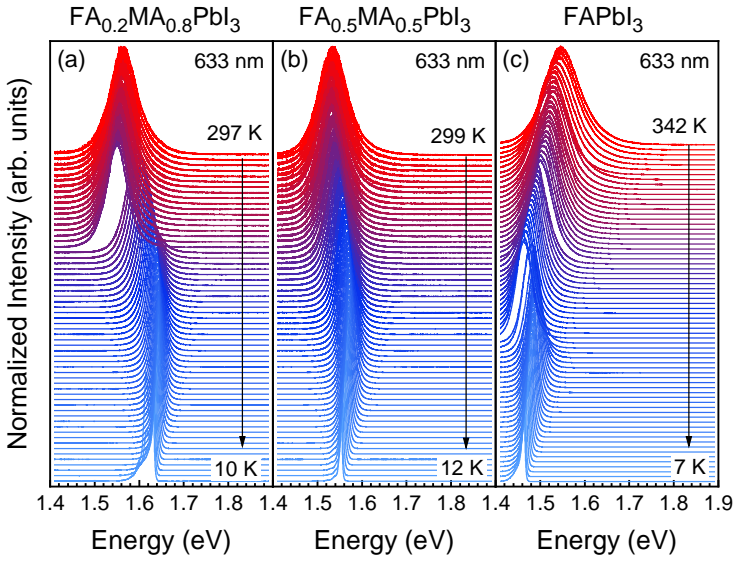
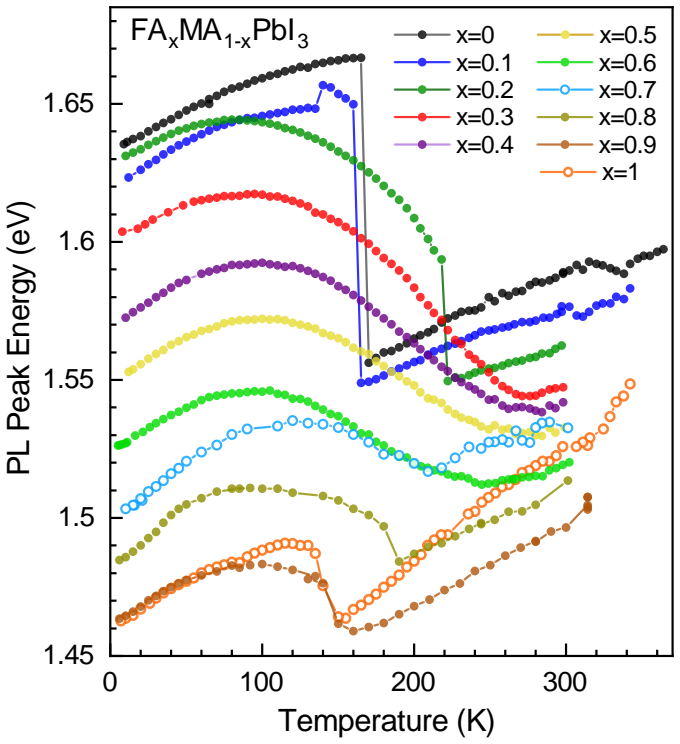
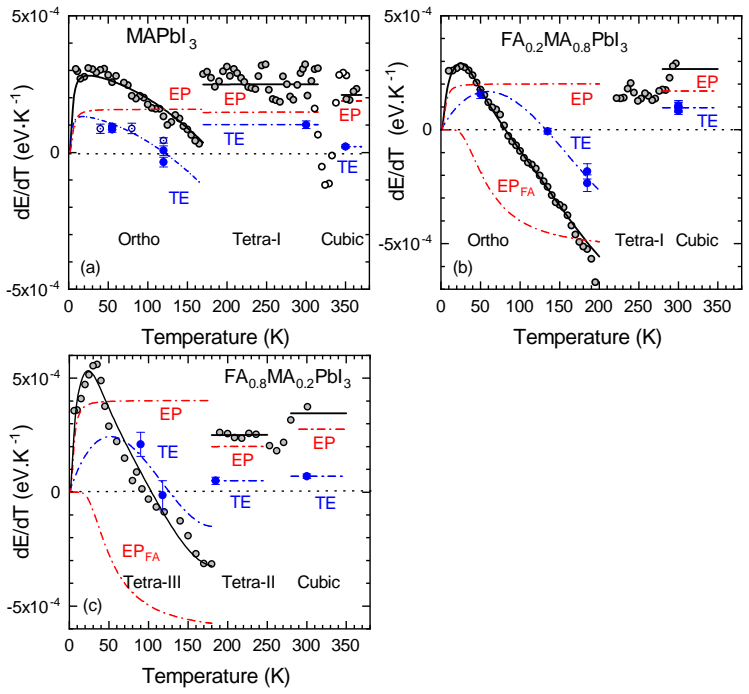
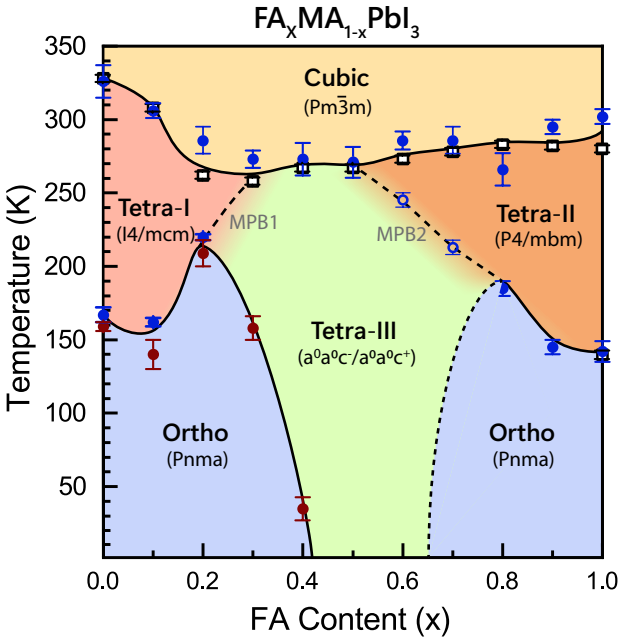
read the original abstract
A thorough understanding of the temperature dependence of semiconductor band gaps is essential for optimizing optoelectronic devices. In this respect, the origin of the pronounced temperature-induced gap bowing observed in low-temperature phases of formamidinium-methylammonium (FA-MA) lead iodide perovskites has remained elusive until now. By combining temperature and pressure-dependent photoluminescence measurements on a series of FA$_x$MA$_{1-x}$PbI$_3$ mixed-cation single crystals with $x\in[0,1]$, we unravel the origin of this bowing. Both thermal expansion as well as electron-phonon interaction effects are responsible. However, the latter is the leading term, driven by the activation of an anomalous electron-phonon coupling mechanism linked to mixed vibrational modes, which combine inorganic-cage phonons involving octahedral tilting with low-frequency FA librations, i.e., FA rattler modes. This occurs in the orthorhombic and (pseudo)tetragonal low-temperature phases, presumably featuring stripe domains with alternating octahedral tilt-axis patterns for FA concentrations between 20\% and 90\%. In this way, we have shed light on an intriguing behavior of lead halide perovskites that directly affects their optoelectronic properties.
Editorial analysis
A structured set of objections, weighed in public.
Referee Report
Summary. The manuscript reports temperature- and pressure-dependent photoluminescence measurements on FA_x MA_{1-x} PbI_3 single crystals (x from 0 to 1) and attributes the pronounced low-temperature gap bowing primarily to an anomalous electron-phonon coupling arising from mixed vibrational modes that combine inorganic-cage octahedral tilting phonons with low-frequency FA librations (rattler modes). Both thermal expansion and electron-phonon contributions are identified, but the latter dominates in the orthorhombic and pseudotetragonal phases for 0.2 < x < 0.9, which the authors presume contain stripe domains with alternating octahedral tilt-axis patterns.
Significance. If substantiated, the work supplies a concrete microscopic mechanism for the composition-dependent temperature bowing that directly impacts optoelectronic performance in mixed-cation lead-halide perovskites. The use of combined temperature-pressure PL data to separate thermal-expansion and electron-phonon channels, together with the identification of specific mixed modes, constitutes a useful advance over purely phenomenological descriptions.
major comments (2)
- [Discussion / Results (domain presumption)] The central mechanistic claim—that the leading electron-phonon term appears only for 0.2 ≤ x ≤ 0.9 because of activation of mixed octahedral-tilt + FA-libration modes—rests on the microstructural assumption of stripe domains with alternating tilt-axis patterns in the low-T phases. No XRD, TEM, neutron diffraction, or other structural data are cited to establish the existence or periodicity of these domains; the PL linewidths and pressure coefficients alone cannot discriminate this picture from simpler composition-dependent mode softening without long-range domain order.
- [Results (temperature dependence)] The assignment of the anomalous coupling specifically to the orthorhombic and (pseudo)tetragonal phases for mixed compositions requires explicit comparison of the measured temperature coefficients against the pure end-members (x=0 and x=1) across the same temperature window; without tabulated values or a figure showing the differential bowing magnitude, it is difficult to quantify how much of the observed bowing is truly anomalous versus a smooth interpolation.
minor comments (2)
- [Introduction / Discussion] The abstract states the domain picture with the qualifier 'presumably'; this qualification should be repeated in the main text when the mechanism is first introduced so that readers immediately recognize the assumption.
- [Methods / Discussion] Notation for the mixed vibrational modes (e.g., how the FA libration frequency is extracted or coupled to the tilt mode) should be defined consistently with any supporting Raman or DFT references.
Simulated Author's Rebuttal
We thank the referee for the constructive comments and positive assessment of the significance of our work. We address each major comment below.
read point-by-point responses
-
Referee: [Discussion / Results (domain presumption)] The central mechanistic claim—that the leading electron-phonon term appears only for 0.2 ≤ x ≤ 0.9 because of activation of mixed octahedral-tilt + FA-libration modes—rests on the microstructural assumption of stripe domains with alternating tilt-axis patterns in the low-T phases. No XRD, TEM, neutron diffraction, or other structural data are cited to establish the existence or periodicity of these domains; the PL linewidths and pressure coefficients alone cannot discriminate this picture from simpler composition-dependent mode softening without long-range domain order.
Authors: We agree that the stripe-domain interpretation is presented as a presumption ('presumably featuring stripe domains') rather than a directly demonstrated feature. The PL and pressure data show that the anomalous electron-phonon contribution is activated only for 0.2 < x < 0.9 in the low-T phases and exhibits pressure coefficients and temperature ranges consistent with mixed FA-libration + octahedral-tilt modes; this composition window and the deviation from end-member behavior provide indirect support. We will revise the text to state more explicitly that the domain picture is a proposed mechanism consistent with the spectroscopic results but that direct structural confirmation is absent and would be required to rule out simpler mode-softening scenarios without long-range order. revision: partial
-
Referee: [Results (temperature dependence)] The assignment of the anomalous coupling specifically to the orthorhombic and (pseudo)tetragonal phases for mixed compositions requires explicit comparison of the measured temperature coefficients against the pure end-members (x=0 and x=1) across the same temperature window; without tabulated values or a figure showing the differential bowing magnitude, it is difficult to quantify how much of the observed bowing is truly anomalous versus a smooth interpolation.
Authors: Figures 2 and 3 already display the full temperature series for all x values, including the end members, and extract the bowing parameter versus composition at multiple fixed temperatures. To make the differential explicit, we will add a supplementary table of linear temperature coefficients dE_g/dT extracted in the orthorhombic and pseudotetragonal windows for every composition, together with the deviation from linear interpolation between x=0 and x=1. revision: yes
- Direct structural data (XRD, TEM, or neutron diffraction) confirming the existence and periodicity of stripe domains with alternating tilt-axis patterns; no such measurements were performed in this study.
Circularity Check
No significant circularity; derivation self-contained from PL data
full rationale
The paper derives its claims from temperature- and pressure-dependent photoluminescence measurements across the FA_x MA_{1-x} PbI_3 series. Attribution of the leading electron-phonon term to mixed octahedral-tilt plus FA-libration modes is presented as an interpretation of the observed bowing behavior, with the stripe-domain microstructure explicitly labeled as a presumption rather than a fitted or self-cited result. No equations reduce a prediction to its own input by construction, no parameters are fitted on one subset and renamed as a prediction on another, and no load-bearing premise rests solely on prior self-citation. The central result therefore remains externally falsifiable against the reported PL and pressure datasets.
Axiom & Free-Parameter Ledger
Reference graph
Works this paper leans on
-
[1]
www.nrel.gov/pv/cell-efficiency.html (2025)
See Best Research-Cell Efficiency Chart , source: National Renewable Energy Laboratory (NREL), Golden, Colorado, USA. www.nrel.gov/pv/cell-efficiency.html (2025)
2025
-
[2]
N.; Garc\' a de Arquer, F
Lin, K.; Xing, J.; Quan, L. N.; Garc\' a de Arquer, F. P.; Gong, X.; Lu, J.; Xie, L.; Zhao, W.; Zhang, D.; Yan, C.; Li, W.; Liu, X.; Lu, Y.; Kirman, J.; Sargent, E. H.; Xiong, Q.; Wei, Z. Perovskite Light-Emitting Diodes with External Quantum Efficiency Exceeding 20 per Cent. Nature 2018, 562, 245-248
2018
-
[3]
B.; Cardona, M
Lautenschlager, P.; Allen, P. B.; Cardona, M. Temperature Dependence of Band Gaps in Si and Ge. Phys. Rev. B 1985 , 31, 2163-2171
1985
-
[4]
Temperature Dependence of the Shifts and Broadenings of the Critical Points in GaAs
Gopalan, S.; Lautenschlager, P.; Cardona, M. Temperature Dependence of the Shifts and Broadenings of the Critical Points in GaAs. Phys. Rev. B 1987 , 35, 5577-5584
1987
-
[5]
Interband Critical Points of GaAs and their Temperature Dependence
Lautenschlager, P.; Garriga, M.; Logothetidis, S.; Cardona, M. Interband Critical Points of GaAs and their Temperature Dependence. Phys. Rev. B 1987 , 35, 9174-9189
1987
-
[6]
R.; Syassen, K
Go\ n i, A. R.; Syassen, K. Optical Properties of Semiconductors Under Pressure. Semicond. Semimetals 1998 , 54, 247-425, and references therein
1998
-
[7]
Temperature Dependence of the Band Structure of Semiconductors: Electron-Phonon Interaction
Cardona, M.; Gopalan, S. Temperature Dependence of the Band Structure of Semiconductors: Electron-Phonon Interaction. In: Doni, E.; Girlanda, R.; Parravicini, G.P.; Quattropani, A. (eds) Progress in Electron Properties of Solids. Physics and Chemistry of Materials with Low-Dimensional Structures (Springer, Dordrecht, 1989), vol. 10, p. 51-64. https://doi....
-
[8]
J.; Petrozza, A.; Calvo, M
Rubino, A.; Francisco-L\' o pez, A.; Barker, A. J.; Petrozza, A.; Calvo, M. E.; Go\ n i, A. R.; M\' guez, H. Disentangling Electron-Phonon Coupling and Thermal Expansion Effects in the Band Gap Renormalization of Perovskite Nanocrystals. J. Phys. Chem. Lett. 2021, 12, 569-575
2021
-
[9]
T.; Wrzesinski, J.; Steube, M.; Reimann, K.; Merle, J.-C.; Joucla, M
G\" o bel, A.; Ruf, T.; Cardona, M.; Lin, C. T.; Wrzesinski, J.; Steube, M.; Reimann, K.; Merle, J.-C.; Joucla, M. Effects of the Isotopic Composition on the Fundamental Gap of CuCl. Phys. Rev. B 1998 , 57, 15183-15190
1998
-
[10]
T.; Reimann, K.; Cardona, M.; Fr\" o hlich, D
Serrano, J.; Schweitzer, Ch.; Lin, C. T.; Reimann, K.; Cardona, M.; Fr\" o hlich, D. Electron-Phonon Renormalization of the Absorption Edge of the Cuprous Halides. Phys. Rev. B 2002 , 65, 125110/1-7
2002
-
[11]
K.; Burger, A.; Mu\ n oz, A.; Romero, A
Bhosale, J.; Ramdas, A. K.; Burger, A.; Mu\ n oz, A.; Romero, A. H.; Cardona, M.; Lauck, R.; Kremer, R. K. Temperature Dependence of Band Gaps in Semiconductors: Electron-Phonon Interaction. Phys. Rev. B 2012 , 86, 195208/1-10
2012
-
[12]
The Electron-Phonon Renormalization in the Electronic Structure Calculation: Fundamentals, Current Status, and Challenges
Shang, H.; Yang, J. The Electron-Phonon Renormalization in the Electronic Structure Calculation: Fundamentals, Current Status, and Challenges. J. Chem. Phys. 2023, 158, 130901/1-11
2023
-
[13]
I.; Polavarapu, L.; Go\ n i, A
Fasahat, S.; Sch\" a fer, B.; Xu, K.; Fiuza-Maneiro, N.; G\' o mez-Gra\ n a, S.; Alonso, M. I.; Polavarapu, L.; Go\ n i, A. R. Absence of Anomalous Electron-Phonon Coupling in the Temperature Renormalization of the Gap of CsPbBr _3 Nanocrystals. J. Phys. Chem. C 2025, 129, 453-463
2025
-
[14]
J.; Alonso, M
Francisco L\' o pez, A.; Charles, B.; Weber, O. J.; Alonso, M. I.; Garriga, M.; Campoy-Quiles, M.; Weller, M. T.; Go\ n i, A. R. Equal Footing of Thermal Expansion and Electron-Phonon Interaction in the Temperature Dependence of Lead Halide Perovskite Band Gaps. J. Phys. Chem. Lett. 2019 , 10, 2971-2977
2019
-
[15]
Anharmonic Electron-Phonon Coupling in Ultrasoft and Locally Disordered Perovskites
Zacharias, M.; Volonakis, G.; Giustino, F.; Even, J. Anharmonic Electron-Phonon Coupling in Ultrasoft and Locally Disordered Perovskites. npj Comput. Mater. 2023, 9, 153/1-13
2023
-
[16]
Electron-Phonon Couplings in Polymorphous Crystals
Zacharias, M.; Volonakis, G.; Pedesseau, L.; Katan, C.; Giustino, F.; Even, J. Electron-Phonon Couplings in Polymorphous Crystals. Phys. Rev. B 2026, 113, L081104/1-10
2026
-
[17]
Roadmap for Electronic Structure, Anharmonicity, and Electron-Phonon Calculations in Locally Disordered Inorganic and Hybrid Halide Perovskites
Zacharias, M.; Volonakis, G.; Pedesseau, L.; Katan, C.; Giustino, F.; Even, J. Roadmap for Electronic Structure, Anharmonicity, and Electron-Phonon Calculations in Locally Disordered Inorganic and Hybrid Halide Perovskites. Phys. Rev. B 2026, 113, 085118/1-45
2026
-
[18]
P.; Przypis, L.; Herman, A
Pieniazek, A.; Dybala, F.; Polak, M. P.; Przypis, L.; Herman, A. P.; Kopaczek, J.; Kudrawiec, R. Bandgap Pressure Coefficient of a CH _3 NH _3 PbI _3 Thin Film Perovskite, J. Phys. Chem. Lett. 2023, 14, 6470-6476
2023
-
[19]
P.; Norek, M.; Kowalski, B
Pieniazek, A.; Dybala, F.; Przypis, L.; Polak, M. P.; Norek, M.; Kowalski, B. J.; Kudrawiec, R. Beyond the Cubic Phase: Pressure-Induced Bandgap Modulation in a CH _3 NH _3 PbBr _3 Perovskite at Low Temperatures. Adv. Optical Mater. 2025, e03177/1-12
2025
-
[20]
G.; Curry, R
Saran, R.; Heuer-Jungemann, A.; Kanaras, A. G.; Curry, R. J. Giant Bandgap Renormalization and Exciton-Phonon Scattering in Perovskite Nanocrystals. Adv. Optical Mater. 2017 , 5, 1700231/1-9
2017
-
[21]
Nonmonotonic Temperature-Dependent Bandgap Change of CsPbCl _3 Films Induced by Optical Phonon Scattering
Xu, F.; Wei, H.; Wu, Y.; Zhou, Y.; Li, J.; Cao, B. Nonmonotonic Temperature-Dependent Bandgap Change of CsPbCl _3 Films Induced by Optical Phonon Scattering. J. Lumin. 2023, 257, 119736/1-7
2023
-
[22]
I.; Polavarapu, L.; Go\ n i, A
Fasahat, S.; Fiuza-Maneiro, N.; Sch\" a fer, B.; Xu, K.; G\' o mez-Gra\ n a, S.; Alonso, M. I.; Polavarapu, L.; Go\ n i, A. R. Sign of the Gap Temperature Dependence in CsPb(Br,Cl) _3 Nanocrystals Determined by Cs-Rattler-Mediated Electron-Phonon Coupling. J. Phys. Chem. Lett. 2025, 16, 1134-1141
2025
-
[23]
Tuning Einstein Oscillator Frequencies of Cation Rattlers: A Molecular Dynamics Study of the Lattice Thermal Conductivity of CsPbBr _3
Lahnsteiner, J.; Rang, M.; Bokdam, M. Tuning Einstein Oscillator Frequencies of Cation Rattlers: A Molecular Dynamics Study of the Lattice Thermal Conductivity of CsPbBr _3 . J. Phys. Chem. C 2024, 128, 1341-1349
2024
-
[24]
Temperature-Dependent Photoluminescence Properties of Mixed-Cation Methylammonium-Formamidium Lead Iodide [HC(NH _2 ) _2 ] _x [CH _3 NH _3 ] _ 1-x PbI _3 Perovskite Nanostructures
Zheng, H.; Dai, J.; Duan, J.; Chen, F.; Zhu, G.; Wang, F.; Xu, C. Temperature-Dependent Photoluminescence Properties of Mixed-Cation Methylammonium-Formamidium Lead Iodide [HC(NH _2 ) _2 ] _x [CH _3 NH _3 ] _ 1-x PbI _3 Perovskite Nanostructures. J. Mater. Chem. C 2017, 5, 12057-12061
2017
-
[25]
I., Garriga, M., Campoy-Quiles, M., Weller, M
Francisco-L\' o pez, A., Charles, B., Alonso, M. I., Garriga, M., Campoy-Quiles, M., Weller, M. T., Go\ n i, A. R. Phase Diagram of Methylammonium/Formamidinium Lead Iodide Perovskite Solid Solutions from Temperature-Dependent Photoluminescence and Raman Spectroscopies. J. Phys. Chem. C 2020 , 124, 3448-3458
2020
-
[26]
A Morphotropic Phase Boundary in MA _ 1-x FA _x PbI _3 : Linking Structure, Dynamics and Electronic Properties
Hainer, T.; Fransson, E.; Dutta, S.; Wiktor, J.; Erhart, P. A Morphotropic Phase Boundary in MA _ 1-x FA _x PbI _3 : Linking Structure, Dynamics and Electronic Properties. Nat. Commun. 2025, 16, 8775/1-9
2025
-
[27]
Phase Transitions and Dynamics in Mixed Three- and Low-Dimensional Lead Halide Perovskites
Simenas, M.; Gagor, A.; Banys, J.; Maczka, M. Phase Transitions and Dynamics in Mixed Three- and Low-Dimensional Lead Halide Perovskites. Chem. Rev. 2024, 124, 2281-2326
2024
-
[28]
J.; Charles, B
Weber, O. J.; Charles, B. L.; Weller, M. T. Phase Behaviour and Composition in the Formamidinium-Methylammonium hybrid Lead Iodide Perovskite Solid Solution. J. Mater. Chem. A 2016, 4, 15375-15382
2016
-
[29]
J.; Ghosh, D.; Gaines, S.; Henry, P
Weber, O. J.; Ghosh, D.; Gaines, S.; Henry, P. F.; Walker, A. B.; Islam, M. S.; Weller, M. T. Phase Behavior and Polymorphism of Formamidinium Lead Iodide. Chem. Mater. 2018, 30, 3768-3778
2018
-
[30]
Mohanty, A.; Swain, D.; Govinda, S.; Row, T. N. G.; Sarma, D. D. Phase Diagram and Dielectric Properties of MA _ 1-x FA _x PbI _3 . ACS Energy Lett. 2019, 4, 2045-2051
2019
-
[31]
M.; Kubicki, D
Dutta, S.; Fransson, E.; Hainer, T.; Gallant, B. M.; Kubicki, D. J.; Erhart, P.; Wiktor, J. Revealing the Low-Temperature Phase of FAPbI _3 Using a Machine-Learned Potential. J. Am. Chem. Soc. 2025, 147, 37019-37029
2025
-
[32]
G.; Manolis, G
Kontos, A. G.; Manolis, G. K.; Kaltzoglou, A.; Palles, D.; Kamitsos, E. I.; Kanatzidis, M. G.; Falaras. P. Halogen-NH _2^+ Interaction, Temperature-Induced Phase Transition, and Ordering in (NH _2 CHNH _2 )PbX _3 (X = Cl, Br, I) Hybrid Perovskites. J. Phys. Chem. C 2020, 124, 8479-8487
2020
-
[33]
G.; Lorenc, D.; Zhumekenov, A
Wei, Y.; Volosniev, A. G.; Lorenc, D.; Zhumekenov, A. A.; Bakr, O. M.; Lemeshko, M.; Alpichshev, Z. Bond Polarizability as a Probe of Local Crystal Fields in Hybrid Lead-Halide Perovskites. J. Phys. Chem. Lett. 2023, 14, 6309-6314
2023
-
[34]
L.; Weller, M
Xu, K.; P\' e rez-Fidalgo, L.; Charles, B. L.; Weller, M. T.; Alonso, M. I.; Go\ n i, A. R. Using Pressure to Unravel the Structure Dynamic-Disorder Relationship in Metal Halide Perovskites. Sci. Rep. 2023, 13, 9300/1-12
2023
-
[35]
Go\ n i, A. R. Phonon Interactions in Metal Halide Perovskites Elucidated by Raman Scattering. To be published in Appl. Phys. Rev. 2026
2026
-
[36]
T.; Weber, O
Weller, M. T.; Weber, O. J.; Henry, P. F.; Di Pumpo, A. M.; Hansen, T. C. Complete Structure and Cation Orientation in the Perovskite Photovoltaic Methylammonium Lead Iodide between 100 and 352 K. Chem. Commun. 2015 , 51, 4180-4183
2015
-
[37]
T.; Weber, O
Weller, M. T.; Weber, O. J.; Frost, J. M.; Walsh, A. Cubic Perovskite Structure of Black Formamidinium Lead Iodide, -[HC(NH _2 ) _2 ]PbI _3 , at 298 K. J. Phys. Chem. Lett. 2015 , 6, 3209-3212
2015
-
[38]
I.; Abdelhady, A
Saidaminov, M. I.; Abdelhady, A. L.; Murali, B.; Alarousu, E.; Burlakov, V. M.; Peng, W.; Dursun, I.; Wang, L.; He, Y.; Maculan, G.; et al. High-Quality Bulk Hybrid Perovskite Single Crystals within Minutes by Inverse Temperature Crystallization. Nature Commun. 2015 , 6, 7586
2015
-
[39]
Leguy, A. M. A.; Go\ n i, A. R.; Frost, J. M.; Skelton, J.; Brivio, F.; Rodr\' guez-Mart\' nez, X.; Weber, O. J.; Pallipurath, A.; Alonso, M. I.; Campoy-Quiles, M.; Weller, M. T.; Nelson, J.; Walsh, A.; Barnes, P. R. F. Dynamic Disorder, Phonon Lifetimes, and the Assignment of Modes to the Vibrational Spectra of Methylammonium Lead Halide Perovskites. Phy...
2016
-
[40]
A.; Surrente, A.; Yang, Z.; Maude, D
Galkowski, K.; Mitioglu, A. A.; Surrente, A.; Yang, Z.; Maude, D. K.; Kossaki, P.; Eperon, G. E.; Wang, J. T.-W.; Snaith, H. J.; Plochocka, P.; Nicholas, R. J. Spatially Resolved Studies of the Phases and Morphology of Methylammonium and Formamidinium Lead Tri-Halide Perovskites. Nanoscale 2017 , 9, 3222-3230
2017
-
[41]
R.; Colton, J
Hansen, K. R.; Colton, J. S.; Whittaker-Brooks, L. Measuring the Exciton Binding Energy: Learning from a Decade of Measurements on Halide Perovskites and Transition Metal Dichalcogenides. Adv. Optical Mater. 2024, 12, 2301659/1-136
2024
-
[42]
I.; Charles, B.; Francisco-L\' o pez, A.; Garriga, M.; Weller, M
Alonso, M. I.; Charles, B.; Francisco-L\' o pez, A.; Garriga, M.; Weller, M. T.; Go\ n i, A. R. Spectroscopic Ellipsometry Study of FA _x MA _ 1-x PbI _3 Hybrid Perovskite Single Crystals. J. Vac. Sci. Technol. B 2019 , 37, 062901/1-7
2019
-
[43]
M.; Br\' e das, J.-L.; Mohammed, O
Oranskaia, A.; Yin, J.; Bakr, O. M.; Br\' e das, J.-L.; Mohammed, O. F. Halogen Migration in Hybrid Perovskites: The Organic Cation Matters. J. Phys. Chem. Lett. 2018 , 9, 5474-5480
2018
-
[44]
First-Principle Modeling of Defects in Lead Halide Perovskites: Best Practices and Open Issues
Meggiolaro, D.; De Angelis, F. First-Principle Modeling of Defects in Lead Halide Perovskites: Best Practices and Open Issues. ACS Energy Lett. 2018 , 3, 2206-2222
2018
-
[45]
I.; Garriga, M.; Weller, M
Francisco-L\' o pez, A.; Charles, B.; Alonso, M. I.; Garriga, M.; Weller, M. T.; Go\ n i, A. R. Photoluminescence of Bound-Exciton Complexes and Assignment to Shallow Defects in Methylammonium/Formamidinium Lead Iodide Mixed Crystals. it Adv. Optical Mater. 2021, 2001969/1-9
2021
-
[46]
J.; Islam, M
Charles, B.; Dillon, J.; Weber, O. J.; Islam, M. S.; Weller, M. T. Understanding the Stability of Mixed A-Cation Lead Iodide Perovskites. J. Mater. Chem.A 2017 , 5, 22495-22499
2017
-
[47]
L.; Henry, P
P\' e rez-Fidalgo, L.; Xu, K.; Charles, B. L.; Henry, P. F.; Weller, M. T.; Alonso, M. I.; Go\ n i, A. R. Anomalous Electron-Phonon Coupling in Cesium-Substituted Methylammonium Lead Iodide Perovskites. J. Phys. Chem. C 2023, 127, 22817-22826
2023
-
[48]
J.; Alonso, M
Francisco L\' o pez, A.; Charles, B.; Weber, O. J.; Alonso, M. I.; Garriga, M.; Campoy-Quiles, M.; Weller, M. T.; Go\ n i, A. R. Pressure-Induced Locking of Methylammonium Cations Versus Amorphization in Hybrid Lead Iodide Perovskites. J. Phys. Chem. C 2018 , 122, 22073-22082
2018
-
[49]
Pressure-induced effects in organic-inorganic hybrid perovskites
Postorino, P.; Malavasi, L. Pressure-induced effects in organic-inorganic hybrid perovskites. J. Phys. Chem. Lett. 2017 , 8, 2613-2622
2017
-
[50]
J.; Schwan, L
Jacobsson, T. J.; Schwan, L. J.; Ottosson, M.; Hagfeldt, A.; Edvinsson, T. Determination of Thermal Expansion Coefficients and Locating the Temperature-Induced Phase Transition in Methylammonium Lead Perovskites Using X-ray Diffraction, Inorg. Chem. 2015, 54, 10678-10685
2015
-
[51]
S.; Herron, N.; Guise, W
Whitfield, P. S.; Herron, N.; Guise, W. E.; Page, K.; Cheng, Y. Q.; Milas, I.; Crawford, M. K. Corrigendum: Structures, Phase Transitions and Tricritical Behavior of the Hybrid Perovskite Methyl Ammonium Lead Iodide, Sci. Rep. 2017, 7, 42831
2017
-
[52]
S.; Herron, N.; Guise, W
Whitfield, P. S.; Herron, N.; Guise, W. E.; Page, K.; Cheng, Y. Q.; Milas, I.; Crawford, M. K. Structures, Phase Transitions and Tricritical Behavior of the Hybrid Perovskite Methyl Ammonium Lead Iodide, Sci. Rep. 2016, 6, 35685/1-15
2016
-
[53]
H.; Stoumpos, C
Fabini, D. H.; Stoumpos, C. C.; Laurita, G.; Kaltzoglou, A.; Kontos, A. G.; Falaras, P.; Kanatzidis, M. G.; Seshadri, R. Reentrant Structural and Optical Properties and Large Positive Thermal Expansion in Perovskite Formamidinium Lead Iodide, Angew. Chem. 2016, 128, 15618-15622
2016
-
[54]
M.; Voss, J.; Mao, W
Jaffe, A.; Lin, Y.; Beavers, C. M.; Voss, J.; Mao, W. L.; Karunadasa, H. I. High-Pressure Single-Crystal Structures of 3D Lead-Halide Hybrid Perovskites and Pressure Effects on their Electronic and Optical Properties. ACS Cent. Sci. 2016 , 2, 201-209
2016
-
[55]
Mechanism of Pressure-Induced Phase Transitions, Amorphization, and Absorption-Edge Shift in Photovoltaic Methylammonium Lead Iodide
Szafra\' n ski, M.; Katrusiak, A. Mechanism of Pressure-Induced Phase Transitions, Amorphization, and Absorption-Edge Shift in Photovoltaic Methylammonium Lead Iodide. J. Phys. Chem. Lett. 2016 , 7, 3458-3466
2016
-
[56]
M.; Pennesi, G
Cordero, F.; Craciun, F.; Trequattrini, F.; Generosi, A.; Paci, B.; Paoletti, A. M.; Pennesi, G. Stability of Cubic FAPbI _3 from X-ray Diffraction, Anelastic, and Dielectric Measurements, J. Phys. Chem. Lett. 2019, 10, 2463-2469
2019
-
[57]
M.; Wang, Z.; Zunger, A
Zhao, X.-G.; Dalpian, G. M.; Wang, Z.; Zunger, A. Polymorphous Nature of Cubic Halide Perovskites, Phys. Rev. B 2020, 101, 155137/1-19
2020
-
[58]
Molecular Disorder and Translation/Rotation Coupling in the Plastic Crystal Phase of Hybrid Perovskites, Nanoscale 2016, 8, 6222-6236
Even, J.; Carignano, M.; Katan, C. Molecular Disorder and Translation/Rotation Coupling in the Plastic Crystal Phase of Hybrid Perovskites, Nanoscale 2016, 8, 6222-6236
2016
-
[59]
Theory of the Special Displacement Method for Electronic Structure Calculations at Finite Temperature, Phys
Zacharias, M.; Giustino, F. Theory of the Special Displacement Method for Electronic Structure Calculations at Finite Temperature, Phys. Rev. Res. 2020, 2, 013357/1-24
2020
-
[60]
D.; Dera, P.; Zhang, D.; Liu, Z.; Yang, W.; Tang, Y.; Wang, C.; Wei, S.-H.; Xu, T.; Mao, H.-K
Kong, L.; Liu, G.; Gong, J.; Hu, Q.; Schaller, R. D.; Dera, P.; Zhang, D.; Liu, Z.; Yang, W.; Tang, Y.; Wang, C.; Wei, S.-H.; Xu, T.; Mao, H.-K. Simultaneous Band-Gap Narrowing and Carrier-Lifetime Prolongation of Organic-Inorganic Trihalide Perovskites. PNAS 2016 , 113, 8910-8915
2016
-
[61]
Mixed Formamidinium-Methylammonium Lead Iodide Perovskite from First-Principles: Hydrogen Bonding Impact on the Electronic Properties
Senno, M.; Tinte, S. Mixed Formamidinium-Methylammonium Lead Iodide Perovskite from First-Principles: Hydrogen Bonding Impact on the Electronic Properties. Phys. Chem. Chem. Phys. 2021, 23, 7376-7385
2021
-
[62]
Thomas, L. K. in Bergmann-Schaefer, Lehrbuch der Experimentalphysik-Festk\"orper, ed. by Raith, W. (Walter de Gruyter, Berlin, 1992), Vol. 6, p. 364. ISBN: 3-11-012605-2
1992
-
[63]
Phase Diagram and Cation Dynamics of Mixed MA _ 1-x FA _x PbBr _3 Hybrid Perovskites
Simenas, M.; Balciunas, S.; Svirskas, S.; Kinka, M.; Ptak, M.; Kalendra, V.; Gagor, A.; Szewczyk, D.; Sieradzki, A.; Grigalaitis, R.; Walsh, A.; Maczka, M.; Banys, J. Phase Diagram and Cation Dynamics of Mixed MA _ 1-x FA _x PbBr _3 Hybrid Perovskites. Chem. Mater. 2021, 33, 5926-5934
2021
-
[64]
Ambrosio, F.; De Angelis, F.; Go\ n i, A. R. The Ferroelectric-Ferroelastic Debate about Metal Halide Perovskites. J. Phys. Chem. Lett. 2022 , 13, 7731-7740
2022
-
[65]
H.; Bonn, M
Kim, H.; Hunger, J.; C\' a novas, E.; Karakus, M.; Mics, Z.; Grechko, M.; Turchinovich, D.; Parekh, S. H.; Bonn, M. Direct Observation of Mode-Specific Phonon-Band Gap Coupling in Methylammonium Lead Halide Perovskites. Nature Commun. 2017 , 8, 687/1-9
2017
-
[66]
H.; Li, X.; Li, X.; Zhang, Q.; Stoumpos, C
Guo, P.; Xia, Y.; Gong, J.; Cao, D. H.; Li, X.; Li, X.; Zhang, Q.; Stoumpos, C. C.; Kirschner, M. S.; Wen, H.; Prakapenka, V. B.; Ketterson, J. B.; Martinson, A. B. F.; Xu, T.; Kanatzidis, M. G.; Chan, M. K. Y.; Schaller, R. D. Direct Observation of Bandgap Oscillations Induced by Optical Phonons in Hybrid Lead Iodide Perovskites. Adv. Funct. Mater. 2020,...
2020
discussion (0)
Sign in with ORCID, Apple, or X to comment. Anyone can read and Pith papers without signing in.