Light-induced Faraday effect from dynamical breakdown of Kleinman symmetry
Pith reviewed 2026-06-29 16:30 UTC · model grok-4.3
The pith
A static polarization rotation can originate entirely from the antisymmetric component of the third-order optical susceptibility without generating macroscopic magnetization.
A machine-rendered reading of the paper's core claim, the machinery that carries it, and where it could break.
Core claim
A static polarization rotation can originate entirely from the antisymmetric component of the third-order optical susceptibility, without generating a macroscopic magnetization of the material. This light-induced Faraday effect is inherently dynamical, emerging when Kleinman symmetry breaks down. Using a minimal sp tight-binding model on a square lattice, the light-induced Faraday response can be sizable even far from dissipative resonances. While the effect emerges at a purely electronic level, resonant coupling with phonons can significantly enhance the pump-probe response.
What carries the argument
The antisymmetric component of the third-order optical susceptibility, which produces a static polarization rotation when Kleinman symmetry breaks down dynamically.
If this is right
- The light-induced Faraday effect does not require generation of macroscopic magnetization.
- The polarization rotation persists at a purely electronic level even far from dissipative resonances.
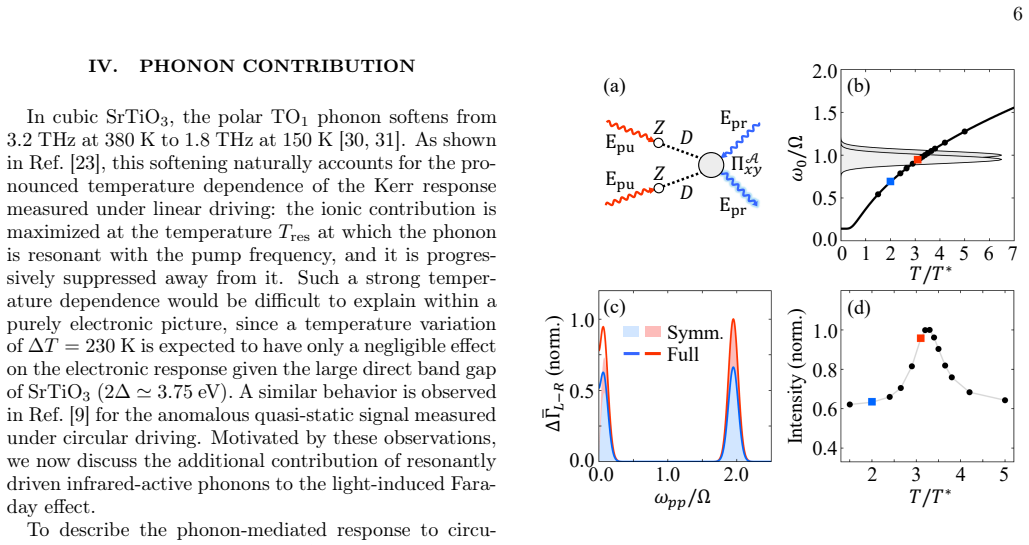
- Resonant phonon coupling provides an additional channel to enhance the pump-probe response.
- The mechanism challenges interpretations that link large rotations directly to effective magnetic fields.
Where Pith is reading between the lines
- Pump-probe rotation data in other materials may need re-examination as possible nonlinear optical effects rather than magnetic ones.
- Similar dynamical symmetry breaking could appear in higher-order nonlinear responses in different crystal structures.
- The effect suggests routes for all-optical polarization control that avoid magnetic materials entirely.
Load-bearing premise
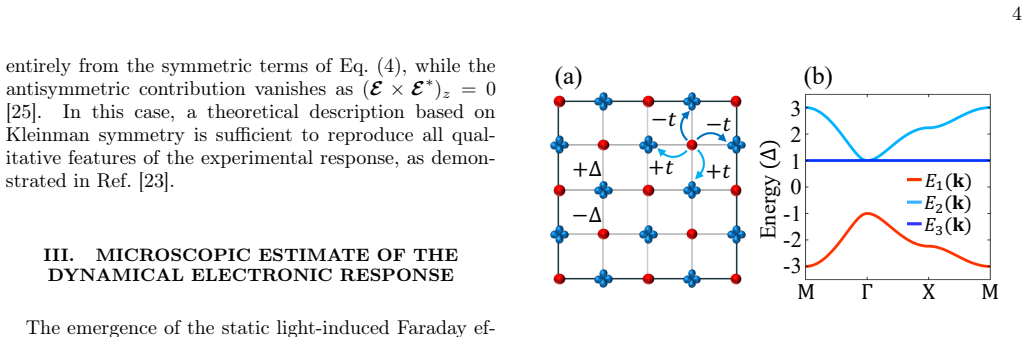
The minimal sp tight-binding model on a square lattice is sufficient to demonstrate that the light-induced Faraday response remains sizable far from dissipative resonances.
What would settle it
Measure the polarization rotation in the model or a real material while tuning parameters to restore Kleinman symmetry and check whether the static rotation disappears.
Figures
read the original abstract
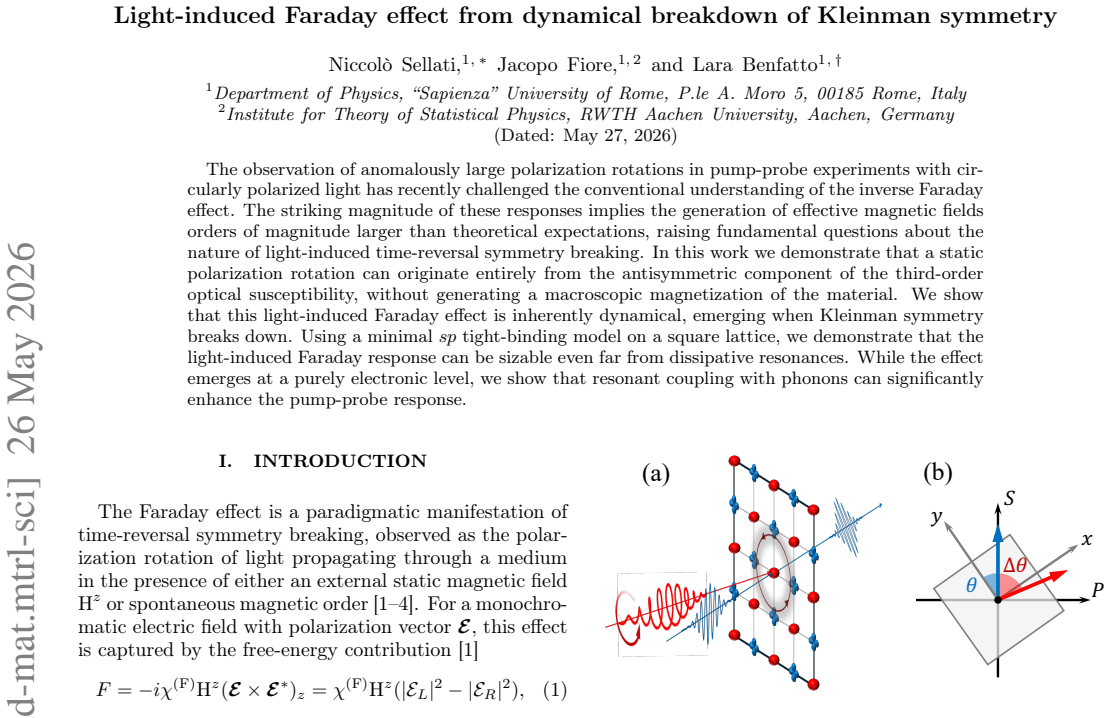
The observation of anomalously large polarization rotations in pump-probe experiments with circularly polarized light has recently challenged the conventional understanding of the inverse Faraday effect. The striking magnitude of these responses implies the generation of effective magnetic fields orders of magnitude larger than theoretical expectations, raising fundamental questions about the nature of light-induced time-reversal symmetry breaking. In this work we demonstrate that a static polarization rotation can originate entirely from the antisymmetric component of the third-order optical susceptibility, without generating a macroscopic magnetization of the material. We show that this light-induced Faraday effect is inherently dynamical, emerging when Kleinman symmetry breaks down. Using a minimal sp tight-binding model on a square lattice, we demonstrate that the light-induced Faraday response can be sizable even far from dissipative resonances. While the effect emerges at a purely electronic level, we show that resonant coupling with phonons can significantly enhance the pump-probe response.
Editorial analysis
A structured set of objections, weighed in public.
Referee Report
Summary. The manuscript claims that a static polarization rotation can arise purely from the antisymmetric component of the third-order optical susceptibility χ^(3) when Kleinman symmetry breaks down dynamically, without any macroscopic magnetization. This light-induced Faraday effect is demonstrated in a minimal sp tight-binding model on a square lattice, where the pump-probe response remains sizable even far from dissipative resonances; resonant phonon coupling is shown to provide further enhancement.
Significance. If substantiated, the result supplies an electronic mechanism for anomalously large polarization rotations seen in circularly polarized pump-probe experiments, decoupling the rotation from effective magnetic fields and highlighting the role of higher-order susceptibilities. The purely electronic demonstration together with the phonon-enhancement pathway constitutes a concrete, falsifiable prediction that can be tested against existing data.
major comments (2)
- [§3] §3 (tight-binding model and response calculation): the assertion that the antisymmetric response remains sizable far from resonances is shown only for the minimal nearest-neighbor sp square-lattice Hamiltonian; no quantitative comparison is given to next-nearest-neighbor terms, multi-orbital extensions, or the continuum limit, leaving open whether the magnitude survives when additional scattering channels or realistic band dispersions are restored.
- [§4] §4 (phonon-coupling section): the enhancement of the pump-probe Faraday signal by resonant phonons is presented without explicit values for the electron-phonon matrix elements or the resulting change in the antisymmetric χ^(3) components, so the claim that phonon coupling “significantly” enhances the response cannot be assessed for load-bearing impact on the central electronic mechanism.
minor comments (3)
- [Abstract/Introduction] The abstract and introduction cite “anomalously large polarization rotations” but do not reference the specific experimental works whose magnitudes are being addressed; adding these citations would clarify the target observables.
- [Theory section] Notation for the symmetric and antisymmetric parts of χ^(3) is introduced without an explicit decomposition (e.g., via permutation of frequency indices); a short equation defining the antisymmetric projector would improve readability.
- [Figures] Figure captions for the response spectra do not state the pump intensity, detuning range, or lattice constant used; these parameters are needed to reproduce the plotted magnitudes.
Simulated Author's Rebuttal
We thank the referee for the positive evaluation of the significance of our work and for the constructive comments on the tight-binding model and phonon-coupling sections. We address each major comment below.
read point-by-point responses
-
Referee: [§3] §3 (tight-binding model and response calculation): the assertion that the antisymmetric response remains sizable far from resonances is shown only for the minimal nearest-neighbor sp square-lattice Hamiltonian; no quantitative comparison is given to next-nearest-neighbor terms, multi-orbital extensions, or the continuum limit, leaving open whether the magnitude survives when additional scattering channels or realistic band dispersions are restored.
Authors: The minimal nearest-neighbor sp tight-binding model is deliberately selected to isolate the dynamical Kleinman symmetry breaking and compute the resulting antisymmetric χ^(3) without extraneous parameters. The sizable far-from-resonance response is a direct numerical outcome within this controlled setting. We agree that quantitative checks against next-nearest-neighbor terms or multi-orbital extensions would be informative, but such extensions lie beyond the scope of the present manuscript, whose goal is to establish the mechanism. In the revision we will add a short paragraph explaining the rationale for the minimal model and noting that the effect originates from symmetry considerations expected to persist in more realistic dispersions. revision: partial
-
Referee: [§4] §4 (phonon-coupling section): the enhancement of the pump-probe Faraday signal by resonant phonons is presented without explicit values for the electron-phonon matrix elements or the resulting change in the antisymmetric χ^(3) components, so the claim that phonon coupling “significantly” enhances the response cannot be assessed for load-bearing impact on the central electronic mechanism.
Authors: We appreciate the referee highlighting the need for quantitative detail. The phonon section employs a model electron-phonon coupling to illustrate resonant enhancement of the antisymmetric susceptibility. In the revised manuscript we will explicitly state the numerical values of the electron-phonon matrix elements employed and report the resulting percentage changes in the relevant χ^(3) components, allowing direct assessment of the enhancement magnitude. revision: yes
Circularity Check
No circularity; derivation self-contained in model calculation
full rationale
The paper computes the antisymmetric component of the third-order susceptibility and resulting static polarization rotation directly from the equations of motion in a minimal sp tight-binding Hamiltonian on the square lattice. No step equates the target observable to a fitted parameter, renames a known result, or reduces the central claim to a self-citation whose content is itself unverified. The demonstration that the response remains sizable far from resonances is an explicit model output, not a tautology, and the phonon-enhancement statement is presented as an additional perturbative effect rather than a definitional necessity.
Axiom & Free-Parameter Ledger
axioms (1)
- domain assumption Kleinman symmetry can break down dynamically in the third-order optical response of the material
Reference graph
Works this paper leans on
-
[1]
#$(norm.)(d) 0.02.0Ω/Δ0.0 1.52.0𝜔/Δ (c)1.00.51.51.00.5 0.00.5>1.0𝜒!
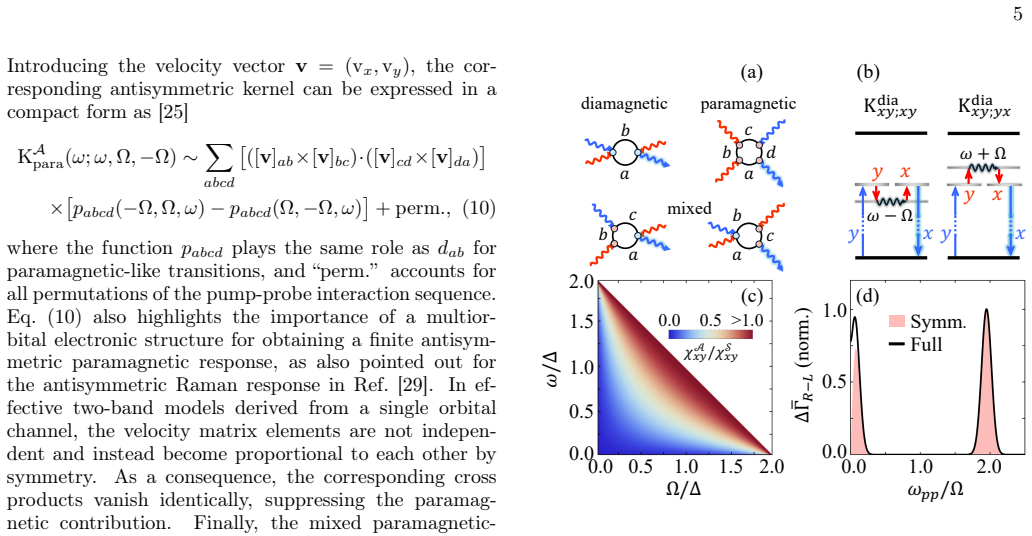
By using this decomposition in Eq. (4) we see that the symmetric field combinations generate oscillations at±2Ω, whereas the antisymmetric component generates a static response. By Fourier transforming the differential signal with re- spect to the pump-probe delay,∆Γ(t pp)→∆ ¯Γ(ωpp), and taking a monochromatic probe at frequencyω, the second-harmonic resp...
-
[2]
P. S. Pershan, Phys. Rev.130, 919 (1963)
1963
-
[3]
J. P. van der Ziel, P. S. Pershan, and L. D. Malmstrom, Phys. Rev. Lett.15, 190 (1965)
1965
-
[4]
P. S. Pershan, J. P. van der Ziel, and L. D. Malmstrom, Phys. Rev.143, 574 (1966)
1966
-
[5]
Kimel, A
A. Kimel, A. Kirilyuk, P. Usachev, R. Pisarev, A. Bal- bashov, and T. Rasing, Nature435, 655 (2005)
2005
-
[6]
M. J. Freiser, IEEE Transactions on Magnetics4, 152 (1968)
1968
-
[7]
G. R. Fowles and D. W. Lynch, American Journal of Physics36, 770 (1968)
1968
-
[8]
Kirilyuk, A
A. Kirilyuk, A. V. Kimel, and T. Rasing, Rev. Mod. Phys.82, 2731 (2010)
2010
-
[9]
R. V. Mikhaylovskiy, E. Hendry, and V. V. Kruglyak, Phys. Rev. B86, 100405 (2012)
2012
-
[10]
Basini, M
M. Basini, M. Pancaldi, B. Wehinger, M. Udina, V. Unikandanunni, T. Tadano, M. C. Hoffmann, A. V. Balatsky, and S. Bonetti, Nature628, 534 (2024)
2024
-
[11]
Davies, F
C. Davies, F. Fennema, A. Tsukamoto, I. Razdolski, A. Kimel, and A. Kirilyuk, Nature628, 540 (2024)
2024
-
[12]
D. M. Juraschek, M. Fechner, A. V. Balatsky, and N. A. Spaldin, Phys. Rev. Mater.1, 014401 (2017)
2017
-
[13]
D. M. Juraschek and N. A. Spaldin, Phys. Rev. Mater. 3, 064405 (2019)
2019
-
[14]
D. M. Juraschek, P. Narang, and N. A. Spaldin, Phys. Rev. Res.2, 043035 (2020)
2020
-
[15]
D. M. Juraschek, T. c. v. Neuman, and P. Narang, Phys. Rev. Res.4, 013129 (2022)
2022
-
[16]
Shabala and R
N. Shabala and R. M. Geilhufe, Phys. Rev. Lett.133, 266702 (2024)
2024
-
[17]
Balatsky, and T
L.Klebl, A.Schobert, M.Eckstein, G.Sangiovanni, A.V. Balatsky, and T. O. Wehling, Phys. Rev. Lett.134, 016705 (2025)
2025
-
[18]
C. P. Romao and D. M. Juraschek, Nature628, 505 (2024)
2024
-
[19]
D. A. B. Lopez, W. Hu, and D. M. Juraschek, Phys. Rev. B112, 144306 (2025)
2025
-
[20]
Nonadiabatic Theory of Phonon Magnetic Moments in Insulators and Metals
H. Chen, W. Chen, K. Yang, T. Cao, and D. Xiao, “Nonadiabatic theory of phonon magnetic moments in insulators and metals,” (2026), arXiv:2605.06983 [cond- mat.mes-hall]
work page internal anchor Pith review Pith/arXiv arXiv 2026
-
[21]
Merlin, Phys
R. Merlin, Phys. Rev. B110, 094312 (2024)
2024
-
[22]
Merlin, PNAS Nexus4, pgaf002 (2025)
R. Merlin, PNAS Nexus4, pgaf002 (2025)
2025
-
[23]
R. W. Boyd, inNonlinear Optics (Fourth Edition)(Aca- demic Press, 2020) fourth edition ed., pp. 1–64
2020
-
[24]
Basini, M
M. Basini, M. Udina, M. Pancaldi, V. Unikandanunni, S. Bonetti, and L. Benfatto, Phys. Rev. B109, 024309 (2024)
2024
-
[25]
Jiménez, N
E. Jiménez, N. Mikuszeit, J. L. F. Cuñado, P. Perna, J. Pedrosa, D. Maccariello, C. Rodrigo, M. A. Niño, A. Bollero, J. Camarero, and R. Miranda, Review of Scientific Instruments85, 053904 (2014)
2014
-
[26]
See Supplemental Information for the derivation of the differential intensity at generic sample orientation for linearly and circularly polarized monochromatic light; the derivation of the differential intensity for frequency- mismatched monochromatic and Gaussian pumps; de- tails of the calculations of the antisymmetric kernel in the spmodel; and details...
-
[27]
Fiore, N
J. Fiore, N. Sellati, M. Udina, and L. Benfatto, Phys. Rev. B113, 174524 (2026)
2026
-
[28]
Benfatto, A
L. Benfatto, A. Toschi, and S. Caprara, Phys. Rev. B 69, 184510 (2004)
2004
-
[29]
Udina, T
M. Udina, T. Cea, and L. Benfatto, Phys. Rev. B100, 165131 (2019)
2019
-
[30]
Udina and I
M. Udina and I. Paul, Phys. Rev. Lett.136, 126505 (2026). 9
2026
-
[31]
Vogt, Phys
H. Vogt, Phys. Rev. B51, 8046 (1995)
1995
-
[32]
Y. Yamada and G. Shirane, Journal of the Physical Society of Japan26, 396 (1969), https://doi.org/10.1143/JPSJ.26.396
-
[33]
Cappelluti, L
E. Cappelluti, L. Benfatto, and A. B. Kuzmenko, Phys. Rev. B82, 041402 (2010)
2010
-
[34]
Cappelluti, L
E. Cappelluti, L. Benfatto, M. Manzardo, and A. B. Kuzmenko, Phys. Rev. B86, 115439 (2012)
2012
-
[35]
Bistoni, P
O. Bistoni, P. Barone, E. Cappelluti, L. Benfatto, and F. Mauri, 2D Materials6, 045015 (2019)
2019
-
[36]
Resta, Rev
R. Resta, Rev. Mod. Phys.66, 899 (1994)
1994
-
[37]
Y. Deng, Y. Du, M. Zhang, J. Han, and Z. Yin, Solid State Communications135, 221 (2005)
2005
-
[38]
Huber, S
L. Huber, S. F. Maehrlein, F. Wang, Y. Liu, and X.- Y. Zhu, The Journal of Chemical Physics154, 094202 (2021)
2021
-
[39]
S. F. Maehrlein, P. P. Joshi, L. Huber, F. Wang, M. Cherasse, Y. Liu, D. M. Juraschek, E. Mosconi, D. Meggiolaro, F. D. Angelis, and X.-Y. Zhu, Pro- ceedings of the National Academy of Sciences118, e2022268118 (2021)
2021
-
[40]
Frenzel, M
M. Frenzel, M. Cherasse, J. M. Urban, F. Wang, B. Xiang, L. Nest, L. Huber, L. Perfetti, M. Wolf, T. Kampfrath, X.-Y. Zhu, and S. F. Maehrlein, Science Advances9, eadg3856 (2023)
2023
-
[41]
Sapienza
N. Sellati, J.Fiore, S.P.Villani, L. Benfatto, andM. Ud- ina, npj Quantum Materials10, 46 (2025). 10 Dynamical time-reversal symmetry breaking from Kleinman symmetry breakdown - Supplemental Material Niccolò Sellati1, Jacopo Fiore1,2, Lara Benfatto1 1Department of Physics, “Sapienza” University of Rome, P.le A. Moro 5, 00185 Rome, Italy 2Institute for The...
2025
discussion (0)
Sign in with ORCID, Apple, or X to comment. Anyone can read and Pith papers without signing in.