Identifying and designing altermagnetic crystals in real space
Pith reviewed 2026-06-29 16:55 UTC · model grok-4.3
The pith
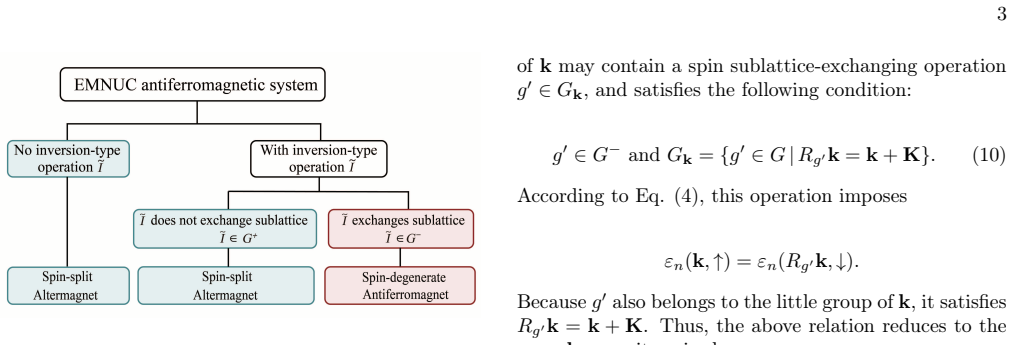
Altermagnetic spin splitting occurs unless an inversion-type operation exchanges opposite-spin sublattices in collinear compensated antiferromagnets with matching primitive cells.
A machine-rendered reading of the paper's core claim, the machinery that carries it, and where it could break.
Core claim
For collinear compensated antiferromagnets whose magnetic primitive cell coincides with the host nonmagnetic crystallographic primitive cell, altermagnetic spin splitting is generally allowed unless an inversion-type operation exists that exchanges the two opposite-spin sublattices. First-principles calculations on representative materials confirm the criterion. Similar rules apply to low-dimensional crystals or quasicrystals.
What carries the argument
The permutation of the two opposite-spin sublattices under the crystallographic operations of the host nonmagnetic structure.
If this is right
- Identification of altermagnetism reduces to checking whether any inversion-type operation swaps the two opposite-spin sublattices.
- The test applies equally to centrosymmetric and noncentrosymmetric materials in the chosen class.
- The same real-space logic supplies a design rule for engineering altermagnetic crystals.
- Analogous rules can be used for low-dimensional crystals and quasicrystals.
Where Pith is reading between the lines
- The criterion may speed up database searches for candidate altermagnets by using only the nonmagnetic structure.
- It could be tested for generalization to antiferromagnets where magnetic and nonmagnetic cells do not coincide.
- The approach connects to symmetry-based design of spintronic materials that require zero net magnetization.
Load-bearing premise
That the cell-coincidence condition together with the sublattice-permutation rule is enough to decide the presence of altermagnetic spin splitting without full magnetic space group analysis.
What would settle it
A material in this class that has an inversion-type operation exchanging the sublattices but still shows exchange-driven spin splitting in first-principles calculations or experiment.
Figures
read the original abstract
Altermagnetism is a compensated magnetic phase characterized by zero net magnetization and exchange-driven spin splitting. However, identifying altermagnets among collinear antiferromagnets usually requires full magnetic-space-group or spin-group analysis, which is not intuitive. Here we formulate a simple real-space criterion based on how the crystallographic operations of the host nonmagnetic structure permute the two opposite-spin sublattices. For simplicity, we focus on collinear compensated antiferromagnets whose magnetic primitive cell coincides with the host nonmagnetic crystallographic primitive cell. In this class, altermagnetic spin splitting is generally allowed unless an inversion-type operation exists that exchanges the two opposite-spin sublattices. First-principles calculations on representative noncentrosymmetric and centrosymmetric materials demonstrate this criterion. Similar rules can also be applied to low-dimensional crystals or quasicrystals. Our work reduces the identification of altermagnetism to a transparent real-space symmetry test and provides a practical route for discovering altermagnetic crystals.
Editorial analysis
A structured set of objections, weighed in public.
Referee Report
Summary. The manuscript formulates a real-space criterion for altermagnetism in the restricted class of collinear compensated antiferromagnets whose magnetic primitive cell coincides with the nonmagnetic crystallographic primitive cell. It states that exchange-driven spin splitting is generally allowed unless an inversion-type crystallographic operation exchanges the two opposite-spin sublattices, derived from how nonmagnetic space-group operations permute the sublattices. The criterion is demonstrated via first-principles calculations on selected noncentrosymmetric and centrosymmetric examples and is suggested to extend to low-dimensional crystals and quasicrystals.
Significance. If the criterion holds within its stated scope, it provides a transparent, intuitive alternative to full magnetic-space-group or spin-group analysis for identifying altermagnets, which could facilitate materials discovery. The first-principles verification on representative cases supplies concrete support, and the absence of free parameters or fitted quantities strengthens the approach as a direct consequence of symmetry.
major comments (2)
- [§2] The central claim that spin splitting is allowed unless an inversion-type operation exchanges the sublattices (§2, criterion statement) rests on the assumption that no other magnetic-space-group elements (e.g., rotations or reflections combined with time reversal) can enforce degeneracy within the restricted class; the manuscript should supply an explicit argument or exhaustive check that such elements are either absent or do not forbid splitting when primitive cells coincide.
- [Table 1] Table 1 (or equivalent summary of first-principles results): the reported spin-splitting magnitudes for the chosen representatives are presented without error bars, k-point convergence tests, or comparison to full magnetic-space-group predictions, leaving open whether the examples fully validate the 'generally allowed' statement or merely avoid counterexamples.
minor comments (2)
- [Abstract] The abstract and introduction use 'inversion-type operation' without a precise definition (e.g., whether it includes rotoinversions); a short clarifying sentence would improve readability.
- [Figure 2] Figure 2 (schematic of sublattice permutation): the arrows indicating spin directions are not labeled with the magnetic propagation vector, which could confuse readers unfamiliar with the restricted class.
Simulated Author's Rebuttal
We thank the referee for the positive assessment of the work and for the constructive comments. We address each major point below and will revise the manuscript to strengthen the presentation.
read point-by-point responses
-
Referee: [§2] The central claim that spin splitting is allowed unless an inversion-type operation exchanges the sublattices (§2, criterion statement) rests on the assumption that no other magnetic-space-group elements (e.g., rotations or reflections combined with time reversal) can enforce degeneracy within the restricted class; the manuscript should supply an explicit argument or exhaustive check that such elements are either absent or do not forbid splitting when primitive cells coincide.
Authors: We agree that an explicit justification is required. Within the restricted class (magnetic primitive cell identical to the crystallographic one), the magnetic space group is generated exclusively by the nonmagnetic space-group operations acting on the two sublattices with opposite spins; any additional element involving time reversal is either redundant with a pure crystallographic operation or cannot enforce k-space degeneracy beyond the inversion-type case already excluded by the criterion. We will insert a concise paragraph in §2 deriving this from the definition of the class and the action of the operations on the sublattices, without requiring an exhaustive enumeration of all possible MSG elements. revision: yes
-
Referee: [Table 1] Table 1 (or equivalent summary of first-principles results): the reported spin-splitting magnitudes for the chosen representatives are presented without error bars, k-point convergence tests, or comparison to full magnetic-space-group predictions, leaving open whether the examples fully validate the 'generally allowed' statement or merely avoid counterexamples.
Authors: We accept that additional numerical validation is needed. In the revised manuscript we will add k-point convergence tests, estimated error bars on the reported spin-splitting values, and a direct comparison of the first-principles results against the spin-splitting pattern predicted by the full magnetic space group for each example. These additions will be placed in the caption or a new supplementary table. revision: yes
Circularity Check
No significant circularity; derivation is symmetry-based and self-contained
full rationale
The paper derives its real-space criterion directly from the action of crystallographic symmetry operations on opposite-spin sublattices within the restricted class where magnetic and nonmagnetic primitive cells coincide. This is an independent symmetry argument, not a fit, not a renaming of a known result, and not dependent on self-citation chains or ansatzes imported from prior work by the same authors. First-principles checks on examples serve as external validation rather than input. No load-bearing step reduces to the target claim by construction.
Axiom & Free-Parameter Ledger
axioms (1)
- domain assumption Focus is restricted to collinear compensated antiferromagnets whose magnetic primitive cell coincides with the host nonmagnetic crystallographic primitive cell.
Reference graph
Works this paper leans on
-
[1]
Both materials are non- centrosymmetric, with crystallographic point groupsC6v andD 2d, respectively
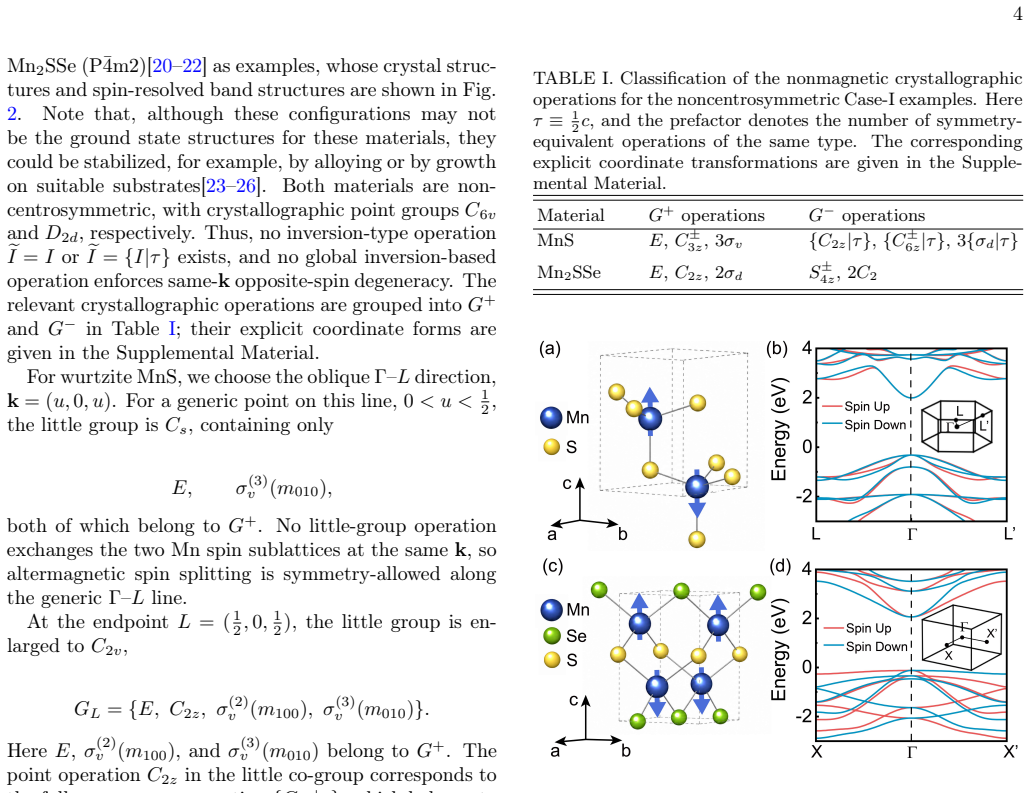
Note that, although these configurations may not be the ground state structures for these materials, they could be stabilized, for example, by alloying or by growth on suitable substrates[23–26]. Both materials are non- centrosymmetric, with crystallographic point groupsC6v andD 2d, respectively. Thus, no inversion-type operation eI=Ior eI={I|τ}exists, an...
-
[2]
Šmejkal, J
L. Šmejkal, J. Sinova, and T. Jungwirth, Beyond conven- tional ferromagnetism and antiferromagnetism: A phase with nonrelativistic spin and crystal rotation symmetry, Physical Review X12, 031042 (2022)
2022
-
[3]
Šmejkal, J
L. Šmejkal, J. Sinova, and T. Jungwirth, Emerging re- search landscape of altermagnetism, Physical Review X 12, 040501 (2022)
2022
-
[4]
S. S. Fender, O. Gonzalez, and D. K. Bediako, Altermag- netism: A chemical perspective, Journal of the American Chemical Society147, 2257 (2025)
2025
-
[5]
Belashchenko, Giant strain-induced spin splitting ef- fect in MnTe, a g-wave altermagnetic semiconductor, Physical Review Letters134, 086701 (2025)
K. Belashchenko, Giant strain-induced spin splitting ef- fect in MnTe, a g-wave altermagnetic semiconductor, Physical Review Letters134, 086701 (2025)
2025
-
[6]
Reimers, L
S. Reimers, L. Odenbreit, L. Šmejkal, V. N. Strocov, P. Constantinou, A. B. Hellenes, R. Jaeschke Ubiergo, W. H. Campos, V. K. Bharadwaj, A. Chakraborty, T. Denneulin, W. Shi, R. E. Dunin-Borkowski, S. Das, M. Kläui, J. Sinova, and M. Jourdan, Direct observation ofaltermagneticbandsplittinginCrSbthinfilms,Nature Communications15, 2116 (2024)
2024
-
[7]
Hayami, Y
S. Hayami, Y. Yanagi, and H. Kusunose, Momentum- dependent spin splitting by collinear antiferromagnetic ordering, Journal of the Physical Society of Japan88, 123702 (2019)
2019
-
[8]
Zhang, P
X. Zhang, P. Jiang, L.-Y. Xu, L. Wang, L. Liu, H.-M. Huang, T. Cao, and Y.-L. Li, Giant spin splitting and anisotropic spin polarization in 2D altermagnet Cr2O, Nano Letters25, 16547 (2025)
2025
-
[9]
L. Bai, W. Feng, S. Liu, L. Šmejkal, Y. Mokrousov, and Y.Yao,Altermagnetism: Exploringnewfrontiersinmag- netism and spintronics, Advanced Functional Materials 34, 2409327 (2024)
2024
-
[10]
S. Lee, S. Lee, S. Jung, J. Jung, D. Kim, Y. Lee, B. Seok, J. Kim, B. G. Park, L. Šmejkal, C.-J. Kang, and C. Kim, Broken Kramers degeneracy in altermag- netic MnTe, Physical Review Letters132, 036702 (2024)
2024
-
[11]
Šmejkal, R
L. Šmejkal, R. González-Hernández, T. Jungwirth, and J. Sinova, Crystal time-reversal symmetry breaking and spontaneousHalleffectincollinearantiferromagnets,Sci- ence Advances6, eaaz8809 (2020)
2020
-
[12]
Z. Wang, R. Wu, C. Ma, S. Gong, C. Zhao, S. Zhang, G. Wang, T. Wang, and Y. An, Symmetry-constrained anomalous transport in the altermagnetic material CuX2 (X = F, Cl), Chinese Physics Letters42, 080705 (2025)
2025
-
[13]
W. Chen, L. Zeng, and W. Zhu, Helicity-controlled spin Hall angle in 2D altermagnets with Rashba spin-orbit coupling, Chinese Physics Letters42, 017201 (2025)
2025
-
[14]
Zeng and Y.-J
S. Zeng and Y.-J. Zhao, Description of two-dimensional altermagnetism: Categorization using spin group theory, Physical Review B110, 054406 (2024)
2024
-
[15]
S. V. Gallego, E. S. Tasci, G. de la Flor, J. M. Perez- Mato, and M. I. Aroyo, Magnetic symmetry in the Bil- bao Crystallographic Server: a computer program to pro- vide systematic absences of magnetic neutron diffraction, Journal of Applied Crystallography45, 1236 (2012)
2012
-
[16]
C. J. Bradley and A. P. Cracknell,The Mathematical Theory Of Symmetry In Solids: Representation theory for point groups and space groups(Oxford University Press, Oxford, 2009)
2009
-
[17]
Z.-F. Gao, S. Qu, B. Zeng, Y. Liu, J.-R. Wen, H. Sun, P.- J. Guo, and Z.-Y. Lu, AI-accelerated discovery of alter- magneticmaterials,NationalScienceReview12,nwaf066 (2025)
2025
-
[18]
Y. Guo, H. Liu, O. Janson, I. C. Fulga, J. van den Brink, and J. I. Facio, Spin-split collinear antiferromagnets: A large-scale ab-initio study, Materials Today Physics32, 100991 (2023)
2023
-
[19]
Cheong and F.-T
S.-W. Cheong and F.-T. Huang, Altermagnetism classi- fication, npj Quantum Materials10, 38 (2025)
2025
-
[20]
L.-D. Yuan, Z. Wang, J.-W. Luo, E. I. Rashba, and A. Zunger, Giant momentum-dependent spin splitting in centrosymmetric low-Z antiferromagnets, Physical Re- view B102, 014422 (2020)
2020
-
[21]
H. Mavani, M. Elekhtiar, K. Huang, N. A. Sha- hed, and E. Y. Tsymbal, Competing antiferromagnetic phases in multiferroic wurtzite transition-metal chalco- genides, Physical Review Materials (to be published), doi:10.1103/fr1l-q5qs
-
[22]
Corliss, N
L. Corliss, N. Elliott, and J. Hastings, Magnetic struc- tures of the polymorphic forms of manganous sulfide, Physical Review104, 924 (1956)
1956
-
[23]
B. J. Stanbery, S. Kincal, S. Kim, C. H. Chang, S. P. Ahrenkiel, G. Lippold, H. Neumann, T. J. Anderson, and O. D. Crisalle, Epitaxial growth and characterization of CuInSe2 crystallographic polytypes, Journal of Applied Physics91, 3598 (2002)
2002
-
[24]
Wei and A
S.-H. Wei and A. Zunger, Alloy-stabilized semiconduct- ing and magnetic zinc-blende phase of MnTe, Physical Review Letters56, 2391 (1986)
1986
-
[25]
Wei and A
S.-H. Wei and A. Zunger, Total-energy and band- structure calculations for the semimagnetic Cd1−xMnxTe semiconductor alloy and its binary constituents, Physical Review B35, 2340 (1987)
1987
-
[26]
Froyen, S.-H
S. Froyen, S.-H. Wei, and A. Zunger, Epitaxy-induced structural phase transformations, Physical Review B38, 10124 (1988)
1988
-
[27]
Janotti and S.-H
A. Janotti and S.-H. Wei, Computational design of a ma- terial for high-efficiency spin-polarized electron source, Applied Physics Letters81, 3957 (2002)
2002
-
[28]
W. Han, X. Yan, Y. Liu, H. Fu, M. Sun, X. Li, D. Wang, L. Yang, and X. Qu, A planar Fe 2B monolayer with room temperature antiferromagnetism, Physical Chem- istry Chemical Physics27, 10867 (2025)
2025
-
[29]
https://next-gen.materialsproject.org/materials
-
[30]
https://github.com/qiushihuang1998/irep-for- atomicand-band
-
[31]
Kahal, A
L. Kahal, A. Zaoui, and M. Ferhat, Magnetic proper- ties of CrSb: A first-principle study, Journal of Applied Physics101, 9 (2007)
2007
-
[32]
S. Giri and N. Ganguli, Strain as a topological selector in altermagnetic CrSb, arXiv:2601.15916 (2026)
discussion (0)
Sign in with ORCID, Apple, or X to comment. Anyone can read and Pith papers without signing in.