Dyck language and fermionic second quantization: II. Applications
Pith reviewed 2026-06-29 15:00 UTC · model grok-4.3
The pith
The supplemented Dyck language determines signed expectation values of fermionic operator chains for vacuum and determinant states.
A machine-rendered reading of the paper's core claim, the machinery that carries it, and where it could break.
Core claim
By mapping creation and annihilation operators (or pairs of them) to a supplemented bracket alphabet, the combinatorial properties of Dyck words directly fix the nullity and the signed value of the expectation of any chain of fermionic second-quantization operators with respect to the physical vacuum or a single-determinant reference.
What carries the argument
Translation of fermionic creation and annihilation operators into a supplemented bracket alphabet whose Dyck words encode the surviving contractions.
If this is right
- Catalan numbers count the non-vanishing terms once vanishing contributions are removed by the Dyck criterion.
- Sufficient conditions for a vanishing expectation value are read directly from the bracket sequence.
- The diagrammatic extension reproduces the signatures given by Wick's theorem for fully contracted terms.
- The translation applies to nested commutators that contain at least one excitation or deexcitation operator.
Where Pith is reading between the lines
- The combinatorial test could be automated to screen large numbers of operator strings before any algebraic expansion.
- The bracket representation may link to other combinatorial encodings used in many-body perturbation theory.
- Software realization of the algorithm indicates that the method is intended for repeated practical evaluation of fermionic matrix elements.
Load-bearing premise
The operator-to-bracket mapping preserves the algebraic contraction rules of the fermionic algebra closely enough that Dyck-word combinatorics control the nullity and signs of the expectations.
What would settle it
Take any concrete chain of creation and annihilation operators, form its bracket word, and compare the nullity or sign predicted by the Dyck criterion against the result obtained from direct application of Wick's theorem.
Figures
read the original abstract
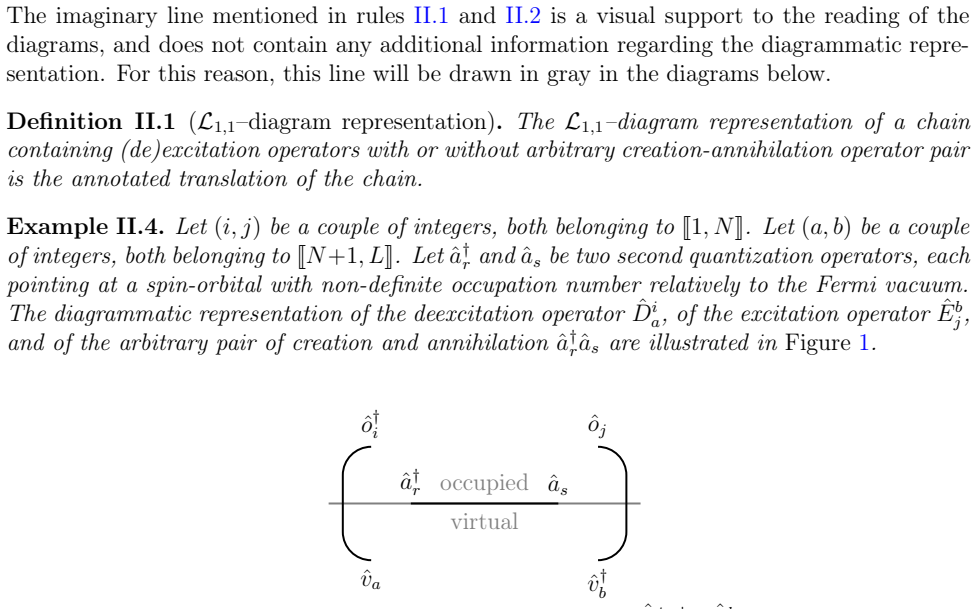
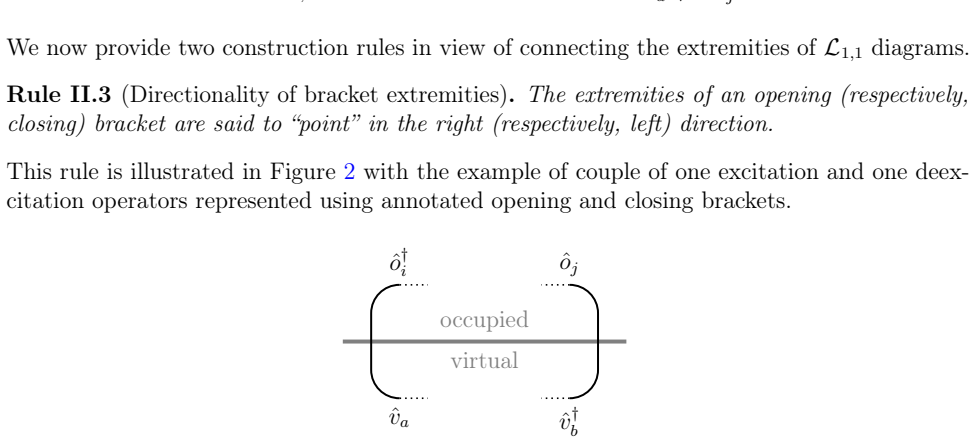
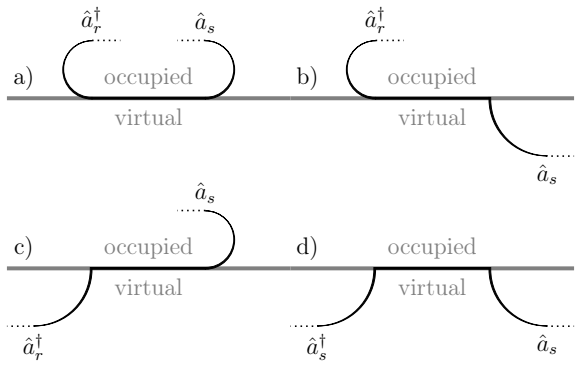
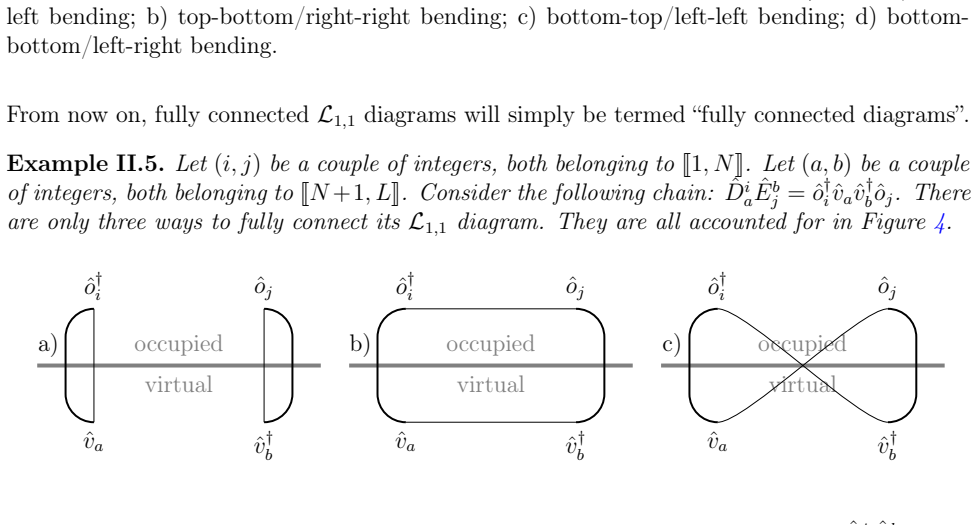
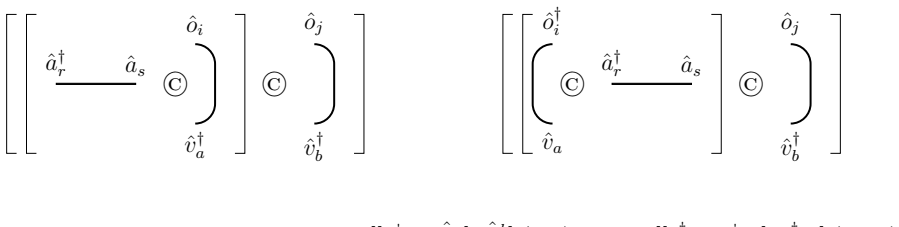
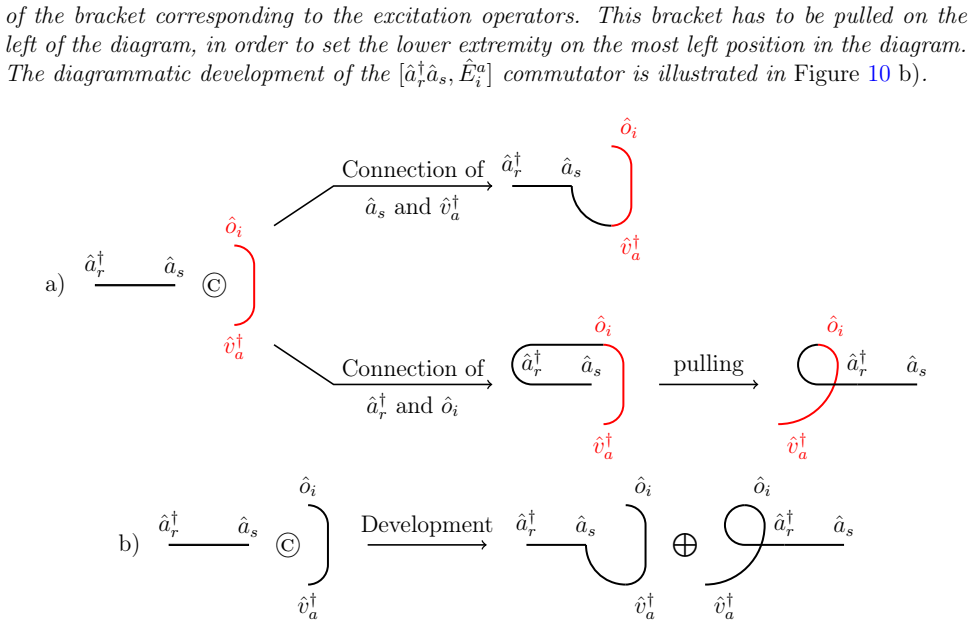
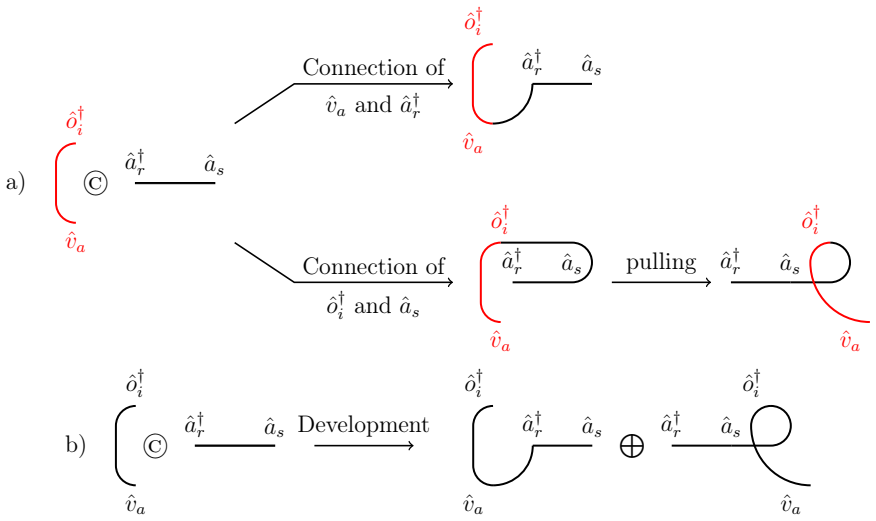
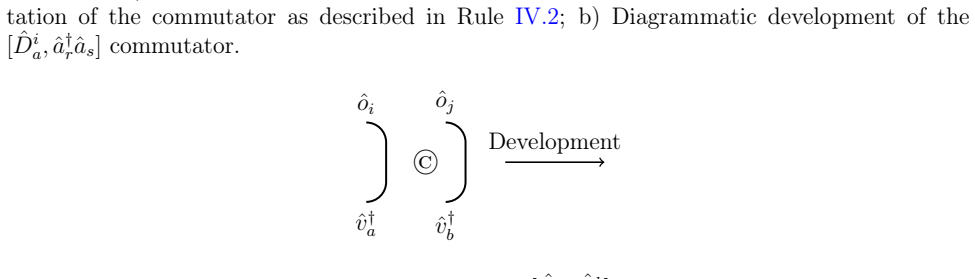
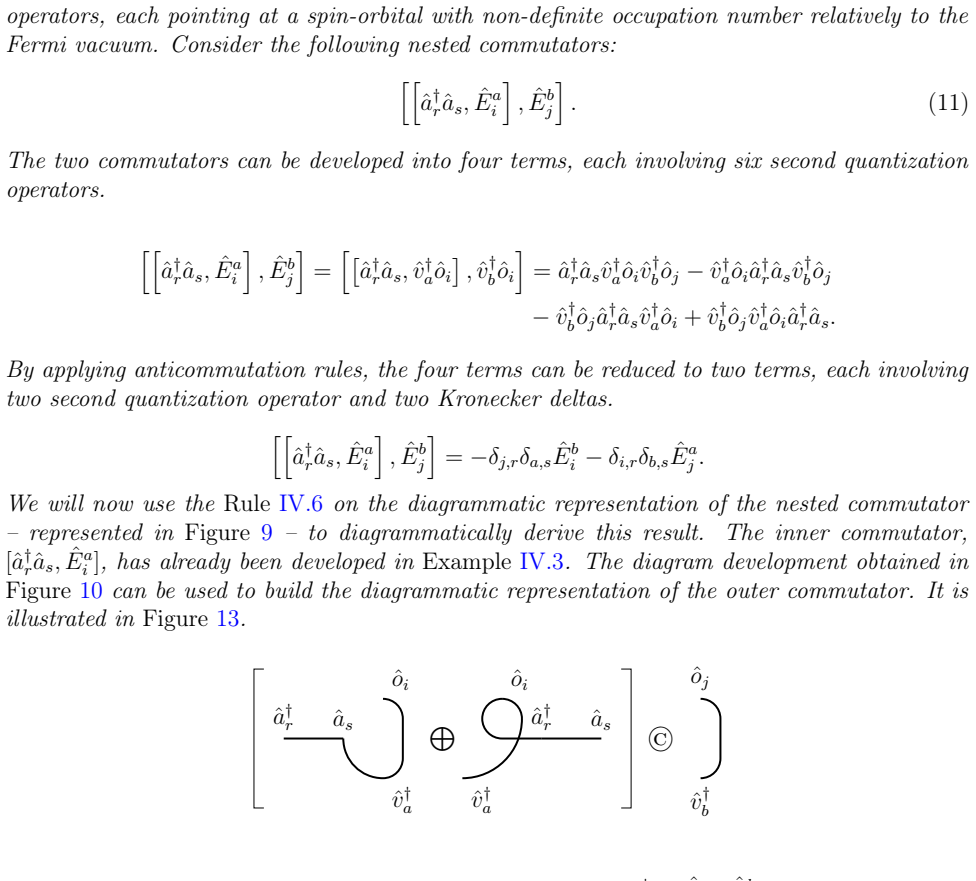
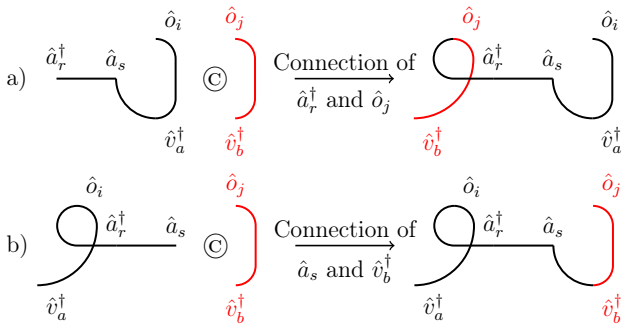
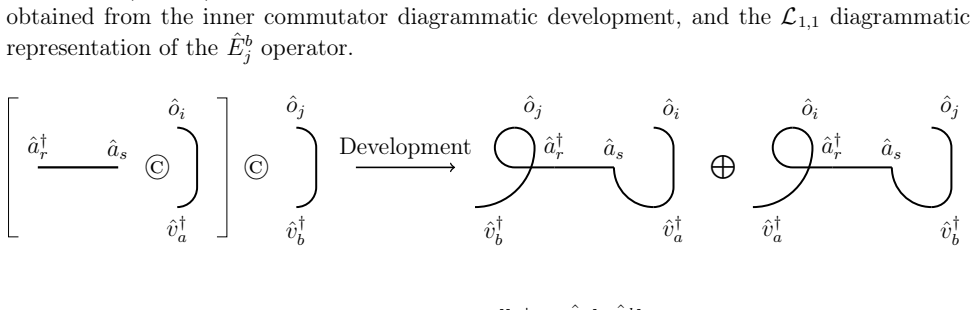
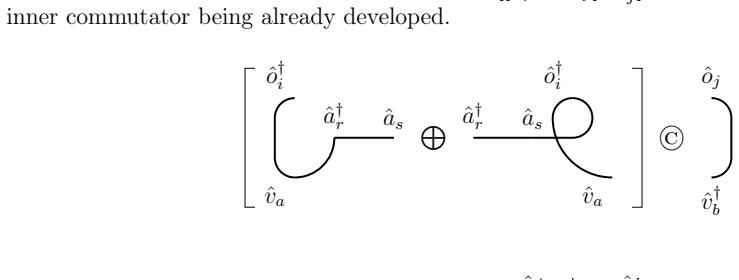
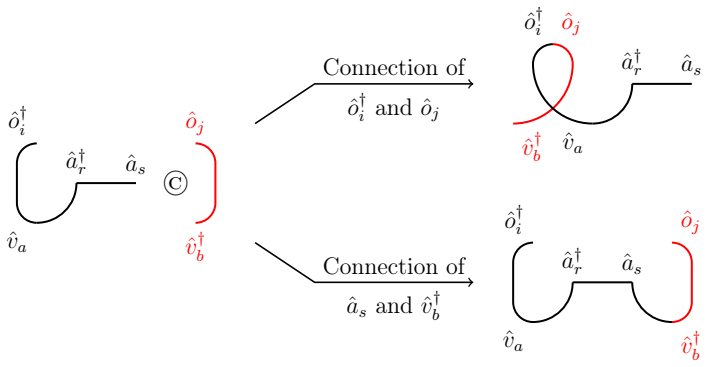
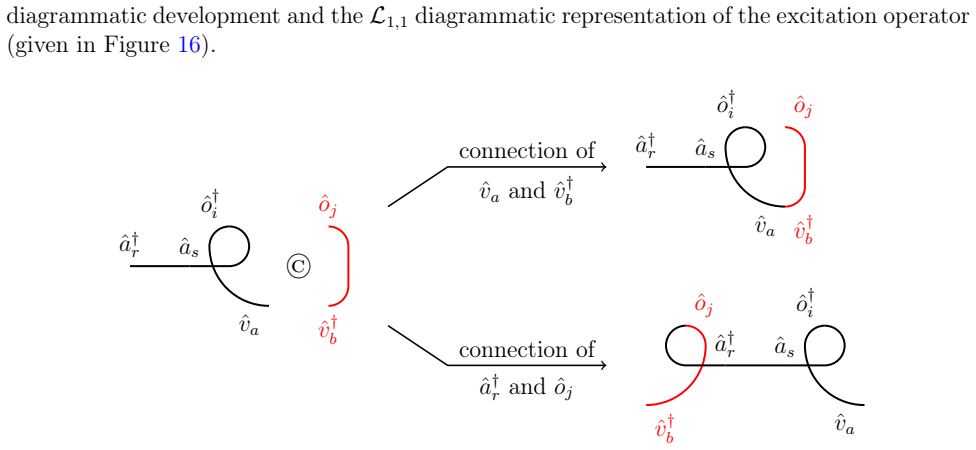
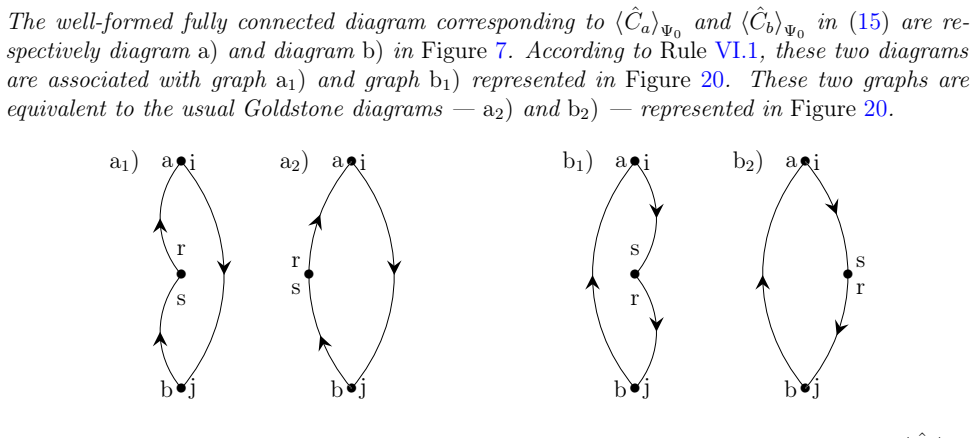
In this work, we establish a direct connection between supplemented Dyck language and the signed expectation value of chains of second quantization operators relatively to the physical vacuum and relatively to a one-determinant state. Inspired by the fact that Dyck language provides an example of the emergence of the Catalan numbers in linguistic framework analysis, we show that these numbers are central when numbering the terms remaining when eliminating vanishing contributions detected by our application of Dyck language to fermionic second quantization. From the translation of creation and annihilation operator - or of pairs of operators - into a bracket alphabet, we derive simple and intuitive sufficient conditions for the nullity of expectation values that does not require an explicit application of Wick's theorem. This is done here with respect to the physical vacuum or relatively to a one-determinant state. We also extend this translation into a diagrammatic framework that allows a visual determination of the signature of fully contracted terms, reproducing the results of Wick's theorem. This approach has been extended to the case of (nested) commutators of pairs of fermionic second quantization including at least one excitation or deexcitation operator. Our results have been implemented in a software, MobiDyck, whose source code is freely available on the web. The algorithmic approach inspired by our work on Dyck language is detailed in this paper. Finally, a comparison of our diagrammatic approach with Goldstone diagrams is provided and closes the article.
Editorial analysis
A structured set of objections, weighed in public.
Referee Report
Summary. The manuscript establishes a direct mapping from fermionic creation/annihilation operators (or pairs) to a supplemented bracket alphabet drawn from Dyck language. This mapping is used to derive sufficient combinatorial conditions for the nullity of vacuum and one-determinant expectation values without explicit application of Wick's theorem, to count surviving terms via Catalan numbers, and to construct a diagrammatic representation that reproduces Wick signatures. The framework is extended to nested commutators containing at least one excitation or de-excitation operator, implemented in the freely available MobiDyck code, and compared side-by-side with Goldstone diagrams.
Significance. If the operator-to-bracket translation preserves the algebraic contraction rules, the work supplies an independent, visually intuitive route to identifying vanishing contributions and signs in fermionic expectation values. The open-source implementation and explicit Goldstone comparison provide concrete verification paths and may prove useful in simplifying diagrammatic expansions in quantum chemistry.
major comments (2)
- [§3] §3 (operator-to-bracket translation): the manuscript asserts that the supplemented alphabet preserves the contraction rules sufficiently for Dyck-word combinatorics to determine nullity, but does not exhibit an explicit side-by-side check of a four-operator vacuum expectation value against the standard Wick expansion; such a check is load-bearing for the central claim.
- [§5] §5 (extension to nested commutators): the sufficient nullity conditions are stated to carry over, yet the text provides no worked example of a commutator containing both an excitation and a de-excitation operator whose vanishing is predicted by the Dyck criterion but would require explicit Wick application to confirm.
minor comments (3)
- [§2] The abstract and introduction both mention “supplemented Dyck language” without a concise definition or reference to the precise alphabet augmentation; a short definitional paragraph early in §2 would improve readability.
- [Figures] Figure captions for the diagrammatic examples do not state the operator string being represented, making it difficult to cross-check the claimed signature against the bracket sequence.
- [Implementation section] The MobiDyck code repository is cited but the manuscript does not indicate which version or commit was used to generate the numerical examples shown.
Simulated Author's Rebuttal
We thank the referee for the careful reading, positive assessment of significance, and constructive major comments. We address each point below and will revise the manuscript accordingly.
read point-by-point responses
-
Referee: [§3] §3 (operator-to-bracket translation): the manuscript asserts that the supplemented alphabet preserves the contraction rules sufficiently for Dyck-word combinatorics to determine nullity, but does not exhibit an explicit side-by-side check of a four-operator vacuum expectation value against the standard Wick expansion; such a check is load-bearing for the central claim.
Authors: We agree that an explicit side-by-side verification strengthens the central claim. In the revised manuscript we will add a worked example of a four-operator vacuum expectation value, presenting both the Dyck-based determination of nullity (including Catalan-number counting of surviving terms) and the corresponding standard Wick expansion with explicit contractions and signs for direct comparison. revision: yes
-
Referee: [§5] §5 (extension to nested commutators): the sufficient nullity conditions are stated to carry over, yet the text provides no worked example of a commutator containing both an excitation and a de-excitation operator whose vanishing is predicted by the Dyck criterion but would require explicit Wick application to confirm.
Authors: We acknowledge that a concrete worked example would clarify the extension. The revised manuscript will include a specific nested commutator containing both an excitation and a de-excitation operator, showing the Dyck criterion prediction of vanishing together with the explicit Wick expansion that confirms the result. revision: yes
Circularity Check
No significant circularity; derivation rests on independent Dyck combinatorics
full rationale
The paper maps creation/annihilation operators (or pairs) to a supplemented bracket alphabet and uses Dyck-word properties to obtain sufficient conditions for nullity of vacuum or one-determinant expectation values, plus a diagrammatic reproduction of Wick signatures. No quoted step reduces a claimed prediction or uniqueness result to a fitted parameter, self-citation chain, or definitional tautology. The central translation is presented as preserving contraction rules by construction of the alphabet, with verification supplied by runnable MobiDyck code and side-by-side Goldstone comparison; these constitute external checks rather than circular inputs. The derivation chain therefore remains self-contained against the stated combinatorial rules.
Axiom & Free-Parameter Ledger
Reference graph
Works this paper leans on
-
[1]
Wiley, Hoboken, 2014
Trygve Helgaker, Poul Jørgensen, and Jeppe Olsen.Molecular Electronic-Structure Theory. Wiley, Hoboken, 2014
2014
-
[2]
On the Use of the Cluster Expansion and the Technique of Diagrams in Cal- culations of Correlation Effects in Atoms and Molecules
Jiří Čížek. On the Use of the Cluster Expansion and the Technique of Diagrams in Cal- culations of Correlation Effects in Atoms and Molecules. In R. LeFebvre and C. Moser, editors,Advances in Chemical Physics, volume 14, pages 35–89. Wiley, 1 edition, January 1969
1969
-
[3]
On the Correlation Problem in Atomic and Molecular Systems
Jiří Čížek. On the Correlation Problem in Atomic and Molecular Systems. Calculation of Wavefunction Components in Ursell-Type Expansion Using Quantum-Field Theoretical Methods.The Journal of Chemical Physics, 45(11):4256–4266, December 1966
1966
-
[4]
Čižek and J
J. Čižek and J. Paldus. Correlation problems in atomic and molecular systems III. Red- erivation of the coupled-pair many-electron theory using the traditional quantum chemical methodst.International Journal of Quantum Chemistry, 5(4):359–379, July 1971
1971
-
[5]
Bartlett.Many-body methods in chemistry and physics: MBPT and coupled-cluster theory
Isaiah Shavitt and Rodney J. Bartlett.Many-body methods in chemistry and physics: MBPT and coupled-cluster theory. Cambridge molecular science. Cambridge University Press, Cambridge New York, 2009
2009
-
[6]
Paldus, J
J. Paldus, J. Čížek, and I. Shavitt. Correlation Problems in Atomic and Molecular Sys- tems. IV. Extended Coupled-Pair Many-Electron Theory and Its Application to the B H 3 Molecule.Physical Review A, 5(1):50–67, January 1972
1972
-
[7]
Adaptive multiconfigurational wave functions
Francesco A. Evangelista. Adaptive multiconfigurational wave functions.The Journal of Chemical Physics, 140(12):124114, March 2014. arXiv:1403.4117 [physics]
work page internal anchor Pith review Pith/arXiv arXiv 2014
-
[8]
Lyakh and Rodney J
Dmitry I. Lyakh and Rodney J. Bartlett. An adaptive coupled-cluster theory: @CC approach.The Journal of Chemical Physics, 133(24):244112, December 2010
2010
-
[9]
G. C. Wick. The Evaluation of the Collision Matrix.Physical Review, 80(2):268–272, October 1950
1950
-
[10]
Springer Berlin Heidel- berg, Berlin, Heidelberg, 1986
Ingvar Lindgren and John Morrison.Atomic Many-Body Theory. Springer Berlin Heidel- berg, Berlin, Heidelberg, 1986
1986
-
[11]
Surján.Second quantized approach to quantum chemistry: an elementary intro- duction: with 11 figures
Péter R. Surján.Second quantized approach to quantum chemistry: an elementary intro- duction: with 11 figures. Springer-Verlag, Berlin Heidelberg New York London Paris Tokyo Hong Kong, softcover reprint of the hardcover 1st edition 1989 edition, 1989
1989
-
[12]
E. K. U. Gross, Erich Runge, Olle Heinonen, and E. K. U. Gross.Many-particle theory. Hilger, Bristol, 1991
1991
-
[13]
Normal order and extended Wick theo- rem for a multiconfiguration reference wave function.The Journal of Chemical Physics, 107(2):432–449, July 1997
Werner Kutzelnigg and Debashis Mukherjee. Normal order and extended Wick theo- rem for a multiconfiguration reference wave function.The Journal of Chemical Physics, 107(2):432–449, July 1997
1997
-
[14]
Stephen Wilson and Geerd H. F. Diercksen, editors.Methods in Computational Molecular Physics, volume 293 ofNATO ASI Series. Springer US, Boston, MA, 1992
1992
-
[15]
Derivation of the Brueckner many-body theory
J Goldstone. Derivation of the Brueckner many-body theory. 239(1217):267–279, February 1957
1957
-
[16]
Mattuck.A guide to Feynman diagrams in the many-body problem
Richard D. Mattuck.A guide to Feynman diagrams in the many-body problem. Dover pub, New York, 2nd ed edition, 1992. 28
1992
-
[17]
Ostlund.Modern quantum chemistry: introduction to advanced electronic structure theory
Attila Szabo and Neil S. Ostlund.Modern quantum chemistry: introduction to advanced electronic structure theory. Dover Publications, Inc, Mineola, New York, 2012
2012
-
[18]
Hugenholtz
N.M. Hugenholtz. Perturbation theory of large quantum systems.Physica, 23(1-5):481– 532, January 1957
1957
-
[19]
Kucharski and Rodney J
Stanislaw A. Kucharski and Rodney J. Bartlett. Fifth-Order Many-Body Perturbation Theory and Its Relationship to Various Coupled-Cluster Approaches. InAdvances in Quantum Chemistry, volume 18, pages 281–344. Elsevier, 1986
1986
-
[20]
Daniel Crawford and Henry F
T. Daniel Crawford and Henry F. Schaefer. An Introduction to Coupled Cluster Theory for Computational Chemists. In Kenny B. Lipkowitz and Donald B. Boyd, editors,Reviews in Computational Chemistry, volume 14, pages 33–136. Wiley, 1 edition, January 2000
2000
-
[21]
Compact textbooks in mathemat- ics
Steven Roman.An introduction to catalan numbers. Compact textbooks in mathemat- ics. Birkhäuser, Cham Heidelberg New York Dordrecht London, softcover reprint of the hardcover 1st edition 2015 edition, 2015
2015
-
[22]
J. H. Conway and N. J. A. Sloane. Low–dimensional lattices. VII. Coordination sequences. Proceedings of the Royal Society of London. Series A: Mathematical, Physical and Engi- neering Sciences, 453(1966):2369–2389, November 1997
1966
-
[23]
Ac- cessed: 2026-05-25
Jérémy Morere.MobiDyck.https://github.com/Jeremy-Morere/MobiDyck, 2026. Ac- cessed: 2026-05-25
2026
-
[24]
Ac- cessed: 2026-03-12
Eugene DePrince.pdaggerq.https://github.com/edeprince3/pdaggerq/, 2025. Ac- cessed: 2026-03-12. 29
2025
discussion (0)
Sign in with ORCID, Apple, or X to comment. Anyone can read and Pith papers without signing in.