REVIEW 2 major objections 2 minor 5 references
The Coverage Illusion: From Pre-retrieval Routing Failure to Post-retrieval Cascades in a Production RAG System
T0 review · 2 major / 2 minor · reviewed 2026-06-29 · grok-4.3
Pith's one-line read Pre-retrieval routing cannot detect when LLM augmentation is needed in RAG systems because that requirement appears only after the index is searched.
desk verdict The paper flags a real synthetic-real query gap in RAG that blocks pre-retrieval fixes and offers a simple post-retrieval cascade, but the whole argument sits on an unvalidated internal deferral policy. read the letter →
The pith
A machine-rendered reading of the paper's core claim, the machinery that carries it, and where it could break.
The reading
What carries the argument
The Coverage Illusion, the structural mismatch between synthetic and real query distributions that makes the requirement for LLM augmentation visible only after retrieval has occurred.
What would settle it
An experiment in which a classifier trained only on query text features predicts the need for LLM augmentation with accuracy comparable to the post-retrieval cascade on held-out production traffic.
Extended reading notes
Core claim
Synthetic queries suggest LLM augmentation is needed for over 90 percent of queries to achieve high retrieval coverage, but under the production deferral policy only 27.8 percent of real user queries require it. Pre-retrieval routing cannot resolve this gap because the need for augmentation is revealed only after searching the index, a result confirmed by evaluation of four machine learning paradigms. This motivates a post-retrieval cascade that runs workflows in cheapest-first order and escalates to LLM augmentation only when a step returns no documents.
Load-bearing premise
The production deferral policy and the chosen composite quality metric correctly mark the queries for which LLM augmentation is truly required rather than when cheaper workflows would suffice.
Editorial extensions
If this is right
- The cascade improves composite quality by 0.140 points over Always-HyDE.
- The cascade reduces end-to-end latency by 31.8 percent.
- The cascade serves 72.2 percent of real user queries without any LLM augmentation.
- The cascade requires no training data or secondary serving infrastructure.
Reading between the lines
- The same cheapest-first escalation pattern could be applied to other RAG domains whose synthetic test sets overstate augmentation needs.
- If the coverage gap is common, many existing pre-retrieval routers may be operating on unrepresentative data and therefore under-delivering on cost savings.
- Measuring the gap on a second production corpus would test whether the illusion is specific to encyclopedic queries or general to retrieval-augmented systems.
Editorial analysis
A structured set of objections, weighed in public.
Referee Report
Summary. The paper presents a production case study of the Danish National Encyclopedia RAG system. It identifies a 'Coverage Illusion' in which synthetic queries indicate that LLM augmentation (e.g., HyDE) is required for >90% of queries to achieve high retrieval coverage, yet a production deferral policy applied to 20,000 real query-workflow pairs flags only 27.8% as needing augmentation. The authors attribute the gap to distributional mismatch, demonstrate that four ML paradigms cannot predict the need from the query alone (confirming it is revealed only post-retrieval), and propose a cheapest-first post-retrieval cascade that improves a composite quality metric by +0.140, reduces latency by 31.8%, and avoids LLM augmentation for 72.2% of real queries.
Significance. If the central empirical claims hold, the work supplies concrete production-traffic evidence that pre-retrieval routing is fundamentally limited for coverage decisions in RAG and that post-retrieval cascades can deliver measurable quality-latency gains without additional training or serving infrastructure. The scale of the evaluation (20k pairs) and the direct comparison of synthetic versus real distributions are strengths that could inform practical RAG design.
major comments (2)
- [Abstract / ML evaluation] Abstract and the section describing the ML evaluation: the claim that 'pre-retrieval routing cannot resolve this gap' rests on four ML paradigms failing to predict labels generated by the production deferral policy and composite quality metric. Because those labels are the sole source of supervision, the result shows only that the models cannot reproduce the policy, not that the underlying coverage need is undetectable pre-retrieval. No external validation (human judgments, alternative policies, or ablation of the metric) is reported.
- [Abstract / Results on real traffic] The paragraph reporting the 27.8% real-query deferral rate and the 90% synthetic figure: the production deferral policy is used both to label the data and to define the 'need' for augmentation. Without an independent criterion (e.g., human-rated answer quality or coverage measured against a held-out gold set), it is unclear whether the policy over- or under-flags cases where augmentation is genuinely required versus where cheaper workflows suffice.
minor comments (2)
- [Abstract] The abstract states concrete percentages and improvements but supplies no methodological details on how the composite quality metric is computed, what the four ML paradigms are, or the exact rules for the deferral policy.
- [Results] No error bars, confidence intervals, or statistical significance tests are mentioned for the reported +0.140 quality gain or 31.8% latency reduction.
Simulated Author's Rebuttal
We thank the referee for the constructive feedback on our production case study. The comments highlight important distinctions between operational definitions in our system and broader claims about pre-retrieval predictability. We address each point below and propose targeted revisions to the abstract and ML evaluation section for greater precision.
read point-by-point responses
-
Referee: [Abstract / ML evaluation] Abstract and the section describing the ML evaluation: the claim that 'pre-retrieval routing cannot resolve this gap' rests on four ML paradigms failing to predict labels generated by the production deferral policy and composite quality metric. Because those labels are the sole source of supervision, the result shows only that the models cannot reproduce the policy, not that the underlying coverage need is undetectable pre-retrieval. No external validation (human judgments, alternative policies, or ablation of the metric) is reported.
Authors: We agree that the ML results demonstrate failure to reproduce the specific labels produced by the production deferral policy rather than an exhaustive proof that coverage needs are undetectable under every conceivable definition. The policy itself is post-retrieval (triggered only after index search returns zero documents), and the four paradigms were trained on query-only features to predict those post-retrieval decisions. Their consistent failure across paradigms supports our narrower claim that the operational coverage decisions in this production system are not resolvable from the query alone. We will revise the abstract and ML section to state explicitly that 'the decisions of the production deferral policy cannot be predicted pre-retrieval' and to note the absence of external validation as a limitation of the current study. revision: partial
-
Referee: [Abstract / Results on real traffic] The paragraph reporting the 27.8% real-query deferral rate and the 90% synthetic figure: the production deferral policy is used both to label the data and to define the 'need' for augmentation. Without an independent criterion (e.g., human-rated answer quality or coverage measured against a held-out gold set), it is unclear whether the policy over- or under-flags cases where augmentation is genuinely required versus where cheaper workflows suffice.
Authors: The 27.8% and >90% figures are both measured under the same production deferral policy, which serves as the system's operational definition of when augmentation is applied. This policy was already deployed in production and is driven by the composite quality metric (coverage plus downstream factors). The central empirical observation is therefore the large distributional mismatch between synthetic and real queries under this fixed policy, not an assertion that the policy is the uniquely correct definition of need. We acknowledge that independent human-rated quality judgments are not reported in the study and will add an explicit limitations paragraph noting this. The post-retrieval cascade result, however, is measured directly against the same composite metric and shows measurable gains without relying on the ML prediction task. revision: partial
- Independent human judgments or alternative gold-standard coverage metrics to externally validate the production deferral policy are not available within the current study.
Circularity Check
No significant circularity detected
full rationale
The paper's derivation rests on direct empirical comparisons between synthetic query conditions (claiming >90% need for LLM augmentation) and real production traffic under the stated deferral policy (27.8% deferral), plus an independent evaluation of four ML paradigms attempting to predict deferral labels from pre-retrieval query features. No equations, fitted parameters renamed as predictions, self-citations, or ansatzes appear in the provided text. The claim that pre-retrieval routing cannot resolve the gap is supported by the ML evaluation results rather than reducing to a definitional loop; the policy functions as an operational benchmark for the production system, and the ML test constitutes an external check on predictability rather than a self-referential confirmation. The overall chain is self-contained against the reported production and synthetic benchmarks.
Assumptions & free parameters
Cite this review
Pith. "Pith review of The Coverage Illusion: From Pre-retrieval Routing Failure to Post-retrieval Cascades in a Production RAG System." pith.science (2026). https://pith.science/paper/5MNRZARS
@misc{pith2026260527220,
  author       = {Pith},
  title        = {Pith review of: The Coverage Illusion: From Pre-retrieval Routing Failure to Post-retrieval Cascades in a Production RAG System},
  year         = {2026},
  howpublished = {\url{https://pith.science/paper/5MNRZARS}},
  note         = {Machine review of arXiv:2605.27220}
}
read the original abstract
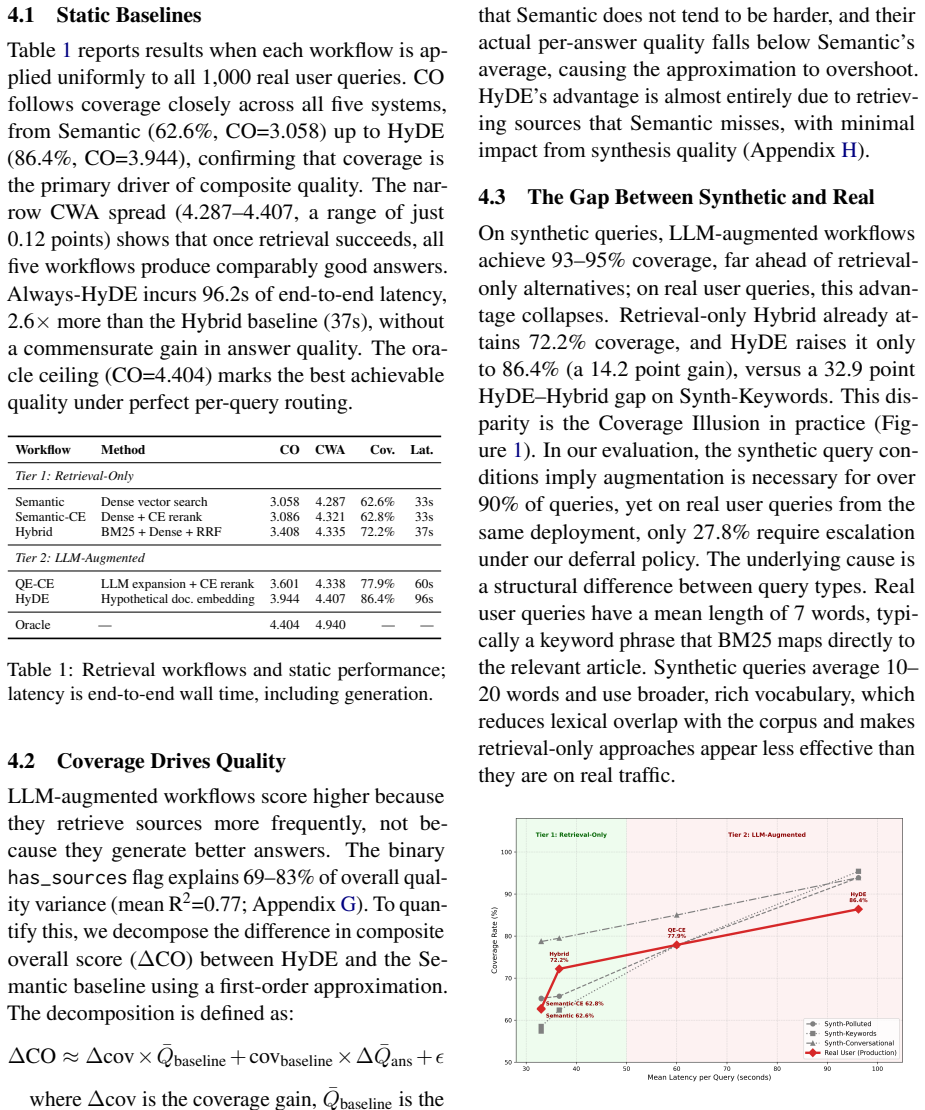
In modern RAG pipelines, query augmentation methods such as HyDE and query expansion are applied to every query, resulting in substantial LLM inference costs and increased end-to-end latency. The empirical justification for this overhead in real production traffic remains largely unexplored. We present a case study of the Danish National Encyclopedia, evaluating five retrieval workflows over 20,000 query-workflow pairs from production traffic and synthetic conditions. In this system, synthetic queries suggest that LLM augmentation is needed for over 90% of queries to achieve high retrieval coverage. However, under our production deferral policy, only 27.8% of real user queries need LLM augmentation. We call this gap the Coverage Illusion and attribute it to a structural mismatch between synthetic and real query distributions. Pre-retrieval routing cannot resolve this gap, as the need for LLM augmentation is only revealed after searching the index, a result confirmed by our evaluation of four machine learning paradigms. The coverage gap, undetectable from the query alone, motivates a post-retrieval cascade that runs workflows in cheapest-first order and escalates to LLM augmentation only when a step returns no documents. Operating entirely without training overhead or secondary serving infrastructure, the cascade improves quality by +0.140 Composite Overall points over Always-HyDE, reduces latency by 31.8%, and serves 72.2% of real user queries without LLM augmentation.
Figures


Figures from the paper (2 more)


Reference graph
Works this paper leans on
-
[1]
InAAAI Conference on Artificial Intelligence
Benchmarking large language models in retrieval-augmented generation. InAAAI Conference on Artificial Intelligence. Gordon V . Cormack, Charles L. A. Clarke, and Stefan Büttcher. 2009. Reciprocal rank fusion outperforms condorcet and individual rank learning methods.Pro- ceedings of the 32nd international ACM SIGIR con- ference on Research and development...
-
[2]
No sources retrieved
Qwen3 technical report. Jiarui Zhang, Xiangyu Liu, Yong Hu, Chaoyue Niu, Fan Wu, and Guihai Chen. 2026. RAGRouter: Learn- ing to route queries to multiple retrieval-augmented language models. InThe Thirty-ninth Annual Con- ference on Neural Information Processing Systems. A Query Generation Prompts The following prompts produced the three syn- thetic quer...
2026
-
[3]
FAITHFULNESS: Is every claim in the answer supported by the sources? Evaluation steps: - Extract the main claims from the answer - For each claim, check whether it is explicitly supported by the sources Scoring: 5: All claims are fully supported by the sources, no hallucination 4: Mostly supported, only minor unsupported details 3: Partially supported, so...
-
[4]
Acknowledging a limitation is not the same as answering the question
ANSWER_RELEVANCE: Does the answer correctly and fully answer the question? Evaluation steps: - Identify what the question is asking for - Check whether the answer addresses ALL key parts - Penalize missing, vague, or indirect responses IMPORTANT: If the answer says it cannot find the information, cannot help, or explains that the sources do not contain th...
-
[5]
No sources retrieved
RETRIEVAL_QUALITY: How relevant are the retrieved sources to the question? Evaluation steps: - If NO SOURCES retrieved: ALWAYS score 1 ("No sources retrieved") - If sources provided: * Determine whether the sources are directly about the topic * Assess whether they contain the information needed to answer * Ignore redundancy; focus only on relevance Scori...
Reviewed June 29, 2026 · model on record in the stance chip above.
Discussion (0). Continue with ORCID to comment.