Symbolic Regression via Latent Iterative Refinement
Pith reviewed 2026-06-29 18:23 UTC · model grok-4.3
The pith
LEE closes the amortization gap in neural symbolic regression through iterative refinement in a functionally grounded latent space.
A machine-rendered reading of the paper's core claim, the machinery that carries it, and where it could break.
Core claim
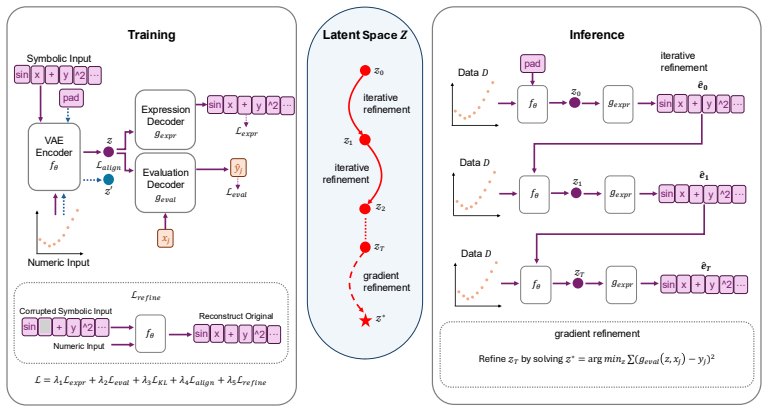
LEE equips a shared latent space Z with an encoder that jointly embeds symbolic tokens and observations, an expression decoder that reconstructs formulas from z, and an evaluation decoder that predicts function values from z. Inference performs iterative refinement by re-encoding decoded expressions jointly with the data; because the evaluation decoder is differentiable in z, the procedure also interleaves continuous gradient descent, turning the encoder itself into a learned optimizer that closes the amortization gap.
What carries the argument
Hybrid discrete-continuous refinement loop that uses the encoder for re-encoding steps and the differentiable evaluation decoder for gradient updates on z.
If this is right
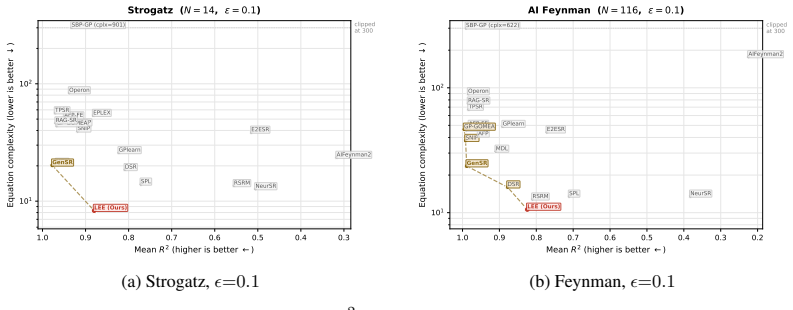
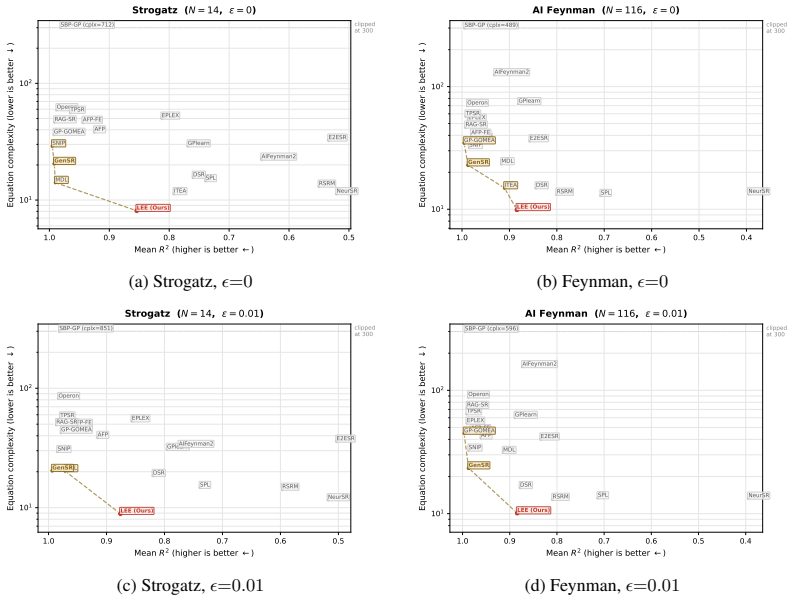
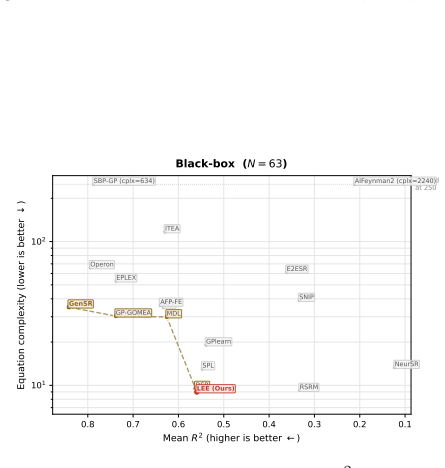
- LEE yields expressions 2-10 times simpler than the strongest accuracy-oriented baselines on SRBench at three noise levels.
- The method maintains competitive accuracy while occupying the low-complexity region of the accuracy-complexity Pareto frontier.
- Performance degrades gracefully rather than collapsing as noise increases.
- The same latent-space machinery works against genetic-programming, symbolic-neural hybrid, and pre-trained Transformer baselines.
Where Pith is reading between the lines
- The functional grounding via the evaluation decoder may generalize to other amortized program-synthesis tasks where one-shot predictors leave a similar gap.
- If the latent space remains well-behaved under larger expression vocabularies, the same refinement loop could scale beyond the current SRBench regime.
- Replacing the gradient steps with a second learned optimizer might further reduce the number of discrete re-encoding iterations required.
Load-bearing premise
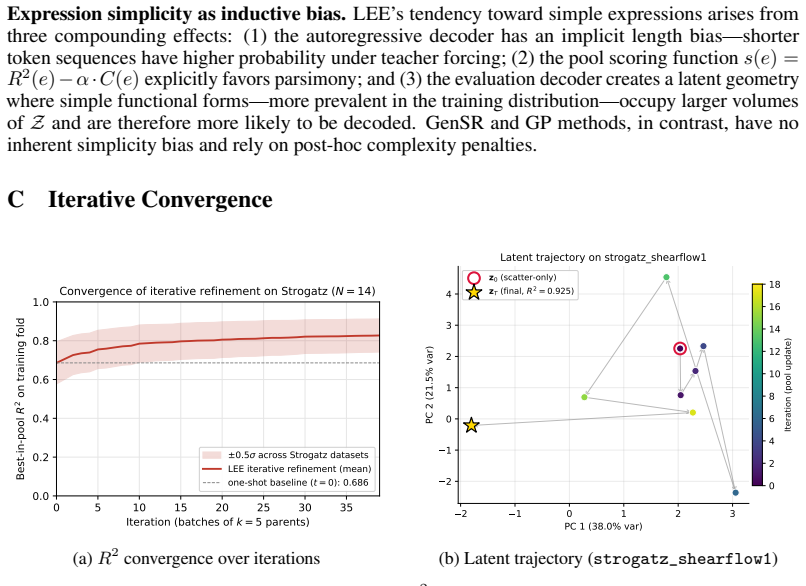
The method assumes that repeated re-encoding plus gradient steps on the evaluation decoder will reliably improve the latent estimate and converge to a better expression even when the initial one-shot prediction is noisy.
What would settle it
Measure whether accuracy and complexity stop improving after a fixed number of refinement iterations, or whether removing the gradient steps entirely produces the same final expressions as the full hybrid procedure.
Figures
read the original abstract
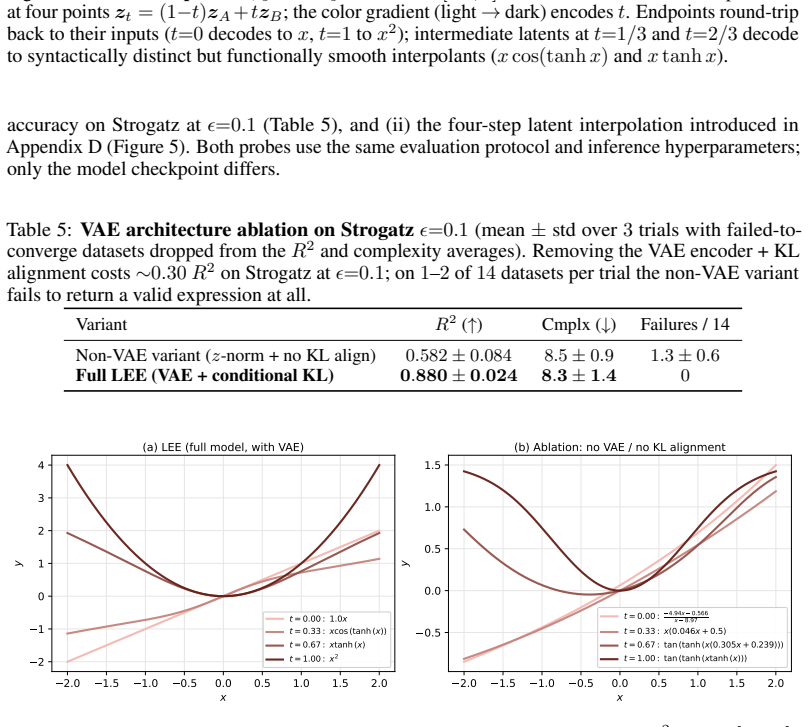
Symbolic regression (SR) seeks closed-form mathematical expressions that fit observed data. Neural SR methods amortize the search by training an encoder to map observations directly to expressions in a single pass, but this amortized inference leaves a residual amortization gap between its one-shot prediction and the true posterior. We propose Latent Equation Embedding (LEE), a framework that closes this gap through iterative amortized inference in a functionally grounded latent space. LEE learns a shared latent space Z equipped with three components: an encoder f_theta that jointly embeds symbolic tokens and numerical observations into a single latent vector z; an expression decoder g_expr that reconstructs formulas from z; and an evaluation decoder g_eval that predicts function values from z, explicitly grounding the latent space in functional behavior. At inference, LEE performs iterative refinement by re-encoding decoded expressions jointly with observations, progressively improving the latent estimate. LEE uses the encoder itself as a learned inference optimizer: each re-encoding step implicitly computes the mismatch between the candidate and the data. Because g_eval is differentiable in z, we additionally interleave continuous gradient descent with discrete re-encoding, yielding a hybrid iterative and gradient refinement procedure. On SRBench across three noise levels, against 19 baselines spanning genetic programming, symbolic-neural hybrids, and pre-trained Transformers, LEE produces expressions 2--10x simpler than the strongest accuracy-oriented baselines, including Operon, GP-GOMEA, TPSR, RAG-SR, and GenSR, with complexity 8--11 versus 20--90. These results advance the low-complexity region of the accuracy-complexity Pareto frontier and show graceful degradation as noise increases.
Editorial analysis
A structured set of objections, weighed in public.
Referee Report
Summary. The paper introduces Latent Equation Embedding (LEE) for symbolic regression. It trains an encoder f_θ to map observations and symbolic tokens to a latent vector z in a shared space Z, together with an expression decoder g_expr and a differentiable evaluation decoder g_eval that grounds z in functional behavior. At inference, LEE performs iterative amortized inference by re-encoding decoded expressions jointly with data and interleaving discrete re-encoding steps with continuous gradient descent on g_eval, using the encoder itself as a learned optimizer to close the amortization gap. On SRBench across three noise levels and against 19 baselines, LEE is reported to produce expressions with complexity 8--11 that are 2--10× simpler than the strongest accuracy-oriented methods while maintaining competitive accuracy.
Significance. If the empirical claims hold after verification, the hybrid discrete-continuous refinement procedure would constitute a meaningful advance in amortized neural symbolic regression by pushing the low-complexity region of the accuracy-complexity Pareto frontier and demonstrating graceful degradation under noise. The use of a functionally grounded latent space and the encoder-as-optimizer idea are technically interesting and could influence subsequent work on iterative inference for structured outputs.
major comments (3)
- [Abstract] Abstract: the central claim that hybrid refinement closes the amortization gap and produces the reported 2--10× simplicity gains rests on the assumption that re-encoding plus gradient steps on g_eval reliably improve z, yet the manuscript supplies no convergence analysis, no monitoring of latent norms or reconstruction error across iterations, and no ablation that isolates the iterative loop from the base encoder or decoder capacity.
- [Abstract] Abstract: the SRBench results (complexity 8--11 vs. 20--90 against Operon, GP-GOMEA, TPSR, RAG-SR, GenSR and 14 others) are presented without details on training procedure, loss functions for the three components, hyper-parameter choices, statistical significance testing, or exact baseline re-implementations, preventing assessment of whether post-hoc selection or implementation differences could explain the complexity numbers.
- [Abstract] The manuscript does not report per-iteration diagnostics or evidence that the latent space remains well-behaved under realistic noise levels, leaving open the possibility that the observed simplicity improvements arise from training choices rather than gap closure.
minor comments (1)
- [Abstract] The abstract states results 'across three noise levels' but does not specify the exact noise variances or how they are applied to the SRBench instances.
Simulated Author's Rebuttal
We thank the referee for the constructive and detailed feedback. We address each major comment below and commit to revisions that directly strengthen the empirical support and reproducibility of the LEE framework.
read point-by-point responses
-
Referee: [Abstract] Abstract: the central claim that hybrid refinement closes the amortization gap and produces the reported 2--10× simplicity gains rests on the assumption that re-encoding plus gradient steps on g_eval reliably improve z, yet the manuscript supplies no convergence analysis, no monitoring of latent norms or reconstruction error across iterations, and no ablation that isolates the iterative loop from the base encoder or decoder capacity.
Authors: We agree the manuscript would benefit from explicit analysis of the iterative procedure. While the SRBench results across noise levels provide empirical evidence that the hybrid refinement improves simplicity without sacrificing accuracy, we will add a dedicated subsection with convergence diagnostics (latent norm trajectories, reconstruction error), per-iteration monitoring, and an ablation isolating the re-encoding + gradient steps from base model capacity. revision: yes
-
Referee: [Abstract] Abstract: the SRBench results (complexity 8--11 vs. 20--90 against Operon, GP-GOMEA, TPSR, RAG-SR, GenSR and 14 others) are presented without details on training procedure, loss functions for the three components, hyper-parameter choices, statistical significance testing, or exact baseline re-implementations, preventing assessment of whether post-hoc selection or implementation differences could explain the complexity numbers.
Authors: The methods section describes the overall training objective, but we acknowledge that hyper-parameter tables, explicit loss formulations for f_θ, g_expr and g_eval, statistical tests, and baseline implementation details are insufficiently detailed. We will expand the experimental section and add an appendix containing these elements to enable full reproducibility assessment. revision: yes
-
Referee: [Abstract] The manuscript does not report per-iteration diagnostics or evidence that the latent space remains well-behaved under realistic noise levels, leaving open the possibility that the observed simplicity improvements arise from training choices rather than gap closure.
Authors: We will add per-iteration diagnostics and latent-space analysis under the three SRBench noise levels in the revision. This will include plots of functional reconstruction error and expression complexity trajectories, directly addressing whether improvements derive from iterative gap closure rather than training artifacts. revision: yes
Circularity Check
No circularity: empirical method with independent experimental claims
full rationale
The paper introduces LEE as a neural SR framework using encoder-decoder components and iterative refinement at inference time. All load-bearing claims (simpler expressions on SRBench vs. 19 baselines) are presented as outcomes of training and evaluation on external benchmarks, with no equations, fitted parameters, or self-citations that reduce the reported complexity or accuracy metrics to quantities defined by the authors' own prior work. The hybrid refinement procedure is described procedurally rather than derived from a uniqueness theorem or ansatz that loops back to the inputs. The derivation chain is therefore self-contained against external data.
Axiom & Free-Parameter Ledger
axioms (1)
- domain assumption A shared latent space Z exists that can be jointly embedded from symbolic tokens and numerical observations while remaining functionally grounded via an evaluation decoder.
Reference graph
Works this paper leans on
-
[1]
Neural symbolic regression that scales
Luca Biggio, Tommaso Bendinelli, Alexander Neitz, Aurelien Lucchi, and Giambattista Paras- candolo. Neural symbolic regression that scales. InInternational Conference on Machine Learning, pages 936–945. PMLR, 2021
2021
-
[2]
Operon C++: an efficient genetic programming framework for symbolic regression
Bogdan Burlacu, Gabriel Kronberger, and Michael Kommenda. Operon C++: an efficient genetic programming framework for symbolic regression. InProceedings of the 2020 Genetic and Evolutionary Computation Conference Companion, pages 1562–1570, 2020
2020
-
[3]
A limited memory algorithm for bound constrained optimization.SIAM Journal on Scientific Computing, 16(5):1190–1208, 1995
Richard H Byrd, Peihuang Lu, Jorge Nocedal, and Ciyou Zhu. A limited memory algorithm for bound constrained optimization.SIAM Journal on Scientific Computing, 16(5):1190–1208, 1995
1995
-
[4]
Interpretable Machine Learning for Science with PySR and SymbolicRegression.jl
Miles Cranmer. Interpretable machine learning for science with PySR and SymbolicRegres- sion.jl.arXiv preprint arXiv:2305.01582, 2023
work page internal anchor Pith review Pith/arXiv arXiv 2023
-
[5]
Bootstrap your own latent: a new approach to self-supervised learning.Advances in Neural Information Processing Systems, 33:21271–21284, 2020
Jean-Bastien Grill, Florian Strub, Florent Altché, Corentin Tallec, Pierre H Richemond, Elena Buchatskaya, Carl Doersch, Bernardo Avila Pires, Zhaohan Daniel Guo, Mohammad Ghesh- laghi Azar, Bilal Piot, Koray Kavukcuoglu, Remi Munos, and Michal Valko. Bootstrap your own latent: a new approach to self-supervised learning.Advances in Neural Information Proc...
2020
-
[6]
Completely derandomized self-adaptation in evolu- tion strategies.Evolutionary Computation, 9(2):159–195, 2001
Nikolaus Hansen and Andreas Ostermeier. Completely derandomized self-adaptation in evolu- tion strategies.Evolutionary Computation, 9(2):159–195, 2001
2001
-
[7]
End-to-end symbolic regression with Transformers.Advances in Neural Information Processing Systems, 35:10269–10281, 2022
Pierre-Alexandre Kamienny, Stéphane d’Ascoli, Guillaume Lample, and François Charton. End-to-end symbolic regression with Transformers.Advances in Neural Information Processing Systems, 35:10269–10281, 2022
2022
-
[8]
Auto-Encoding Variational Bayes
Diederik P Kingma and Max Welling. Auto-encoding variational Bayes.arXiv preprint arXiv:1312.6114, 2013
work page internal anchor Pith review Pith/arXiv arXiv 2013
-
[9]
Contemporary symbolic regression methods and their relative performance
William La Cava, Bogdan Burlacu, Marco Virgolin, Michael Kommenda, Patryk Orzechowski, Fabrício Olivetti de França, Ying Jin, and Jason H Moore. Contemporary symbolic regression methods and their relative performance. InAdvances in Neural Information Processing Systems Datasets and Benchmarks Track, 2021
2021
-
[10]
Deep learning for symbolic mathematics.arXiv preprint arXiv:1912.01412, 2019
Guillaume Lample and François Charton. Deep learning for symbolic mathematics.arXiv preprint arXiv:1912.01412, 2019
-
[11]
A unified framework for Deep Symbolic Regression.Advances in Neural Information Processing Systems, 35: 33985–33998, 2022
Mikel Landajuela, Chak Shing Lee, Jiachen Yang, Ruben Glatt, Claudio P Santiago, Ignacio Aravena, Terrell Mundhenk, Garrett Mulcahy, and Brenden K Petersen. A unified framework for Deep Symbolic Regression.Advances in Neural Information Processing Systems, 35: 33985–33998, 2022
2022
-
[12]
GenSR: Symbolic regression based in equation generative space.arXiv preprint arXiv:2602.20557, 2026
Qian Li, Yuxiao Hu, Juncheng Liu, and Yuntian Chen. GenSR: Symbolic regression based in equation generative space.arXiv preprint arXiv:2602.20557, 2026
-
[13]
Decoupled Weight Decay Regularization
Ilya Loshchilov and Frank Hutter. Decoupled weight decay regularization.arXiv preprint arXiv:1711.05101, 2017
work page internal anchor Pith review Pith/arXiv arXiv 2017
-
[14]
Iterative amortized inference
Joe Marino, Yisong Yue, and Stephan Mandt. Iterative amortized inference. InInternational Conference on Machine Learning, pages 3403–3412. PMLR, 2018
2018
-
[15]
Kazem Meidani, Parshin Shojaee, Chandan K Reddy, and Amir Barati Farimani. SNIP: Bridging mathematical symbolic and numeric realms with unified pre-training.arXiv preprint arXiv:2310.02227, 2023
-
[16]
SymPy: symbolic computing in Python.PeerJ Computer Science, 3:e103, 2017
Aaron Meurer, Christopher P Smith, Mateusz Paprocki, Ond ˇrej ˇCertík, Sergey B Kirpichev, Matthew Rocklin, Amit Kumar, Sergiu Ivanov, Jason K Moore, Sartaj Singh, Thilina Rath- nayake, Sean Vig, Brian E Granger, Richard P Muller, Francesco Bonazzi, Harsh Gupta, Shivam Vats, Fredrik Johansson, Fabian Pedregosa, Matthew J Curry, Andy R Terrel, Štˇepán Rouˇ...
2017
-
[17]
K., Landajuela, M., Mundhenk, T
Brenden K Petersen, Mikel Landajuela, T Nathan Mundhenk, Claudio P Santiago, Soo K Kim, and Joanne T Kim. Deep Symbolic Regression: Recovering mathematical expressions from data via risk-seeking policy gradients.arXiv preprint arXiv:1912.04871, 2019
-
[18]
Bingo: a customizable framework for symbolic regression with genetic programming
David L Randall, Tyler S Townsend, Jacob D Hochhalter, and Geoffrey F Bomarito. Bingo: a customizable framework for symbolic regression with genetic programming. InProceedings of the Genetic and Evolutionary Computation Conference Companion, pages 2282–2288, 2022
2022
-
[19]
Distilling free-form natural laws from experimental data
Michael Schmidt and Hod Lipson. Distilling free-form natural laws from experimental data. Science, 324(5923):81–85, 2009
2009
-
[20]
Transformer- based planning for symbolic regression.Advances in Neural Information Processing Systems, 36:45907–45919, 2023
Parshin Shojaee, Kazem Meidani, Amir Barati Farimani, and Chandan K Reddy. Transformer- based planning for symbolic regression.Advances in Neural Information Processing Systems, 36:45907–45919, 2023
2023
-
[21]
AI Feynman: A physics-inspired method for symbolic regression.Science Advances, 6(16):eaay2631, 2020
Silviu-Marian Udrescu and Max Tegmark. AI Feynman: A physics-inspired method for symbolic regression.Science Advances, 6(16):eaay2631, 2020
2020
-
[22]
Neural discrete representation learning.Advances in Neural Information Processing Systems, 30, 2017
Aaron Van Den Oord, Oriol Vinyals, and Koray Kavukcuoglu. Neural discrete representation learning.Advances in Neural Information Processing Systems, 30, 2017
2017
-
[23]
Attention is all you need.Advances in Neural Information Processing Systems, 30, 2017
Ashish Vaswani, Noam Shazeer, Niki Parmar, Jakob Uszkoreit, Llion Jones, Aidan N Gomez, Łukasz Kaiser, and Illia Polosukhin. Attention is all you need.Advances in Neural Information Processing Systems, 30, 2017
2017
-
[24]
Extracting and composing robust features with denoising autoencoders
Pascal Vincent, Hugo Larochelle, Yoshua Bengio, and Pierre-Antoine Manzagol. Extracting and composing robust features with denoising autoencoders. InProceedings of the 25th International Conference on Machine Learning, pages 1096–1103, 2008
2008
-
[25]
Improving model-based genetic programming for symbolic regression of small expressions.Evolutionary Computation, 29(2):211–237, 2021
Marco Virgolin, Tanja Alderliesten, Cees Witteveen, and Peter A N Bosman. Improving model-based genetic programming for symbolic regression of small expressions.Evolutionary Computation, 29(2):211–237, 2021
2021
-
[26]
error signal
Hengzhe Zhang, Qi Chen, Wolfgang Banzhaf, and Mengjie Zhang. RAG-SR: Retrieval- augmented generation for neural symbolic regression. InThe Thirteenth International Confer- ence on Learning Representations, 2025. 12 A Formal Connection to Iterative Amortized Inference We formalize the connection between LEE’s iterative search and the framework of Marino et...
2025
discussion (0)
Sign in with ORCID, Apple, or X to comment. Anyone can read and Pith papers without signing in.