Real-Time Time-Dependent Density Functional Theory for Pump-Probe Spectroscopies
Pith reviewed 2026-06-29 14:55 UTC · model grok-4.3
The pith
Real-time TDDFT simulates nonlinear pump-probe spectroscopies on attosecond timescales with relativistic corrections included.
A machine-rendered reading of the paper's core claim, the machinery that carries it, and where it could break.
Core claim
Real-time TDDFT propagates the electron density under sequential pump and probe laser fields to simulate nonlinear, non-perturbative ultrafast dynamics, supporting both non-relativistic and relativistic treatments, extraction of transient absorption and circular dichroism spectra, and analysis of induced densities, dipoles, and non-equilibrium response functions to reveal attosecond-scale phenomena.
What carries the argument
Real-time propagation of the time-dependent Kohn-Sham equations under the combined influence of pump and probe pulses, which directly generates the non-stationary state and its spectroscopic response without perturbative expansions.
If this is right
- Transient absorption spectra can be computed directly from the time-dependent density response to pump-probe sequences.
- Transient electronic circular dichroism signals become accessible for chiral molecules in non-equilibrium states.
- Relativistic effects are incorporated when the external field reaches XUV or soft-X-ray energies or when heavy atoms are present.
- Induced electronic densities and dipole moments serve as interpretive sub-observables for the spectroscopic signals.
- Analytical non-equilibrium response functions supply additional tools for signal interpretation.
Where Pith is reading between the lines
- The same propagation framework could be applied to design molecular systems whose attosecond response exhibits targeted control features.
- Direct comparison with attosecond pump-probe experiments on small molecules would test the method's accuracy for specific core excitations.
- Extension to larger systems or condensed-phase environments might reveal collective attosecond phenomena not captured in isolated-molecule calculations.
Load-bearing premise
Real-time formalisms provide a suitable theoretical framework for studying ultrafast light-induced dynamics that are nonlinear and non-perturbative.
What would settle it
A systematic mismatch between real-time TDDFT predictions and measured transient absorption or circular dichroism spectra for a calibrated molecular system in the attosecond regime.
Figures
read the original abstract
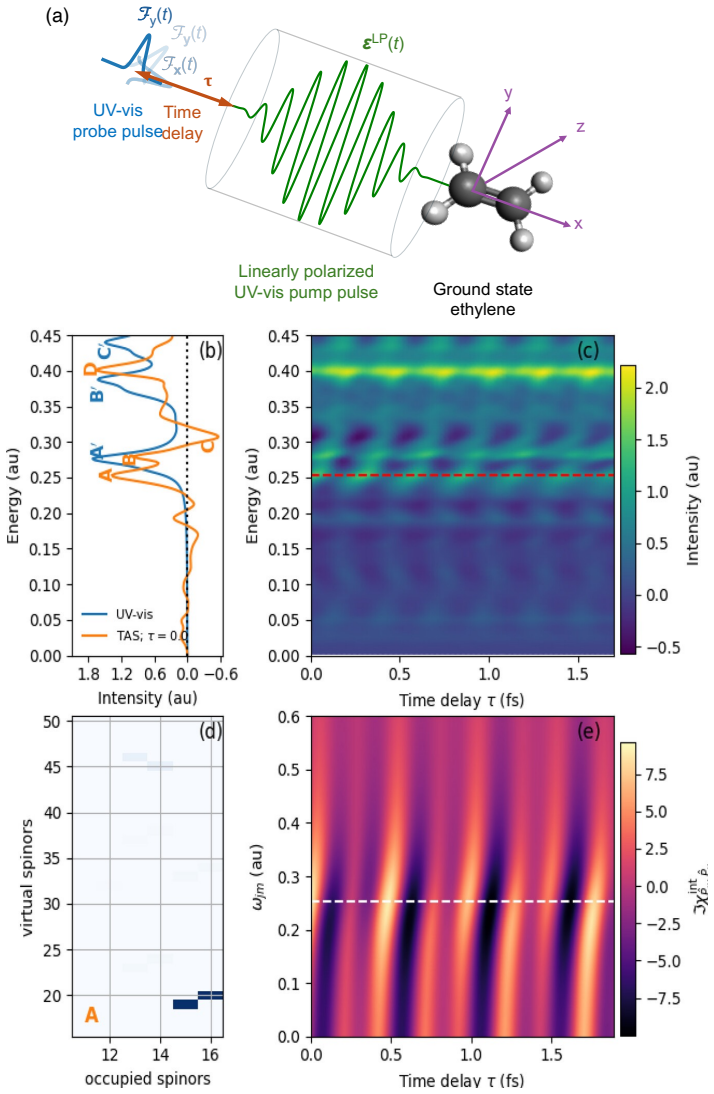
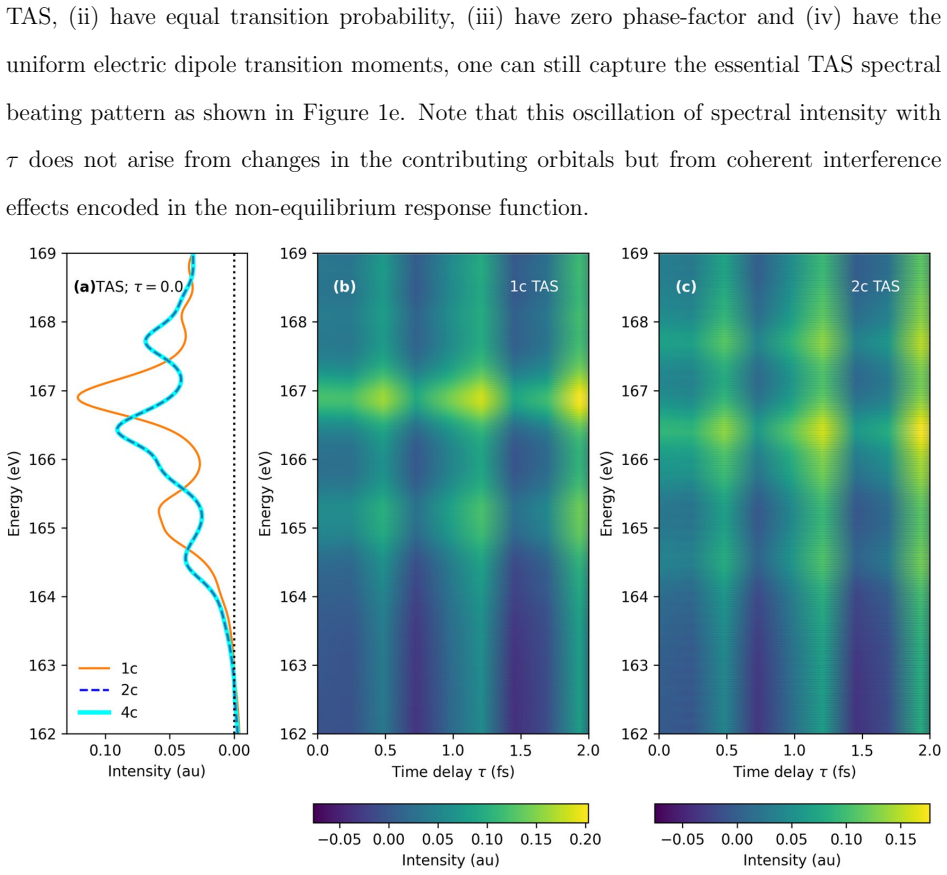
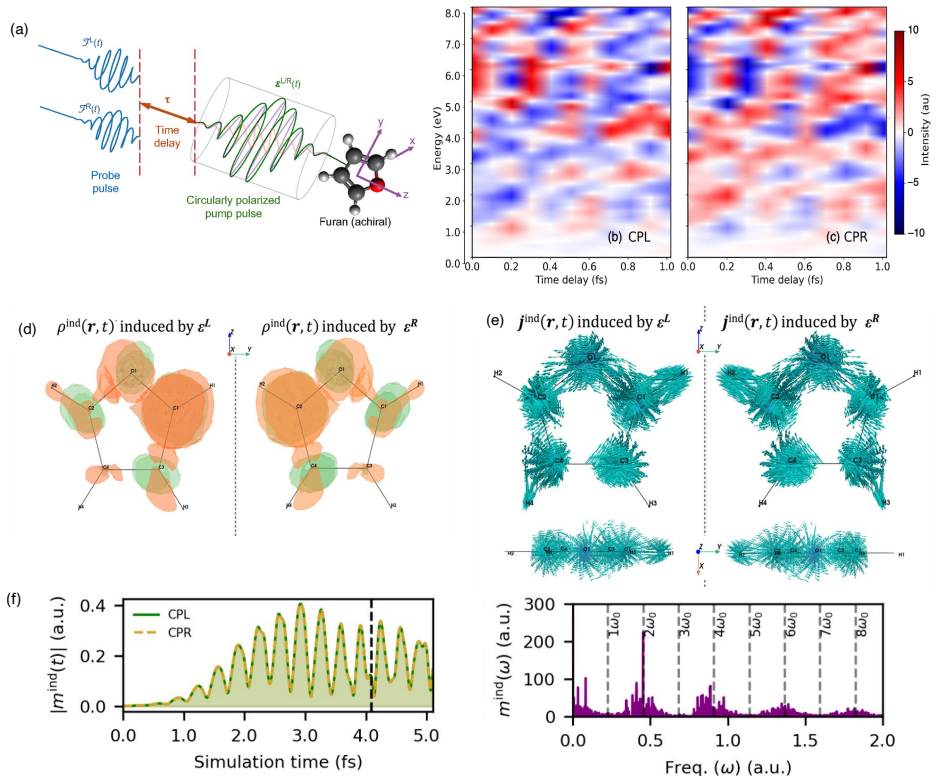
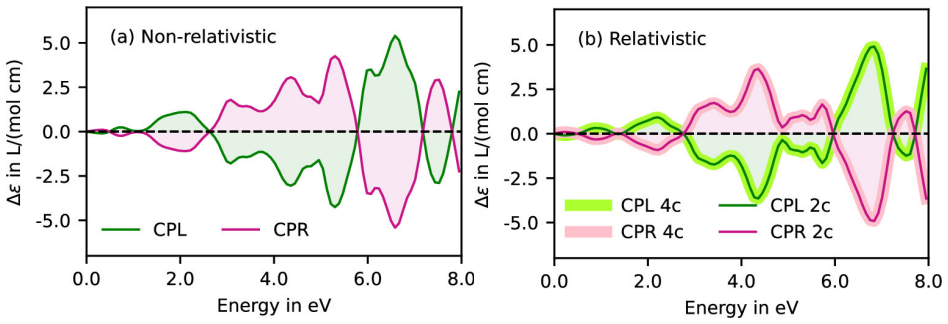
The last decade has witnessed a rapid advancement in laser technology, enabling the direct monitoring and control of electronic motion on its natural attosecond to sub-femtosecond timescales. Ultrafast processes are conventionally studied using pump-probe spectroscopic techniques, where a pump pulse drives the molecule out of equilibrium and a time-delayed probe pulse records the response of the coherent non-stationary state. Since, these processes are non-linear and non-perturbative in nature, real-time formalisms provide a suitable theoretical framework for studying ultrafast light-induced dynamics. In addition, relativistic effects can play an important role in such simulations, either because the external field lies in the XUV to soft-X-ray region targeting core-level excitations, or because the molecular system contains heavy elements. In this chapter, we provide an overview of recent developments in real-time time-dependent density functional theory for simulating pump-probe spectroscopies (namely, transient absorption and transient electronic circular dichroism) at both non-relativistic and relativistic Hamiltonian levels. In order to further interpret these spectroscopic signals, we analyze several spectroscopically relevant time-dependent sub-observables, such as induced electronic densities and induced dipole moments as well as analytical formulations of generalized non-equilibrium response functions. We provide examples to show that the framework can be used to investigate and design new light-induced phenomena that emerge only in the attosecond regime.
Editorial analysis
A structured set of objections, weighed in public.
Referee Report
Summary. The manuscript is a review chapter providing an overview of real-time TDDFT methods (non-relativistic and relativistic) for simulating pump-probe spectroscopies, focusing on transient absorption and transient electronic circular dichroism. It covers analysis of time-dependent sub-observables (induced densities, dipole moments) and generalized non-equilibrium response functions, with examples illustrating attosecond-regime light-induced phenomena that emerge in ultrafast, non-linear, non-perturbative regimes.
Significance. If the summaries of cited developments are accurate, the chapter offers a timely compilation of real-time TDDFT frameworks for attosecond spectroscopy, which is valuable for researchers working on ultrafast laser control of electronic dynamics. Explicit coverage of relativistic effects for core excitations or heavy elements, plus sub-observables for signal interpretation, adds practical utility; the examples demonstrate applicability to designing new phenomena.
Simulated Author's Rebuttal
We thank the referee for their positive review and recommendation to accept the manuscript. We appreciate the acknowledgment of the chapter's timeliness and practical utility for the attosecond spectroscopy community.
Circularity Check
No significant circularity; overview of established methods
full rationale
The manuscript is an overview chapter summarizing real-time TDDFT for pump-probe spectroscopies, including transient absorption and circular dichroism at non-relativistic and relativistic levels, plus sub-observables and response functions. No derivations, predictions, or fitted parameters are presented that could reduce to inputs by construction. The central premise that real-time formalisms suit non-linear/non-perturbative ultrafast dynamics is stated as a standard field premise (abstract, paragraph 2) without internal derivation or self-citation load-bearing. Examples are provided to illustrate applicability, but these do not involve any self-definitional steps, fitted-input predictions, or uniqueness theorems imported from the authors' prior work. The text references external developments without creating circular construction within the paper itself.
Axiom & Free-Parameter Ledger
Reference graph
Works this paper leans on
-
[1]
B.; Krausz, F
(1) Corkum, P. B.; Krausz, F. Attosecond science.Nature Phys.2007,3, 381–387. (2) Nisoli, M.; Decleva, P.; Calegari, F.; Palacios, A.; Mart´ ın, F. Attosecond Electron Dynamics in Molecules.Chem. Rev.2017,117, 10760–10825. (3) Li, X.; Govind, N.; Isborn, C.; DePrince III, A. E.; Lopata, K. Real-time time- dependent electronic structure theory.Chem. Rev.20...
2007
-
[2]
A.; Andrade, X.; Lorenzen, F.; Mar- ques, M
(15) Castro, A.; Appel, H.; Oliveira, M.; Rozzi, C. A.; Andrade, X.; Lorenzen, F.; Mar- ques, M. A.; Gross, E.; Rubio, A. Octopus: a tool for the application of time-dependent density functional theory.Phys. Status Solidi B2006,243, 2465–2488. 27 (16) Andrade, X.; Alberdi-Rodriguez, J.; Strubbe, D. A.; Oliveira, M. J. T.; Nogueira, F.; Castro, A.; Muguerz...
2011
-
[3]
J.; Hoffmann, M
(33) Lestrange, P. J.; Hoffmann, M. R.; Li, X. Time-Dependent Configuration Interaction using the Graphical Unitary Group Approach: Nonlinear Electric Properties.Adv. Quantum Chem.2018,76,
2018
-
[4]
S.; Stewart, Z.; Wilson, A
(34) Ulusoy, I. S.; Stewart, Z.; Wilson, A. K. The Role of the CI Expansion Length in Time-Dependent Studies.J. Chem. Phys.2018,148, 014107. (35) Huber, C.; Klamroth, T. Explicitly Time-dependent Coupled Cluster Singles Doubles Calculations of Laser-driven Many-electron Dynamics.J. Chem. Phys.2011,134, 054113. (36) Kvaal, S. Ab initio quantum dynamics usi...
2018
-
[5]
(39) Sato, T.; Pathak, H.; Orimo, Y.; Ishikawa, K. L. Communication: Time-dependent Optimized Coupled-cluster Method for Multielectron dynamics.J. Chem. Phys.2018, 148, 051101. (40) Skeidsvoll, A. S.; Balbi, A.; Koch, H. Time-dependent coupled-cluster theory for ul- trafast transient-absorption spectroscopy.Phys. Rev. A2020,102. 30 (41) Skeidsvoll, A. S.;...
2018
-
[6]
31 (49) Runge, E.; Gross, E. K. Density-functional theory for time-dependent systems.Phys. Rev. Lett.1984,52,
1984
-
[7]
Mapping from densities to potentials in time-dependent density- functional theory.Phys
(50) van Leeuwen, R. Mapping from densities to potentials in time-dependent density- functional theory.Phys. Rev. Lett.1999,82,
1999
-
[8]
A.; Rubio, A
(51) Castro, A.; Marques, M. A.; Rubio, A. Propagators for the time-dependent Kohn– Sham equations.J. Chem. Phys.2004,121, 3425–3433. (52) Ye, L.; Wang, H.; Zhang, Y.; Xiao, Y.; Liu, W.Comprehensive Computational Chem- istry; Elsevier, 2024; p 229–257. (53) Crank, J.; Nicolson, P. A practical method for numerical evaluation of solutions of partial differe...
2004
-
[9]
from atoms to molecule
32 (59) Alvermann, A.; Fehske, H. High-order commutator-free exponential time-propagation of driven quantum systems.J. Comput. Phys.2011,230, 5930–5956. (60) Gomez Pueyo, A.; Blanes, S.; Castro, A. Propagators for quantum-classical models: Commutator-free magnus methods.J. Chem. Theory Comput.2020,16, 1420–1430. (61) Williams-Young, D.; Goings, J. J.; Li,...
2011
-
[10]
M.; LaMaster, D
34 (77) Bruner, A.; Hernandez, S.; Mauger, F.; Abanador, P. M.; LaMaster, D. J.; Gaarde, M. B.; Schafer, K. J.; Lopata, K. Attosecond Charge Migration with TDDFT: Accurate Dynamics from a Well-Defined Initial State.J. Phys. Chem. Lett.2017,8, 3991–3996. (78) Folorunso, A. S.; Bruner, A.; Mauger, F.; Hamer, K. A.; Hernandez, S.; Jones, R. R.; DiMauro, L. F...
2017
-
[11]
Tailored pump-probe tran- sient spectroscopy with time-dependent density-functional theory: controlling absorp- tion spectra.Eur
35 (86) Walkenhorst, J.; De Giovannini, U.; Castro, A.; Rubio, A. Tailored pump-probe tran- sient spectroscopy with time-dependent density-functional theory: controlling absorp- tion spectra.Eur. Phys. J. B.2016,89. (87) Chen, Y.; Haase, D.; Manz, J.; Wang, H.; Yang, Y. From chiral laser pulses to femto- and attosecond electronic chirality flips in achira...
2016
discussion (0)
Sign in with ORCID, Apple, or X to comment. Anyone can read and Pith papers without signing in.