The Neptunian ridge planet WASP-156 b does not have a polar orbit
Pith reviewed 2026-07-01 15:48 UTC · model grok-4.3
The pith
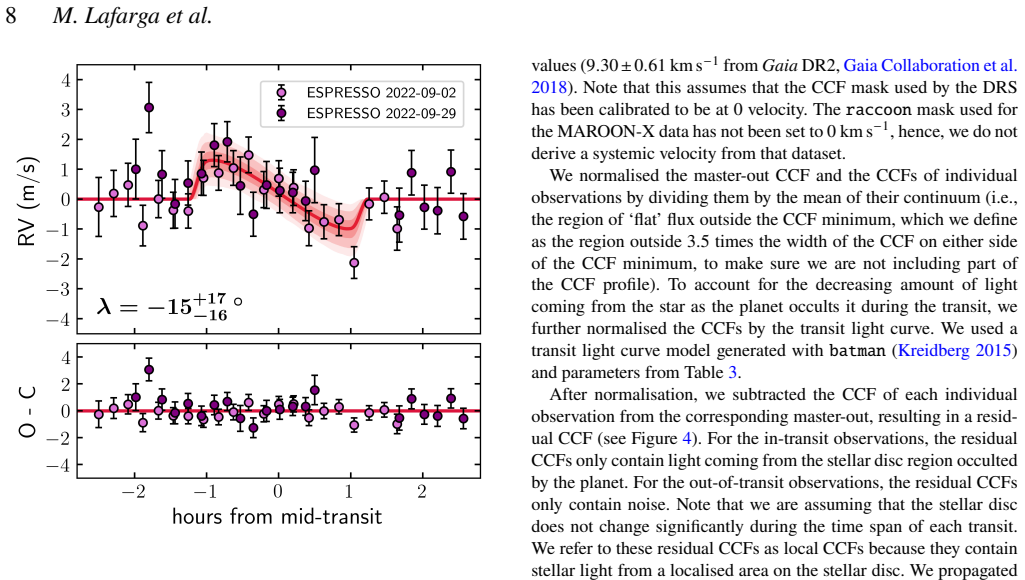
New ESPRESSO observations show WASP-156 b has an aligned orbit with λ near zero rather than a polar one.
A machine-rendered reading of the paper's core claim, the machinery that carries it, and where it could break.
Core claim
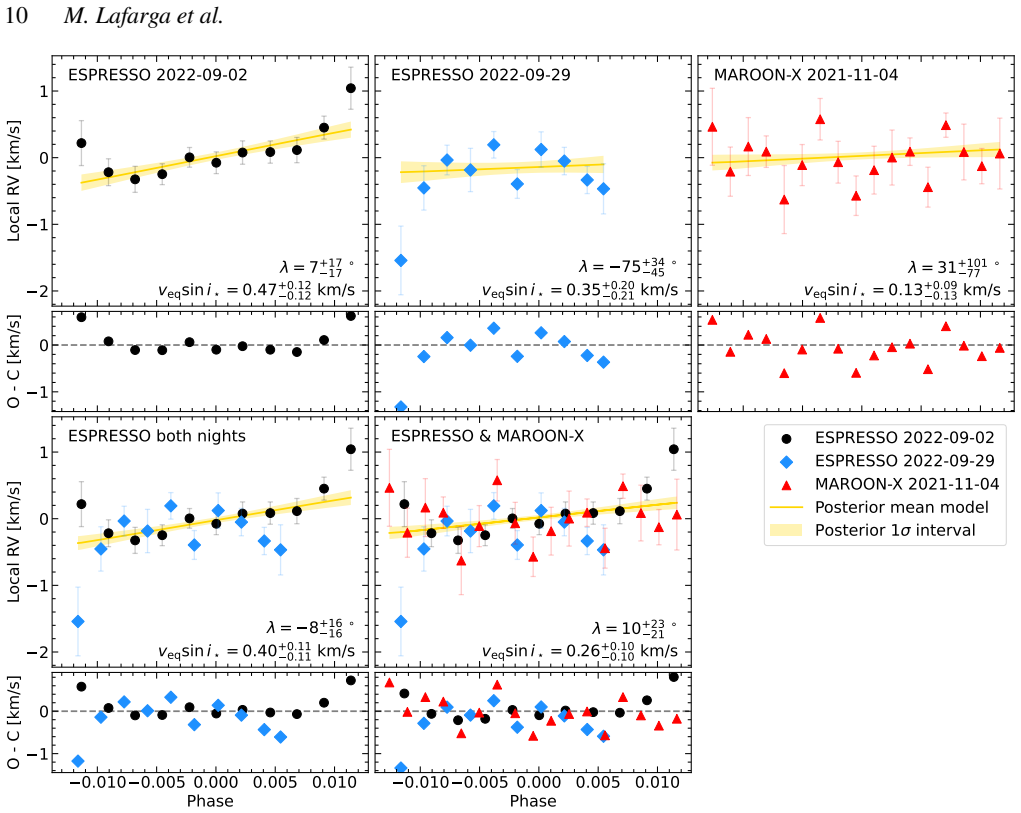
Analyses of new ESPRESSO spectroscopic transit observations show an aligned orbit (λ=-8±16°, based on the ESPRESSO observations), in contrast to a previous report of a highly misaligned orbit. The star's projected rotational velocity is v sin i_star = 0.40±0.11 km/s from the RM modelling, lower than the previously reported value of ~4 km/s. The planet's aligned and circular orbit (e<0.16 at 3σ), and lack of nearby massive companions, are consistent with in situ formation or early disc-driven migration.
What carries the argument
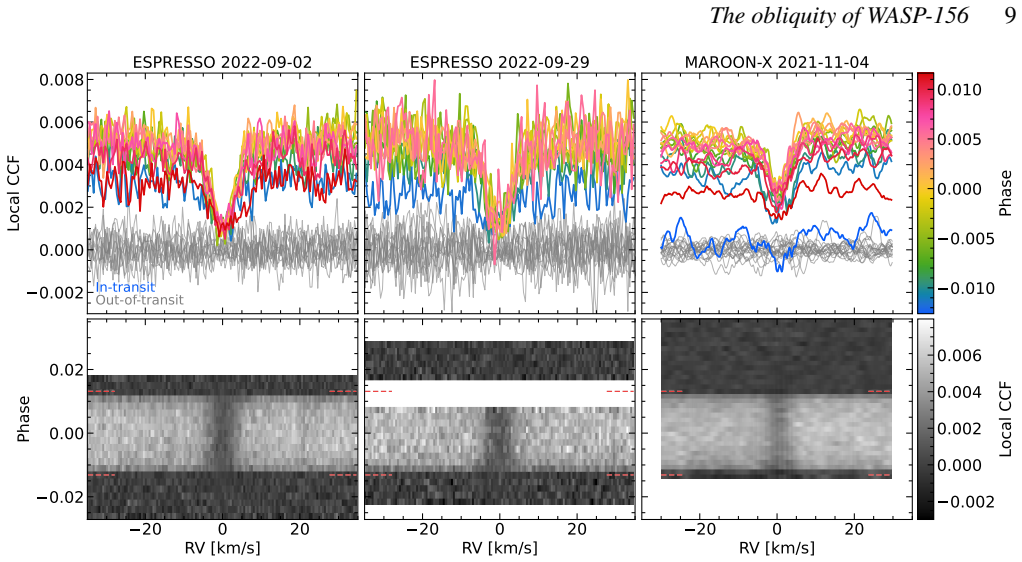
Rossiter-McLaughlin effect modeling applied to high-resolution spectroscopic transit time series to extract the projected obliquity λ and the stellar v sin i_star.
If this is right
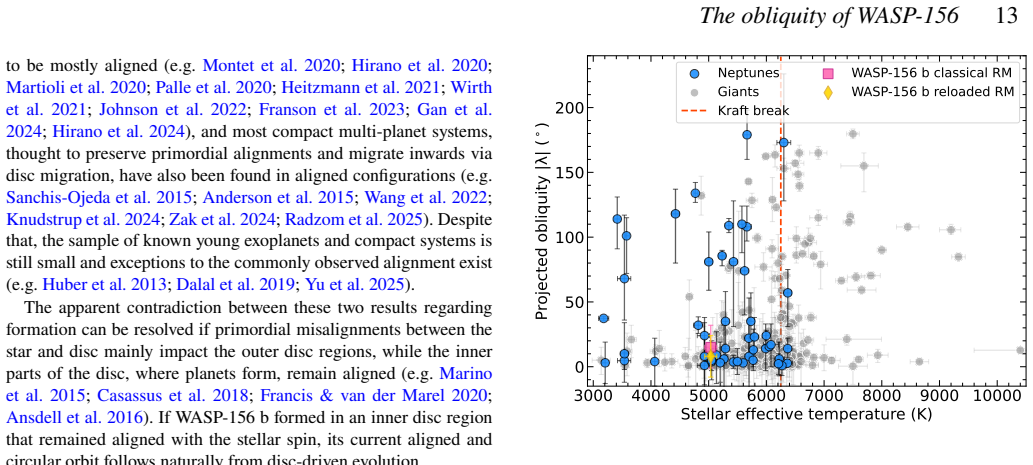
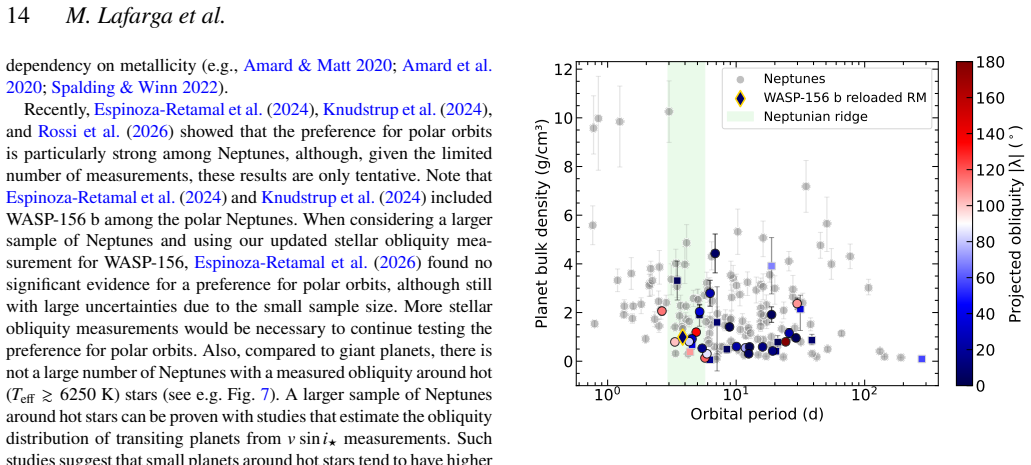
- WASP-156 b moves from a tentative group of close-in Neptunes in polar orbits to the aligned-Neptune population.
- The aligned circular orbit without nearby Jupiter-mass companions is consistent with in situ formation or early disc-driven migration.
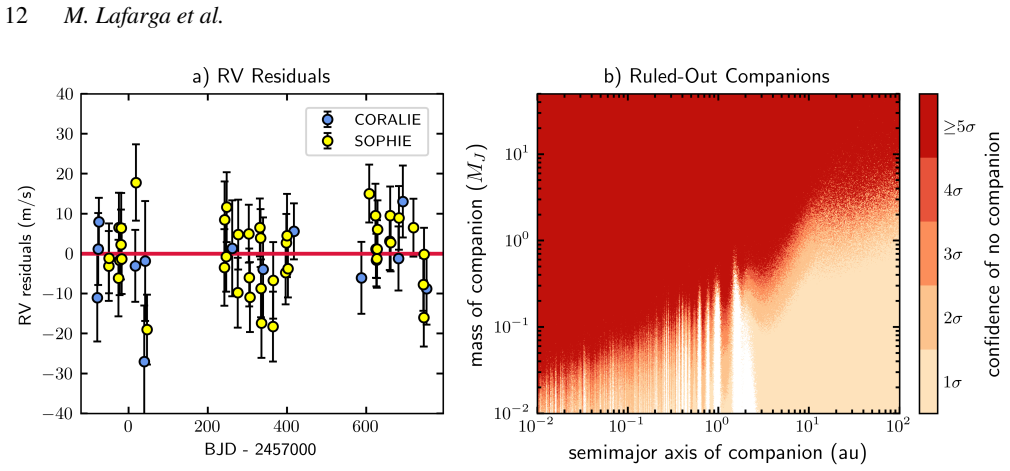
- Long-term radial-velocity monitoring rules out additional Jupiter-mass bodies inside 5 au.
- The orbital eccentricity remains low at the 3-sigma level.
Where Pith is reading between the lines
- Overestimated stellar rotation speeds in earlier studies could have produced spurious polar-orbit reports for other ridge planets.
- Re-observation of additional short-period Neptunes with modern instruments might increase the fraction of aligned systems.
- The absence of massive companions may be a common feature among aligned ridge planets formed without late dynamical scattering.
Load-bearing premise
The new low measurement of the star's projected rotational velocity is taken as correct and any residual line-profile systematics do not artificially produce an aligned signal.
What would settle it
An independent high-precision spectroscopic transit observation that recovers a stellar v sin i_star near 4 km/s or an obliquity far from zero would falsify the aligned-orbit conclusion.
Figures
read the original abstract
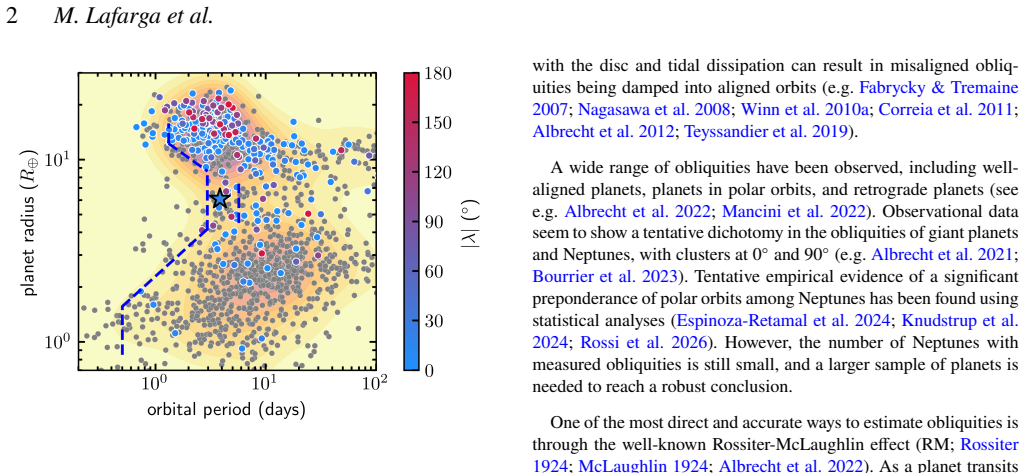
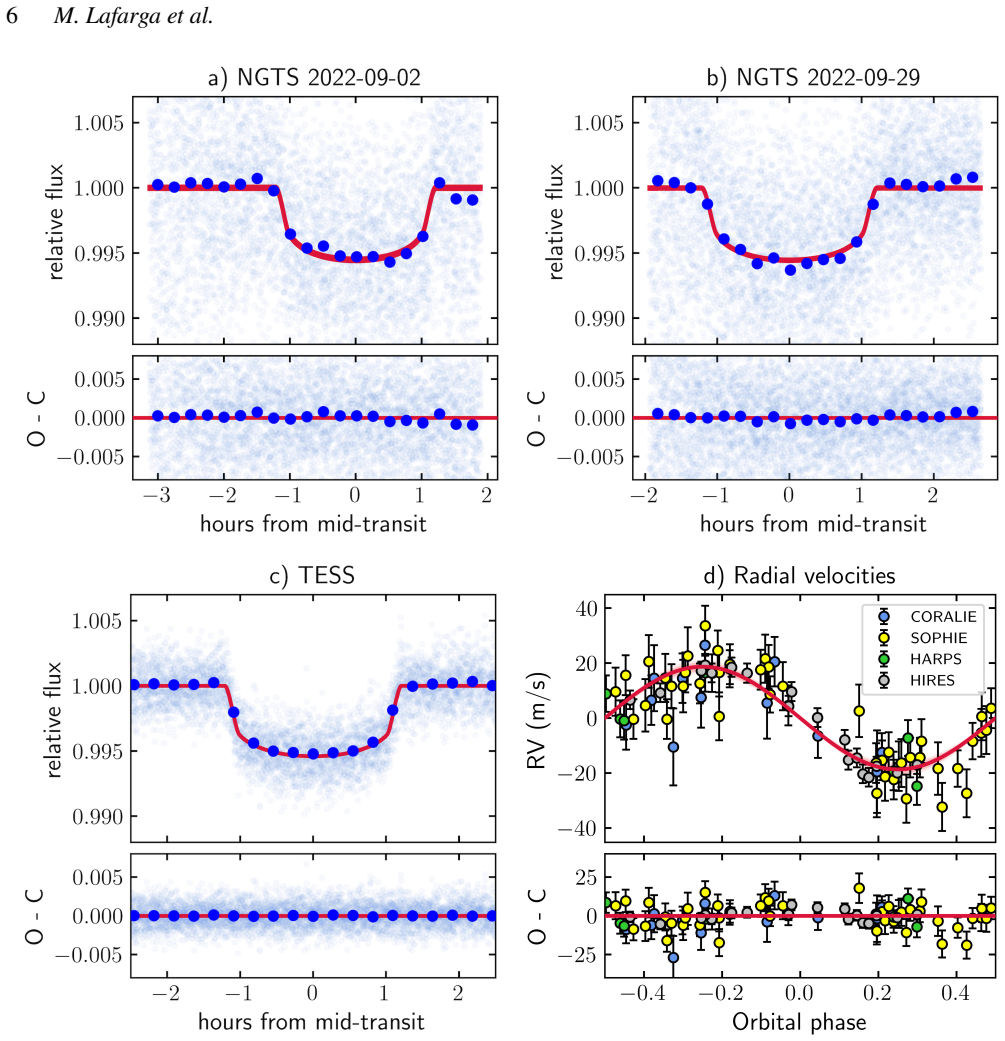
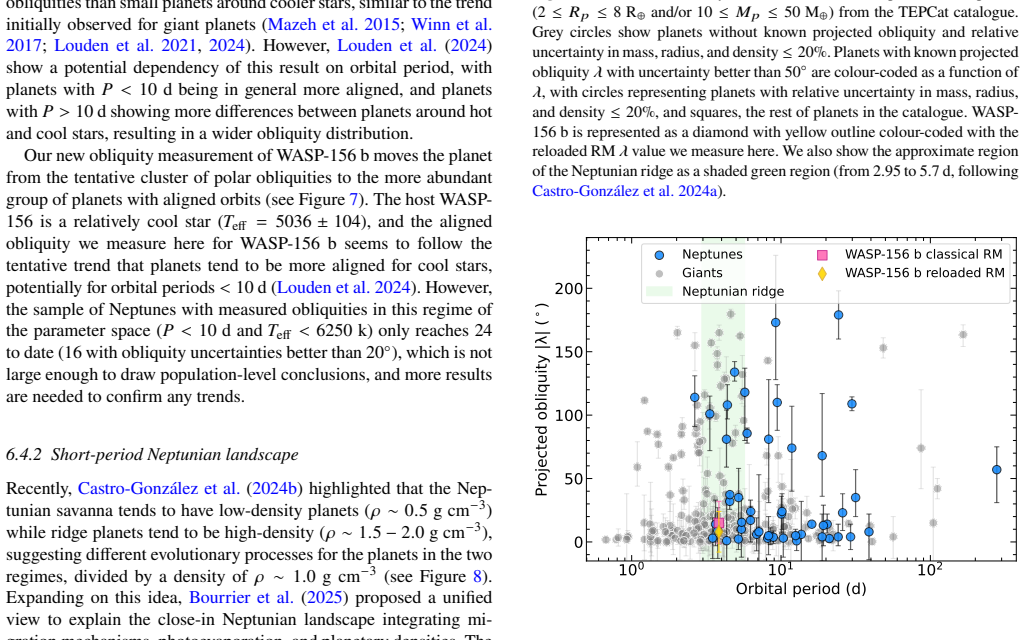
The population of short-period exo-Neptunes is thought to be shaped by an interplay between different dynamical mechanisms, such as orbital migration and tidal effects, and photoevaporation. We can gain insight into these processes by studying observables such as the stellar obliquity. Here we study the Rossiter-McLaughlin (RM) effect and measure the projected obliquity, $\lambda$, of the Neptunian ridge planet WASP-156 b. We analyse new ESPRESSO and MAROON-X spectroscopic transit observations, and new NGTS photometry simultaneous to the ESPRESSO data. Our analyses show an aligned orbit ($\lambda=-8\pm16^\circ$, based on the ESPRESSO observations), in contrast to a previous report of a highly misaligned orbit. We also find the star's projected rotational velocity to be $v \sin i_\mathrm{\star}\leq2$ km/s from spectral line modelling and $v \sin i_\mathrm{\star}=0.40\pm0.11$ km/s from the RM modelling. This is lower than the previously reported value of $\sim4$ km/s, which could partly explain the previously derived polar orbit. We also update the system's orbital parameters and rule out Jupiter-mass companions within 5 au using long-term radial velocity data. The planet's aligned and circular orbit ($e<0.16$ at $3\sigma$), and lack of nearby massive companions, are consistent with in situ formation or early disc-driven migration. Our findings move WASP-156 b from a tentative cluster of close-in Neptunes in polar orbits to the group of aligned Neptunes.
Editorial analysis
A structured set of objections, weighed in public.
Referee Report
Summary. The paper reports new ESPRESSO and MAROON-X transit spectroscopy plus simultaneous NGTS photometry for the Neptunian ridge planet WASP-156 b. The Rossiter-McLaughlin analysis yields an aligned orbit (λ = −8 ± 16°) and a low stellar projected rotation velocity (v sin i⋆ = 0.40 ± 0.11 km s⁻¹ from the RM fit; ≤ 2 km s⁻¹ from line-profile modelling). These values contrast with a prior report of a polar orbit and v sin i⋆ ∼ 4 km s⁻¹; the authors argue the revised low rotation partly explains the earlier result. Updated orbital elements are given and long-term RVs rule out Jupiter-mass companions inside 5 au. The aligned, circular orbit is interpreted as consistent with in-situ formation or early disc migration.
Significance. If the new low v sin i⋆ and aligned λ are robust, the result removes WASP-156 b from the tentative population of close-in Neptunes on polar orbits and strengthens the empirical distinction between aligned and misaligned short-period Neptunes. The direct comparison of two independent v sin i⋆ determinations and the use of simultaneous photometry are positive features.
major comments (2)
- [RM analysis and spectral-line modelling sections] The central claim that the orbit is aligned rests on the RM modelling returning v sin i⋆ = 0.40 ± 0.11 km s⁻¹. A value near the previously reported ∼4 km s⁻¹ would increase the expected RM amplitude and could permit a misaligned solution within the same data. The manuscript must therefore demonstrate (with explicit model comparison or posterior checks) that the ESPRESSO line profiles and RM time series are incompatible with v sin i⋆ ≳ 2 km s⁻¹ once all other parameters are marginalised.
- [Discussion of prior result] The abstract states that the lower v sin i⋆ “could partly explain” the prior polar result, yet no quantitative test is described showing how much of the discrepancy is recovered when the new v sin i⋆ is imposed on the earlier dataset or when the earlier dataset is re-analysed with the new line-profile assumptions.
minor comments (2)
- [Abstract and §4] Notation for v sin i⋆ is inconsistent between the abstract (≤2 km s⁻¹) and the RM result (0.40 ± 0.11 km s⁻¹); a single consistent reporting convention should be adopted.
- [Orbital-parameter table] The 3σ upper limit e < 0.16 should be accompanied by the median and 1σ credible interval from the joint fit so readers can judge the circularity claim directly.
Simulated Author's Rebuttal
We thank the referee for their thorough review and constructive comments on our manuscript. We address each major comment below and will revise the paper accordingly to strengthen the presentation of our results.
read point-by-point responses
-
Referee: [RM analysis and spectral-line modelling sections] The central claim that the orbit is aligned rests on the RM modelling returning v sin i⋆ = 0.40 ± 0.11 km s⁻¹. A value near the previously reported ∼4 km s⁻¹ would increase the expected RM amplitude and could permit a misaligned solution within the same data. The manuscript must therefore demonstrate (with explicit model comparison or posterior checks) that the ESPRESSO line profiles and RM time series are incompatible with v sin i⋆ ≳ 2 km s⁻¹ once all other parameters are marginalised.
Authors: We agree that explicit model comparisons and posterior checks are needed to robustly rule out higher v sin i⋆ values. In the revised manuscript we will add a dedicated subsection with (i) the full posterior distribution for v sin i⋆ from the joint RM + line-profile fit, (ii) Bayesian evidence ratios for models with v sin i⋆ fixed at 2 km s⁻¹ and 4 km s⁻¹ versus the free fit, and (iii) residual analysis of the ESPRESSO line profiles when higher rotation is imposed. These additions will directly address the concern. revision: yes
-
Referee: [Discussion of prior result] The abstract states that the lower v sin i⋆ “could partly explain” the prior polar result, yet no quantitative test is described showing how much of the discrepancy is recovered when the new v sin i⋆ is imposed on the earlier dataset or when the earlier dataset is re-analysed with the new line-profile assumptions.
Authors: The statement is qualitative and based on the factor-of-ten reduction in expected RM amplitude. We do not possess the original spectra from the prior study and therefore cannot perform a full re-analysis. In revision we will (i) replace the abstract phrasing with a more precise statement, (ii) add a quantitative estimate of the RM semi-amplitude difference (0.4 vs 4 km s⁻¹) and its effect on misalignment detectability at the S/N of the earlier data, and (iii) note the limitation regarding re-analysis of the prior observations. revision: partial
- Full re-analysis of the prior spectroscopic dataset (requires the original observations, which are not available to us)
Circularity Check
No circularity: result is direct fit to new observational data
full rationale
The paper reports new ESPRESSO and MAROON-X transit spectroscopy plus simultaneous NGTS photometry. The projected obliquity λ = −8 ± 16° is obtained by modeling the Rossiter-McLaughlin signal on these fresh observations; the low v sin i⋆ = 0.40 ± 0.11 km s⁻¹ is likewise extracted from the same RM fit and independently from spectral-line broadening. No equation chain, self-citation, or fitted parameter is invoked to generate the reported λ value from prior inputs. The contrast with the earlier ~4 km s⁻¹ measurement is presented as an empirical update, not a definitional or self-referential step. The analysis is therefore self-contained against external benchmarks and receives the default non-circularity score.
Axiom & Free-Parameter Ledger
free parameters (2)
- projected obliquity λ
- v sin i_star
axioms (1)
- domain assumption The Rossiter-McLaughlin distortion is dominated by the planet's transit geometry and the star's rotation, with negligible contribution from unaccounted stellar surface features.
Reference graph
Works this paper leans on
-
[1]
The TESS All-Sky Rotation Survey: Periods for 1,046,317 Stars Within 500 pc
Albrecht S., et al., 2011, ApJ, 738, 50 Albrecht S., et al., 2012, ApJ, 757, 18 Albrecht S. H., Marcussen M. L., Winn J. N., Dawson R. I., Knudstrup E., 2021, The Astrophysical Journal, 916, L1 Albrecht S. H., Dawson R. I., Winn J. N., 2022, PASP, 134, 082001 Allart R., et al., 2018, Science, 362, 1384 Amard L., Matt S. P., 2020, ApJ, 889, 108 Amard L., R...
work page internal anchor Pith review Pith/arXiv arXiv doi:10.1117/12.395520 2011
-
[2]
Our frequency grid spanned from 1.01 d (to avoid strong 1 d signals) up to 1500 d (about half the span of the𝑔′ band dataset)
of the data of each band both before and after detrending. Our frequency grid spanned from 1.01 d (to avoid strong 1 d signals) up to 1500 d (about half the span of the𝑔′ band dataset). The cleaned data and corresponding periodograms can be seen in Fig. B1. Similarly, we also looked for periodicities in HATPI data. WASP- 156 was observed by HATPI in two d...
2023
-
[3]
Sampled Parameter Posterior 𝛾CORALIE (m s−1)9630.5±2.5 𝜎CORALIE (m s−1)0.1 +1.6 −0.1 𝛾SOPHIE (m s−1)9589±1 𝜎SOPHIE (m s−1)5.2±1.4 𝛾HARPS (m s−1)9650±2 𝜎HARPS (m s−1)6.4 +2.3 −1.5 𝛾HIRES (m s−1)0.8±0.8 𝜎HIRES (m s−1)3.0 +0.8 −0.6 𝜎TESS (ppm)1.4 +8.5 −1.2 𝑚flux,TESS 0.002±0.004 GP𝜎,TESS (ppm)0.0105 +0.0008 −0.0004 GP𝜌,TESS (d)14.4 +1.2 −1.0 𝜎NGTS11 (ppm)0.0...
2022
discussion (0)
Sign in with ORCID, Apple, or X to comment. Anyone can read and Pith papers without signing in.