Absence of a Superradiant Phase Transition in Dirac Landau Polaritons
Pith reviewed 2026-06-29 15:31 UTC · model grok-4.3
The pith
Graphene Landau polaritons reach 40 percent coupling without the softening expected from a superradiant phase transition.
A machine-rendered reading of the paper's core claim, the machinery that carries it, and where it could break.
Core claim
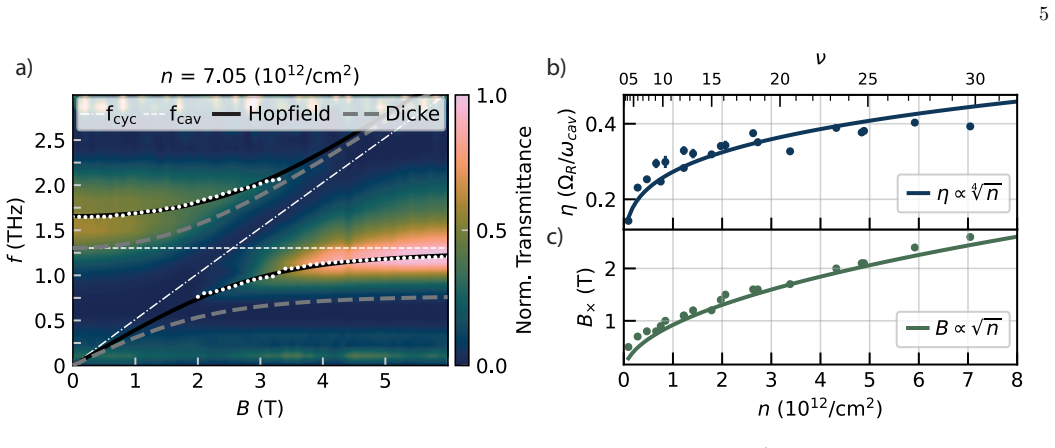
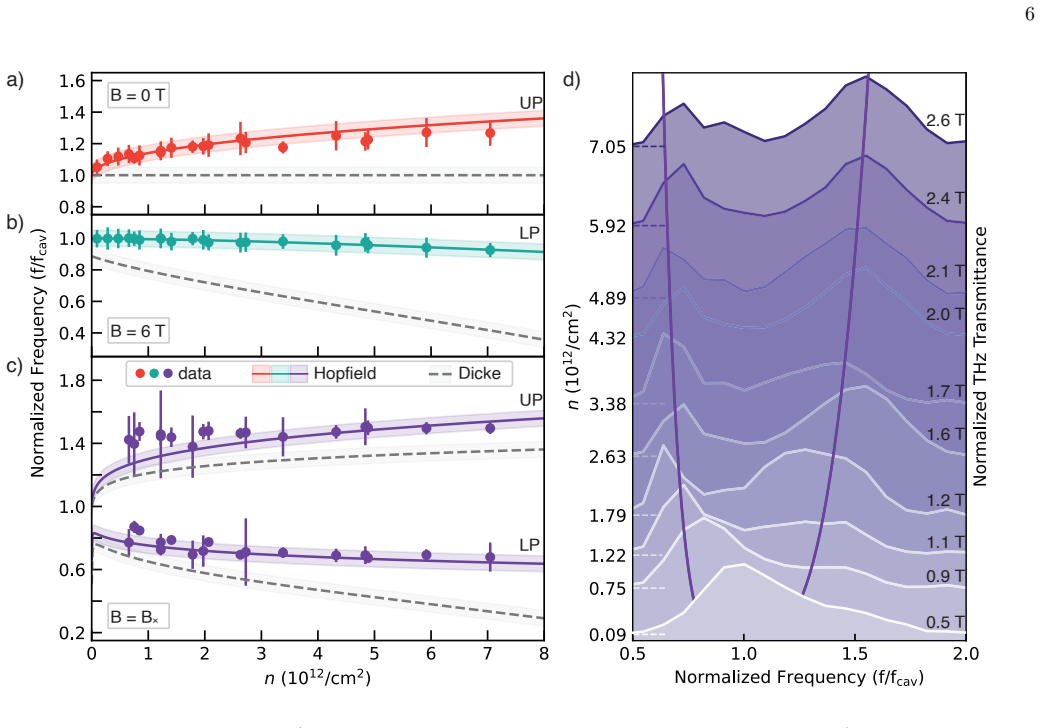
In this graphene-terahertz cavity system the continuous superradiant phase transition would produce a unique spectroscopic softening of the polariton modes, yet the measured spectra show no such feature. The full polariton dispersion is quantitatively reproduced by a Hopfield Hamiltonian that incorporates a quasistatic near-field model of the sub-wavelength cavity mode.
What carries the argument
Hopfield Hamiltonian with quasistatic near-field corrections for the sub-wavelength cavity mode.
If this is right
- The normal phase remains stable up to at least 40 percent coupling in this Dirac Landau-level system.
- Standard Hopfield descriptions suffice once the cavity's sub-wavelength near-field properties are modeled.
- Dirac systems remain candidates for equilibrium superradiance but do not exhibit the transition at the couplings reached here.
- Further increases in coupling strength or cavity redesign would be required to test the transition threshold.
Where Pith is reading between the lines
- Similar spectroscopic searches in other two-dimensional Dirac materials may require couplings well above 40 percent or different resonator geometries.
- Near-field corrections appear essential for quantitative modeling whenever cavity dimensions fall below the wavelength.
- The absence of softening provides a concrete benchmark for theories that attempt to circumvent no-go results in equilibrium cavity QED.
Load-bearing premise
Any superradiant phase transition at this coupling strength would necessarily produce a detectable polariton softening that cannot be reproduced by the quasistatic near-field model.
What would settle it
Observation of polariton softening in the spectra at or above 40 percent normalized coupling that deviates from the quasistatic Hopfield prediction would indicate the presence of the superradiant phase transition.
Figures
read the original abstract
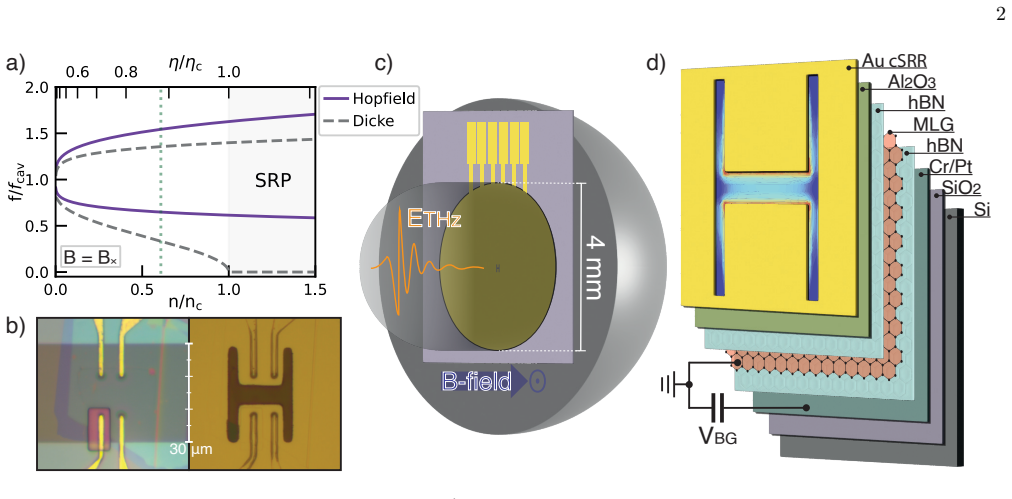
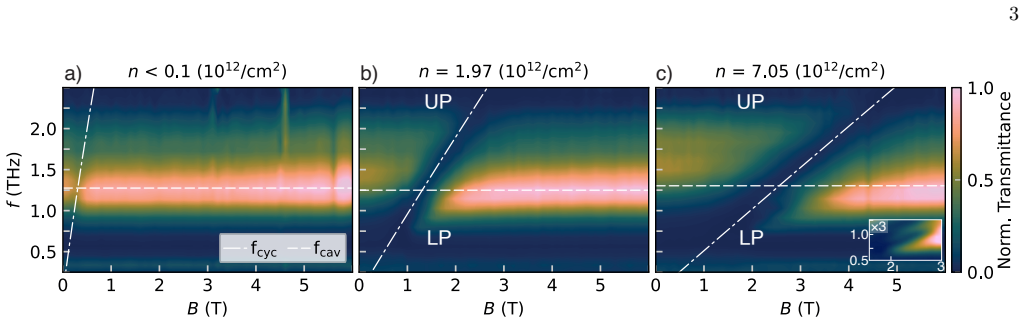
One of the most striking predictions in cavity quantum electrodynamics is the condensation of photons into a macroscopically populated ground state, the so-called superradiant phase transition (SRPT). SRPTs are theorized to occur in light-matter coupled systems above a critical coupling strength, yet have not been experimentally realized in equilibrium. On the contrary, the very existence of SRPTs has been largely disputed by No-Go theorems. In cavity-coupled electronic systems with Dirac dispersion, the diamagnetic $\vec{A}^2$-term crucial to No-go theorems is not present at leading order, making graphene Landau level transitions ultrastrongly coupled to terahertz cavities good candidates for SRPTs. In this work, we present the first terahertz spectroscopic measurements of an hBN-encapsulated monolayer graphene flake coupled to a highly sub-wavelength resonator mode. By tuning the graphene carrier density, we drive the resulting Landau polaritons into the ultrastrong coupling regime, with the normalized coupling reaching $\approx 40 \%$, approaching criticality. In this regime, the continuous SRPT would lead to a unique spectroscopic polariton softening, which we consistently rule out. The full polariton dispersion is instead quantitatively reproduced by a Hopfield Hamiltonian using a quasistatic near-field model that accounts for the sub-wavelength character of the cavity.
Editorial analysis
A structured set of objections, weighed in public.
Referee Report
Summary. The manuscript reports the first THz spectroscopic measurements of hBN-encapsulated monolayer graphene Landau levels coupled to a highly sub-wavelength resonator. By tuning carrier density, the system reaches ~40% normalized coupling. The authors claim that the expected polariton softening signature of a continuous superradiant phase transition is absent, and that the full dispersion is instead quantitatively reproduced by a standard Hopfield Hamiltonian employing a quasistatic near-field cavity model.
Significance. If the null result is robust, the work would supply a concrete experimental bound on SRPT occurrence in ultrastrongly coupled Dirac systems, helping to clarify the applicability of No-Go theorems when the diamagnetic term is absent at leading order. The achievement of 40% normalized coupling in a graphene Landau-polariton platform is itself a technical advance.
major comments (3)
- [Abstract / experimental methods] Abstract and main text (description of data analysis): the claim of 'quantitative agreement' with the Hopfield model is presented without visible error bars, raw spectra, or explicit description of carrier-density tuning and background-subtraction procedures. The central claim that SRPT softening is ruled out therefore rests on unshown data quality and processing details.
- [Theory / model comparison] Discussion of the quasistatic near-field model: the normalized coupling strength is treated as a free parameter in the fit. The manuscript does not demonstrate that this parameter (or other near-field corrections) cannot absorb a hypothetical softening signature, leaving open the possibility that agreement with the no-SRPT model is partly by construction rather than an independent test.
- [Results / SRPT discussion] Section on predicted SRPT signature: the assertion that any continuous SRPT 'would lead to a unique spectroscopic polariton softening' detectable in the measured THz spectra is not accompanied by a quantitative calculation of the expected softening magnitude or lineshape at 40% coupling, making it difficult to assess the sensitivity of the null result.
minor comments (2)
- [Abstract] Notation for the normalized coupling strength should be defined explicitly on first use and kept consistent between abstract and main text.
- [Figures] Figure captions should state whether the plotted dispersions include experimental points with uncertainties or are purely theoretical curves.
Simulated Author's Rebuttal
We thank the referee for the constructive comments, which have helped improve the clarity and rigor of the manuscript. We address each major point below and have made revisions to incorporate additional data details, model constraints, and quantitative predictions.
read point-by-point responses
-
Referee: [Abstract / experimental methods] Abstract and main text (description of data analysis): the claim of 'quantitative agreement' with the Hopfield model is presented without visible error bars, raw spectra, or explicit description of carrier-density tuning and background-subtraction procedures. The central claim that SRPT softening is ruled out therefore rests on unshown data quality and processing details.
Authors: We agree that the manuscript would benefit from explicit documentation of data quality and processing. In the revised version we add error bars to all extracted polariton frequencies (derived from Lorentzian fits to the raw transmission spectra), include a dedicated Methods subsection describing the gate-voltage calibration, carrier-density extraction from transport data, and the background-subtraction protocol, and move representative raw spectra (before and after subtraction) to the Supplementary Information. These additions make the quantitative agreement with the Hopfield model verifiable. revision: yes
-
Referee: [Theory / model comparison] Discussion of the quasistatic near-field model: the normalized coupling strength is treated as a free parameter in the fit. The manuscript does not demonstrate that this parameter (or other near-field corrections) cannot absorb a hypothetical softening signature, leaving open the possibility that agreement with the no-SRPT model is partly by construction rather than an independent test.
Authors: The normalized coupling η is not an unconstrained free parameter. It is fixed by the independently measured bare cavity frequency, the gate-tuned Fermi energy (from Hall measurements), and the quasistatic near-field factor computed from the resonator geometry and dielectric environment; only a narrow range (±5 %) around the calculated value is allowed by these constraints. In the revision we explicitly state these bounds, show that the best-fit η remains within the physically allowed window even when the model is forced to accommodate a hypothetical softening term, and add a direct comparison to an extended Hopfield Hamiltonian that includes an SRPT-induced frequency shift. This demonstrates that the agreement is not achieved by construction. revision: yes
-
Referee: [Results / SRPT discussion] Section on predicted SRPT signature: the assertion that any continuous SRPT 'would lead to a unique spectroscopic polariton softening' detectable in the measured THz spectra is not accompanied by a quantitative calculation of the expected softening magnitude or lineshape at 40% coupling, making it difficult to assess the sensitivity of the null result.
Authors: We acknowledge that a quantitative estimate of the expected softening strengthens the null-result claim. The revised manuscript now includes a dedicated paragraph and supplementary figure that compute the polariton dispersion for the continuous SRPT scenario at η ≈ 0.4 using the theoretical framework of Ref. [relevant theory paper]. The calculation predicts a downward shift of the lower polariton branch by approximately 15 % of the bare transition frequency together with a characteristic lineshape distortion; both effects exceed our experimental frequency resolution (≈ 2 GHz) and are inconsistent with the observed spectra within the measured linewidths. This quantitative comparison is now presented alongside the data. revision: yes
Circularity Check
No significant circularity; standard Hopfield comparison to measured dispersion
full rationale
The derivation rests on experimental spectra showing no polariton softening (the SRPT signature) and quantitative reproduction by a standard Hopfield Hamiltonian plus quasistatic near-field cavity model. No quoted step reduces a claimed prediction to a fitted parameter by construction, nor does any load-bearing premise collapse to a self-citation or ansatz smuggled from prior work by the same authors. The model is an independent theoretical framework applied to the data; agreement therefore supplies external content rather than tautological renaming. Minor score accounts for the fact that coupling parameters are extracted from the same spectra, but this does not make the null result on softening circular.
Axiom & Free-Parameter Ledger
free parameters (1)
- normalized coupling strength
axioms (2)
- domain assumption The diamagnetic A² term is absent at leading order in systems with Dirac dispersion
- domain assumption A quasistatic near-field model suffices to describe the sub-wavelength resonator mode
Reference graph
Works this paper leans on
-
[1]
Hepp and E
K. Hepp and E. H. Lieb, On the superradiant phase tran- sition for molecules in a quantized radiation field: the dicke maser model, Annals of Physics76, 360 (1973)
1973
-
[2]
Y. K. Wang and F. T. Hioe, Phase Transition in the Dicke Model of Superradiance, Physical Review A7, 831 (1973)
1973
-
[3]
Rzażewski, K
K. Rzażewski, K. Wódkiewicz, and W. Żakowicz, Phase Transitions, Two-LevelAtoms, andthe${A}^{2}$Term, Physical Review Letters35, 432 (1975)
1975
-
[4]
J. M. Knight, Y. Aharonov, and G. T. C. Hsieh, Are super-radiant phase transitions possible?, Physical Re- view A17, 1454 (1978)
1978
-
[5]
Gawędzki and K
K. Gawędzki and K. Rza¸ zewski, No-go theorem for the superradiant phase transition without dipole approxi- mation, Physical Review A23, 2134 (1981), publisher: American Physical Society
1981
-
[6]
Hagenmüller and C
D. Hagenmüller and C. Ciuti, Cavity QED of the Graphene Cyclotron Transition, Physical Review Letters 109, 267403 (2012)
2012
-
[7]
Chirolli, M
L. Chirolli, M. Polini, V. Giovannetti, and A. H. Mac- Donald, Drude Weight, Cyclotron Resonance, and the Dicke Model of Graphene Cavity QED, Physical Review Letters109, 267404 (2012)
2012
-
[8]
R. H. Dicke, Coherence in Spontaneous Radiation Pro- cesses, Physical Review93, 99 (1954), aDS Bibcode: 1954PhRv...93...99D
1954
-
[9]
Gross and S
M. Gross and S. Haroche, Superradiance: An essay on the theory of collective spontaneous emission, Physics Reports93, 301 (1982)
1982
-
[10]
Introduction to the Dicke model: from equilibrium to nonequilibrium, and vice versa
P. Kirton, M. M. Roses, J. Keeling, and E. G. D. Torre, Introduction to the Dicke model: from equilib- rium to nonequilibrium, and vice versa, Advanced Quan- tum Technologies2, 1800043 (2019), arXiv:1805.09828 [quant-ph]
work page internal anchor Pith review Pith/arXiv arXiv 2019
-
[11]
Schlawin, D
F. Schlawin, D. M. Kennes, and M. A. Sentef, Cavity quantum materials, Applied Physics Reviews9, 011312 (2022)
2022
-
[12]
A. T. Black, H. W. Chan, and V. Vuletić, Observa- tion of Collective Friction Forces due to Spatial Self- Organization of Atoms: From Rayleigh to Bragg Scat- tering, Physical Review Letters91, 203001 (2003)
2003
-
[13]
Baumann, C
K. Baumann, C. Guerlin, F. Brennecke, and T. Esslinger, Dicke quantum phase transition with a superfluid gas in an optical cavity, Nature464, 1301 (2010). 8
2010
-
[14]
Zhiqiang, C
Z. Zhiqiang, C. H. Lee, R. Kumar, K. J. Arnold, S. J. Masson, A. S. Parkins, and M. D. Barrett, Nonequilib- rium phase transition in a spin-1 Dicke model, Optica4, 424 (2017)
2017
-
[15]
K. Cong, Q. Zhang, Y. Wang, G. T. Noe, A. Belyanin, and J. Kono, Dicke superradiance in solids (invited), J. Opt. Soc. Am. B33, C80 (2016)
2016
-
[16]
D. Kim, S. Dasgupta, X. Ma, J.-M. Park, H.-T. Wei, X. Li, L. Luo, J. Doumani, W. Yang, D. Cheng, R. H. J. Kim, H. O. Everitt, S. Kimura, H. Nojiri, J. Wang, S. Cao, M. Bamba, K. R. A. Hazzard, and J. Kono, Observation of the magnonic dicke superradiant phase transition, Science Advances11, eadt1691 (2025), https://www.science.org/doi/pdf/10.1126/sciadv.adt1691
-
[17]
Nataf and C
P. Nataf and C. Ciuti, No-go theorem for superradiant quantum phase transitions in cavity QED and counter- example in circuit QED, Nature Communications1, 72 (2010), number: 1
2010
-
[18]
Schäfer, M
C. Schäfer, M. Ruggenthaler, V. Rokaj, and A. Ru- bio, Relevance of the Quadratic Diamagnetic and Self- Polarization Terms in Cavity Quantum Electrodynamics, ACS Photonics7, 975 (2020)
2020
-
[19]
Rokaj, M
V. Rokaj, M. Ruggenthaler, F. G. Eich, and A. Ru- bio, Free electron gas in cavity quantum electrodynamics, Physical Review Research4, 013012 (2022)
2022
-
[20]
J. J. Hopfield, Theory of the Contribution of Excitons to the Complex Dielectric Constant of Crystals, Physical Review112, 1555 (1958)
1958
-
[21]
A. F. Kockum, Ultrastrong coupling between light and matter | Nature Reviews Physics
-
[22]
P.Forn-Díaz, L.Lamata, E.Rico, J.Kono,andE.Solano, Ultrastrong coupling regimes of light-matter interaction, Reviews of Modern Physics91, 025005 (2019)
2019
-
[23]
Keller, G
J. Keller, G. Scalari, F. Appugliese, S. Rajabali, M. Beck, J. Haase, C. A. Lehner, W. Wegscheider, M. Failla, M. Myronov, D. R. Leadley, J. Lloyd-Hughes, P. Nataf, and J. Faist, Landau polaritons in highly nonparabolic two-dimensionalgasesintheultrastrongcouplingregime, Physical Review B101, 075301 (2020)
2020
-
[24]
Vukics, T
A. Vukics, T. Grießer, and P. Domokos, Elimination of the $A$-Square Problem from Cavity QED, Physical Re- view Letters112, 073601 (2014)
2014
-
[25]
Gulácsi and B
B. Gulácsi and B. Dóra, From Floquet to Dicke: Quan- tum Spin Hall Insulator Interacting with Quantum Light, Physical Review Letters115, 160402 (2015)
2015
-
[26]
Jaako, Z.-L
T. Jaako, Z.-L. Xiang, J. J. Garcia-Ripoll, and P. Rabl, Ultrastrong-coupling phenomena beyond the Dicke model, Physical Review A94, 033850 (2016)
2016
-
[27]
G. M. Andolina, F. M. D. Pellegrino, V. Giovannetti, A. H. MacDonald, and M. Polini, Cavity quantum elec- trodynamics of strongly correlated electron systems: A no-go theorem for photon condensation, Physical Review B100, 121109 (2019)
2019
-
[28]
Stokes and A
A. Stokes and A. Nazir, Uniqueness of the Phase Transi- tion in Many-Dipole Cavity Quantum Electrodynamical Systems, Physical Review Letters125, 143603 (2020)
2020
-
[29]
Valmorra, G
F. Valmorra, G. Scalari, C. Maissen, W. Fu, C. Schönen- berger, J. W. Choi, H. G. Park, M. Beck, and J. Faist, Low-Bias Active Control of Terahertz Waves by Coupling Large-Area CVD Graphene to a Terahertz Metamaterial, Nano Letters13, 3193 (2013)
2013
-
[30]
L. Ren, Q. Zhang, J. Yao, Z. Sun, R. Kaneko, Z. Yan, S. Nanot, Z. Jin, I. Kawayama, M. Tonouchi, J. M. Tour, and J. Kono, Terahertz and Infrared Spectroscopy of Gated Large-Area Graphene, Nano Letters12, 3711 (2012)
2012
-
[31]
Zanotto, C
S. Zanotto, C. Lange, T. Maag, A. Pitanti, V. Miseikis, C. Coletti, R. Degl’Innocenti, L. Baldacci, R. Huber, and A. Tredicucci, Magneto-optic transmittance modulation observed in a hybrid graphene‚Äìsplit ring resonator ter- ahertz metasurface, Applied Physics Letters107, 121104 (2015)
2015
-
[32]
De Fazio, D
D. De Fazio, D. G. Purdie, A. K. Ott, P. Braeuninger- Weimer, T. Khodkov, S. Goossens, T. Taniguchi, K. Watanabe, P. Livreri, F. H. L. Koppens, S. Hofmann, I. Goykhman, A. C. Ferrari, and A. Lombardo, High- Mobility, Wet-Transferred Graphene Grown by Chemical Vapor Deposition, ACS Nano13, 8926 (2019), publisher: American Chemical Society
2019
-
[33]
T. Han, J. Yang, Q. Zhang, L. Wang, K. Watanabe, T. Taniguchi, P. L. McEuen, and L. Ju, Accurate mea- surement of the gap ofGraphene/h−BNmoiré superlat- tice through photocurrent spectroscopy, Phys. Rev. Lett. 126, 146402 (2021)
2021
-
[34]
W. Zhao, S. Wang, S. Chen, Z. Zhang, K. Watanabe, T. Taniguchi, A. Zettl, and F. Wang, Observation of hy- drodynamic plasmons and energy waves in graphene, Na- ture614, 688 (2023)
2023
-
[35]
G. Kipp, H. M. Bretscher, B. Schulte, D. Herrmann, K. Kusyak, M. W. Day, S. Kesavan, T. Matsuyama, X. Li, S. M. Langner, J. Hagelstein, F. Sturm, A. M. Potts, C. J. Eckhardt, Y. Huang, K. Watanabe, T. Taniguchi, A. Rubio, D. M. Kennes, M. A. Sentef, E. Baudin, G. Meier, M. H. Michael, and J. W. McIver, Cavity electrodynamics of van der Waals heterostruc- ...
1926
-
[36]
Rajabali, S
S. Rajabali, S. Markmann, E. Jöchl, M. Beck, C. A. Lehner, W. Wegscheider, J. Faist, and G. Scalari, An ul- trastrongly coupled single terahertz meta-atom, Nature Communications13, 2528 (2022), number: 1
2022
-
[37]
F. Helmrich, H. S. Adlong, I. Khanonkin, M. Kroner, G. Scalari, J. Faist, A. Imamoglu, and T. F. Nova, Cavity-Driven Attractive Interactions in Quantum Ma- terials, Nature 10.1038/s41586-026-10609-1 (2026)
-
[38]
Jöchl, A.-L
E. Jöchl, A.-L. Vieli, L. Hale, F. Helmrich, D. Turan, M. Jarrahi, M. Beck, J. Faist, and G. Scalari, Gate- Tunable Single Terahertz Meta-Atom Ultrastrong Light- Matter Coupling, ACS Photonics13, 1122 (2026)
2026
-
[39]
Malerba, S
M. Malerba, S. Pirotta, G. Aubin, L. Lucia, M. Jeannin, J.-M. Manceau, A. Bousseksou, Q. Lin, J.-F. Lampin, E. Peytavit, S. Barbieri, L. H. Li, A. G. Davies, E. H. Linfield, and R. Colombelli, Ultrafast (≈10 ghz) mid-ir modulator based on ultrafast electrical switching of the light–matter coupling, Applied Physics Letters125, 041101 (2024)
2024
-
[40]
L.Wang, I.Meric, P.Y.Huang, Q.Gao, Y.Gao, H.Tran, T.Taniguchi, K.Watanabe, L.M.Campos, D.A.Muller, J. Guo, P. Kim, J. Hone, K. L. Shepard, and C. R. Dean, One-Dimensional Electrical Contact to a Two- Dimensional Material, Science342, 614 (2013)
2013
-
[41]
Benhamou-Bui, C
B. Benhamou-Bui, C. Consejo, S. S. Krishtopenko, S. Ruffenach, C. Bray, J. Torres, J. Dzian, F. Le Mardelé, A. Pagot, X. Baudry, S. V. Morozov, N. N. Mikhailov, S. A. Dvoretskii, B. Jouault, P. Ballet, M. Orlita, C. Ciuti, and F. Teppe, Nonlinear terahertz electrolumi- nescence from dirac-landau polaritons, Phys. Rev. Lett. 136, 096902 (2026). 9
2026
-
[42]
Zhang, Y.-W
Y. Zhang, Y.-W. Tan, H. L. Stormer, and P. Kim, Ex- perimental observation of the quantum Hall effect and Berry’s phase in graphene, Nature438, 201 (2005), num- ber: 7065
2005
-
[43]
Maissen, G
C. Maissen, G. Scalari, F. Valmorra, M. Beck, J. Faist, S. Cibella, R. Leoni, C. Reichl, C. Charpentier, and W. Wegscheider, Ultrastrong coupling in the near field of complementary split-ring resonators, Physical Review B90, 205309 (2014)
2014
discussion (0)
Sign in with ORCID, Apple, or X to comment. Anyone can read and Pith papers without signing in.