Impact of Clouds on the Atmosphere-Mantle Interface of Sub-Neptunes
Pith reviewed 2026-07-01 15:48 UTC · model grok-4.3
The pith
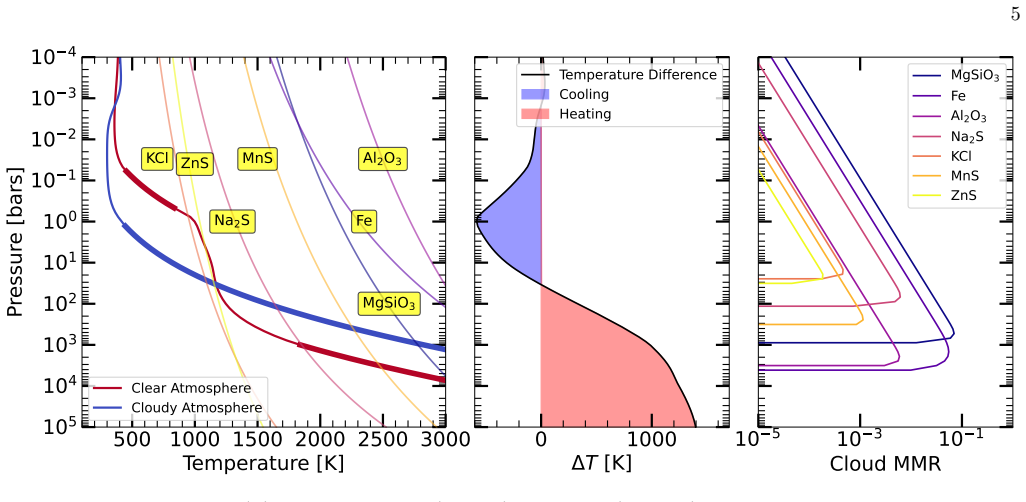
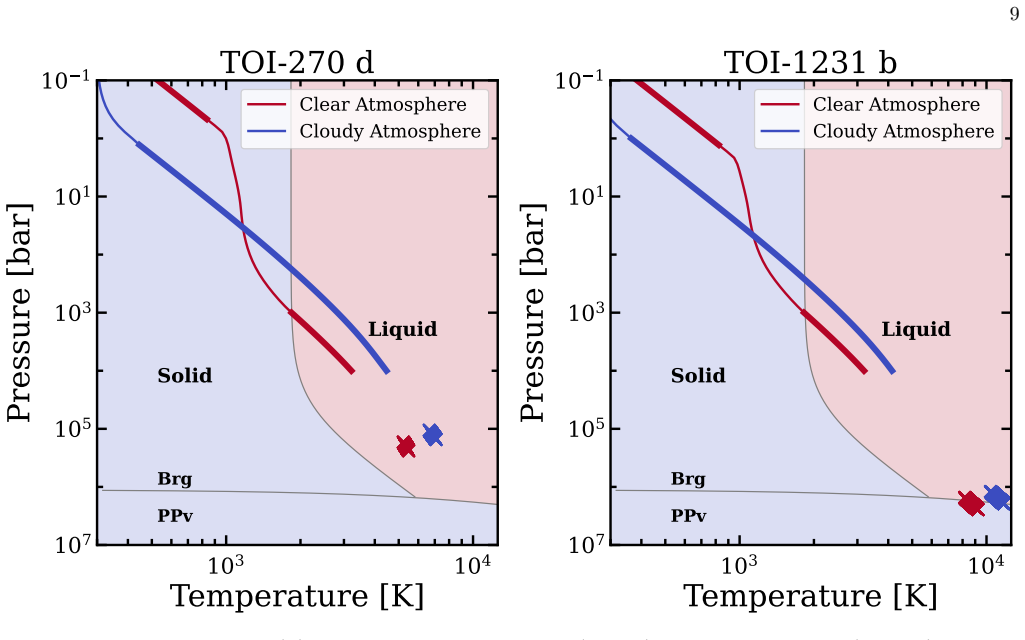
Clouds heat sub-Neptune deep layers by at least 1000 K, melting most atmosphere-mantle interfaces and shifting their chemistry.
A machine-rendered reading of the paper's core claim, the machinery that carries it, and where it could break.
Core claim
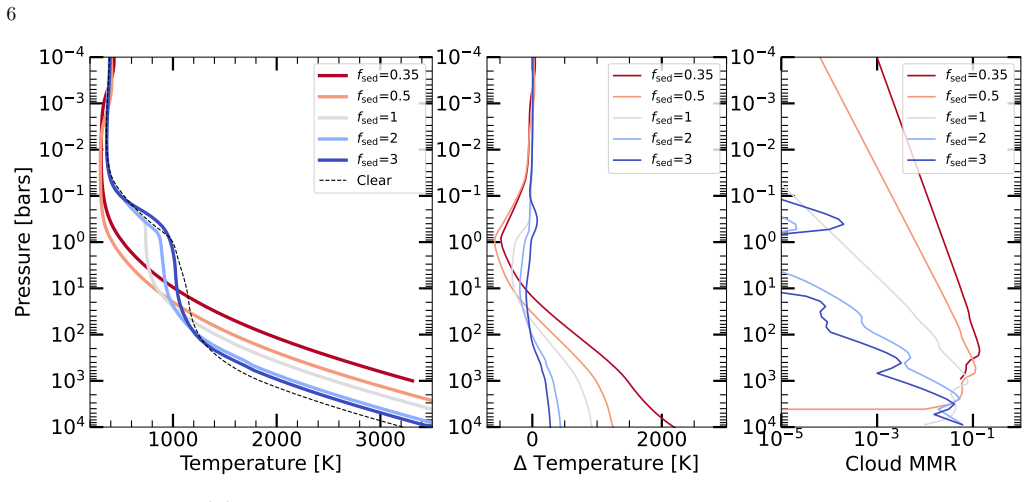
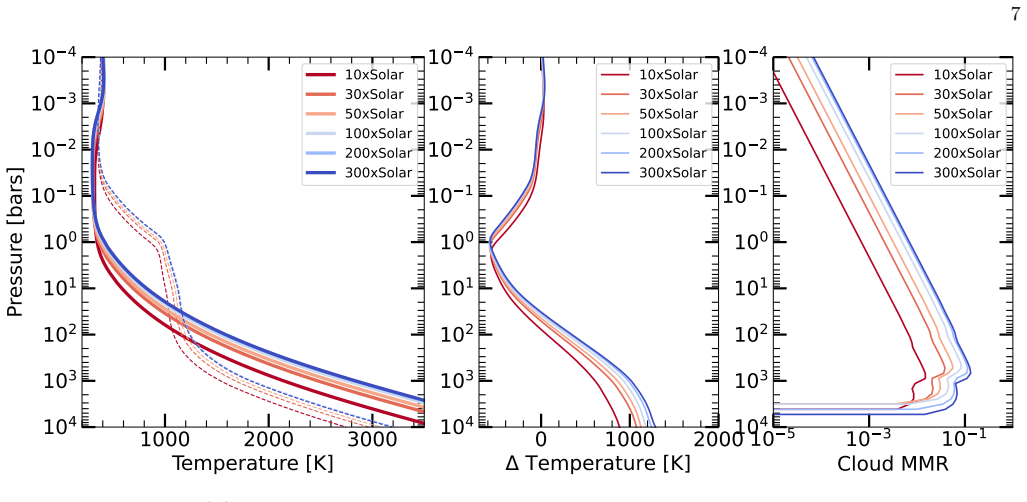
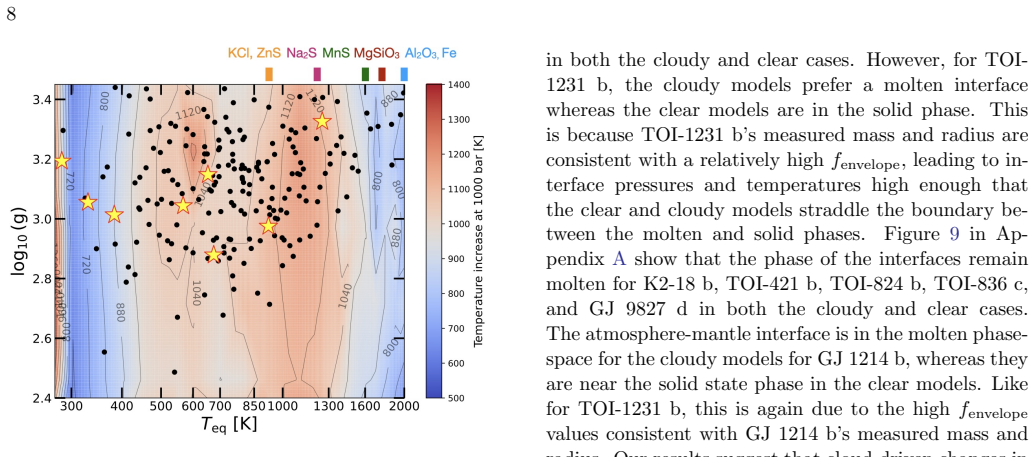
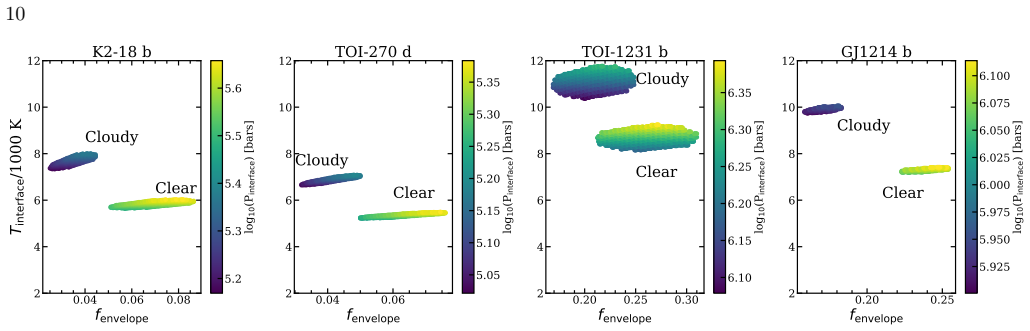
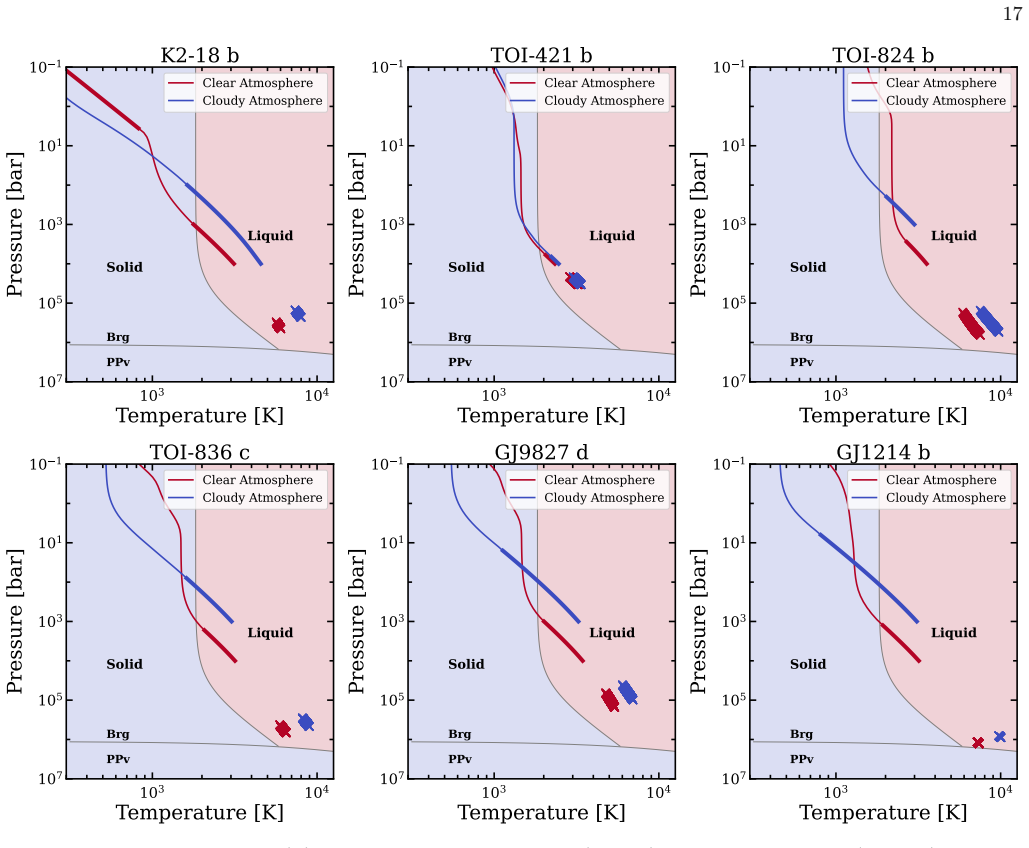
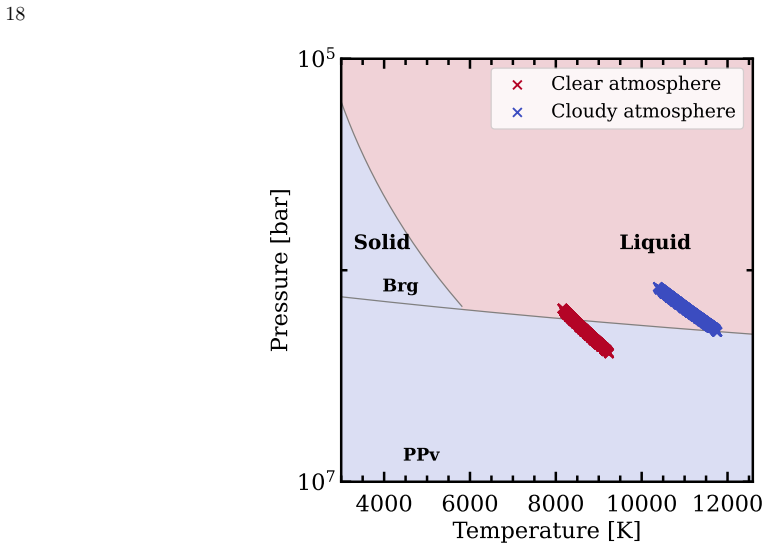
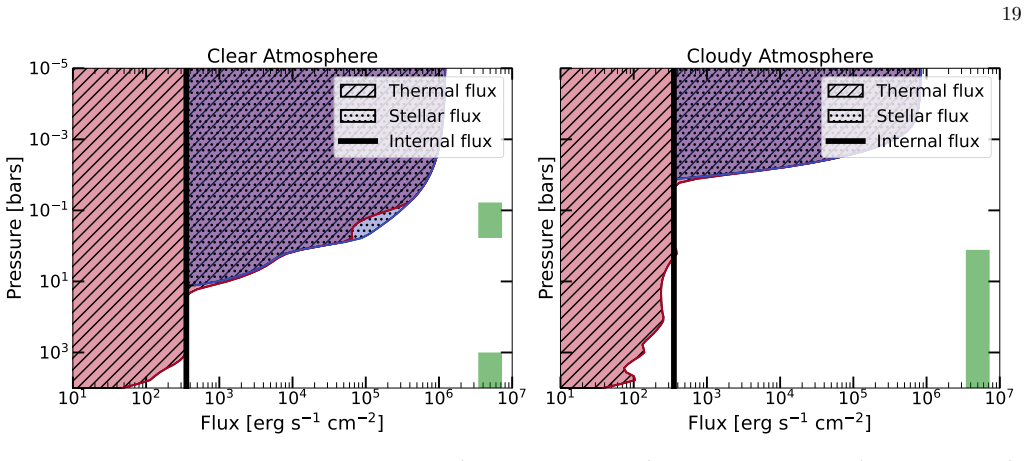
Using the PICASO 1D climate model coupled to interior-structure and magma-atmosphere chemistry frameworks, the authors find that for temperate sub-Neptunes like TOI-270 d, clouds lead to at least 1000 K heating at depths around 10,000 bar and about 600 K cooling at around 1 bar. This heating is sensitive to cloud sedimentation efficiency and metallicity. Most sub-Neptunes in the sample have molten atmosphere-mantle interfaces due to clouds, with temperature differences of 1400-2600 K compared to clear models, leading to increases of at least 36 percent in abundances of O2, SiH4, and SiO at the interface for TOI-270 d.
What carries the argument
The PICASO 1D climate model coupled to interior-structure and magma-atmosphere chemistry frameworks that generates temperature-pressure profiles and chemical abundances for cloudy versus clear atmospheres.
If this is right
- Most sub-Neptunes in the sample maintain molten atmosphere-mantle interfaces once clouds are included.
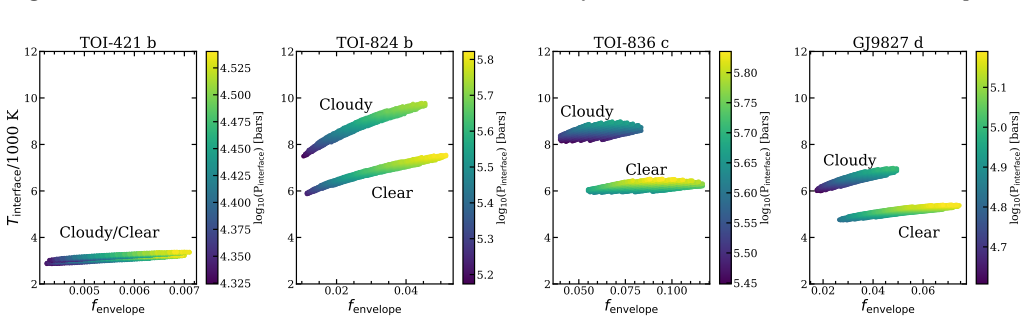
- Cloudy models raise the interface temperature by 1400-2600 K relative to clear models for most planets examined.
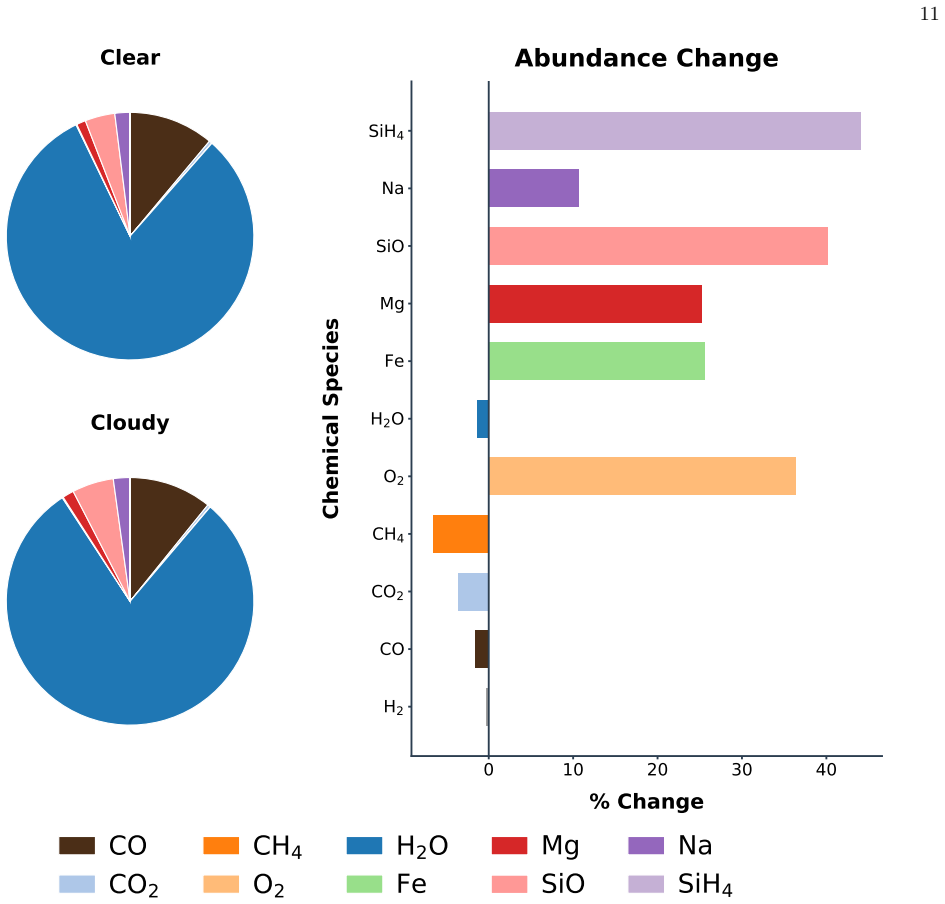
- Abundances of O2, SiH4, and SiO at the interface increase by at least 36 percent between cloudy and clear cases for TOI-270 d.
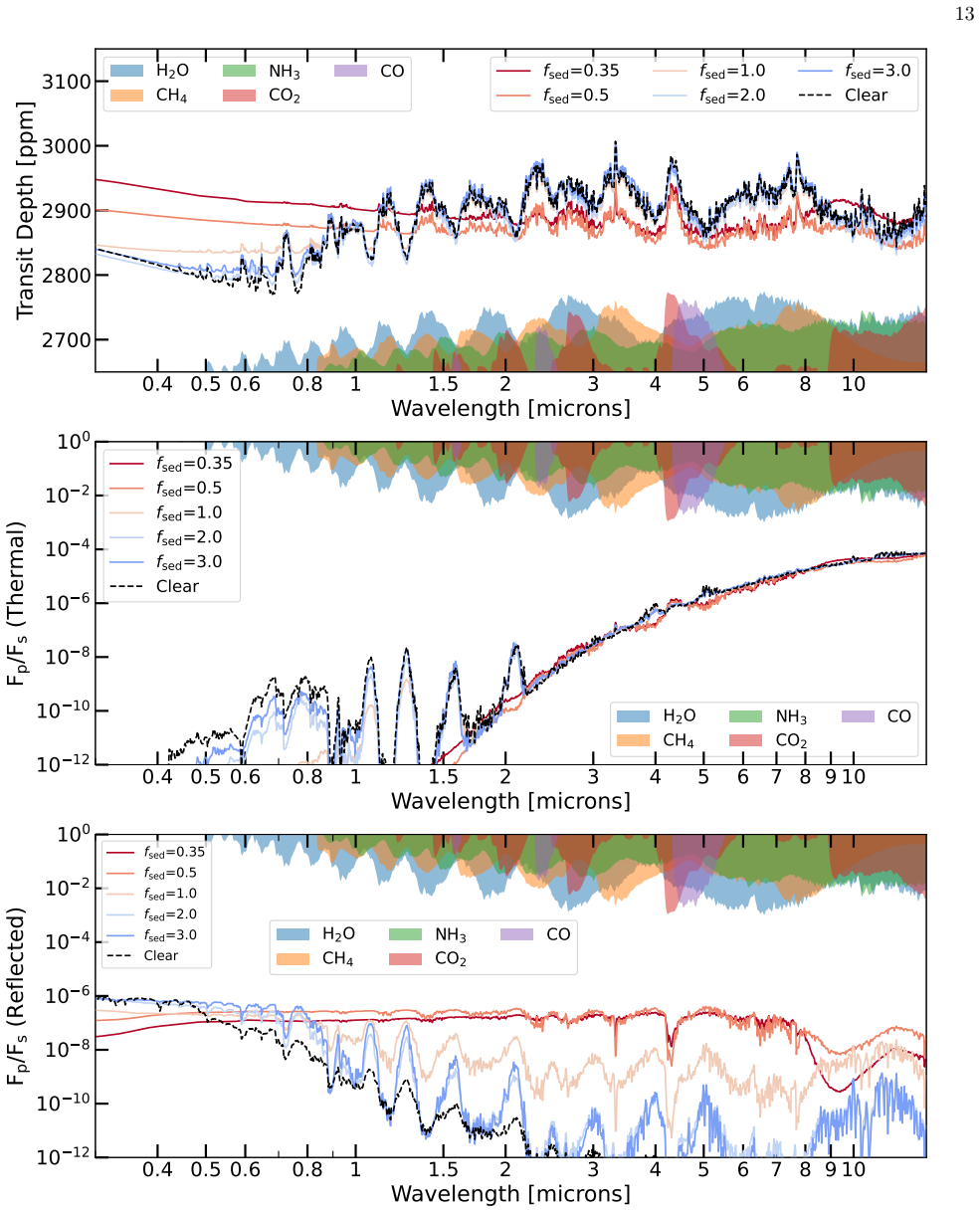
- The magnitude of deep heating depends strongly on cloud sedimentation efficiency.
- TOI-1231 b and GJ 1214 b show molten interfaces only in the cloudy models while clear models can permit a solid boundary.
Where Pith is reading between the lines
- Atmospheric observations that ignore clouds could misinfer the metallicity or bulk composition of sub-Neptunes.
- Direct measurements of a planet's intrinsic luminosity could test whether the cloud-driven heating is present.
- The temperature shift at the interface may alter the rate of volatile exchange between mantle and atmosphere over geologic time.
- Similar cloud effects could appear in models of other thick-atmosphere exoplanets beyond the sub-Neptune sample.
Load-bearing premise
The PICASO 1D climate model coupled to the interior-structure and magma-atmosphere chemistry frameworks produces temperature profiles and chemical abundances that accurately reflect real sub-Neptune physics without missing major feedbacks or unmodeled processes.
What would settle it
A measurement of the intrinsic heat flux or interface temperature for TOI-270 d that matches clear-atmosphere model predictions instead of the cloudy heating values would falsify the central result.
Figures
read the original abstract
Sub-Neptunes are among the most common type of close-in planets found in our galaxy, yet their bulk composition remains largely uncertain; H-rich envelopes overlaying rocky cores, volatile-rich planets, and carbon-rich interiors all remain viable configurations for members of this population. Atmospheric characterization has been proposed as a means of distinguishing between these scenarios, but growing evidence suggests that sub-Neptunes may host molten atmosphere-mantle interfaces which could alter the composition of their atmosphere. We use the PICASO 1D climate model, coupled to interior-structure and magma-atmosphere chemistry frameworks to quantify how clouds alter the atmospheric and interior structure of sub-Neptunes. For temperate sub-Neptunes like TOI-270 d, we find that clouds can lead to $\ge{1000}$ K heating at depth (${\sim}10^{4}$ bar) and $\sim{600}$ K cooling at shallow pressures ($\sim$1 bar). This heating is very sensitive to the cloud sedimentation efficiency and, to a lesser extent, to metallicity. Most sub-Neptunes in our sample should have a molten atmosphere-mantle interface, except TOI-1231 b and GJ 1214 b. For these two planets, cloudy models have a molten interface whereas clear models can allow a solid boundary. Clouds can heat the atmosphere-mantle interfaces by a temperature difference between $\sim{1400}-2600$ K for most sub-Neptunes in our sample. Such cloud-driven heating can substantially change the composition of the interface with abundances of O$_2$, SiH$_4$, and SiO showing a $\ge{36}$\% increase between cloudy and clear models of TOI-270 d. We discuss the implications of our results for the thermal evolution and measurements of intrinsic heat flux for this population.
Editorial analysis
A structured set of objections, weighed in public.
Referee Report
Summary. The paper uses the PICASO 1D climate model coupled to interior-structure and magma-atmosphere chemistry frameworks to examine how clouds affect the thermal and chemical structure of sub-Neptunes, focusing on the atmosphere-mantle interface. For temperate planets such as TOI-270 d, it reports that clouds produce ≥1000 K heating at ~10^4 bar and ~600 K cooling at ~1 bar; the heating is highly sensitive to cloud sedimentation efficiency and metallicity. The work concludes that most sub-Neptunes in the sample maintain molten interfaces even with clouds, that clouds raise interface temperatures by 1400–2600 K, and that this alters key abundances (O2, SiH4, SiO) by ≥36 % between cloudy and clear cases, with implications for thermal evolution and intrinsic heat flux.
Significance. If the quantitative temperature shifts and abundance changes hold under the stated modeling assumptions, the results would indicate that cloud physics must be included when interpreting sub-Neptune interior boundaries and when using atmospheric observations to constrain bulk composition. The explicit demonstration that sedimentation efficiency controls the sign and magnitude of deep heating provides a concrete, testable link between observable cloud properties and interior thermal state.
major comments (2)
- [Abstract] Abstract: the reported ≥1000 K deep heating and 1400–2600 K interface temperature differences are stated to be 'very sensitive' to the cloud sedimentation efficiency, a free parameter whose value is chosen within the modeling framework rather than derived from first principles. Because the central quantitative claims scale directly with this choice, the specific temperature and abundance differences cannot be regarded as robust without a systematic exploration of the parameter range and its effect on the interface state.
- [Abstract] Abstract: the coupling of PICASO to the interior-structure and magma-chemistry modules at ~10^4 bar is presented without discussion of model validation at these pressures, the validity of the 1D radiative-convective assumption, or possible missing feedbacks (deep convection, non-gray opacities, two-way chemistry-radiative coupling). Any of these omissions would rescale the claimed heating magnitudes and the conclusion that most planets retain molten interfaces.
Simulated Author's Rebuttal
We thank the referee for their constructive comments, which have helped us improve the clarity and robustness of the manuscript. We address each major comment below and have made revisions to incorporate additional analysis and discussion as appropriate.
read point-by-point responses
-
Referee: [Abstract] Abstract: the reported ≥1000 K deep heating and 1400–2600 K interface temperature differences are stated to be 'very sensitive' to the cloud sedimentation efficiency, a free parameter whose value is chosen within the modeling framework rather than derived from first principles. Because the central quantitative claims scale directly with this choice, the specific temperature and abundance differences cannot be regarded as robust without a systematic exploration of the parameter range and its effect on the interface state.
Authors: We agree that sedimentation efficiency (f_sed) is a tunable parameter and that its influence on the quantitative results warrants explicit exploration. Our original calculations already compared f_sed = 0.1 and f_sed = 1.0 for the full sample, showing that the sign of deep heating and the molten-interface conclusion are preserved across these values. To address the concern directly, the revised manuscript now includes a new parameter study (Section 4.3 and Figure 8) that systematically varies f_sed from 0.01 to 3.0 for the representative planets TOI-270 d, TOI-1231 b, and GJ 1214 b. The results confirm that interface temperatures remain above the silicate melting point for the majority of the sample across this range, while the two planets noted in the abstract can transition to solid interfaces only in the clear-atmosphere limit at the lowest f_sed. Abundance shifts retain the same direction and remain ≥30 % for the key species, although the exact percentage varies with f_sed. We have updated the abstract to reflect this expanded exploration. revision: yes
-
Referee: [Abstract] Abstract: the coupling of PICASO to the interior-structure and magma-chemistry modules at ~10^4 bar is presented without discussion of model validation at these pressures, the validity of the 1D radiative-convective assumption, or possible missing feedbacks (deep convection, non-gray opacities, two-way chemistry-radiative coupling). Any of these omissions would rescale the claimed heating magnitudes and the conclusion that most planets retain molten interfaces.
Authors: We acknowledge that the high-pressure coupling and modeling assumptions require explicit justification. The revised manuscript adds a dedicated subsection (Section 2.4) that (i) cites prior applications of PICASO to pressures exceeding 10^3 bar in sub-Neptune and giant-planet contexts, (ii) discusses the 1D radiative-convective equilibrium assumption in light of expected deep convective zones, and (iii) outlines the iterative one-way coupling procedure between atmosphere, interior structure, and magma chemistry. We note that full two-way chemistry-radiative feedback and non-gray opacities at these depths remain computationally prohibitive and are identified as future work. These additions do not change the reported temperature differences or molten-interface conclusions, which are presented under the stated modeling framework, but they clarify the scope and limitations of the results. revision: yes
Circularity Check
No significant circularity in forward modeling results
full rationale
The paper applies the established PICASO 1D climate model coupled to interior-structure and magma-chemistry frameworks to compute the effects of clouds on sub-Neptune temperature profiles and interface conditions. Reported quantities such as ≥1000 K deep heating and 1400–2600 K interface temperature shifts are direct outputs of these simulations, with explicit dependence on input parameters like cloud sedimentation efficiency noted in the abstract. No self-definitional steps, fitted inputs renamed as predictions, or load-bearing self-citations appear in the provided text; the derivation chain consists of standard radiative-convective modeling rather than any reduction of results to their own inputs by construction. The work is therefore self-contained as a forward-modeling study.
Axiom & Free-Parameter Ledger
free parameters (2)
- cloud sedimentation efficiency
- metallicity
axioms (1)
- domain assumption The PICASO 1D climate model coupled to interior-structure and magma-atmosphere chemistry frameworks produces physically realistic temperature and composition profiles for sub-Neptunes.
Reference graph
Works this paper leans on
-
[1]
, " * write output.state after.block = add.period write newline
ENTRY address archivePrefix author booktitle chapter doi edition editor eprint howpublished institution journal key month number organization pages publisher school series title misctitle type volume year version url label extra.label sort.label short.list INTEGERS output.state before.all mid.sentence after.sentence after.block FUNCTION init.state.consts ...
-
[2]
write newline
" write newline "" before.all 'output.state := FUNCTION format.url url empty "" new.block "" url * "" * if FUNCTION format.eprint eprint empty "" archivePrefix empty "" archivePrefix "arXiv" = new.block " " eprint * " " * new.block " " eprint * " " * if if if FUNCTION format.doi doi empty "" " " doi * " " * if FUNCTION format.pid doi empty eprint empty ur...
-
[3]
thebibliography [1] 20pt to REFERENCES 6pt =0pt \@twocolumntrue 12pt -12pt 10pt plus 3pt =0pt =0pt =1pt plus 1pt =0pt =0pt -12pt =13pt plus 1pt =20pt =13pt plus 1pt \@M =10000 =-1.0em =0pt =0pt 0pt =0pt =1.0em @enumiv\@empty 10000 10000 `\.\@m \@noitemerr \@latex@warning Empty `thebibliography' environment \@ifnextchar \@reference \@latexerr Missing key o...
-
[4]
Ackerman , A. S., & Marley , M. S. 2001, title Precipitating Condensation Clouds in Substellar Atmospheres , , 556, 872, 10.1086/321540
-
[5]
R., Seager , S., & Elkins-Tanton , L
Adams , E. R., Seager , S., & Elkins-Tanton , L. 2008, title Ocean Planet or Thick Atmosphere: On the Mass-Radius Relationship for Solid Exoplanets with Massive Atmospheres , , 673, 1160, 10.1086/524925
-
[6]
S., Tremblin , P., Manners , J., Baraffe , I., & Mayne , N
Amundsen , D. S., Tremblin , P., Manners , J., Baraffe , I., & Mayne , N. J. 2017, title Treatment of overlapping gaseous absorption with the correlated-k method in hot Jupiter and brown dwarf atmosphere models , , 598, A97, 10.1051/0004-6361/201629322
-
[7]
Barat , S., D \'e sert , J.-M., Vazan , A., et al. 2024, title The metal-poor atmosphere of a potential sub-Neptune progenitor , Nature Astronomy, 8, 899, 10.1038/s41550-024-02257-0
-
[8]
Barat , S., D \'e sert , J.-M., Mukherjee , S., et al. 2025, title A Metal-poor Atmosphere with a Hot Interior for a Young Sub-Neptune Progenitor: JWST/NIRSpec Transmission Spectrum of V1298 Tau b , , 170, 165, 10.3847/1538-3881/adec89
-
[9]
Barnes , R., Jackson , B., Raymond , S. N., West , A. A., & Greenberg , R. 2009, title The HD 40307 Planetary System: Super-Earths or Mini-Neptunes? , , 695, 1006, 10.1088/0004-637X/695/2/1006
-
[10]
Batalha , N. E., Marley , M. S., Lewis , N. K., & Fortney , J. J. 2019, title Exoplanet Reflected-light Spectroscopy with PICASO , , 878, 70, 10.3847/1538-4357/ab1b51
-
[11]
Batalha , N. E., Rooney , C. M., Visscher , C., et al. 2025, title Condensation Clouds in Substellar Atmospheres with Virga , arXiv e-prints, arXiv:2508.15102, 10.48550/arXiv.2508.15102
-
[12]
G., Welbanks , L., Schlawin , E., et al
Beatty , T. G., Welbanks , L., Schlawin , E., et al. 2024, title Sulfur Dioxide and Other Molecular Species in the Atmosphere of the Sub-Neptune GJ 3470 b , , 970, L10, 10.3847/2041-8213/ad55e9
-
[13]
Begemann , B., Dorschner , J., Henning , T., et al. 1997, title Aluminum Oxide and the Opacity of Oxygen-rich Circumstellar Dust in the 12-17 Micron Range , , 476, 199, 10.1086/303597
-
[14]
Belonoshko , A. B., Skorodumova , N. V., Rosengren , A., et al. 2005, title High-Pressure Melting of MgSiO _ 3 , , 94, 195701, 10.1103/PhysRevLett.94.195701
-
[15]
Benneke , B., & Seager , S. 2013, title How to Distinguish between Cloudy Mini-Neptunes and Water/Volatile-dominated Super-Earths , , 778, 153, 10.1088/0004-637X/778/2/153
-
[16]
Benneke , B., Wong , I., Piaulet , C., et al. 2019, title Water Vapor and Clouds on the Habitable-zone Sub-Neptune Exoplanet K2-18b , , 887, L14, 10.3847/2041-8213/ab59dc
-
[18]
Benneke , B., Roy , P.-A., Coulombe , L.-P., et al. 2024 b , title JWST Reveals CH _4 , CO _2 , and H _2 O in a Metal-rich Miscible Atmosphere on a Two-Earth-Radius Exoplanet , arXiv e-prints, arXiv:2403.03325, 10.48550/arXiv.2403.03325
-
[19]
Brande , J., Crossfield , I. J. M., Kreidberg , L., et al. 2024, title Clouds and Clarity: Revisiting Atmospheric Feature Trends in Neptune-size Exoplanets , , 961, L23, 10.3847/2041-8213/ad1b5c
-
[20]
Breza , B., Nixon , M. C., & Kempton , E. M.-R. 2025, title Not All Sub-Neptune Exoplanets Have Magma Oceans , , 993, L46, 10.3847/2041-8213/ae0c07
-
[21]
Burt , J. A., Nielsen , L. D., Quinn , S. N., et al. 2020, title TOI-824 b: A New Planet on the Lower Edge of the Hot Neptune Desert , , 160, 153, 10.3847/1538-3881/abac0c
-
[22]
A., Dragomir , D., Molli \`e re , P., et al
Burt , J. A., Dragomir , D., Molli \`e re , P., et al. 2021, title TOI-1231 b: A Temperate, Neptune-sized Planet Transiting the Nearby M3 Dwarf NLTT 24399 , , 162, 87, 10.3847/1538-3881/ac0432
-
[23]
Most Rocky Sub-Neptunes are Molten: Mapping the Solidification Shoreline for Gas Dwarf Exoplanets
Calder , R., Shorttle , O., Nicholls , H., Lichtenberg , T., & Guimond , C.-M. 2025, title Most Rocky Sub-Neptunes are Molten: Mapping the Solidification Shoreline for Gas Dwarf Exoplanets , arXiv e-prints, arXiv:2512.05816, 10.48550/arXiv.2512.05816
work page internal anchor Pith review Pith/arXiv arXiv doi:10.48550/arxiv.2512.05816 2025
-
[24]
2020, title The Multiplanet System TOI-421 , , 160, 114, 10.3847/1538-3881/aba124
Carleo , I., Gandolfi , D., Barrag \'a n , O., et al. 2020, title The Multiplanet System TOI-421 , , 160, 114, 10.3847/1538-3881/aba124
-
[25]
Charbonneau , D., Berta , Z. K., Irwin , J., et al. 2009, title A super-Earth transiting a nearby low-mass star , , 462, 891, 10.1038/nature08679
-
[26]
Charnay , B., Blain , D., B \'e zard , B., et al. 2021, title Formation and dynamics of water clouds on temperate sub-Neptunes: the example of K2-18b , , 646, A171, 10.1051/0004-6361/202039525
-
[27]
Coulombe , L.-P., Radica , M., Benneke , B., et al. 2025, title Highly reflective white clouds on the western dayside of an exo-Neptune , Nature Astronomy, 9, 512, 10.1038/s41550-025-02488-9
-
[28]
Davenport , B., Kempton , E. M. R., Nixon , M. C., et al. 2025, title TOI-421 b: A Hot Sub-Neptune with a Haze-Free, Low Mean Molecular Weight Atmosphere , arXiv e-prints, arXiv:2501.01498, 10.48550/arXiv.2501.01498
-
[29]
Dymont , A. H., Yu , X., Ohno , K., et al. 2022, title Cleaning Our Hazy Lens: Exploring Trends in Transmission Spectra of Warm Exoplanets , , 937, 90, 10.3847/1538-4357/ac7f40
-
[30]
A., Kubyshkina , D., Alibert , Y., et al
Egger , J. A., Kubyshkina , D., Alibert , Y., et al. 2025, title Searching for hot water world candidates with CHEOPS: Refining the radii and analysing the internal structures and atmospheric lifetimes of TOI-238 b and TOI-1685 b , , 696, A28, 10.1051/0004-6361/202453325
-
[31]
Fei , Y., Seagle , C. T., Townsend , J. P., et al. 2021, title Melting and density of MgSiO _ 3 determined by shock compression of bridgmanite to 1254GPa , Nature Communications, 12, 876, 10.1038/s41467-021-21170-y
-
[32]
Fortney , J. J., Marley , M. S., & Barnes , J. W. 2007, title Planetary Radii across Five Orders of Magnitude in Mass and Stellar Insolation: Application to Transits , , 659, 1661, 10.1086/512120
work page internal anchor Pith review doi:10.1086/512120 2007
-
[33]
J., Mordasini , C., Nettelmann , N., et al
Fortney , J. J., Mordasini , C., Nettelmann , N., et al. 2013, title A Framework for Characterizing the Atmospheres of Low-mass Low-density Transiting Planets , , 775, 80, 10.1088/0004-637X/775/1/80
-
[34]
Fortney , J. J., Visscher , C., Marley , M. S., et al. 2020, title Beyond Equilibrium Temperature: How the Atmosphere/Interior Connection Affects the Onset of Methane, Ammonia, and Clouds in Warm Transiting Giant Planets , , 160, 288, 10.3847/1538-3881/abc5bd
-
[35]
Fressin , F., Torres , G., Charbonneau , D., et al. 2013, title The False Positive Rate of Kepler and the Occurrence of Planets , , 766, 81, 10.1088/0004-637X/766/2/81
-
[36]
Fu , G., Mukherjee , S., Stevenson , K. B., et al. 2025, title Overcast Mornings and Clear Evenings in Hot Jupiter Exoplanet Atmospheres , , 989, L17, 10.3847/2041-8213/adf20f
-
[37]
Fu , R., O'Connell , R. J., & Sasselov , D. D. 2010, title The Interior Dynamics of Water Planets , , 708, 1326, 10.1088/0004-637X/708/2/1326
-
[38]
Fulton , B. J., Petigura , E. A., Howard , A. W., et al. 2017, title The California-Kepler Survey. III. A Gap in the Radius Distribution of Small Planets , , 154, 109, 10.3847/1538-3881/aa80eb
-
[39]
Gandhi , S., & Jermyn , A. S. 2020, title Coupled day-night models of exoplanetary atmospheres , , 499, 4984, 10.1093/mnras/staa3143
-
[40]
2018, title Microphysics of KCl and ZnS Clouds on GJ 1214 b , , 863, 165, 10.3847/1538-4357/aad461
Gao , P., & Benneke , B. 2018, title Microphysics of KCl and ZnS Clouds on GJ 1214 b , , 863, 165, 10.3847/1538-4357/aad461
-
[41]
Gao , P., Marley , M. S., & Ackerman , A. S. 2018, title Sedimentation Efficiency of Condensation Clouds in Substellar Atmospheres , , 855, 86, 10.3847/1538-4357/aab0a1
-
[42]
Gao , P., Marley , M. S., Zahnle , K., Robinson , T. D., & Lewis , N. K. 2017, title Sulfur Hazes in Giant Exoplanet Atmospheres: Impacts on Reflected Light Spectra , , 153, 139, 10.3847/1538-3881/aa5fab
-
[43]
Gao , P., Piette , A. A. A., Steinrueck , M. E., et al. 2023, title The Hazy and Metal-rich Atmosphere of GJ 1214 b Constrained by Near- and Mid-infrared Transmission Spectroscopy , , 951, 96, 10.3847/1538-4357/acd16f
-
[44]
J., & Conrath , B
Gierasch , P. J., & Conrath , B. J. 1985, title Energy conversion processes in the outer planets. , in Recent Advances in Planetary Meteorology, ed. G. E. Hunt , 121--146
1985
-
[45]
Grant , D., Lewis , N. K., Wakeford , H. R., et al. 2023, title JWST-TST DREAMS: Quartz Clouds in the Atmosphere of WASP-17b , , 956, L32, 10.3847/2041-8213/acfc3b10.3847/2041-8213/acfdab
work page doi:10.3847/2041-8213/acfc3b10.3847/2041-8213/acfdab 2023
-
[46]
1994, title Are the Giant Planets Fully Convective? , , 112, 337, 10.1006/icar.1994.1188
Guillot , T., Gautier , D., Chabrier , G., & Mosser , B. 1994, title Are the Giant Planets Fully Convective? , , 112, 337, 10.1006/icar.1994.1188
-
[48]
G \"u nther , M. N., Pozuelos , F. J., Dittmann , J. A., et al. 2019 b , title A super-Earth and two sub-Neptunes transiting the nearby and quiet M dwarf TOI-270 , Nature Astronomy, 3, 1099, 10.1038/s41550-019-0845-5
-
[49]
Gupta , A., & Schlichting , H. E. 2019, title Sculpting the valley in the radius distribution of small exoplanets as a by-product of planet formation: the core-powered mass-loss mechanism , , 487, 24, 10.1093/mnras/stz1230
-
[50]
Hakim , K., Bower , D. J., Seidler , F. L., & Sossi , P. A. 2026, title Silane─methane competition in sub-Neptune atmospheres as a diagnostic of metallicity and magma oceans , , 546, stag133, 10.1093/mnras/stag133
-
[51]
Hawthorn , F., Bayliss , D., Wilson , T. G., et al. 2023, title TOI-836: A super-Earth and mini-Neptune transiting a nearby K-dwarf , , 520, 3649, 10.1093/mnras/stad306
-
[53]
He , C., Radke , M., Moran , S. E., et al. 2024 b , title Optical properties of organic haze analogues in water-rich exoplanet atmospheres observable with JWST , Nature Astronomy, 8, 182, 10.1038/s41550-023-02140-4
-
[54]
Herbort , O., Woitke , P., Helling , C., & Zerkle , A. L. 2022, title The atmospheres of rocky exoplanets. II. Influence of surface composition on the diversity of cloud condensates , , 658, A180, 10.1051/0004-6361/202141636
-
[55]
Holmberg , M., & Madhusudhan , N. 2024, title Possible Hycean conditions in the sub-Neptune TOI-270 d , , 683, L2, 10.1051/0004-6361/202348238
-
[56]
Horn , H., Vazan , A., Chariton , S., Prakapenka , V., & Shim , S.-H. 2025, title Building Wet Planets through High-Pressure Magma-Hydrogen Reactions , arXiv e-prints, arXiv:2511.06507, 10.48550/arXiv.2511.06507
-
[57]
H \"o rst , S. M., He , C., Lewis , N. K., et al. 2018, title Haze production rates in super-Earth and mini-Neptune atmosphere experiments , Nature Astronomy, 2, 303, 10.1038/s41550-018-0397-0
-
[58]
Howard , A. W., Marcy , G. W., Bryson , S. T., et al. 2012, title Planet Occurrence within 0.25 AU of Solar-type Stars from Kepler , , 201, 15, 10.1088/0067-0049/201/2/15
-
[59]
Hu , R., Bello-Arufe , A., Tokadjian , A., et al. 2025, title A water-rich interior in the temperate sub-Neptune K2-18 b revealed by JWST , arXiv e-prints, arXiv:2507.12622, 10.48550/arXiv.2507.12622
-
[60]
Huang , C., Rice , D. R., & Steffen , J. H. 2022, title MAGRATHEA: an open-source spherical symmetric planet interior structure code , , 513, 5256, 10.1093/mnras/stac1133
-
[61]
Huffman , D. R., & Wild , R. L. 1967, title Optical Properties of -MnS , Physical Review, 156, 989, 10.1103/PhysRev.156.989
-
[62]
Huseby , L., Moran , S. E., Pearson , N., et al. 2025, title Effects of Ultraviolet Radiation on Sub-Neptune Exoplanet Hazes through Laboratory Experiments , , 6, 145, 10.3847/PSJ/adda4a
-
[63]
Inglis , J., Batalha , N. E., Lewis , N. K., et al. 2024, title Quartz Clouds in the Dayside Atmosphere of the Quintessential Hot Jupiter HD 189733 b , , 973, L41, 10.3847/2041-8213/ad725e
-
[64]
Jiang , I.-G., Yeh , L.-C., Edwards , B., et al. 2025, title Toward High-precision Mass Measurements of Two Sub-Neptunes in the K2-266 Planetary System Through Transit Timing , , 169, 243, 10.3847/1538-3881/adbe7a
-
[65]
Kempton , E. M. R., Zhang , M., Bean , J. L., et al. 2023, title A reflective, metal-rich atmosphere for GJ 1214b from its JWST phase curve , , 620, 67, 10.1038/s41586-023-06159-5
-
[66]
Khachai , H., Khenata , R., Bouhemadou , A., et al. 2009, title FP-APW+lo calculations of the electronic and optical properties of alkali metal sulfides under pressure , Journal of Physics Condensed Matter, 21, 095404, 10.1088/0953-8984/21/9/095404
-
[67]
Kiefer , S., Morley , C. V., & Rowland , M. 2026, title Connecting JWST Silicate Cloud Observations to Exoplanet Cloud Microphysics with Nimbus , arXiv e-prints, arXiv:2603.13167. 2603.13167
-
[68]
S., Fegley , Jr., B., Schaefer , L., & Ford , E
Kite , E. S., Fegley , Jr., B., Schaefer , L., & Ford , E. B. 2019, title Superabundance of Exoplanet Sub-Neptunes Explained by Fugacity Crisis , , 887, L33, 10.3847/2041-8213/ab59d9
-
[69]
S., Fegley , Jr., B., Schaefer , L., & Ford , E
Kite , E. S., Fegley , Jr., B., Schaefer , L., & Ford , E. B. 2020, title Atmosphere Origins for Exoplanet Sub-Neptunes , , 891, 111, 10.3847/1538-4357/ab6ffb
-
[70]
1995, title Extinction spectra of corundum in the wavelengths from UV to FIR
Koike , C., Kaito , C., Yamamoto , T., et al. 1995, title Extinction spectra of corundum in the wavelengths from UV to FIR. , , 114, 203, 10.1006/icar.1995.1055
-
[71]
Kreidberg , L., Bean , J. L., D \'e sert , J.-M., et al. 2014, title Clouds in the atmosphere of the super-Earth exoplanet GJ1214b , , 505, 69, 10.1038/nature12888
-
[72]
Kuchner , M. J. 2003, title Volatile-rich Earth-Mass Planets in the Habitable Zone , , 596, L105, 10.1086/378397
-
[73]
E., Garc \' a Mu \ n oz , A., & Showman , A
Lavvas , P., Koskinen , T., Steinrueck , M. E., Garc \' a Mu \ n oz , A., & Showman , A. P. 2019, title Photochemical Hazes in Sub-Neptunian Atmospheres with a Focus on GJ 1214b , , 878, 118, 10.3847/1538-4357/ab204e
-
[74]
2017, title Condensation-inhibited convection in hydrogen-rich atmospheres
Leconte , J., Selsis , F., Hersant , F., & Guillot , T. 2017, title Condensation-inhibited convection in hydrogen-rich atmospheres . Stability against double-diffusive processes and thermal profiles for Jupiter, Saturn, Uranus, and Neptune , , 598, A98, 10.1051/0004-6361/201629140
-
[75]
Lee , E. K. H., Werlen , A., & Dorn , C. 2025, title Mineral Cloud Formation above Magma Oceans in Sub-Neptune Atmospheres , , 990, L43, 10.3847/2041-8213/adfe62
-
[76]
Li , J., Bergin , E. A., Hirschmann , M. M., et al. 2026, title Soot Planets Instead of Water Worlds , , 997, L29, 10.3847/2041-8213/ae29a6
-
[77]
Lin , Z., & Seager , S. 2025, title Carbon-rich Sub-Neptune Interiors Are Compatible with JWST Observations , , 990, L35, 10.3847/2041-8213/adfcc8
-
[78]
Lines , S., Mayne , N. J., Manners , J., et al. 2019, title Overcast on Osiris: 3D radiative-hydrodynamical simulations of a cloudy hot Jupiter using the parametrized, phase-equilibrium cloud formation code EDDYSED , , 488, 1332, 10.1093/mnras/stz1788
-
[79]
Livingston , J. H., Petigura , E. A., David , T. J., et al. 2026, title A young progenitor for the most common planetary systems in the Galaxy , , 649, 310, 10.1038/s41586-025-09840-z
-
[80]
Lopez , E. D., & Fortney , J. J. 2014, title Understanding the Mass-Radius Relation for Sub-neptunes: Radius as a Proxy for Composition , , 792, 1, 10.1088/0004-637X/792/1/1
-
[81]
Luque , R., Nowak , G., Hirano , T., et al. 2022, title Precise mass determination for the keystone sub-Neptune planet transiting the mid-type M dwarf G 9-40 , , 666, A154, 10.1051/0004-6361/202244426
-
[82]
MacDonald , R. J., & Madhusudhan , N. 2017, title HD 209458b in new light: evidence of nitrogen chemistry, patchy clouds and sub-solar water , , 469, 1979, 10.1093/mnras/stx804
-
[83]
Madhusudhan , N. 2012, title C/O Ratio as a Dimension for Characterizing Exoplanetary Atmospheres , , 758, 36, 10.1088/0004-637X/758/1/36
discussion (0)
Sign in with ORCID, Apple, or X to comment. Anyone can read and Pith papers without signing in.