Generalized multilevel amplitude damping channels and their thermodynamic performances
Pith reviewed 2026-06-29 17:10 UTC · model grok-4.3
The pith
GMAD channels show ergotropic capacitance is non-monotonic in bath temperature and produce a Markovian Mpemba effect under iteration.
A machine-rendered reading of the paper's core claim, the machinery that carries it, and where it could break.
Core claim
The ergotropic capacitance of a GMAD channel is not monotonic in the temperature of the environment; moreover, iterating the map can lead to crossings between ergotropic functionals at different temperatures, indicating the presence of a Markovian Mpemba effect.
What carries the argument
The GMAD channel family, a parameterized set of completely positive maps that generalize amplitude damping to multilevel systems while incorporating thermal equilibrium states, used to compute work functionals and separate coherent versus incoherent ergotropy.
If this is right
- Optimal initial states for a qudit in a thermal environment can be chosen to maximize retained work extraction value.
- The non-monotonic dependence on temperature implies that an intermediate bath temperature can preserve more ergotropy than either a colder or hotter bath.
- Repeated application of the channel produces crossings, so the ordering of work-extraction performance at two temperatures can reverse after sufficient noise steps.
- New quantifiers separate the coherent and incoherent parts of ergotropy, allowing finer diagnosis of which resource is lost first.
Where Pith is reading between the lines
- The observed crossings suggest that protocols relying on thermal relaxation steps might sometimes benefit from waiting longer rather than shorter times at fixed temperature.
- The same non-monotonicity could appear in other noise models that interpolate between zero-temperature damping and full thermalization.
- Device calibration routines that assume monotonic resource loss with temperature may need revision when operating near the crossing points.
Load-bearing premise
The chosen mathematical form of the GMAD family is assumed to correctly capture the physical coupling of a qudit to a thermal bath.
What would settle it
A laboratory measurement on a physical qudit that shows ergotropic capacitance rising or falling steadily with bath temperature, or that shows no crossing of ergotropic curves after repeated applications of the noise map.
Figures
read the original abstract
We introduce a new class of quantum channels, the Generalized Multilevel Amplitude Damping (GMAD) channels, to model noise and decoherence effects in a qudit coupled to a thermal environment. The degradation of energetic resources under GMADs is investigated by evaluating work functionals and ergotropic capacitances, with particular attention to the coherent and incoherent contributions to ergotropy, for which we introduce new quantifiers. Our analysis sheds light on how to optimally prepare a qudit in a thermal environment in order to preserve its value from the perspective of work extraction, and reveals several counterintuitive phenomena: the ergotropic capacitance of a GMAD channel is not monotonic in the temperature of the environment; moreover, iterating the map can lead to crossings between ergotropic functionals at different temperatures, indicating the presence of a Markovian Mpemba effect.
Editorial analysis
A structured set of objections, weighed in public.
Referee Report
Summary. The paper introduces Generalized Multilevel Amplitude Damping (GMAD) channels as a model for noise on a qudit coupled to a thermal environment. It evaluates the degradation of energetic resources via work functionals and ergotropic capacitances, defines new quantifiers separating coherent and incoherent ergotropy contributions, and reports that ergotropic capacitance is non-monotonic in bath temperature while iterated applications produce crossings between ergotropic functionals at different temperatures, interpreted as a Markovian Mpemba effect.
Significance. If the GMAD family is accepted as a faithful thermal-noise model, the reported non-monotonicity and Mpemba crossings would constitute concrete, falsifiable predictions about resource preservation under iterated thermal maps, extending known single-qubit results to multilevel systems. The new ergotropy quantifiers are a modest but useful addition to the quantum-thermodynamics toolkit. The absence of a microscopic derivation, however, confines the significance to the mathematical properties of the chosen parametrization rather than generic thermal physics.
major comments (2)
- [Introduction / channel definition (abstract and opening sections)] The central claims (non-monotonic ergotropic capacitance and Markovian Mpemba crossings) rest on the assertion that GMAD channels faithfully represent coupling to a thermal bath. The manuscript introduces the channel family by direct definition of its Kraus operators and temperature-dependent rates without supplying a system-bath Hamiltonian, weak-coupling limit, or Born-Markov derivation that would fix the functional form of those rates. This modeling choice is load-bearing: any observed non-monotonicity could be an artifact of the ad-hoc parametrization rather than a generic feature of thermal noise.
- [Sections presenting the ergotropic capacitance and iteration results] The thermodynamic performance analysis (work extraction, ergotropic capacitance) is performed exclusively on the GMAD family as defined; no comparison is provided to standard amplitude-damping or generalized amplitude-damping channels whose rates do arise from microscopic models. Without such a benchmark, it is unclear whether the reported counter-intuitive phenomena survive under physically derived rate equations.
minor comments (2)
- [Definitions of new quantifiers] Notation for the new coherent/incoherent ergotropy quantifiers should be introduced with explicit equations and contrasted with existing ergotropy decompositions in the literature.
- [Figures] Figure captions and axis labels for any plots of ergotropic capacitance versus temperature or iteration number should explicitly state the dimension of the qudit and the precise GMAD parameters used.
Simulated Author's Rebuttal
We thank the referee for the careful and constructive report. The two major comments raise valid points about the modeling assumptions and the need for benchmarks. We address each below and indicate the revisions we will make.
read point-by-point responses
-
Referee: The central claims (non-monotonic ergotropic capacitance and Markovian Mpemba crossings) rest on the assertion that GMAD channels faithfully represent coupling to a thermal bath. The manuscript introduces the channel family by direct definition of its Kraus operators and temperature-dependent rates without supplying a system-bath Hamiltonian, weak-coupling limit, or Born-Markov derivation that would fix the functional form of those rates. This modeling choice is load-bearing: any observed non-monotonicity could be an artifact of the ad-hoc parametrization rather than a generic feature of thermal noise.
Authors: We agree that the absence of a microscopic derivation limits the claim to a specific family of channels. The GMAD Kraus operators and rates are constructed phenomenologically to generalize the qubit amplitude-damping channel while enforcing that the Gibbs state is a fixed point and satisfying detailed balance. This ensures thermodynamic consistency by design, but the functional form of the rates is not derived from a system-bath Hamiltonian in the manuscript. We will revise the introduction and channel-definition section to state explicitly that GMAD is a phenomenological model, to discuss its reduction to standard thermal maps in the qubit limit, and to note that the reported non-monotonicity and Mpemba crossings are properties of this parametrization rather than proven generic features of all thermal noise. revision: partial
-
Referee: The thermodynamic performance analysis (work extraction, ergotropic capacitance) is performed exclusively on the GMAD family as defined; no comparison is provided to standard amplitude-damping or generalized amplitude-damping channels whose rates do arise from microscopic models. Without such a benchmark, it is unclear whether the reported counter-intuitive phenomena survive under physically derived rate equations.
Authors: We accept that an explicit benchmark would strengthen the manuscript. For dimension d=2 the GMAD channel coincides with the standard temperature-dependent amplitude-damping channel whose rates follow from the usual thermal detailed-balance condition. We will add a short subsection (or appendix) that recomputes the ergotropic capacitance for the qubit case using the standard microscopic rate expressions and verifies that the non-monotonicity persists. For d>2 we will note that no universally accepted microscopic derivation of generalized amplitude damping exists in the literature, so a direct comparison is not currently possible; we will flag this as a limitation and suggest that the observed phenomena motivate future microscopic studies. revision: yes
Circularity Check
No significant circularity; results are direct computations on explicitly defined GMAD channels and new ergotropic quantifiers.
full rationale
The paper defines the GMAD channel family and introduces new quantifiers for coherent/incoherent ergotropy contributions. All reported phenomena (non-monotonic ergotropic capacitance, Mpemba crossings under iteration) follow by direct evaluation of these objects as functions of the channel parameters, including temperature. No steps reduce by construction to fitted inputs, self-citations, or imported uniqueness theorems; the chain is self-contained within the introduced definitions and does not rely on external load-bearing premises that collapse to the target claims.
Axiom & Free-Parameter Ledger
Reference graph
Works this paper leans on
-
[1]
5 is to write the spaces H(E) SB introduced in Eq
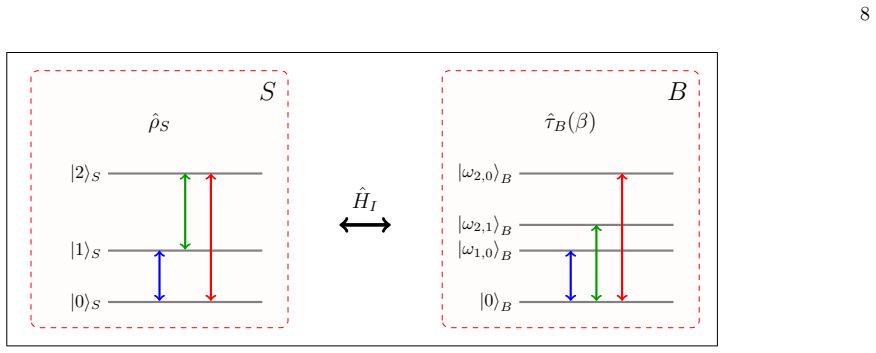
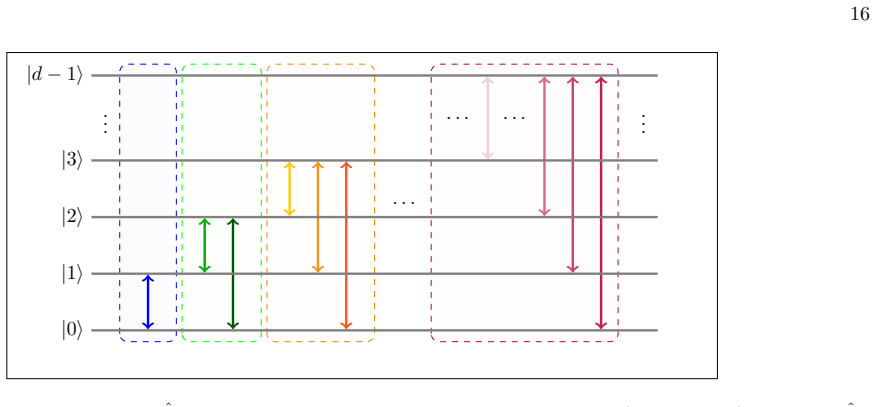
Microscopic derivation of the Kraus operators The starting point to associate a general structure to the microscopic model outlined in Fig. 5 is to write the spaces H(E) SB introduced in Eq. (A3). We can divide these subspaces in two categories: 9 1.Non-trivial fixed energy subspaces.In these subspaces the energyEis exactly equal toϵ i fori∈[0, d−1], that...
-
[2]
Local Ergotropy Thelocal ergotropyquantifies the maximum amount of work which islocally unitarily extractablefrom a system HS in a state ˆρS, i. e. work extractable only using unitary transformationsU loc(d) that act locally on the subsystems ofH S: E(ˆρ;ˆH) := max ˆU∈U loc(d) n Tr[ˆρˆH]−Tr[ ˆUˆρˆU † ˆH] o (D1)
-
[3]
Maximal Work Functionals Given a quantum channel Λ, fixing the input energyE≥0 and the numbernof copies of the systemH S, one can define the following Maximal Work Functionals (MWF) [4]: •Shell-Maximal Work Functionals for noisy channels. Then-cells shell-maximal work functionalfor a noisy channel is: W (n) (Λ;E) = max ˆρ(n) ∈S (n) E W(Λ ⊗n(ˆρ(n)); ˆH(n))...
-
[4]
MAWERs A way of taking advantage of thencopies of the system, which is alternative to what done to define work capaci- tances, is to use them to store a finite amount of energyE, such thatE/n=e→0 asn→ ∞. In this framework, it is appropriate to study theMaximal Asymptotic Work-Energy Ratio(MAWER), defined as [4, 58]: JW(Λ) := lim sup E→∞ sup n≥⌈E/emax⌉ W(n...
-
[5]
Since the interaction Hamiltonian commutes with the free evolution, it is sufficient to evaluate B⟨ωk|e−it ˆHI |ωh⟩B instead of the full unitary generated by ˆHtot
-
[6]
the terms ˆHij and ˆHrs commute for every{ij}and{rs}, unlesss=j: [ ˆHij, ˆHrs] =g ijgrsδjs (|i⟩ ⟨r| ⊗ |ωij⟩ ⟨ωrs| − |r⟩ ⟨i| ⊗ |ωrs⟩ ⟨ωij|), (E3) This relation is illustrated in Fig. 6. Using equation (E3) it is possible to rewrite: e−it ˆHI =e −it ˆH01 e−it( ˆH02+ ˆH12)e−it( ˆH03+ ˆH13+ ˆH23)... (E4)
-
[7]
The action of ˆHI can be decomposed on the different subspacesH (E) SB , as discussed in Appendix A. In partic- ular, ˆHI acts trivially on the subspace spanned by the kets|0, ω 0⟩,|0, ω 21⟩,|1, ω 10⟩,|1, ω 20⟩,|2, ω 10⟩,|2, ω 21⟩, |2, ω20⟩, while it acts as a Pauli ˆσ x on the subspace{|0, ω 10⟩,|1, ω 00⟩}. In the three-dimensional subspace {|0, ω20⟩,|1,...
-
[8]
(3) andc 1, s1,¯c,¯s, α0, α1 are real numbers derived from the coupling constantsg k in Eq
Therefore, it is possible to calculate the Kraus operators, which are listed below: ˆK(D) 00 :=r 00 diag[1, c1,¯c], ˆK(D) 10 :=r 10 diag[c1,1,1], ˆK(D) 21 :=r 21 diag[1, α2 0 +α 2 1¯c,1], ˆK(D) 20 :=r 20 diag[α2 1 +α 2 0¯c,1,1] ; ˆK(1) 10 :=−ir 00s1|0⟩ ⟨1|, ˆK(2) 21 :=−ir 00¯sα1|1⟩ ⟨2|, ˆK(2) 20 :=−ir 00¯sα0|0⟩ ⟨2|, ˆK(2) 10 :=r 20(¯c−1)α0α1|0⟩ ⟨1|; ˆK(1)...
-
[9]
Gyongyosi, S
L. Gyongyosi, S. Imre, and H. V. Nguyen, A survey on quantum channel capacities, IEEE Communications Sur- veys & Tutorials20, 1149 (2018)
2018
-
[10]
G. Francica, F. Binder, G. Guarnieri, M. Mitchison, J. Goold, and F. Plastina, Quantum coherence and er- gotropy, Physical Review Letters125, 10.1103/phys- revlett.125.180603 (2020)
-
[11]
Tirone, R
S. Tirone, R. Salvia, and V. Giovannetti, Quantum en- ergy lines and the optimal output ergotropy problem, Phys. Rev. Lett.127, 210601 (2021)
2021
- [12]
-
[13]
Alicki and R
R. Alicki and R. Kosloff, Introduction to quantum ther- modynamics: History and prospects, inThermodynamics in the Quantum Regime: Fundamental Aspects and New Directions(Springer, 2019) pp. 1–33
2019
-
[14]
Deffner and S
S. Deffner and S. Campbell,Quantum Thermodynamics: An introduction to the thermodynamics of quantum in- formation(Morgan & Claypool Publishers, 2019)
2019
-
[15]
Vinjanampathy and J
S. Vinjanampathy and J. Anders, Quantum thermody- namics, Contemporary Physics57, 545 (2016)
2016
-
[16]
Auff` eves, Quantum technologies need a quantum en- ergy initiative, PRX Quantum3, 020101 (2022)
A. Auff` eves, Quantum technologies need a quantum en- ergy initiative, PRX Quantum3, 020101 (2022)
2022
-
[17]
R. Castellano, V. Cavina, M. Perarnau-Llobet, P. Sekatski, and V. Giovannetti, Exact require- ments for battery-assisted qubit gates, arXiv preprint arXiv:2506.11855 (2025)
-
[18]
Energetics of Trapped-Ion Quantum Computation
F. G´ ois, M. Pezzutto, and Y. Omar, Towards energetic quantum advantage in trapped-ion quantum computa- tion, arXiv preprint arXiv:2404.11572 (2024)
work page internal anchor Pith review Pith/arXiv arXiv 2024
-
[19]
Silva Pratapsi, P
S. Silva Pratapsi, P. H. Huber, P. Barthel, S. Bose, C. Wunderlich, and Y. Omar, Classical half-adder us- ing trapped-ion quantum bits: Toward energy-efficient computation, Applied Physics Letters123(2023)
2023
-
[20]
Campaioli, F
F. Campaioli, F. A. Pollock, and S. Vinjanampathy, Quantum batteries, Thermodynamics in the Quantum Regime: Fundamental Aspects and New Directions , 207 (2018)
2018
-
[21]
J. Q. Quach, K. E. McGhee, L. Ganzer, D. M. Rouse, B. W. Lovett, E. M. Gauger, J. Keeling, G. Cerullo, D. G. Lidzey, and T. Virgili, Superabsorption in an organic mi- crocavity: Toward a quantum battery, Science advances 8, eabk3160 (2022)
2022
-
[22]
Canzio, V
A. Canzio, V. Cavina, M. Polini, and V. Giovannetti, Single-atom dissipation and dephasing in dicke and tavis- cummings quantum batteries, Physical Review A111, 022222 (2025)
2025
-
[23]
Breuer and F
H.-P. Breuer and F. Petruccione,The Theory of Open Quantum Systems(Oxford University Press, 2002)
2002
-
[24]
M. A. Nielsen and I. L. Chuang,Quantum computation and quantum information(Cambridge university press, 2010)
2010
-
[25]
Khatri, K
S. Khatri, K. Sharma, and M. M. Wilde, Information- theoretic aspects of the generalized amplitude-damping channel, Physical Review A102, 012401 (2020)
2020
-
[26]
Giovannetti and R
V. Giovannetti and R. Fazio, Information-capacity de- scription of spin-chain correlations, Physical Review A—Atomic, Molecular, and Optical Physics71, 032314 (2005). 18
2005
-
[27]
S. Chessa and V. Giovannetti, Quantum capacity analy- sis of multi-level amplitude damping channels, Commu- nications Physics4, 10.1038/s42005-021-00524-4 (2021)
-
[28]
Quantum capacity analysis of finite-dimensional lossy channels
S. Cocciaretto and V. Giovannetti, Quantum capac- ity analysis of finite-dimensional lossy channels, arXiv preprint arXiv:2601.18960 (2026)
work page internal anchor Pith review Pith/arXiv arXiv 2026
-
[29]
Chessa and V
S. Chessa and V. Giovannetti, Resonant multilevel am- plitude damping channels, Quantum7, 902 (2023)
2023
-
[30]
Menta, F
R. Menta, F. Cioni, R. Aiudi, M. Polini, and V. Giovan- netti, Globally driven superconducting quantum comput- ing architecture, Physical Review Research7, L012065 (2025)
2025
-
[31]
G. N. Hatsopoulos and E. P. Gyftopoulos, A unified quantum theory of mechanics and thermodynamics. Part IIa. Available energy, Found Phys6, 127 (1976)
1976
-
[32]
A. E. Allahverdyan, R. Balian, and T. M. Nieuwenhuizen, Maximal work extraction from finite quantum systems, Europhysics Letters67, 565 (2004)
2004
-
[33]
Brandao, M
F. Brandao, M. Horodecki, N. Ng, J. Oppenheim, and S. Wehner, The second laws of quantum thermodynam- ics, Proceedings of the National Academy of Sciences 112, 3275 (2015)
2015
-
[34]
N. H. Y. Ng and M. P. Woods, Resource theory of quan- tum thermodynamics: Thermal operations and second laws, inThermodynamics in the quantum regime: Fun- damental aspects and new directions(Springer, 2019) pp. 625–650
2019
-
[35]
Lu and O
Z. Lu and O. Raz, Nonequilibrium thermodynamics of the markovian mpemba effect and its inverse, Proceed- ings of the National Academy of Sciences114, 5083 (2017)
2017
-
[36]
Carollo, A
F. Carollo, A. Lasanta, and I. Lesanovsky, Exponentially accelerated approach to stationarity in markovian open quantum systems through the mpemba effect, Physical Review Letters127, 060401 (2021)
2021
-
[37]
Baumgratz, M
T. Baumgratz, M. Cramer, and M. B. Plenio, Quantify- ing coherence, Phys. Rev. Lett.113, 140401 (2014)
2014
-
[38]
Marvian, R
I. Marvian, R. W. Spekkens, and P. Zanardi, Quantum speed limits, coherence, and asymmetry, Physical Review A93, 052331 (2016)
2016
-
[39]
Winter and D
A. Winter and D. Yang, Operational resource theory of coherence, Phys. Rev. Lett.116, 120404 (2016)
2016
-
[40]
Alicki, On the detailed balance condition for non- hamiltonian systems, Reports on Mathematical Physics 10, 249 (1976)
R. Alicki, On the detailed balance condition for non- hamiltonian systems, Reports on Mathematical Physics 10, 249 (1976)
1976
-
[41]
Fagnola and V
F. Fagnola and V. Umanit` a, Detailed balance, time re- versal, and generators of quantum markov semigroups, Mathematical Notes84, 108 (2008)
2008
-
[42]
Soret, V
A. Soret, V. Cavina, and M. Esposito, Thermodynamic consistency of quantum master equations (2022)
2022
-
[43]
Pusz and S
W. Pusz and S. L. Woronowicz, Passive states and kms states for general quantum systems, Communications in Mathematical Physics58, 273 (1978)
1978
-
[44]
Lenard, Thermodynamical proof of the gibbs formula for elementary quantum systems, Journal of Statistical Physics19, 575 (1978)
A. Lenard, Thermodynamical proof of the gibbs formula for elementary quantum systems, Journal of Statistical Physics19, 575 (1978)
1978
- [45]
-
[46]
H. J. Greenberg and W. P. Pierskalla, A review of quasi- convex functions, Operations research19, 1553 (1971)
1971
-
[47]
Perarnau-Llobet, K
M. Perarnau-Llobet, K. V. Hovhannisyan, M. Huber, P. Skrzypczyk, N. Brunner, and A. Ac´ ın, Extractable work from correlations, Physical Review X5, 041011 (2015)
2015
-
[48]
S. Tirone, R. Salvia, S. Chessa, and V. Giovannetti, Work extraction processes from noisy quantum batteries: The role of nonlocal resources, Physical Review Letters131, 10.1103/physrevlett.131.060402 (2023)
-
[49]
Tavis and F
M. Tavis and F. W. Cummings, Exact solution for an n- molecule—radiation-field hamiltonian, Physical Review 170, 379 (1968)
1968
-
[50]
Loudon and M
R. Loudon and M. O. Scully, The quantum theory of light, Physics Today27, 48 (1974)
1974
- [51]
-
[52]
M. J. Hartmann, F. G. Brandao, and M. B. Plenio, Strongly interacting polaritons in coupled arrays of cav- ities, Nature Physics2, 849 (2006)
2006
-
[53]
Singh, S
U. Singh, S. Das, and N. J. Cerf, Partial order on passive states and hoffman majorization in quantum thermody- namics, Physical Review Research3, 033091 (2021)
2021
-
[54]
Medina, O
I. Medina, O. Culhane, F. C. Binder, G. T. Landi, and J. Goold, Anomalous discharging of quantum batteries: The ergotropic mpemba effect, Physical Review Letters 134, 220402 (2025)
2025
- [55]
-
[56]
Campisi, Unified theory of classical and quantum er- gotropy, Europhysics Letters (2026)
M. Campisi, Unified theory of classical and quantum er- gotropy, Europhysics Letters (2026)
2026
-
[57]
E. B. Mpemba and D. G. Osborne, Cool?, Physics Edu- cation4, 172 (1969)
1969
-
[58]
F. Ares, P. Calabrese, and S. Murciano, The quantum mpemba effects, Nature Reviews Physics7, 451 (2025)
2025
-
[59]
Ergotropy and Work Extraction in Quantum Heat Engines via Quantum Channels
I. VS and D. Verma, Ergotropy and work extraction in quantum heat engines via quantum channels, arXiv preprint arXiv:2605.20969 (2026)
work page internal anchor Pith review Pith/arXiv arXiv 2026
-
[60]
Chiribella, Y
G. Chiribella, Y. Yang, and R. Renner, Fundamental en- ergy requirement of reversible quantum operations, Phys- ical Review X11, 021014 (2021)
2021
-
[61]
Alimuddin, T
M. Alimuddin, T. Guha, and P. Parashar, Bound on er- gotropic gap for bipartite separable states, Physical Re- view A99, 052320 (2019)
2019
-
[62]
Berge, Espaces topologiques: Fonctions multivoques
C. Berge, Espaces topologiques: Fonctions multivoques. dunod, paris, 1959. english translation: Translated by em patterson. topological spaces (1963)
1959
-
[63]
P. M. Alberti and A. Uhlmann,Stochasticity and Par- tial Order: Doubly Stochastic Maps and Unitary Mixing (Springer Netherlands, 1982)
1982
-
[64]
Hiai, Majorization and stochastic maps in von neu- mann algebras, Journal of mathematical analysis and ap- plications127, 18 (1987)
F. Hiai, Majorization and stochastic maps in von neu- mann algebras, Journal of mathematical analysis and ap- plications127, 18 (1987)
1987
-
[65]
Bhatia, Positive definite matrices, inPositive Definite Matrices(Princeton university press, 2009)
R. Bhatia, Positive definite matrices, inPositive Definite Matrices(Princeton university press, 2009)
2009
- [66]
-
[67]
T. L. Curtright and C. K. Zachos, Elementary results for the fundamental representation of su(3), Reports on Mathematical Physics76, 401–404 (2015)
2015
discussion (0)
Sign in with ORCID, Apple, or X to comment. Anyone can read and Pith papers without signing in.