Influence of the QCD Analogue of the Inverse Compton Effect on the Transverse Momentum and Pseudorapidity Distributions of Secondary Particles in pp Collisions at sqrt (s)= 30 GeV, 510 GeV, and 14 TeV
Pith reviewed 2026-06-29 17:24 UTC · model grok-4.3
The pith
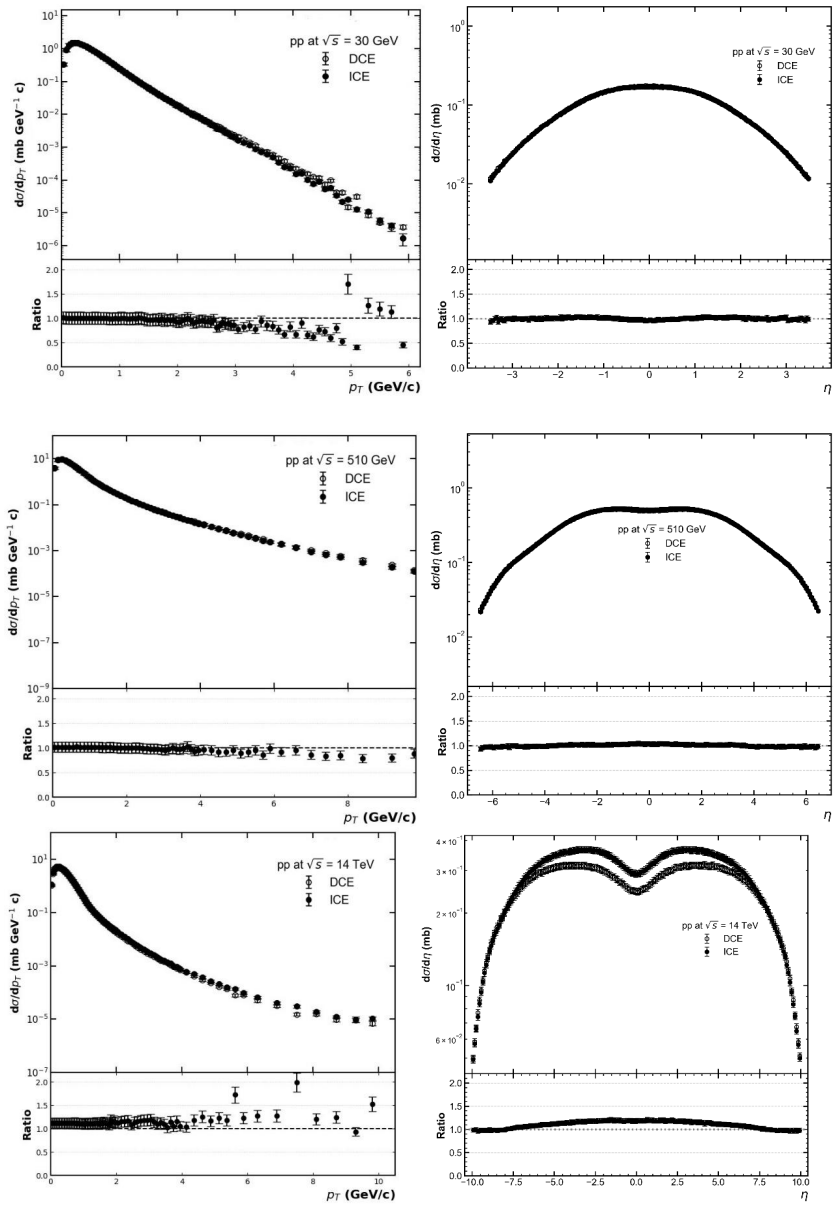
As collision energy rises from 30 GeV to 14 TeV, the QCD analogue of the inverse Compton effect contributes as much as or more than the direct counterpart to particle production over a broad transverse-momentum range.
A machine-rendered reading of the paper's core claim, the machinery that carries it, and where it could break.
Core claim
Within the framework of numerical simulations using the PYTHIA 8.316 event generator, the relative contributions of ICE and DCE in the qg → qg process depend strongly on collision energy. As energy rises from √s=30 GeV to √s=14 TeV, the ICE contribution becomes comparable to or exceeds the DCE contribution over a broad p_T range. Deviations of the ICE/DCE ratio from unity occur predominantly in the central |η|≈0 region, while peripheral regions show ratios near unity. The growth of ICE is linked to the increased importance of gluon collisions at small x.
What carries the argument
The kinematic classification of qg → qg events into ICE (quark x > gluon x) and DCE (gluon x > quark x) configurations, whose separate contributions are extracted from full event-generator output to study their influence on p_T and η spectra.
If this is right
- ICE/DCE ratio reaches or exceeds one at the highest energies over wide p_T intervals.
- Ratio deviations concentrate in the central pseudorapidity region tied to symmetric x1≈x2 parton configurations.
- Higher energies amplify ICE-like processes through small-x gluon dynamics.
- Both transverse-momentum and pseudorapidity distributions of secondary particles reflect the shifting balance.
Where Pith is reading between the lines
- If the kinematic labels correspond to measurable differences, future analyses could isolate contributions from different initial-state parton combinations without full Monte Carlo reweighting.
- The result suggests that small-x gluon dominance at LHC energies may require explicit inclusion of ICE-weighted subprocesses in analytic calculations of high-p_T yields.
- Repeating the analysis with other event generators could test whether the energy-dependent crossover is a robust feature or tied to specific modeling choices in PYTHIA.
Load-bearing premise
That the kinematic label ICE versus DCE, defined only by which incoming parton has the larger momentum fraction x, marks physically distinct classes of processes whose contributions can be separately extracted from the event generator.
What would settle it
Data from 14 TeV collisions showing p_T and η distributions that remain unchanged when the simulation weights for ICE and DCE qg scatterings are swapped or equalized.
Figures
read the original abstract
Within the framework of numerical simulations, this work investigates the influence of the QCD analogue of the inverse Compton effect (ICE) in the quark--gluon scattering process qg \rightarrow qg on the transverse momentum p_T and pseudorapidity eta distributions of secondary particles produced in proton--proton collisions at energies sqrt{s}=30 GeV, 510 GeV, 14 TeV. In the present context, ICE refers to a class of parton-level kinematic configurations in which the incoming quark carries a larger fraction of energy than the gluon, in contrast to the complementary DCE regime. The simulations were performed using the PYTHIA~8.316 event generator. It is shown that the relative contributions of ICE and DCE strongly depend on the collision energy. As the energy increases from sqrt{s}=30 GeV to sqrt{s}=14 TeV, the ICE contribution becomes comparable to or exceeds the DCE contribution over a broad p_T range. The analysis of pseudorapidity distributions demonstrates that deviations of the ICE/DCE ratio from unity appear predominantly in the central region |eta| simeq 0, corresponding to symmetric partonic configurations x_1 sim x_2, whereas in peripheral regions the ratio approaches unity. The obtained results indicate that, with increasing collision energy, the contribution of ICE-like processes grows due to the enhanced role of gluon collisions in the small-x region.
Editorial analysis
A structured set of objections, weighed in public.
Referee Report
Summary. The manuscript uses PYTHIA 8.316 to simulate pp collisions at √s = 30 GeV, 510 GeV and 14 TeV. It partitions qg → qg events into an 'ICE' class (incoming quark x larger than gluon x) and a complementary 'DCE' class, then reports that the ICE fraction grows with energy until it equals or exceeds the DCE contribution over a wide p_T interval, while the ICE/DCE ratio deviates from unity mainly at |η| ≃ 0.
Significance. The numerical trends simply trace the known small-x rise of the gluon PDF; the kinematic partition adds no new dynamical information beyond what is already present in standard PDF sampling and the 2→2 matrix element. Consequently the work does not establish an independent physical mechanism whose influence can be isolated from the generator output.
major comments (2)
- [Abstract] Abstract and definition of ICE: the classification is performed after the fact by comparing the two sampled x values inside the identical qg → qg matrix element. Because |M|^2 is the same for both labels, any reported growth of the ICE fraction with √s follows directly from the gluon PDF at small x and does not demonstrate a distinct dynamical effect.
- [Abstract] Abstract, final paragraph: the statement that 'the contribution of ICE-like processes grows due to the enhanced role of gluon collisions in the small-x region' restates the standard PDF behavior; the manuscript provides no analytic derivation, cross-generator comparison, or data validation that would elevate the kinematic label to a physically separable mechanism.
minor comments (1)
- [Abstract] The abstract contains the typographical string 'simeq' instead of the intended ≈ symbol.
Simulated Author's Rebuttal
We thank the referee for the detailed review of our manuscript. Our work is a numerical simulation study using PYTHIA to examine the relative contributions of kinematically defined classes in qg scattering. We address the major comments below.
read point-by-point responses
-
Referee: [Abstract] Abstract and definition of ICE: the classification is performed after the fact by comparing the two sampled x values inside the identical qg → qg matrix element. Because |M|^2 is the same for both labels, any reported growth of the ICE fraction with √s follows directly from the gluon PDF at small x and does not demonstrate a distinct dynamical effect.
Authors: We agree that the underlying 2→2 matrix element is identical for both classes and that the energy dependence of the ICE fraction originates from the small-x behavior of the gluon PDF. The manuscript presents this as a post-sampling kinematic classification within standard PYTHIA events to quantify how these configurations affect the resulting p_T and η distributions. The ICE label is introduced by analogy to the QED inverse Compton effect to highlight the x_quark > x_gluon regime, but we do not assert an independent dynamical mechanism. revision: no
-
Referee: [Abstract] Abstract, final paragraph: the statement that 'the contribution of ICE-like processes grows due to the enhanced role of gluon collisions in the small-x region' restates the standard PDF behavior; the manuscript provides no analytic derivation, cross-generator comparison, or data validation that would elevate the kinematic label to a physically separable mechanism.
Authors: The statement in the abstract summarizes the trend observed in the PYTHIA simulations at the three energies. As the study is explicitly numerical and generator-specific, it contains no analytic derivation, cross-generator tests, or comparison to data. We can revise the abstract wording to emphasize that the growth reflects the increasing sampling of small-x gluons within the standard PDF and matrix-element framework, without implying a separable physical mechanism. revision: partial
Circularity Check
No circularity: results are direct Monte Carlo counts from kinematic partitions on standard PYTHIA matrix elements
full rationale
The paper performs no analytic derivation. It defines ICE/DCE solely by comparing sampled x values in qg→qg events generated by PYTHIA 8.316, then reports binned counts of those events in p_T and η. The reported growth of the ICE fraction with √s follows directly from the known small-x rise of the gluon PDF inside the generator; the paper presents this as a numerical observation rather than a derived prediction. No parameters are fitted, no self-citation chain is invoked to justify uniqueness, and no ansatz is smuggled in. The central claim therefore remains a straightforward post-processing of generator output and does not reduce to its inputs by construction.
Axiom & Free-Parameter Ledger
invented entities (1)
-
QCD analogue of the inverse Compton effect (ICE)
no independent evidence
Reference graph
Works this paper leans on
-
[1]
M. Alizada , M. Suleymanov . The influence of the inverse Compton effect on the transverse momentum spectra of particles produced in pp collisions at √𝑠=14 TeV. hep- ph>arXiv:2604.18654
work page internal anchor Pith review Pith/arXiv arXiv
-
[2]
Fritzsch H and Minkowski P 1977 Phys. Lett. B 69 316–32
1977
-
[3]
Suleymanov M 2009 Proceedings of Science EPS -HEP2009 406; Suleymanov M
Suleymanov M 2016 Georgian Electronic Scientific Journal: Physics 1(15) 92. Suleymanov M 2009 Proceedings of Science EPS -HEP2009 406; Suleymanov M . 2012 J. Phys.: Conf. Ser. 347 012024
2016
-
[4]
Kristy E. McGhee. A century of Compton scattering. Nature Reviews Physics.5,322(2023)
2023
-
[5]
A.V. Olinto. Ultra-high energy cosmic rays: the theoretical challenge. Physics Reports Volumes 333–334, August 2000, Pages 329–348]
2000
-
[6]
https://home.cern/science/accelerators/large-hadron-collider 109-1312
-
[7]
R. K. Ellis, W. J. Stirling, B. R. Webber. QCD and Collider Physics. Cambridge Monographs on Particle Physics, Nuclear Physics and Cosmology.Cambridge University Press. 05 May 2010
2010
-
[8]
Parton Distribution Functions of Hadrons
J F Owens and W Tung. Parton Distribution Functions of Hadrons. Annual Review of Nuclear and Particle Science. Vol. 42:291-332 (1992), https://doi.org/10.1146/annurev.ns.42.120192.001451
-
[9]
Carl Schmidt, Jon Pumplin, Daniel Stump, and C.-P. Yuan. CT14QED parton distribution functions from isolated photon production in deep inelastic scattering. Phys. Rev. D 93, 114015 (2016). DOI: https://doi.org/10.1103/PhysRevD.93.114015
-
[10]
J. D. Bjorken . Asymptotic Sum Rules at Infinite Momentum. Phys. Rev. 179, 1547 , 1969. DOI: https://doi.org/10.1103/PhysRev.179.1547
-
[11]
2015 Comput
Sjöstrand T et al. 2015 Comput. Phys. Commun. 191 159–177
2015
-
[12]
Parton Fragmentation and String Dynamics
Bo Andersson et al. Parton Fragmentation and String Dynamics . Physics Reports 97 (1983) 31 –
1983
-
[13]
DOI: https://doi.org/10.1016/0370-1573(83)90080-7
discussion (0)
Sign in with ORCID, Apple, or X to comment. Anyone can read and Pith papers without signing in.