Quantum criticality of the ferromagnetic Dicke-Ising model
Pith reviewed 2026-06-29 15:37 UTC · model grok-4.3
The pith
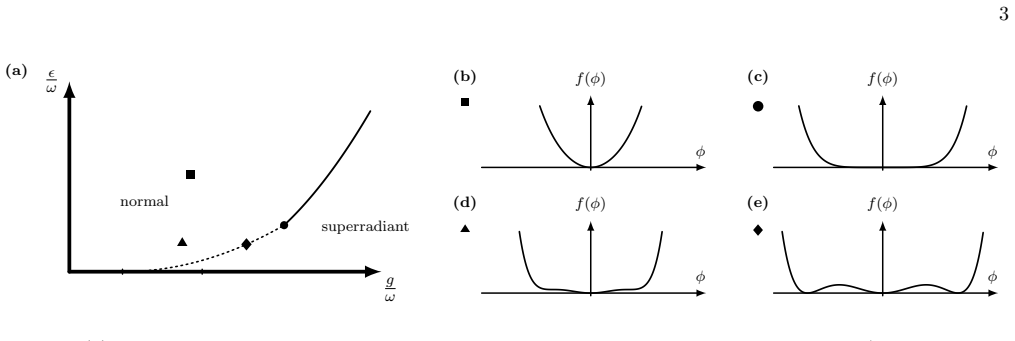
Landau theory shows virtual nearest-neighbor double spin-flip processes drive a tricritical point that switches the normal-superradiant transition from second-order to first-order in the ferromagnetic Dicke-Ising model.
A machine-rendered reading of the paper's core claim, the machinery that carries it, and where it could break.
Core claim
The Landau theory quantitatively captures the change from a second- to a first-order transition between the normal and superradiant phases through a tricritical point. Virtual nearest-neighbor double spin-flip processes are the crucial mechanism responsible for this behavior. The tricritical point constitutes a quantum phase transition above the upper critical dimension. The results emphasize the need for adapted finite-size scaling forms in all-to-all interacting quantum systems.
What carries the argument
Virtual nearest-neighbor double spin-flip processes that enter the Landau expansion and determine whether the normal-superradiant transition is second- or first-order.
If this is right
- The tricritical point is a quantum phase transition above the upper critical dimension.
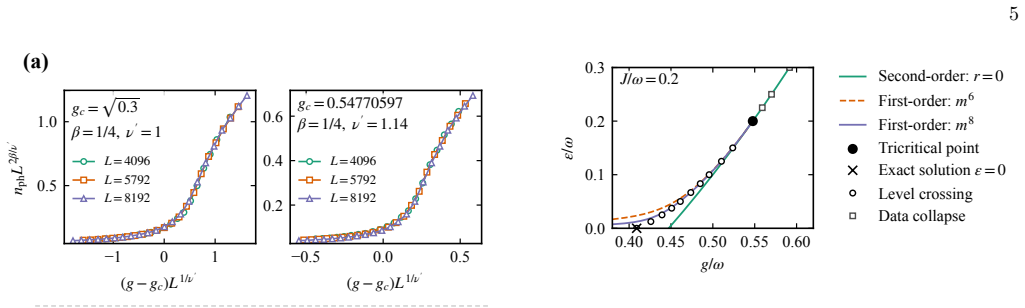
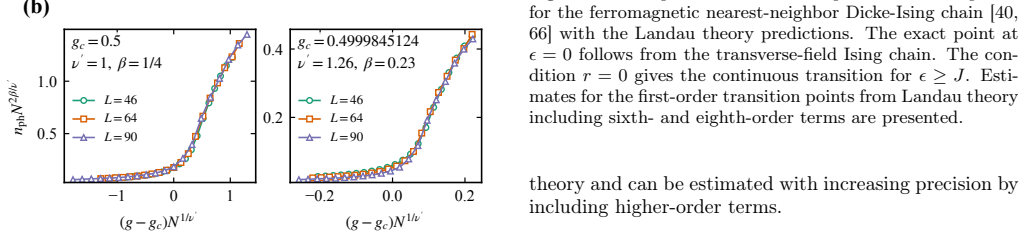
- Numerical data at the tricritical point must be analyzed with modified finite-size scaling forms.
- The ferromagnetic Dicke-Ising model provides a platform for studying both standard φ⁴ criticality and transitions beyond it in all-to-all systems.
- Adapted scaling analysis is required for any all-to-all interacting quantum model near a change in transition order.
Where Pith is reading between the lines
- Similar Landau expansions that retain only selected virtual processes may quantify transition-order changes in other infinite-range spin-boson models.
- Numerical studies of all-to-all systems should test whether double spin-flip terms dominate before applying standard scaling forms.
- The same mechanism could shift the location of tricritical points when weak perturbations break the all-to-all symmetry.
Load-bearing premise
The Landau theory expansion remains quantitatively accurate for this all-to-all model and virtual double spin-flip processes are the dominant mechanism controlling the order of the transition.
What would settle it
An exact diagonalization or quantum Monte Carlo run on finite but large system sizes that shows the effective potential at the putative tricritical point is controlled by higher-order processes other than nearest-neighbor double flips, producing a different transition order.
Figures
read the original abstract
We describe the quantum phase transitions in the ferromagnetic Dicke-Ising model using a Landau theory approach. The theory quantitatively captures the change from a second- to a first-order transition between the normal and superradiant phases through a tricritical point. We identify virtual nearest-neighbor double spin-flip processes as the crucial mechanism responsible for this behavior. The tricritical point constitutes a quantum phase transition above the upper critical dimension. We discuss the modifications to finite-size scaling required for the correct interpretation of numerical data at the tricritical point. Our results emphasize the need for adapted finite-size scaling forms in all-to-all interacting quantum systems and establish the ferromagnetic Dicke-Ising model as a paradigmatic platform for quantum phase transitions above the upper critical dimension, encompassing both standard $\phi^4$ criticality and beyond.
Editorial analysis
A structured set of objections, weighed in public.
Referee Report
Summary. The manuscript develops a Landau theory description of the quantum phase transitions in the ferromagnetic Dicke-Ising model. It claims that this effective theory quantitatively captures the change from second- to first-order transitions between the normal and superradiant phases via a tricritical point, identifies virtual nearest-neighbor double spin-flip processes as the dominant mechanism driving the sign change in the quartic coefficient, and treats the tricritical point as a quantum phase transition above the upper critical dimension. The work also discusses required modifications to finite-size scaling for interpreting numerical data in this all-to-all interacting system.
Significance. If the perturbative derivation and quantitative accuracy hold, the results establish the ferromagnetic Dicke-Ising model as a clean platform for studying quantum criticality above the upper critical dimension in mixed infinite-range/short-range systems, with direct implications for finite-size scaling analysis in all-to-all models. The explicit mechanism identification would provide a falsifiable link between microscopic virtual processes and the order of the transition.
major comments (2)
- [Landau expansion / mechanism identification (main text derivation)] The central claim that virtual nearest-neighbor double spin-flip processes are the crucial mechanism (and that the Landau expansion is quantitatively accurate) requires explicit demonstration that other virtual channels (e.g., higher-order photon-mediated or non-local processes) do not contribute at the same perturbative order to the quartic term. In a model with both all-to-all and short-range couplings, the separation of scales justifying truncation at this order is not automatic; without a term-by-term comparison showing dominance, the location of the tricritical point and the predicted change in transition order remain at risk.
- [Tricritical point and upper critical dimension discussion] The assertion that the tricritical point is a quantum phase transition above the upper critical dimension, with the Landau theory remaining quantitatively valid, needs to address whether the effective φ^4 theory acquires logarithmic corrections or other non-mean-field effects due to the all-to-all component; the manuscript should show that the upper critical dimension analysis holds without additional renormalization from the infinite-range terms.
minor comments (2)
- [Finite-size scaling section] The abstract states that modifications to finite-size scaling are discussed, but the specific adapted scaling forms, their derivation, and how they differ from standard φ^4 scaling should be stated more explicitly with at least one concrete example or equation.
- Notation for the effective Landau coefficients (e.g., the quartic term and its dependence on the virtual processes) should be introduced with clear definitions early in the text to aid readability.
Simulated Author's Rebuttal
We thank the referee for their thorough review and constructive comments. We address the two major comments point by point below, providing clarifications and indicating revisions made to the manuscript.
read point-by-point responses
-
Referee: [Landau expansion / mechanism identification (main text derivation)] The central claim that virtual nearest-neighbor double spin-flip processes are the crucial mechanism (and that the Landau expansion is quantitatively accurate) requires explicit demonstration that other virtual channels (e.g., higher-order photon-mediated or non-local processes) do not contribute at the same perturbative order. In a model with both all-to-all and short-range couplings, the separation of scales justifying truncation at this order is not automatic; without a term-by-term comparison showing dominance, the location of the tricritical point and the predicted change in transition order remain at risk.
Authors: We thank the referee for this valuable observation. Our perturbative derivation of the Landau coefficients was performed by systematically expanding to the relevant order in the strong-coupling regime, where the virtual nearest-neighbor double spin-flip processes enter at leading order in the quartic term. In the revised manuscript we have added an explicit term-by-term comparison (new subsection in Sec. III) of all virtual channels at the same perturbative order. This shows that photon-mediated and non-local processes are suppressed by additional powers of the inverse cavity frequency and inter-spin coupling, while the nearest-neighbor channel dominates. The separation of scales is therefore justified by the hierarchy of energy denominators, supporting both the mechanism and the location of the tricritical point. revision: yes
-
Referee: [Tricritical point and upper critical dimension discussion] The assertion that the tricritical point is a quantum phase transition above the upper critical dimension, with the Landau theory remaining quantitatively valid, needs to address whether the effective φ^4 theory acquires logarithmic corrections or other non-mean-field effects due to the all-to-all component; the manuscript should show that the upper critical dimension analysis holds without additional renormalization from the infinite-range terms.
Authors: We agree that further clarification is warranted. At the tricritical point the effective theory is a φ^6 model whose upper critical dimension is three. The all-to-all (infinite-range) interactions are fully resummed into the Landau coefficients and do not generate momentum-dependent vertices that would produce additional logarithmic corrections or renormalization beyond mean-field. The fluctuation spectrum remains governed by the short-range Ising component. In the revised manuscript we have expanded the discussion (new paragraph in Sec. IV) to explicitly state this point and reference analogous treatments of mixed-range models, confirming that the standard upper-critical-dimension analysis applies without modification from the infinite-range sector. revision: yes
Circularity Check
No circularity: independent Landau expansion on mixed all-to-all + NN model
full rationale
The derivation applies standard Landau theory to the ferromagnetic Dicke-Ising model, expanding the free energy to locate the tricritical point where the quartic coefficient changes sign due to virtual NN double spin-flip processes. No quoted step reduces a claimed prediction to a fitted input, self-citation chain, or definitional renaming; the central result follows from perturbative identification of the leading correction within the model's Hamiltonian, which remains externally falsifiable against numerics without requiring the target tricritical location as input. This is the normal non-circular outcome for an application of mean-field methods.
Axiom & Free-Parameter Ledger
Forward citations
Cited by 1 Pith paper
-
Folds of one curve: the superradiant phase diagram of Dicke modes with interacting matter
Superradiant first-order transitions in Dicke models with interacting matter are folds of one equation of state from the matter's magnetization response rather than crossings of disjoint sheets.
Reference graph
Works this paper leans on
-
[1]
then yields the ground-state energy density of the short-range model on a regular lattice with coordination numberz ¯e(hx) =e 0 − h2 x 2A + |ϵ| −J 8A3B h4 x +O(h 6 x),(10) wheree 0 =−|ϵ| −zJ/2,A=|ϵ|+ 2J, andB=|ϵ|+J. The corresponding magnetization is mx =− ∂¯e ∂hx = hx A − |ϵ| −J 2A3B h3 x +O(h 5 x).(11) 4 We perform a Legendre transformation of the short...
-
[2]
Browaeys and T
A. Browaeys and T. Lahaye, Many-body physics with in- dividually controlled rydberg atoms, Nature Physics16, 132–142 (2020)
2020
-
[3]
Monroe, W
C. Monroe, W. C. Campbell, L.-M. Duan, Z.-X. Gong, A. V. Gorshkov, P. W. Hess, R. Islam, K. Kim, N. M. Linke, G. Pagano, P. Richerme, C. Senko, and N. Y. Yao, Programmable quantum simulations of spin systems with trapped ions, Rev. Mod. Phys.93, 025001 (2021)
2021
-
[4]
Chomaz, I
L. Chomaz, I. Ferrier-Barbut, F. Ferlaino, B. Laburthe- Tolra, B. L. Lev, and T. Pfau, Dipolar physics: a review of experiments with magnetic quantum gases, Reports on Progress in Physics86, 026401 (2022)
2022
-
[5]
Defenu, T
N. Defenu, T. Donner, T. Macrì, G. Pagano, S. Ruffo, and A. Trombettoni, Long-range interacting quantum systems, Rev. Mod. Phys.95, 035002 (2023)
2023
-
[6]
Aidelsburger, M
M. Aidelsburger, M. Atala, M. Lohse, J. T. Barreiro, B. Paredes, and I. Bloch, Realization of the hofstadter hamiltonian with ultracold atoms in optical lattices, Phys. Rev. Lett.111, 185301 (2013)
2013
-
[7]
Bernien, S
H. Bernien, S. Schwartz, A. Keesling, H. Levine, A. Om- ran, H. Pichler, S. Choi, A. S. Zibrov, M. Endres, M. Greiner, V. Vuletić, and M. D. Lukin, Probing many- body dynamics on a 51-atom quantum simulator, Nature 551, 579–584 (2017)
2017
-
[8]
Lienhard, S
V. Lienhard, S. de Léséleuc, D. Barredo, T. Lahaye, A. Browaeys, M. Schuler, L.-P. Henry, and A. M. Läuchli, Observing the space- and time-dependent growth of cor- relations in dynamically tuned synthetic ising models with antiferromagnetic interactions, Phys. Rev. X8, 021070 (2018)
2018
-
[9]
Scholl, M
P. Scholl, M. Schuler, H. J. Williams, A. A. Eberharter, D. Barredo, K.-N. Schymik, V. Lienhard, L.-P. Henry, T. C. Lang, T. Lahaye, A. M. Läuchli, and A. Browaeys, Quantum simulation of 2d antiferromagnets with hun- dreds of rydberg atoms, Nature595, 233–238 (2021)
2021
-
[10]
C. Chen, G. Bornet, M. Bintz, G. Emperauger, L. Leclerc, V. S. Liu, P. Scholl, D. Barredo, J. Hauschild, S. Chatterjee, M. Schuler, A. M. Läuchli, M. P. Zale- tel, T. Lahaye, N. Y. Yao, and A. Browaeys, Continuous symmetry breaking in a two-dimensional rydberg array, Nature616, 691–695 (2023)
2023
-
[11]
L. Su, A. Douglas, M. Szurek, R. Groth, S. F. Ozturk, A. Krahn, A. H. Hébert, G. A. Phelps, S. Ebadi, S. Dick- erson, F. Ferlaino, O. Marković, and M. Greiner, Dipolar quantum solids emerging in a hubbard quantum simula- tor, Nature622, 724–729 (2023)
2023
-
[12]
Michel, L
A. Michel, L. Henriet, C. Domain, A. Browaeys, and T. Ayral, Hubbard physics with rydberg atoms: Using a quantum spin simulator to simulate strong fermionic correlations, Phys. Rev. B109, 174409 (2024)
2024
-
[13]
One-to-one quantum simulation of a frustrated magnet with 256 qubits
L. Leclerc, S. Julià-Farré, G. S. Freitas, G. Villaret, B. Albrecht, L. Béguin, L. Bourachot, C. Briosne- Frejaville, D. Claveau, A. Cornillot, J. de Hond, D. Di- allo, C. Dupays, R. Dupont, T. Eritzpokhoff, E. Got- tlob, L. Henriet, M. Kaicher, L. Lassablière, A. Lind- berg, Y. Machu, H. Mamann, T. Pansiot, J. Ripoll, E. S. Choi, A. Signoles, J. Vovrosh,...
work page internal anchor Pith review Pith/arXiv arXiv 2026
-
[14]
Hepp and E
K. Hepp and E. H. Lieb, On the superradiant phase tran- sition for molecules in a quantized radiation field: the dicke maser model, Annals of Physics76, 360 (1973)
1973
-
[15]
Hepp and E
K. Hepp and E. H. Lieb, Equilibrium statistical mechan- ics of matter interacting with the quantized radiation field, Phys. Rev. A8, 2517 (1973). 7
1973
-
[16]
A. J. Leggett, S. Chakravarty, A. T. Dorsey, M. P. A. Fisher, A. Garg, and W. Zwerger, Dynamics of the dissi- pative two-state system, Reviews of Modern Physics59, 1–85 (1987)
1987
-
[17]
Dimer, B
F. Dimer, B. Estienne, A. S. Parkins, and H. J. Carmichael, Proposed realization of the dicke-model quantum phase transition in an optical cavity qed sys- tem, Phys. Rev. A75, 013804 (2007)
2007
-
[18]
Baumann, C
K. Baumann, C. Guerlin, F. Brennecke, and T. Esslinger, Dicke quantum phase transition with a superfluid gas in an optical cavity, Nature464, 1301–1306 (2010)
2010
-
[19]
F. Haas, J. Volz, R. Gehr, J. Reichel, and J. Estève, Entangled states of more than 40 atoms in an optical fiber cavity, Science344, 180–183 (2014)
2014
-
[20]
Klinder, H
J. Klinder, H. Keßler, M. R. Bakhtiari, M. Thorwart, and A. Hemmerich, Observation of a superradiant mott insulator in the dicke-hubbard model, Phys. Rev. Lett. 115, 230403 (2015)
2015
-
[21]
Landig, L
R. Landig, L. Hruby, N. Dogra, M. Landini, R. Mottl, T. Donner, and T. Esslinger, Quantum phases from com- peting short- and long-range interactions in an optical lattice, Nature532, 476–479 (2016)
2016
-
[22]
Zhiqiang, C
Z. Zhiqiang, C. H. Lee, R. Kumar, K. J. Arnold, S. J. Masson, A. S. Parkins, and M. D. Barrett, Nonequilib- rium phase transition in a spin-1 dicke model, Optica4, 424 (2017)
2017
-
[23]
Zhang, C
Z. Zhang, C. H. Lee, R. Kumar, K. J. Arnold, S. J. Mas- son, A. L. Grimsmo, A. S. Parkins, and M. D. Barrett, Dicke-model simulation via cavity-assisted raman transi- tions, Phys. Rev. A97, 043858 (2018)
2018
-
[24]
C. F. Lee and N. F. Johnson, First-order superradiant phase transitions in a multiqubit cavity system, Phys. Rev. Lett.93, 083001 (2004)
2004
-
[26]
Zhang, Q
X.-F. Zhang, Q. Sun, Y.-C. Wen, W.-M. Liu, S. Eggert, and A.-C. Ji, Rydberg polaritons in a cavity: A superra- diant solid, Phys. Rev. Lett.110, 090402 (2013)
2013
-
[27]
Zhang, L
Y. Zhang, L. Yu, J. Q. Liang, G. Chen, S. Jia, and F. Nori, Quantum phases in circuit qed with a supercon- ducting qubit array, Scientific Reports4, 4083 (2014)
2014
-
[28]
Gelhausen, M
J. Gelhausen, M. Buchhold, A. Rosch, and P. Strack, Quantum-optical magnets with competing short- and long-range interactions: Rydberg-dressed spin lattice in an optical cavity, SciPost Phys.1, 004 (2016)
2016
-
[29]
Schuler, D
M. Schuler, D. D. Bernardis, A. M. Läuchli, and P. Rabl, The vacua of dipolar cavity quantum electrodynamics, SciPost Phys.9, 066 (2020)
2020
-
[30]
J. Rohn, M. Hörmann, C. Genes, and K. P. Schmidt, Ising model in a light-induced quantized transverse field, Phys. Rev. Res.2, 023131 (2020)
2020
-
[31]
Schellenberger and K
A. Schellenberger and K. P. Schmidt, (Almost) every- thing is a Dicke model - Mapping non-superradiant cor- related light-matter systems to the exactly solvable Dicke model, SciPost Phys. Core7, 038 (2024)
2024
- [32]
-
[33]
T. O. Puel and T. Macrì, Confined meson excitations in rydberg-atom arrays coupled to a cavity field, Phys. Rev. Lett.133, 106901 (2024)
2024
-
[34]
Román-Roche, Á
J. Román-Roche, Á. Gómez-León, F. Luis, and D. Zueco, Bound polariton states in the dicke-ising model, Nanophotonics14, 2053 (2025)
2053
-
[35]
J. Román-Roche, Á. Gómez-León, F. Luis, and D. Zueco, Linear response theory for cavity qed materials at arbi- trary light-matter coupling strengths, Physical Review B 111, 10.1103/physrevb.111.035156 (2025)
-
[36]
J. A. Koziol, A. Langheld, and K. P. Schmidt, Melting of devil’s staircases in the long-range dicke-ising model, Phys. Rev. B111, 224427 (2025)
2025
-
[37]
R. H. Dicke, Coherence in spontaneous radiation pro- cesses, Phys. Rev.93, 99 (1954)
1954
-
[38]
Y. K. Wang and F. T. Hioe, Phase transition in the dicke model of superradiance, Phys. Rev. A7, 831 (1973)
1973
-
[39]
Vidal and S
J. Vidal and S. Dusuel, Finite-size scaling exponents in the dicke model, Europhysics Letters (EPL)74, 817–822 (2006)
2006
-
[40]
Larson and E
J. Larson and E. K. Irish, Some remarks on ‘superradi- ant’ phase transitions in light-matter systems, Journal of Physics A: Mathematical and Theoretical50, 174002 (2017)
2017
-
[41]
Langheld, M
A. Langheld, M. Hörmann, and K. P. Schmidt, Quan- tum phase diagrams of dicke-ising models by a wormhole algorithm, Phys. Rev. B112, L161123 (2025)
2025
-
[42]
N. S. Bassler, Absence of entanglement growth in dicke superradiance, Phys. Rev. A112, 053713 (2025)
2025
-
[43]
Rosario, L
P. Rosario, L. O. R. Solak, A. Cidrim, R. Bachelard, and J. Schachenmayer, Unraveling dicke superradiant decay withseparablecoherentspinstates,Phys.Rev.Lett.135, 133602 (2025)
2025
-
[44]
X. H. H. Zhang, D. Malz, and P. Rabl, Unraveling su- perradiance: Entanglement and mutual information in collective decay, Phys. Rev. Lett.135, 033602 (2025)
2025
-
[45]
J. a. P. Mendonça, K. Jachymski, and Y. Wang, Role of matter interactions in superradiant phenomena, Phys. Rev. Lett.135, 133601 (2025)
2025
-
[46]
L. F. dos Prazeres, H. Hosseinabadi, and J. Marino, Kinetically constrained superradiance (2026), arXiv:2605.05343 [quant-ph]
work page internal anchor Pith review Pith/arXiv arXiv 2026
-
[47]
Extensive mixed-state entanglement in kinetically constrained superradiance
L. Winter, J. Kumlin, T. Pohl, and A. Nunnenkamp, Extensive mixed-state entanglement in kinetically con- strained superradiance (2026), arXiv:2605.16131 [quant- ph]
work page internal anchor Pith review Pith/arXiv arXiv 2026
- [48]
-
[49]
Binder, Critical properties and finite-size effects of the five-dimensional ising model, Zeitschrift für Physik B Condensed Matter61, 13–23 (1985)
K. Binder, Critical properties and finite-size effects of the five-dimensional ising model, Zeitschrift für Physik B Condensed Matter61, 13–23 (1985)
1985
-
[50]
Binder, M
K. Binder, M. Nauenberg, V. Privman, and A. P. Young, Finite-size tests of hyperscaling, Physical Review B31, 1498–1502 (1985)
1985
-
[51]
Luijten and H
E. Luijten and H. W. J. Blöte, Classical critical behav- ior of spin models with long-range interactions, Physical Review B56, 8945–8958 (1997)
1997
-
[52]
Kenna and B
R. Kenna and B. Berche, A new critical exponent koppa and its logarithmic counterpart koppa-hat, Condensed Matter Physics16, 23601 (2013)
2013
-
[53]
E. J. Flores-Sola, B. Berche, R. Kenna, and M. Weigel, Finite-size scaling above the upper critical dimension in ising models with long-range interactions, The Euro- peanPhysicalJournalB88,10.1140/epjb/e2014-50683-1 (2015). 8
-
[54]
E. Flores-Sola, B. Berche, R. Kenna, and M. Weigel, Role of fourier modes in finite-size scaling above the upper critical dimension, Physical Review Letters116, 10.1103/physrevlett.116.115701 (2016)
-
[55]
J. A. Koziol, A. Langheld, S. C. Kapfer, and K. P. Schmidt, Quantum-critical properties of the long-range transverse-field ising model from quantum monte carlo simulations, Phys. Rev. B103, 245135 (2021)
2021
-
[56]
Berche, T
B. Berche, T. Ellis, Y. Holovatch, and R. Kenna, Phase transitions above the upper critical dimension, SciPost Phys. Lect. Notes , 60 (2022)
2022
-
[57]
Langheld, J
A. Langheld, J. A. Koziol, P. Adelhardt, S. C. Kapfer, and K. P. Schmidt, Scaling at quantum phase transitions above the upper critical dimension, SciPost Phys.13, 088 (2022)
2022
-
[58]
P. Adelhardt, J. A. Koziol, A. Langheld, and K. P. Schmidt, Monte carlo based techniques for quantum magnets with long-range interactions, Entropy26, 10.3390/e26050401 (2024)
-
[59]
M. E. Fisher, Scaling, universality and renormalization group theory, inCritical Phenomena, edited by F. J. W. Hahne (Springer Berlin Heidelberg, Berlin, Heidelberg,
-
[60]
M. Suzuki, Relationship between d-dimensional quan- tal spin systems and (d+1)-dimensional ising systems: Equivalence, critical exponents and systematic approx- imants of the partition function and spin correlations, Progress of Theoretical Physics56, 1454–1469 (1976)
1976
-
[61]
Sachdev,Quantum Phase Transitions(Cambridge University Press, 2011)
S. Sachdev,Quantum Phase Transitions(Cambridge University Press, 2011)
2011
-
[62]
J. Zhao, M. Song, Y. Qi, J. Rong, and Z. Y. Meng, Finite-temperature critical behaviors in 2d long-range quantum heisenberg model, npj Quantum Materials8, 10.1038/s41535-023-00591-6 (2023)
-
[63]
Adelhardt and K
P. Adelhardt and K. P. Schmidt, Continuously varying critical exponents in long-range quantum spin ladders, SciPost Phys.15, 087 (2023)
2023
-
[64]
M. Song, J. Zhao, Y. Qi, J. Rong, and Z. Y. Meng, Quan- tum criticality and entanglement for the two-dimensional long-rangeheisenbergbilayer,Phys.Rev.B109,L081114 (2024)
2024
-
[65]
Adelhardt, A
P. Adelhardt, A. Duft, and K. P. Schmidt, Quantum- critical and dynamical properties of the xxz bilayer with long-range interactions, Phys. Rev. B111, 024409 (2025)
2025
-
[66]
P. Adelhardt, S. R. Muleady, K. P. Schmidt, and A. V. Gorshkov, Unconventional entanglement scaling and quantum criticality in the long-range spin-one heisenberg chainwithsingle-ionanisotropy(2026),arXiv:2604.12754 [cond-mat.str-el]
work page internal anchor Pith review Pith/arXiv arXiv 2026
-
[67]
quantum phase diagrams of dicke-ising models by a wormhole algorithm
A. Langheld, M. Hörmann, and K. P. Schmidt, Raw data to "quantum phase diagrams of dicke-ising models by a wormhole algorithm", 10.5281/zenodo.15774230 (2025)
-
[68]
Gammelmark and K
S. Gammelmark and K. Mølmer, Phase transitions and heisenberg limited metrology in an ising chain interacting with a single-mode cavity field, New Journal of Physics 13, 053035 (2011)
2011
-
[69]
Solutions forϵ <0are obtained byσ z i → −σ z i
-
[70]
S. Sur, Y. Wang, M. Mahankali, S. Paschen, and Q. Si, Amplified response of cavity-coupled quantum-critical systems, Nature Communications17, 10.1038/s41467- 026-73112-1 (2026)
- [71]
-
[72]
Otake and M
S. Otake and M. Bamba, Exactly solvable phase tran- sition in a cavity-coupled one-dimensional ising chain, Phys. Rev. Res.8, 023150 (2026)
2026
-
[73]
role of mat- ter interactions in superradiant phenomena
M. Hörmann, A. Langheld, J. Leibig, A. Schellen- berger, and K. P. Schmidt, Comment on "role of mat- ter interactions in superradiant phenomena" (2025), arXiv:2511.08452 [quant-ph]
-
[74]
P. M. Chaikin and T. C. Lubensky, Mean-field theory, inPrinciples of Condensed Matter Physics(Cambridge University Press, 1995) p. 144–212
1995
-
[75]
Reslen, L
J. Reslen, L. Quiroga, and N. F. Johnson, Direct equiv- alence between quantum phase transition phenomena in radiation-matter and magnetic systems: Scaling of en- tanglement, Europhysics Letters (EPL)69, 8–14 (2005)
2005
-
[76]
Tindemans and H
P. Tindemans and H. Capel, On the free energy in sys- tems with separable interactions. iii, Physica A: Statisti- cal Mechanics and its Applications79, 478–502 (1975)
1975
-
[77]
den Ouden, H
L. den Ouden, H. Capel, J. Perk, and P. Tindemans, Sys- tems with separable many-particle interactions. i, Phys- ica A: Statistical Mechanics and its Applications85, 51–70 (1976)
1976
-
[78]
den Ouden, H
L. den Ouden, H. Capel, and J. Perk, Systems with sepa- rable many-particle interactions. ii, Physica A: Statistical Mechanics and its Applications85, 425–456 (1976)
1976
-
[79]
J. Perk, H. Capel, and L. den Ouden, Convex-envelope formulation for separable many-particle interactions, Physica A: Statistical Mechanics and its Applications89, 555–568 (1977)
1977
-
[80]
Capel, L
H. Capel, L. Den Ouden, and J. Perk, Stability of critical behaviour, critical-exponent renormalization and first- order transitions, Physica A: Statistical Mechanics and its Applications95, 371–416 (1979)
1979
-
[81]
Here an analytical solution is available [85, 86]
The notable exception is the model withϵ= 0on the chain. Here an analytical solution is available [85, 86]
discussion (0)
Sign in with ORCID, Apple, or X to comment. Anyone can read and Pith papers without signing in.