From Provable to Practical: A Problem-Driven Survey of Classical and Machine-Learning Defenses for DV/CV Quantum Key Distribution
Reviewed by Pith T0 review T1 audit T2 compute T3 formal T4 kernel 2026-06-29 17:18 UTCgrok-4.3pith:YXZLFLVPrecord.jsonopen to challenge →
The pith
A problem-driven survey finds ML defenses reach 99.8% recall for CV QKD attacks and proposes unified benchmarks to move from provable security to practical deployment.
A machine-rendered reading of the paper's core claim, the machinery that carries it, and where it could break.
Core claim
The survey establishes that ML-enabled solutions achieve high performance on targeted tasks such as DBSCAN-based CV attack detection at P=99.7%, R=99.8%, F1=0.998, adversarial robustness recovery up to 79.5%, channel-amplification detection at 100%/91.26% under low/high-noise conditions, and LightGBM-based noise prediction reducing evaluation time by up to 98.8%, while the nine problem classes (P1-P9) provide a structure for comparing these against classical methods and for introducing a unified benchmarking framework that incorporates SKR impact, maximum distance, latency, and robustness metrics along with defense-in-depth guidelines.
What carries the argument
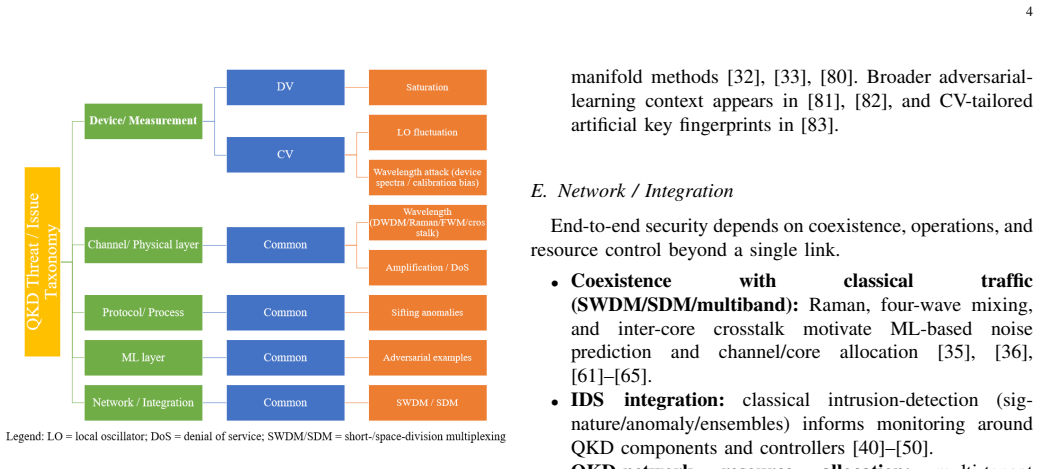
The nine problem classes (P1-P9) that span device, channel, protocol, ML, and network layers and serve as the organizing structure for comparing classical defenses with ML techniques including anomaly detection, parameter prediction, noise estimation, adversarial purification, and resource allocation.
If this is right
- ML methods can deliver specific performance gains such as 99.8% recall in CV attack detection and 98.8% reduction in noise-prediction time when the reported conditions hold.
- A unified benchmarking framework allows direct comparison of defenses using shared datasets, stress protocols, and metrics including SKR impact and robustness.
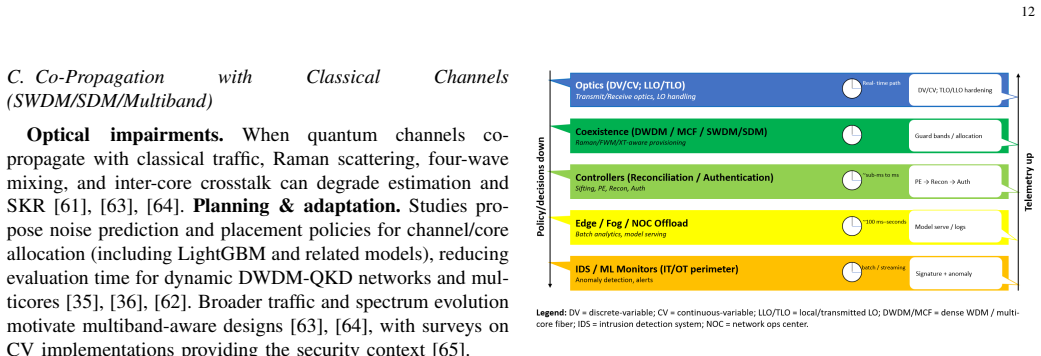
- Defense-in-depth guidelines can be applied across the nine problem classes to improve practical QKD security.
- Future work should address the outlined research directions for integrating ML components securely into QKD systems.
Where Pith is reading between the lines
- If the benchmarking framework is adopted, it could accelerate standardization efforts for QKD defense evaluation across different hardware platforms.
- High reported ML performance on isolated tasks suggests potential for hybrid classical-ML systems that maintain information-theoretic security proofs while improving adaptability to channel variations.
- The survey's emphasis on finite-key effects and ML-component vulnerabilities implies that practical QKD networks may require ongoing monitoring rather than one-time certification.
Load-bearing premise
That the nine problem classes comprehensively cover the practical vulnerabilities that matter most for real DV and CV QKD deployments.
What would settle it
An independent test that applies a vulnerability outside the nine classes to a deployed QKD link and measures a larger drop in secret key rate or distance than any of the surveyed ML or classical defenses can recover.
Figures



read the original abstract
Quantum key distribution (QKD) promises information-theoretic security, yet practical deployments in discrete-variable (DV) and continuous-variable (CV) settings remain exposed to device imperfections, channel manipulation, finite-key effects, and vulnerabilities in machine-learning (ML) components used for adaptation and monitoring. This survey adopts a problem-driven perspective based on nine practical problem classes (P1-P9) spanning device, channel, protocol, ML, and network layers. For each class, we compare classical defenses with ML-enabled solutions including anomaly detection, parameter prediction, noise estimation, adversarial purification, and resource allocation. Reported results include DBSCAN-based CV attack detection at P=99.7%, R=99.8%, F1=0.998, adversarial robustness recovery up to 79.5%, channel-amplification detection at 100%/91.26% under low/high-noise conditions, and LightGBM-based noise prediction reducing evaluation time by up to 98.8%. The survey further proposes a benchmarking framework combining datasets, stress protocols, and unified evaluation metrics including SKR impact, maximum distance, latency, and robustness. Finally, we provide defense-in-depth deployment guidelines and outline future research directions for secure and practical QKD systems.
Editorial analysis
A structured set of objections, weighed in public.
Referee Report
Summary. The paper is a problem-driven survey of classical and ML-enabled defenses for discrete-variable (DV) and continuous-variable (CV) quantum key distribution (QKD). It organizes practical vulnerabilities into nine problem classes (P1-P9) spanning device, channel, protocol, ML, and network layers. For each class it compares classical and ML approaches (anomaly detection, parameter prediction, adversarial purification, etc.), citing literature metrics such as DBSCAN CV attack detection (P=99.7%, R=99.8%, F1=0.998), adversarial robustness recovery up to 79.5%, and LightGBM noise prediction reducing evaluation time by 98.8%. The manuscript proposes a unified benchmarking framework with datasets, stress protocols, and metrics (SKR impact, maximum distance, latency, robustness), provides defense-in-depth deployment guidelines, and outlines future directions.
Significance. A well-executed survey that successfully maps the landscape of QKD defenses and introduces a concrete benchmarking framework could help standardize evaluation practices and accelerate the transition from theoretical security proofs to deployable systems. The compilation of ML techniques applied to QKD monitoring and adaptation is timely. However, the significance is limited by the absence of any demonstrated mapping of the cited performance numbers onto the framework's own metrics, leaving the framework's claimed utility unverified within the manuscript.
major comments (1)
- [Abstract] Abstract: The headline performance figures (DBSCAN F1=0.998, LightGBM 98.8% time reduction, etc.) are reported verbatim from the source papers. No evidence is provided that these results were re-evaluated or even mapped onto the unified metrics declared central to the benchmarking framework (SKR impact, maximum distance, latency, robustness). Because the manuscript positions the framework as the mechanism that converts isolated ML results into comparable, actionable defenses, this missing linkage is load-bearing for the central claim.
minor comments (1)
- [Introduction / Problem Classes] The selection criteria and completeness argument for the nine problem classes (P1-P9) are stated but not accompanied by an explicit justification or gap analysis relative to known real-world QKD deployment failures.
Simulated Author's Rebuttal
We thank the referee for the detailed and constructive report. The single major comment identifies a genuine gap between the proposed benchmarking framework and the cited performance numbers. We respond point-by-point below and indicate the revisions we will make.
read point-by-point responses
-
Referee: [Abstract] Abstract: The headline performance figures (DBSCAN F1=0.998, LightGBM 98.8% time reduction, etc.) are reported verbatim from the source papers. No evidence is provided that these results were re-evaluated or even mapped onto the unified metrics declared central to the benchmarking framework (SKR impact, maximum distance, latency, robustness). Because the manuscript positions the framework as the mechanism that converts isolated ML results into comparable, actionable defenses, this missing linkage is load-bearing for the central claim.
Authors: We agree that the cited figures are taken directly from the source literature without re-implementation or explicit remapping onto the new metrics (SKR impact, maximum distance, latency, robustness). Because the work is a survey, its scope is to classify existing results under the nine problem classes (P1–P9) and to introduce the benchmarking framework as a forward-looking proposal rather than to retroactively apply it. Performing such a mapping would require original code, datasets, and experimental setups from multiple prior papers, which exceeds the remit of a survey. We will revise the abstract, introduction, and framework section to state explicitly that the framework is offered for future standardization and that the reported numbers remain illustrative of the literature rather than benchmarked under the new protocol. This clarification removes the implication that the framework has already been used to unify the cited results. revision: yes
Circularity Check
No circularity: survey compiles external results without derivations or self-referential predictions
full rationale
This is a survey paper that organizes existing literature on QKD defenses into nine problem classes and reports performance numbers taken verbatim from the cited source papers (e.g., DBSCAN F1=0.998). No equations, fitted parameters, or predictions are derived inside the paper itself; the proposed benchmarking framework is an organizational proposal rather than a mathematical reduction. No self-citation chains, uniqueness theorems, or ansatzes are invoked as load-bearing steps. The central claims rest on external citations, which the instructions treat as independent when they are not internally fitted or redefined.
Axiom & Free-Parameter Ledger
Reference graph
Works this paper leans on
-
[1]
Quantum cryptography,
N. Gisin, G. G. Ribordy, W. Tittel, and H. Zbinden, “Quantum cryptography,”Reviews of Modern Physics, vol. 74, no. 1, p. 145, 2002
2002
-
[2]
Continuous variable quantum key distribution,
Y . M. Li, X. Y . Wang, Z. L. Bai, W. Y . Liu, S. S. Yang, and K. C. Peng, “Continuous variable quantum key distribution,”Chinese Physics B, vol. 26, no. 4, p. 040303, Apr. 2017
2017
-
[3]
The security of practical quantum key distribution,
V . Scarani, H. Bechmann-Pasquinucci, N. J. Cerf, M. Du ˇsek, N. L ¨utkenhaus, and M. Peev, “The security of practical quantum key distribution,”Reviews of Modern Physics, vol. 81, no. 3, pp. 1301– 1350, 2009
2009
-
[4]
Secure quantum key distribution with realistic devices,
F. Xu, X. Ma, Q. Zhang, H.-K. Lo, and J.-W. Pan, “Secure quantum key distribution with realistic devices,”Reviews of Modern Physics, vol. 92, no. 2, p. 025002, May 2020
2020
-
[5]
Local oscillator fluctuation opens a loophole for eve in practical continuous-variable quantum-key-distribution systems,
X. C. Ma, S. H. Sun, M. S. Jiang, and L. M. Liang, “Local oscillator fluctuation opens a loophole for eve in practical continuous-variable quantum-key-distribution systems,”Physical Review A, vol. 88, no. 2, p. 022339, Aug. 2013
2013
-
[6]
Quantum hacking of a continuous-variable quantum-key-distribution system using a wavelength attack,
J. Z. Huanget al., “Quantum hacking of a continuous-variable quantum-key-distribution system using a wavelength attack,”Physical Review A, vol. 87, no. 6, p. 062329, Jun. 2013
2013
-
[7]
Wavelength attack on practical continuous-variable quantum-key-distribution system with a heterodyne protocol,
X. C. Ma, S. H. Sun, M. S. Jiang, and L. M. Liang, “Wavelength attack on practical continuous-variable quantum-key-distribution system with a heterodyne protocol,”Physical Review A, vol. 87, no. 5, p. 052309, May 2013
2013
-
[8]
Preventing calibration attacks on the local oscillator in continuous-variable quantum key distribution,
P. Jouguet, S. Kunz-Jacques, and E. Diamanti, “Preventing calibration attacks on the local oscillator in continuous-variable quantum key distribution,”Physical Review A, vol. 87, no. 6, p. 062313, Jun. 2013
2013
-
[9]
Quantum hacking: Saturation attack on practical continuous-variable quantum key distribution,
H. Qin, R. Kumar, and R. All ´eaume, “Quantum hacking: Saturation attack on practical continuous-variable quantum key distribution,” Physical Review A, vol. 94, no. 1, p. 012325, Jul. 2016
2016
-
[10]
Homodyne-detector- blinding attack in continuous-variable quantum key distribution,
H. Qin, R. Kumar, V . Makarov, and R. All´eaume, “Homodyne-detector- blinding attack in continuous-variable quantum key distribution,”Phys- ical Review A, vol. 98, no. 1, p. 012312, Jul. 2018
2018
-
[11]
Hacking commercial quantum cryptography systems by tailored bright illumination,
L. Lydersen, C. Wiechers, C. Wittmann, D. Elser, J. Skaar, and V . Makarov, “Hacking commercial quantum cryptography systems by tailored bright illumination,”Nature Photonics, vol. 4, no. 10, pp. 686– 689, 2010
2010
-
[12]
After-gate attack on a quantum cryptosystem,
C. Wiecherset al., “After-gate attack on a quantum cryptosystem,”New Journal of Physics, vol. 13, p. 013043, Jan. 2011
2011
-
[13]
Time-shift attack in practical quantum cryptosystems,
B. Qi, “Time-shift attack in practical quantum cryptosystems,”Quan- tum Information and Computation, vol. 7, pp. 73–82, 2007
2007
-
[14]
Phase-remapping attack in practical quantum-key-distribution systems,
C. H. F. Fung, B. Qi, K. Tamaki, and H. K. Lo, “Phase-remapping attack in practical quantum-key-distribution systems,”Physical Review A, vol. 75, no. 3, p. 032314, Mar. 2007
2007
-
[15]
Advances in continuous variable measurement-device-independent quantum key distribution,
P. Wang, Y . Tian, and Y . Li, “Advances in continuous variable measurement-device-independent quantum key distribution,”Science China Information Sciences, vol. 68, no. 8, pp. 1–17, 2025
2025
-
[16]
Long-distance continuous- variable quantum key distribution by controlling excess noise,
D. Huang, P. Huang, D. Lin, and G. Zeng, “Long-distance continuous- variable quantum key distribution by controlling excess noise,”Scien- tific Reports, vol. 6, p. 19201, Jan. 2016
2016
-
[17]
Experimental demonstration of long-distance continuous- variable quantum key distribution,
P. Jouguet, S. Kunz-Jacques, A. Leverrier, P. Grangier, and E. Dia- manti, “Experimental demonstration of long-distance continuous- variable quantum key distribution,”Nature Photonics, vol. 7, no. 5, pp. 378–381, 2013
2013
-
[18]
Monitoring of continuous-variable quantum key distribution system in real environ- ment,
W. Liu, J. Peng, P. Huang, D. Huang, and G. Zeng, “Monitoring of continuous-variable quantum key distribution system in real environ- ment,”Optics Express, vol. 25, no. 16, pp. 19 429–19 443, 2017
2017
-
[19]
Continuous-variable quantum key distribution over 60 km optical fiber with real local oscillator,
A. A. E. Hajomer, H. Mani, N. Jain, H.-M. Chin, U. L. Andersen, and T. Gehring, “Continuous-variable quantum key distribution over 60 km optical fiber with real local oscillator,” inEuropean Conference on Optical Communication (ECOC) 2022 Technical Digest, J. Leuthold, C. Harder, B. Offrein, and H. Limberger, Eds. Basel: Optica Publishing Group, 2022, p. ...
2022
-
[20]
Remote quantum networks based on quantum memories,
T.-X. Zhu, X. Liu, Z.-Q. Zhou, and C.-F. Li, “Remote quantum networks based on quantum memories,”Nanophotonics, vol. 14, no. 11, pp. 1975–1992, 2025
1975
-
[21]
Device-independent security of quantum cryptography against collec- tive attacks,
A. Ac ´ın, N. Brunner, N. Gisin, S. Massar, S. Pironio, and V . Scarani, “Device-independent security of quantum cryptography against collec- tive attacks,”Physical Review Letters, vol. 98, no. 23, p. 230501, Jun. 2007
2007
-
[22]
Measurement-device-independent quantum key distribution,
H. K. Lo, M. Curty, and B. Qi, “Measurement-device-independent quantum key distribution,”Physical Review Letters, vol. 108, no. 13, p. 130503, Mar. 2012
2012
-
[23]
Experi- mental demonstration of polarization encoding measurement-device- independent quantum key distribution,
Z. Tang, Z. Liao, F. Xu, B. Qi, L. Qian, and H. K. Lo, “Experi- mental demonstration of polarization encoding measurement-device- independent quantum key distribution,”Physical Review Letters, vol. 112, no. 19, p. 190503, May 2014
2014
-
[24]
Integrating machine learning to achieve an automatic parameter prediction for practical continuous-variable quantum key distribution,
W. Liu, P. Huang, J. Peng, J. Fan, and G. Zeng, “Integrating machine learning to achieve an automatic parameter prediction for practical continuous-variable quantum key distribution,”Physical Review A, vol. 97, no. 2, p. 022316, Feb. 2018
2018
-
[25]
Machine learning for optimal parameter prediction in quantum key distribution,
W. Wang and H. K. Lo, “Machine learning for optimal parameter prediction in quantum key distribution,”Physical Review A, vol. 100, no. 6, p. 062334, Dec. 2019
2019
-
[26]
Predicting optimal parameters with random forest for quantum key distribution,
H. J. Ding, J. Y . Liu, C. M. Zhang, and Q. Wang, “Predicting optimal parameters with random forest for quantum key distribution,”Quantum Information Processing, vol. 19, no. 2, Feb. 2020
2020
-
[27]
Parameter optimization based bpnn of atmosphere continuous-variable quantum key distribution,
Y . Su, Y . Guo, and D. Huang, “Parameter optimization based bpnn of atmosphere continuous-variable quantum key distribution,”Entropy, vol. 21, no. 9, Sep. 2019
2019
-
[28]
Practical phase-modulation stabilization in quantum key distribution via machine learning,
J. Y . Liu, H. J. Ding, C. M. Zhang, S. P. Xie, and Q. Wang, “Practical phase-modulation stabilization in quantum key distribution via machine learning,”Physical Review Applied, vol. 12, no. 1, p. 014059, 2019
2019
-
[29]
Detecting quantum attacks: A machine learning based defense strategy for practical continuous-variable quantum key distribution,
Y . Maoet al., “Detecting quantum attacks: A machine learning based defense strategy for practical continuous-variable quantum key distribution,”New Journal of Physics, vol. 22, no. 8, Aug. 2020
2020
-
[30]
Multi-attack detection: General defense strategy based on neural networks for cv-qkd,
H. Du and D. Huang, “Multi-attack detection: General defense strategy based on neural networks for cv-qkd,”Photonics, vol. 9, no. 3, Mar. 2022. 16
2022
-
[31]
Detecting practical quantum attacks for continuous-variable quantum key distribution using density-based spatial clustering of applications with noise (DBSCAN),
Q. Liao, Z. Wang, H. Liu, Y . Mao, and X. Fu, “Detecting practical quantum attacks for continuous-variable quantum key distribution using density-based spatial clustering of applications with noise (DBSCAN),” Physical Review A, vol. 106, no. 2, p. 022607, Aug. 2022
2022
-
[32]
Adversarial perturbation elimination with gan based defense in continuous-variable quantum key distribution systems,
X. Tang, P. Yin, Z. Zhou, and D. Huang, “Adversarial perturbation elimination with gan based defense in continuous-variable quantum key distribution systems,”Electronics, vol. 12, no. 11, Jun. 2023
2023
-
[33]
Adversarial attack defense method for a continuous-variable quantum key distribution system based on kernel robust manifold non-negative matrix factorization,
Y . Fu, E. Xia, D. Huang, and Y . Jing, “Adversarial attack defense method for a continuous-variable quantum key distribution system based on kernel robust manifold non-negative matrix factorization,” Applied Sciences, vol. 13, no. 17, p. 9928, Sep. 2023
2023
-
[34]
Sifting scheme for continuous-variable quantum key distribution with short samples,
Z. Wuet al., “Sifting scheme for continuous-variable quantum key distribution with short samples,”Journal of the Optical Society of America B, vol. 39, no. 3, pp. 694–704, 2022
2022
-
[35]
Noise prediction based on ma- chine learning in quantum secured SWDM B5G fronthaul networks,
C. Wang, Y . Sun, W. Kong, and Y . Gao, “Noise prediction based on ma- chine learning in quantum secured SWDM B5G fronthaul networks,” inProceedings of the 2022 IEEE 22nd International Conference on Communication Technology (ICCT). IEEE, Nov. 2022, pp. 1426– 1431
2022
-
[36]
Noise-suppressing channel allo- cation in dynamic DWDM-QKD networks using LightGBM,
J. Niu, Y . Sun, Y . Zhang, and Y . Ji, “Noise-suppressing channel allo- cation in dynamic DWDM-QKD networks using LightGBM,”Optics Express, vol. 27, no. 22, p. 31741, Oct. 2019
2019
-
[37]
Machine learning techniques for enhancing quantum key distribution,
A. Al-Kuwari, S. Alqrinawi, L. Al-Amir, A. Mollazehi, and S. Al- Kuwari, “Machine learning techniques for enhancing quantum key distribution,”arXiv preprint arXiv:2603.07384, 2026
-
[38]
AML-QKD: Adaptive Machine Learning Framework for Real-time Parameter Tuning in QKD
N. Mohamed, J. Kaldari, and S. Al-Kuwari, “Optiqkd: A machine learning-optimized framework for real-time parameter tuning in quan- tum key distribution,”arXiv preprint arXiv:2603.04192, 2026
work page internal anchor Pith review Pith/arXiv arXiv 2026
-
[39]
Ai-driven quantum cryptography: Machine learning for robust qkd, secure operations, and quantum-safe integra- tion,
A. Gupta and S. Mittal, “Ai-driven quantum cryptography: Machine learning for robust qkd, secure operations, and quantum-safe integra- tion,” in2026 IEEE 5th International Conference on AI in Cybersecu- rity (ICAIC). IEEE, 2026, pp. 1–5
2026
-
[40]
Cyber-security threats and side-channel attacks for digital agriculture,
A. N. Alahmadi, S. U. Rehman, H. S. Alhazmi, D. G. Glynn, H. Shoaib, and P. Sol´e, “Cyber-security threats and side-channel attacks for digital agriculture,”Sensors, vol. 22, no. 9, May 2022
2022
-
[41]
TIDCS: A dynamic intrusion detection and classification system based feature selection,
Z. Chkirbene, A. Erbad, R. Hamila, A. Mohamed, M. Guizani, and M. Hamdi, “TIDCS: A dynamic intrusion detection and classification system based feature selection,”IEEE Access, vol. 8, pp. 95 864– 95 877, 2020
2020
-
[42]
A deep learning approach for intrusion detection system in industry network,
A. Hijazi, A. El Safadi, and J.-M. Flaus, “A deep learning approach for intrusion detection system in industry network,” inProceedings of BDCSIntell, 2018, pp. 55–62
2018
-
[43]
Vacca,Computer and Information Security Handbook
J. Vacca,Computer and Information Security Handbook. Newnes, 2012
2012
-
[44]
Intrusion detection system: A comprehensive review,
H. J. Liao, C. H. R. Lin, Y . C. Lin, and K. Y . Tung, “Intrusion detection system: A comprehensive review,”Journal of Network and Computer Applications, 2013
2013
-
[45]
TSE-IDS: A two-stage classifier ensemble for intelligent anomaly-based intrusion detection system,
B. A. Tama, M. Comuzzi, and K. H. Rhee, “TSE-IDS: A two-stage classifier ensemble for intelligent anomaly-based intrusion detection system,”IEEE Access, vol. 7, pp. 94 497–94 507, 2019
2019
-
[46]
Anomaly-based network intrusion detection: Techniques, systems and challenges,
P. Garc ´ıa-Teodoro, J. D ´ıaz-Verdejo, G. Maci ´a-Fern´andez, and E. V´azquez, “Anomaly-based network intrusion detection: Techniques, systems and challenges,”Computer & Security, vol. 28, no. 1–2, pp. 18–28, Feb. 2009
2009
-
[47]
A comprehen- sive survey of databases and deep learning methods for cybersecurity and intrusion detection systems,
D. G ¨um¨us ¸bas ¸, T. Yıldırım, A. Genovese, and F. Scotti, “A comprehen- sive survey of databases and deep learning methods for cybersecurity and intrusion detection systems,”IEEE Systems Journal, Jun. 2021
2021
-
[48]
A brief analysis on efficient machine learning techniques for intrusion detection model to provide network security,
A. Sirisha and B. Premamayudu, “A brief analysis on efficient machine learning techniques for intrusion detection model to provide network security,” inProceedings of the 2nd International Conference on Sustainable Computing and Data Communication Systems (ICSCDS 2023). IEEE, 2023, pp. 105–112
2023
-
[49]
A secure optimization routing algorithm for mobile ad hoc networks,
U. Srilakshmi, S. A. Alghamdi, V . A. Vuyyuru, N. Veeraiah, and Y . Alotaibi, “A secure optimization routing algorithm for mobile ad hoc networks,”IEEE Access, vol. 10, pp. 14 260–14 269, 2022
2022
-
[50]
Energy-efficient co- operative routing scheme for heterogeneous wireless sensor networks,
L. L. Hung, F. Y . Leu, K. L. Tsai, and C. Y . Ko, “Energy-efficient co- operative routing scheme for heterogeneous wireless sensor networks,” IEEE Access, vol. 8, pp. 56 321–56 332, 2020
2020
-
[51]
Quantum secure direct communication: whispering with photons,
M. Wang and G.-L. Long, “Quantum secure direct communication: whispering with photons,”National Science Review, p. nwaf096, 2025
2025
-
[52]
High key rate continuous-variable quantum key distribution using telecom optical components,
T. Wang, P. Huang, L. Li, Y . Zhou, and G. Zeng, “High key rate continuous-variable quantum key distribution using telecom optical components,”New Journal of Physics, vol. 26, no. 2, p. 023002, 2024
2024
-
[53]
Continuous variable quantum key distribution: Finite- key analysis of composable security against coherent attacks,
F. Furreret al., “Continuous variable quantum key distribution: Finite- key analysis of composable security against coherent attacks,”Physical Review Letters, vol. 109, no. 10, p. 100502, Sep. 2012
2012
-
[54]
Security of continuous-variable quantum key distribution via a gaussian de finetti reduction,
A. Leverrier, “Security of continuous-variable quantum key distribution via a gaussian de finetti reduction,”Physical Review Letters, vol. 118, no. 20, p. 200501, May 2017
2017
-
[55]
Qkd protocol for securing the communication with real-life application scenarios,
H. A. Al-Mohammed, E. Yaacoub, and K. Abualsaud, “Qkd protocol for securing the communication with real-life application scenarios,” inQuantum Computing and Cryptography in Future Computers. IGI Global Scientific Publishing, 2024, pp. 209–230
2024
-
[56]
Multidimensional reconciliation for a continuous-variable quantum key distribution,
A. Leverrier, R. All ´eaume, J. Boutros, G. Z ´emor, and P. Grangier, “Multidimensional reconciliation for a continuous-variable quantum key distribution,”Physical Review A, vol. 77, no. 4, p. 042325, Apr. 2008
2008
-
[57]
Mitigation of channel tampering attacks in continuous-variable quan- tum key distribution,
S. P. Kish, C. Thapa, M. Sayat, H. Suzuki, J. Pieprzyk, and S. Camtepe, “Mitigation of channel tampering attacks in continuous-variable quan- tum key distribution,”Physical Review Research, vol. 6, no. 2, p. 023301, Jun. 2024
2024
-
[58]
Controlling optical- cavity locking using reinforcement learning,
E. Fazzari, H. A. Loughlin, and C. Stoughton, “Controlling optical- cavity locking using reinforcement learning,”Machine Learning: Sci- ence and Technology, vol. 5, no. 3, p. 035027, 2024
2024
-
[59]
Improving robustness of quan- tum feedback control with reinforcement learning,
M. Guatto, G. A. Susto, and F. Ticozzi, “Improving robustness of quan- tum feedback control with reinforcement learning,”Physical Review A, vol. 110, no. 1, p. 012605, 2024
2024
-
[60]
En- hancing data security in satellite communication systems: Integrating quantum cryptography with catboost machine learning,
M. Nadeem, S. Anas Ansar, S. Halwai, A. Singh, and R. Kumar, “En- hancing data security in satellite communication systems: Integrating quantum cryptography with catboost machine learning,”Information, vol. 17, no. 3, p. 220, 2026
2026
-
[61]
Influence of four- wave mixing in short- and medium-range 1310 nm dense wavelength division multiplexing systems,
K. Markowski, Ł. Chorchos, and J. P. Turkiewicz, “Influence of four- wave mixing in short- and medium-range 1310 nm dense wavelength division multiplexing systems,”Applied Optics, vol. 55, no. 11, pp. 3051–3057, 2016
2016
-
[62]
Core and wavelength allocation of sending-or-not-sending quantum key distribution for future metropoli- tan networks over multicore fiber,
W. Kong, Y . Sun, Y . Gao, and Y . Ji, “Core and wavelength allocation of sending-or-not-sending quantum key distribution for future metropoli- tan networks over multicore fiber,” inOptical Fiber Communication Conference (OFC) 2022, Technical Digest, S. Matsuo, D. Plant, J. Shan, J. Wey, C. Fludger, R. Ryf, and D. Simeonidou, Eds. San Diego, California: O...
2022
-
[63]
Fiber-optic trans- mission and networking: the previous 20 and the next 20 years,
P. J. Winzer, D. T. Neilson, and A. R. Chraplyvy, “Fiber-optic trans- mission and networking: the previous 20 and the next 20 years,”Optics Express, vol. 26, no. 18, pp. 24 190–24 239, 2018
2018
-
[64]
Towards multiband optical systems,
A. Napoliet al., “Towards multiband optical systems,” inPhotonic Networks and Devices (PND). Optica Publishing Group, 2018, pp. NeTu3E–1
2018
-
[65]
Distributing secret keys with quan- tum continuous variables: Principle, security and implementations,
E. Diamanti and A. Leverrier, “Distributing secret keys with quan- tum continuous variables: Principle, security and implementations,” Entropy, vol. 17, no. 9, pp. 6072–6092, 2015
2015
-
[66]
Deep learning based latent feature extraction for intrusion detection,
S. N. Mighan and M. Kahani, “Deep learning based latent feature extraction for intrusion detection,” in2018 Iranian Conference on Electrical Engineering (ICEE), 2018, pp. 1511–1516
2018
-
[67]
ESCV AD: An energy-saving routing protocol based on voronoi adaptive clustering for wireless sensor networks,
N. Ma, H. Zhang, H. Hu, and Y . Qin, “ESCV AD: An energy-saving routing protocol based on voronoi adaptive clustering for wireless sensor networks,”IEEE Internet of Things Journal, vol. 9, no. 11, pp. 9071–9085, Jun. 2022
2022
-
[68]
Detecting attackers during quantum key distribution in IoT networks using neural networks,
H. A. Al-Mohammed, A. Al-Ali, E. Yaacoub, K. Abualsaud, and T. Khattab, “Detecting attackers during quantum key distribution in IoT networks using neural networks,” inGLOBECOM 2021 - 2021 IEEE Global Communications Conference, 2021
2021
-
[69]
On the use of quantum communications for securing IoT devices in the 6G era,
H. A. Al-Mohammed and E. Yaacoub, “On the use of quantum communications for securing IoT devices in the 6G era,” in2021 IEEE International Conference on Communications Workshops (ICC Workshops), 2021, pp. 1–6
2021
-
[70]
Machine learning techniques for detecting attackers during quantum key distribution in IoT networks with appli- cation to railway scenarios,
H. A. Al-Mohammedet al., “Machine learning techniques for detecting attackers during quantum key distribution in IoT networks with appli- cation to railway scenarios,”IEEE Access, vol. 9, pp. 136 994–137 004, 2021
2021
-
[71]
Quantum key distribution with application to iot security,
H. A. J. Al-Mohammed, “Quantum key distribution with application to iot security,” Master’s thesis, Qatar Univesity, 2021
2021
-
[72]
A thermodynamic approach to linear and quantum cross- talk in multimode fiber systems,
M. Zitelli, “A thermodynamic approach to linear and quantum cross- talk in multimode fiber systems,”Journal of Lightwave Technology, 2025
2025
-
[73]
Sample classification using machine learning-assisted entangled two-photon absorption,
´A. Mart ´ınez-Tapia and R. d. J. Le ´on-Montiel, “Sample classification using machine learning-assisted entangled two-photon absorption,”AVS Quantum Science, vol. 7, no. 2, 2025
2025
-
[74]
Quantum machine learning for 6g network intelligence and adversarial threats,
V .-L. Nguyen, L.-H. Nguyen, R.-H. Hwang, B. Canberk, and T. Q. Duong, “Quantum machine learning for 6g network intelligence and adversarial threats,”IEEE, 2025, early access; maps QML threats (kernel poisoning, PQC/VQA backdoors, adversarial qubit noise) and defenses for 6G/QML-assisted networks. 17
2025
-
[75]
The impact of key lengths on qkd security: An ml study,
H. A. Al-Mohammed, A. S. Al-Ali, E. Yaacoub, and K. Abualsaud, “The impact of key lengths on qkd security: An ml study,” inQuantum Computing and Cryptography in Future Computers. IGI Global Scientific Publishing, 2024, pp. 231–250
2024
-
[76]
Analysis of imperfections in practical continuous-variable quantum key distri- bution,
P. Jouguet, S. Kunz-Jacques, E. Diamanti, and A. Leverrier, “Analysis of imperfections in practical continuous-variable quantum key distri- bution,”Physical Review A, vol. 86, no. 3, p. 032309, Sep. 2012
2012
-
[77]
Practical security of continuous-variable quantum key distribution with finite sampling bandwidth effects,
C. Wang, P. Huang, D. Huang, D. Lin, and G. Zeng, “Practical security of continuous-variable quantum key distribution with finite sampling bandwidth effects,”Physical Review A, vol. 93, no. 2, p. 022315, Feb. 2016
2016
-
[78]
Improving the secret key rate of coherent quantum key distribution with Bayesian inference,
S. Kleis and C. G. Schaeffer, “Improving the secret key rate of coherent quantum key distribution with Bayesian inference,”Journal of Lightwave Technology, vol. 37, no. 3, pp. 722–728, Feb. 2019
2019
-
[79]
Towards scalable quantum key distribution: A machine learning-based cascade protocol approach,
H. A. Al-Mohammed, S. Al-Kuwari, H. Kuniyil, and A. Farouk, “Towards scalable quantum key distribution: A machine learning-based cascade protocol approach,”arXiv preprint arXiv:2409.08038, 2024
-
[80]
One-pixel attack for continuous- variable quantum key distribution systems,
Y . Guo, P. Yin, and D. Huang, “One-pixel attack for continuous- variable quantum key distribution systems,”Photonics, vol. 10, no. 2, Feb. 2023
2023
discussion (0)
Sign in with ORCID, Apple, or X to comment. Anyone can read and Pith papers without signing in.