Constraints on a Light Leptophilic Scalar from Dark-Sector Couplings
Pith reviewed 2026-06-29 16:44 UTC · model grok-4.3
The pith
A light electron-coupled scalar mediator permits only a narrow parameter space for sub-GeV Majorana dark matter to match the relic density.
A machine-rendered reading of the paper's core claim, the machinery that carries it, and where it could break.
Core claim
We study a minimal framework where a Majorana fermion dark matter particle interacts with a light scalar mediator coupled mainly to electrons. We examine both freeze-out and freeze-in production to determine the regions of parameter space that yield the correct relic abundance with particular emphasis on a detailed comparison with results in the recent literature. The analysis includes cosmological and astrophysical constraints as well as laboratory bounds from electron-recoil experiments, fixed target searches, and precision measurements. The combined results identify a narrow but viable parameter region, favoring sub-GeV dark matter, and define clear targets for future experimental tests.
What carries the argument
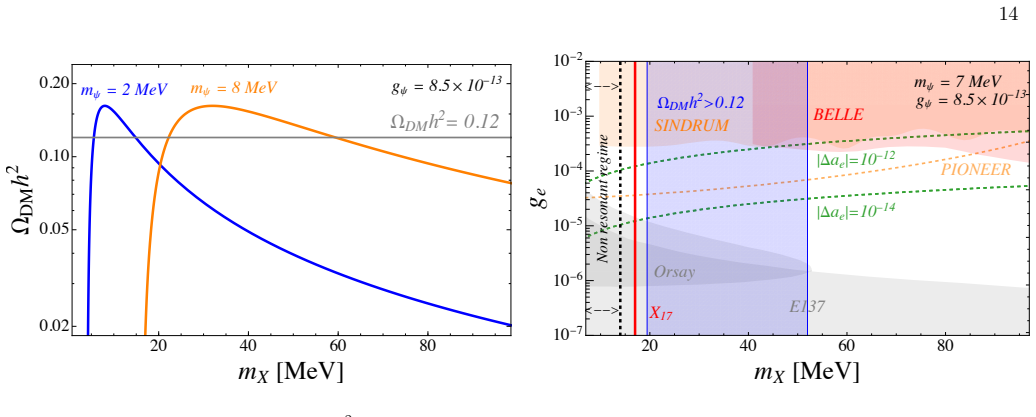
The light leptophilic scalar mediator that transmits interactions between the Majorana dark matter fermion and electrons, with possible light-quark couplings near 17 MeV.
If this is right
- Only sub-GeV dark matter masses remain viable after all constraints are applied.
- The analysis defines specific targets for future direct-detection and collider experiments.
- Direct searches already exclude large portions of parameter space even when dark matter is produced via freeze-in.
- Strong complementarity exists between direct-detection experiments and collider searches for testing the model.
Where Pith is reading between the lines
- If the 17 MeV mediator signal holds, it would require fine-tuning of quark couplings inside the surviving window.
- Low-threshold detectors now under development could close or confirm the narrow remaining space.
- Analogous light-mediator setups with different fermion couplings might produce similarly restricted viable regions for light dark matter.
Load-bearing premise
The scalar mediator is assumed to couple mainly to electrons in a minimal setup, with relic abundance determined solely by standard freeze-out or freeze-in without additional effects.
What would settle it
Observation of dark matter with mass above 1 GeV in electron-recoil data within the model's predicted coupling range, or complete exclusion of the remaining window by upcoming direct-detection runs, would falsify the viable region.
Figures
read the original abstract
We study a minimal framework where a Majorana fermion dark matter particle interacts with a light scalar mediator coupled mainly to electrons. We examine both freeze-out and freeze-in production to determine the regions of parameter space that yield the correct relic abundance with particular emphasis on a detailed comparison with results in the recent literature. The analysis includes cosmological and astrophysical constraints as well as laboratory bounds from electron-recoil experiments, fixed target searches, and precision measurements. The combined results identify a narrow but viable parameter region, favoring sub-GeV dark matter, and define clear targets for future experimental tests. This highlights the strong complementarity between direct-detection experiments and collider searches. We additionally investigate the mediator-mass region around 17 MeV, motivated by the hints reported by the ATOMKI experiment and the PADME collaboration, including couplings between the mediator and light quarks. Direct searches already constrain a large region of the parameter space, even when dark matter is produced via freeze-in, pointing again to sub-GeV dark matter.
Editorial analysis
A structured set of objections, weighed in public.
Referee Report
Summary. The paper studies a minimal model with Majorana fermion dark matter interacting via a light scalar mediator coupled primarily to electrons. It computes relic abundance via freeze-out and freeze-in, applies cosmological, astrophysical, and laboratory bounds (electron-recoil, fixed-target, precision measurements), identifies a narrow viable sub-GeV DM region, and extends the analysis to the ~17 MeV mediator motivated by ATOMKI/PADME hints with added quark couplings. The work stresses complementarity between direct detection and collider searches.
Significance. If the derivations and constraint implementations hold, the manuscript supplies a timely, consolidated update on leptophilic scalar mediators in DM models. The explicit comparison to recent literature, dual production mechanisms, and targeted 17 MeV extension provide concrete targets for upcoming experiments and illustrate the interplay between lab and cosmological probes.
minor comments (3)
- [Abstract] Abstract: the phrase 'detailed comparison with results in the recent literature' is not accompanied by citations; the introduction should list the specific prior works being compared.
- [Abstract] The manuscript states that freeze-in and freeze-out are examined but does not indicate in the abstract or early sections whether the viable region is dominated by one mechanism or both; a brief statement would improve clarity.
- [Abstract] The 17 MeV extension includes quark couplings, yet the abstract does not specify the size of the quark coupling relative to the electron coupling or whether it is fixed by a particular ansatz; this should be stated explicitly when the extension is introduced.
Simulated Author's Rebuttal
We thank the referee for the positive assessment of our manuscript, the recognition of its timeliness, and the recommendation for minor revision. The summary accurately captures the scope of our analysis on the leptophilic scalar mediator with Majorana dark matter, including freeze-out/freeze-in production, constraints, and the 17 MeV extension. No specific major comments were listed in the report.
Circularity Check
No significant circularity identified
full rationale
The paper describes a standard minimal model analysis for a leptophilic scalar mediator coupled to electrons and Majorana DM, computing relic density via freeze-out or freeze-in and overlaying external cosmological, astrophysical, and laboratory bounds. No derivation step reduces by construction to a fitted parameter or self-defined quantity, and the abstract and description contain no load-bearing self-citations or uniqueness theorems imported from prior author work. The analysis is self-contained against external benchmarks and literature comparisons.
Axiom & Free-Parameter Ledger
free parameters (3)
- DM mass
- mediator mass
- electron coupling strength
axioms (2)
- domain assumption The scalar mediator couples mainly to electrons (leptophilic)
- domain assumption Freeze-out and freeze-in production mechanisms determine the relic abundance
invented entities (2)
-
light leptophilic scalar mediator
no independent evidence
-
Majorana fermion dark matter
no independent evidence
Reference graph
Works this paper leans on
-
[1]
CMB and Indirect detection Dark Matter annihilationsψψ→XXare followed by the instantaneous decaysX→e+e−and are potentially constrained by CMB measurements and indirect detec- tion searches. However, due to theirp-wave nature, the corresponding cross sections are suppressed by the low DM velocity both at the time of recombination and at present time, so th...
-
[2]
These attracted attention due to their ability to reduce the central densities of DM halos
Bullet Cluster and SIDM Scenarios with a DM elastic self-interaction cross sec- tion per unit mass ofO(cm 2/gr)are known in the lit- erature as Self-Interacting Dark Matter (SIDM) mod- els [65]. These attracted attention due to their ability to reduce the central densities of DM halos. Indeed, such large cross sections could alleviate some tension between...
-
[3]
Therecent study carriedout inRef.[80] has precisely investigated this kind of bounds and, in what follows, we will briefly review its findings
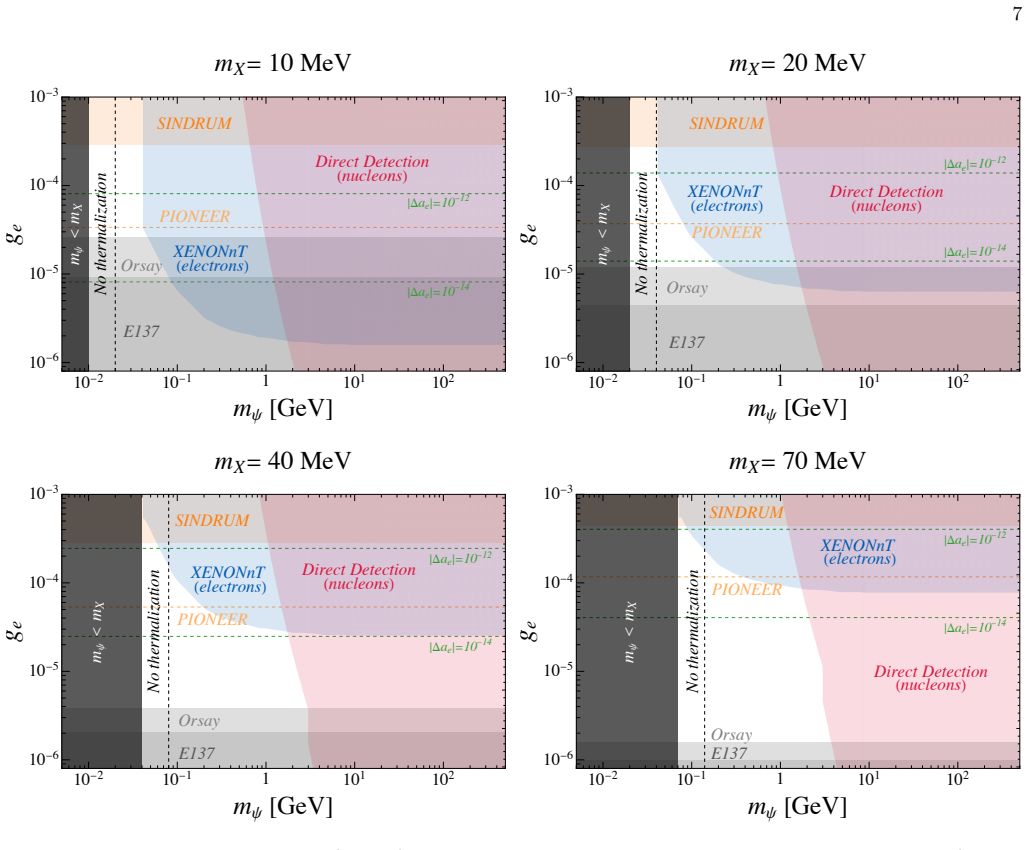
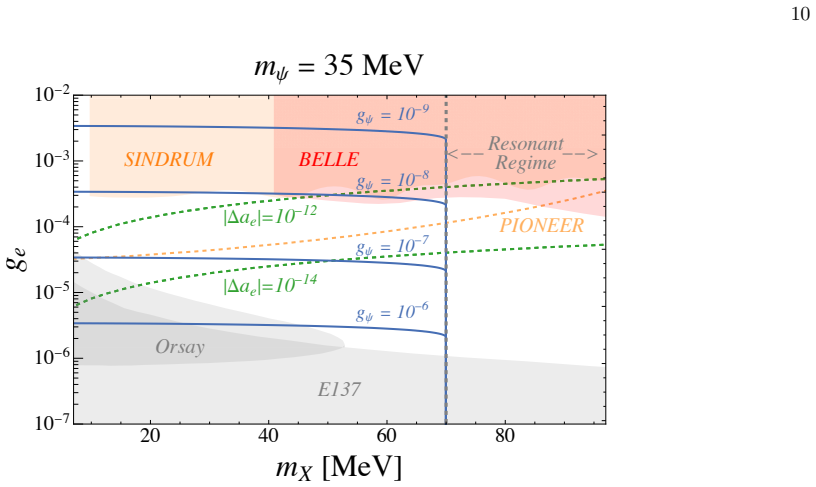
Laboratory constraints Data from low-energy observables can give important constraints on the parameter space of the CP-even elec- trophilic scalar mediatorX, independently of its hypo- thetical role as a mediator between the visible and the darksectors. Therecent study carriedout inRef.[80] has precisely investigated this kind of bounds and, in what foll...
-
[4]
When the DM particle scatters off the electrons bounded in the atoms of the target material, it can ion- ize them, provided it possesses enough kinetic energy, i.e
Direct detection–electron scatterings Direct detection (DD) experiments are sensitive to scatteringsofDMoffelectronsandprovideanupperlimit on the corresponding cross section (see for instance [88– 90])7. When the DM particle scatters off the electrons bounded in the atoms of the target material, it can ion- ize them, provided it possesses enough kinetic e...
-
[5]
neutrinofog
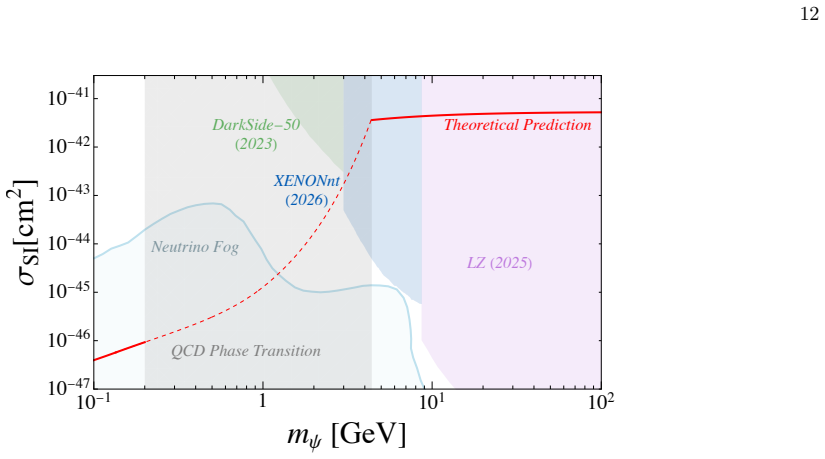
Direct detection–nuclear scatterings Despite the fact that the electrophilic mediator does not couple at tree level with quarks and gluons, such in- teractions are induced at the loop level, thus providing loop-suppressed DM scatterings off nucleons. These are relevant for DM masses above the GeV, where the experi- mentallimitsfromnuclearrecoilsareorderso...
2022
-
[6]
neutrino fog
This article is based upon work from COST Action COSMIC WISPers CA21106, supported by COST (Eu- ropean Cooperation in Science and Technology). The work of CT has received funding from the French ANR, under contracts ANR-19-CE31-0016 (‘GammaRare’) and ANR-23-CE31-0018 (‘InvISYble’), that he gratefully ac- knowledges. The work of LV is supported by the Ital...
2024
-
[7]
C.-Y. Chen, J. Kozaczuk, and Y.-M. Zhong, JHEP10, 154 (2018), arXiv:1807.03790 [hep-ph]
work page internal anchor Pith review Pith/arXiv arXiv 2018
-
[8]
J. Kopp, V. Niro, T. Schwetz, and J. Zupan, Phys. Rev. D80, 083502 (2009), arXiv:0907.3159 [hep-ph]
work page internal anchor Pith review Pith/arXiv arXiv 2009
-
[9]
S.-I. Horigome, T. Katayose, S. Matsumoto, and I. Saha, Phys. Rev. D104, 055001 (2021), arXiv:2102.08645 [hep-ph]
- [10]
-
[11]
Leptophilic Dark Matter in Lepton Interactions at LEP and ILC
A. Freitas and S. Westhoff, JHEP10, 116 (2014), arXiv:1408.1959 [hep-ph]
work page internal anchor Pith review Pith/arXiv arXiv 2014
-
[12]
Electrophilic dark matter with dark photon: from DAMPE to direct detection
P.-H. Gu and X.-G. He, Phys. Lett. B778, 292 (2018), arXiv:1711.11000 [hep-ph]
work page internal anchor Pith review Pith/arXiv arXiv 2018
- [13]
- [14]
- [15]
- [16]
-
[17]
Exploring muonphilic dark matter with theZ2-even mediator at muon colliders,
W. Chen, H. Li, C.-T. Lu, and Q. Wang, “Exploring muonphilic dark matter with theZ2-even mediator at muon colliders,” (2025), arXiv:2511.21290 [hep-ph]
-
[18]
P. J. Fox and E. Poppitz, Phys. Rev. D79, 083528 (2009), arXiv:0811.0399 [hep-ph]
work page internal anchor Pith review Pith/arXiv arXiv 2009
-
[19]
Q.-H. Cao, E. Ma, and G. Shaughnessy, Phys. Lett. B 673, 152 (2009), arXiv:0901.1334 [hep-ph]
work page internal anchor Pith review Pith/arXiv arXiv 2009
-
[20]
Cosmic Rays from Leptophilic Dark Matter Decay via Kinetic Mixing
A. Ibarra, A. Ringwald, D. Tran, and C. Weniger, JCAP08, 017 (2009), arXiv:0903.3625 [hep-ph]
work page internal anchor Pith review Pith/arXiv arXiv 2009
-
[21]
Y. Bai and J. Berger, JHEP08, 153 (2014), arXiv:1402.6696 [hep-ph]
work page internal anchor Pith review Pith/arXiv arXiv 2014
-
[22]
S. Okawa and Y. Omura, JHEP02, 231 (2021), arXiv:2011.04788 [hep-ph]
-
[23]
S. N. Gninenko, N. V. Krasnikov, and V. A. Matveev, Phys. Rev. D91, 095015 (2015), arXiv:1412.1400 [hep- ph]
work page internal anchor Pith review Pith/arXiv arXiv 2015
-
[24]
S. Yaser Ayazi and A. Mohamadnejad, J. Phys. G47, 095003 (2020), arXiv:1909.10729 [hep-ph]
-
[25]
G. Armando, P. Panci, J. Weiss, and R. Ziegler, Phys. Rev. D109, 055029 (2024), arXiv:2310.05827 [hep-ph]
-
[26]
Model-independent analysis of the DAMPE excess
P. Athron, C. Balazs, A. Fowlie, and Y. Zhang, JHEP 02, 121 (2018), arXiv:1711.11376 [hep-ph]
work page internal anchor Pith review Pith/arXiv arXiv 2018
- [27]
-
[28]
M. Abdughani, Y.-Z. Fan, C.-T. Lu, T.-P. Tang, and Y.-L. S. Tsai, JHEP07, 127 (2022), arXiv:2111.02946 [astro-ph.HE]
- [29]
-
[30]
C. Cesarotti and G. Krnjaic, Phys. Rev. Lett.135, 171802 (2025), arXiv:2404.02906 [hep-ph]
-
[31]
Dubinski and R
J. Dubinski and R. G. Carlberg, Astrophys. J.378, 496 (1991)
1991
-
[32]
J. F. Navarro, C. S. Frenk, and S. D. M. White, Astro- phys. J.462, 563 (1996), arXiv:astro-ph/9508025
work page internal anchor Pith review Pith/arXiv arXiv 1996
-
[33]
J. F. Navarro, C. S. Frenk, and S. D. M. White, Astro- phys. J.490, 493 (1997), arXiv:astro-ph/9611107
work page internal anchor Pith review Pith/arXiv arXiv 1997
- [34]
-
[35]
Subhaloes in Self-Interacting Galactic Dark Matter Haloes
M. Vogelsberger, J. Zavala, and A. Loeb, Mon. Not. Roy. Astron. Soc.423, 3740 (2012), arXiv:1201.5892 [astro-ph.CO]
work page internal anchor Pith review Pith/arXiv arXiv 2012
-
[36]
M. Rocha, A. H. G. Peter, J. S. Bullock, M. Kapling- hat, S. Garrison-Kimmel, J. Onorbe, and L. A. Mous- takas, Mon. Not. Roy. Astron. Soc.430, 81 (2013), arXiv:1208.3025 [astro-ph.CO]
work page internal anchor Pith review Pith/arXiv arXiv 2013
-
[37]
A. H. G. Peter, M. Rocha, J. S. Bullock, and 16 M. Kaplinghat, Mon. Not. Roy. Astron. Soc.430, 105 (2013), arXiv:1208.3026 [astro-ph.CO]
work page internal anchor Pith review Pith/arXiv arXiv 2013
-
[38]
O. D. Elbert, J. S. Bullock, S. Garrison-Kimmel, M. Rocha, J. Oñorbe, and A. H. G. Peter, Mon. Not. Roy. Astron. Soc.453, 29 (2015), arXiv:1412.1477 [astro-ph.GA]
work page internal anchor Pith review Pith/arXiv arXiv 2015
-
[39]
A. B. Fry, F. Governato, A. Pontzen, T. Quinn, M. Tremmel, L. Anderson, H. Menon, A. M. Brooks, and J. Wadsley, Mon. Not. Roy. Astron. Soc.452, 1468 (2015), arXiv:1501.00497 [astro-ph.CO]
work page internal anchor Pith review Pith/arXiv arXiv 2015
-
[40]
Duttaet al., (2023), arXiv:2301.08768 [nucl-ex]
D. Duttaet al., (2023), arXiv:2301.08768 [nucl-ex]
-
[41]
Celentano, M
A. Celentano, M. Battaglieri, M. Bondì, P. Cole, M. De Napoli, R. De Vita, L. Marsicano, N. Randazzo, E. Smith, and M. Spreafico, PoSICHEP2022, 327 (2022)
2022
-
[42]
M. Battaglieriet al., Phys. Rev. D106, 072011 (2022), arXiv:2208.01387 [hep-ex]
-
[43]
Akessonet al.(LDMX), (2025), arXiv:2508.11833 [hep-ex]
T. Akessonet al.(LDMX), (2025), arXiv:2508.11833 [hep-ex]
- [44]
- [45]
-
[46]
Dark Sectors at fixed targets: The example of NA62
B. Döbrich (NA62), Frascati Phys. Ser.66, 312 (2018), arXiv:1807.10170 [hep-ex]
work page internal anchor Pith review Pith/arXiv arXiv 2018
-
[47]
Bossiet al.(PADME), JHEP11, 007 (2025), arXiv:2505.24797 [hep-ex]
F. Bossiet al.(PADME), JHEP11, 007 (2025), arXiv:2505.24797 [hep-ex]
-
[48]
A.J.Krasznahorkayet al.,Phys.Rev.Lett.116,042501 (2016), arXiv:1504.01527
work page internal anchor Pith review Pith/arXiv arXiv 2016
-
[49]
A. J. Krasznahorkayet al., J. Phys.: Conf. Ser.1056, 012028 (2018)
2018
-
[50]
New evidence supporting the existence of the hypothetic X17 particle,
A. J. Krasznahorkayet al., “New evidence supporting the existence of the hypothetic X17 particle,” (2019), arXiv:1910.10459 [nucl-ex]
-
[51]
A. J. Krasznahorkayet al., Phys. Rev. C104, 044003 (2021)
2021
-
[52]
A. J. Krasznahorkayet al., Phys. Rev. C106, L061601 (2022)
2022
-
[53]
A. J. Krasznahorkayet al., EPJ Web Conf.232, 04005 (2020)
2020
-
[54]
A. J. Krasznahorkayet al., EPJ Web Conf.232, 04005 (2024), update of previous results
2024
- [55]
-
[56]
Planck 2018 results. VI. Cosmological parameters
N. Aghanimet al.(Planck), Astron. Astrophys.641, A6 (2020), [Erratum: Astron.Astrophys. 652, C4 (2021)], arXiv:1807.06209 [astro-ph.CO]
work page internal anchor Pith review Pith/arXiv arXiv 2020
-
[57]
The anomalous magnetic moment of the muon in the Standard Model: an update
R. Alibertiet al., Phys. Rept.1143, 1 (2025), arXiv:2505.21476 [hep-ph]
work page internal anchor Pith review Pith/arXiv arXiv 2025
-
[58]
Searches for invisible higgs bosons: Preliminary combined results using lep data up to 209 gev,
ALEPH, DELPHI, L3, OPAL Collaborations and the LEP Higgs Working Group, “Searches for invisible higgs bosons: Preliminary combined results using lep data up to 209 gev,” LEP LHWG Note 2001-06 (hep- ex/0107032) (2001)
-
[59]
Decay-mode independent searches for neutral scalar bosons at lep,
A. Quadt and the LEP Collaborations, “Decay-mode independent searches for neutral scalar bosons at lep,” CERN-EP/2002-XXX (CERN Document Server) (2002), overview of ALEPH, DELPHI, L3, and OPAL scalar searches
2002
-
[60]
D. Biswaset al.(Belle), Phys. Rev. D109, 032002 (2024), arXiv:2207.07476 [hep-ex]
-
[61]
J. D. Bjorken, S. Ecklund, W. R. Nelson, A. Abashian, C. Church, B. Lu, L. W. Mo, T. A. Nunamaker, and P. Rassmann, Phys. Rev. D38, 3375 (1988)
1988
-
[62]
Davier and H
M. Davier and H. Nguyen Ngoc, Phys. Lett. B229, 150 (1989)
1989
-
[63]
D. Cogollo, Y. M. Oviedo-Torres, F. S. Queiroz, Y. Vil- lamizar, and J. Zamora-Saa, Eur. Phys. J. C85, 1404 (2025), arXiv:2412.19893 [hep-ph]
-
[64]
Cosmological Implications of Dark Matter Bound States
A. Mitridate, M. Redi, J. Smirnov, and A. Strumia, JCAP05, 006 (2017), arXiv:1702.01141 [hep-ph]
work page internal anchor Pith review Pith/arXiv arXiv 2017
-
[65]
Beyond Collisionless Dark Matter: Particle Physics Dynamics for Dark Matter Halo Structure
S. Tulin, H.-B. Yu, and K. M. Zurek, Phys. Rev. D87, 115007 (2013), arXiv:1302.3898 [hep-ph]
work page internal anchor Pith review Pith/arXiv arXiv 2013
-
[66]
M. B. Wise and Y. Zhang, Phys. Rev. D90, 055030 (2014), [Erratum: Phys.Rev.D 91, 039907 (2015)], arXiv:1407.4121 [hep-ph]
work page internal anchor Pith review Pith/arXiv arXiv 2014
-
[67]
Dark-matter bound states from Feynman diagrams
K. Petraki, M. Postma, and M. Wiechers, JHEP06, 128 (2015), arXiv:1505.00109 [hep-ph]
work page internal anchor Pith review Pith/arXiv arXiv 2015
-
[68]
Radiative bound-state-formation cross-sections for dark matter interacting via a Yukawa potential
K. Petraki, M. Postma, and J. de Vries, JHEP04, 077 (2017), arXiv:1611.01394 [hep-ph]
work page internal anchor Pith review Pith/arXiv arXiv 2017
-
[69]
Dark matter bound states via emission of scalar mediators
R. Oncala and K. Petraki, JHEP01, 070 (2019), arXiv:1808.04854 [hep-ph]
work page internal anchor Pith review Pith/arXiv arXiv 2019
-
[70]
H. An, M. B. Wise, and Y. Zhang, Phys. Lett. B773, 121 (2017), arXiv:1606.02305 [hep-ph]
work page internal anchor Pith review Pith/arXiv arXiv 2017
-
[71]
D. N. Spergel and P. J. Steinhardt, Phys. Rev. Lett.84, 3760 (2000), arXiv:astro-ph/9909386
work page internal anchor Pith review Pith/arXiv arXiv 2000
-
[72]
The non-gravitational interactions of dark matter in colliding galaxy clusters
D. Harvey, R. Massey, T. Kitching, A. Taylor, and E. Tittley, Science347, 1462 (2015), arXiv:1503.07675 [astro-ph.CO]
work page internal anchor Pith review Pith/arXiv arXiv 2015
-
[73]
Constraining self-interacting dark matter with scaling laws of observed halo surface densities
K. Bondarenko, A. Boyarsky, T. Bringmann, and A. Sokolenko, JCAP04, 049 (2018), arXiv:1712.06602 [astro-ph.CO]
work page internal anchor Pith review Pith/arXiv arXiv 2018
- [74]
-
[75]
L. Sagunski, S. Gad-Nasr, B. Colquhoun, A. Robertson, and S. Tulin, JCAP01, 024 (2021), arXiv:2006.12515 [astro-ph.CO]
-
[76]
D. Crosset al.(DES), Mon. Not. Roy. Astron. Soc.529, 52 (2024), arXiv:2304.10128 [astro-ph.CO]
-
[77]
Resonant Dark Forces and Small Scale Structure
S. Tulin, H.-B. Yu, and K. M. Zurek, Phys. Rev. Lett. 110, 111301 (2013), arXiv:1210.0900 [hep-ph]
work page internal anchor Pith review Pith/arXiv arXiv 2013
-
[78]
Cores in Dwarf Galaxies from Dark Matter with a Yukawa Potential
A. Loeb and N. Weiner, Phys. Rev. Lett.106, 171302 (2011), arXiv:1011.6374 [astro-ph.CO]
work page internal anchor Pith review Pith/arXiv arXiv 2011
-
[79]
Self-Scattering for Dark Matter with an Excited State
K. Schutz and T. R. Slatyer, JCAP01, 021 (2015), arXiv:1409.2867 [hep-ph]
work page internal anchor Pith review Pith/arXiv arXiv 2015
-
[80]
J. L. Feng, M. Kaplinghat, and H.-B. Yu, Phys. Rev. Lett.104, 151301 (2010), arXiv:0911.0422 [hep-ph]
work page internal anchor Pith review Pith/arXiv arXiv 2010
discussion (0)
Sign in with ORCID, Apple, or X to comment. Anyone can read and Pith papers without signing in.