REVIEW 2 major objections 1 minor 71 references
Li₃Co₂SbO₆ is established as a Kitaev A-type antiferromagnet via neutron scattering and spin wave modeling.
Reviewed by Pith at T0; open to challenge. T0 means a machine referee read the full paper against a public rubric. the ladder, T0–T4 →
T0 review · grok-4.3
2026-07-01 16:04 UTC pith:WHOS3KYD
load-bearing objection This paper supplies the first INS data on Li₃Co₂SbO₆ and fits it to an extended Kitaev-Heisenberg model via LSWT, but the fit rests on an untested assumption that linear spin-wave theory captures the spectrum without sizable quantum corrections. the 2 major comments →
Inelastic Neutron Scattering of the layered Kitaev ferromagnet Li₃Co₂SbO₆
The pith
A machine-rendered reading of the paper's core claim, the machinery that carries it, and where it could break.
Core claim
The inelastic neutron scattering spectra of Li₃Co₂SbO₆ are well reproduced by linear spin wave theory calculations based on an extended Kitaev-Heisenberg model. This modeling identifies the compound as a Kitaev A-type antiferromagnet with ferromagnetic honeycomb layers stacked antiferromagnetically.
What carries the argument
Extended Kitaev-Heisenberg model simulated with linear spin wave theory to match the observed spin excitations in the honeycomb lattice.
Load-bearing premise
Linear spin wave theory provides an accurate description of the excitations without significant contributions from multi-magnon processes or quantum fluctuations altering the parameters.
What would settle it
A clear mismatch between the measured inelastic neutron scattering intensity or dispersion and the linear spin wave theory predictions at specific momentum transfers would falsify the model.
If this is right
- The compound exhibits dominant Kitaev interactions in its magnetic Hamiltonian.
- It realizes A-type antiferromagnetic order at low temperatures.
- The model parameters allow simulation of field-dependent magnetic properties.
- Similar cobalt compounds may be analyzed with the same framework for Kitaev physics.
Where Pith is reading between the lines
- Other layered honeycomb cobalt magnets could be tested for Kitaev ferromagnetism using similar neutron scattering techniques.
- The success of linear spin wave theory suggests relatively classical spin behavior in this material compared to more frustrated Kitaev candidates.
- Field-induced phases might reveal additional Kitaev-related phenomena not explored in the paper.
Editorial analysis
A structured set of objections, weighed in public.
Referee Report
Summary. The manuscript reports inelastic neutron scattering (INS) experiments on Li₃Co₂SbO₆, which exhibits ferromagnetic honeycomb planes with A-type antiferromagnetic stacking. By direct comparison of the measured spin-wave dispersions and intensities to linear spin-wave theory (LSWT) calculations for an extended Kitaev-Heisenberg Hamiltonian, the authors conclude that the data are well described by this model, thereby establishing the material as a Kitaev-ferromagnet (specifically a Kitaev A-type antiferromagnet). The analysis is supplemented by magnetic-field-dependent INS data and simulations.
Significance. If the modeling holds, the work adds a new Kitaev-candidate material distinguished by ferromagnetic Kitaev exchange, broadening the range of systems available for studying Kitaev physics beyond the antiferromagnetic examples such as α-RuCl₃. The use of INS combined with LSWT to extract parameters follows established practice in the field.
major comments (2)
- [Abstract] Abstract: the assertion that the magnetic properties 'can be well-modelled' by the extended Kitaev-Heisenberg model is presented without quantitative fit metrics (e.g., χ², goodness-of-fit values, or parameter uncertainties), without error bars on the extracted interactions, and without explicit comparison to alternative Hamiltonians, rendering the central claim of model establishment difficult to assess.
- [Abstract] Abstract and modeling discussion: the identification as a Kitaev-ferromagnet rests on LSWT parameter extraction, yet no bounds or calculations are provided on the size of multi-magnon or quantum-fluctuation corrections, which are known to renormalize dispersions and intensities in Kitaev systems and could alter the fitted Kitaev and Heisenberg strengths.
minor comments (1)
- [Abstract] The abstract refers to 'magnetic field measurements and simulations' without indicating the field range, temperature, or the specific field-induced features that were simulated.
Simulated Author's Rebuttal
We thank the referee for their careful reading of the manuscript and for the constructive comments. We address each major comment below.
read point-by-point responses
-
Referee: [Abstract] Abstract: the assertion that the magnetic properties 'can be well-modelled' by the extended Kitaev-Heisenberg model is presented without quantitative fit metrics (e.g., χ², goodness-of-fit values, or parameter uncertainties), without error bars on the extracted interactions, and without explicit comparison to alternative Hamiltonians, rendering the central claim of model establishment difficult to assess.
Authors: We agree that the abstract lacks quantitative support for the modeling claim. The main text shows visual agreement between LSWT calculations and the measured dispersions/intensities, but does not report χ² values, parameter uncertainties, or comparisons to alternative models such as a pure Heisenberg Hamiltonian. We will revise the abstract to reference the quality of the fit and add error bars on the extracted parameters together with a brief comparison to a Heisenberg-only model in the revised manuscript. revision: yes
-
Referee: [Abstract] Abstract and modeling discussion: the identification as a Kitaev-ferromagnet rests on LSWT parameter extraction, yet no bounds or calculations are provided on the size of multi-magnon or quantum-fluctuation corrections, which are known to renormalize dispersions and intensities in Kitaev systems and could alter the fitted Kitaev and Heisenberg strengths.
Authors: We acknowledge that LSWT is an approximation and that multi-magnon/quantum corrections can renormalize parameters in Kitaev materials. For the ferromagnetic Kitaev case realized here the ordered moment remains close to the classical value, suggesting smaller corrections than in antiferromagnetic Kitaev candidates, but we have not performed explicit calculations of these effects. In the revision we will add a discussion paragraph noting this limitation and referencing literature estimates for similar systems. revision: partial
Circularity Check
No significant circularity; standard model fitting to data
full rationale
The derivation consists of acquiring INS data on Li₃Co₂SbO₆, then comparing dispersions and intensities to linear spin-wave theory simulations of an extended Kitaev-Heisenberg Hamiltonian whose parameters are adjusted to reproduce the observed spectrum. This is conventional parameter extraction from independent experimental data and does not reduce any claimed result to its own inputs by construction. No self-citation is invoked as load-bearing justification, no uniqueness theorem is imported from prior work by the same authors, and no ansatz or known empirical pattern is renamed as a new derivation. The label 'Kitaev A-type antiferromagnet' follows directly from the sign and relative magnitude of the fitted Kitaev term; the fit itself remains falsifiable against the measured spectra and is not presented as a prediction of a held-out quantity. The paper is therefore self-contained against external benchmarks.
Axiom & Free-Parameter Ledger
free parameters (1)
- Kitaev, Heisenberg, and additional interaction strengths
axioms (1)
- domain assumption Linear spin wave theory accurately captures the low-energy magnetic excitations
read the original abstract
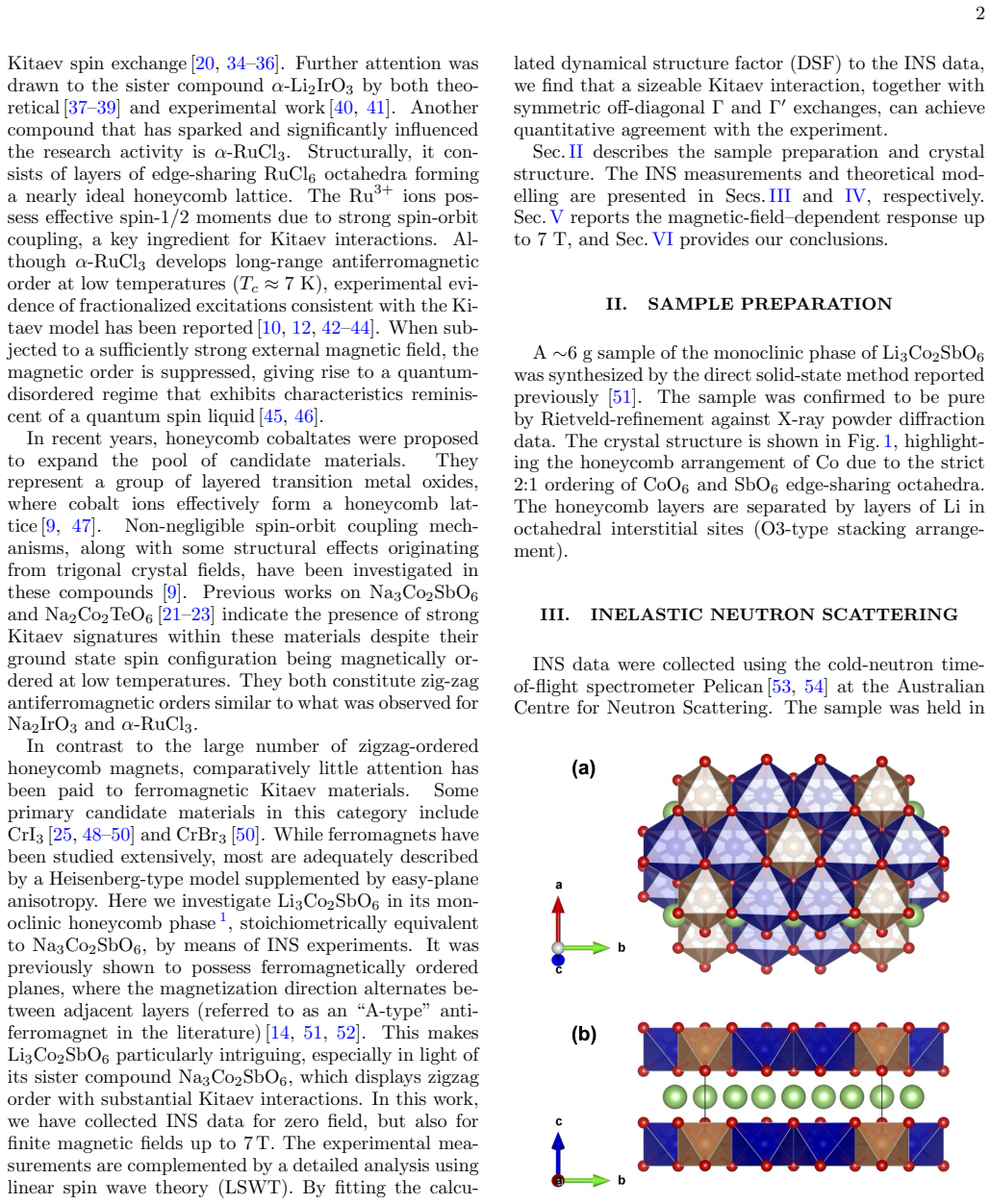
Cobalt-based quantum magnets forming layered honeycomb arrangements have attracted much attention recently, as they are considered as a potential platform for materials with exotic Kitaev spin exchange. Amongst the discussed candidate materials are Na$_3$Co$_2$SbO$_6$ and Na$_2$Co$_2$TeO$_6$, both possessing a low-temperature ground state with magnetic zigzag ordering, similar to Na$_2$IrO$_3$ and $\alpha$-RuCl$_3$. Here we report inelastic neutron scattering experiments on the quantum magnet Li$_3$Co$_2$SbO$_6$, which features ferromagnetic honeycomb planes with opposite magnetizations in neighboring planes. By comparing with linear spin wave theory, we show that the magnetic properties of Li$_3$Co$_2$SbO$_6$ can be well-modelled by an extended Kitaev--Heisenberg model, establishing it as a Kitaev-ferromagnet, or more specifically, as a Kitaev A-type antiferromagnet. Our analysis is complemented by magnetic field measurements and simulations.
Figures


Reference graph
Works this paper leans on
-
[1]
andS ⊥(k, ω) being the DSF defined as S⊥(k, ω) = X αβ δαβ − kαkβ |k|2 Sαβ(k, ω).(16) The matrix elements of the DSF are given by Sαβ(k, ω) = X i,j Z ∞ −∞ dτ 2π e−iωτ ⟨Sα −ki(0)Sβ kj(τ)⟩,(17) where the indices (i, j) correspond to inequivalent lattice sites within the magnetic unit cell.S α k (t) represents the Fourier transform of the spin operatorS α i i...
-
[2]
Upon the application of an external magnetic field, the inten- sity of the (0,0, 1
is characteristic of A-type antiferromagnetic or- dering, which doubles the magnetic unit cell relative to the nuclear unit cell along the interlayercaxis. Upon the application of an external magnetic field, the inten- sity of the (0,0, 1
-
[3]
reflection decreases with increasing field to vanish at approximately 5 T, consistent with the suppression of A-type order. Conversely, the intensity of the (0,0,1) reflection increases with applied magnetic field, reflecting the progressive alignment of spins into a fully polarized ferromagnetic state where the magnetic unit cell is the same as the nucle...
-
[4]
Balents, Spin liquids in frustrated magnets, Nature 464, 199 (2010)
L. Balents, Spin liquids in frustrated magnets, Nature 464, 199 (2010)
work page 2010
-
[5]
L. Savary and L. Balents, Quantum spin liquids: A re- view, Rep. Prog. Phys.80, 016502 (2016)
work page 2016
-
[6]
Anderson, Resonating valence bonds: A new kind of insulator?, Mat
P. Anderson, Resonating valence bonds: A new kind of insulator?, Mat. Res. Bull.8, 153 (1973)
work page 1973
-
[7]
Kitaev, Anyons in an exactly solved model and be- yond, Ann
A. Kitaev, Anyons in an exactly solved model and be- yond, Ann. Phys.321, 2 (2006)
work page 2006
-
[8]
G. Jackeli and G. Khaliullin, Mott insulators in the strong spin-orbit coupling limit: From Heisenberg to a quantum compass and Kitaev models, Phys. Rev. Lett. 102, 017205 (2009)
work page 2009
-
[9]
W. Witczak-Krempa, G. Chen, Y. B. Kim, and L. Ba- lents, Correlated quantum phenomena in the strong spin- orbit regime, Annu. Rev. Condens. Matter Phys.5, 57 (2014)
work page 2014
-
[10]
S. Hwan Chun, J.-W. Kim, J. Kim, H. Zheng, C. C. Stoumpos, C. D. Malliakas, J. F. Mitchell, K. Mehlawat, Y. Singh, Y. Choi, T. Gog, A. Al-Zein, M. M. Sala, M. Krisch, J. Chaloupka, G. Jackeli, G. Khaliullin, and B. J. Kim, Direct evidence for dominant bond-directional interactions in a honeycomb lattice iridate Na2IrO3, Nat. Phys.11, 462 (2015)
work page 2015
-
[11]
J. G. Rau, E. K.-H. Lee, and H.-Y. Kee, Spin-orbit physics giving rise to novel phases in correlated systems: Iridates and related materials, Annu. Rev. Condens. Mat- ter Phys.7, 195 (2016)
work page 2016
-
[12]
Liu, Towards Kitaev spin liquid in 3dtransition metal compounds, Int
H. Liu, Towards Kitaev spin liquid in 3dtransition metal compounds, Int. J. Mod. Phys. B35, 2130006 (2021). 13
work page 2021
-
[13]
A. Banerjee, C. A. Bridges, J.-Q. Yan, A. A. Aczel, L. Li, M. B. Stone, G. E. Granroth, M. D. Lumsden, Y. Yiu, J. Knolle, S. Bhattacharjee, D. L. Kovrizhin, R. Moess- ner, D. A. Tennant, D. G. Mandrus, and S. E. Nagler, Proximate Kitaev quantum spin liquid behaviour in a honeycomb magnet, Nat. Mater.15, 733 (2016)
work page 2016
-
[14]
E. H. T. Poldi, R. Tartaglia, G. Fabbris, N. Nguyen, H. Park, Z. Liu, M. van Veenendaal, R. Kumar, G. Jose, S. Samanta, W. Bi, Y. Xiao, D. Popov, Y. Wu, J.-W. Kim, H. Zheng, J. Yan, J. F. Mitchell, R. J. Hemley, and D. Haskel, Pressure tuning of Kitaev spin liquid candi- date Na3Co2SbO6, Commun. Phys.8, 310 (2025)
work page 2025
-
[15]
P. Lampen-Kelley, S. Rachel, J. Reuther, J.-Q. Yan, A. Banerjee, C. A. Bridges, H. B. Cao, S. E. Nagler, and D. Mandrus, Anisotropic susceptibilities in the hon- eycomb Kitaev systemα-RuCl 3, Phys. Rev. B98, 100403 (2018)
work page 2018
-
[16]
S. D. Das, S. Kundu, Z. Zhu, E. Mun, R. D. McDon- ald, G. Li, L. Balicas, A. McCollam, G. Cao, J. G. Rau, H.-Y. Kee, V. Tripathi, and S. E. Sebastian, Magnetic anisotropy of the alkali iridate Na2IrO3 at high magnetic fields: Evidence for strong ferromagnetic Kitaev correla- tions, Phys. Rev. B99, 081101 (2019)
work page 2019
-
[17]
H. K. Vivanco, B. A. Trump, C. M. Brown, and T. M. McQueen, Competing antiferromagnetic-ferromagnetic states in ad 7 Kitaev honeycomb magnet, Phys. Rev. B 102, 224411 (2020)
work page 2020
-
[18]
J. Knolle, G.-W. Chern, D. Kovrizhin, R. Moessner, and N. Perkins, Raman scattering signatures of Kitaev spin liquids inA 2IrO3 iridates withA= Na or Li, Phys. Rev. Lett.113, 187201 (2014)
work page 2014
-
[19]
B. Perreault, J. Knolle, N. B. Perkins, and F. J. Burnell, Theory of Raman response in three-dimensional Kitaev spin liquids: Application toβ- andγ−Li 2IrO3 com- pounds, Phys. Rev. B92, 094439 (2015)
work page 2015
-
[20]
S. N. Gupta, P. V. Sriluckshmy, K. Mehlawat, A. Balodhi, D. K. Mishra, S. R. Hassan, T. V. Ramakr- ishnan, D. V. S. Muthu, Y. Singh, and A. K. Sood, Ra- man signatures of strong Kitaev exchange correlations in (Na1−xLix)2IrO3 : Experiments and theory, EPL114, 47004 (2016)
work page 2016
-
[21]
A. Banerjee, P. Lampen-Kelley, J. Knolle, C. Balz, A. A. Aczel, B. Winn, Y. Liu, D. Pajerowski, J. Yan, C. A. Bridges, A. T. Savici, B. C. Chakoumakos, M. D. Lums- den, D. A. Tennant, R. Moessner, D. G. Mandrus, and S. E. Nagler, Excitations in the field-induced quantum spin liquid state ofα-RuCl 3, npj Quantum Mater.3, 8 (2018)
work page 2018
- [22]
-
[23]
S. K. Choi, R. Coldea, A. N. Kolmogorov, T. Lancaster, I. I. Mazin, S. J. Blundell, P. G. Radaelli, Y. Singh, P. Gegenwart, K. R. Choi, S.-W. Cheong, P. J. Baker, C. Stock, and J. Taylor, Spin waves and revised crystal structure of honeycomb iridate Na2IrO3, Phys. Rev. Lett. 108, 127204 (2012)
work page 2012
-
[24]
A. L. Sanders, R. A. Mole, J. Liu, A. J. Brown, D. Yu, C. D. Ling, and S. Rachel, Dominant Kitaev inter- actions in the honeycomb materials Na 3Co2SbO6 and Na2Co2TeO6, Phys. Rev. B106, 014413 (2022)
work page 2022
-
[25]
C. Kim, J. Jeong, G. Lin, P. Park, T. Masuda, S. Asai, S. Itoh, H.-S. Kim, H. Zhou, J. Ma, and J.-G. Park, Anti- ferromagnetic Kitaev interaction injeff= 1/2 cobalt hon- eycomb materials Na 3Co2Sb6 and Na2Co2Te6, J. Phys.: Condens. Matter , 045802 (2021)
work page 2021
-
[26]
M. Songvilay, J. Robert, S. Petit, J. A. Rodriguez-Rivera, W. D. Ratcliff, F. Damay, V. Bal´ edent, M. Jim´ enez-Ruiz, P. Lejay, E. Pachoud, A. Hadj-Azzem, V. Simonet, and C. Stock, Kitaev interactions in the Co honeycomb anti- ferromagnets Na3Co2SbO6 and Na2Co2TeO6, Phys. Rev. B102, 224429 (2020)
work page 2020
-
[27]
L. Chen, J.-H. Chung, B. Gao, T. Chen, M. B. Stone, A. I. Kolesnikov, Q. Huang, and P. Dai, Topological spin excitations in honeycomb ferromagnet CrI 3, Phys. Rev. X8, 041028 (2018)
work page 2018
-
[28]
L. Chen, J.-H. Chung, T. Chen, C. Duan, A. Schnei- dewind, I. Radelytskyi, D. J. Voneshen, R. A. Ewings, M. B. Stone, A. I. Kolesnikov, B. Winn, S. Chi, R. A. Mole, D. H. Yu, B. Gao, and P. Dai, Magnetic anisotropy in ferromagnetic CrI3, Phys. Rev. B101, 134418 (2020)
work page 2020
-
[29]
L. Chen, M. B. Stone, A. I. Kolesnikov, B. Winn, W. Shon, P. Dai, and J.-H. Chung, Massless Dirac magnons in the two dimensional van der Waals honey- comb magnet CrCl3, 2D Mater.9, 015006 (2021)
work page 2021
-
[30]
P. Laurell and S. Okamoto, Dynamical and thermal mag- netic properties of the Kitaev spin liquid candidateα- RuCl3, npj Quantum Mater.5, 2 (2020)
work page 2020
-
[31]
S. K. Pandey and J. Feng, Spin interaction and mag- netism in cobaltate Kitaev candidate materials: Anab initioand model Hamiltonian approach, Phys. Rev. B 106, 174411 (2022)
work page 2022
-
[32]
S. M. Winter, A. A. Tsirlin, M. Daghofer, J. v. d. Brink, Y. Singh, P. Gegenwart, and R. Valenti, Models and ma- terials for generalized Kitaev magnetism, J. Phys.: Cond. Matt.29, 493002 (2017)
work page 2017
-
[33]
S. Chakrabarti, A. Singh, and A. K. Thakur, Density functional theory study of monoclinic Li 3Co2SbO6 for Li ion battery applications, Mater. Today Commun.34, 105249 (2023)
work page 2023
-
[34]
V. M. Katukuri, S. Nishimoto, V. Yushankhai, A. Stoy- anova, H. Kandpal, S. Choi, R. Coldea, I. Rousochatza- kis, L. Hozoi, and J. v. d. Brink, Kitaev interactions betweenj= 1/2 moments in honeycomb Na 2IrO3 are large and ferromagnetic: insights fromab initioquantum chemistry calculations, New J. Phys.16, 013056 (2014)
work page 2014
-
[35]
P. Bhattacharyya, A. Basit, T. Petersen, S. Rachel, S. Nishimoto, and L. Hozoi, Relevance of on-site and intersite Coulomb interactions in the Kitaev-Heisenberg magnet Na3Co2SbO6, Phys. Rev. B113, L161103 (2026)
work page 2026
-
[36]
P. Bhattacharyya, N. A. Bogdanov, and L. Hozoi, The importance of direct exchange in Kitaev magnetism, PNAS Nexus5, pgag056 (2026)
work page 2026
-
[37]
Y. Singh and P. Gegenwart, Antiferromagnetic Mott in- sulating state in single crystals of the honeycomb lattice material Na2IrO3, Phys. Rev. B82, 064412 (2010)
work page 2010
-
[38]
X. Liu, T. Berlijn, W.-G. Yin, W. Ku, A. Tsvelik, Y.-J. Kim, H. Gretarsson, Y. Singh, P. Gegenwart, and J. P. Hill, Long-range magnetic ordering in Na 2IrO3, Phys. Rev. B83, 220403 (2011)
work page 2011
-
[39]
F. Ye, S. Chi, H. Cao, B. C. Chakoumakos, J. A. Fernandez-Baca, R. Custelcean, T. F. Qi, O. B. Kor- neta, and G. Cao, Direct evidence of a zigzag spin-chain structure in the honeycomb lattice: A neutron and x-ray diffraction investigation of single-crystal Na 2IrO3, Phys. 14 Rev. B85, 180403 (2012)
work page 2012
- [40]
-
[41]
J. Reuther, R. Thomale, and S. Rachel, Spiral order in the honeycomb iridate Li2IrO3, Phys. Rev. B90, 100405 (2014)
work page 2014
-
[42]
I. Rousochatzakis, J. Reuther, R. Thomale, S. Rachel, and N. Perkins, Phase diagram and quantum order by disorder in the KitaevK 1-K2 honeycomb magnet, Phys. Rev. X5, 041035 (2015)
work page 2015
-
[43]
S. C. Williams, R. D. Johnson, F. Freund, S. Choi, A. Jesche, I. Kimchi, S. Manni, A. Bombardi, P. Manuel, P. Gegenwart, and R. Coldea, Incommensurate counter- rotating magnetic order stabilized by Kitaev interactions in the layered honeycombα-Li 2IrO3, Phys. Rev. B93, 195158 (2016)
work page 2016
-
[44]
S. Choi, S. Manni, J. Singleton, C. V. Topping, T. Lan- caster, S. J. Blundell, D. T. Adroja, V. Zapf, P. Gegen- wart, and R. Coldea, Spin dynamics and field-induced magnetic phase transition in the honeycomb Kitaev mag- netα-Li 2IrO3, Phys. Rev. B99, 054426 (2019)
work page 2019
- [45]
-
[46]
A. U. B. Wolter, L. T. Corredor, L. Janssen, K. Nenkov, S. Sch¨ onecker, S.-H. Do, K.-Y. Choi, R. Albrecht, J. Hunger, T. Doert, M. Vojta, and B. B¨ uchner, Field-induced quantum criticality in the Kitaev system α-RuCl3, Phys. Rev. B96, 041405 (2017)
work page 2017
- [47]
-
[48]
Y. Kasahara, K. Sugii, T. Ohnishi, M. Shimozawa, M. Yamashita, N. Kurita, H. Tanaka, J. Nasu, Y. Mo- tome, T. Shibauchi, and Y. Matsuda, Unusual thermal Hall effect in a Kitaev spin liquid candidateα-RuCl 3, Phys. Rev. Lett.120, 217205 (2018)
work page 2018
- [49]
- [50]
-
[51]
I. Lee, F. G. Utermohlen, D. Weber, K. Hwang, C. Zhang, J. van Tol, J. E. Goldberger, N. Trivedi, and P. C. Hammel, Fundamental spin interactions underlying the magnetic anisotropy in the Kitaev ferromagnet CrI 3, Phys. Rev. Lett.124, 017201 (2020)
work page 2020
-
[52]
C. Xu, J. Feng, H. Xiang, and L. Bellaiche, Interplay between Kitaev interaction and single ion anisotropy in ferromagnetic CrI3 and CrGeTe3 monolayers, npj Com- put. Mater.4, 57 (2018)
work page 2018
-
[53]
I. Lee, J. Cen, O. Molchanov, S. Feng, W. L. Huey, J. Van Tol, J. E. Goldberger, N. Trivedi, H.-Y. Kee, and P. C. Hammel, Spin-orbit coupling controlled two- dimensional magnetism in chromium trihalides, Phys. Rev. B113, 014401 (2026)
work page 2026
-
[54]
A. J. Brown, Q. Xia, M. Avdeev, B. J. Kennedy, and C. D. Ling, Synthesis-controlled polymorphism and mag- netic and electrochemical properties of Li 3Co2SbO6, In- org. Chem.58, 13881 (2019)
work page 2019
-
[55]
M. I. Stratan, I. L. Shukaev, T. M. Vasilchikova, A. N. Vasiliev, A. N. Korshunov, A. I. Kurbakov, V. B. Nal- bandyan, and E. A. Zvereva, Synthesis, structure and magnetic properties of honeycomb-layered Li 3Co2SbO6 with new data on its sodium precursor, Na 3Co2SbO6, New J. Chem.43, 13545 (2019)
work page 2019
-
[56]
D. Yu, R. Mole, T. Noakes, S. Kennedy, and R. Robin- son, Pelican—a time of flight cold neutron polarization analysis spectrometer at OPAL, J. Phys. Soc. Jap.82, SA027 (2013)
work page 2013
-
[57]
D. Yu, R. A. Mole, and G. J. Kearley, Performance test on PELICAN - a multi-purpose time of flight cold neu- tron spectrometer, EPJ Web Conf.83, 03019 (2015)
work page 2015
-
[58]
J. Chaloupka and G. Khaliullin, Hidden symmetries of the extended Kitaev-Heisenberg model: Implications for the honeycomb-lattice iridatesA 2IrO3, Phys. Rev. B92, 024413 (2015)
work page 2015
-
[59]
J. M. Luttinger and L. Tisza, Theory of dipole interaction in crystals, Phys. Rev.70, 954 (1946)
work page 1946
-
[60]
D. B. Litvin, The Luttinger-Tisza method, Physica77, 205 (1974)
work page 1974
-
[61]
L. Janssen, E. C. Andrade, and M. Vojta, Honeycomb- lattice Heisenberg-Kitaev model in a magnetic field: Spin canting, metamagnetism, and vortex crystals, Phys. Rev. Lett.117, 277202 (2016)
work page 2016
-
[62]
L. Janssen, E. C. Andrade, and M. Vojta, Magnetiza- tion processes of zigzag states on the honeycomb lattice: Identifying spin models forα-RuCl 3 and Na2IrO3, Phys. Rev. B96, 064430 (2017)
work page 2017
-
[63]
J. Chaloupka, G. Jackeli, and G. Khaliullin, Zigzag mag- netic order in the iridium oxide Na2IrO3, Phys. Rev. Lett. 110, 097204 (2013)
work page 2013
-
[64]
R. L. Smit, S. Keupert, O. Tsyplyatyev, P. A. Maksimov, A. L. Chernyshev, and P. Kopietz, Magnon damping in the zigzag phase of the Kitaev-Heisenberg-Γ model on a honeycomb lattice, Phys. Rev. B101, 054424 (2020)
work page 2020
-
[65]
E. Rastelli,Statistical Mechanics of Magnetic Excita- tions: From Spin Waves to Stripes and Checkerboards (World Scientific, 2013)
work page 2013
-
[66]
J. H. P. Colpa, Diagonalization of the quadratic boson Hamiltonian, Physica A93, 327 (1978)
work page 1978
-
[67]
R. E. Watson and A. J. Freeman, Hartree–Fock atomic scattering factors for the iron transition series, Acta Crys- tallogr.14, 27 (1961)
work page 1961
-
[68]
J. G. Rau, P. A. McClarty, and R. Moessner, Pseudo- Goldstone gaps and order-by-quantum disorder in frus- trated magnets, Phys. Rev. Lett.121, 237201 (2018)
work page 2018
-
[69]
M. Georgiou, I. Rousochatzakis, D. J. J. Farnell, J. Richter, and R. F. Bishop, Spin-SKitaev-Heisenberg model on the honeycomb lattice: A high-order treatment via the many-body coupled cluster method, Phys. Rev. Res.6, 033168 (2024)
work page 2024
-
[70]
Y. Tymoshenko, Y. Onykiienko, T. M¨ uller, R. Thomale, S. Rachel, A. Cameron, P. Portnichenko, D. Efremov, V. Tsurkan, D. Abernathy, J. Ollivier, A. Schneidewind, A. Piovano, V. Felea, A. Loidl, and D. Inosov, Pseudo- Goldstone magnons in the frustratedS= 3/2 Heisenberg helimagnet ZnCr2Se4 with a pyrochlore magnetic sublat- tice, Phys. Rev. X7, 041049 (2017)
work page 2017
-
[71]
L. Janssen and M. Vojta, Heisenberg–Kitaev physics in magnetic fields, J. Phys.: Condens. Matter31, 423002 (2019)
work page 2019
discussion (0)
Sign in with ORCID, Apple, or X to comment. Anyone can read and Pith papers without signing in.