Agyn: An Open-Source Platform for AI Agents with Scalable On-Demand Execution, Agent Definition as a Code, and Zero-Trust Access
Pith reviewed 2026-06-29 17:10 UTC · model grok-4.3
The pith
Agyn is an open-source platform for scaling AI agents via code-defined definitions, a signal-driven Kubernetes runtime, and zero-trust security.
A machine-rendered reading of the paper's core claim, the machinery that carries it, and where it could break.
Core claim
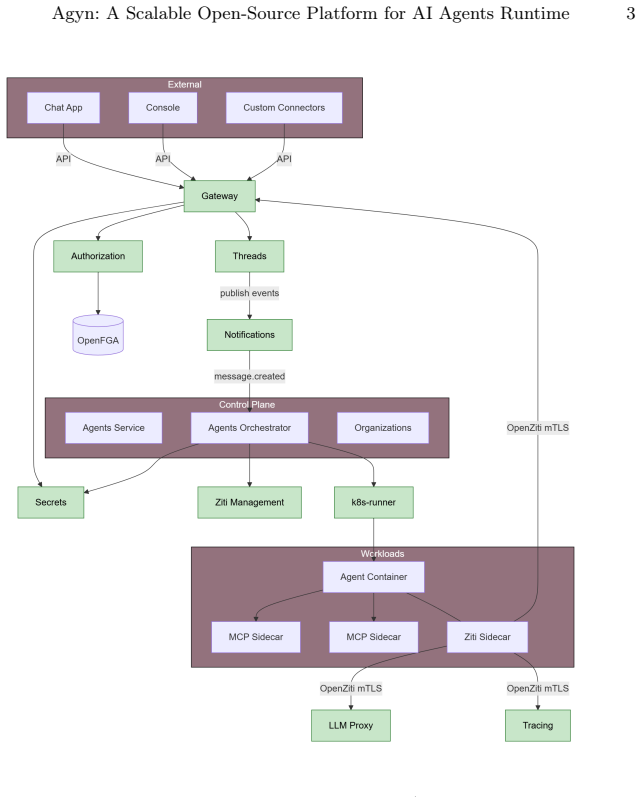
We present Agyn, an open-source platform designed around three key principles tailored for agent workloads: a signal-driven, stateful serverless runtime on Kubernetes; a Terraform provider for agent and harness definition; and a security model grounded in zero-trust and least-privilege principles. Agyn is agent-agnostic, model-agnostic, and cloud-agnostic.
What carries the argument
The Agyn platform, which combines a signal-driven stateful serverless runtime on Kubernetes, a Terraform provider for agent definition as code, and a zero-trust least-privilege security model.
If this is right
- Agents and their execution harnesses can be defined, versioned, and deployed as infrastructure code through the Terraform provider.
- Execution becomes on-demand and scalable through the signal-driven serverless runtime on Kubernetes.
- Access follows zero-trust and least-privilege rules, limiting what each agent can reach.
- The same platform can host any agent or model without custom changes.
- Deployments remain independent of specific cloud providers.
Where Pith is reading between the lines
- Teams could treat agent configurations the same way they treat other infrastructure, enabling standard review and rollback processes.
- The zero-trust model might simplify compliance checks for regulated environments that run agents.
- The runtime design could support other stateful, event-driven workloads that share similar isolation needs.
Load-bearing premise
These three architectural choices are sufficient to deliver the required isolation, governance, and security for production AI agents at scale.
What would settle it
A deployed agent in Agyn gaining unauthorized access to an internal service or failing to maintain state and scale under a non-deterministic workload.
Figures
read the original abstract
As organizations move toward production deployments of AI agents, which execute non-deterministic workflows, maintain stateful sessions, and often operate with privileged access to internal services, the engineering challenge shifts from building individual agents to operating them at scale with proper isolation, governance, and security. In this paper we present Agyn, an open-source platform designed around three key principles tailored for agent workloads: a signal-driven, stateful serverless runtime on Kubernetes; a Terraform provider for agent and harness definition; and a security model grounded in zero-trust and least-privilege principles. Agyn is agent-agnostic, model-agnostic, and cloud-agnostic.
Editorial analysis
A structured set of objections, weighed in public.
Referee Report
Summary. The paper presents Agyn, an open-source platform for operating AI agents at scale. It is designed around three principles: a signal-driven, stateful serverless runtime on Kubernetes, a Terraform provider for agent and harness definition as code, and a zero-trust least-privilege security model. The platform is described as agent-agnostic, model-agnostic, and cloud-agnostic, targeting challenges of isolation, governance, and security for non-deterministic, stateful agent workflows with privileged access.
Significance. If the platform is implemented and released as described, it would provide a practical open-source contribution for infrastructure-as-code management of AI agents on Kubernetes with explicit security controls. The combination of serverless execution, Terraform-based definitions, and zero-trust principles aligns with established cloud-native practices and could facilitate reproducible deployments. The agent- and cloud-agnostic stance is a noted strength for broad applicability.
major comments (1)
- [Abstract] Abstract: The central claim that the three architectural choices address isolation, governance, and security for production AI agents at scale is presented without any description of the signal-driven runtime mechanics, state management implementation, or concrete zero-trust enforcement mechanisms (e.g., how least-privilege is enforced across agent sessions). This absence is load-bearing for assessing whether the design actually solves the stated engineering challenges.
minor comments (1)
- The manuscript would benefit from a dedicated related-work section citing prior serverless frameworks (e.g., Knative, OpenFaaS) and Terraform-based agent orchestration efforts to clarify novelty.
Simulated Author's Rebuttal
We thank the referee for their constructive feedback on the manuscript. We address the major comment below and agree that revisions to the abstract are warranted to better support the central claims.
read point-by-point responses
-
Referee: [Abstract] Abstract: The central claim that the three architectural choices address isolation, governance, and security for production AI agents at scale is presented without any description of the signal-driven runtime mechanics, state management implementation, or concrete zero-trust enforcement mechanisms (e.g., how least-privilege is enforced across agent sessions). This absence is load-bearing for assessing whether the design actually solves the stated engineering challenges.
Authors: We agree that the abstract is currently too high-level and does not include even brief descriptions of the signal-driven runtime mechanics, state management approach, or zero-trust enforcement details. This limits the ability to evaluate the claims from the abstract alone. In the revised version, we will expand the abstract to concisely outline these elements (e.g., signal propagation for execution triggering, persistent session state handling on Kubernetes, and RBAC/identity-based least-privilege controls across sessions) while keeping it within length constraints. The full technical details remain in the body sections on the runtime, Terraform provider, and security model. revision: yes
Circularity Check
No significant circularity: pure system description with no derivations or predictions
full rationale
The manuscript is a high-level engineering description of an open-source platform (Agyn) built around three architectural components: a signal-driven Kubernetes runtime, a Terraform provider, and a zero-trust security model. No equations, fitted parameters, quantitative predictions, or derivation chains appear anywhere in the text. The central claim is simply the existence and design of these components to address isolation/governance/security needs; this is not derived from prior results within the paper or via self-citation chains. The contribution is self-contained as a descriptive artifact and contains no load-bearing steps that reduce to inputs by construction.
Axiom & Free-Parameter Ledger
Reference graph
Works this paper leans on
-
[1]
Agyn Inc.: Agyn Platform,https://github.com/agynio/platform
-
[2]
Amazon Web Services: Amazon Bedrock AgentCore.https://aws.amazon.com/ bedrock/agentcore/(2024), accessed 2026-05-22
2024
-
[3]
io/specification(2024), accessed 2026-05-22 8 N
Anthropic: Model context protocol specification.https://modelcontextprotocol. io/specification(2024), accessed 2026-05-22 8 N. Benkovich, V. Valkov
2024
-
[4]
Anthropic: Claude Code: An agentic coding tool.https://docs.anthropic.com/ en/docs/claude-code(2025), accessed 2026-05-24
2025
-
[5]
https://platform.claude.com/docs/en/ managed-agents(2026), public beta, April 2026
Anthropic: Claude Managed Agents. https://platform.claude.com/docs/en/ managed-agents(2026), public beta, April 2026. Accessed 2026-05-31
2026
-
[6]
Agentic AI Security: Threats, Defenses, Evaluation, and Open Challenges
Chhabra, A., Datta, S., Nahin, S.K., Mohapatra, P.: Agentic AI security: Threats, defenses, evaluation, and open challenges. arXiv preprint arXiv:2510.23883 (2025)
work page internal anchor Pith review Pith/arXiv arXiv 2025
-
[7]
Cloud Native Computing Foundation: OpenFGA: A relationship-based access control system.https://openfga.dev/(2024), accessed 2026-05-22
2024
-
[8]
https://github.com/ kagent-dev/kagent(2025), accessed 2026-05-24
CNCF: kagent: Kubernetes-native AI agent platform. https://github.com/ kagent-dev/kagent(2025), accessed 2026-05-24
2025
-
[9]
Google: AX: A distributed agent runtime.https://github.com/google/ax (2025), accessed 2026-05-24
2025
-
[10]
In: Proceedings of the 16th ACM Workshop on Artificial Intelligence and Security (2023)
Greshake, K., Abdelnabi, S., Mishra, S., Endres, C., Holz, T., Fritz, M.: Not what you’ve signed up for: Compromising real-world LLM-integrated applications with indirect prompt injection. In: Proceedings of the 16th ACM Workshop on Artificial Intelligence and Security (2023)
2023
-
[11]
HashiCorp: Terraform: Infrastructure as code.https://www.terraform.io/ (2024), accessed 2026-05-22
2024
-
[12]
In: Proceedings of the Conference on Innovative Data Systems Research (CIDR) (2019)
Hellerstein, J.M., Faleiro, J., Gonzalez, J.E., Schleier-Smith, J., Sreekanti, V., Tumanov, A., Wu, C.: Serverless computing: One step forward, two steps back. In: Proceedings of the Conference on Innovative Data Systems Research (CIDR) (2019)
2019
-
[13]
Cloud Programming Simplified: A Berkeley View on Serverless Computing
Jonas, E., Schleier-Smith, J., Sreekanti, V., Tsai, C.C., Khandelwal, A., Pu, Q., Shankar, V., Carreira, J., Krauth, K., Yadwadkar, N., et al.: Cloud program- ming simplified: A Berkeley view on serverless computing. In: arXiv preprint arXiv:1902.03383 (2019)
work page internal anchor Pith review Pith/arXiv arXiv 1902
-
[14]
LangChain: LangGraph: A library for building stateful, multi-actor applications with LLMs.https://github.com/langchain-ai/langgraph (2024), accessed 2026- 05-22
2024
-
[15]
NetFoundry: OpenZiti: A zero-trust networking platform.https://openziti.io/ (2024), accessed 2026-05-22
2024
-
[16]
OpenAI: OpenAI Codex: An agentic coding tool.https://github.com/openai/ codex(2025), accessed 2026-05-31
2025
-
[17]
In: 2019 USENIX Annual Technical Conference (USENIX ATC) (2019)
Pang, R., Caceres, R., Burrows, M., Chen, Z., Dave, P., Germer, N., Golynski, A., Graney, K., Kang, N., Kissner, L., et al.: Zanzibar: Google’s consistent, global authorization system. In: 2019 USENIX Annual Technical Conference (USENIX ATC) (2019)
2019
-
[18]
Information and Software Technology108, 65–77 (2019)
Rahman, A., Mahdavi-Hezaveh, R., Williams, L.: A systematic mapping study of Infrastructure as Code research. Information and Software Technology108, 65–77 (2019)
2019
-
[19]
arXiv preprint arXiv:2510.16720 (2025)
Sang, J., Xiao, J., Han, J., Chen, J., Chen, X., Wei, S., Sun, Y., Wang, Y.: Beyond pipelines: A survey of the paradigm shift toward model-native agentic AI. arXiv preprint arXiv:2510.16720 (2025)
-
[20]
In: ;login: The USENIX Magazine
Ward, R., Beyer, B.: BeyondCorp: A new approach to enterprise security. In: ;login: The USENIX Magazine. vol. 39 (2014)
2014
-
[21]
AutoGen: Enabling Next-Gen LLM Applications via Multi-Agent Conversation
Wu, Q., Bansal, G., Zhang, J., Wu, Y., Zhang, S., Zhu, E., Li, B., Jiang, L., Zhang, X., Wang, C.: AutoGen: Enabling next-gen LLM applications via multi-agent conversations. In: arXiv preprint arXiv:2308.08155 (2023)
work page internal anchor Pith review Pith/arXiv arXiv 2023
-
[22]
In: Proceedings of the 32nd Network and Distributed System Security Symposium (NDSS) (2025)
Wu, Y., Ma, S., Feng, Y., Tao, G., Xu, X., Zhang, X.: IsolateGPT: LLM-based agents with least-privilege isolation. In: Proceedings of the 32nd Network and Distributed System Security Symposium (NDSS) (2025)
2025
discussion (0)
Sign in with ORCID, Apple, or X to comment. Anyone can read and Pith papers without signing in.