Hydrodynamic Response of Mildly Evolved Common Envelope Donors in Luminous Red Novae
Pith reviewed 2026-07-01 15:59 UTC · model grok-4.3
The pith
The ratio of central to mean density in the donor star sets the inspiral morphology and mass-ejection timeline in common-envelope events.
A machine-rendered reading of the paper's core claim, the machinery that carries it, and where it could break.
Core claim
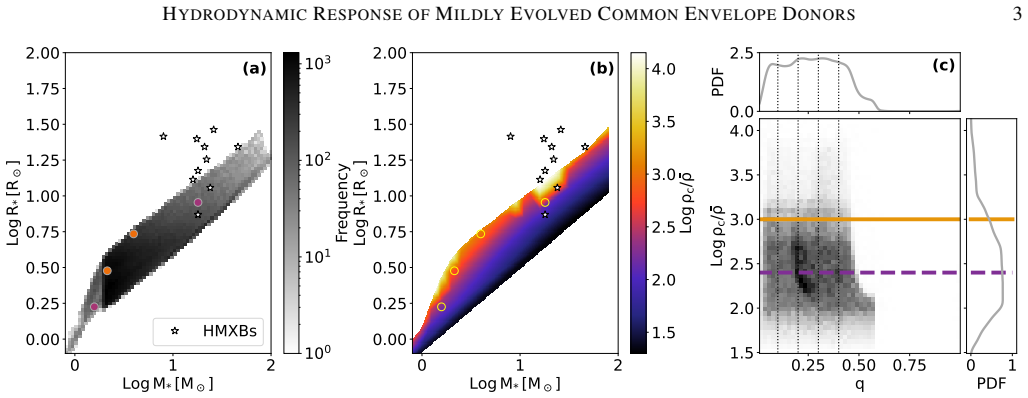
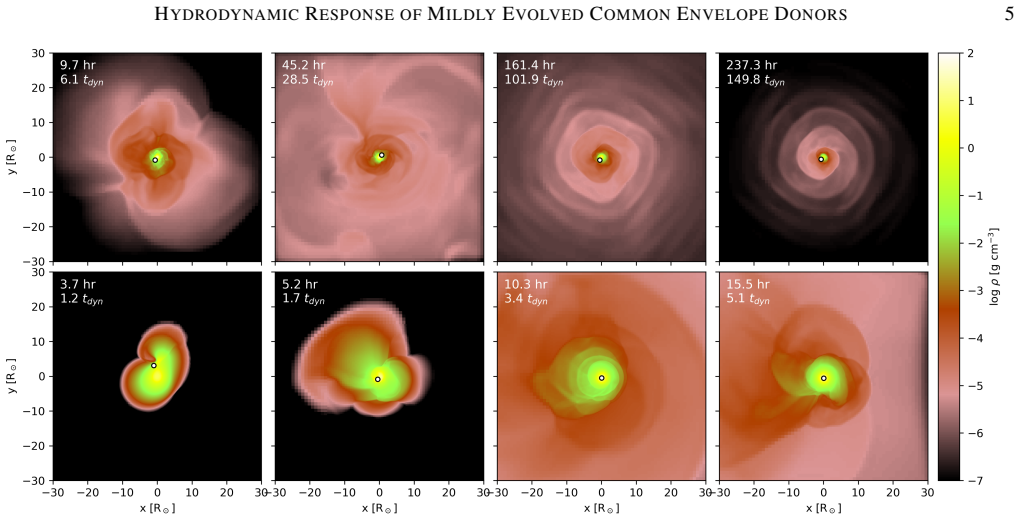
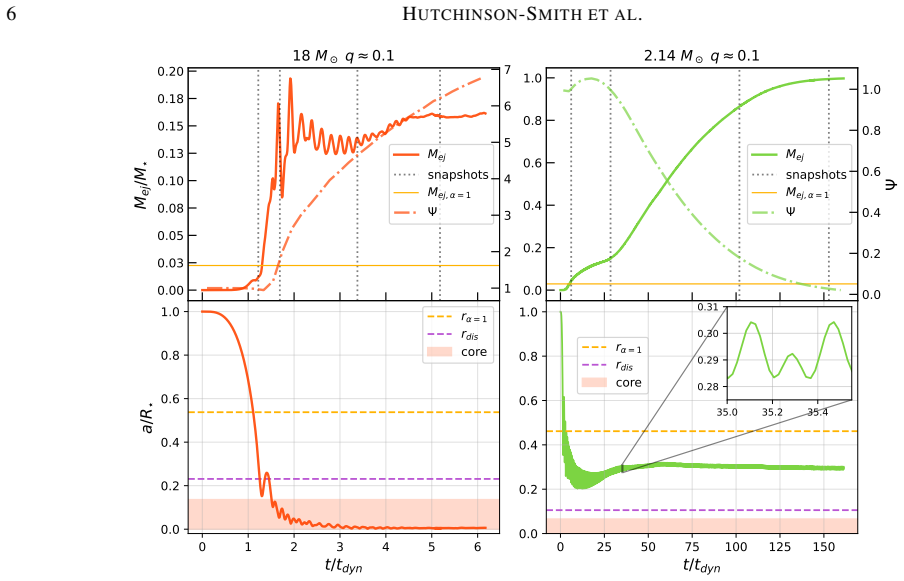
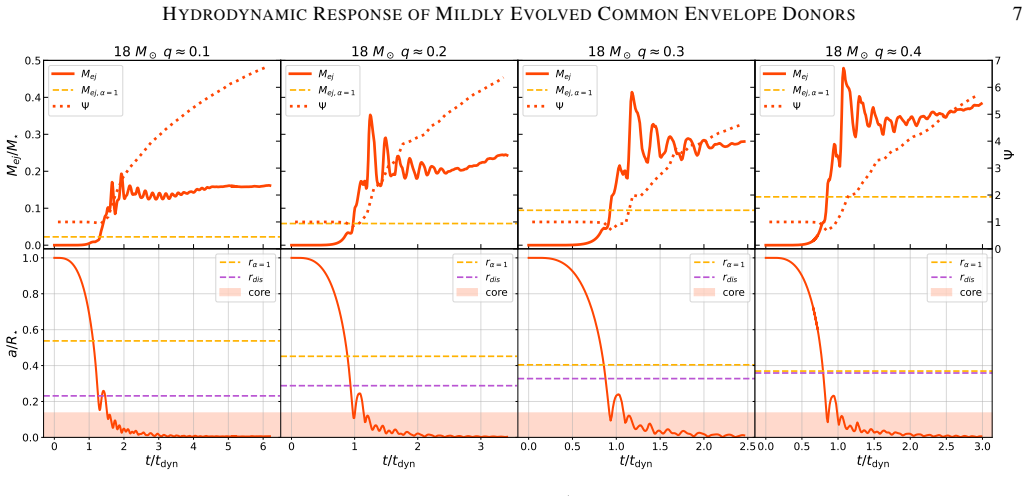
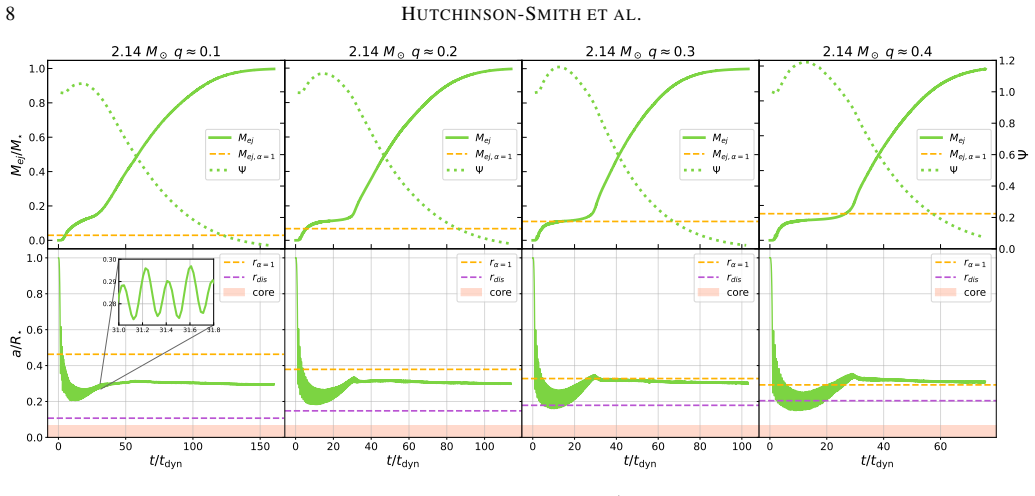
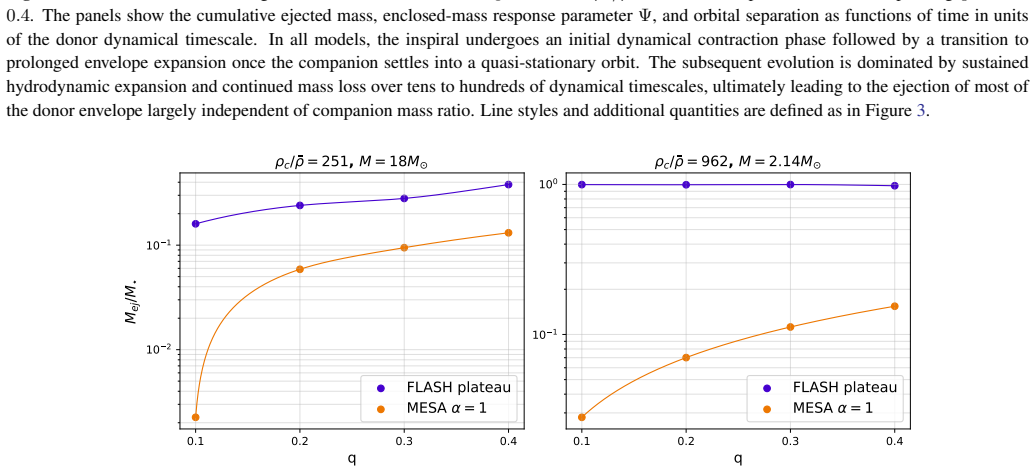
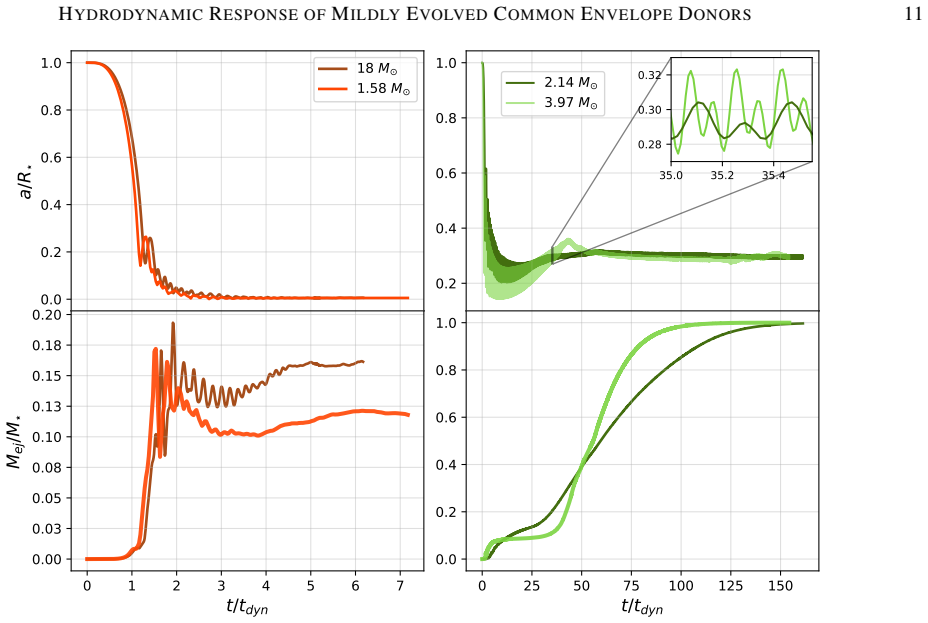
Three-dimensional hydrodynamic simulations of mildly evolved donors interacting with embedded companions demonstrate that hydrodynamic evolution is strongly regulated by the donor central concentration, parameterized by the ratio ρ_c/ρ_bar. Donors with similar values of ρ_c/ρ_bar exhibit similar inspiral morphologies and mass-ejection histories despite substantial differences in stellar mass and radius. Systems with relatively modest central concentration undergo rapid inspiral dominated by local orbital-energy deposition, while more centrally concentrated donors develop prolonged expansion-driven phases in which shocks and large-scale envelope motions redistribute deposited energy and angul
What carries the argument
The ratio ρ_c/ρ_bar, which parameterizes the donor's central concentration and thereby controls whether inspiral proceeds via rapid local energy deposition or via extended envelope-wide redistribution of energy and angular momentum.
If this is right
- Donors sharing the same ρ_c/ρ_bar value produce comparable inspiral paths and ejection histories regardless of differences in total mass or radius.
- Modest central concentration produces rapid inspiral driven by localized orbital-energy release near the companion.
- Higher central concentration produces extended expansion phases in which envelope shocks and bulk motions continue to drive mass loss after the initial plunge slows.
- The envelope itself remains dynamically active in mass ejection well after the rapid-inspiral stage, altering the temporal structure of the outflow.
- Semi-analytic models that assume nearly instantaneous envelope ejection do not capture the diversity arising from different central concentrations.
Where Pith is reading between the lines
- Population-synthesis calculations of luminous red novae should treat central concentration as an explicit input parameter rather than deriving it solely from mass and radius.
- Light-curve fitting of individual events could be used to back out the progenitor donor's ρ_c/ρ_bar and thereby test the simulated regimes against real systems.
- The same density-ratio dependence may govern mass-loss timing in other common-envelope transients whose donors occupy the mildly evolved structural range.
Load-bearing premise
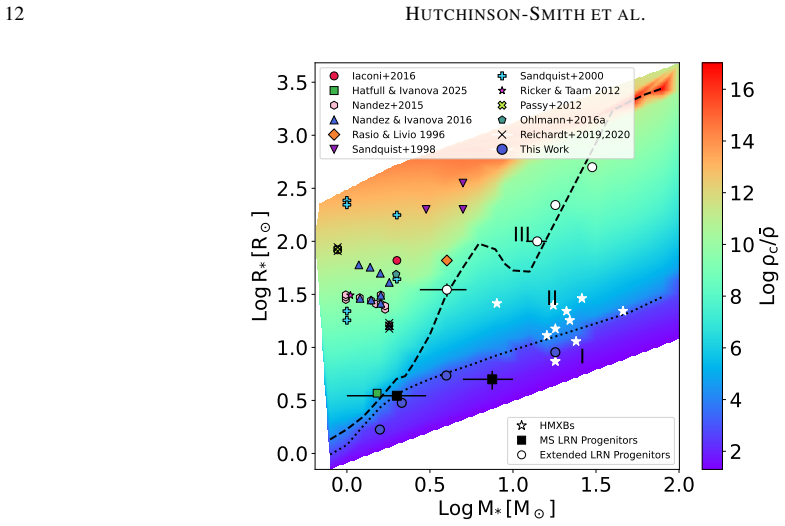
The chosen range of mass ratios and central density concentrations in the simulations adequately captures the internal structures of real mildly evolved donors that produce observed luminous red novae.
What would settle it
If two observed luminous red novae whose donor stars can be inferred to have nearly identical ρ_c/ρ_bar values nevertheless display clearly different light-curve timescales or ejecta-velocity distributions, the claim that this single ratio dominates the hydrodynamic outcome would be falsified.
Figures
read the original abstract
Luminous red novae trace unstable binary interactions in which common-envelope evolution can produce either a stellar merger or a surviving binary following envelope ejection. Recent population studies suggest that a substantial fraction of these systems originate from mildly evolved donors whose structures occupy an intermediate regime between simplified polytropic envelopes and highly stratified giant stars. We present a suite of three-dimensional hydrodynamic simulations of mildly evolved donors interacting with embedded companions spanning a range of mass ratios and central density concentrations. We show that the hydrodynamic evolution is strongly regulated by the donor central concentration, parameterized by the ratio $\rho_c/\bar{\rho}$. Donors with similar values of $\rho_c/\bar{\rho}$ exhibit similar inspiral morphologies and mass-ejection histories despite substantial differences in stellar mass and radius. Systems with relatively modest central concentration undergo rapid inspiral dominated by local orbital-energy deposition, while more centrally concentrated donors develop prolonged expansion-driven phases in which shocks and large-scale envelope motions redistribute deposited energy and angular momentum throughout the star. In this regime, the envelope itself becomes dynamically important in driving continued mass loss long after the rapid plunge-in phase slows. These results challenge semi-analytic models of luminous red novae that assume nearly instantaneous envelope ejection and suggest that their observed diversity may depend not only on total ejecta mass, but also on the temporal structure of the outflow.
Editorial analysis
A structured set of objections, weighed in public.
Referee Report
Summary. The manuscript presents a suite of three-dimensional hydrodynamic simulations of common-envelope interactions between mildly evolved stellar donors and embedded companions across a range of mass ratios and central density concentrations. The central claim is that hydrodynamic evolution—including inspiral morphologies and mass-ejection histories—is strongly regulated by the donor central concentration parameterized by ρ_c/ρ_bar. Donors with similar values of this ratio exhibit similar behaviors despite differences in stellar mass and radius: lower-concentration systems undergo rapid inspiral dominated by local orbital-energy deposition, while more concentrated donors develop prolonged expansion-driven phases in which shocks and envelope motions redistribute energy and angular momentum, making the envelope dynamically important for continued mass loss. These results challenge semi-analytic models assuming nearly instantaneous envelope ejection and suggest that LRN diversity depends on the temporal structure of the outflow.
Significance. If the simulation results hold under scrutiny, the work would be significant for binary evolution and luminous red novae studies. It bridges the gap between simplified polytropic and highly stratified giant-star models by focusing on the intermediate regime of mildly evolved donors, which population studies indicate are relevant for a substantial fraction of LRNs. The finding that ρ_c/ρ_bar organizes the outcomes offers a potentially useful organizing principle for generalizing across stellar structures, and the emphasis on prolonged, envelope-driven mass loss phases provides a concrete mechanism that could explain observed diversity in LRN light curves beyond total ejecta mass alone.
major comments (2)
- [Abstract and §3] Abstract and §3 (Numerical Setup): The central claim that evolution is 'strongly regulated' by ρ_c/ρ_bar and that similar ratios produce similar morphologies rests on the 3D simulation suite, yet the manuscript supplies no quantitative validation metrics, convergence tests with varying resolution, or error analysis on the reported inspiral times, mass-loss rates, or morphological classifications. This is load-bearing for the reliability of the similarity statements.
- [§4] §4 (Results): The assertion that 'donors with similar values of ρ_c/ρ_bar exhibit similar inspiral morphologies and mass-ejection histories despite substantial differences in stellar mass and radius' is presented qualitatively; specific quantitative comparisons (e.g., overlap integrals on mass-loss curves, tabulated decay timescales, or statistical measures across matched ρ_c/ρ_bar pairs at different total masses) are needed to substantiate the claim.
minor comments (2)
- [Abstract] Abstract: The mean density in the ratio ρ_c/ρ_bar should be explicitly defined on first use (e.g., as the volume-averaged density within the stellar radius) for readers unfamiliar with the parameterization.
- [§5] §5 (Discussion): The manuscript could usefully add a brief comparison table or figure overlaying the simulated mass-ejection histories against predictions from existing semi-analytic LRN models to make the challenge to those models more concrete.
Simulated Author's Rebuttal
We thank the referee for their thoughtful and constructive report. The comments correctly identify that the central claims regarding regulation by central concentration would be strengthened by additional quantitative support. We address each major comment below and commit to revisions that directly respond to the concerns raised.
read point-by-point responses
-
Referee: [Abstract and §3] Abstract and §3 (Numerical Setup): The central claim that evolution is 'strongly regulated' by ρ_c/ρ_bar and that similar ratios produce similar morphologies rests on the 3D simulation suite, yet the manuscript supplies no quantitative validation metrics, convergence tests with varying resolution, or error analysis on the reported inspiral times, mass-loss rates, or morphological classifications. This is load-bearing for the reliability of the similarity statements.
Authors: We acknowledge that the manuscript currently presents the results through qualitative descriptions supported by figures rather than explicit quantitative validation. In the revised version we will expand §3 to include resolution convergence tests performed on representative models from each central-concentration regime. These tests will report the variation in inspiral timescale and total ejected mass with grid resolution, together with estimated uncertainties on the key quantities. The added material will directly underpin the reliability of the morphological classifications and the organizing role of ρ_c/ρ_bar. revision: yes
-
Referee: [§4] §4 (Results): The assertion that 'donors with similar values of ρ_c/ρ_bar exhibit similar inspiral morphologies and mass-ejection histories despite substantial differences in stellar mass and radius' is presented qualitatively; specific quantitative comparisons (e.g., overlap integrals on mass-loss curves, tabulated decay timescales, or statistical measures across matched ρ_c/ρ_bar pairs at different total masses) are needed to substantiate the claim.
Authors: The present text relies on visual side-by-side comparisons of evolutionary tracks. To provide a more rigorous basis we will add, in the revised §4, a table of inspiral timescales, characteristic decay times, and mass-loss rates for all models, grouped by ρ_c/ρ_bar. We will also compute and report overlap integrals (or equivalent correlation measures) between the cumulative mass-loss histories of models sharing similar central concentrations but differing in total mass. These quantitative metrics will be discussed in the text to substantiate the similarity statement. revision: yes
Circularity Check
No significant circularity in derivation chain
full rationale
The paper reports results from direct 3D hydrodynamic simulations of common-envelope interactions. The central claim—that inspiral morphologies and mass-ejection histories are regulated by the parameter ρ_c/ρ_bar—is presented as an empirical outcome of those integrations across a suite of models. No equations, fitted parameters, or self-citations are invoked in the abstract or stated claim structure that would reduce the reported similarities to a definitional identity or to a prior result by the same authors. The derivation is therefore self-contained; external-validity questions about representativeness of the chosen models do not constitute internal circularity.
Axiom & Free-Parameter Ledger
free parameters (2)
- mass ratio q
- central concentration ρ_c/ρ_bar
axioms (2)
- standard math Three-dimensional hydrodynamics governed by the Euler equations with self-gravity accurately captures the envelope response on dynamical timescales.
- domain assumption Initial stellar models for mildly evolved donors can be constructed with the chosen central concentrations and remain stable until companion insertion.
Reference graph
Works this paper leans on
-
[1]
2021, A&A, 653, A134, doi: 10.1051/0004-6361/202140525
Blagorodnova, N., Klencki, J., Pejcha, O., et al. 2021, A&A, 653, A134, doi: 10.1051/0004-6361/202140525
-
[2]
2017, ApJ, 834, 107, doi: 10.3847/1538-4357/834/2/107
Blagorodnova, N., Kotak, R., Polshaw, J., et al. 2017, ApJ, 834, 107, doi: 10.3847/1538-4357/834/2/107
-
[3]
Bond, H. E., Henden, A., Levay, Z. G., et al. 2003, Natur, 422, 405, doi: 10.1038/nature01508
-
[4]
Bush, R. C., Wu, S. C., Everson, R. W., et al. 2025, ApJL, 990, L7, doi: 10.3847/2041-8213/adefde
-
[5]
Z., Pastorello, A., Fraser, M., et al
Cai, Y . Z., Pastorello, A., Fraser, M., et al. 2019, A&A, 632, L6, doi: 10.1051/0004-6361/201936749 De Marco, O., Sandquist, E. L., Mac Low, M.-M., et al. 2003, in Revista Mexicana de Astronomia y Astrofisica Conference
-
[6]
2023, ApJ, 954, 143, doi: 10.3847/1538-4357/aced97
Dori, N., Bear, E., & Soker, N. 2023, ApJ, 954, 143, doi: 10.3847/1538-4357/aced97
-
[7]
2024, ApJ, 971, 132, doi: 10.3847/1538-4357/ad595e
Ramirez-Ruiz, E. 2024, ApJ, 971, 132, doi: 10.3847/1538-4357/ad595e
-
[8]
W., MacLeod, M., De, S., Macias, P., & Ramirez-Ruiz, E
Everson, R. W., MacLeod, M., De, S., Macias, P., & Ramirez-Ruiz, E. 2020, ApJ, 899, 77, doi: 10.3847/1538-4357/aba75c
-
[9]
W., MacLeod, M., & Ramirez-Ruiz, E
Everson, R. W., MacLeod, M., & Ramirez-Ruiz, E. 2025, ApJL, 979, L11, doi: 10.3847/2041-8213/ada0ae
-
[10]
2015, A&A, 577, A130, doi: 10.1051/0004-6361/201425191
Falanga, M., Bozzo, E., Lutovinov, A., et al. 2015, A&A, 577, A130, doi: 10.1051/0004-6361/201425191
-
[11]
2000, ApJS, 131, 273, doi: 10.1086/317361
Fryxell, B., Olson, K., Ricker, P., et al. 2000, ApJS, 131, 273, doi: 10.1086/317361
-
[12]
2013, ApJ, 767, 25, doi: 10.1088/0004-637X/767/1/25
Guillochon, J., & Ramirez-Ruiz, E. 2013, ApJ, 767, 25, doi: 10.1088/0004-637X/767/1/25
-
[13]
2009, ApJ, 705, 844, doi: 10.1088/0004-637X/705/1/844
Guillochon, J., Ramirez-Ruiz, E., Rosswog, S., & Kasen, D. 2009, ApJ, 705, 844, doi: 10.1088/0004-637X/705/1/844
-
[14]
Hutchinson-Smith, T., Everson, R. W., Twum, A. A., et al. 2024, ApJ, 977, 196, doi: 10.3847/1538-4357/ad88f3
-
[15]
2017, MNRAS, 464, 4028, doi: 10.1093/mnras/stw2569
Iaconi, R., De Marco, O., Passy, J.-C., et al. 2017, MNRAS, 464, 4028, doi: 10.1093/mnras/stw2569
-
[16]
2018, MNRAS, 477, 3409, doi: 10.1093/mnras/sty825
Iaconi, R., De Marco, O., Reichardt, T., et al. 2018, MNRAS, 477, 3409, doi: 10.1093/mnras/sty825
-
[17]
Iben, I. J., & Livio, M. 1993, PASP, 105, 1373, doi: 10.1086/133321
-
[18]
2011, ApJL, 731, L36, doi: 10.1088/2041-8205/731/2/L36
Ivanova, N., & Chaichenets, S. 2011, ApJL, 731, L36, doi: 10.1088/2041-8205/731/2/L36
-
[19]
Ivanova, N., Justham, S., Avendano Nandez, J. L., & Lombardi, J. C. 2013a, Science, 339, 433, doi: 10.1126/science.1225540
-
[20]
2013b, A&A Rv, 21, 59, doi: 10.1007/s00159-013-0059-2
Ivanova, N., Justham, S., Chen, X., et al. 2013b, A&A Rv, 21, 59, doi: 10.1007/s00159-013-0059-2
-
[21]
Jermyn, A. S., Bauer, E. B., Schwab, J., et al. 2023, ApJS, 265, 15, doi: 10.3847/1538-4365/acae8d
-
[22]
Red novae, their progenitors, and remnants
Kaminski, T., & Blagorodnova, N. 2026, arXiv e-prints, arXiv:2605.17005. https://arxiv.org/abs/2605.17005
work page internal anchor Pith review Pith/arXiv arXiv 2026
-
[23]
Klencki, J., Nelemans, G., Istrate, A. G., & Chruslinska, M. 2021, A&A, 645, A54, doi: 10.1051/0004-6361/202038707
-
[24]
Kulkarni, S. R., Ofek, E. O., Rau, A., et al. 2007, Natur, 447, 458, doi: 10.1038/nature05822
-
[25]
A., Pessev, P., Tomov, T., et al
Kurtenkov, A. A., Pessev, P., Tomov, T., et al. 2015, A&A, 578, L10, doi: 10.1051/0004-6361/201526564
-
[26]
Lau, M. Y . M., Hirai, R., Price, D. J., & Mandel, I. 2022, MNRAS, 512, 4665, doi: 10.1093/mnras/stac049
-
[27]
2019, ApJL, 882, L25, doi: 10.3847/2041-8213/ab379a
Law-Smith, J., Guillochon, J., & Ramirez-Ruiz, E. 2019, ApJL, 882, L25, doi: 10.3847/2041-8213/ab379a
-
[28]
2017, ApJ, 841, 132, doi: 10.3847/1538-4357/aa6ffb
Ramirez-Ruiz, E. 2017, ApJ, 841, 132, doi: 10.3847/1538-4357/aa6ffb
-
[29]
2020, ApJ, 905, 141, doi: 10.3847/1538-4357/abc489
Ramirez-Ruiz, E. 2020, ApJ, 905, 141, doi: 10.3847/1538-4357/abc489
-
[30]
2025, ApJ, 979, 40, doi: 10.3847/1538-4357/ad9b0b
Liu, C., Yarza, R., & Ramirez-Ruiz, E. 2025, ApJ, 979, 40, doi: 10.3847/1538-4357/ad9b0b
-
[31]
1988, ApJ, 329, 764, doi: 10.1086/166419
Livio, M., & Soker, N. 1988, ApJ, 329, 764, doi: 10.1086/166419
-
[32]
2017a, ApJ, 838, 56, doi: 10.3847/1538-4357/aa6117
Ramirez-Ruiz, E. 2017a, ApJ, 838, 56, doi: 10.3847/1538-4357/aa6117
-
[33]
2022, ApJ, 937, 96, doi: 10.3847/1538-4357/ac8c31
MacLeod, M., De, K., & Loeb, A. 2022, ApJ, 937, 96, doi: 10.3847/1538-4357/ac8c31
-
[34]
2012, ApJ, 757, 134, doi: 10.1088/0004-637X/757/2/134 14 HUTCHINSON-SMITH ET AL
MacLeod, M., Guillochon, J., & Ramirez-Ruiz, E. 2012, ApJ, 757, 134, doi: 10.1088/0004-637X/757/2/134 14 HUTCHINSON-SMITH ET AL
-
[35]
2017b, ApJ, 835, 282, doi: 10.3847/1538-4357/835/2/282
MacLeod, M., Macias, P., Ramirez-Ruiz, E., et al. 2017b, ApJ, 835, 282, doi: 10.3847/1538-4357/835/2/282
-
[36]
MacLeod, M., Ostriker, E. C., & Stone, J. M. 2018, ApJ, 863, 5, doi: 10.3847/1538-4357/aacf08
-
[37]
2015, ApJ, 803, 41, doi: 10.1088/0004-637X/803/1/41
MacLeod, M., & Ramirez-Ruiz, E. 2015, ApJ, 803, 41, doi: 10.1088/0004-637X/803/1/41
-
[38]
2025, arXiv e-prints, arXiv:2506.02316, doi: 10.48550/arXiv.2506.02316
Mandel, I., Riley, J., Boesky, A., et al. 2025, arXiv e-prints, arXiv:2506.02316, doi: 10.48550/arXiv.2506.02316
-
[39]
Martini, P., Wagner, R. M., Tomaney, A., et al. 1999, AJ, 118, 1034, doi: 10.1086/300951
-
[41]
Matsumoto, T., & Metzger, B. D. 2022, The Astrophysical Journal, 938, 5, doi: 10.3847/1538-4357/ac6269
-
[42]
2002, A&A, 389, L51, doi: 10.1051/0004-6361:20020715
Munari, U., Henden, A., Kiyota, S., et al. 2002, A&A, 389, L51, doi: 10.1051/0004-6361:20020715
-
[43]
Nandez, J. L. A., & Ivanova, N. 2016, MNRAS, 460, 3992, doi: 10.1093/mnras/stw1266
-
[44]
Nandez, J. L. A., Ivanova, N., & Lombardi, J. C. 2015, ApJ, 806, 170, doi: 10.1088/0004-637X/806/2/170
-
[45]
Ohlmann, S. T., R¨opke, F. K., Pakmor, R., Springel, V ., & M¨uller, E. 2016, ApJL, 816, L9, doi: 10.3847/2041-8205/816/1/L9 OpenAI. 2025, Introducing Codex. https://openai.com/index/introducing-codex/
-
[46]
1976, in IAU Symposium, V ol
Paczynski, B. 1976, in IAU Symposium, V ol. 73, Structure and Evolution of Close Binary Systems, ed. P. Eggleton, S. Mitton, & J. Whelan, 75
1976
-
[47]
Passy, J.-C., De Marco, O., Fryer, C. L., et al. 2012, ApJ, 744, 52, doi: 10.1088/0004-637X/744/1/52
-
[48]
2019b, A&A, 630, A75, doi: 10.1051/0004-6361/201935999
Pastorello, A., Mason, E., Taubenberger, S., et al. 2019b, A&A, 630, A75, doi: 10.1051/0004-6361/201935999
-
[49]
Pavlovskii, K., Ivanova, N., Belczynski, K., & Van, K. X. 2017, MNRAS, 465, 2092, doi: 10.1093/mnras/stw2786
-
[50]
2011, ApJS, 192, 3, doi: 10.1088/0067-0049/192/1/3
Paxton, B., Bildsten, L., Dotter, A., et al. 2011, ApJS, 192, 3, doi: 10.1088/0067-0049/192/1/3
-
[51]
Paxton, B., Cantiello, M., Arras, P., et al. 2013, ApJS, 208, 4, doi: 10.1088/0067-0049/208/1/4
work page internal anchor Pith review doi:10.1088/0067-0049/208/1/4 2013
-
[52]
Modules for Experiments in Stellar Astrophysics (MESA): Binaries, Pulsations, and Explosions
Paxton, B., Marchant, P., Schwab, J., et al. 2015, ApJS, 220, 15, doi: 10.1088/0067-0049/220/1/15
work page internal anchor Pith review doi:10.1088/0067-0049/220/1/15 2015
-
[53]
2019, ApJS, 243, 10, doi: 10.3847/1538-4365/ab2241
Paxton, B., Smolec, R., Schwab, J., et al. 2019, ApJS, 243, 10, doi: 10.3847/1538-4365/ab2241
-
[54]
Paxton, B., Schwab, J., Bauer, E. B., et al. 2018, ApJS, 234, 34, doi: 10.3847/1538-4365/aaa5a8
work page internal anchor Pith review doi:10.3847/1538-4365/aaa5a8 2018
-
[55]
2001, in Astrophysics and Space Science Library, V ol
Podsiadlowski, P., Rappaport, S., & Pfahl, E. 2001, in Astrophysics and Space Science Library, V ol. 264, The Influence of Binaries on Stellar Population Studies, ed. D. Vanbeveren, 355, doi: 10.1007/978-94-015-9723-4 26
-
[56]
N., Covarrubias, R., & Ramirez-Ruiz, E
Quinteros, K. N., Covarrubias, R., & Ramirez-Ruiz, E. 2025, Nature Astronomy, 9, 1770, doi: 10.1038/s41550-025-02736-y
-
[57]
Rasio, F. A., & Livio, M. 1996, ApJ, 471, 366, doi: 10.1086/177973
-
[58]
Reichardt, T. A., Marco, O. D., Iaconi, R., Chamandy, L., & Price, D. J. 2020, MNRAS, 494, 5333, doi: 10.1093/mnras/staa937
-
[59]
Reichardt, T. A., Marco, O. D., Iaconi, R., Tout, C. A., & Price, D. J. 2019, MNRAS, 484, 631, doi: 10.1093/mnras/sty3485
-
[61]
Ricker, P. M., & Taam, R. E. 2012, ApJ, 746, 74, doi: 10.1088/0004-637X/746/1/74
-
[62]
Riley, J., Agrawal, P., Barrett, J. W., et al. 2022, ApJS, 258, 34, doi: 10.3847/1538-4365/ac416c R¨opke, F. K., & De Marco, O. 2023, Living Reviews in Computational Astrophysics, 9, 2, doi: 10.1007/s41115-023-00017-x
-
[63]
2024, ApJ, 977, 16, doi: 10.3847/1538-4357/ad84ee
Rosselli-Calderon, A., Yarza, R., Murguia-Berthier, A., et al. 2024, ApJ, 977, 16, doi: 10.3847/1538-4357/ad84ee
-
[64]
Sana, H., de Mink, S. E., de Koter, A., et al. 2012, Science, 337, 444, doi: 10.1126/science.1223344
-
[65]
Sandquist, E. L., Taam, R. E., & Chen, X. 2000, New Astronomy, 4, 313, doi: 10.1016/S1384-1076(99)00076-4
-
[66]
1998, ApJ, 500, 909, doi: 10.1086/305774
Burkert, A. 1998, ApJ, 500, 909, doi: 10.1086/305774
-
[67]
Smith, N., Andrews, J. E., Dyk, S. D. V ., et al. 2016, MNRAS, 458, 950, doi: 10.1093/mnras/stw219
-
[68]
E., Phinney, E
Soberman, G. E., Phinney, E. S., & van den Heuvel, E. P. J. 1997, A&A, 327, 620
1997
-
[69]
2015, ApJ, 800, 114, doi: 10.1088/0004-637X/800/2/114 —
Soker, N. 2015, ApJ, 800, 114, doi: 10.1088/0004-637X/800/2/114 —. 2024, Galaxies, 12, 33, doi: 10.3390/galaxies12040033
-
[70]
2003, ApJL, 582, L105, doi: 10.1086/367759
Soker, N., & Tylenda, R. 2003, ApJL, 582, L105, doi: 10.1086/367759
-
[71]
2017, Nature Communications, 8, 14906, doi: 10.1038/ncomms14906
Stevenson, S., Vigna-G´omez, A., Mandel, I., et al. 2017, Nature Communications, 8, 14906, doi: 10.1038/ncomms14906
-
[72]
D., Taddia, F., Fraser, M., et al
Stritzinger, M. D., Taddia, F., Fraser, M., et al. 2020, A&A, 639, A104, doi: 10.1051/0004-6361/202038019
-
[73]
E., Bodenheimer, P., & Ostriker, J
Taam, R. E., Bodenheimer, P., & Ostriker, J. P. 1978, ApJ, 222, 269, doi: 10.1086/156142
-
[74]
Timmes, F. X., & Swesty, F. D. 2000, ApJS, 126, 501, doi: 10.1086/313304
-
[75]
Twum, A. A. G., Vigna-G´omez, A., MacLeod, M., et al. 2026, arXiv e-prints, arXiv:2602.10211, doi: 10.48550/arXiv.2602.10211
-
[76]
2011, A&A, 528, A114, doi: 10.1051/0004-6361/201016221
Tylenda, R., Hajduk, M., Kami´nski, T., et al. 2011, A&A, 528, A114, doi: 10.1051/0004-6361/201016221
-
[77]
Webbink, R. F. 1984, ApJ, 277, 355, doi: 10.1086/161701
-
[78]
2020, ApJ, 901, 44, doi: 10.3847/1538-4357/abaf48
Ramirez-Ruiz, E. 2020, ApJ, 901, 44, doi: 10.3847/1538-4357/abaf48
-
[79]
B., Murguia-Berthier, A., et al
Yarza, R., Razo-L´opez, N. B., Murguia-Berthier, A., et al. 2023, ApJ, 954, 176, doi: 10.3847/1538-4357/acbdfc
discussion (0)
Sign in with ORCID, Apple, or X to comment. Anyone can read and Pith papers without signing in.