Information-theoretic Multimodal Representation Learning for Electrocardiogram Signals
Pith reviewed 2026-06-29 18:29 UTC · model grok-4.3
The pith
MERIT derives a tractable information-theoretic objective for ECG representations that preserves physiological structure while integrating clinical semantics from reports.
A machine-rendered reading of the paper's core claim, the machinery that carries it, and where it could break.
Core claim
By deriving a tractable information-theoretic objective that jointly preserves the rich physiological structure of ECG waveforms across multiple abstraction levels and integrates clinical semantics, the dual-branch MERIT framework produces representations that outperform prior methods on PTB-XL All and SubClass tasks by more than 3% and 5% F1 respectively, with additional gains in zero-shot AUC and robustness under distribution shift.
What carries the argument
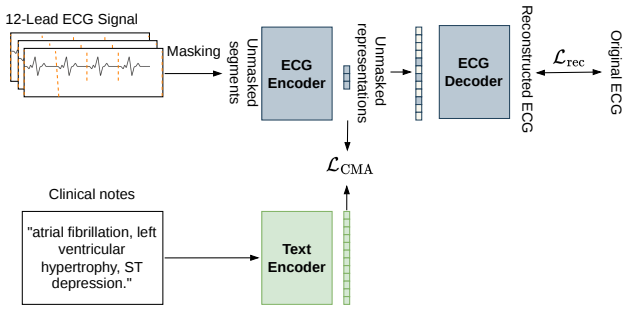
The tractable information-theoretic objective that jointly preserves signal structure at multiple levels while integrating clinical semantics, implemented via a dual-branch pretraining framework of masked ECG modeling and ECG-text contrastive alignment.
If this is right
- Consistent outperformance on fine-grained ECG classification tasks such as PTB-XL SubClass.
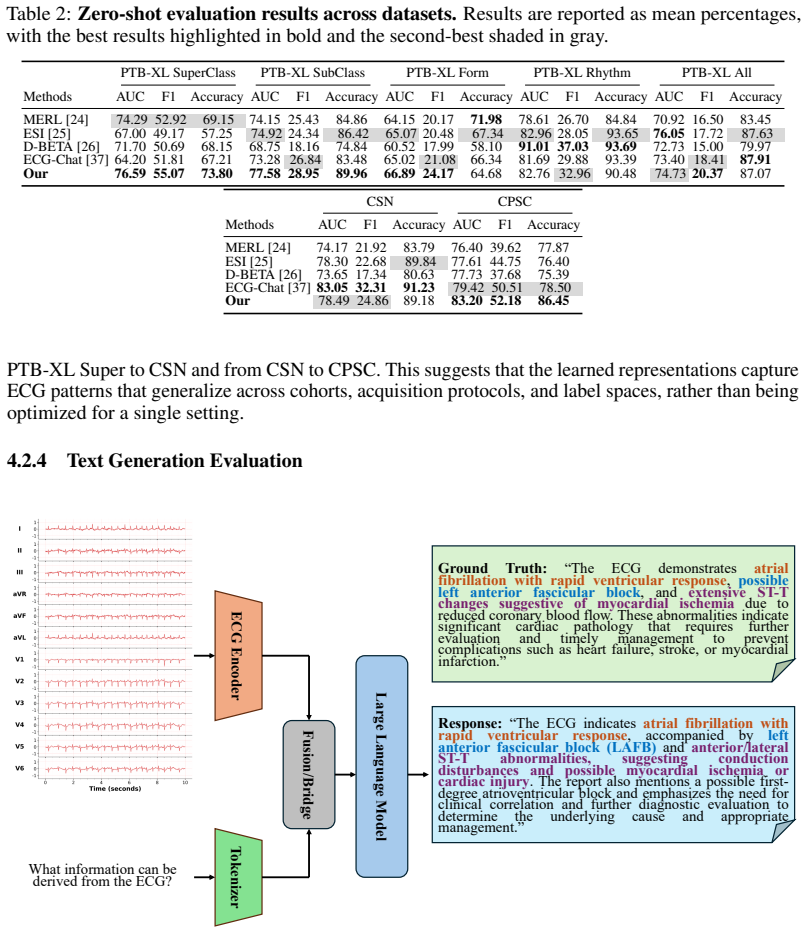
- Improved zero-shot performance up to +2.66% AUC and +2.11% F1 on PTB-XL SubClass.
- Greater robustness across multiple distribution-shift settings.
- Higher quality ECG-conditioned clinical text generation measured by ROUGE and METEOR.
Where Pith is reading between the lines
- The same objective could be tested on other time-series biosignals where accompanying text is similarly incomplete.
- If the objective remains tractable at scale, it might reduce reliance on large paired datasets for other medical modalities.
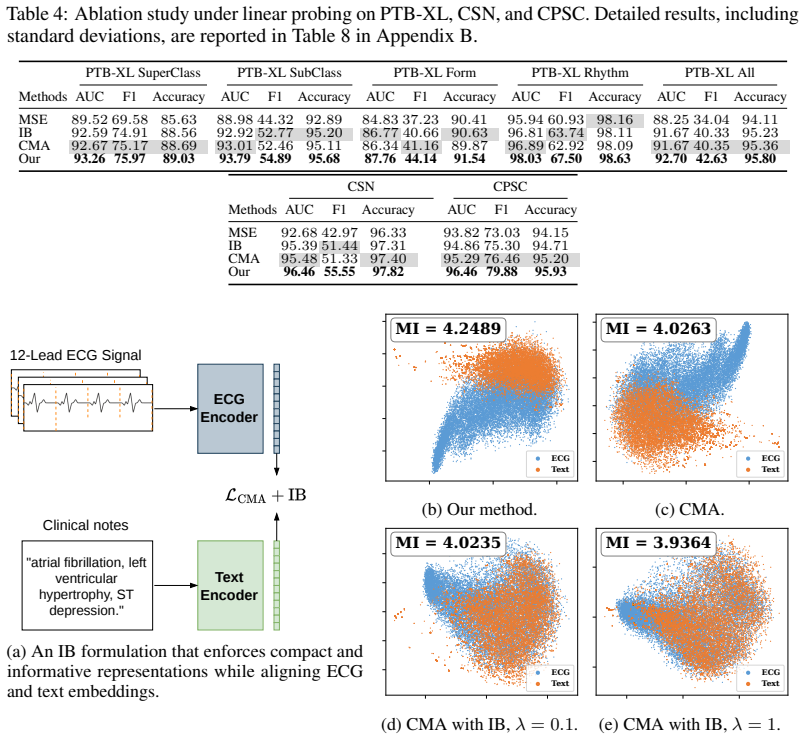
- The dual-branch design invites direct comparison against single-branch contrastive or masked-only baselines on the same data.
Load-bearing premise
A tractable information-theoretic objective can be derived that jointly preserves the rich physiological structure of ECG waveforms across multiple abstraction levels while integrating clinical semantics from reports that often fail to preserve that structure.
What would settle it
Reproducing the PTB-XL experiments and failing to observe gains exceeding 3% F1 on All classification or 2.66% AUC in zero-shot SubClass settings would falsify the claim that the derived objective yields more informative representations.
Figures
read the original abstract
Electrocardiograms (ECGs) are widely used non-invasive measurements of cardiac activity and play a central role in clinical diagnosis. Recent multimodal approaches align ECG signals with clinical reports to incorporate diagnostic semantics, but clinical reports often fail to preserve the rich physiological structure of ECG waveforms, particularly across multiple levels of abstraction ranging from coarse diagnostic categories to fine-grained morphology. To address this limitation, we formulate ECG representation learning from an information-theoretic perspective and derive a tractable objective that jointly preserves signal structure and integrates clinical semantics. Based on this principle, we propose \textbf{MERIT} (Multimodal ECG Representation via Information Theory), a dual-branch pretraining framework combining masked ECG modeling with ECG--text contrastive alignment. Extensive experiments on PTB-XL and additional benchmarks demonstrate consistent improvements over prior methods, including gains exceeding $3%$ F1 on PTB-XL All and $5%$ F1 on SubClass classification. In zero-shot evaluation, MERIT further improves performance by up to $ +2.66\%$ AUC and $ +2.11\%$ F1 on PTB-XL SubClass, while also demonstrating robustness under multiple distribution-shift settings. Moreover, leveraging the learned ECG representations for ECG-conditioned clinical text generation with large language models improves text quality across several metrics, including ROUGE and METEOR. Together, these results demonstrate that MERIT learns more informative and clinically meaningful ECG representations, particularly for fine-grained clinical applications.
Editorial analysis
A structured set of objections, weighed in public.
Referee Report
Summary. The paper claims that clinical reports often fail to capture fine-grained ECG waveform structure across abstraction levels, and addresses this by deriving a tractable information-theoretic objective for joint signal-structure preservation (via masked modeling) and semantic alignment (via contrastive ECG-text learning). It proposes the MERIT dual-branch framework and reports consistent gains over baselines on PTB-XL (exceeding 3% F1 on All classification, 5% F1 on SubClass) plus up to +2.66% AUC in zero-shot settings, robustness under distribution shift, and improved ECG-conditioned text generation metrics.
Significance. If the central derivation is sound and the empirical gains are attributable to the proposed objective rather than implementation details, the work would offer a principled multimodal approach to ECG representation learning that explicitly targets the mismatch between report semantics and waveform morphology. The combination of masked modeling with contrastive alignment, together with the reported improvements in fine-grained and zero-shot tasks, could influence downstream clinical applications and LLM-based text generation from ECGs.
major comments (2)
- [Abstract] Abstract: the central claim rests on a tractable information-theoretic objective that jointly preserves ECG waveform structure across multiple abstraction levels while aligning to clinical reports; yet the abstract itself states that those reports often fail to preserve the very structure to be preserved. No derivation is supplied showing how the mutual-information terms recover or enforce missing morphological details without circularity or additional inductive biases.
- [Abstract] Abstract: the reported gains (e.g., >3% F1 on PTB-XL All, >5% F1 on SubClass, +2.66% AUC zero-shot) are presented without reference to specific baselines, ablation controls, or error analysis that would establish attribution to the information-theoretic objective versus standard masked modeling or contrastive components.
minor comments (1)
- [Abstract] The abstract uses the term 'parameter-free' in describing the objective but supplies no supporting equations or definitions; any such claim should be accompanied by explicit notation.
Simulated Author's Rebuttal
We thank the referee for the constructive comments. We address each major point below, clarifying the information-theoretic derivation and experimental attribution while proposing targeted revisions to the abstract.
read point-by-point responses
-
Referee: [Abstract] Abstract: the central claim rests on a tractable information-theoretic objective that jointly preserves ECG waveform structure across multiple abstraction levels while aligning to clinical reports; yet the abstract itself states that those reports often fail to preserve the very structure to be preserved. No derivation is supplied showing how the mutual-information terms recover or enforce missing morphological details without circularity or additional inductive biases.
Authors: The abstract is a high-level summary; the full derivation appears in Section 3. The objective decomposes into two independent terms: (i) a masked modeling loss that maximizes mutual information between observed and masked ECG segments to preserve waveform structure at multiple abstraction levels without any dependence on reports, and (ii) a contrastive term that aligns the resulting representations to report semantics. Because structure preservation is achieved solely through the signal reconstruction pathway, the approach avoids circularity; reports supply complementary semantics rather than the morphological details themselves. We will revise the abstract to explicitly separate these two mechanisms. revision: partial
-
Referee: [Abstract] Abstract: the reported gains (e.g., >3% F1 on PTB-XL All, >5% F1 on SubClass, +2.66% AUC zero-shot) are presented without reference to specific baselines, ablation controls, or error analysis that would establish attribution to the information-theoretic objective versus standard masked modeling or contrastive components.
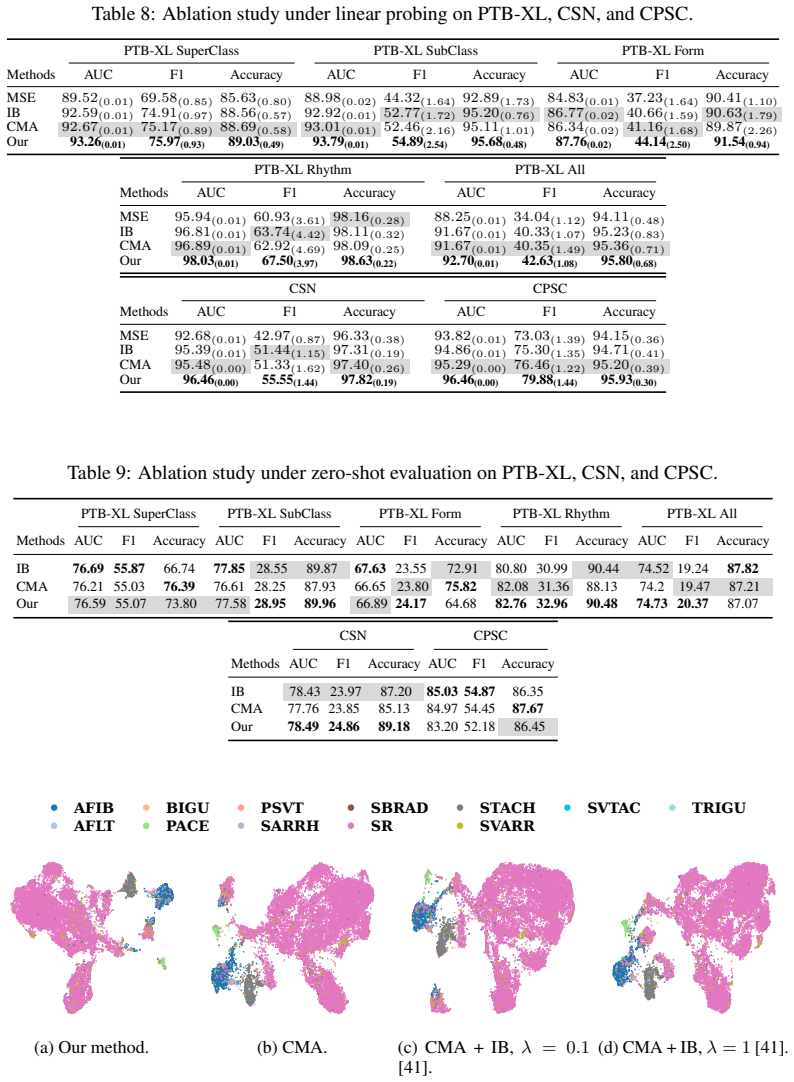
Authors: The main text (Sections 4 and 5) provides comparisons against the exact baselines referenced in the referee summary, together with ablations that isolate the contribution of the joint objective and error analysis across distribution-shift settings. To improve clarity we will augment the abstract with a concise reference to the primary baselines and note that full controls appear in the experimental section. revision: yes
Circularity Check
No circularity identified; derivation presented as independent information-theoretic construction
full rationale
The abstract states that the authors formulate representation learning from an information-theoretic perspective and derive a tractable objective jointly preserving signal structure via masked modeling and integrating semantics via contrastive alignment. No equations are visible that reduce this objective to fitted parameters, self-definitions, or prior self-citations by construction. The dual-branch MERIT framework is introduced as following from the derived principle rather than presupposing its outputs. No load-bearing self-citation chains, ansatz smuggling, or renaming of known results are exhibited in the provided text. The central claim therefore remains self-contained against external benchmarks and does not reduce to its inputs by definition.
Axiom & Free-Parameter Ledger
Reference graph
Works this paper leans on
-
[1]
Global ECG classification by self-operational neural networks with feature injection.IEEE Transactions on Biomedical Engineering, 70(1):205 – 215, 2023
Muhammad Uzair Zahid, Serkan Kiranyaz, and Moncef Gabbouj. Global ECG classification by self-operational neural networks with feature injection.IEEE Transactions on Biomedical Engineering, 70(1):205 – 215, 2023
2023
-
[2]
Le et al
Khiem H. Le et al. LightX3ECG: A lightweight and explainable deep learning system for 3-lead electrocardiogram classification.Biomedical Signal Processing and Control, 85, 2023
2023
-
[3]
G2-resNeXt: A novel model for ECG signal classification.IEEE Access, 11:34808 – 34820, 2023
Shengnan Hao et al. G2-resNeXt: A novel model for ECG signal classification.IEEE Access, 11:34808 – 34820, 2023
2023
-
[4]
A new approach of transparent and explainable artificial intelligence technique for patient-specific ECG beat classification.IEEE Sensors Letters, 7(5), 2023
Allam Jaya Prakash et al. A new approach of transparent and explainable artificial intelligence technique for patient-specific ECG beat classification.IEEE Sensors Letters, 7(5), 2023
2023
-
[5]
A dual-scale lead-separated transformer for ECG classification
Yang Li et al. A dual-scale lead-separated transformer for ECG classification. InAnnual International Conference of the IEEE Engineering in Medicine & Biology Society (EMBC). IEEE, 2023
2023
-
[6]
A multi-resolution mutual learning network for multi-label ECG classification
Wei Huang et al. A multi-resolution mutual learning network for multi-label ECG classification. InInternational Conference on Bioinformatics and Biomedicine (BIBM). IEEE, 2024
2024
-
[7]
ECGTransForm: Empowering adaptive ECG arrhyth- mia classification framework with bidirectional transformer.Biomedical Signal Processing and Control, 89, 2024
Hany El-Ghaish and Emadeldeen Eldele. ECGTransForm: Empowering adaptive ECG arrhyth- mia classification framework with bidirectional transformer.Biomedical Signal Processing and Control, 89, 2024
2024
-
[8]
arXiv preprint arXiv:2411.00755 (2024)
Xiaoya Tang, Jake Berquist, Benjamin A. Steinberg, and Tolga Tasdizen. Hierarchical trans- former for electrocardiogram diagnosis, 2025. URL https://arxiv.org/abs/2411.00755
-
[9]
BaT: Beat-aligned transformer for electrocardiogram classification
Xiaoyu Li et al. BaT: Beat-aligned transformer for electrocardiogram classification. InInterna- tional Conference on Data Mining (ICDM). IEEE, 2021
2021
-
[10]
Han, Gautham Raghupathi, Andrew Y
Bryan Gopal, Ryan W. Han, Gautham Raghupathi, Andrew Y . Ng, Geoffrey H. Tison, and Pranav Rajpurkar. 3KG: Contrastive learning of 12-lead electrocardiograms using physiologically- inspired augmentations. InAdvances in Neural Information Processing Systems (NeurIPS), 2021
2021
-
[11]
Dani Kiyasseh, Tingting Zhu, and David A. Clifton. CLOCS: Contrastive learning of cardiac signals across space, time, and patients. InInternational Conference on Machine Learning (ICML), 2021
2021
-
[12]
Wei, Ming-En Hsieh, Chien-Liang Liu, and Vincent S
Crystal T. Wei, Ming-En Hsieh, Chien-Liang Liu, and Vincent S. Tseng. Contrastive heart- beats: Contrastive learning for self-supervised ECG representation and phenotyping. InIEEE International Conference on Acoustics, Speech and Signal Processing (ICASSP), 2022
2022
-
[13]
Pritam Sarkar and Ali Etemad. Self-supervised ecg representation learning for emotion recognition.IEEE Transactions on Affective Computing, 13(3):1541–1554, 2022. doi: 10.1109/TAFFC.2020.3014842
-
[14]
Analysis of augmentations for contrastive ECG representation learning
Sahar Soltanieh, Ali Etemad1, and Javad Hashem. Analysis of augmentations for contrastive ECG representation learning. InInternational Joint Conference on Neural Networks (IJCNN), 2022
2022
-
[15]
Zhang Huaicheng et al. MaeFE: Masked autoencoders family of electrocardiogram for self- supervised pretraining and transfer learning.IEEE Transactions on Instrumentation and Measurement, 72:1–15, 2022. doi: 10.1109/TIM.2022.3228267
-
[16]
Zhang Wenrui, Yang Ling, Geng Shijia, and Hong Shenda. Self-supervised time series repre- sentation learning via cross reconstruction transformer.IEEE Transactions on Neural Networks and Learning Systems, 35(11):16129–16138, 2024. doi: 10.1109/TNNLS.2023.3292066
-
[17]
Guiding masked representa- tion learning to capture spatio-temporal relationship of electrocardiogram
Yeongyeon Na, Minje Park, Yunwon Tae, and Sunghoon Joo. Guiding masked representa- tion learning to capture spatio-temporal relationship of electrocardiogram. InInternational Conference on Learning Representations (ICLR), 2024. 11
2024
-
[18]
Reading your heart: Learning ecg words and sentences via pre-training ECG language model
Jiarui Jin et al. Reading your heart: Learning ecg words and sentences via pre-training ECG language model. InInternational Conference on Learning Representations (ICLR), 2025
2025
-
[19]
Sehun Kim. Learning general representation of 12-lead electrocardiogram with a joint- embedding predictive architecture, 2024. URLhttps://arxiv.org/pdf/2410.08559
work page internal anchor Pith review Pith/arXiv arXiv 2024
- [20]
-
[21]
Nguyen et al
Phu X. Nguyen et al. ECG-Soup: Harnessing multi-layer synergy for ECG foundation models,
- [22]
-
[23]
ECG-FM: An open electrocardiogram foundation model, 2025
Kaden McKeen, Sameer Masood, Augustin Toma, Barry Rubin, and Bo Wang. ECG-FM: An open electrocardiogram foundation model, 2025. URL https://arxiv.org/pdf/2408. 05178
2025
-
[24]
Frozen language model helps ECG Zero-Shot Learning
Jun Li, Che Liu, Sibo Cheng, Rossella Arcucci, and Shenda Hong. Frozen language model helps ECG Zero-Shot Learning. InMedical Imaging with Deep Learning (MIDL), 2023
2023
-
[25]
Zero-shot ECG classification with multimodal learning and test-time clinical knowledge enhancement
Che Liu et al. Zero-shot ECG classification with multimodal learning and test-time clinical knowledge enhancement. InInternational Conference on Machine Learning (ICML), 2024
2024
-
[26]
ECG semantic integrator (ESI): A foundation ECG model pretrained with LLM-enhanced cardiological text.Transactions on Machine Learning Research,
Han Yu, Peikun Guo, and Akane Sano. ECG semantic integrator (ESI): A foundation ECG model pretrained with LLM-enhanced cardiological text.Transactions on Machine Learning Research,
-
[27]
URLhttps://openreview.net/forum?id=giEbq8Khcf
ISSN 2835-8856. URLhttps://openreview.net/forum?id=giEbq8Khcf
-
[28]
Boosting masked ECG-text auto-encoders as discriminative learners
Hung Manh Pham, Aaqib Saeed, and Dong Ma. Boosting masked ECG-text auto-encoders as discriminative learners. InInternational Conference on Machine Learning (ICML), 2025
2025
-
[29]
From token to rhythm: A multi-scale approach for ECG-language pretraining
Fuying Wang, Jiacheng Xu, and Lequan Yu. From token to rhythm: A multi-scale approach for ECG-language pretraining. InInternational Conference on Machine Learning (ICML), 2025
2025
-
[30]
Pereira, and William Bialek
Naftali Tishby, Fernando C. Pereira, and William Bialek. The information bottleneck method,
-
[31]
URLhttps://arxiv.org/abs/physics/0004057
work page internal anchor Pith review Pith/arXiv arXiv
-
[32]
Deep learning and the information bottleneck principle,
Naftali Tishby and Noga Zaslavsky. Deep learning and the information bottleneck principle,
-
[33]
URLhttps://arxiv.org/abs/1503.02406
work page internal anchor Pith review Pith/arXiv arXiv
-
[34]
Learning deep representations by mutual information estimation and maximization
R Devon Hjelm et al. Learning deep representations by mutual information estimation and maximization. InInternational Conference on Learning Representations (ICLR), 2019
2019
-
[35]
PDMX: A large-scale public domain MusicXML dataset for symbolic music processing
Chang Lele, Liu Peilin, Guo Qinghai, and Wen Fei. Explicit mutual information maximization for self-supervised learning. InIEEE International Conference on Acoustics, Speech and Signal Processing (ICASSP), 2025. doi: 10.1109/ICASSP49660.2025.10890783
-
[36]
A simple framework for contrastive learning of visual representations
Ting Chen, Simon Kornblith, Mohammad Norouzi, and Geoffrey Hinton. A simple framework for contrastive learning of visual representations. InInternational Conference on Machine Learning (ICML). PMLR, 2020
2020
-
[37]
Representation Learning with Contrastive Predictive Coding
Aaron van den Oord, Yazhe Li, and Oriol Vinyals. Representation learning with contrastive predictive coding, 2019. URLhttps://arxiv.org/abs/1807.03748
work page internal anchor Pith review Pith/arXiv arXiv 2019
-
[38]
Self-supervised representation learning from 12-lead ECG data.Computers in Biology and Medicine, 141, 2022
Temesgen Mehari and Nils Strodthoff. Self-supervised representation learning from 12-lead ECG data.Computers in Biology and Medicine, 141, 2022
2022
-
[39]
Towards enhancing time series contrastive learning: A dynamic bad pair mining approach
Xiang Lan, Hanshu Yan, Shenda Hong, and Mengling Feng. Towards enhancing time series contrastive learning: A dynamic bad pair mining approach. InInternational Conference on Machine Learning (ICML). PMLR, 2024
2024
-
[40]
Rosenberg, Emerson Liu, and Ding Zhao
William Han, Chaojing Duan, Michael A. Rosenberg, Emerson Liu, and Ding Zhao. ECG- Byte: A tokenizer for end-to-end generative electrocardiogram language modeling, 2025. URL https://arxiv.org/abs/2412.14373. 12
-
[41]
ECG-Chat: A large ECG- language model for cardiac disease diagnosis
Zhao Yubao, Kang Jiaju, Zhang Tian, Han Puyu, and Chen Tong. ECG-Chat: A large ECG- language model for cardiac disease diagnosis. InIEEE International Conference on Multimedia and Expo (ICME), pages 1–6, 2025. doi: 10.1109/ICME59968.2025.11209476
-
[42]
Med-R1: Reinforcement learning for generalizable medical reasoning in vision-language models, 2025
Yuxiang Lai, Jike Zhong, Ming Li, Shitian Zhao, and Xiaofeng Yang. Med-R1: Reinforcement learning for generalizable medical reasoning in vision-language models, 2025. URL https: //arxiv.org/abs/2503.13939
-
[43]
QoQ-Med: Building multi- modal clinical foundation models with domain-aware GRPO training
Wei Dai, Peilin Chen, Chanakya Ekbote, and Paul Pu Liang. QoQ-Med: Building multi- modal clinical foundation models with domain-aware GRPO training. InAdvances in Neural Information Processing Systems (NeurIPS), 2025
2025
-
[44]
The im algorithm: a variational approach to information maximization
David Barber and Felix Agakov. The im algorithm: a variational approach to information maximization. InProceedings of the 17th International Conference on Neural Information Processing Systems, NIPS’03, page 201–208, Cambridge, MA, USA, 2003. MIT Press
2003
-
[45]
Aligning multimodal representations through an information bottleneck
Antonio Almudévar, José Miguel Hernández-Lobato, Sameer Khurana, Ricard Marxer, and Alfonso Ortega. Aligning multimodal representations through an information bottleneck. In International Conference on Machine Learning (ICML), 2025
2025
-
[46]
Qiao Jin et al. MedCPT: Contrastive pre-trained transformers with large-scale pubmed search logs for zero-shot biomedical information retrieval.Bioinformatics, 39(11), November 2023. ISSN 1367-4811. doi: 10.1093/bioinformatics/btad651. URL http://dx.doi.org/10. 1093/bioinformatics/btad651
-
[47]
MIMIC-IV-ECG: Diagnostic Electrocardiogram Matched Subset.PhysioNet, September 2023
Brian Gow et al. MIMIC-IV-ECG: Diagnostic Electrocardiogram Matched Subset.PhysioNet, September 2023. doi: 10.13026/4nqg-sb35. URL https://doi.org/10.13026/4nqg-sb35. Version 1.0
-
[48]
PTB-XL, a large publicly available electrocardiography dataset.PhysioNet, November 2022
Patrick Wagner et al. PTB-XL, a large publicly available electrocardiography dataset.PhysioNet, November 2022. doi: 10.13026/kfzx-aw45. URL https://doi.org/10.13026/kfzx-aw45. Version 1.0.3
-
[49]
PTB-XL, a large publicly available electrocardiography dataset.Scientific Data, 7(1), 2020
Patrick Wagner et al. PTB-XL, a large publicly available electrocardiography dataset.Scientific Data, 7(1), 2020
2020
-
[50]
Eddie Y . K. Ng, Feifei Liu, Chengyu Liu, Lina Zhao, X. Zhang, Xiaoling Wu, Xiaoyan Xu, Yulin Liu, Caiyun Ma, Shoushui Wei, Zhiqiang He, and Jianqing Li. An open access database for evaluating the algorithms of electrocardiogram rhythm and morphology abnormality detection.Journal of Medical Imaging and Health Informatics, 2018. URL https://api. semanticsc...
2018
-
[51]
Optimal multi-stage arrhythmia classification approach.Scientific Reports, 2020
Jianwei Zheng et al. Optimal multi-stage arrhythmia classification approach.Scientific Reports, 2020
2020
-
[52]
atrial fibrillation, left ventricular hypertrophy, ST depression
Jianwei Zheng, Hangyuan Guo, and Huimin Chu. A large scale 12-lead electrocardiogram database for arrhythmia study.PhysioNet, August 2022. doi: 10.13026/wgex-er52. URL https://doi.org/10.13026/wgex-er52. Version 1.0.0. 13 Appendix A Implementation Details A.1 Pre-training Details We use the MIMIC-ECG dataset [43], comprising 800,035 ECG-report pairs from ...
discussion (0)
Sign in with ORCID, Apple, or X to comment. Anyone can read and Pith papers without signing in.