Electron spectra from strong-field enhanced ionization in heavy water
Pith reviewed 2026-06-29 14:12 UTC · model grok-4.3
The pith
Enhanced ionization in heavy water shows tunneling rate maximized at a critical laser field value rather than the optical cycle peak.
A machine-rendered reading of the paper's core claim, the machinery that carries it, and where it could break.
Core claim
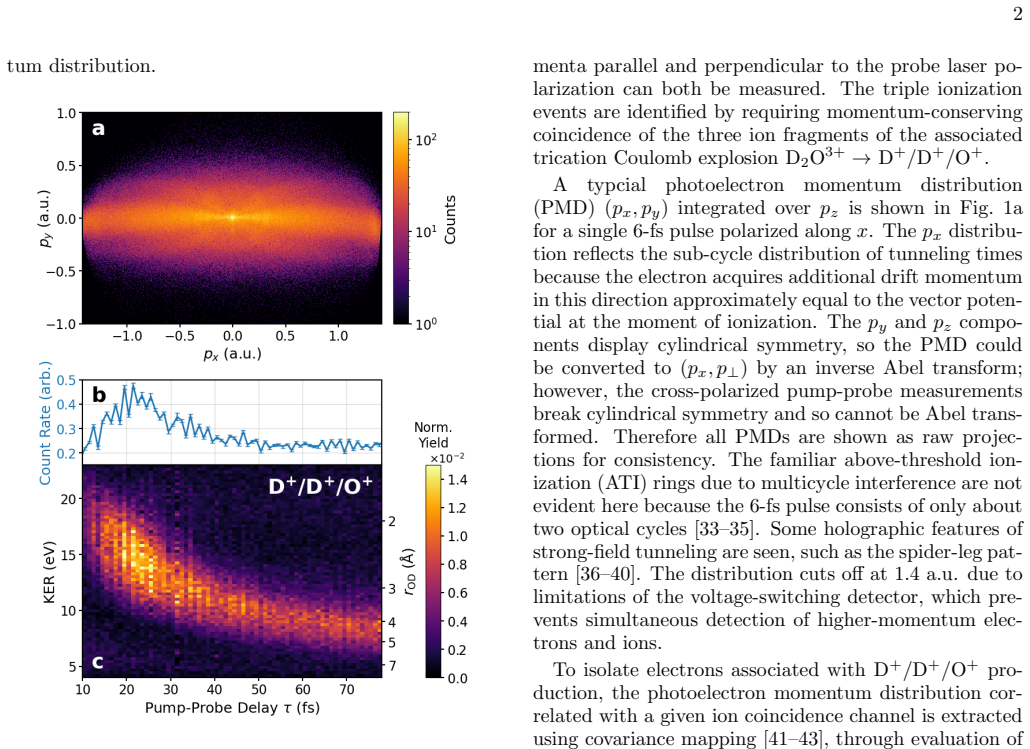
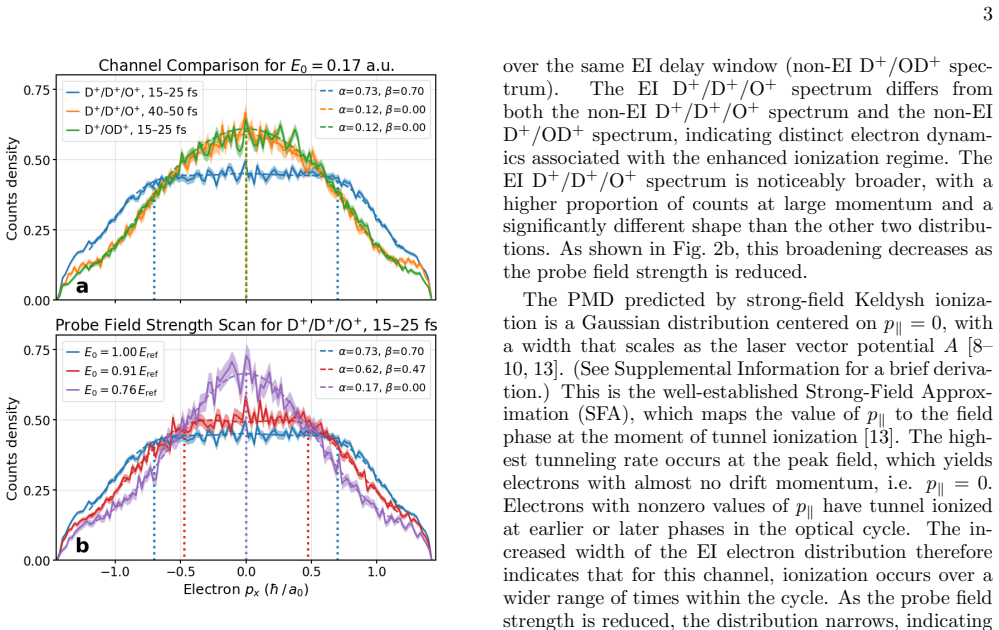
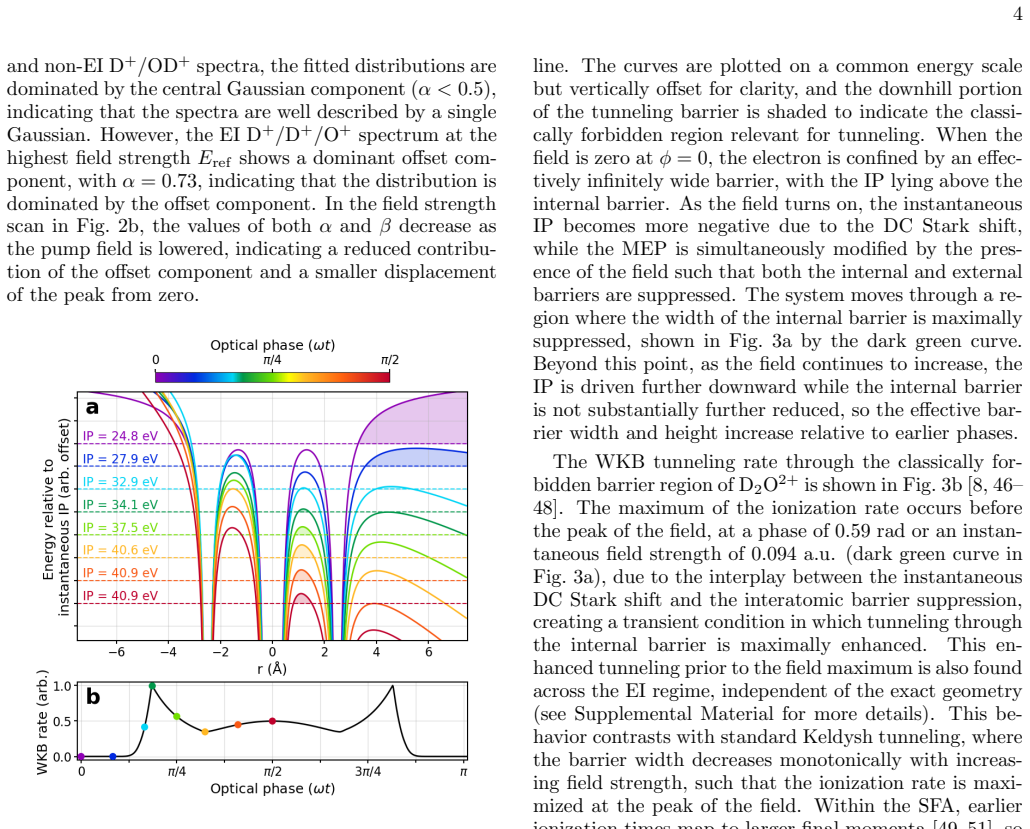
Measurements of the EI electron momentum distribution in D2O triple ionization reveal an increased yield of high-momentum electrons parallel to the laser polarization and a non-Gaussian profile. These observations indicate that the instantaneous EI tunneling rate is maximized at a critical value of the laser electric field, rather than at the peak of an optical cycle. This finding distinguishes EI from Keldysh tunneling rate predictions, where tunneling rate increases monotonically with field strength.
What carries the argument
The isolated EI electron momentum distribution obtained via electron-ion correlation methods and full fragment momentum imaging.
If this is right
- Models of enhanced ionization must incorporate a non-monotonic dependence of tunneling rate on instantaneous field strength.
- The observed spectral differences supply concrete benchmarks for testing and refining EI theories.
- Sub-cycle timing of electron release in EI may be controllable by tuning the field strength at which ionization occurs.
- Pronounced deviations from standard tunneling spectra can be used to identify the EI contribution in mixed ionization signals.
Where Pith is reading between the lines
- The critical field value may correspond to a particular molecular bond length reached during stretching, suggesting a geometry-dependent resonance in the ionization rate.
- Repeating the measurement with different pulse durations or wavelengths could test whether the critical field remains fixed or shifts with the optical period.
- If the same non-monotonic behavior appears in other triatomic molecules, it would indicate a general feature of EI rather than a D2O-specific effect.
- The result could influence predictions for processes such as high-harmonic generation when EI pathways contribute to the electron dynamics.
Load-bearing premise
The measured momentum distribution belongs only to electrons from the enhanced ionization channel with no significant mixing from other pathways or later dynamics.
What would settle it
If the yield of high-momentum electrons in the EI channel keeps rising with increasing peak laser field instead of showing a maximum at an intermediate strength, the claim of a critical-field peak would be contradicted.
Figures
read the original abstract
Strong-field enhanced ionization (EI) is a phenomenon in which stretching of interatomic bonds into a distorted molecular geometry leads to an increase in the tunneling ionization rate driven by a strong field. Isolating the momentum distribution of the electrons involved in EI is critical to fully characterizing the phenomenon. We have measured this EI distribution in triple ionization of D$_2$O using 6-fs pulse pairs together with full fragment momentum imaging and electron-ion correlation methods. We find that the EI electron momentum distribution differs substantially from that of standard strong-field tunneling from molecules, exhibiting an increased yield of electrons with large momentum in the direction of the laser polarization, and a change from the expected Gaussian distribution. These observations indicate that the instantaneous EI tunneling rate is maximized at a critical value of the laser electric field, rather than at the peak of an optical cycle. This finding distinguishes EI from Keldysh tunneling rate predictions, where tunneling rate increases monotonically with field strength. These pronounced differences between EI and non-EI electron spectra are critical tests of models of enhanced ionization and suggest a route towards control of the sub-cycle timing of electron emission.
Editorial analysis
A structured set of objections, weighed in public.
Referee Report
Summary. The manuscript reports an experimental study of electron momentum distributions in the enhanced ionization (EI) channel during triple ionization of D2O, using 6-fs pulse pairs, full fragment momentum imaging, and electron-ion correlation methods. The central claim is that the EI-selected electron spectra exhibit increased high-momentum yield along the laser polarization and deviation from the expected Gaussian form, indicating that the instantaneous EI tunneling rate is maximized at a critical field strength below the optical-cycle peak rather than increasing monotonically with field strength as in standard Keldysh tunneling.
Significance. If the isolation of the EI channel is robust and the momentum-to-ionization-time mapping holds without significant post-tunneling distortions, the result would provide a direct experimental test of sub-cycle dynamics in molecular enhanced ionization, distinguishing EI from conventional tunneling models and offering a potential route to control electron emission timing. The experimental approach using pulse pairs and correlations is a methodological strength for channel selection.
major comments (2)
- [Abstract] Abstract: The central claim that the observations indicate a non-monotonic EI rate peaking at critical E (rather than E_max) is load-bearing but rests on the unquantified assumption that the measured high-p_parallel yield and non-Gaussian shape arise exclusively from the instantaneous rate and cannot be reproduced by a monotonic Keldysh-like rate plus realistic post-tunneling dynamics or geometry-induced shifts in the stretched D2O geometry. No forward-model comparisons or contamination bounds are referenced.
- [Methods] Methods (electron-ion correlation section): The claim of successful isolation of the EI momentum distribution requires explicit quantitative exclusion criteria, leakage estimates from standard tunneling or double-ionization channels, and error analysis on the fragment momentum imaging; the abstract supplies none of these, preventing assessment of whether the reported spectral differences are statistically robust or contaminated.
minor comments (1)
- [Abstract] Abstract: The notation for the laser electric field and momentum components (p_parallel) should be defined explicitly on first use for clarity.
Simulated Author's Rebuttal
We thank the referee for their careful review and constructive comments on our manuscript. The points raised regarding the robustness of our EI channel isolation and the interpretation of the momentum spectra are important. We address each major comment below and have revised the manuscript accordingly to strengthen the presentation of our results.
read point-by-point responses
-
Referee: [Abstract] Abstract: The central claim that the observations indicate a non-monotonic EI rate peaking at critical E (rather than E_max) is load-bearing but rests on the unquantified assumption that the measured high-p_parallel yield and non-Gaussian shape arise exclusively from the instantaneous rate and cannot be reproduced by a monotonic Keldysh-like rate plus realistic post-tunneling dynamics or geometry-induced shifts in the stretched D2O geometry. No forward-model comparisons or contamination bounds are referenced.
Authors: We agree that explicit forward-model comparisons and contamination bounds would strengthen the central claim. In the revised manuscript we have added a dedicated paragraph in the discussion section that presents simple forward simulations of a monotonic Keldysh rate convolved with realistic post-tunneling propagation and geometry-induced momentum shifts; these simulations fail to reproduce the observed non-Gaussian shape and high-momentum enhancement. We also include quantitative upper bounds on contamination from non-EI channels derived from our electron-ion correlation data. These additions directly address the load-bearing assumption. revision: yes
-
Referee: [Methods] Methods (electron-ion correlation section): The claim of successful isolation of the EI momentum distribution requires explicit quantitative exclusion criteria, leakage estimates from standard tunneling or double-ionization channels, and error analysis on the fragment momentum imaging; the abstract supplies none of these, preventing assessment of whether the reported spectral differences are statistically robust or contaminated.
Authors: We have expanded the electron-ion correlation subsection of the Methods to provide the requested quantitative details: explicit momentum and energy exclusion windows used to isolate the EI channel, leakage estimates from standard tunneling and double-ionization channels (upper bound <6% based on correlation gating), and propagated uncertainties from the fragment momentum imaging. These additions allow direct assessment of the statistical robustness of the reported spectral differences. The abstract itself is kept concise, but the new quantitative information is now referenced there as well. revision: yes
Circularity Check
No circularity: purely experimental measurement with interpretive claim
full rationale
The paper reports experimental electron momentum distributions isolated via fragment imaging and electron-ion correlations in D2O triple ionization. The central claim—that EI rate peaks at a critical field rather than cycle peak—is presented as an indication from the observed non-Gaussian high-p yield, not as a derivation from equations or fitted parameters. No self-definitional loops, fitted inputs renamed as predictions, or load-bearing self-citations appear in the provided text. The work is self-contained as data plus interpretation against external Keldysh expectations, with no reduction of results to inputs by construction.
Axiom & Free-Parameter Ledger
axioms (1)
- domain assumption Standard assumptions of strong-field tunneling ionization and momentum imaging techniques apply to the interpretation of the measured distributions.
Reference graph
Works this paper leans on
-
[1]
L. V. Keldysh, Ionization in the field of a strong elec- tromagnetic wave, J Exp Theor Phys (USSR)47, 1945 (1964)
1945
-
[2]
M. V. Ammosov, N. B. Delone, and V. P. Krainov, Tun- nel Ionization Of Complex Atoms And Atomic Ions In Electromagnetic Field, in High Intensity Laser Process., Vol. 0664 (SPIE, 1986) pp. 138–141
1986
-
[3]
A. M. Perelomov, V. S. Popov, and M. V. Terent’Ev, Ionization of atoms in an alternating electric field, Sov. Phys. JETP23, 924 (1966)
1966
-
[4]
P. B. Corkum, Plasma perspective on strong field multi- photon ionization, Phys. Rev. Lett.71, 1994 (1993)
1994
-
[5]
J. L. Krause, K. J. Schafer, and K. C. Kulander, High- order harmonic generation from atoms and ions in the high intensity regime, Phys. Rev. Lett.68, 3535 (1992)
1992
-
[6]
P. H. Bucksbaum, A. Zavriyev, H. G. Muller, and D. W. Schumacher, Softening of the H 2 + molecular bond in in- tense laser fields, Phys. Rev. Lett.64, 1883 (1990)
1990
-
[7]
L. J. Frasinski, K. Codling, P. Hatherly, J. Barr, I. N. Ross, and W. T. Toner, Femtosecond dynamics of mul- tielectron dissociative ionization by use of a picosecond laser, Phys. Rev. Lett.58, 2424 (1987)
1987
-
[8]
Ibrahim, C
H. Ibrahim, C. Lefebvre, A. D. Bandrauk, A. Staudte, and F. L´ egar´ e, H2: The benchmark molecule for ultrafast science and technologies, J. Phys. B: At. Mol. Opt. Phys. 51, 042002 (2018)
2018
-
[9]
J. H. Posthumus, The dynamics of small molecules in intense laser fields, Rep. Prog. Phys.67, 623 (2004)
2004
-
[10]
Zuo and A
T. Zuo and A. D. Bandrauk, Charge-resonance-enhanced ionization of diatomic molecular ions by intense lasers, Phys. Rev. A52, R2511 (1995)
1995
-
[11]
J. H. Posthumus, L. J. Frasinski, A. J. Giles, and K. Codling, Dissociative ionization of molecules in in- tense laser fields: A method of predicting ion kinetic en- ergies and appearance intensities, J. Phys. B: At. Mol. Opt. Phys.28, L349 (1995)
1995
-
[12]
Seideman, M
T. Seideman, M. Yu. Ivanov, and P. B. Corkum, Role of Electron Localization in Intense-Field Molecular Ioniza- tion, Phys. Rev. Lett.75, 2819 (1995)
1995
-
[13]
Trump, H
C. Trump, H. Rottke, and W. Sandner, Multiphoton ion- ization of dissociating D 2 + molecules, Phys. Rev. A59, 2858 (1999)
1999
-
[14]
Trump, H
C. Trump, H. Rottke, and W. Sandner, Strong-field pho- toionization of vibrational ground-state H 2 + and D 2 + molecules, Phys. Rev. A60, 3924 (1999)
1999
-
[15]
Ben-Itzhak, P
I. Ben-Itzhak, P. Q. Wang, A. M. Sayler, K. D. Carnes, M. Leonard, B. D. Esry, A. S. Alnaser, B. Ulrich, X. M. Tong, I. V. Litvinyuk, C. M. Maharjan, P. Ranitovic, T. Osipov, S. Ghimire, Z. Chang, and C. L. Cocke, Elu- sive enhanced ionization structure for H 2 + in intense ul- trashort laser pulses, Phys. Rev. A78, 063419 (2008)
2008
-
[16]
H. Xu, F. He, D. Kielpinski, R. Sang, and I. Litvinyuk, Experimental observation of the elusive double-peak structure in R-dependent strong-field ionization rate of H2 +, Sci Rep5, 13527 (2015)
2015
-
[17]
Ergler, A
Th. Ergler, A. Rudenko, B. Feuerstein, K. Zrost, C. D. Schr¨ oter, R. Moshammer, and J. Ullrich, Time-Resolved Imaging and Manipulation of H 2 Fragmentation in In- tense Laser Fields, Phys. Rev. Lett.95, 093001 (2005)
2005
-
[18]
L´ egar´ e, I
F. L´ egar´ e, I. V. Litvinyuk, P. W. Dooley, F. Qu´ er´ e, A. D. Bandrauk, D. M. Villeneuve, and P. B. Corkum, Time- Resolved Double Ionization with Few Cycle Laser Pulses, Phys. Rev. Lett.91, 093002 (2003)
2003
-
[19]
A. J. Howard, M. Britton, Z. L. Streeter, C. Cheng, R. Forbes, J. L. Reynolds, F. Allum, G. A. Mc- Cracken, I. Gabalski, R. R. Lucchese, C. W. McCurdy, T. Weinacht, and P. H. Bucksbaum, Filming enhanced ionization in an ultrafast triatomic slingshot, Commun Chem6, 81 (2023)
2023
-
[20]
A. J. Howard, Uncovering, Filming, and Controlling Molecular Dynamics in Water Using Strong-Field Ionization, 6 Ph.D. thesis, Stanford University, Stanford, California (2024)
2024
-
[21]
A. J. Howard, M. Britton, Z. L. Streeter, C. Cheng, R. R. Lucchese, C. W. McCurdy, and P. H. Bucksbaum, Isotope-selective strong-field ionization of semiheavy wa- ter, Phys. Rev. Research7, L012062 (2025)
2025
-
[22]
G. A. McCracken, A. Kaldun, C. Liekhus-Schmaltz, and P. H. Bucksbaum, Geometric dependence of strong field enhanced ionization in D2O, J. Chem. Phys.147, 124308 (2017)
2017
-
[23]
X. Gong, Q. Song, Q. Ji, H. Pan, J. Ding, J. Wu, and H. Zeng, Strong-Field Dissociative Double Ionization of Acetylene, Phys. Rev. Lett.112, 243001 (2014)
2014
-
[24]
Erattupuzha, C
S. Erattupuzha, C. L. Covington, A. Russakoff, E. L¨ otstedt, S. Larimian, V. Hanus, S. Bubin, M. Koch, S. Gr¨ afe, A. Baltuˇ ska, X. Xie, K. Yamanouchi, K. Varga, and M. Kitzler, Enhanced ionisation of polyatomic molecules in intense laser pulses is due to energy upshift and field coupling of multiple orbitals, J. Phys. B: At. Mol. Opt. Phys.50, 125601 (2017)
2017
-
[25]
Burger, A
C. Burger, A. Atia-Tul-Noor, T. Schnappinger, H. Xu, P. Rosenberger, N. Haram, S. Beaulieu, F. L´ egar´ e, A. S. Alnaser, R. Moshammer, R. T. Sang, B. Bergues, M. S. Schuurman, R. de Vivie-Riedle, I. V. Litvinyuk, and M. F. Kling, Time-resolved nuclear dynamics in bound and dissociating acetylene, Struct. Dyn.5, 044302 (2018)
2018
-
[26]
S. A. Mohideen, A. J. Howard, C. Cheng, I. Gabalski, A. M. Ghrist, E. Weckwerth, and P. H. Bucksbaum, Orientation-dependent enhanced ionization in acetylene revealed by ultrafast cross-polarized pulse pairs, Phys. Rev. A112, 013105 (2025)
2025
-
[27]
Bocharova, R
I. Bocharova, R. Karimi, E. F. Penka, J.-P. Brichta, P. Lassonde, X. Fu, J.-C. Kieffer, A. D. Bandrauk, I. Litvinyuk, J. Sanderson, and F. L´ egar´ e, Charge Res- onance Enhanced Ionization of CO 2 Probed by Laser Coulomb Explosion Imaging, Phys. Rev. Lett.107, 063201 (2011)
2011
-
[28]
J. P. Brichta, S. J. Walker, R. Helsten, and J. H. Sander- son, Ultrafast imaging of multielectronic dissociative ion- ization of CO2 in an intense laser field, J. Phys. B: At. Mol. Opt. Phys.40, 117 (2006)
2006
-
[29]
P. Song, Y. Zhu, Y. Yang, X. Wang, C. Meng, J. Zhao, J. Liu, Z. Lv, D. Zhang, Z. Zhao, and J. Yuan, Dissocia- tive multiple ionization of carbon dioxide dimers in in- tense femtosecond laser fields, Phys. Rev. A106, 023109 (2022)
2022
-
[30]
J. Wu, M. Meckel, L. P. H. Schmidt, M. Kunitski, S. Voss, H. Sann, H. Kim, T. Jahnke, A. Czasch, and R. D¨ orner, Probing the tunnelling site of electrons in strong field enhanced ionization of molecules, Nat Commun3, 1113 (2012)
2012
-
[31]
A. Zhao, P. S´ andor, and T. Weinacht, Coincidence veloc- ity map imaging using a single detector, J. Chem. Phys. 147, 013922 (2017)
2017
-
[33]
Wickenhauser, X
M. Wickenhauser, X. M. Tong, and C. D. Lin, Laser- induced substructures in above-threshold-ionization spectra from intense few-cycle laser pulses, Phys. Rev. A73, 011401 (2006)
2006
-
[34]
Brabec and F
T. Brabec and F. Krausz, Intense few-cycle laser fields: Frontiers of nonlinear optics, Rev. Mod. Phys.72, 545 (2000)
2000
-
[35]
R. R. Freeman, P. H. Bucksbaum, H. Milchberg, S. Darack, D. Schumacher, and M. E. Geusic, Above- threshold ionization with subpicosecond laser pulses, Phys. Rev. Lett.59, 1092 (1987)
1987
-
[36]
Werby, A
N. Werby, A. S. Maxwell, R. Forbes, P. H. Bucksbaum, and C. F. D. M. Faria, Dissecting subcycle interference in photoelectron holography, Phys. Rev. A104, 013109 (2021)
2021
-
[37]
Huismans, A
Y. Huismans, A. Rouz´ ee, A. Gijsbertsen, J. H. Jung- mann, A. S. Smolkowska, P. S. W. M. Logman, F. L´ epine, C. Cauchy, S. Zamith, T. Marchenko, J. M. Bakker, G. Berden, B. Redlich, A. F. G. van der Meer, H. G. Muller, W. Vermin, K. J. Schafer, M. Spanner, M. Yu. Ivanov, O. Smirnova, D. Bauer, S. V. Popruzhenko, and M. J. J. Vrakking, Time-Resolved Holo...
2011
-
[38]
D. D. Hickstein, P. Ranitovic, S. Witte, X.-M. Tong, Y. Huismans, P. Arpin, X. Zhou, K. E. Keister, C. W. Hogle, B. Zhang, C. Ding, P. Johnsson, N. Toshima, M. J. J. Vrakking, M. M. Murnane, and H. C. Kapteyn, Direct Visualization of Laser-Driven Electron Multiple Scattering and Tunneling Distance in Strong-Field Ion- ization, Phys. Rev. Lett.109, 073004 (2012)
2012
-
[39]
X. Gong, P. He, Q. Song, Q. Ji, K. Lin, W. Zhang, P. Lu, H. Pan, J. Ding, H. Zeng, F. He, and J. Wu, Pathway- resolved photoelectron emission in dissociative ionization of molecules, Optica, OPTICA3, 643 (2016)
2016
-
[40]
M¨ oller, F
M. M¨ oller, F. Meyer, A. M. Sayler, G. G. Paulus, M. F. Kling, B. E. Schmidt, W. Becker, and D. B. Miloˇ sevi´ c, Off-axis low-energy structures in above-threshold ioniza- tion, Phys. Rev. A90, 023412 (2014)
2014
-
[41]
Cheng, L
C. Cheng, L. J. Frasinski, G. Mo˘ gol, F. Allum, A. J. Howard, D. Rolles, P. H. Bucksbaum, M. Brouard, R. Forbes, and T. Weinacht, Multiparticle Cumulant Mapping for Coulomb Explosion Imaging, Phys. Rev. Lett.130, 093001 (2023)
2023
-
[42]
Allum, V
F. Allum, V. Music, L. Inhester, R. Boll, B. Erk, P. Schmidt, T. M. Baumann, G. Brenner, M. Burt, P. V. Demekhin, S. D¨ orner, A. Ehresmann, A. Galler, P. Grychtol, D. Heathcote, D. Kargin, M. Larsson, J. W. L. Lee, Z. Li, B. Manschwetus, L. Marder, R. Ma- son, M. Meyer, H. Otto, C. Passow, R. Pietschnig, D. Ramm, K. Schubert, L. Schwob, R. D. Thomas, C. ...
2022
-
[43]
Cheng, Y
C. Cheng, Y. Kumagai, K. Nagaya, T. Gejo, J. Harries, M. Burt, M. Brouard, A. Duley, P. Hockett, J. W. Mc- Manus, R. S. Minns, S. Mondal, S. Owada, W. Razmus, D. Rolles, T. Sato, H. J. Thompson, A. S. Venkatacha- lam, E. M. Warne, T. Walmsley, M. Yagi, P. Bucksbaum, F. Allum, and R. Forbes, Imaging Three-Dimensional Molecular Structure and Dynamics with M...
2026
-
[44]
Hofmann, A
C. Hofmann, A. S. Landsman, A. Zielinski, C. Cirelli, T. Zimmermann, A. Scrinzi, and U. Keller, Interpreting electron-momentum distributions and nonadiabaticity in strong-field ionization, Phys. Rev. A90, 043406 (2014)
2014
-
[45]
Wolter, C
B. Wolter, C. Lemell, M. Baudisch, M. G. Pullen, X.-M. Tong, M. Hemmer, A. Senftleben, C. D. Schr¨ oter, J. Ull- 7 rich, R. Moshammer, J. Biegert, and J. Burgd¨ orfer, For- mation of very-low-energy states crossing the ionization threshold of argon atoms in strong mid-infrared fields, Phys. Rev. A90, 063424 (2014)
2014
-
[46]
Wentzel, Eine Verallgemeinerung der Quantenbedin- gungen f¨ ur die Zwecke der Wellenmechanik, Z
G. Wentzel, Eine Verallgemeinerung der Quantenbedin- gungen f¨ ur die Zwecke der Wellenmechanik, Z. Physik 38, 518 (1926)
1926
-
[47]
H. A. Kramers, Wellenmechanik und halbzahlige Quan- tisierung, Z. Physik39, 828 (1926)
1926
-
[48]
Brillouin, La m´ ecanique ondulatoire de Schr¨ odinger; une m´ ethode g´ en´ erale de resolution par approximations successives, Compt
L. Brillouin, La m´ ecanique ondulatoire de Schr¨ odinger; une m´ ethode g´ en´ erale de resolution par approximations successives, Compt. Rend. Hebd. Seances Acad. Sci.183, 24 (1926)
1926
-
[49]
F. H. M. Faisal, Multiple absorption of laser photons by atoms, J. Phys. B: At. Mol. Phys.6, L89 (1973)
1973
-
[50]
H. R. Reiss, Effect of an intense electromagnetic field on a weakly bound system, Phys. Rev. A22, 1786 (1980)
1980
-
[51]
Lewenstein, Ph
M. Lewenstein, Ph. Balcou, M. Yu. Ivanov, A. L’Huillier, and P. B. Corkum, Theory of high-harmonic generation by low-frequency laser fields, Phys. Rev. A49, 2117 (1994)
1994
-
[52]
K. J. Schafer, B. Yang, L. F. DiMauro, and K. C. Ku- lander, Above threshold ionization beyond the high har- monic cutoff, Phys. Rev. Lett.70, 1599 (1993)
1993
-
[53]
slingshot
E. Weckwerth, C. Cheng, I. Gabalski, A. J. Howard, M. Britton, A. M. Ghrist, H. Ma, S. A. Mohideen, and P. H. Bucksbaum, Data for Weckwerth, E. et al., ”Electron spectra from strong-field enhanced ionization in heavy water” (2026). 8 S1. Supplemental Experimental Methods The few-cycle pulse pairs used in the experiment were generated starting from 40-fs 8...
2026
-
[54]
Robinson, C
J. Robinson, C. Haworth, H. Teng, R. Smith, J. Marangos, and J. Tisch, The generation of intense, transform-limited laser pulses with tunable duration from 6 to 30 fs in a differentially pumped hollow fibre, Appl. Phys. B85, 525 (2006). 13 FIG. S4. Dependence of the WKB tunneling rate on peak field strength for a fixed geometry (O-D bond length of 2.50 ˚A...
2006
-
[55]
Miranda, T
M. Miranda, T. Fordell, C. Arnold, A. L’Huillier, and H. Crespo, Simultaneous compression and characterization of ultrashort laser pulses using chirped mirrors and glass wedges, Opt. Express, OE20, 688 (2012)
2012
-
[56]
A. T. J. B. Eppink and D. H. Parker, Velocity map imaging of ions and electrons using electrostatic lenses: Application in photoelectron and photofragment ion imaging of molecular oxygen, Rev. Sci. Instrum.68, 3477 (1997)
1997
-
[57]
D. W. Chandler and P. L. Houston, Two-dimensional imaging of state-selected photodissociation products detected by multiphoton ionization, J. Chem. Phys.87, 1445 (1987)
1987
-
[58]
A. Zhao, P. S´ andor, and T. Weinacht, Coincidence velocity map imaging using a single detector, J. Chem. Phys.147, 013922 (2017)
2017
-
[59]
I. Gabalski, E. Weckwerth, C. Cheng, and P. H. Bucksbaum, Fast array-based particle coincidence detection in a TimePix3- based velocity map imaging instrument (2026), arXiv:2603.04942 [physics]
-
[60]
A. J. Howard, M. Britton, Z. L. Streeter, C. Cheng, R. R. Lucchese, C. W. McCurdy, and P. H. Bucksbaum, Isotope- selective strong-field ionization of semiheavy water, Phys. Rev. Research7, L012062 (2025)
2025
-
[61]
L. V. Keldysh, Ionization in the field of a strong electromagnetic wave, J Exp Theor Phys (USSR)47, 1945 (1964)
1945
-
[62]
M. V. Ammosov, N. B. Delone, and V. P. Krainov, Tunnel Ionization Of Complex Atoms And Atomic Ions In Electro- magnetic Field, in High Intensity Laser Process., Vol. 0664 (SPIE, 1986) pp. 138–141
1986
-
[63]
A. M. Perelomov, V. S. Popov, and M. V. Terent’Ev, Ionization of atoms in an alternating electric field, Sov. Phys. JETP 23, 924 (1966)
1966
-
[64]
Ditmire, Strong Field Physics: Ultra-Intense Light Interaction with Matter, 1st ed
T. Ditmire, Strong Field Physics: Ultra-Intense Light Interaction with Matter, 1st ed. (Cambridge University Press, 2025)
2025
-
[65]
H. v. L. van den Heuvell and H. Muller, Limiting cases of excess-photon ionization, Multiphoton Process.8, 25 (1988)
1988
-
[66]
P. B. Corkum, Plasma perspective on strong field multiphoton ionization, Phys. Rev. Lett.71, 1994 (1993)
1994
-
[67]
D. M. Volkov, ¨Uber eine Klasse von L¨ osungen der Diracschen Gleichung, Z. Physik94, 250 (1935)
1935
-
[68]
G. M. J. Barca, C. Bertoni, L. Carrington, D. Datta, N. De Silva, J. E. Deustua, D. G. Fedorov, J. R. Gour, A. O. Gunina, E. Guidez, T. Harville, S. Irle, J. Ivanic, K. Kowalski, S. S. Leang, H. Li, W. Li, J. J. Lutz, I. Magoulas, J. Mato, V. Mironov, H. Nakata, B. Q. Pham, P. Piecuch, D. Poole, S. R. Pruitt, A. P. Rendell, L. B. Roskop, K. Ruedenberg, T....
2020
discussion (0)
Sign in with ORCID, Apple, or X to comment. Anyone can read and Pith papers without signing in.