Reading between the rings: observed dust ring properties as probes of planet masses
Pith reviewed 2026-06-29 14:58 UTC · model grok-4.3
The pith
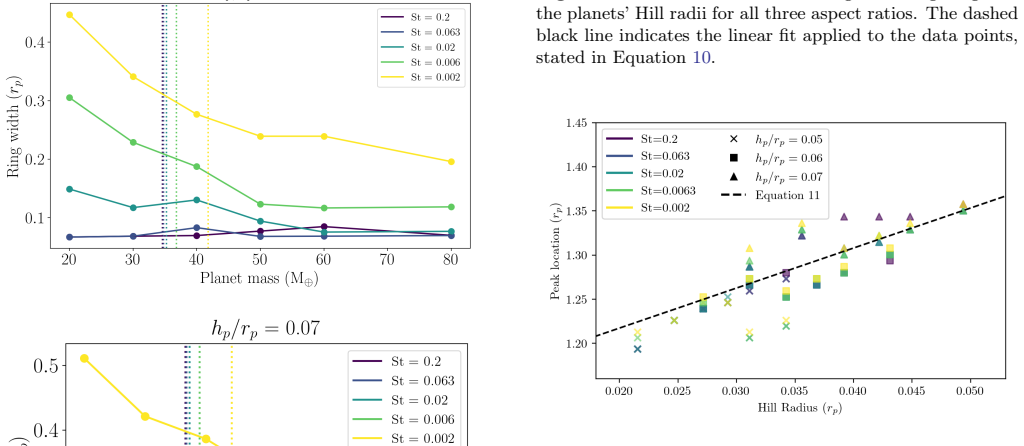
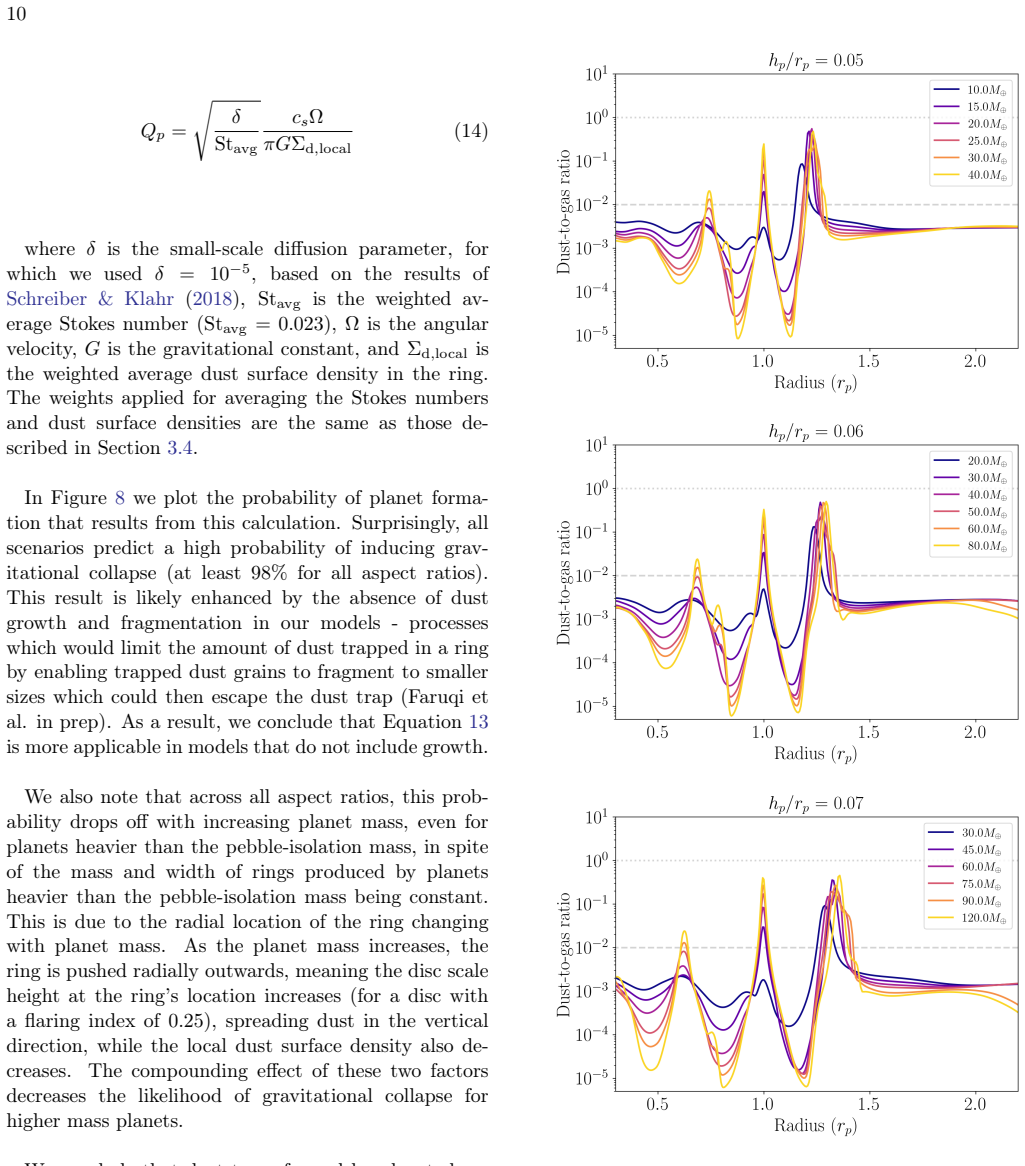
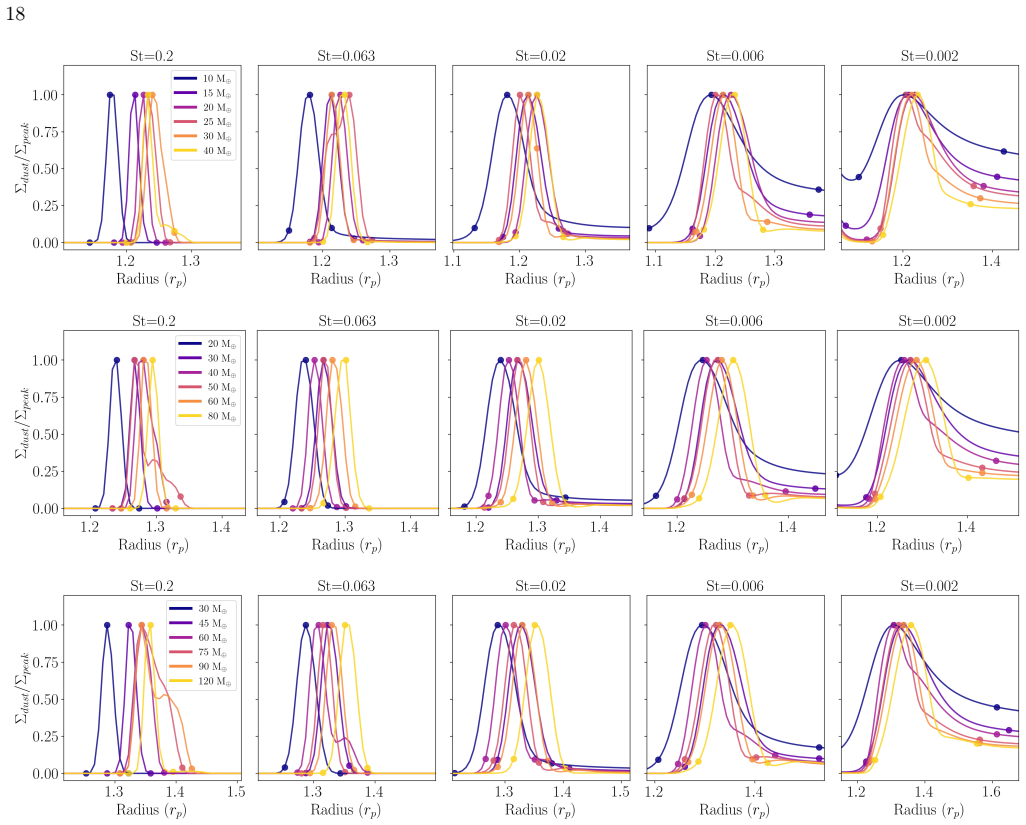
Dust ring peak locations scale linearly with the Hill radius of the embedded planet.
A machine-rendered reading of the paper's core claim, the machinery that carries it, and where it could break.
Core claim
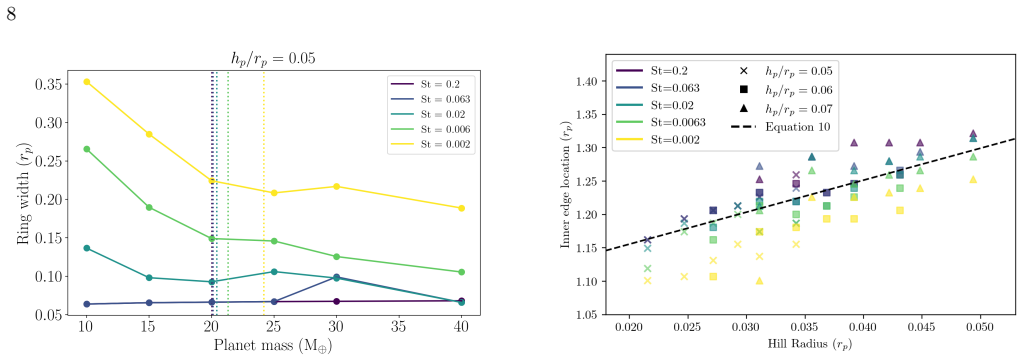
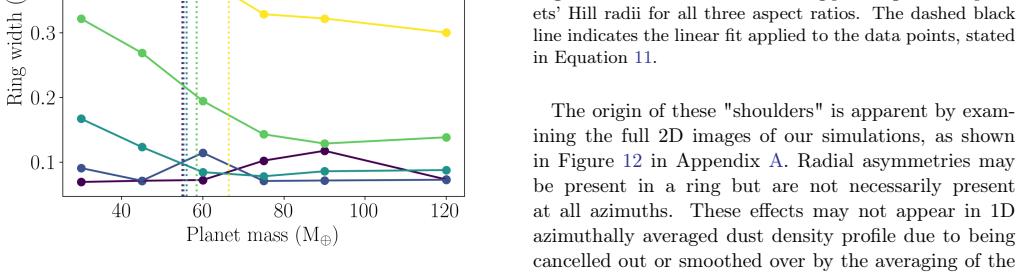
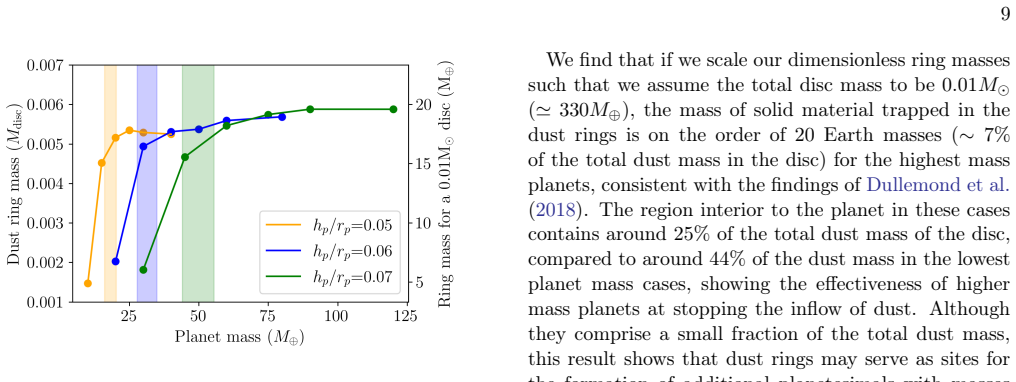
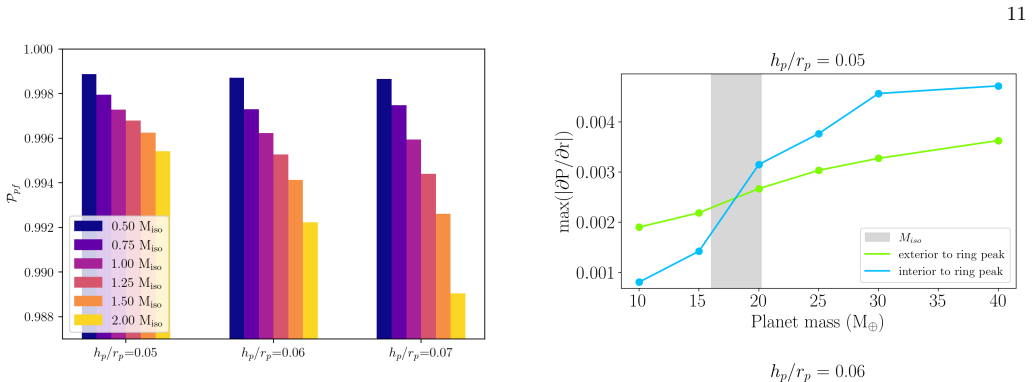
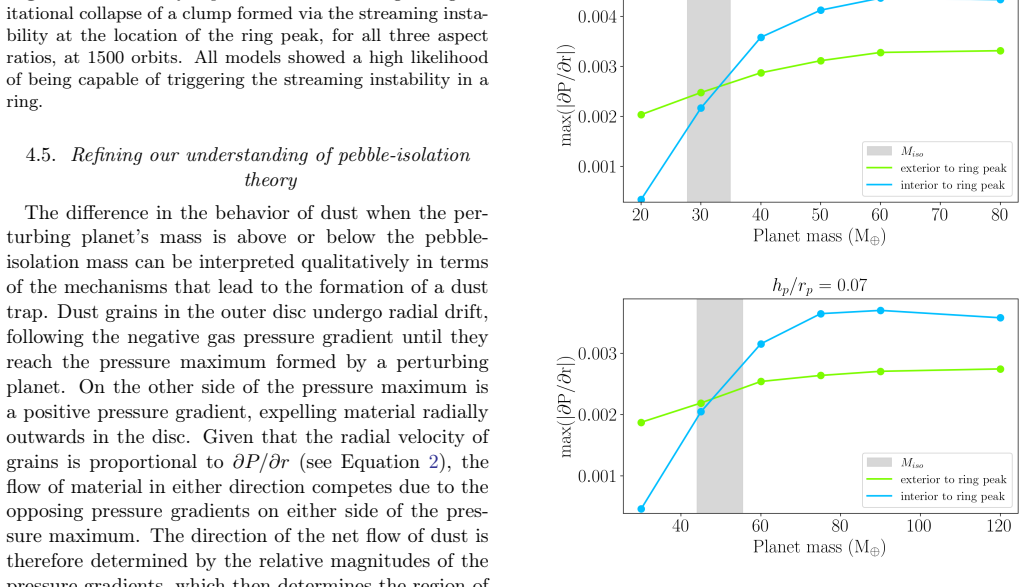
Simulations of planets between 0.5 and 2 times the pebble-isolation mass demonstrate that the radial location of a dust ring's density peak increases linearly with the planet's Hill radius. Ring width and dust mass increase with planet mass only up to the pebble-isolation mass and then plateau. The radial profile of gas pressure around the ring shows an asymmetry whose sense reverses exactly at the pebble-isolation mass, which the authors redefine as the minimum mass that makes the interior pressure gradient steeper than the exterior one. These scalings are applied to observed rings to constrain planet masses and disk aspect ratios.
What carries the argument
The positive linear relationship between a planet's Hill radius and the radial location of its dust ring's density peak, which directly maps observed ring positions to planet mass.
If this is right
- Ring width and dust mass increase with planet mass only up to the pebble-isolation mass and remain constant thereafter.
- The sense of asymmetry in the gas pressure gradient around the ring indicates whether the planet lies above or below the pebble-isolation mass.
- The new pressure-gradient definition identifies the pebble-isolation mass as the point where the interior gradient first exceeds the exterior gradient.
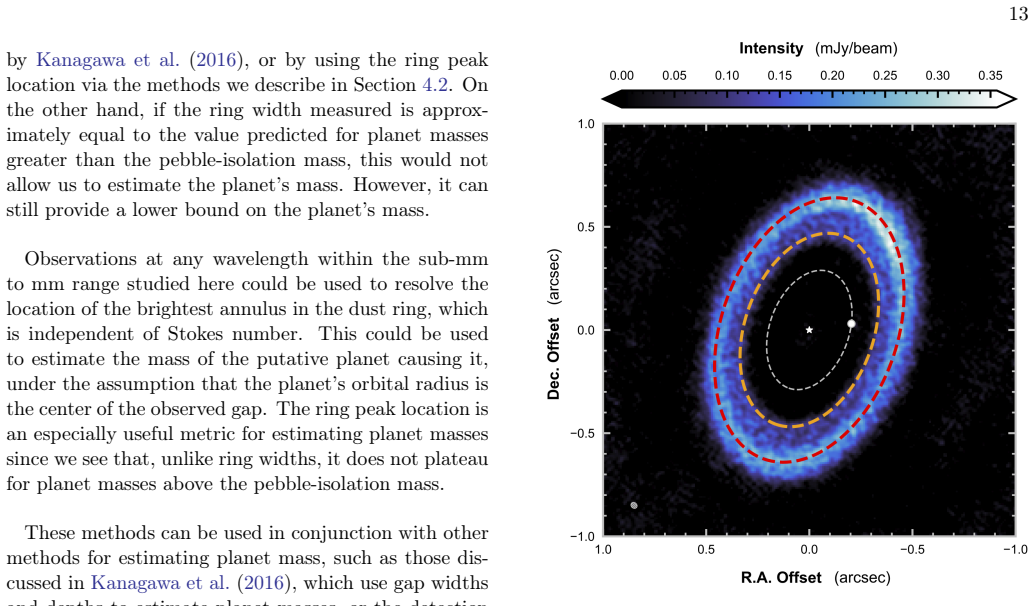
- The linear peak-location relation supplies mass estimates for planets in disks with resolved rings such as PDS 70.
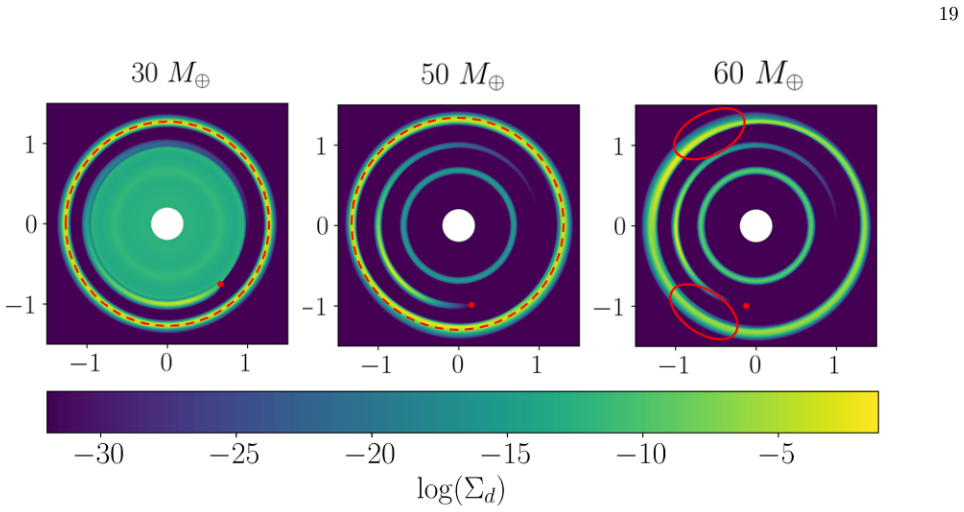
- Planetesimal formation efficiency inside the ring is expected to vary with planet mass through changes in ring width and surface density.
Where Pith is reading between the lines
- The same ring-position method could be applied to disks where planets have already been detected by direct imaging to test consistency between independent mass measurements.
- Rings produced by mechanisms other than embedded planets would be expected to fall off the linear relation, offering a discriminant between formation channels.
- Extending the simulations to include dust back-reaction or vertical structure would show whether the reported linear scaling survives more realistic physics.
- The pressure-asymmetry diagnostic could be checked against gas kinematic observations to independently confirm the pebble-isolation threshold in the same disks.
Load-bearing premise
Observed dust rings in real protoplanetary disks are produced by the same embedded-planet mechanism that operates in the two-dimensional hydrodynamical simulations.
What would settle it
An observed dust ring whose measured density-peak location deviates from the linear Hill-radius prediction once an independent planet mass and disk aspect ratio are known would falsify the claimed relationship.
Figures
read the original abstract
We hypothesise that dust rings in protoplanetary discs formed by an embedded planet should have properties that reflect the planet's mass. We use 2D hydrodynamical simulations of planet-disc interactions to investigate this, focusing on planets ranging 0.5-2.0x the pebble-isolation mass, for three different aspect ratios. We find the ring's dust mass, peak location, and width to correlate with planet mass. We confirm a positive linear relationship between a planet's Hill radius and the location of a ring's density peak and demonstrate how this relationship can be used to constrain planet masses in observed systems by applying it to PDS 70. The dust ring width and mass change with planet mass for planet masses up to the pebble-isolation mass, beyond which they become constant. The steepness of the gas pressure radial profile is asymmetric, with the direction of the asymmetry being determined by whether the planet mass is above or below the pebble-isolation mass. We therefore propose a new way to define the pebble-isolation mass: the minimum planet mass which perturbs the gas enough for the pressure gradient interior to the pressure maximum to exceed the pressure gradient exterior to it. We discuss how our findings could be used to constrain or estimate planet masses from gas or dust observations of discs with measurable substructures and apply our results to 5 discs in the exoALMA sample to estimate planet masses and constrain disc aspect ratios. We also discuss how the potential for planetesimal formation in a ring varies with planet mass.
Editorial analysis
A structured set of objections, weighed in public.
Referee Report
Summary. The paper uses 2D hydrodynamical simulations of embedded planets (0.5–2.0× pebble-isolation mass, three aspect ratios) to show that dust ring mass, peak location, and width correlate with planet mass. It reports a positive linear relation between planet Hill radius and ring density peak location, proposes a new operational definition of pebble-isolation mass based on asymmetry in the gas pressure gradient, and applies the scaling to estimate planet masses in PDS 70 and five exoALMA disks while discussing implications for planetesimal formation.
Significance. If the planet-induced ring mechanism dominates observed substructures, the reported Hill-radius scaling supplies an observationally accessible route to planet-mass estimates that is independent of gap-depth fitting. The work covers a focused mass range near pebble isolation and multiple aspect ratios, and the new pressure-gradient definition of pebble isolation is a falsifiable, observationally testable proposal. These elements would strengthen the paper’s contribution to disk-planet interaction studies if the underlying assumption is addressed.
major comments (3)
- [Simulation setup section] Simulation setup section: numerical resolution, grid size, dust treatment (fluid vs. Lagrangian particles, size distribution, and back-reaction), and boundary conditions are not specified. These choices directly control the reported ring peak location, width, and the slope of the Hill-radius relation, so the central correlations cannot be reproduced or assessed without them.
- [Application to PDS 70 and exoALMA sample] Application to PDS 70 and exoALMA sample (results/discussion sections): the linear fit is derived exclusively from planet-induced rings and is then inverted to obtain planet masses. No quantitative test or discussion is provided of how alternative ring-forming mechanisms (snow lines, vortices, dead-zone edges) would shift the peak location, rendering the mass estimates conditional on an untested premise that is load-bearing for the claimed observational application.
- [Definition of pebble-isolation mass] Definition of pebble-isolation mass (results section): the new criterion (minimum mass at which the interior pressure gradient exceeds the exterior one) is presented as an improvement, but no direct comparison is made to the conventional definition based on the pebble-trapping efficiency or to the pebble-isolation mass values used to normalize the simulation suite. This leaves the relation between the two definitions unclear.
minor comments (2)
- Figure captions should explicitly state the number of simulation runs per aspect ratio and the exact planet-mass grid used to generate the linear fit.
- The abstract states the relation is 'positive linear' but does not report the fitted slope, intercept, or R²; these statistics should appear in the main text or a table.
Simulated Author's Rebuttal
We thank the referee for their constructive comments. We address each major point below, indicating revisions where appropriate to improve reproducibility, clarify assumptions, and strengthen comparisons.
read point-by-point responses
-
Referee: [Simulation setup section] Simulation setup section: numerical resolution, grid size, dust treatment (fluid vs. Lagrangian particles, size distribution, and back-reaction), and boundary conditions are not specified. These choices directly control the reported ring peak location, width, and the slope of the Hill-radius relation, so the central correlations cannot be reproduced or assessed without them.
Authors: We agree these parameters are required for reproducibility. The revised manuscript will expand the Simulation setup section with explicit values for grid resolution (radial and azimuthal cells), dust treatment (fluid approximation with specified size bins and back-reaction), and boundary conditions. This addition will enable direct assessment of the reported correlations. revision: yes
-
Referee: [Application to PDS 70 and exoALMA sample] Application to PDS 70 and exoALMA sample (results/discussion sections): the linear fit is derived exclusively from planet-induced rings and is then inverted to obtain planet masses. No quantitative test or discussion is provided of how alternative ring-forming mechanisms (snow lines, vortices, dead-zone edges) would shift the peak location, rendering the mass estimates conditional on an untested premise that is load-bearing for the claimed observational application.
Authors: We acknowledge the estimates are conditional on the planet-induced ring assumption. The revised discussion will explicitly state this caveat and qualitatively address how alternative mechanisms could alter peak locations. A quantitative test of alternatives lies outside the current simulation suite, but the conditional nature will be emphasized to avoid over-interpretation. revision: partial
-
Referee: [Definition of pebble-isolation mass] Definition of pebble-isolation mass (results section): the new criterion (minimum mass at which the interior pressure gradient exceeds the exterior one) is presented as an improvement, but no direct comparison is made to the conventional definition based on the pebble-trapping efficiency or to the pebble-isolation mass values used to normalize the simulation suite. This leaves the relation between the two definitions unclear.
Authors: The new pressure-gradient definition is offered as an observationally testable alternative. In revision we will add a direct comparison in the results section, relating the new threshold to conventional pebble-trapping efficiency and to the normalization masses adopted in our runs, thereby clarifying the connection between definitions. revision: yes
Circularity Check
No circularity: relations derived from independent hydro simulations and applied externally
full rationale
The paper runs new 2D hydrodynamical simulations across a stated planet-mass range and aspect ratios, measures ring properties (mass, peak location, width) directly from the outputs, and reports an empirical linear correlation between Hill radius and density-peak location. This correlation is then applied to external systems (PDS 70 and exoALMA discs). No quoted step defines a quantity in terms of itself, renames a fitted parameter as a prediction, or reduces the central result to a self-citation chain. The hypothesis that observed rings form via the modeled mechanism is an applicability assumption, not a definitional or self-referential reduction in the derivation itself.
Axiom & Free-Parameter Ledger
free parameters (2)
- planet mass range (0.5-2.0 times pebble-isolation mass)
- three different aspect ratios
axioms (1)
- domain assumption 2D hydrodynamical equations adequately represent planet-disk interactions for the purpose of ring formation
Reference graph
Works this paper leans on
-
[1]
, " * write output.state after.block = add.period write newline
ENTRY address archivePrefix author booktitle chapter doi edition editor eprint howpublished institution journal key month number organization pages publisher school series title misctitle type volume year version url label extra.label sort.label short.list INTEGERS output.state before.all mid.sentence after.sentence after.block FUNCTION init.state.consts ...
-
[2]
write newline
" write newline "" before.all 'output.state := FUNCTION format.url url empty "" new.block "" url * "" * if FUNCTION format.eprint eprint empty "" archivePrefix empty "" archivePrefix "arXiv" = new.block " " eprint * " " * new.block " " eprint * " " * if if if FUNCTION format.doi doi empty "" " " doi * " " * if FUNCTION format.pid doi empty eprint empty ur...
-
[3]
- [1] #1 = = ^ ^ ^ .\!\!^ d .\!\!^ h .\!\!^ m .\!\!^ s .\!\!^ @mss
thebibliography [1] 20pt to REFERENCES 6pt =0pt -12pt 10pt plus 3pt =0pt =0pt =1pt plus 1pt =0pt =0pt -12pt =13pt plus 1pt =20pt =13pt plus 1pt \@M =10000 =-1.0em =0pt =0pt 0pt =0pt =1.0em @enumiv\@empty 10000 10000 `\.\@m \@noitemerr \@latex@warning Empty `thebibliography' environment \@ifnextchar \@reference \@latexerr Missing key on reference command E...
discussion (0)
Sign in with ORCID, Apple, or X to comment. Anyone can read and Pith papers without signing in.