Bar-driven gas redistribution suppresses star formation in spiral galaxies: Evidence from dust lanes in NGC 3351
Pith reviewed 2026-06-29 15:12 UTC · model grok-4.3
The pith
Stellar bars in galaxies like NGC 3351 drive molecular gas inward, emptying dust-lane regions of fuel and suppressing star formation along the bar.
A machine-rendered reading of the paper's core claim, the machinery that carries it, and where it could break.
Core claim
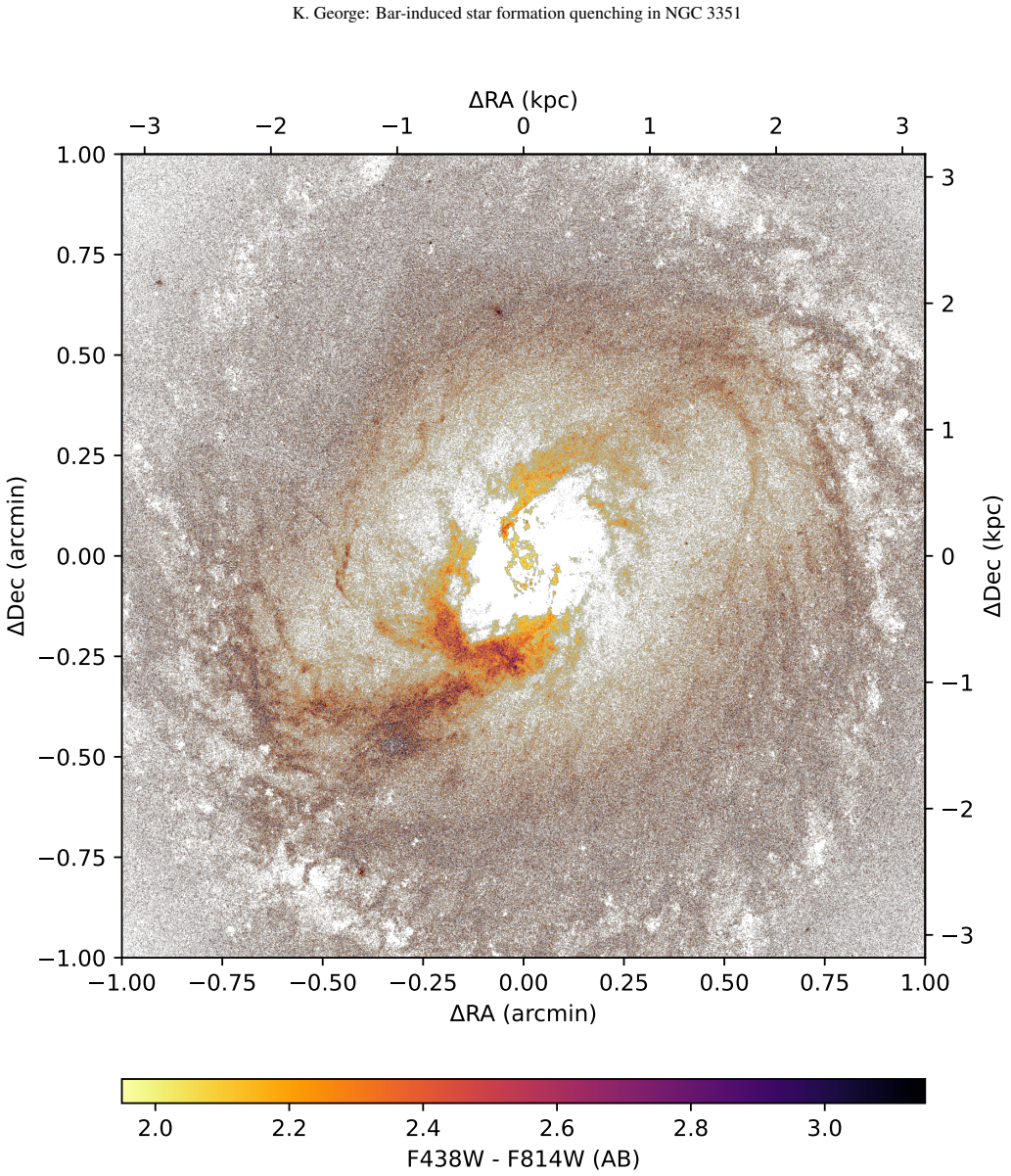
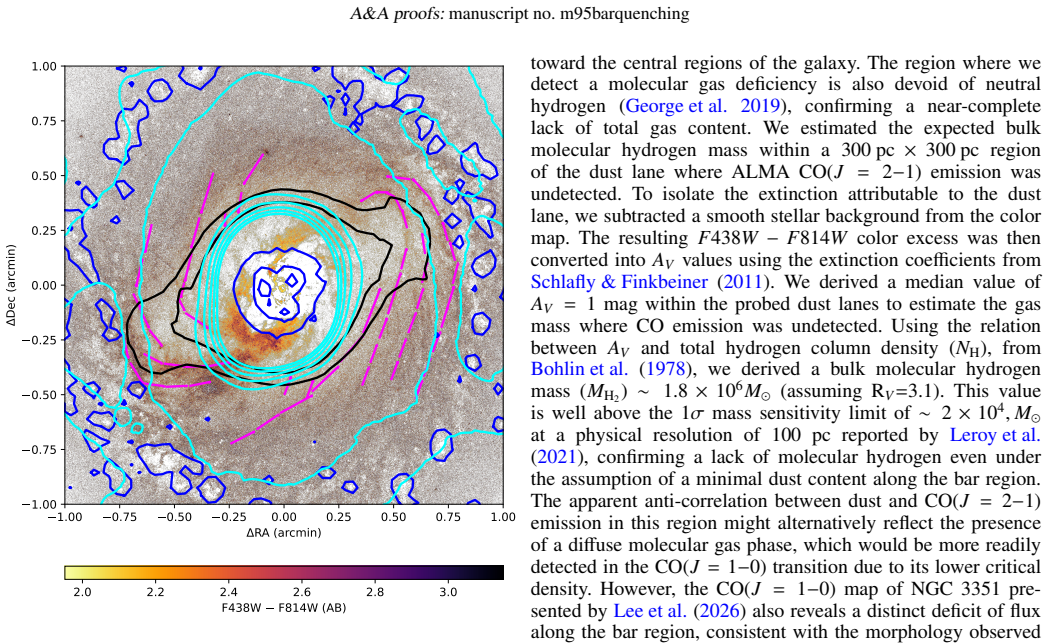
In the bar-covered central regions of NGC 3351, dust lanes appear in the HST F438W-F814W color map but coincide with neither ALMA-detected molecular gas nor UVIT-detected recent star formation. The inward-pointing morphology of these lanes indicates that molecular gas once present along the bar has been redistributed to the nucleus by the stellar bar, thereby suppressing star formation along the bar while accumulating a central reservoir.
What carries the argument
Dust-lane morphology in optical color maps used as a fossil tracer of past molecular-gas distribution and bar-driven radial inflows.
If this is right
- The stellar bar has channeled molecular gas all the way to the nucleus.
- Star formation along the bar is suppressed because the gas supply has been removed.
- The consistent inward orientation of dust lanes records the direction of past bar-driven inflows.
- Central molecular-gas reservoirs are built at the expense of gas that previously lay along the bar.
Where Pith is reading between the lines
- Dust-lane orientation could be checked in other face-on barred galaxies to test how common this redistribution is.
- If the process is general, barred galaxies should show systematically lower star-formation rates along their bars than unbarred galaxies of similar mass.
- High-resolution molecular-gas maps of the very center of NGC 3351 would directly test whether the accumulated gas matches the amount once implied by the dust lanes.
Load-bearing premise
The inward tilt of the dust lanes means molecular gas was once distributed along the bar and has since been moved inward by the bar.
What would settle it
ALMA maps showing substantial molecular gas still sitting inside the observed dust-lane regions, or maps showing no molecular gas accumulated at the nucleus, would falsify the redistribution claim.
Figures
read the original abstract
We present observational evidence, based on high-resolution imaging from HST, ALMA, and AstroSat/UVIT, that the redistribution of gas driven by the bar in the face-on spiral galaxy NGC 3351 results in suppressed star formation in its central regions. Dust and molecular gas coexist in galaxies, allowing dust lanes observed in galaxies to be used to probe the distribution of gas. In the central regions of NGC 3351, covered by the stellar bar, dust lanes are visible in the HST F438W-F814W color map, but surprisingly, these areas lack molecular gas and recent star formation. The inward orientation of the dust lane morphology towards the galaxy's center suggests that molecular gas may have once been present in this region, but was redistributed to the center due to the stellar bar's action. The direction of dust lanes, therefore, indicates the past inflows of gas toward the galaxy center, with their morphology consistently oriented inward along the bar. These findings support a scenario where the stellar bar has efficiently channeled molecular gas into the nucleus, building the central reservoir while suppressing star formation along the bar.
Editorial analysis
A structured set of objections, weighed in public.
Referee Report
Summary. The manuscript claims that the stellar bar in the face-on spiral galaxy NGC 3351 has redistributed molecular gas inward, suppressing star formation in the central bar-covered regions. This is based on high-resolution HST F438W-F814W color maps showing dust lanes in areas that lack molecular gas (ALMA) and recent star formation (AstroSat/UVIT). The inward orientation of the dust lane morphology is interpreted as recording past gas inflows along the bar, supporting a scenario of efficient bar-driven channeling to the nucleus.
Significance. If the interpretation is robust, the work would provide multi-wavelength observational evidence connecting bar dynamics to local suppression of star formation and central gas buildup in spirals, with relevance to models of secular evolution and nuclear activity. The combination of dust morphology, molecular gas maps, and UV tracers is a positive aspect, though the result's impact hinges on strengthening the causal link beyond morphology.
major comments (3)
- [Abstract and interpretation section] The central claim that dust lanes indicate prior molecular gas presence and bar-driven redistribution (abstract and interpretation) is load-bearing but rests on an untested inference. No kinematic data (e.g., non-circular velocity fields from ALMA), dynamical modeling, or depletion timescale arguments are presented to confirm the direction and timing of flows, leaving alternatives such as projection effects or dust destruction unaddressed.
- [Results and methods] No quantitative measurements, error bars, or statistical tests are reported for gas surface densities, SFRs, or the alignment of dust lane orientations with the bar (abstract). This absence makes it impossible to evaluate the significance of the claimed suppression or to compare the central region rigorously to control areas.
- [Discussion] Alternative explanations for the absence of molecular gas and recent SF in the dust lane regions (e.g., prior consumption, varying dust-to-gas ratios, or unrelated dust sources) receive no discussion or quantitative assessment, weakening the uniqueness of the bar-redistribution scenario.
minor comments (2)
- [Figures] Figure captions should explicitly label the HST color map, ALMA contours, and UVIT data with consistent scale bars, north arrows, and beam sizes for reproducibility.
- Ensure all instrument acronyms (HST, ALMA, UVIT) are defined on first use and used consistently.
Simulated Author's Rebuttal
We thank the referee for the constructive and detailed comments. These have highlighted areas where the manuscript can be strengthened through additional discussion, quantitative analysis, and explicit treatment of limitations. We respond to each major comment below and indicate the revisions that will be made.
read point-by-point responses
-
Referee: [Abstract and interpretation section] The central claim that dust lanes indicate prior molecular gas presence and bar-driven redistribution (abstract and interpretation) is load-bearing but rests on an untested inference. No kinematic data (e.g., non-circular velocity fields from ALMA), dynamical modeling, or depletion timescale arguments are presented to confirm the direction and timing of flows, leaving alternatives such as projection effects or dust destruction unaddressed.
Authors: We acknowledge that the interpretation is morphological and inferential rather than directly kinematic. The evidence rests on the spatial anti-correlation of dust lanes with molecular gas (ALMA) and recent star formation (UVIT), together with the systematic inward orientation of the lanes along the bar. In the revised manuscript we will add a dedicated paragraph in the discussion that explicitly considers projection effects and dust destruction, noting that the consistent alignment with the bar axis makes these alternatives less probable than bar-driven redistribution. We will also state clearly that kinematic confirmation lies beyond the scope of the present imaging dataset. revision: partial
-
Referee: [Results and methods] No quantitative measurements, error bars, or statistical tests are reported for gas surface densities, SFRs, or the alignment of dust lane orientations with the bar (abstract). This absence makes it impossible to evaluate the significance of the claimed suppression or to compare the central region rigorously to control areas.
Authors: We agree that the absence of quantitative metrics weakens the presentation. The revised manuscript will include: (i) molecular gas surface-density measurements (or upper limits) from the ALMA cube in the dust-lane regions versus the nucleus, with uncertainties; (ii) SFR surface densities derived from the UVIT FUV and NUV data, again with errors; and (iii) position-angle measurements of the dust lanes relative to the bar major axis, together with a simple statistical comparison against control regions outside the bar. revision: yes
-
Referee: [Discussion] Alternative explanations for the absence of molecular gas and recent SF in the dust lane regions (e.g., prior consumption, varying dust-to-gas ratios, or unrelated dust sources) receive no discussion or quantitative assessment, weakening the uniqueness of the bar-redistribution scenario.
Authors: We will expand the discussion to contain a new subsection that quantitatively evaluates the listed alternatives. Depletion timescales will be estimated from the available gas and SFR limits to assess prior consumption. Published dust-to-gas ratios for spiral-galaxy disks will be used to test whether extreme variations could reproduce the observations. The morphological specificity of the lanes to the bar will be invoked to argue against unrelated dust. These additions will make the relative strength of the bar-redistribution interpretation explicit. revision: yes
Circularity Check
No circularity: purely observational interpretation with no derivations or self-referential reductions
full rationale
The paper reports HST/ALMA/UVIT imaging of dust lanes in NGC 3351, notes their absence of molecular gas and recent SF, and offers a morphological interpretation that the bar redistributed gas inward. No equations, fitted parameters, predictions, or derivations appear. No self-citations are invoked as load-bearing uniqueness theorems or ansatzes. The central claim is an inference from direct data, not a result that reduces to its own inputs by construction. This matches the default expectation of a non-circular observational study.
Axiom & Free-Parameter Ledger
axioms (1)
- domain assumption Dust lanes reliably trace the past distribution of molecular gas
Reference graph
Works this paper leans on
-
[1]
Agrawal, P. C. 2006, Advances in Space Research, 38, 12,
2006
-
[2]
doi:10.1016/j.asr.2006.03.038 Beck, R., Fletcher, A., Shukurov, A., et al. 2005, A&A, 444, 3,
-
[3]
doi:10.1051/0004-6361:20053556 Bohlin, R. C., Savage, B. D., & Drake, J. F. 1978, ApJ, 224,
-
[4]
doi:10.1086/156357 Cheung, E., Athanassoula, E., Masters, K. L., et al. 2013, ApJ, 779, 162 Combes, F., & Gerin, M. 1985, A&A, 150, 327 Consolandi, Guido; Dotti, Massimo; Boselli, Alessandro; Gavazzi, Giuseppe; Gargiulo, Fabio, 2017, A&A, 598, 114 Devereux, N. A., Kenney, J. D., & Young, J. S. 1992, AJ, 103,
-
[5]
doi:10.1086/116100 Donohoe-Keyes, C. E., Martig, M., James, P. A., et al. 2019, MNRAS, 489, 4,
-
[6]
doi:10.1093/mnras/stz2474 Draine, B. T. 2009, Cosmic Dust - Near and Far, 414,
-
[7]
Interstellar Dust Models and Evolutionary Implications
doi:10.48550/arXiv.0903.1658 Emsellem, E., Schinnerer, E., Santoro, F., et al. 2022, A&A, 659, A191. doi:10.1051/0004-6361/202141727 Freedman, W. L., Madore, B. F., Gibson, B. K., et al. 2001, ApJ, 553, 47 Gavazzi, G., Consolandi, G., Dotti, M., et al. 2015, A&A, 580, A116 George, K., Joseph, P., Mondal, C., et al. 2019, A&A, 621, L4. doi:10.1051/0004-636...
work page internal anchor Pith review Pith/arXiv arXiv doi:10.48550/arxiv.0903.1658 2022
-
[8]
doi:10.1093/mnras/stab2064 Géron, T., Smethurst, R. J., Dickinson, H., et al. 2025, ApJ, 987, 1,
-
[9]
doi:10.3847/1538-4357/add7d0 Guo, Y ., Jogee, S., Wise, E., et al. 2025, ApJ, 985, 2,
-
[11]
doi:10.3847/1538-4365/ad152c Haywood, M., Lehnert, M. D., Di Matteo, P., et al. 2016, A&A, 589, A66 Huang, S., Kawabe, R., Umehata, H., et al. 2025, Nature, 641, 8064,
-
[12]
doi:10.1038/s41586-025-08914-2 Euclid Collaboration, Huertas-Company, M., Walmsley, M., et al. 2025, arXiv:2503.15311. doi:10.48550/arXiv.2503.15311 James P. A., Bretherton C. F. & Knapen J. H., 2009, A&A,501, 207 James, P. A., & Percival, S. M., 2015, MNRAS, 450, 3503 James, P. A., & Percival, S. M. 2016, MNRAS, 457, 917 James, P. A., & Percival, S. M. 2...
-
[13]
doi:10.3847/1538-4357/ae2755 Kennicutt, R. C. & Evans, N. J. 2012, ARA&A, 50,
-
[14]
doi:10.1146/annurev- astro-081811-125610 Khoperskov, S., Haywood, M., Di Matteo, P., Lehnert, M. D., & Combes, F. 2018, A&A, 609, A60 Komatsu E. et al., 2011, ApJS, 192, 18 Lee, J. C., Whitmore, B. C., Thilker, D. A., et al. 2022, ApJS, 258, 1,
-
[15]
M., Koda, J., Egusa, F., et al
doi:10.3847/1538-4365/ac1fe5 Lee, A. M., Koda, J., Egusa, F., et al. 2026, ApJ, 1001, 1,
-
[17]
K., Walter, F., Brinks, E., et al
doi:10.1093/mnras/stz1844 Leroy, A. K., Walter, F., Brinks, E., et al. 2008, AJ, 136, 2782 Leroy, A. K., Schinnerer, E., Hughes, A., et al. 2021, ApJS, 257, 2,
-
[18]
doi:10.3847/1538-4365/ac17f3 Man, A. & Belli, S. 2018, Nature Astronomy, 2,
-
[19]
doi:10.1038/s41550-018- 0558-1 Marshall, D. J., Fux, R., Robin, A. C., et al. 2008, A&A, 477, 2, L21. doi:10.1051/0004-6361:20078967 Masters, K. L., Mosleh, M., Romer, A. K., et al. 2010, MNRAS, 405, 783 Masters, K. L., Nichol, R. C., Haynes, M. P., et al. 2012, MNRAS, 424,
-
[20]
E., Schinnerer, E., van de Ven, G., et al
Meidt, S. E., Schinnerer, E., van de Ven, G., et al. 2014, ApJ, 788, 144 Newnham, L., Hess, K. M., Masters, K. L., et al. 2020, MNRAS, 492, 4,
2014
-
[21]
doi:10.1093/mnras/staa064 Percival, S. M. & James, P. A. 2020, MNRAS, 496, 1,
-
[22]
Tracing evolutionary pathways of bar-driven quenching in local Universe disc galaxies
doi:10.1093/mnras/staa1369 Renu, D., Subramanian, S., Rao, S., et al. 2025, A&A, 696, A118. doi:10.1051/0004-6361/202452701 Renu, D., Subramanian, S., & George, K. 2026, arXiv:2604.15208. doi:10.48550/arXiv.2604.15208 Reynaud, D., & Downes, D. 1998, A&A, 337, 671 Rémy-Ruyer, A., Madden, S. C., Galliano, F., et al. 2014, A&A, 563, A31 Rodríguez, M. J., Lee...
work page internal anchor Pith review Pith/arXiv arXiv doi:10.1093/mnras/staa1369 2025
-
[23]
doi:10.3847/1538-4357/adbb69 Ruiz-García, M., Querejeta, M., García-Burillo, S., et al. 2024, A&A, 691, A351. doi:10.1051/0004-6361/202450935 Sánchez-Menguiano, L., Pérez, I., Zurita, A., et al. 2015, MNRAS, 450, 3,
-
[24]
doi:10.1093/mnras/stv782 Scaloni, L., Rodighiero, G., Enia, A., et al. 2024, A&A, 687, A255. doi:10.1051/0004-6361/202449894 Schlafly, E. F. & Finkbeiner, D. P. 2011, ApJ, 737, 2,
-
[25]
2015 FIP bias evolution in a decaying active region
doi:10.1088/0004- 637X/737/2/103 Shlosman, I. & Heller, C. H. 2002, ApJ, 565, 2,
-
[26]
2017, MNRAS, 465, 3729 Sun, J., He, H., Batschkun, K., et al
doi:10.1086/324403 Spinoso, D., Bonoli, S., Dotti, M., et al. 2017, MNRAS, 465, 3729 Sun, J., He, H., Batschkun, K., et al. 2024, ApJ, 967, 2,
-
[27]
doi:10.3847/1538- 4357/ad3de6 Tandon, S. N., Subramaniam, A., Girish, V ., et al. 2017, AJ, 154, 3,
-
[28]
doi:10.3847/1538-3881/aa8451 Tubbs, A. D. 1982, ApJ, 255, 458 Verley, S., Combes, F., Verdes-Montenegro, L., Bergond,G., & Leon, S. 2007, A&A, 474, 43 Williams, T. G., Lee, J. C., Larson, K. L., et al. 2024, ApJS, 273, 1,
-
[29]
doi:10.3847/1538-4365/ad4be5 Article number, page 5 A&A proofs:manuscript no. m95barquenching Fig. A.1: Schematic depiction of gas redistribution in NGC 3351 derived from the dust-lane analysis presented in this work. Bar region and disc are not to scale. Appendix A: Bar-driven gas redistribution scenario A schematic illustration of the gas redistribution...
discussion (0)
Sign in with ORCID, Apple, or X to comment. Anyone can read and Pith papers without signing in.